How Gulf Cities Could Turn Rainfall Into a Valuable Urban Resource
Cities built in dry climates face an unusual water challenge. Rainfall may be scarce for much of the year, yet occasional storms can produce enough water to overwhelm roads, drainage systems, and public infrastructure. At the same time, households, businesses, parks, and urban developments require reliable water supplies throughout the year.
- 1. Why Rainwater Harvesting Is Becoming Important in Dry Climate Cities
- 2. How Rainwater Harvesting Systems Could Work in Modern Urban Developments
- 3. What Dubai and Saudi Arabia Reveal About Rainfall Management
- 4. How Rainwater Harvesting Could Support Urban Landscaping and Water Conservation
- 5. Why Smart Technology Could Improve Urban Rainwater Harvesting
- 6. The Environmental and Financial Challenges of Rainwater Harvesting
- 7. The Future of Rainwater Harvesting in Sustainable Dry Climate Cities
- Conclusion
Rainwater harvesting in dry climate cities could offer an important opportunity to address parts of both challenges. By capturing, storing, treating, and using suitable rainwater, urban authorities and property owners may reduce some stormwater runoff while supplementing water supplies for selected purposes.
The concept is particularly relevant across the Arabian Gulf, where high temperatures, limited freshwater resources, and expanding urban populations place pressure on water infrastructure.
Cities such as Dubai, Abu Dhabi, Riyadh, Jeddah, Muscat, Doha, Manama, and Kuwait City experience different rainfall patterns, but many share concerns involving water security and infrastructure resilience.
Modern urban development often includes large areas of concrete, asphalt, rooftops, and other impermeable surfaces. During heavy rainfall, these surfaces can accelerate runoff and contribute to flooding if drainage infrastructure is overwhelmed.
Rainwater harvesting offers a way to retain part of that water for suitable uses rather than treating every rainfall event solely as a drainage problem.
However, the technology has limitations. Rainfall is unpredictable, storage systems require maintenance, and collected water may contain pollutants requiring treatment. In extremely arid cities, harvested rainwater may provide only a small fraction of annual water demand.
The future of rainwater harvesting will therefore depend on integrating it with drainage networks, urban landscaping, water conservation, and wider climate-resilience strategies.
1. Why Rainwater Harvesting Is Becoming Important in Dry Climate Cities
Rainwater harvesting involves collecting rainfall from suitable surfaces and storing or directing it for beneficial use.
Systems can range from small rooftop tanks to larger infrastructure designed to capture runoff from buildings, roads, and urban developments.
The appropriate approach depends on local rainfall, available space, water quality, and intended use.
The Contradiction of Water Scarcity and Urban Flooding
Dry climates are often associated with prolonged periods of limited rainfall.
However, low annual rainfall does not mean intense storms cannot occur.
Some arid regions experience occasional heavy rainfall concentrated within short periods.
If roads, buildings, and drainage networks are not designed to manage these events, water can accumulate rapidly.
Cities therefore face two separate but connected challenges: managing excess stormwater during rainfall and maintaining adequate water supplies during dry periods.
Rainwater harvesting may contribute to both objectives when systems are designed appropriately.
The Role of Urban Surfaces
Natural landscapes allow some rainfall to infiltrate into the ground.
Urban surfaces such as asphalt roads, paved parking areas, and building rooftops often reduce this opportunity.
As a result, rainfall may flow quickly toward low-lying areas or drainage systems.
Urban planners can use rainwater collection, permeable surfaces, and suitable landscape designs to manage part of this runoff closer to where it falls.
However, infiltration is not appropriate at every location, particularly where soil conditions, contamination, groundwater levels, or underground structures create risks.
Why Water Scarcity Matters
The World Bank identifies the Middle East and North Africa as one of the world’s most water-stressed regions.
Its research highlights the growing pressures created by population growth, agricultural demand, and limited freshwater availability.
Rainwater harvesting cannot solve regional water scarcity independently, but it may supplement other water-management approaches.
Urban Rainwater Management Approaches
| Approach | Main Purpose | Important Limitation |
|---|---|---|
| Rooftop Rainwater Collection | Capture rainfall from buildings | Limited by roof size and rainfall |
| Storage Tanks | Retain water for later use | Require space and maintenance |
| Retention Basins | Hold runoff for longer periods | Evaporation and water quality |
| Detention Basins | Temporarily manage stormwater peaks | Not necessarily designed for reuse |
| Permeable Pavement | Encourage infiltration | Depends on soils and maintenance |
| Bioswales | Slow and filter selected runoff | Require suitable vegetation and design |
| Conventional Drainage | Convey excess runoff safely | Does not necessarily conserve water |
The strongest strategies often combine several approaches rather than relying on one system.
2. How Rainwater Harvesting Systems Could Work in Modern Urban Developments
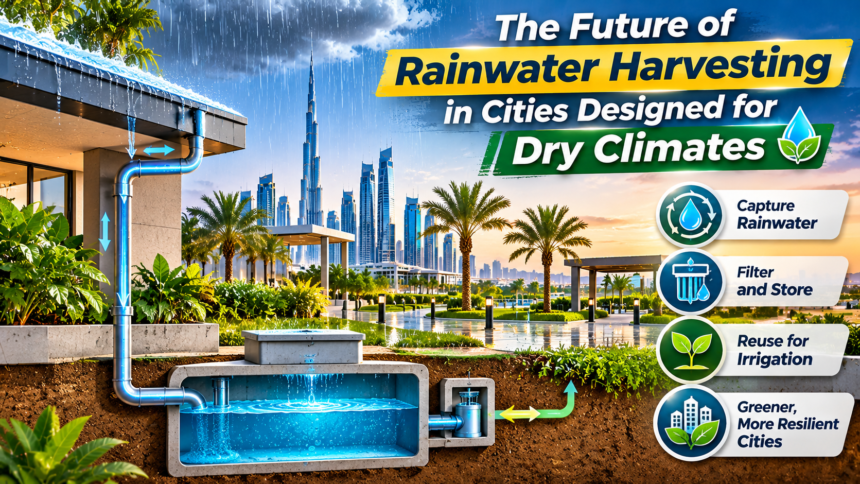
The basic principle of rainwater harvesting is straightforward: collect suitable rainfall, convey it safely, and store or use it according to its quality and intended purpose.
However, designing reliable urban systems requires careful engineering.
Rooftop Collection

Buildings provide one of the most accessible surfaces for rainwater collection.
Rain falling onto roofs can be directed through gutters and pipes toward tanks.
Depending on the system, water may pass through screens, sediment filters, and first-flush diversion equipment.
A first-flush device can redirect an initial portion of runoff that may contain accumulated dust and debris.
However, it does not guarantee that the remaining water is safe to drink.
Storage and Distribution
Collected water may be stored in underground or above-ground tanks.
Storage design depends on expected rainfall, available roof area, intended demand, and acceptable investment costs.
Water may then be supplied to suitable non-potable uses through an appropriately designed system.
Examples include selected landscape irrigation or cleaning applications where permitted.
The plumbing arrangement must prevent unsafe connections with drinking-water systems.
Water Treatment Requirements
Rainwater can contain dust, microorganisms, bird droppings, chemicals, and contaminants from collection surfaces.
Therefore, collected rainwater should not automatically be considered potable.
Treatment requirements depend on the source, storage conditions, intended use, and applicable local regulations.
Water intended for drinking requires an appropriate treatment and monitoring system meeting relevant drinking-water standards.
An Illustrative Collection Calculation
Consider a commercial building with a roof area of 2,000 square metres.
If a rainfall event delivers 20 millimetres of rain, the theoretical maximum falling on the roof is 40 cubic metres, or 40,000 litres.
Assuming an illustrative collection efficiency of 80%, approximately 32,000 litres could be captured before other practical losses.
This example is not a forecast of actual collection in any particular Gulf city.
Actual results depend on rainfall distribution, roof characteristics, system condition, and storage capacity.
Main Components of a Rainwater Harvesting System
| Component | Function |
|---|---|
| Catchment Surface | Receives rainfall |
| Gutters and Pipes | Convey collected water |
| Leaf and Debris Screens | Remove larger contaminants |
| First-Flush Diverter | Redirects an initial runoff portion |
| Storage Tank | Holds collected rainwater |
| Filtration and Treatment | Improve water quality for intended use |
| Pumping System | Distributes water where necessary |
| Overflow Arrangement | Safely manages excess rainfall |
Proper overflow design is essential because an undersized tank can fill quickly during an intense storm.
3. What Dubai and Saudi Arabia Reveal About Rainfall Management
Gulf cities are investing in stormwater infrastructure to improve resilience during heavy rainfall.
These developments offer lessons for future rainwater harvesting, although drainage and water reuse are distinct activities.
Dubai’s Tasreef Programme
In June 2024, Dubai approved the AED30 billion Tasreef project to upgrade the emirate’s stormwater drainage infrastructure.
The programme aims to increase drainage capacity by 700%, with implementation planned in phases through 2033.
Its principal objectives include improving drainage performance, protecting urban infrastructure, and strengthening preparedness for future weather events.
The programme is not equivalent to a citywide potable rainwater harvesting system.
However, investments in runoff collection, monitoring, and infrastructure planning can inform future water-management strategies.
Stormwater Storage and Emergency Preparedness
In October 2026, Dubai Municipality announced the preparation of 10 temporary water collection lakes to manage runoff during heavy rainfall.
The municipality also described maintenance work involving thousands of drainage inlets and coordinated response teams.
Such storage facilities can help reduce pressure on drainage networks.
However, temporary stormwater collection does not automatically mean the stored water is suitable or available for beneficial reuse.
Riyadh’s Expanding Drainage Networks
In March 2026, Riyadh Municipality announced the completion of more than 56 kilometres of stormwater drainage works in the Al-Qirawan and Al-Arid neighbourhoods.
The project directs collected runoff toward designated discharge points in Wadi Hanifah.
The Saudi Ministry of Municipalities and Housing also reported the completion of approximately 200.3 kilometres of drainage networks nationwide during the first half of 2026.
These projects demonstrate investment in urban flood management rather than confirmed rainwater reuse at the reported scale.
What Cities Can Learn
| Regional Example | Main Infrastructure Focus | Potential Lesson |
|---|---|---|
| Dubai Tasreef | Large-scale drainage expansion | Long-term stormwater planning |
| Dubai Temporary Collection Lakes | Management of intense runoff | Importance of temporary storage |
| Riyadh Drainage Networks | Urban runoff conveyance | Coordinating districts and discharge routes |
| Saudi National Drainage Works | Expanded network coverage | Resilience across growing cities |
| Green Riyadh | Treated wastewater for irrigation | Matching water sources to intended uses |
The Importance of Integrated Planning
A city may need both conventional drainage and additional water-retention infrastructure.
The goal should be to safely manage storms while identifying where retaining runoff makes practical environmental and economic sense.
4. How Rainwater Harvesting Could Support Urban Landscaping and Water Conservation
Urban parks, roadside vegetation, public gardens, and landscaped developments require irrigation in many dry cities.
Maintaining these spaces can be resource-intensive, especially during hot weather.
Harvested rainwater may provide a supplementary source for selected irrigation needs.
Supporting Public Green Spaces
Collected rainwater could be used to irrigate suitable trees and landscaped areas when water quality and local rules permit.
For example, a park may capture rainfall from nearby buildings or paved areas.
The water could then be stored temporarily or directed toward planted areas.
However, seasonal rainfall may not coincide with the periods of greatest irrigation demand.
Storage and water budgeting are therefore essential.
The Role of Native and Climate-Adapted Plants
Rainwater harvesting works best when landscape design considers local conditions.
Using plants suited to hot and dry environments can reduce irrigation requirements.
However, even drought-tolerant plants may need additional water during establishment.
Plant selection should consider soil conditions, root requirements, maintenance, and biodiversity.
Combining Rainwater With Other Water Sources
Riyadh’s urban greening plans provide a relevant example of integrated water management.
The Royal Commission for Riyadh City has identified treated wastewater as an important irrigation source for major landscaping projects.
Rainwater harvesting could supplement similar systems in appropriate locations, but it should not be confused with reclaimed wastewater infrastructure.
Landscape Water Management Options
| Water Source | Potential Advantage | Main Limitation |
|---|---|---|
| Harvested Rainwater | Captures part of local rainfall | Highly variable supply |
| Treated Wastewater | Potentially more predictable availability | Requires suitable treatment and distribution |
| Desalinated Water | Established supply in some Gulf cities | Energy and infrastructure requirements |
| Groundwater | May be available locally | Depletion and salinity concerns |
| Soil Moisture Retention | Can reduce irrigation requirements | Depends on soil and landscape design |
The Limits of Irrigation Savings
Rainwater harvesting may reduce the use of other water sources, but actual savings depend on the volume collected and used.
A tank installed in a city with very little rainfall may provide limited annual savings.
Projects should therefore measure actual water substitution rather than relying on storage capacity alone.
5. Why Smart Technology Could Improve Urban Rainwater Harvesting
Digital monitoring, weather information, and automated controls may improve the performance of rainwater harvesting systems.
These technologies can help operators understand tank levels, water quality, and expected rainfall.
However, automation does not create additional rainfall or eliminate maintenance needs.
Monitoring Water Storage
Connected sensors can measure water levels inside storage tanks.
This information may help facilities teams understand when water is available for selected uses.
Sensors may also identify unusual losses or equipment problems.
However, readings require calibration, maintenance, and reliable communication.
Weather-Informed Control Systems
Forecast information may help operators prepare for an expected storm.
For example, a system might reserve storage capacity in advance where safe and legally permitted.
However, forecasts remain uncertain.
Releasing stored water before rainfall could waste useful resources if the predicted storm does not occur.
Automated decisions must therefore account for uncertainty and safe discharge requirements.
Digital Flood Management
Smart-city systems can combine rainfall gauges, drainage monitoring, and infrastructure information.
These tools may help authorities identify where runoff is accumulating.
However, sensor information must connect to effective operational procedures.
Accurate data alone cannot prevent flooding if drainage capacity is insufficient.
Smart Rainwater Management Technologies
| Technology | Potential Function | Key Limitation |
|---|---|---|
| Water-Level Sensors | Monitor stored volume | Calibration and equipment reliability |
| Rainfall Sensors | Measure local precipitation | Limited coverage |
| Weather Forecast Integration | Support operational planning | Forecast uncertainty |
| Automated Valves | Manage water movement | Control and maintenance risks |
| Digital Monitoring Dashboards | Display system performance | Requires reliable input data |
| Predictive Models | Estimate runoff and storage needs | Depends on model accuracy |
The Importance of Cybersecurity
Connected water infrastructure may introduce cybersecurity vulnerabilities.
Remote controls and monitoring platforms require appropriate authentication, software management, and network protection.
Systems should also retain safe operating procedures during communication failures.
6. The Environmental and Financial Challenges of Rainwater Harvesting
Although rainwater harvesting has potential benefits, it is not universally appropriate.
In dry climates, the main challenge is that collection systems must function economically despite long periods without rainfall.
Unpredictable Rainfall
Rainfall can vary considerably between years.
A system designed using average annual rainfall may perform poorly if storms arrive in a few concentrated events.
Developers should examine long-term rainfall records and storm intensity rather than relying only on annual averages.
High Storage Requirements
Large tanks can capture more rainfall but require additional space and investment.
In dense urban areas, underground storage may be costly.
Developers need to determine whether increased storage produces sufficient benefits to justify construction and maintenance expenses.
Evaporation Losses
Open water storage can experience substantial evaporation in hot climates.
Covered or enclosed tanks may reduce some losses.
However, stored water still requires appropriate maintenance and water-quality management.
Water Contamination
Runoff from streets and parking areas may contain oils, metals, sediment, and other pollutants.
Using this water requires careful assessment.
Infiltration into the ground may also be unsuitable where contamination could threaten groundwater resources.
Financial Challenges
| Challenge | Potential Impact | Practical Response |
|---|---|---|
| Low Annual Rainfall | Limited water savings | Conservative yield estimates |
| Intense Short Storms | Rapid storage overflow | Appropriate overflow and drainage |
| High Construction Costs | Long financial payback | Evaluate lifecycle benefits |
| Water Contamination | Unsafe reuse | Suitable treatment and testing |
| Evaporation | Reduced stored volume | Covered storage where appropriate |
| Maintenance Requirements | Reduced reliability | Scheduled inspections |
| Uncertain Demand | Stored water may remain unused | Match storage with actual needs |
When Harvesting May Not Be Worthwhile
Small buildings with limited roof area and low demand for non-potable water may struggle to justify expensive installations.
However, rainwater systems can also provide stormwater-management benefits.
Economic analysis should therefore consider both potential water savings and avoided runoff-related costs, without double-counting benefits.
7. The Future of Rainwater Harvesting in Sustainable Dry Climate Cities
The future of rainwater harvesting may involve combining building-level collection with neighbourhood drainage systems, green infrastructure, and digital monitoring.
Rather than treating rainfall solely as waste to be removed, cities could assess whether some runoff can be safely retained, reused, or infiltrated.
However, flood protection must remain the first priority during hazardous storms.
Integrating Rainwater Into New Developments
Urban planners can consider rainwater management before streets, buildings, and utility networks are constructed.
This may make it easier to allocate space for storage, permeable surfaces, and safe overflow routes.
In existing cities, retrofitting can be more difficult because underground infrastructure is already established.
The Role of Green Infrastructure
The US Environmental Protection Agency identifies green infrastructure approaches such as rain gardens, bioswales, permeable pavement, and rainwater harvesting.
These measures can complement conventional pipes and drainage channels.
However, arid landscapes require careful design because planted systems may need irrigation and suitable maintenance.
Green infrastructure should not be introduced without considering local soils and climate.
A Practical Rainwater Harvesting Planning Checklist
- Review long-term local rainfall records.
- Assess rainfall intensity and runoff risks.
- Identify suitable collection surfaces.
- Estimate realistic annual water collection.
- Determine intended non-potable uses.
- Evaluate water quality and treatment requirements.
- Calculate appropriate storage capacity.
- Design safe overflow and drainage connections.
- Consider evaporation and maintenance costs.
- Verify local technical and regulatory requirements.
How Cities Should Measure Success
Rainwater harvesting performance should be evaluated using actual outcomes.
Relevant indicators include annual water captured, the amount successfully reused, reduced demand for other water sources, runoff diverted from drainage systems, and system operating costs.
However, the amount collected alone does not establish success.
A large storage tank may remain underused if the city receives little rain or if there is no appropriate demand for the stored water.
Key Performance Indicators
| Indicator | What It Measures |
|---|---|
| Annual Rainwater Captured | Total collected rainfall |
| Water Reuse Volume | Amount used for approved purposes |
| Runoff Reduction | Volume diverted from drainage |
| Storage Utilisation | How effectively tanks are used |
| Water Quality | Suitability for intended applications |
| Maintenance Costs | Long-term operating requirements |
| Flood Performance | Contribution to local runoff management |
| Financial Value | Benefits relative to lifecycle costs |
Opportunities for Gulf Businesses
Rainwater management could create opportunities for engineering companies, construction firms, landscape specialists, water-treatment providers, and smart-infrastructure developers.
Businesses may develop services involving storage design, filtration, monitoring, and maintenance.
However, commercial products should be evaluated against local rainfall and actual performance.
A system effective in a wetter climate may require substantial adaptation for the Arabian Peninsula.
The Importance of Realistic Expectations
Rainwater harvesting cannot replace desalination, treated wastewater, or other major water sources across most extremely arid Gulf cities.
Its greatest value may lie in selected applications where suitable rainfall can be captured economically and safely.
It could also complement flood-management infrastructure by reducing some local runoff.
Conclusion
Rainwater harvesting could become a useful part of future urban water management in cities designed for dry climates.
Although rainfall is limited and unpredictable across much of the Arabian Gulf, occasional storms create opportunities to capture water that would otherwise enter drainage networks.
Rooftop systems, storage tanks, permeable surfaces, and suitable landscape infrastructure may help reduce local runoff and supplement selected non-potable uses.
Developments in Dubai and Saudi Arabia demonstrate the growing importance of stormwater management, although their major drainage investments should not be confused with operational rainwater reuse programmes.
For cities considering harvesting, the strongest results will depend on careful engineering, realistic rainfall estimates, appropriate water treatment, and long-term maintenance.
The technology should complement rather than replace conventional drainage, desalination, treated wastewater, and broader conservation strategies.
Ultimately, sustainable rainwater management is not about assuming every storm can solve water scarcity.
It is about understanding when rainfall can be safely retained, where its reuse makes economic sense, and how cities can better manage water throughout both wet and dry periods.
As climate variability and urban development continue shaping the Arabian Peninsula, thoughtful rainwater harvesting could help cities become more resilient, resource-conscious, and better prepared for changing environmental conditions.
Do follow us on Instagram
Read More – How Desert Soil Restoration Could Support Sustainable Agriculture in the Arabian Peninsula