


Complete Guide For How Much Should UAE Residents Save Monthly?
Saving money every month is one of the most important financial habits for anyone living in the United Arab Emirates. Whether you are an Emirati citizen, expatriate, salaried professional, freelancer, or business owner, having a consistent savings plan can help you handle unexpected expenses, achieve financial goals, manage debt, and prepare for the future.
- How Much Should UAE Residents Save Every Month?
- Monthly Savings Based on UAE Income
- Why Saving Monthly Is Important in the UAE
- The 50/30/20 Budgeting Approach
- How Much Should Low-Income UAE Residents Save?
- How Much Should Middle-Income UAE Residents Save?
- How Much Should High-Income UAE Residents Save?
- Build an Emergency Fund First
- Should You Save or Pay Off Debt First?
- Save for Short-Term Financial Goals
- Save for Long-Term Goals
- How Much Should UAE Residents Save for Retirement?
- Track Your Monthly Expenses
- Housing Costs Can Determine Your Savings Rate
- Avoid Lifestyle Inflation
- Automate Your Monthly Savings
- Where Should UAE Residents Keep Their Savings?
- How to Increase Your Monthly Savings in the UAE
- A Simple Monthly Savings Plan for UAE Residents
- Common Saving Mistakes UAE Residents Should Avoid
- Should You Save 20% of Your Salary?
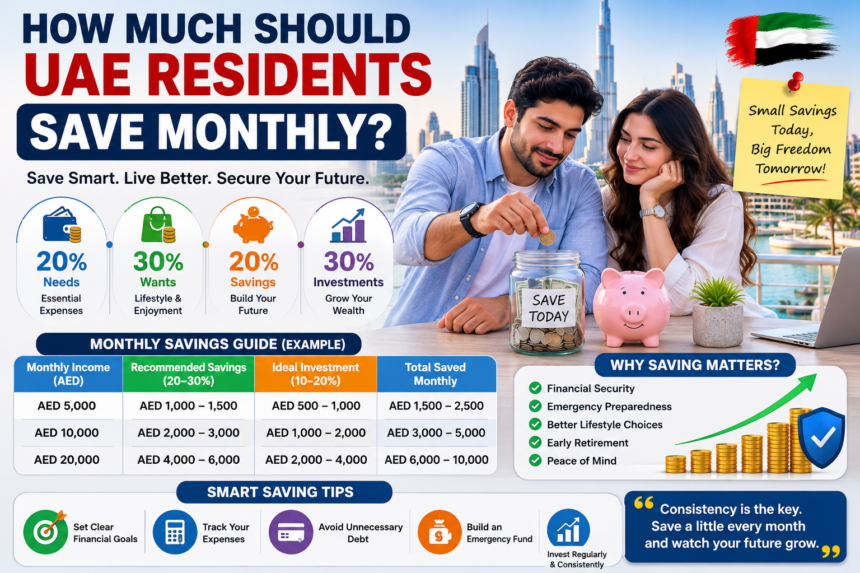
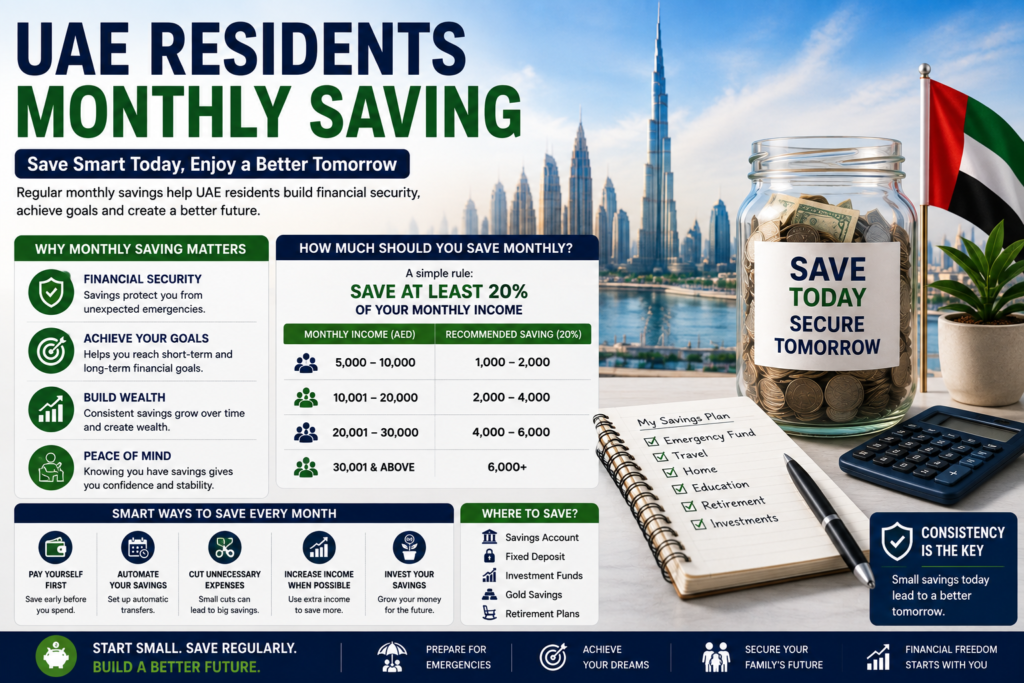
One of the most common questions people ask is: How much should UAE residents save monthly? There is no single amount that works for everyone because the right savings target depends on your income, rent, family responsibilities, lifestyle, debt, financial goals, and future plans. However, a useful starting point is to aim to save around 20% of your monthly income, while adjusting the percentage according to your personal circumstances.
For someone earning AED 10,000 per month, a 20% savings target would mean putting aside approximately AED 2,000. Someone earning AED 20,000 could aim for AED 4,000, while a person earning AED 30,000 could target AED 6,000. These are guidelines rather than strict requirements. If your current expenses make saving 20% difficult, starting with 5% or 10% and increasing the amount gradually can still build a strong financial habit.
This guide explains how much UAE residents should save monthly, how to calculate a realistic savings target, how much you may need for emergencies, and practical ways to increase your monthly savings.
How Much Should UAE Residents Save Every Month?
A commonly used personal-finance guideline is to save approximately 20% of monthly take-home income. However, the ideal percentage can be higher or lower depending on your circumstances.
For example:
- 5%–10%: A reasonable starting point if you have high living costs or significant debt.
- 10%–20%: A practical savings range for many households.
- 20%–30%: A stronger target for people with manageable expenses.
- 30% or more: Potentially suitable for high earners or people pursuing aggressive financial goals.
The most important factor is consistency. Saving AED 1,000 every month is generally more useful than planning to save AED 5,000 but regularly saving nothing.
Your savings target should also increase when your income rises. If you receive a salary increase, bonus, promotion, or additional income, consider directing at least part of that increase toward savings instead of immediately increasing lifestyle spending.
Monthly Savings Based on UAE Income
A simple way to understand the 20% savings guideline is to look at different income levels.
| Monthly Income | 10% Savings | 20% Savings | 30% Savings |
|---|---|---|---|
| AED 5,000 | AED 500 | AED 1,000 | AED 1,500 |
| AED 7,500 | AED 750 | AED 1,500 | AED 2,250 |
| AED 10,000 | AED 1,000 | AED 2,000 | AED 3,000 |
| AED 15,000 | AED 1,500 | AED 3,000 | AED 4,500 |
| AED 20,000 | AED 2,000 | AED 4,000 | AED 6,000 |
| AED 25,000 | AED 2,500 | AED 5,000 | AED 7,500 |
| AED 30,000 | AED 3,000 | AED 6,000 | AED 9,000 |
| AED 40,000 | AED 4,000 | AED 8,000 | AED 12,000 |
| AED 50,000 | AED 5,000 | AED 10,000 | AED 15,000 |
These figures are examples rather than financial advice. Someone earning AED 10,000 in a high-cost household may find AED 2,000 difficult to save, while another person with the same income and fewer obligations may be able to save considerably more.
Why Saving Monthly Is Important in the UAE
The UAE offers excellent career, business, and lifestyle opportunities, but living costs can also be significant, particularly in major cities. Housing, transportation, education, healthcare, dining, entertainment, and travel can all affect a household budget.
Regular savings provide a financial buffer when circumstances change.
Monthly savings can help you:
- Handle unexpected expenses.
- Build an emergency fund.
- Prepare for future travel.
- Purchase a home.
- Pay for education.
- Support family members.
- Reduce dependence on credit cards.
- Prepare for retirement.
- Invest for long-term growth.
- Create greater financial independence.
Without savings, even a temporary financial problem can force you to borrow money. With an adequate financial reserve, you have more flexibility when unexpected costs arise.
The 50/30/20 Budgeting Approach
One useful budgeting framework is the 50/30/20 rule. Under this approach, approximately 50% of income goes toward needs, 30% toward wants, and 20% toward savings and financial goals.
For UAE residents, however, this should be treated as a flexible framework rather than a fixed formula.
Housing costs alone can make the 50% allocation unrealistic for some households. A family paying high rent, school fees, transportation costs, and healthcare expenses may need to allocate more than 50% toward essential expenses.
The basic concept is still useful:
- Needs: Rent, groceries, utilities, transportation, insurance, and essential bills.
- Wants: Dining out, entertainment, shopping, holidays, and non-essential purchases.
- Savings: Emergency funds, investments, retirement, and other financial goals.
The goal is to create a budget that reflects your actual financial situation.
How Much Should Low-Income UAE Residents Save?
Residents earning AED 5,000 to AED 10,000 per month may find it difficult to save 20%, especially if they live in an expensive area or support family members.
For these households, starting with 5% to 10% may be more realistic.
For example, someone earning AED 7,000 could begin by saving AED 350 to AED 700 each month. Once that habit becomes comfortable, the savings rate can gradually increase.
The important thing is not to wait until you earn a high salary before starting to save.
A small amount saved consistently can create an important financial habit.
How Much Should Middle-Income UAE Residents Save?
Residents earning approximately AED 10,000 to AED 25,000 per month may have greater flexibility, although their expenses can vary significantly.
A reasonable target could be 15% to 25% of monthly income, depending on household commitments.
For example, someone earning AED 15,000 might aim to save AED 2,250 to AED 3,750 per month.
The exact amount should be determined after considering:
- Monthly rent.
- Household expenses.
- Family responsibilities.
- Debt repayments.
- Insurance.
- Transportation.
- Education costs.
- Lifestyle spending.
If you have limited debt and manageable expenses, increasing your savings rate can accelerate your progress toward long-term financial goals.
How Much Should High-Income UAE Residents Save?
Higher-income residents often have an opportunity to save significantly more than 20%, particularly when essential expenses represent a smaller percentage of income.
Someone earning AED 30,000, AED 40,000, or AED 50,000 per month may be able to target 25% to 40% or more, depending on their lifestyle.
For example, a resident earning AED 40,000 could potentially allocate:
- AED 8,000 toward savings.
- AED 8,000 toward investments or long-term goals.
- The remainder toward housing, living expenses, family costs, and lifestyle.
High income does not automatically mean high savings. Lifestyle inflation can consume additional income quickly.
If your salary increases by AED 5,000, you do not necessarily need to increase your monthly spending by AED 5,000. Directing part of the increase toward savings can substantially improve your long-term financial position.
Build an Emergency Fund First
Before focusing heavily on investments or major purchases, UAE residents should consider building an emergency fund.
An emergency fund is money reserved for unexpected but necessary expenses.
It can help cover situations such as:
- Job loss.
- Medical expenses.
- Emergency travel.
- Major vehicle repairs.
- Unexpected family obligations.
- Temporary income disruption.
- Urgent relocation expenses.
A common target is three to six months of essential living expenses. People with unstable income, dependents, or greater employment uncertainty may want a larger reserve.
For example, if your essential expenses total AED 10,000 per month, an emergency fund of AED 30,000 to AED 60,000 could provide several months of financial protection.
This should generally be kept somewhere accessible rather than invested in highly volatile assets.
Should You Save or Pay Off Debt First?
Many UAE residents have a combination of savings and debt. The right approach depends on the type and cost of the debt.
High-cost debt, particularly expensive revolving credit-card debt, can make it difficult to build wealth. Paying down such debt may therefore deserve priority after establishing a basic emergency reserve.
A practical approach could be:
- Build a small emergency fund.
- Continue making all required debt payments.
- Prioritize expensive debt.
- Gradually increase emergency savings.
- Begin or increase long-term investing once high-cost debt is under control.
Avoid stopping all savings simply because you have debt. Having no emergency reserve can force you to borrow again when an unexpected expense occurs.
Save for Short-Term Financial Goals
Not all savings need to be for retirement or emergencies. UAE residents may have several short-term goals that require dedicated funds.
Examples include:
- Annual holidays.
- New furniture.
- A vehicle down payment.
- Professional education.
- Visa-related expenses.
- Family visits.
- Technology purchases.
- Wedding expenses.
Creating separate savings categories can prevent you from using emergency money for planned purchases.
For example, if you know that you spend AED 12,000 on annual travel, saving AED 1,000 per month creates a dedicated travel fund without disrupting your regular budget.
Save for Long-Term Goals
Long-term savings are equally important.
Your goals may include:
- Buying a home.
- Funding children’s education.
- Starting a business.
- Building an investment portfolio.
- Retirement.
- Achieving financial independence.
Long-term goals benefit from starting early. Even modest monthly contributions can become significant over many years.
For example, consistently setting aside AED 2,000 each month means AED 24,000 in contributions over one year and AED 120,000 over five years, before considering any investment returns.
The key is consistency and choosing financial products appropriate for your goals and risk tolerance.
How Much Should UAE Residents Save for Retirement?
Retirement planning is particularly important for expatriates because many may not have the same long-term pension arrangements as citizens or may eventually retire in another country.
Do not assume that your end-of-service benefits alone will provide everything you need for retirement.
Consider building a separate long-term retirement strategy.
Your retirement planning should consider:
- Desired retirement age.
- Expected retirement location.
- Current savings.
- Investment strategy.
- Inflation.
- Healthcare expenses.
- Family responsibilities.
- Expected future income.
The earlier you begin, the more time your savings and investments have to potentially grow.
Track Your Monthly Expenses
One of the easiest ways to increase savings is to understand where your money is going.
Many residents know their monthly income but cannot identify how much they spend on restaurants, subscriptions, shopping, entertainment, or transportation.
Track expenses for at least one or two months.
Divide spending into categories such as:
- Housing.
- Groceries.
- Utilities.
- Transportation.
- Healthcare.
- Education.
- Dining.
- Entertainment.
- Shopping.
- Travel.
- Debt.
- Savings and investments.
Once you understand your spending patterns, you can identify areas where reductions are possible.
Housing Costs Can Determine Your Savings Rate
Housing is often one of the biggest expenses for UAE residents. Rent can significantly affect how much a household is able to save.
When choosing accommodation, consider the total cost rather than rent alone.
Include:
- Rent.
- Utilities.
- Internet.
- Parking.
- Transportation.
- Maintenance.
- Commuting costs.
A slightly cheaper home located far from work may not actually save money if transportation costs increase substantially.
The best housing decision balances affordability, location, convenience, and long-term financial goals.
Avoid Lifestyle Inflation
Lifestyle inflation occurs when spending increases as income rises.
Imagine someone earning AED 12,000 who saves AED 2,000 each month. After receiving a promotion and earning AED 18,000, they increase their rent, purchase a more expensive car, dine out more often, and travel more frequently. Despite earning AED 6,000 more, their savings may remain unchanged.
This is a common reason why high earners sometimes have surprisingly low savings.
When your income increases, consider dividing the additional money.
For example:
- 50% toward savings or investments.
- 30% toward improving lifestyle.
- 20% toward debt or other financial goals.
The exact split can vary, but the principle is simple: let your savings grow when your income grows.
Automate Your Monthly Savings
One of the simplest ways to save consistently is to automate the process.
Instead of saving whatever remains at the end of the month, transfer your planned savings shortly after receiving your salary.
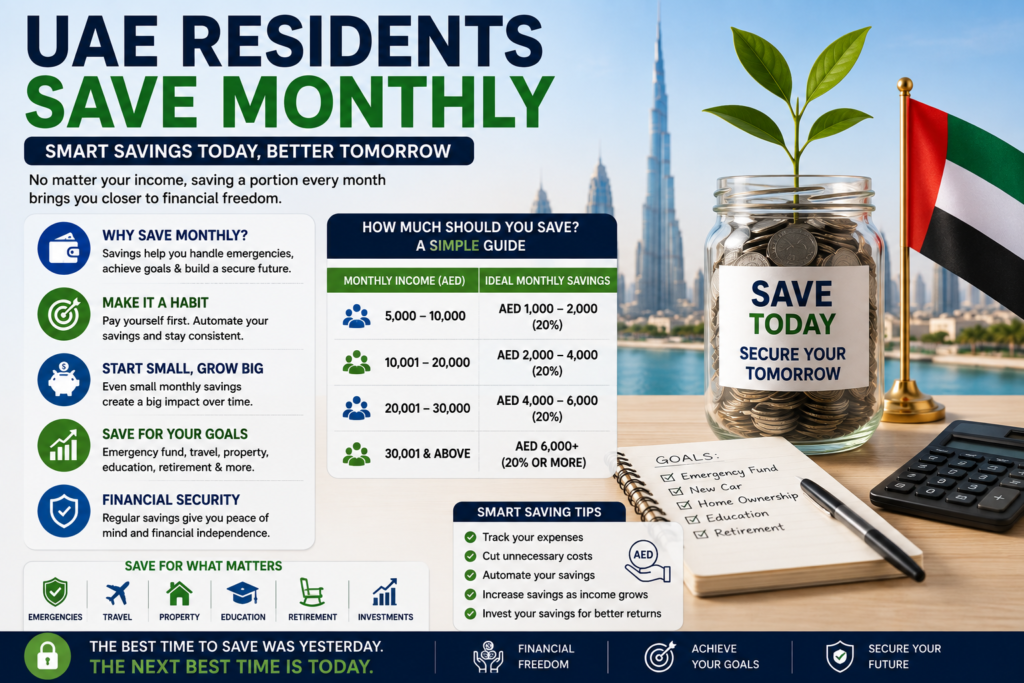
For example, if you earn AED 15,000 and want to save AED 3,000, set aside the AED 3,000 first. Then create your monthly budget around the remaining AED 12,000.
Automation removes some of the temptation to spend the money.
You can divide automated savings into different goals:
- Emergency fund.
- Home deposit.
- Retirement.
- Education.
- Travel.
- Investments.
Where Should UAE Residents Keep Their Savings?
The right place for your savings depends on the purpose and time horizon.
An emergency fund should generally prioritize accessibility and capital preservation. Long-term money may be suitable for investments depending on your risk tolerance, financial goals, and circumstances.
Potential options may include:
- Savings accounts.
- Term or fixed deposits.
- Government or regulated savings products.
- Investment funds.
- Diversified investment portfolios.
- Retirement-oriented investments.
Before choosing a product, understand its fees, risks, liquidity, returns, and applicable terms.
Do not put emergency savings into an investment simply because the potential return appears attractive.
How to Increase Your Monthly Savings in the UAE
If you currently save very little, you do not have to make a dramatic change immediately.
Start with practical adjustments:
- Reduce unnecessary subscriptions.
- Prepare more meals at home.
- Compare insurance costs.
- Review mobile and internet plans.
- Limit impulse shopping.
- Use public transportation when practical.
- Compare major purchases before buying.
- Set a monthly dining-out budget.
- Reduce unnecessary debt.
- Direct bonuses toward savings.
- Automate monthly transfers.
- Increase your savings percentage whenever your income rises.
Even saving an additional AED 500 per month means AED 6,000 more saved over a year.
A Simple Monthly Savings Plan for UAE Residents
A practical monthly budget could look like this:
Step 1: Calculate your take-home income.
Know exactly how much money reaches your bank account each month.
Step 2: Calculate essential expenses.
Include rent, food, utilities, transportation, insurance, education, and debt payments.
Step 3: Set a savings target.
Start around 10% if 20% is difficult, and gradually work toward 20% or more.
Step 4: Create an emergency fund.
Build enough savings to cover several months of essential expenses.
Step 5: Separate short-term and long-term goals.
Do not mix holiday savings with retirement savings.
Step 6: Review the budget every month.
Your expenses and financial priorities can change.
Example: UAE Resident Earning AED 10,000
Consider a resident with a monthly take-home income of AED 10,000.
A possible budget could be:
- Housing and utilities: AED 3,500
- Food and groceries: AED 1,500
- Transportation: AED 800
- Insurance and other essentials: AED 700
- Lifestyle and entertainment: AED 1,000
- Savings: AED 2,000
- Miscellaneous: AED 500
This is only an illustration. Actual expenses can vary considerably depending on the emirate, household size, accommodation, and lifestyle.
The key idea is to deliberately allocate money to savings instead of saving only whatever happens to remain.
Example: UAE Resident Earning AED 20,000
A resident earning AED 20,000 may have more flexibility.
A potential structure could include:
- Essential expenses: AED 9,000
- Lifestyle spending: AED 3,000
- Emergency and short-term savings: AED 3,000
- Long-term investments: AED 3,000
- Other financial goals or debt repayment: AED 2,000
This example puts AED 6,000, or 30%, toward savings and long-term financial goals.
Again, there is no universal formula. A family with school fees and significant housing costs may need a different allocation.
Common Saving Mistakes UAE Residents Should Avoid
Saving money is important, but there are also mistakes that can undermine your financial progress.
Avoid:
- Saving without a specific goal.
- Keeping no emergency fund.
- Depending entirely on credit cards.
- Increasing lifestyle spending whenever income rises.
- Ignoring debt.
- Investing money you may need soon.
- Keeping all your money in cash for long-term goals without considering inflation.
- Taking unnecessary financial risks.
- Failing to review your budget.
- Assuming your current income will continue indefinitely.
A good savings strategy should be flexible enough to adapt when your career, family, or financial situation changes.
Should You Save 20% of Your Salary?
For many people, 20% is a useful starting benchmark, but it should not be treated as a universal rule.
If you earn AED 8,000 and have essential expenses of AED 7,500, saving AED 1,600 may not be realistic without creating financial stress.
In such a situation, start smaller.
If you earn AED 30,000 and have relatively low expenses, saving only AED 3,000 may be unnecessarily conservative.
The right question is not simply:
“What percentage should everyone save?”
Instead, ask:
“What percentage can I consistently save while meeting my essential needs and progressing toward my financial goals?”
Final Thoughts: How Much Should UAE Residents Save Monthly?
So, how much should UAE residents save monthly?
A practical starting point is to aim for 10% to 20% of monthly take-home income, with 20% being a useful target for people whose budgets allow it. Residents with strong incomes and manageable expenses may be able to save 25%, 30%, or even more.
The exact amount is less important than developing a consistent habit.
If you earn AED 5,000, start with an amount you can realistically maintain. If you earn AED 10,000, consider targeting AED 1,000 to AED 2,000 or more. At AED 20,000, AED 4,000 can represent a 20% savings target. Higher earners may have the opportunity to save considerably more.
Your monthly savings should ideally support several financial priorities, including an emergency fund, short-term goals, long-term investments, and retirement planning.
Most importantly, avoid comparing your savings with someone else’s. A single professional living alone will have very different financial needs from a family with children, while an expatriate supporting relatives abroad may have different priorities from someone who does not have those responsibilities.
Start with a realistic amount, automate it, review your expenses regularly, and increase your savings whenever your income improves. For UAE residents, consistent monthly saving is not simply about putting money aside—it is about creating financial security, reducing dependence on debt, and building the freedom to make better choices in the future.
Do follow us on Instagram
Read More – How to Save Money in Dubai as an Expats