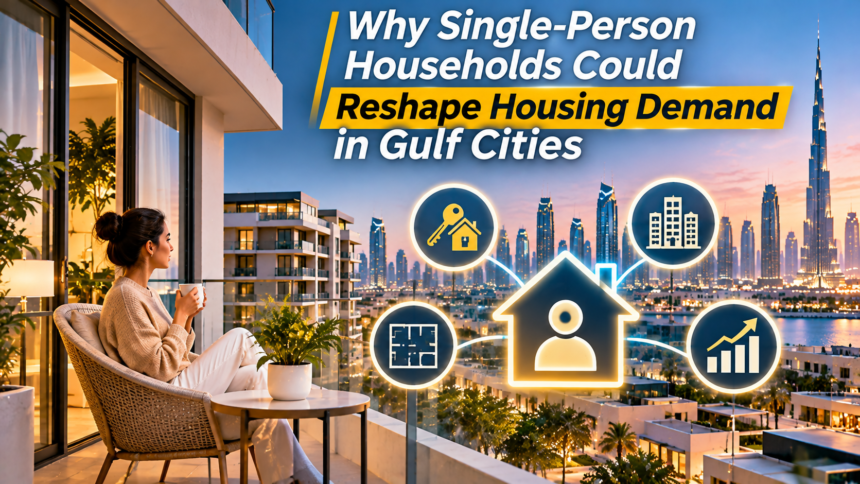
Why Solo Living Could Transform Gulf Real Estate Markets
Housing markets across the Arabian Gulf have traditionally been associated with family apartments, spacious villas, residential compounds, and large-scale urban developments. However, changing employment patterns, international mobility, lifestyle preferences, and household structures could influence the types of homes that residents need in the coming years.
- 1. Why Single-Person Households Are Becoming Important to Gulf Housing Markets
- 2. How Employment Mobility and Changing Lifestyles Could Influence Solo Living
- 3. Why Compact Apartments and Flexible Housing Designs Could Gain Demand
- 4. How Rental Markets and Real Estate Investment Could Respond
- 5. The Role of Co-Living, Serviced Apartments, and Community Facilities
- 6. How Single-Person Households Could Change Urban Planning and Sustainability
- 7. The Future of Single-Person Households and Gulf Housing Demand
- Conclusion
Single-person households in Gulf cities represent an increasingly relevant segment for real estate developers, property investors, urban planners, and rental housing providers. A single-person household consists of an individual living alone and managing a separate household, regardless of whether that person is young, middle-aged, elderly, employed, or retired.
These households can have different housing priorities from larger families. Location, affordability, accessibility, security, maintenance, and efficient use of space may matter more than additional bedrooms or large private outdoor areas.
Across cities such as Dubai, Abu Dhabi, Riyadh, Jeddah, Doha, Muscat, Manama, and Kuwait City, housing demand is shaped by a combination of population growth, workforce mobility, family circumstances, and urban development.
Recent research indicates that single-person living is a meaningful housing category in parts of the region. Saudi Arabia’s Family Statistics Report 2024 found that 14% of Saudi households consisted of one person. In the UAE, a household outlook published by Euromonitor anticipates relatively strong growth in single-person households, partly associated with young expatriate professionals.
However, the Gulf is not one uniform housing market. Family households remain important, and national statistics do not necessarily describe the situation in individual cities.
Understanding these differences can help explain why smaller households could influence future apartment design, rental services, real estate investment, and urban planning across the GCC.
1. Why Single-Person Households Are Becoming Important to Gulf Housing Markets
Housing demand depends on more than the number of people living in a city.
The number of households, their composition, and the types of homes they can afford also influence how much housing is required.
Two cities with similar populations may have different residential needs if one has a greater proportion of people living alone.
Understanding the Difference Between Population and Households
Consider a simplified example involving 100 residents.
If those residents live in households averaging five people, approximately 20 homes would be required.
If the same population lives in households averaging two people, approximately 50 homes would be needed.
This illustration shows why changing household size can influence the number of housing units required, even when total population remains unchanged.
However, real housing demand is also affected by vacant properties, shared accommodation, affordability, migration, and household formation.
What Saudi Arabia’s Statistics Reveal
The Saudi General Authority for Statistics published its Family Statistics Report 2024 in May 2025.
The report found that single-person households represented 14% of Saudi households, while households containing at least two people accounted for approximately 86%.
It also reported that 55.8% of single-person households lived in apartments, compared with 43.4% of households containing multiple people.
These figures demonstrate that living alone is an identifiable residential category within Saudi society.
However, they do not establish that the proportion is increasing, nor do they represent the entire population including all non-Saudi households.
Changing Household Formation
Single-person households can emerge for different reasons.
Some people live independently when relocating for work. Others may choose to establish separate homes after completing education or beginning professional careers.
Divorce, bereavement, retirement, and personal circumstances can also result in individuals living alone.
Consequently, housing research should avoid assuming that every one-person household consists of a young unmarried professional.
Housing Needs by Household Type
| Household Type | Common Housing Considerations |
|---|---|
| Single Young Professional | Access to employment, affordable rent, transport |
| Single Mid-Career Resident | Privacy, convenient location, quality amenities |
| Single Older Adult | Accessibility, healthcare proximity, secure accommodation |
| Couple Without Children | Flexible layouts and lifestyle facilities |
| Family With Children | Additional bedrooms, schools, community facilities |
| Shared Household | Suitable room arrangements and shared expenses |
Different household types can overlap in their preferences, but their combined demand influences the residential mix cities need.
2. How Employment Mobility and Changing Lifestyles Could Influence Solo Living
Employment opportunities and urban mobility play important roles in Gulf housing markets.
Cities with expanding business districts, international companies, universities, and specialised industries can attract residents who initially relocate without other household members.
This may create demand for accommodation suited to individual occupants.
The Role of Expatriate Professionals
The GCC has long attracted international workers across industries including finance, healthcare, aviation, education, technology, hospitality, and construction.
Some workers relocate independently before establishing longer-term residential arrangements.
Others maintain households or family relationships elsewhere.
However, an individual working away from family does not necessarily live alone. Many residents share apartments or occupy collective accommodation.
Real estate analysis must distinguish between a single resident, a single-person private household, and shared housing.
Changing Career Patterns
Job changes, professional training, international assignments, and temporary relocation can influence housing preferences.
A professional moving to Riyadh for a new position may prefer a furnished apartment near the workplace.
A technology employee relocating to Dubai might prioritise public transport access and flexible lease arrangements.
These are potential demand scenarios rather than universal preferences.
Independent Living and Personal Choice

Single-person living can also reflect personal preferences involving privacy, convenience, and independence.
Some residents may prefer their own homes even when shared accommodation would reduce expenses.
Others may choose smaller residences to limit maintenance responsibilities.
However, independent living is influenced by cultural expectations, financial capacity, housing availability, and personal circumstances.
Why Smaller Households Do Not Always Mean Smaller Homes
A person living alone may still prefer a two-bedroom apartment with space for a home office or visiting relatives.
Similarly, some couples may choose compact studios.
Developers should avoid treating household size as the only determinant of preferred property size.
Income, lifestyle, location, and housing quality can be equally important.
3. Why Compact Apartments and Flexible Housing Designs Could Gain Demand
If single-person households become a larger share of urban housing demand, developers may need to reconsider the balance between studios, one-bedroom apartments, larger apartments, and villas.
Compact homes can offer advantages in affordability and convenience.
However, successful design requires more than reducing floor area.
The Appeal of Studio Apartments
Studios combine living, sleeping, and selected kitchen functions within a relatively compact layout.
They can appeal to individuals seeking a private residence while managing housing expenses.
For developers, studios can increase the number of units accommodated within an appropriately designed building.
However, smaller units do not automatically produce affordable rents.
Location, construction costs, maintenance fees, and local market conditions still influence pricing.
One-Bedroom Apartments and Functional Space
One-bedroom homes provide greater separation between sleeping and living areas.
They may appeal to residents who work remotely, entertain guests, or prefer additional privacy.
Some single occupants may therefore choose one-bedroom apartments even when smaller studios are available.
The appropriate mix depends on local demand rather than a fixed assumption that solo residents always prefer the least expensive property.
Flexible Interior Design
Compact housing can benefit from thoughtful layouts.
Features may include integrated storage, efficient kitchens, adaptable furniture, sound insulation, and well-designed natural lighting.
However, flexibility should not come at the expense of ventilation, privacy, accessibility, or safety.
Housing Formats and Potential Uses
| Housing Format | Potential Advantage | Important Limitation |
|---|---|---|
| Studio Apartment | Efficient use of space | Limited separation between activities |
| One-Bedroom Apartment | Privacy and functional layout | Higher costs than some studios |
| Furnished Rental | Convenient relocation | Furniture and service premiums |
| Serviced Apartment | Maintenance and support services | Potentially higher recurring charges |
| Co-Living Accommodation | Shared facilities and social interaction | Privacy and regulatory considerations |
| Two-Bedroom Apartment | Flexible space for working or guests | Higher rent and utility costs |
Avoiding Poor-Quality Micro-Housing
Smaller homes should not be confused with overcrowded or inadequate accommodation.
Municipal building requirements, fire safety, ventilation, and minimum residential standards remain essential.
Compact housing is most useful when it provides a comfortable living environment rather than simply maximising the number of units.
4. How Rental Markets and Real Estate Investment Could Respond
A shift in household composition can influence rental demand and property investment strategies.
Investors typically examine location, purchase price, rental income, maintenance costs, and expected occupancy.
If more residents seek independent accommodation, smaller rental properties could become attractive in selected neighbourhoods.
However, demand varies between cities and property segments.
The Importance of Rental Affordability
People living alone generally cannot divide household expenses with other members of the same household.
Rent, utilities, internet, furnishing, and other residential costs must be covered individually.
This may make affordability particularly important.
However, some single residents have substantial disposable incomes and may prefer premium properties.
The market therefore includes several price segments rather than one uniform budget category.
Rental Yield Versus Operating Costs
Smaller properties may sometimes generate attractive rental income relative to purchase price.
However, investors should consider operating expenses, service charges, vacancies, agent fees, and refurbishment costs.
A studio apartment with a relatively high advertised gross rental yield may produce a lower net return after these expenses.
An Illustrative Investment Comparison
| Investment Consideration | Compact Apartment | Larger Apartment |
|---|---|---|
| Purchase Price | May be lower in the same development | Usually higher |
| Potential Tenants | Individuals and some couples | Couples, families and shared households |
| Rental Demand | Depends on local solo-living demand | Depends on wider household needs |
| Turnover | May vary with tenant mobility | Depends on tenant circumstances |
| Maintenance | Smaller internal area | More space and potential maintenance |
| Investment Risk | Oversupply and price competition | Higher capital requirements |
These are general considerations rather than guaranteed investment outcomes.
Why Location Remains Critical
A compact apartment near employment centres, public transport, universities, or healthcare facilities may appeal to certain residents.
However, similar accommodation in areas with limited access to everyday services may attract less demand.
Property investors should examine neighbourhood-level housing conditions rather than relying only on citywide trends.
5. The Role of Co-Living, Serviced Apartments, and Community Facilities
Single-person households could also influence demand for residential services beyond conventional apartment rentals.
Some residents may value flexible accommodation, shared amenities, and social opportunities.
These preferences could support specialised housing formats, although their commercial viability remains location-dependent.
Understanding Co-Living
Co-living generally involves private or shared residential spaces combined with communal facilities.
Depending on the development, residents may have private bedrooms or self-contained units while sharing lounges, kitchens, or working areas.
Such housing can appeal to individuals who value community interaction and convenience.
However, co-living is distinct from a single-person household when unrelated residents share one household unit.
Researchers must use consistent definitions when comparing demand.
Serviced Apartments
Serviced apartments provide residential accommodation combined with selected services such as housekeeping, furnishing, maintenance, or reception support.
They may suit people relocating temporarily or seeking accommodation with fewer management responsibilities.
However, service fees and rental costs can be higher than those of conventional apartments.
Shared Amenities
Residential developments may offer facilities such as gyms, coworking spaces, lounges, gardens, and communal recreation areas.
These amenities could make smaller private apartments more attractive.
However, their usefulness depends on actual resident demand and the additional costs involved.
Residential Features for Independent Occupants
| Feature | Potential Resident Benefit |
|---|---|
| Reliable Building Security | Greater confidence in residential access |
| Maintenance Support | Reduced responsibility for repairs |
| Coworking Space | Alternative workspace |
| Shared Recreation Areas | Social interaction |
| Public Transport Access | Reduced dependence on private vehicles |
| Accessible Building Design | Greater convenience for older or disabled residents |
| Flexible Furnishing | Easier relocation |
Avoiding One-Size-Fits-All Development
Not every person living alone wants extensive shared facilities.
Some residents prioritise privacy, quiet surroundings, and low service charges.
Developers should therefore test demand before incorporating expensive communal amenities.
A building that offers numerous underused facilities may increase costs without delivering equivalent resident value.
6. How Single-Person Households Could Change Urban Planning and Sustainability
Household composition influences more than property demand.
It can affect transportation systems, neighbourhood services, infrastructure capacity, and environmental performance.
If the number of households grows faster than population, cities may need additional residential units and supporting infrastructure.
Why Household Size Matters for Infrastructure
Every residence requires access to electricity, water, sanitation, waste collection, and telecommunications.
A larger number of smaller households may increase the number of separate kitchens, bathrooms, appliances, and utility connections required.
However, overall resource consumption depends on building design, floor area, occupancy, climate, and personal behaviour.
Smaller homes are not automatically more environmentally efficient in every comparison.
The Findings of UN-Habitat
The United Nations Human Settlements Programme’s World Cities Report 2026 examines how smaller households and demographic change affect housing demand.
It highlights that declining household size can increase housing space and infrastructure needs per person, depending on how cities respond.
The report also identifies wider housing affordability and environmental implications.
These considerations are relevant to Gulf cities, particularly where cooling and electricity demand are significant.
Walkable Neighbourhoods and Public Transport
Residents living alone may benefit from neighbourhoods that provide convenient access to workplaces, shops, healthcare, and recreation.
Mixed-use developments can reduce the need for some long-distance journeys.
However, planning should serve households of different sizes and abilities.
Walkability is valuable for many residents, not only people living alone.
Environmental and Urban Planning Trade-Offs
| Planning Choice | Potential Benefit | Possible Trade-Off |
|---|---|---|
| Compact Apartments | Reduced space per dwelling | More separate households and appliances |
| High-Density Development | More residents near services | Infrastructure capacity requirements |
| Shared Amenities | Less need for some private facilities | Maintenance and operating expenses |
| Transit-Oriented Housing | Improved access to transport | Location premiums and affordability concerns |
| Mixed-Use Neighbourhoods | Convenient local services | Noise and development-management issues |
| Energy-Efficient Buildings | Reduced operational consumption | Higher initial investment in some cases |
The Importance of Inclusive Housing
Housing policy must continue serving families, older adults, lower-income residents, and people with disabilities.
A market shift toward smaller households should not lead developers to abandon larger or accessible homes.
Balanced urban planning requires diverse residential options.
7. The Future of Single-Person Households and Gulf Housing Demand
The future influence of single-person households will depend on migration, employment, income, household formation, demographic change, and housing affordability.
Some cities may experience stronger demand for independent living than others.
Developers and policymakers should therefore monitor evidence instead of assuming a uniform regional transformation.
The Importance of Reliable Household Data
Real estate research often focuses on population growth, housing transactions, prices, and rental rates.
However, household composition can provide an additional perspective.
Statistics describing household size, tenure, age, income, and residential location may help identify underserved housing categories.
Dubai’s 2024 Household Income and Expenditure Survey collected information on families, collective households, and workers’ accommodation to support public policy.
This distinction matters because not every individual resident occupies a separate private dwelling.
Understanding Regional Differences
Dubai and Abu Dhabi have substantial international employment markets, while Riyadh and Jeddah have distinct demographic and housing structures.
Doha, Muscat, Manama, and Kuwait City also differ in population composition, urban development, and available residential stock.
Consequently, the same housing model may not perform equally across these markets.
A Practical Checklist for Developers and Investors
- Study local household composition rather than relying only on population growth.
- Distinguish single residents from one-person private households.
- Assess demand for studios, one-bedroom units, and other apartment types.
- Evaluate neighbourhood-level employment and transport access.
- Compare rental affordability across relevant income groups.
- Examine existing and planned housing supply.
- Consider demand from older single residents.
- Test preferences for furnishing and shared facilities.
- Analyse maintenance costs and realistic net rental returns.
- Review local housing, safety, and occupancy regulations.
Measuring Market Demand
Developers can monitor several indicators when evaluating smaller housing formats.
These include occupancy rates, advertised rents, achieved rents, tenant turnover, average marketing periods, and the relationship between housing costs and individual incomes.
Surveys can also help identify preferences involving location, apartment size, privacy, and communal facilities.
However, survey responses should be compared with actual leasing behaviour.
People may express interest in a property type without being willing or able to pay the asking rent.
What Could Happen Next?
One possible outcome is greater diversification of apartment developments.
Some projects may include a higher proportion of studios and one-bedroom homes, while others focus on flexible layouts or serviced accommodation.
Developers could also introduce more adaptable unit designs suited to residents whose needs change over time.
However, future demand depends on market conditions.
If compact units become oversupplied, rental performance may weaken even when the number of one-person households increases.
A growing household category does not guarantee profitability for every project targeting it.
Conclusion
Single-person households could become an increasingly important factor in housing demand across Gulf cities.
Changes in employment mobility, household formation, lifestyle preferences, and population characteristics may influence how residents choose accommodation.
Research from Saudi Arabia already demonstrates that one-person households form a measurable part of the national housing market, while projections for the UAE suggest potential growth in this segment.
For developers and investors, these changes could create opportunities in compact apartments, flexible rentals, serviced accommodation, and residential developments offering convenient access to everyday services.
However, housing demand cannot be understood through household size alone.
Affordability, location, cultural expectations, income, household definitions, and local regulations all influence residential choices.
Urban planners must also consider the wider consequences of household change for infrastructure, environmental performance, accessibility, and community development.
The future of Gulf housing is therefore unlikely to involve replacing family-oriented properties with smaller apartments.
Instead, it may require a more diverse housing market capable of serving different household structures and stages of life.
Ultimately, cities that understand how their residents actually live may be better positioned to develop housing that is financially accessible, commercially viable, and responsive to changing urban needs.
Do follow us on Instagram
Read More – The Hidden Environmental Cost of Expanding Data Centres in Desert Countries