How AI Infrastructure Is Increasing Energy and Water Demand in the Gulf
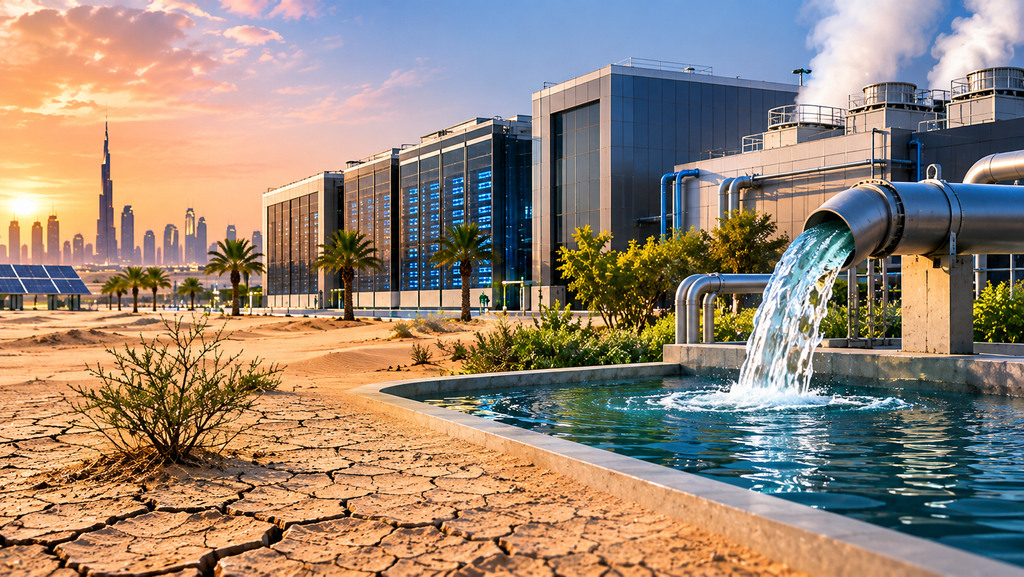
Across the Middle East, data centres are becoming essential infrastructure for artificial intelligence, cloud computing, online banking, digital government services, and connected businesses. As countries invest in advanced technology and seek to become international digital hubs, demand for large computing facilities continues to grow. However, behind the servers, powerful processors, and sophisticated digital systems lies an environmental challenge that is receiving increasing attention.
- 1. Why Data Centres in Desert Countries Face Unique Environmental Challenges
- 2. How Cooling Systems Increase Water and Electricity Consumption
- 3. The Hidden Water Crisis Behind Desert Data Centre Expansion
- 4. How Electricity Demand and Carbon Emissions Affect Gulf Sustainability Goals
- 5. The Environmental Impact of Construction, Hardware, and Electronic Waste
- 6. Why UAE and Saudi Data Centre Growth Raises Sustainability Questions
- 7. How Desert Countries Can Build More Sustainable Data Centres
- Conclusion
The environmental impact of data centres in desert countries is particularly important because these facilities require reliable electricity and effective cooling while operating in regions characterised by high temperatures and limited natural freshwater resources.
Unlike ordinary office buildings, data centres contain computing equipment that produces substantial heat during operation. This equipment must remain within appropriate temperature ranges to avoid damage, performance problems, and service interruptions. Maintaining these conditions can require considerable energy, especially during the extremely hot summer months experienced across Gulf countries.
Water consumption presents another challenge. Certain cooling technologies rely on evaporation to remove heat, while other systems consume more electricity but use substantially less water. In regions where freshwater is scarce and desalination is widely used, these decisions can create complicated environmental trade-offs.
The United Arab Emirates, Saudi Arabia, Qatar, Oman, Bahrain, and Kuwait are all pursuing digital development, although their data-centre markets and environmental conditions differ.
The expansion of AI infrastructure offers economic opportunities, including investment, specialised employment, and advanced digital services. Yet these benefits must be considered alongside electricity demand, water resources, carbon emissions, construction impacts, and long-term infrastructure requirements.
Understanding these hidden costs is essential for building a digital economy that is both technologically competitive and environmentally responsible.
1. Why Data Centres in Desert Countries Face Unique Environmental Challenges
Data centres are specialised facilities designed to house servers, storage equipment, networking systems, and related digital infrastructure.
They support essential services by processing, storing, and transmitting information.
While these facilities exist worldwide, operating them in extremely hot and dry environments creates particular challenges.
The Impact of Extreme Temperatures
Computing equipment generates heat whenever it processes information.
Cooling systems remove this heat to maintain reliable operating conditions.
In cooler environments, facilities may be able to use outdoor air or other favourable conditions for part of the year.
However, desert climates can experience prolonged periods of high temperatures, reducing the opportunities for certain energy-saving cooling approaches.
Data-centre operators may therefore depend more heavily on mechanical refrigeration or specially designed heat-rejection systems.
The precise energy requirements depend on equipment density, facility design, temperature conditions, and cooling technology.
Why Artificial Intelligence Changes the Equation
Modern AI infrastructure often uses specialised processors capable of performing intensive computational tasks.
These processors can generate high heat loads within relatively small physical spaces.
As server racks become more powerful, traditional cooling arrangements may become less suitable for certain facilities.
Operators may need liquid cooling, improved airflow systems, or more advanced thermal management.
However, AI workloads vary significantly, and not every data centre contains the same type of equipment.
The Scale of Global Electricity Demand
The International Energy Agency estimated that data centres consumed approximately 415 terawatt-hours of electricity worldwide in 2024, representing around 1.5% of global electricity consumption.
Its updated 2026 analysis estimated consumption of approximately 485 TWh in 2025 and projected around 950 TWh by 2030.
These figures highlight growing demand but should not be interpreted as measurements of Gulf data-centre consumption.
Environmental Pressures Compared
| Environmental Factor | Why It Matters in Desert Countries |
|---|---|
| High Ambient Temperature | Can increase cooling-system energy requirements |
| Water Scarcity | Makes water-intensive cooling more sensitive |
| Electricity Demand | Can create pressure on generation and grid infrastructure |
| Carbon Emissions | Depends on electricity sources and operational efficiency |
| Dust and Sand | Can increase filtration and equipment maintenance needs |
| Construction Activity | Requires materials, land, and infrastructure |
| Equipment Replacement | Creates material consumption and electronic waste |
The environmental challenge is therefore broader than simply keeping computers cool.
It involves the complete infrastructure required to operate digital services reliably.
2. How Cooling Systems Increase Water and Electricity Consumption
Cooling is one of the most important environmental considerations for data centres in hot climates.
Different cooling technologies use different combinations of electricity, water, and equipment.
A system that reduces electricity demand may require more water, while a water-saving system may increase electricity consumption.
Why Servers Need Cooling
Electrical energy used by computing equipment is largely converted into heat.
If this heat accumulates, temperatures may exceed acceptable operating limits.
Cooling systems transfer heat from equipment to the surrounding environment.
This may involve air circulation, chilled water, direct liquid cooling, refrigeration equipment, or other technologies.
The most appropriate solution depends on the facility’s technical requirements and environmental conditions.
Evaporative Cooling and Water Demand
Evaporative cooling removes heat by allowing water to evaporate.
This process can improve cooling efficiency under suitable conditions.
However, water lost through evaporation must be replaced.
In desert countries, where freshwater resources are already constrained, large-scale use of evaporative cooling may create additional water-management challenges.
The amount consumed depends on system design, operating conditions, and cooling requirements.
Air Cooling and Electricity Consumption
Air-based cooling systems can reduce or avoid certain direct water requirements.
However, they may need more electrical power to remove heat, particularly during extremely hot weather.
Dry cooling can therefore shift part of the environmental burden from water use toward electricity demand.
Whether this produces a better environmental outcome depends on the electricity supply and local water situation.
Liquid Cooling for Advanced Computing
Liquid cooling transfers heat using fluids circulating through dedicated equipment.
It can be particularly relevant for high-density AI servers.
However, liquid cooling does not automatically mean that a facility consumes large quantities of water.
Some systems operate through closed loops and reject heat using separate cooling equipment.
The environmental result depends on the complete cooling architecture.
Cooling Technologies Compared
| Cooling Approach | Potential Advantage | Environmental Trade-Off |
|---|---|---|
| Conventional Air Cooling | Established technology | Can require substantial electricity |
| Evaporative Cooling | May improve energy efficiency | Direct water consumption |
| Closed-Loop Liquid Cooling | Effective heat removal for dense equipment | Still requires external heat rejection |
| Dry Cooling | Lower direct water use | Potentially higher electricity demand |
| Hybrid Cooling | Flexibility across operating conditions | More complex equipment and management |
| Reclaimed-Water Cooling | Reduces reliance on potable water | Requires suitable water quality and infrastructure |
Why There Is No Universal Best Solution
Water-efficient technologies are not automatically energy-efficient.
Similarly, a cooling system with low electricity consumption may have significant water requirements.
A responsible assessment should examine both electricity and water use, along with reliability and operating conditions.
3. The Hidden Water Crisis Behind Desert Data Centre Expansion
Freshwater availability is a significant environmental concern across the Arabian Gulf.
Many countries depend heavily on desalination to meet important water requirements.
Data centres can contribute to water demand directly through cooling and indirectly through electricity generation and associated infrastructure.
Direct and Indirect Water Consumption
Direct water consumption occurs when water is used at the data-centre facility itself.
For example, evaporative cooling systems may consume water during heat rejection.
Indirect water use can occur elsewhere in the supply chain, including electricity generation.
A facility may report low on-site water consumption while relying on electricity produced through processes that also require water.
This distinction is important when evaluating the full environmental impact of digital infrastructure.
Understanding Water Usage Effectiveness
Water Usage Effectiveness, or WUE, is a commonly used data-centre sustainability metric.
It measures annual site water consumption relative to the electricity used by IT equipment.
The result is generally expressed in litres per kilowatt-hour.
A lower site WUE indicates less on-site water consumption for a given amount of IT electricity use.
However, WUE alone does not describe local water scarcity or indirect water consumption.
Why Local Water Stress Matters
Using a certain quantity of water in a water-abundant region may have different environmental implications from using the same amount in a water-stressed location.
The World Resources Institute identifies countries across the Middle East and North Africa among those facing extremely high water stress.
For Gulf data centres, this means water assessments should consider not only quantity but also availability, source, competing demand, and local environmental conditions.
The Desalination Connection
Desalination transforms seawater into freshwater suitable for various uses.
The process requires energy and can have environmental effects involving seawater intake and concentrated brine discharge.
If a data centre uses desalinated water for cooling, its water supply may therefore create additional energy and environmental considerations.
However, impacts depend on desalination technology, energy sources, water treatment, and discharge management.
Key Water-Management Questions
- What quantity of water does the facility consume annually?
- Is cooling water potable, desalinated, recycled, or reclaimed?
- How much water is lost through evaporation?
- Does the facility operate in a highly water-stressed area?
- Can cooling requirements be reduced through design improvements?
- What indirect water use is associated with electricity supply?
- Are consumption figures independently verified?
A meaningful sustainability assessment must consider these questions together rather than focusing on one isolated indicator.
4. How Electricity Demand and Carbon Emissions Affect Gulf Sustainability Goals
Data centres require continuous electricity for computing, cooling, networking, and supporting equipment.
They also need reliable backup arrangements to maintain service availability during power interruptions.
As large facilities expand, their electricity requirements can influence infrastructure planning and emissions.
The Relationship Between Data Centres and Carbon Emissions
The carbon footprint of a data centre depends partly on the sources used to generate its electricity.
Facilities connected to grids with substantial fossil-fuel generation may be associated with higher operational emissions than equivalent facilities supplied by lower-carbon electricity.
However, actual emissions depend on electricity use, generation characteristics, contractual arrangements, and accounting methods.
A facility should not automatically be described as carbon-neutral simply because its operator purchases renewable energy certificates.
Such instruments require appropriate accounting and transparent reporting.
The Challenge of Continuous Electricity Demand
Solar power offers important opportunities in desert regions because of strong sunlight availability.
However, solar generation varies throughout the day and is unavailable at night.
Data centres generally operate continuously.
Consequently, renewable electricity integration may require appropriate grid infrastructure, storage, complementary generation, and effective energy planning.
Grid Capacity and Infrastructure Investment
Large data centres can require substantial electrical connections.
New projects may increase demand for substations, transformers, transmission capacity, and backup systems.
These investments can have environmental and financial implications beyond the data-centre building itself.
The International Energy Agency has emphasised that local impacts can be significant even when data centres represent a relatively modest share of global electricity demand.
Operational Emissions and Energy Sources
| Energy Arrangement | Potential Benefit | Important Limitation |
|---|---|---|
| Conventional Grid Electricity | Established supply infrastructure | Emissions depend on generation mix |
| Solar Power | Low-carbon electricity generation | Variable output |
| Wind Power | Additional renewable supply | Location-dependent generation |
| Battery Storage | Helps manage short-term power requirements | Manufacturing impacts and storage limits |
| Natural Gas Generation | Dispatchable electricity | Direct greenhouse gas emissions |
| Lower-Carbon Grid Supply | Can reduce operational emissions | Requires sufficient available generation |
Why Efficiency Alone Is Insufficient
A data centre can become more efficient while its total electricity consumption continues rising.
For example, better cooling efficiency may reduce energy use per unit of computing activity, but an increase in computing demand can outweigh those savings.
This is why total electricity use and associated emissions should be reported alongside efficiency metrics.
5. The Environmental Impact of Construction, Hardware, and Electronic Waste
The environmental footprint of a data centre begins before the first server is switched on.
Constructing facilities requires concrete, steel, electrical systems, mechanical equipment, and electronic components.
These materials create environmental impacts through extraction, manufacturing, transportation, and installation.
Embodied Carbon in Construction Materials
Embodied carbon refers to greenhouse gas emissions associated with producing, transporting, and constructing materials and infrastructure.
Large data-centre buildings may require substantial structural materials, cooling installations, electrical equipment, and supporting infrastructure.
The environmental impact varies according to facility size, construction methods, materials, and supply chains.
These emissions are separate from the electricity consumed during operation.
The Environmental Footprint of Computing Hardware
Servers, processors, storage devices, and networking equipment require complex manufacturing processes.
These may involve semiconductor production, metals, specialised chemicals, and international logistics.
As computing technology advances, equipment may be replaced to meet higher performance requirements.
However, replacement schedules vary, and some operators extend equipment life through maintenance or refurbishment.
Electronic Waste and Material Recovery
Retired equipment can contain recoverable materials, but it may also require specialised handling.
Data centres must consider secure data removal, equipment testing, refurbishment, component recovery, and authorised recycling.
Improper disposal can create environmental and security risks.
Lifecycle Environmental Impacts
| Lifecycle Stage | Environmental Consideration |
|---|---|
| Material Production | Energy and emissions associated with concrete, steel and equipment |
| Construction | Land disturbance, transport and construction emissions |
| Hardware Manufacturing | Raw materials and semiconductor production |
| Operation | Electricity, cooling and water use |
| Maintenance | Replacement parts, transport and servicing |
| Equipment Retirement | Electronic waste and recovery requirements |
| Facility Decommissioning | Demolition, material reuse and disposal |
Why Lifecycle Assessment Matters
A facility reporting excellent operating efficiency may still have significant impacts associated with construction and equipment.
Lifecycle assessment helps organisations consider environmental effects across multiple stages.
However, comparisons must use consistent boundaries and reliable information.
The International Telecommunication Union’s environmental assessment methodologies provide guidance for examining greenhouse gas emissions associated with information and communication technology infrastructure.
6. Why UAE and Saudi Data Centre Growth Raises Sustainability Questions
The UAE and Saudi Arabia are investing in data-centre infrastructure as part of broader digital development strategies.
These investments can support cloud computing, AI, international business services, and national digital capabilities.
However, growth also creates questions about energy supply, water demand, and environmental reporting.
The UAE’s Energy Planning Response
In February 2025, the UAE Ministry of Energy and Infrastructure announced the first meeting of a national team established to review the impact of data centres on the energy sector.
The initiative examined the development of data centres, their influence on local electricity systems, and opportunities to improve sustainability.
This reflects recognition that digital infrastructure requires coordinated energy planning.
The Environmental Trade-Off in the UAE
Research published in October 2026 examined possible environmental outcomes associated with rapid data-centre expansion in the UAE.
The study modelled different combinations of electricity supply, cooling technology, and infrastructure growth.
Its findings indicated that dry cooling could substantially reduce direct water demand but increase electricity requirements.
The study also demonstrated how additional fossil-fuel generation could influence system-wide emissions.
These are scenario-based research findings, not measurements of every UAE data centre.
Saudi Arabia’s Digital Infrastructure Development
Saudi Arabia is pursuing significant growth in data-centre capacity and advanced computing infrastructure.
The country’s Communications, Space and Technology Commission published its Digital and Space Sustainability in Saudi Arabia 2026 report, highlighting technologies designed to improve cooling efficiency and reduce water consumption.
Among the examples is a geothermal cooling technology developed for extremely hot environments.
The report presents potential reductions in cooling electricity and water use, although technology-specific claims should be evaluated against independent operational evidence.
Comparing Sustainability Priorities
| Country | Relevant Consideration | Potential Response |
|---|---|---|
| UAE | Electricity demand from growing data-centre capacity | Energy planning and efficiency improvements |
| Saudi Arabia | Cooling requirements and expanding AI infrastructure | Water-saving cooling innovation |
| Qatar | Water and energy requirements in hot conditions | Integrated utility and cooling planning |
| Oman | Data-centre growth and infrastructure location | Site selection and resource assessment |
| Bahrain | Digital infrastructure and electricity use | Efficient facility design |
| Kuwait | Extreme summer temperatures and resource demand | Cooling and electricity planning |
These considerations do not mean every GCC country has identical data-centre policies or investment conditions.
Environmental performance must be assessed using facility-specific evidence.
7. How Desert Countries Can Build More Sustainable Data Centres
The environmental challenges of data-centre expansion are significant, but operators and governments have several options for reducing potential harm.
The most effective strategies address electricity, water, construction, equipment, and long-term infrastructure planning together.
Selecting Appropriate Cooling Technology
Cooling systems should be chosen according to local temperature conditions, water availability, computing requirements, and long-term operating costs.
A water-efficient system may be particularly relevant in a highly water-stressed location.
However, operators must also evaluate the additional electricity that certain dry-cooling technologies may require.
Using Cleaner Electricity
Expanding access to low-carbon electricity can reduce the operational emissions associated with data-centre activity.
Potential approaches include suitable renewable energy procurement, grid decarbonisation, and energy storage.
However, environmental claims should distinguish physical electricity supply from contractual instruments.
Improving Hardware Efficiency
Energy-efficient processors, server utilisation, workload management, and appropriate equipment selection can reduce unnecessary electricity demand.
Businesses should also assess whether computing tasks require their most energy-intensive systems.
However, improvements must be evaluated against the total workload being processed.
Designing for Longer Equipment Life
Responsible procurement, maintainable equipment, refurbishment, and component recovery can reduce some lifecycle impacts.
Companies should establish clear procedures for secure equipment retirement and authorised recycling.
Data Centre Sustainability Checklist
- Evaluate local water scarcity before selecting a site.
- Assess expected electricity demand throughout the facility’s life.
- Compare cooling systems using both energy and water indicators.
- Identify available lower-carbon electricity options.
- Measure total electricity consumption and operating emissions.
- Record direct and relevant indirect water impacts.
- Evaluate construction materials and embodied carbon.
- Establish responsible hardware procurement and retirement policies.
- Assess backup generation and associated emissions.
- Publish clear, consistent, and verifiable environmental information.
Measuring Sustainability Performance
Data-centre operators commonly use Power Usage Effectiveness, or PUE, to evaluate facility energy efficiency.
PUE compares total facility electricity use with the electricity consumed by IT equipment.
Water Usage Effectiveness measures site water consumption relative to IT electricity use.
Carbon metrics can help evaluate greenhouse gas emissions.
However, no single metric provides a complete environmental assessment.
Important Sustainability Indicators
| Indicator | What It Measures | Limitation |
|---|---|---|
| PUE | Facility electricity efficiency | Does not directly measure water use or emissions |
| WUE | Site water consumption per unit of IT electricity | Does not fully represent local water stress |
| Carbon Emissions | Greenhouse gas impact | Depends on accounting boundaries |
| Total Electricity Use | Absolute power consumption | Does not describe energy sources |
| Embodied Carbon | Construction and equipment emissions | Requires detailed lifecycle information |
| Water Stress Impact | Water demand in local environmental context | Depends on reliable local data |
The Need for Transparent Reporting
Environmental claims should include appropriate reporting boundaries, measurement periods, and methodologies.
A facility described as water-efficient should disclose enough information to understand whether the claim refers only to direct cooling consumption or broader water impacts.
Similarly, claims about renewable energy should explain the basis for emissions accounting.
Independent verification can help improve credibility.
Conclusion
The expansion of data centres in desert countries presents an important environmental challenge alongside significant technological and economic opportunities.
Cloud computing, artificial intelligence, financial services, and digital government applications increasingly depend on reliable computing infrastructure.
However, these facilities require electricity, cooling, construction materials, and advanced electronic equipment.
In Gulf countries, high temperatures and water scarcity make these demands particularly important.
Cooling technology can create difficult trade-offs between water consumption and electricity use, while data-centre construction and hardware replacement contribute additional lifecycle impacts.
Research and government initiatives in the UAE and Saudi Arabia demonstrate growing attention to these issues.
The challenge is not necessarily to prevent digital infrastructure development. It is to ensure that expansion takes place with credible environmental planning, appropriate cooling systems, cleaner energy, and transparent performance measurement.
For governments and operators, long-term sustainability requires evaluating total environmental impacts rather than relying on isolated efficiency claims.
Ultimately, the future of data centres in desert countries will depend on balancing digital ambition with the responsible management of energy, water, materials, and environmental resources.
A more sustainable digital economy will require not only powerful computing systems but also infrastructure designed around the environmental realities of the regions in which those systems operate.
Do follow us on Instagram
Read More – How Edge Computing Could Improve Smart Infrastructure Across Gulf Cities