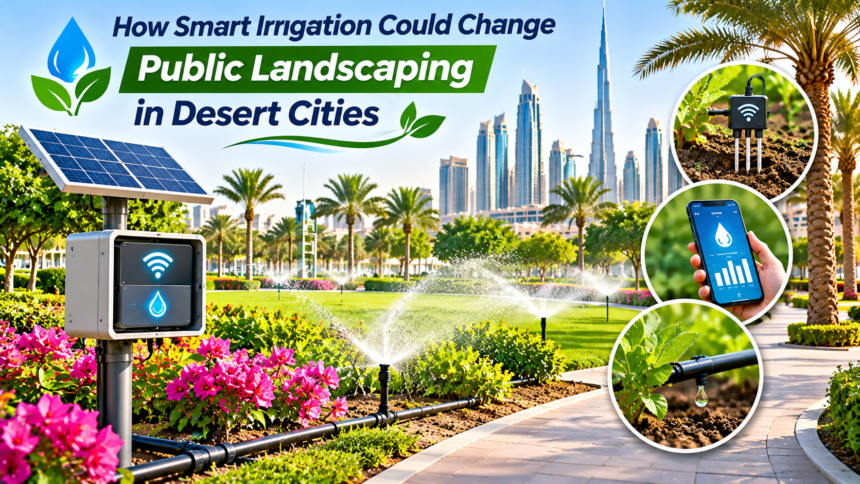
How AI, Sensors and Recycled Water Work Together
A public park in Dubai may contain thousands of trees, colourful flower beds and carefully maintained lawns, all surrounded by a naturally dry landscape. In Riyadh, new green corridors are being developed to provide shade and recreational opportunities, while expanding residential communities across the Gulf are introducing landscaped streets and public gardens. Maintaining these spaces requires water, electricity, infrastructure and ongoing maintenance.
- Why Smart Irrigation in Desert Cities Is Becoming Essential
- 7 Powerful Ways Smart Irrigation Could Transform Public Landscaping
- Dubai, Riyadh and Ajman: Smart Irrigation Projects in Practice
- How AI, Sensors and Recycled Water Work Together
- The Economics of Smart Irrigation for Public Parks
- Water Scarcity, Plant Selection and the Risks of Smart Landscaping
- The Future of Smart Irrigation in Desert Cities and FAQs
As Gulf cities pursue ambitious urban greening programmes, Smart Irrigation in Desert Cities is emerging as an important solution for balancing green development with responsible water consumption.
Traditional irrigation systems often operate according to fixed schedules. Water may be distributed at predetermined times regardless of whether the soil is already moist or the weather has changed.
Smart irrigation introduces a more responsive approach.
Sensors, automated controllers, weather information and connected monitoring platforms can help landscape managers determine when irrigation is needed and how much water to apply.
Instead of watering every location equally, systems can respond to different plant requirements, soil conditions and environmental factors.
This approach is particularly relevant to the UAE, Saudi Arabia and other Gulf countries, where high temperatures and limited natural freshwater resources create challenges for maintaining green public spaces.
Several initiatives demonstrate how these technologies are already being adopted.
In July 2025, Dubai Municipality announced AED 190 million in landscaping projects covering more than three million square metres. These developments incorporated smart irrigation systems connected to Internet of Things networks for real-time monitoring and water-use management.
In September 2026, the municipality launched its Greenery and Plantation Manual 2026, establishing guidance for sustainable irrigation, climate-responsive landscaping and appropriate plant selection.
Saudi Arabia’s Green Riyadh programme is also developing extensive irrigation infrastructure designed to use treated wastewater rather than relying entirely on freshwater resources.
These developments show how landscaping is becoming connected to broader water management systems.
However, installing smart technology does not automatically guarantee water savings.
Performance depends on reliable sensors, correct programming, suitable plants, maintenance and the availability of appropriate irrigation water.
The future of public landscaping may therefore depend on combining intelligent systems with better landscape design rather than simply installing more irrigation equipment.
Why Smart Irrigation in Desert Cities Is Becoming Essential
Public landscaping contributes to the appearance and usability of cities.
Trees can provide shade, parks offer recreational space, and landscaped streets may make urban environments more pleasant.
However, maintaining vegetation in arid climates can require significant irrigation.
The Challenge of Water Scarcity
Desert regions generally receive limited and irregular rainfall.
High temperatures and dry conditions can increase the amount of water lost through evaporation and plant transpiration.
This makes irrigation an important part of maintaining many urban green spaces.
Yet water resources must also support households, businesses, agriculture and other essential activities.
Why Conventional Irrigation Can Waste Water
A fixed irrigation schedule may distribute water when plants do not need it.
For example, a system programmed for frequent watering might continue operating despite unusually cool weather or sufficient soil moisture.
Excess irrigation can create runoff, waterlogging and unnecessary operational costs.
The extent of these problems depends on the system design and local conditions.
Public Landscaping Is Expanding
Dubai Municipality reported planting 216,500 trees during 2024 and expanding green spaces by 391.5 hectares.
Its 2026 programme also includes the development of additional public parks and landscaped areas.
Meanwhile, Riyadh’s Green Riyadh programme aims to plant more than 7.5 million trees by 2030.
These ambitious programmes make efficient irrigation infrastructure increasingly important.
Conventional vs Smart Irrigation
| Feature | Conventional Irrigation | Smart Irrigation |
|---|---|---|
| Watering Schedule | Predetermined | Adjusted using available data |
| Soil Monitoring | Often Manual | Sensors may provide readings |
| Weather Response | Manual Adjustments | Automated where configured |
| Water Distribution | Fixed Zones | Programmable Zones |
| Leak Detection | Routine Inspection | Potential Automated Alerts |
| Maintenance | Scheduled Checks | Monitoring and Targeted Checks |
| Main Challenge | Overwatering Risk | Technical Complexity |
Smart systems can improve control, but their effectiveness depends on proper installation and operation.
7 Powerful Ways Smart Irrigation Could Transform Public Landscaping
Smart irrigation offers several opportunities to improve how municipalities maintain parks, roadside vegetation and public gardens.
The benefits extend beyond water conservation to infrastructure management and long-term landscaping performance.
1. Reducing Unnecessary Water Consumption
Soil moisture sensors can help identify when plants already have sufficient water.
Connected controllers can then delay or adjust irrigation.
The US Environmental Protection Agency explains that soil moisture-based controllers can reduce waste by preventing scheduled watering when it is unnecessary.
However, actual water savings depend on the original system and site conditions.
2. Responding to Weather Conditions
Weather-based irrigation systems can use information such as temperature and estimated evapotranspiration to adjust watering.
During cooler conditions, some landscapes may need less irrigation.
During hotter periods, water requirements may increase.
However, weather information should be combined with plant needs and soil conditions.
3. Monitoring Parks Remotely
Large municipalities may manage thousands of irrigation zones across different neighbourhoods.
Connected platforms allow technicians to monitor equipment and receive alerts without visiting every location.
Dubai Municipality has already introduced remote-controlled irrigation infrastructure supported by IoT technology.
4. Identifying Leaks and Equipment Problems
Unexpected changes in flow or pressure may indicate damaged pipes, faulty valves or other issues.
Monitoring systems can flag abnormal conditions for investigation.
However, an alert does not necessarily identify the exact cause, and maintenance teams still need to inspect equipment.
5. Supporting Healthier Plant Growth
Both insufficient and excessive irrigation can affect vegetation.
Providing suitable water quantities may support healthier roots and more consistent landscape performance.
However, soil quality, plant species, salinity and maintenance practices remain important.
6. Improving Municipal Efficiency
Automated monitoring can reduce some routine manual adjustments.
Technicians may be able to focus their attention on sites showing irregular performance.
Dubai Municipality’s 2025 WETEX presentation described smart irrigation systems capable of reducing water use by up to 50% and manual operations by more than 40%.
These are reported technology performance figures, not guaranteed savings for every public landscape.
7. Supporting Long-Term Urban Greening
Expanding urban vegetation requires dependable water supply and maintenance.
Intelligent irrigation can help authorities assess how different landscapes use resources.
This information may improve planning for future parks, streets and green corridors.
Seven Benefits Compared
| Benefit | Technology Involved | Potential Result |
|---|---|---|
| Water Conservation | Soil Sensors | Less Unnecessary Watering |
| Weather Responsiveness | Climate-Based Controllers | Adaptive Scheduling |
| Remote Management | IoT Networks | Centralised Oversight |
| Leak Detection | Flow and Pressure Sensors | Faster Fault Identification |
| Plant Health | Soil Monitoring | More Suitable Water Delivery |
| Operational Efficiency | Automated Alerts | Targeted Maintenance |
| Urban Greening | Data Analytics | Better Resource Planning |
The greatest value comes when technologies are integrated into a well-managed landscape system.
Dubai, Riyadh and Ajman: Smart Irrigation Projects in Practice
Gulf cities are approaching irrigation modernisation through different combinations of automation, recycled water and urban landscaping strategies.
These projects provide practical examples, although their scope and completion status vary.
Dubai’s Smart Landscaping Projects
In July 2025, Dubai Municipality announced the completion of landscaping and afforestation projects valued at AED 190 million.
The projects covered more than three million square metres along major road intersections and corridors.
They included over 300,000 trees and seedlings and approximately 222,500 square metres of flowers and ground cover.
Smart irrigation systems were connected to remotely controlled IoT networks to improve monitoring and water efficiency.
The announcement described the infrastructure and intended operational benefits but did not establish a single independently measured saving percentage for every project.
Dubai’s 2026 Greenery and Plantation Manual
Launched on September 3, 2026, Dubai Municipality’s Greenery and Plantation Manual provides guidance for parks, green corridors, landscaped roads and recreational spaces.
It addresses sustainable irrigation, water-efficient landscape design, biodiversity, maintenance and climate-responsive plant selection.
The manual supports the Dubai Parks and Greenery Strategy 2040.
Its significance lies in treating irrigation as part of overall landscape planning rather than as equipment added after a park has been designed.
Green Riyadh’s Treated Water Network
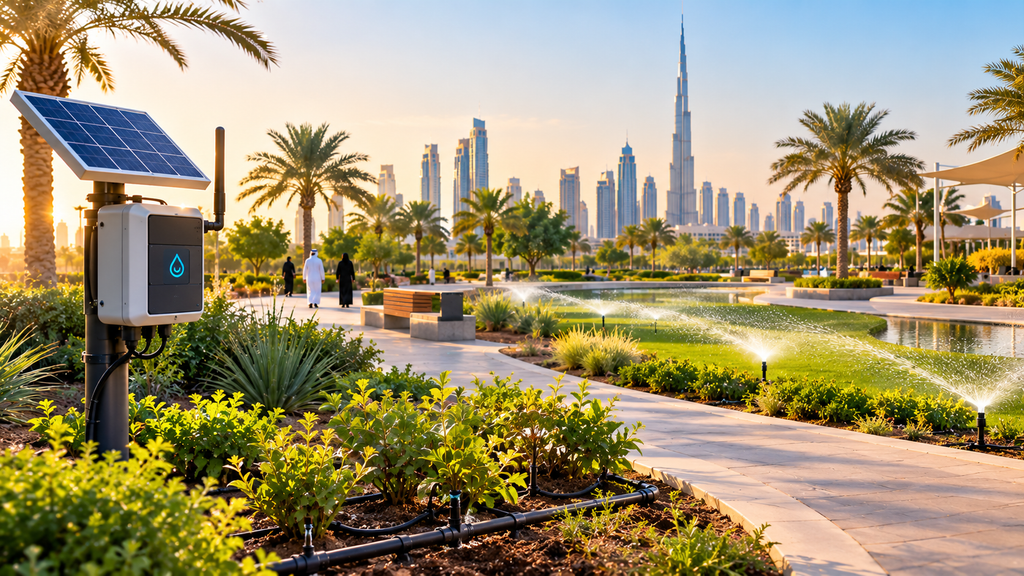
Saudi Arabia’s Green Riyadh programme aims to plant more than 7.5 million trees across the capital by 2030.
The programme includes extensive irrigation infrastructure intended to distribute treated wastewater.
Riyadh’s voluntary local review submitted through the United Nations SDG platform describes ICT-monitored drip irrigation and the installation of 1,350 irrigation lines as part of the first phase.
The programme aims to meet the irrigation requirements of that phase using treated wastewater.
These are programme objectives and reported works, not proof that every planned tree has already been planted or irrigated.
Ajman’s Planned Smart Park
In April 2026, Ajman Municipality described plans for a 30,000-square-metre community park in Al Montazah.
The proposed facility includes a smart irrigation system using treated water.
The project was expected to be completed by the end of 2027.
It should therefore be described as a planned development rather than an already operational park.
Regional Projects Compared
| Location | Initiative | Irrigation Approach |
|---|---|---|
| Dubai | Major Road Landscaping | IoT-Connected Remote Monitoring |
| Dubai | Greenery and Plantation Manual | Sustainable Irrigation Standards |
| Riyadh | Green Riyadh | ICT-Monitored Drip Irrigation |
| Ajman | Al Montazah Community Park | Planned Smart Irrigation Using Treated Water |
These initiatives demonstrate how irrigation technology can be adapted to different public spaces.
How AI, Sensors and Recycled Water Work Together
Smart irrigation depends on several technologies operating together.
A soil sensor alone does not necessarily create an intelligent irrigation network.
The system must collect relevant information, interpret it and control watering appropriately.
Soil Moisture Sensors
Soil sensors estimate how much water is present in the ground.
Their readings can inform decisions about whether irrigation is required.
However, placement matters. A sensor installed in an unrepresentative location may produce misleading information about the wider planting area.
Weather-Based Controllers
Weather-based systems may use local weather observations or evapotranspiration estimates.
Evapotranspiration describes water transferred from soil and plants to the atmosphere.
Estimating this process can help determine irrigation requirements.
However, plant species and soil conditions must still be considered.
Flow and Pressure Monitoring
Flow meters measure the quantity of water moving through an irrigation system.
Pressure sensors can help identify unusual operating conditions.
Together, these tools may support earlier detection of faults.
Artificial Intelligence and Predictive Monitoring
AI can analyse information from multiple sources to identify patterns.
For example, a system might flag irrigation zones with unusual water consumption or possible plant stress.
Dubai Municipality’s Smart Municipality Eye initiative, launched in November 2025, uses AI-enabled drone monitoring to assess green spaces and identify concerns involving irrigation and plant health.
The initiative includes monitoring across extensive municipal green infrastructure.
However, automated analysis still requires reliable data and human oversight.
The Role of Recycled Water
Smart irrigation controls how water is distributed.
Recycled water systems address where some of that water comes from.
Dubai Municipality has developed extensive infrastructure for distributing treated wastewater to public landscapes and other eligible uses.
The municipality’s published policy describes more than 2,200 kilometres of main irrigation lines and approximately 270 million cubic metres of recycled water distributed annually at the time of the policy.
These are historical network figures, not newly verified 2026 consumption statistics.
Using treated water can reduce pressure on freshwater supplies when treatment quality and distribution systems meet the applicable requirements.
Smart Irrigation System Components
| Component | Main Function | Important Consideration |
|---|---|---|
| Soil Sensors | Measure Soil Conditions | Proper Placement |
| Weather Data | Estimate Water Demand | Local Accuracy |
| Flow Meters | Track Water Use | Regular Calibration |
| Automated Valves | Control Water Distribution | Reliable Operation |
| AI Analytics | Identify Patterns | Data Quality |
| Recycled Water Network | Supply Suitable Treated Water | Water Quality |
| Control Platform | Coordinate Irrigation Zones | Cybersecurity |
Smart irrigation becomes most useful when water supply, system controls and landscape requirements are managed together.
The Economics of Smart Irrigation for Public Parks
Smart irrigation systems require upfront investment.
Municipalities may need sensors, controllers, communication networks, valves, software and technical training.
The financial case depends on whether water savings and operating improvements justify these expenses.
Where the Costs Come From
Installing smart irrigation across an existing park may require replacing outdated controllers or upgrading pipes.
New developments may find it easier to incorporate the technology during initial construction.
Ongoing costs can include maintenance, calibration, software and equipment replacement.
Potential Financial Benefits
Smart irrigation may reduce unnecessary water consumption.
It can also help maintenance teams identify faults earlier and manage multiple locations from a central platform.
However, the actual value of saved water depends on supply arrangements and treatment, pumping or distribution costs.
Public-sector savings should not be assumed equal to residential water tariffs.
Illustrative Public Park Financial Model
Consider a fictional municipal park using 100,000 cubic metres of irrigation water annually.
Assume an intelligent control upgrade reduces consumption by 20%.
| Financial Measure | Hypothetical Figure |
|---|---|
| Existing Annual Water Consumption | 100,000 m³ |
| Assumed Water Reduction | 20% |
| Annual Water Saved | 20,000 m³ |
| Assumed Avoided Water Cost | AED 3/m³ |
| Annual Water-Related Savings | AED 60,000 |
| Additional Annual Maintenance | AED 15,000 |
| Net Annual Savings | AED 45,000 |
| Initial Smart Irrigation Investment | AED 180,000 |
| Simple Payback Period | 4 Years |
These figures are hypothetical and do not reflect actual municipal water tariffs, project costs or typical savings.
The calculation also excludes financing, replacement equipment, taxes and other costs.
A different site could achieve much smaller or larger savings.
Why Water Savings Vary
A park already using well-designed drip irrigation may have less room for improvement than a site operating inefficient fixed sprinklers.
Soil characteristics, plant selection and maintenance also affect results.
Financial Comparison
| Investment Factor | Possible Benefit | Potential Cost |
|---|---|---|
| Soil Sensors | Better Scheduling | Installation and Calibration |
| Automated Controllers | Reduced Manual Adjustments | Equipment and Software |
| Leak Detection | Lower Water Loss | Monitoring Infrastructure |
| Centralised Management | Operational Efficiency | Training |
| Recycled Water Supply | Reduced Freshwater Demand | Treatment and Distribution |
| Climate-Responsive Planting | Lower Irrigation Needs | Landscape Redesign |
A successful business case requires measured baseline consumption and realistic projections.
Water Scarcity, Plant Selection and the Risks of Smart Landscaping
Although smart irrigation offers practical benefits, it cannot solve every challenge associated with maintaining vegetation in desert cities.
Water management must also consider plant species, soil quality, climate and public safety.
Choosing Suitable Plants
Plants differ considerably in their water requirements.
Dubai’s 2026 landscaping guidance promotes appropriate native and adaptive species alongside sustainable irrigation practices.
Using suitable vegetation may reduce maintenance requirements compared with species poorly matched to local conditions.
However, native plants are not automatically maintenance-free or appropriate for every site.
Managing Soil Salinity
Irrigation water can contain dissolved salts.
If salinity accumulates in the root zone, some plants may experience stress.
Proper irrigation management therefore requires attention to water quality, drainage and soil conditions.
Simply reducing water delivery without considering salinity can create additional problems.
Sensor and Communication Failures
Connected systems may fail because of damaged sensors, electrical problems or communication interruptions.
If automated controllers receive inaccurate information, irrigation schedules may become unsuitable.
Manual override capabilities and regular inspections remain important.
Cybersecurity
Connected irrigation infrastructure can form part of wider municipal operational networks.
Unauthorised access could potentially disrupt controls or information systems.
Operators should establish appropriate access permissions, security updates and operational safeguards.
Recycled Water Safety
Treated wastewater can be suitable for landscaping when it meets relevant standards.
However, it should not automatically be considered safe for every purpose.
Municipalities must manage treatment quality, distribution infrastructure and potential human exposure.
Over-Greening and Resource Use
Adding vegetation to every available urban space may not be the most efficient approach.
Landscape design should consider whether the public benefits justify the water, energy and maintenance required.
Suitable shaded structures, permeable surfaces and drought-adapted planting may sometimes achieve better results than extensive irrigated lawns.
Challenges and Safeguards
| Challenge | Potential Problem | Practical Response |
|---|---|---|
| Unsuitable Plants | Excessive Water Demand | Appropriate Species Selection |
| Salinity | Plant Stress | Soil and Water Testing |
| Sensor Failure | Incorrect Scheduling | Inspection and Calibration |
| Network Disruption | Reduced Automation | Manual Override |
| Cybersecurity | Unauthorised Control | Secure Systems |
| Water Quality | Safety or Plant Health Issues | Approved Treatment Standards |
| Excessive Landscaping | High Operating Costs | Resource-Based Planning |
Technology should support thoughtful landscaping rather than justify water-intensive design.
The Future of Smart Irrigation in Desert Cities and FAQs
The next stage of urban landscaping in the Gulf will likely involve greater integration between irrigation networks, recycled water infrastructure and environmental monitoring.
Cities may increasingly use information from sensors, weather systems and maintenance operations to manage large green areas more efficiently.
However, the success of these systems will depend on their measurable performance and long-term reliability.
Connected Urban Green Infrastructure
A connected landscaping network can give municipal teams a broader view of irrigation performance.
Instead of treating every park or roadside planting area separately, operators may compare patterns across different locations.
This could support more targeted maintenance and better resource allocation.
Predictive Plant Health Monitoring
AI-enabled systems may help identify changes in vegetation health before they become visible through routine inspections.
Dubai Municipality’s Smart Municipality Eye initiative provides an example of this direction.
However, identifying plant stress does not automatically determine its cause.
Human assessment may still be required to distinguish irrigation problems from pests, disease or soil conditions.
Combining Smart Technology With Better Design
The most efficient urban landscapes may combine suitable plant species, soil improvements, shade and carefully managed irrigation.
Technology cannot compensate indefinitely for poor site design.
Municipalities should therefore evaluate landscaping as an integrated system.
Practical Municipal Checklist
- Measure baseline irrigation consumption.
- Identify high-consumption landscape zones.
- Check whether plant species suit local conditions.
- Assess soil and irrigation water quality.
- Select appropriate sensors and controllers.
- Establish leak and fault-monitoring procedures.
- Provide manual override capabilities.
- Train maintenance personnel.
- Monitor actual water savings.
- Review financial and environmental performance regularly.
Frequently Asked Questions
What is smart irrigation?
Smart irrigation uses technologies such as sensors, automated controllers and weather information to help adjust water delivery according to landscape needs.
Why is smart irrigation important in desert cities?
It can help manage irrigation more efficiently in regions with limited rainfall, high temperatures and significant demand for maintained green spaces.
Does Dubai use smart irrigation?
Yes. Dubai Municipality has documented smart irrigation systems in landscaping projects and broader municipal monitoring programmes.
How much water can smart irrigation save?
Savings vary by site. Dubai Municipality has reported that certain systems can reduce water use by up to 50%, but this is not a guaranteed result for every landscape.
What is Green Riyadh?
Green Riyadh is a Saudi urban greening programme aiming to plant more than 7.5 million trees by 2030, supported by extensive irrigation infrastructure.
Can treated wastewater be used for public landscaping?
Yes, when it is appropriately treated and used according to relevant standards and regulatory requirements.
Does smart irrigation require artificial intelligence?
No. Basic smart irrigation can operate through soil moisture sensors, automated controllers and programmed rules without AI.
Can sensors detect underground leaks?
Monitoring systems can identify abnormal flow or pressure patterns that may indicate leaks, but investigation is often necessary to confirm the cause.
Is drip irrigation better than sprinklers?
Drip irrigation can be efficient for suitable planting areas, but the appropriate method depends on vegetation, site design and technical requirements.
Are native plants always better for desert landscaping?
Native and adapted plants can offer advantages, but suitability depends on specific ecological and landscaping conditions.
Is smart irrigation expensive?
Costs vary according to project size, equipment and existing infrastructure. Financial value should be assessed through actual water savings and lifecycle expenses.
Will smart irrigation make desert cities completely green?
No. Urban greening remains constrained by water availability, climate, land use and maintenance requirements. Smart irrigation is one tool for improving efficiency.
Final Thoughts
Smart irrigation is becoming an important component of public landscaping across desert cities.
As Dubai, Riyadh and other Gulf municipalities expand parks, green corridors and roadside vegetation, maintaining these spaces efficiently presents an increasing operational challenge.
Soil sensors, automated controllers, connected monitoring platforms and artificial intelligence can help authorities understand irrigation needs and identify unnecessary water consumption.
At the same time, treated wastewater networks offer opportunities to reduce reliance on freshwater resources for suitable landscaping applications.
Recent projects in Dubai and Saudi Arabia demonstrate how these approaches are being incorporated into urban greening programmes.
However, technology alone cannot guarantee sustainability.
Successful landscaping requires appropriate plant selection, reliable water quality, well-designed infrastructure and consistent maintenance.
The environmental and financial value of a smart system should be measured through actual performance rather than assumed savings.
Ultimately, Smart Irrigation in Desert Cities could help Gulf municipalities create greener public spaces while using resources more responsibly.
The future of desert landscaping will depend not simply on planting more trees, but on ensuring that every new green space can be maintained efficiently, safely and sustainably over time.
Do follow us on Instagram
Read More – Arabian Gulf Coastal Protection: 7 Critical Solutions for the Future