Mangroves, Seawalls and the Economics of Coastal Protection
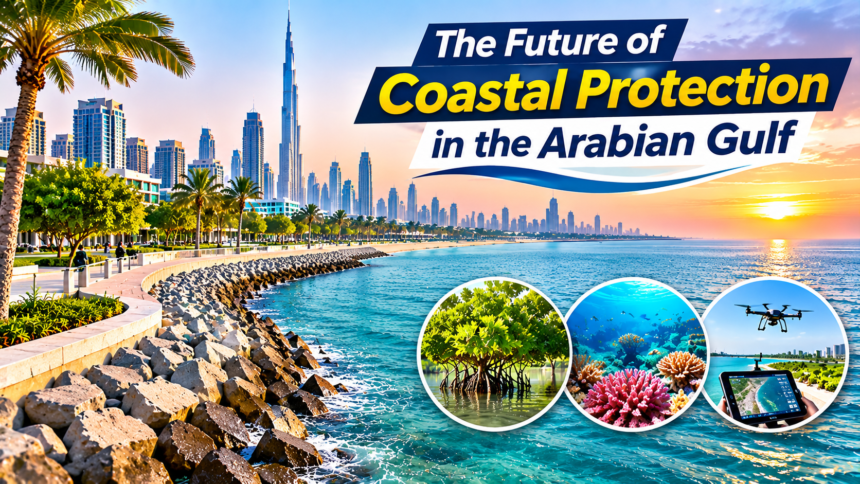
From Dubai’s waterfront developments to Abu Dhabi’s mangrove forests and Qatar’s coastal communities, the Arabian Gulf’s shoreline plays an essential role in everyday life. Residential neighbourhoods, ports, beaches, industrial facilities and tourism destinations depend on the relationship between land and sea. However, rising sea levels, coastal erosion and expanding urban development are creating new challenges for protecting these valuable coastal environments.
- Why Arabian Gulf Coastal Protection Is Becoming Essential
- 7 Critical Solutions That Could Protect Gulf Coastlines
- UAE, Qatar and Saudi Arabia: Coastal Protection in Practice
- Mangroves, Seawalls and the Economics of Coastal Protection
- Environmental and Engineering Challenges Facing Gulf Coastlines
- How Gulf Cities Can Build Climate-Resilient Coastlines
- The Future of Arabian Gulf Coastal Protection and FAQs
Arabian Gulf Coastal Protection is becoming an increasingly important part of regional environmental planning as governments explore engineering solutions, ecosystem restoration and advanced monitoring technologies.
For decades, Gulf cities have invested in waterfront infrastructure, reclaimed land and commercial development. These investments have supported urban growth, international trade and tourism.
Yet coastal development also requires long-term maintenance and careful environmental management.
Sea levels are rising globally as the climate warms, while local conditions such as tides, waves, sediment movement and land elevation influence the risks experienced along individual coastlines.
The Intergovernmental Panel on Climate Change (IPCC) projects that global mean sea level could rise by approximately 0.28–0.55 metres by 2100 under a very low greenhouse gas emissions scenario, relative to the 1995–2014 average.
Under a very high emissions scenario, the likely range increases to 0.63–1.01 metres.
These are global projections rather than precise forecasts for any individual location in the Arabian Gulf.
Local risk assessments must also consider coastal geography, storm surges, land movement and the exposure of buildings and infrastructure.
Gulf authorities are already implementing different responses.
In June 2026, Dubai Municipality highlighted engineering improvements at Jumeirah Beach 1 that included replenishing the shoreline with 250,000 cubic metres of clean sand and raising the beach level.
In July 2026, Environment Agency – Abu Dhabi launched a digital Mangrove Observatory to monitor restoration projects across the emirate.
Qatar has also established coastal development controls through its National Master Plan and has promoted mangrove conservation as part of its environmental strategy.
These initiatives illustrate how coastal protection is evolving beyond conventional concrete barriers.
The future may involve combining engineered infrastructure with restored natural habitats, advanced monitoring and more careful planning of coastal development.
However, no single solution can protect every shoreline.
The most effective approach depends on local conditions, technical performance, environmental impacts and long-term maintenance requirements.
Why Arabian Gulf Coastal Protection Is Becoming Essential
The Arabian Gulf is bordered by major cities, ports, industrial developments, residential communities and ecologically important coastal habitats.
Its shorelines support economic activities while providing recreational and environmental benefits.
Protecting these areas requires understanding the different pressures affecting them.
Sea Level Rise
Global sea level rise is associated primarily with the expansion of warming ocean water and the melting of land-based ice.
As average sea levels increase, coastal flooding can become more likely during high tides and certain extreme weather events.
However, the size and timing of changes at a specific Gulf location cannot be established from global averages alone.
Coastal Erosion
Coastal erosion occurs when waves, currents and other processes remove sediment from a shoreline.
It is a natural process, but coastal construction can alter sediment movement and affect how beaches change over time.
Some locations may lose sand while others accumulate it.
The resulting risks depend on the shoreline’s characteristics and nearby development.
Urban Expansion
Coastal cities continue to accommodate housing, tourism facilities and commercial infrastructure.
Developments close to the sea can increase the economic consequences of flooding or erosion.
Reclamation, dredging and shoreline modification may also alter coastal ecosystems and sediment transport.
Damage to Natural Habitats
Mangroves, tidal flats, coral communities and other marine habitats contribute to biodiversity and coastal functioning.
Their degradation can reduce environmental resilience.
However, the protective capacity of each habitat varies depending on location and ecological conditions.
Main Coastal Risks
| Risk | Potential Impact | Planning Requirement |
|---|---|---|
| Rising Sea Levels | Greater Flood Exposure | Long-Term Risk Assessment |
| Coastal Erosion | Loss of Beach Sediment | Shoreline Monitoring |
| Storm Surges | Temporary High Water Levels | Flood Protection |
| Coastal Development | Changes in Sediment Movement | Environmental Assessment |
| Habitat Degradation | Reduced Ecological Resilience | Conservation and Restoration |
| Infrastructure Exposure | Damage to Roads and Utilities | Resilient Design |
The challenge is to manage these interconnected risks without undermining the ecological systems that make coastal areas valuable.
7 Critical Solutions That Could Protect Gulf Coastlines
The future of coastal protection will probably involve different approaches operating together.
Engineering structures can protect exposed assets, while natural habitats and improved planning may help manage other risks.
1. Mangrove Restoration
Mangrove forests grow in suitable coastal environments and can help reduce wave energy under certain conditions.
Their root systems also influence sediment movement and provide habitat for marine organisms.
However, planting mangroves is not appropriate along every shoreline.
Successful restoration requires suitable tidal conditions, water quality, sediment and species selection.
2. Seawalls and Coastal Barriers
Seawalls and other engineered barriers can help protect valuable infrastructure from waves and flooding.
They may be necessary where buildings and roads are located close to exposed shorelines.
However, these structures can be expensive and may alter erosion patterns or reduce natural beach functions.
They also require maintenance and potential upgrading as conditions change.
3. Beach Nourishment
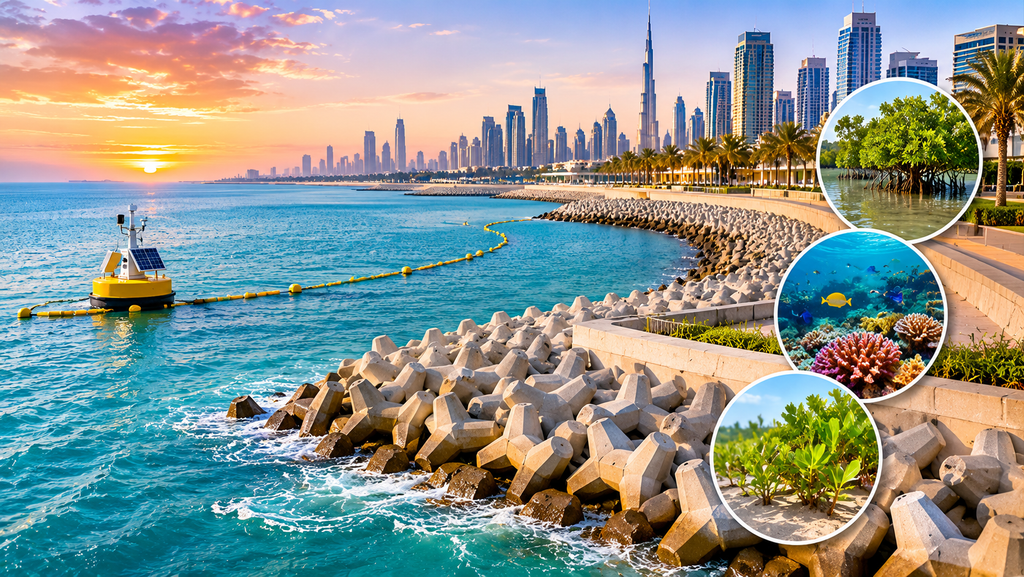
Beach nourishment involves adding suitable sand to an eroding or vulnerable shoreline.
It can increase beach width and provide a buffer against waves.
Dubai’s Jumeirah Beach 1 project offers a recent example of this approach.
However, replenished sand may move or erode over time, making monitoring and future maintenance important.
4. Restoring Coastal Wetlands
Salt marshes, tidal flats and other coastal ecosystems can contribute to biodiversity and coastal processes.
Where conditions are suitable, conserving these habitats may complement engineered protection.
However, wetland restoration cannot simply replace seawalls in every high-risk urban location.
5. Smart Monitoring and Early Warning
Satellites, coastal sensors, tide gauges and modelling systems can provide information about shoreline conditions.
Authorities can use these tools to monitor changes and identify locations requiring attention.
However, monitoring is valuable only when the information informs practical decisions.
6. Climate-Resilient Infrastructure
New roads, utilities and buildings can be designed using suitable coastal hazard assessments.
Measures may include elevating vulnerable equipment, protecting critical systems and avoiding unnecessary exposure.
Requirements should be based on local engineering assessments rather than a universal elevation figure.
7. Integrated Coastal Planning
Coastal protection works best when development, environmental management and infrastructure planning are coordinated.
A project protecting one beach should not unintentionally increase erosion elsewhere.
Integrated planning considers the wider coastline rather than treating each property separately.
Seven Solutions Compared
| Solution | Potential Benefit | Main Limitation |
|---|---|---|
| Mangrove Restoration | Habitat and Wave Attenuation | Site Suitability |
| Seawalls | Local Infrastructure Protection | Cost and Ecological Effects |
| Beach Nourishment | Beach Restoration | Repeated Maintenance |
| Wetland Conservation | Ecosystem Resilience | Limited Applicability |
| Smart Monitoring | Better Risk Information | Data and Technical Capacity |
| Resilient Infrastructure | Reduced Asset Vulnerability | Initial Investment |
| Integrated Planning | Coordinated Protection | Institutional Complexity |
The most appropriate combination depends on the shoreline, surrounding communities and the level of risk.
UAE, Qatar and Saudi Arabia: Coastal Protection in Practice
Several regional initiatives provide examples of how coastal authorities are responding to environmental pressures.
However, projects must be considered in their proper geographical and technical context.
Not every mangrove plantation or beach redevelopment is primarily a flood-defence project.
Dubai’s Jumeirah Beach 1 Development
Dubai Municipality’s 2026 Jumeirah Beach 1 development includes measures to improve coastal resilience.
According to the municipality, the project involved adding 250,000 cubic metres of clean sand and raising beach levels, based on technical and environmental studies.
These measures were designed partly to strengthen protection against rising sea levels.
The project also includes public facilities, recreational infrastructure and monitoring systems.
It demonstrates how beach development can combine visitor services with adaptation measures.
However, the long-term protective performance will depend on subsequent shoreline conditions and maintenance.
Abu Dhabi’s Mangrove Observatory
In July 2026, Environment Agency – Abu Dhabi launched the Abu Dhabi Mangrove Initiative’s Mangrove Observatory.
The platform combines information from field surveys, satellite imagery and participating organisations.
At launch, it covered 19 active restoration projects and more than 1,775 hectares of restored habitat.
The agency reported that more than 18.5 million mangroves had been planted across monitored sites, with a recorded growth count exceeding 10.4 million and an average restoration success rate of 46.94%.
These figures demonstrate why counting planted trees alone is not an adequate measure of success.
Long-term survival and ecosystem performance are essential.
A Regional Monitoring Toolkit
In February 2026, Environment Agency – Abu Dhabi and the International Union for Conservation of Nature’s Mangrove Specialist Group introduced a monitoring toolkit specifically designed for Arabian Gulf ecosystems.
The toolkit provides methods intended to support mangrove conservation and restoration assessment.
This is important because approaches developed for other tropical regions may not perform identically in the Gulf’s high-salinity and high-temperature environments.
Qatar’s Coastal Protection Framework
Qatar’s National Master Plan includes a Coastal Protection Overlay intended to regulate development in environmentally sensitive coastal areas.
Its framework identifies a coastal planning zone extending approximately one kilometre inland and one kilometre offshore from the high spring tide mark.
The regulations recognise different sensitivity categories and help guide development decisions.
This is a planning mechanism, not a continuous physical sea barrier.
In February 2025, Qatar’s Ministry of Environment and Climate Change also organised a forum with Earthna and Qatar University focused on coastal protection and mangrove afforestation.
Saudi Arabia’s Coastal Restoration
Saudi Arabia is investing in mangrove restoration along its coastlines.
In July 2026, the Saudi Press Agency reported that more than 23 million mangrove trees had been planted along the Jazan coast under the National Afforestation Program.
Jazan is on the Red Sea, not the Arabian Gulf.
Its restoration experience is relevant to broader Gulf-region environmental practice, but it should not be presented as a project protecting the Arabian Gulf shoreline.
Saudi Arabia’s Arabian Gulf coast has different ecological and development conditions, requiring its own planning and technical assessments.
Regional Approaches
| Location | Documented Initiative | Main Purpose |
|---|---|---|
| Dubai | Jumeirah Beach 1 replenishment | Beach resilience and public infrastructure |
| Abu Dhabi | Mangrove Observatory | Restoration monitoring |
| Arabian Gulf Region | Mangrove monitoring toolkit | Consistent ecological assessment |
| Qatar | Coastal Protection Overlay | Development management |
| Qatar | Coastal mangrove forum | Conservation planning |
| Saudi Arabia’s Red Sea Coast | Mangrove restoration programmes | Habitat and coastal sustainability |
These initiatives show different aspects of adaptation. They should not be treated as interchangeable solutions or evidence that all coastlines are equally protected.
Mangroves, Seawalls and the Economics of Coastal Protection
Protecting coastlines involves significant financial decisions.
Authorities need to compare construction expenses, ongoing maintenance, potential damage avoided and environmental consequences.
A solution with a low initial cost may become expensive if it requires frequent repairs.
Conversely, a costly engineering project may be justified where essential infrastructure faces substantial risk.
The Cost of Engineered Protection
Seawalls, revetments and offshore breakwaters can require substantial materials and construction work.
Their cost depends on water depth, foundation conditions, wave exposure and the length of shoreline being protected.
Maintenance, inspection and future upgrades must also be considered.
The Economics of Beach Nourishment
Replenishing a beach requires suitable sand, transportation, placement and monitoring.
A wide beach may provide both recreational value and a buffer against waves.
However, recurring erosion can create future expenditure.
The frequency of replenishment depends on sediment movement and coastal conditions.
Nature-Based Protection
Mangrove restoration can provide multiple ecosystem benefits, including habitat creation and potential wave attenuation.
However, it requires suitable land, ecological conditions and long-term management.
The costs of planting should not be confused with the full costs of achieving a healthy, functioning mangrove ecosystem.
Restoration failure can also increase the effective cost of successful establishment.
Illustrative Coastal Project Budget
Consider a hypothetical municipality comparing a hybrid protection programme involving engineering and ecosystem restoration.
| Expense | Illustrative Amount |
|---|---|
| Coastal Surveys and Modelling | AED 2 million |
| Beach Nourishment | AED 12 million |
| Selected Engineered Protection | AED 18 million |
| Habitat Restoration | AED 5 million |
| Monitoring and Initial Maintenance | AED 3 million |
| Total Illustrative Programme | AED 40 million |
These figures are fictional and do not represent actual construction quotations, project benchmarks or approved government expenditure.
The example excludes financing, land acquisition, future major rehabilitation and other site-specific costs.
Measuring Return on Investment
A coastal protection project may generate value by reducing expected flood damage, protecting transport routes or maintaining access to public beaches.
Some nature-based measures can also provide ecological and recreational benefits.
However, these benefits should not be counted as guaranteed revenue.
A proper evaluation requires estimates of hazard probability, exposed assets, project performance and lifecycle costs.
Economic Comparison
| Approach | Possible Economic Benefit | Long-Term Cost Consideration |
|---|---|---|
| Seawall | Protects exposed assets | Inspection and upgrades |
| Beach Nourishment | Maintains beach function | Repeat sand placement |
| Mangrove Restoration | Multiple ecosystem services | Establishment and survival |
| Coastal Monitoring | Supports earlier intervention | Equipment and data management |
| Development Setbacks | Reduces future exposure | Land-use trade-offs |
| Hybrid Protection | Combines several functions | Design and coordination |
The least expensive solution is not always the one with the lowest initial construction budget.
Environmental and Engineering Challenges Facing Gulf Coastlines
Coastal protection can create problems when projects are poorly designed or implemented without suitable environmental assessment.
The Gulf’s marine environment also presents conditions that may complicate ecological restoration and engineering.
High Salinity and Temperature
The Arabian Gulf experiences demanding marine conditions, including high water temperatures and elevated salinity in some areas.
These factors can affect coastal habitats and influence material performance.
Mangrove restoration requires appropriate species selection and understanding of local ecological conditions.
Changes in Sediment Movement
A seawall or breakwater can alter the way waves and currents move sediment.
This may protect one location while changing erosion patterns elsewhere.
Coastal engineering therefore requires modelling beyond the immediate construction site.
Development Pressure
Waterfront real estate, tourism and industrial development can increase pressure on natural coastal habitats.
Reclamation and dredging may affect seabed environments and water movement.
Project assessments should consider cumulative effects where several developments occupy the same coastal system.
Limits of Mangrove Protection
Mangroves can reduce wave energy under suitable conditions, but their effectiveness varies.
A narrow or unhealthy mangrove stand should not be assumed to provide the same protection as a mature, wider forest.
Restoration also requires suitable sediment, tidal exchange and room for vegetation to adapt as sea levels change.
Long-Term Climate Uncertainty
The IPCC states that coastal risks will continue increasing as sea levels rise.
However, the precise timing and magnitude of local changes remain uncertain.
Protection infrastructure designed only around historical conditions may therefore require future adaptation.
Coastal Protection Challenges
| Challenge | Potential Consequence | Recommended Response |
|---|---|---|
| High Salinity | Ecological stress | Site-specific restoration |
| Extreme Heat | Habitat pressure | Long-term monitoring |
| Sediment Changes | Erosion elsewhere | Coastal modelling |
| Development Pressure | Habitat loss | Environmental assessment |
| Restoration Failure | Limited protective benefit | Survival monitoring |
| Sea Level Uncertainty | Infrastructure underdesign | Adaptable plans |
| Maintenance Needs | Declining performance | Lifecycle budgeting |
The goal should be to protect coastal communities without creating unnecessary risks for neighbouring shorelines or natural ecosystems.
How Gulf Cities Can Build Climate-Resilient Coastlines
A successful coastal protection strategy requires more than constructing barriers or planting vegetation.
It should begin with reliable environmental information and continue through design, implementation, maintenance and monitoring.
Identify the Most Exposed Areas
Authorities can use elevation data, coastal surveys and flood modelling to identify vulnerable locations.
Risk assessments should consider residential communities, utilities, transport routes, industrial facilities and ecological habitats.
The most exposed coastline is not always the location with the largest population.
A small area containing critical infrastructure may also require special attention.
Develop Local Coastal Risk Models
Global sea level projections provide valuable context, but they are insufficient for designing individual Gulf projects.
Engineers need information about local tides, waves, coastal elevation, storm conditions and sediment movement.
Climate scenarios should be considered alongside existing exposure.
Choose Appropriate Protection Methods
An exposed industrial waterfront may require engineered protection, while a suitable natural coastline may benefit from ecosystem conservation.
Some locations may need a combination of approaches.
The preferred solution should reflect both technical requirements and environmental consequences.
Monitor Performance
Coastal protection requires continuing evaluation.
A replenished beach may lose sediment, while a mangrove restoration project may experience variable survival rates.
Monitoring should examine whether the intervention is delivering the intended results.
Plan for Future Adjustments
Infrastructure designed today may need upgrades as sea levels and development patterns change.
Adaptive planning allows authorities to establish monitoring thresholds and identify when additional measures may become necessary.
The IPCC describes this approach as adaptation pathways, which divide long-term adaptation into manageable decisions while preserving future options.
Coastal Resilience Checklist
- Map shoreline elevation and existing coastal hazards.
- Identify exposed infrastructure and communities.
- Assess local sea level and storm scenarios.
- Understand sediment movement.
- Protect existing natural coastal habitats.
- Evaluate engineered and nature-based alternatives.
- Conduct environmental impact assessments.
- Establish realistic project budgets.
- Monitor shoreline and ecosystem changes.
- Plan for maintenance and future adaptation.
A coastline should be evaluated as a connected system rather than a collection of unrelated developments.
The Future of Arabian Gulf Coastal Protection and FAQs
The coming decades will place greater importance on coastal resilience across the Arabian Gulf.
Cities will need to accommodate economic development while managing rising seas, erosion and environmental pressures.
The most promising approaches combine technical knowledge with ecosystem conservation and long-term planning.
Smarter Coastal Monitoring
The use of satellite imagery, digital monitoring platforms and environmental data may improve how authorities understand shoreline changes.
Abu Dhabi’s Mangrove Observatory provides an example of combining different information sources to assess restoration projects.
Similar approaches could support future monitoring of erosion and coastal infrastructure.
More Nature-Based and Hybrid Solutions
Mangroves and other coastal habitats can complement engineered structures in suitable locations.
Hybrid solutions may combine natural habitats, beach nourishment and protective infrastructure.
However, their performance must be evaluated according to actual local conditions.
Better Development Decisions
Future coastal planning may increasingly consider flood exposure before new buildings and infrastructure are approved.
Qatar’s Coastal Protection Overlay offers an established example of incorporating environmental sensitivity into coastal land-use regulation.
Reducing avoidable exposure can be as important as strengthening existing defences.
Frequently Asked Questions
Why is coastal protection important in the Arabian Gulf?
The region’s shorelines support residential communities, ports, tourism, industry and natural ecosystems that may be exposed to erosion, flooding and rising sea levels.
Is sea level rising in the Arabian Gulf?
Global sea levels are rising, but the rate and relative impact along individual Arabian Gulf coastlines require local measurements and assessment.
What is the biggest coastal threat?
There is no single threat across the entire region. Risks vary between sea level rise, erosion, extreme water levels, development pressures and habitat loss.
Can mangroves protect coastlines?
Yes, healthy mangroves can reduce some wave energy and contribute to coastal resilience in suitable environments. Their effectiveness depends on the width and condition of the habitat and local coastal processes.
Are seawalls better than mangroves?
Neither solution is universally preferable. Seawalls may be necessary for specific exposed assets, while mangroves provide ecological benefits and potential protection where conditions are appropriate.
What is beach nourishment?
Beach nourishment is the placement of suitable sand along a shoreline to restore or maintain beach width and coastal function.
What is Dubai doing to protect its beaches?
Dubai Municipality’s Jumeirah Beach 1 development includes replenishing the beach with 250,000 cubic metres of clean sand and raising beach levels as part of its resilience measures.
How is Abu Dhabi protecting mangroves?
Environment Agency – Abu Dhabi is supporting restoration, monitoring and research through initiatives including the 2026 Mangrove Observatory.
Does Qatar regulate coastal development?
Yes. Qatar’s National Master Plan includes a Coastal Protection Overlay that guides development in environmentally sensitive coastal areas.
Can technology predict coastal flooding?
Monitoring and modelling systems can help assess hazards and support forecasts, but predictions contain uncertainty and require reliable local data.
Will coastal protection become more expensive?
Costs may increase where additional protection or upgrades are needed, but the financial outcome depends on local hazards, project choices, maintenance and future development.
Can coastal ecosystems replace all engineering structures?
No. Natural habitats can contribute to resilience, but some highly exposed locations require engineered protection or other risk-reduction measures.
Final Thoughts
The future of coastal protection in the Arabian Gulf will depend on combining infrastructure resilience with careful environmental management.
Rising sea levels, shoreline erosion and expanding development create challenges that cannot be addressed through a single technology or construction method.
Engineered barriers, beach nourishment, mangrove conservation and advanced monitoring each have a role under suitable circumstances.
Recent projects in Dubai and Abu Dhabi demonstrate how coastal resilience is being incorporated into beach redevelopment and environmental restoration.
Qatar’s coastal planning framework also illustrates the importance of managing development before risks become more difficult to address.
For Gulf cities, successful adaptation requires reliable scientific information, appropriate technical standards and realistic long-term investment.
Environmental protection must also remain a priority because healthy coastal ecosystems provide benefits that extend beyond physical flood defence.
Ultimately, Arabian Gulf Coastal Protection is not simply about preventing water from reaching buildings.
It is about creating resilient coastal environments where communities, infrastructure, economic activity and marine ecosystems can continue to function as conditions change.
The most effective future strategies will be those that remain adaptable, measurable and responsive to the needs of both people and the natural coastline.
Do follow us on Instagram
Read More – Gulf Construction Waste Recycling: 7 Powerful Ways to Turn Debris Into Building Materials