Why Wooden Sailing Vessels Were Essential to the Gulf Economy
Long before modern cargo ships, international shipping companies and advanced container ports transformed global commerce, the waters surrounding the Arabian Peninsula were filled with wooden sailing vessels carrying merchants, fishermen, pearl divers and valuable goods.
- 1. How Maritime Trade Began Along the Arabian Peninsula
- 2. The Dhow Became a Symbol of Arabian Maritime Heritage
- 3. How Arabian Shipbuilders Created Strong Wooden Trading Vessels
- 4. How Monsoon Winds Helped Arabian Sailors Reach Distant Ports
- 5. Traditional Ships Supported the Gulf’s Pearling and Fishing Economies
- 6. How Maritime Trade Helped Develop Gulf Ports and Commercial Cities
- 7. Why Traditional Boatbuilding and Navigation Skills Are Important to Arabian Heritage
- 8. How Gulf Countries Are Preserving Traditional Ships for Future Generations
- Conclusion
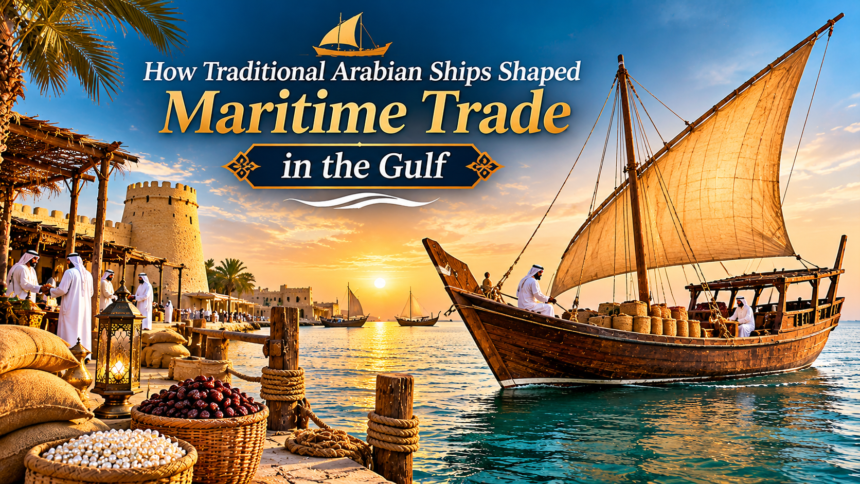
These vessels connected coastal communities with distant trading centres across the Arabian Gulf, Arabian Sea, Indian Ocean and East Africa. They transported spices, textiles, dates, timber, pearls and other products, helping develop commercial relationships that shaped the economic and cultural history of the region.
Among the most recognisable vessels were traditional Arabian ships commonly known as dhows.
Built using generations of maritime knowledge, these wooden boats became closely associated with the seafaring traditions of the United Arab Emirates, Oman, Qatar, Bahrain, Kuwait and other coastal communities.
Their designs varied according to their intended purposes. Some vessels transported merchandise across long distances, while others were used for pearl diving, fishing and shorter journeys between neighbouring ports.
The history of these ships also reveals the importance of skilled boatbuilders, experienced navigators and sailors who understood changing winds, seasonal weather conditions and coastal geography.
The Qatar Digital Library, drawing on historical maritime records, explains that the word dhow became a broad term used by British officials for several kinds of traditional sailing vessels in the western Indian Ocean. Local communities distinguished between numerous designs, including the boom, baghlah, jalboot and other types. Qatar Digital Library
These differences are important because Arabian maritime history cannot be explained through a single type of boat.
From the ancient maritime connections of Bahrain’s Dilmun civilisation to the Indian Ocean trading voyages of Omani sailors, wooden ships supported centuries of commercial exchange.
Traditional sailing vessels also played a major role in the Gulf’s pearling economy before the industry declined during the twentieth century.
Today, museums, heritage festivals and specialist boatbuilding workshops continue to preserve this extraordinary maritime history.
Understanding traditional Arabian ships provides a fascinating perspective on how seafaring helped build trading communities, connect cultures and establish the commercial foundations of the modern Gulf.
1. How Maritime Trade Began Along the Arabian Peninsula
The Arabian Peninsula occupies an important position between major bodies of water that have connected different civilisations for thousands of years.
Its coastline borders the Arabian Gulf, Gulf of Oman, Arabian Sea and Red Sea, creating opportunities for fishing, transportation and commercial exchange.
Even before the development of modern ports, coastal communities used boats to move people and goods between settlements.
Over time, improvements in navigation and vessel construction allowed merchants to undertake longer journeys.
One of the earliest important maritime trading regions was ancient Dilmun, associated with present-day Bahrain and surrounding areas.
Archaeological evidence indicates that Dilmun served as a commercial connection between Mesopotamia and the Indus Valley during the Bronze Age.
UNESCO identifies Qal’at al-Bahrain as an ancient harbour and centre of commercial activity associated with these long-distance relationships. UNESCO World Heritage Centre
Trade during this period involved goods moving through interconnected settlements rather than a single continuous shipping route operated by one group of merchants.
Further southeast, ancient Oman was associated with the region known in Mesopotamian records as Magan.
Historical and archaeological research has linked this region with early maritime commerce and the movement of commodities such as copper.
These early trading networks developed long before the familiar wooden dhow designs of more recent centuries.
It is therefore important to distinguish ancient Arabian seafaring from the later evolution of particular sailing vessels.
As communities expanded, maritime commerce became increasingly connected with inland caravan routes.
Goods arriving by sea could be distributed to oases and desert settlements, while locally produced merchandise was transported toward coastal ports.
The development of these networks helped create trading communities in areas that later became important commercial centres.
| Historical region | Maritime significance |
|---|---|
| Dilmun, associated with Bahrain | Bronze Age commerce between Mesopotamia and the Indus region |
| Ancient Magan, associated with Oman | Early seafaring and regional commodity exchange |
| Arabian Gulf coastal settlements | Local transport, fishing and commercial activity |
| Gulf of Oman ports | Connections between the Gulf and Arabian Sea |
| Red Sea ports | Trade linking Arabia with Africa and wider maritime networks |
| Indian Ocean routes | Long-distance exchange involving Asian and African trading centres |
Maritime commerce did not emerge all at once. It developed through centuries of technological improvement, commercial relationships and adaptation to regional conditions.
2. The Dhow Became a Symbol of Arabian Maritime Heritage
The dhow is one of the most recognisable symbols of traditional seafaring in the Arabian region.
It is commonly associated with a wooden hull, sails and the ability to carry people or merchandise across coastal and open waters.
However, historians use the term carefully because it covers several vessels with different construction methods, dimensions and purposes.
Local sailors traditionally recognised individual boat types rather than treating them all as identical.
Some designs were suited to fishing or pearling, while larger cargo vessels transported products across considerable distances.
The shapes of their hulls, sails and sterns developed in response to practical requirements and regional boatbuilding traditions.
The Museum With No Frontiers collection identifies several traditional types, including the jalboot, shuw’i, sambuq and baghlah, reflecting the variety of vessels associated with Arabian and Indian Ocean commerce. Sharing History
The boom was particularly associated with transporting cargo between Gulf ports and destinations farther across the Indian Ocean.
Baghlah vessels were also important in long-distance commercial sailing.
Smaller boats could serve local transport, fishing and pearl-diving operations.
Their suitability depended on water conditions, carrying capacity, crew requirements and the intended journey.
Sails were a defining feature of many traditional vessels.
Common sailing rigs used angled or triangular sail forms that allowed crews to make use of favourable winds.
However, the precise arrangement differed between boat types and historical periods.
Sailors needed experience to handle these vessels safely, especially when navigating narrow coastal channels or changing weather.
Common types of traditional Arabian vessels
| Vessel type | Historical association | Typical use |
|---|---|---|
| Boom or bum | Arabian Gulf and Indian Ocean | Cargo transportation and longer voyages |
| Baghlah | Gulf and Indian Ocean commerce | Long-distance trading |
| Sambuq or sanbuq | Arabian maritime communities | Trading, fishing and other maritime activities |
| Jalboot or jalbut | Gulf coastal communities | Pearling, fishing and transport |
| Shuw’i | Arabian Gulf | Fishing and coastal commerce |
| Batil | Gulf maritime traditions | Pearling and coastal activities |
These categories describe common historical associations, not rigid rules that applied to every vessel.
The same design might be adapted for different activities, while terminology could vary between locations.
The importance of the dhow lies not simply in its appearance but in the maritime knowledge and economic activity associated with its use.
3. How Arabian Shipbuilders Created Strong Wooden Trading Vessels
Building a traditional sailing vessel required considerable skill.
Boatbuilders needed to understand hull shapes, timber properties, joinery, balance and the practical demands of transporting cargo or passengers.
These skills were often learned through apprenticeships and experience in coastal workshops.
In many communities, boatbuilding knowledge passed between generations.
Experienced craftsmen used methods suited to the materials available and the intended use of each vessel.
Although Arabia had its own timber resources in some areas, shipbuilders also relied on imported wood obtained through trading relationships.
This created another connection between maritime construction and international commerce.
One important historical technique was the construction of sewn-plank boats.
Instead of relying entirely on metal fasteners, boatbuilders joined wooden planks using cordage or other fibre-based materials.
Different traditions also used wooden components, nails and sealing substances to strengthen hulls and reduce water leakage.
Research on sewn boats in Oman and the Indian Ocean documents the long history of this construction method and its importance in regional maritime technology. Taylor & Francis Online
However, not all Arabian ships were sewn together.
Boatbuilding changed over time, and different vessel types used different fastening methods.
The construction process generally involved deciding the dimensions of the hull, preparing timber, shaping structural components and assembling the vessel.
Builders also needed to consider the distribution of weight.
A cargo vessel had to carry merchandise while remaining stable in the water.
Fishing boats required arrangements suitable for equipment and crew activities, while pearl-diving vessels needed space for divers and their supplies.
Traditional builders often worked without the same technical instruments used in modern shipyards.
Their practical knowledge came from established methods, observation and repeated experience.
Such expertise allowed them to create vessels capable of travelling across demanding marine environments.
Oman’s National Museum preserves evidence of these maritime traditions, including models and reconstructions of historic sailing vessels. Its collection includes the Jewel of Muscat, a reconstruction inspired by a ninth-century sewn-plank shipwreck discovered near Indonesia. nm.gov.om
Important elements of traditional shipbuilding
| Element | Purpose |
|---|---|
| Wooden hull | Provided the vessel’s main structure |
| Structural frames | Supported hull shape and strength |
| Planking | Formed the outer body of the ship |
| Fastening methods | Joined structural components |
| Sealing materials | Helped reduce water entry |
| Mast and sails | Used wind for propulsion |
| Steering equipment | Allowed the crew to control direction |
| Cargo space | Carried goods and supplies |
Traditional boatbuilding was both a practical industry and a highly specialised craft.
Its success depended on knowledge of materials, marine conditions and the requirements of commercial sailing.
4. How Monsoon Winds Helped Arabian Sailors Reach Distant Ports
One of the most fascinating aspects of Arabian maritime history is the way sailors used seasonal winds to support long-distance travel.
Before steam engines and modern propulsion systems became widespread, sailing depended heavily on environmental conditions.
Merchants and captains needed to understand when winds were favourable for particular journeys.
The Indian Ocean’s monsoon system played an important role in organising voyages between Arabian ports and trading centres in South Asia and East Africa.
During different parts of the year, prevailing wind patterns change direction.
Experienced sailors could plan departure times around these seasonal conditions, improving opportunities for outward and return voyages.
However, the monsoon system was not a guarantee of safe travel.
Weather, currents, storms and local coastal conditions continued to present significant risks.
The Qatar Digital Library explains how monsoon winds influenced shipping between Muscat and other Indian Ocean ports, shaping the timing and direction of historical maritime commerce. Qatar Digital Library
Navigation also required careful attention to geography.
Sailors relied on accumulated knowledge of coastlines, islands, harbours and recognisable landmarks.
Celestial navigation, including observations of stars, also formed part of wider Indian Ocean navigational traditions.
The level of equipment and techniques available varied across historical periods.
Long-distance voyages required planning beyond navigation.
Ships carried water, food, spare materials and goods intended for sale.
Merchants needed to understand where they could obtain supplies and which ports offered opportunities for exchange.
Trade routes therefore depended on networks of coastal settlements as well as the capabilities of individual vessels.
Omani sailors became especially associated with voyages across the Arabian Sea and wider Indian Ocean.
The National Museum of Oman documents the reconstruction of the sewn-plank ship Sohar, which sailed from Oman to China in 1980–1981 to explore aspects of early Islamic maritime travel. nm.gov.om
Although modern experimental voyages cannot reproduce every historical condition, they provide researchers with useful insights into sailing technology and traditional construction.
| Navigational factor | Importance to historical sailors |
|---|---|
| Monsoon winds | Influenced seasonal voyage planning |
| Coastal landmarks | Helped identify positions near shore |
| Knowledge of currents | Supported route selection |
| Stars and celestial observations | Assisted navigation |
| Harbour networks | Provided opportunities for trade and supplies |
| Crew experience | Helped manage changing marine conditions |
The ability to use seasonal winds helped connect Arabian merchants with trading communities across vast distances.
These maritime relationships contributed to the movement of goods, people and cultural practices throughout the Indian Ocean region.
5. Traditional Ships Supported the Gulf’s Pearling and Fishing Economies
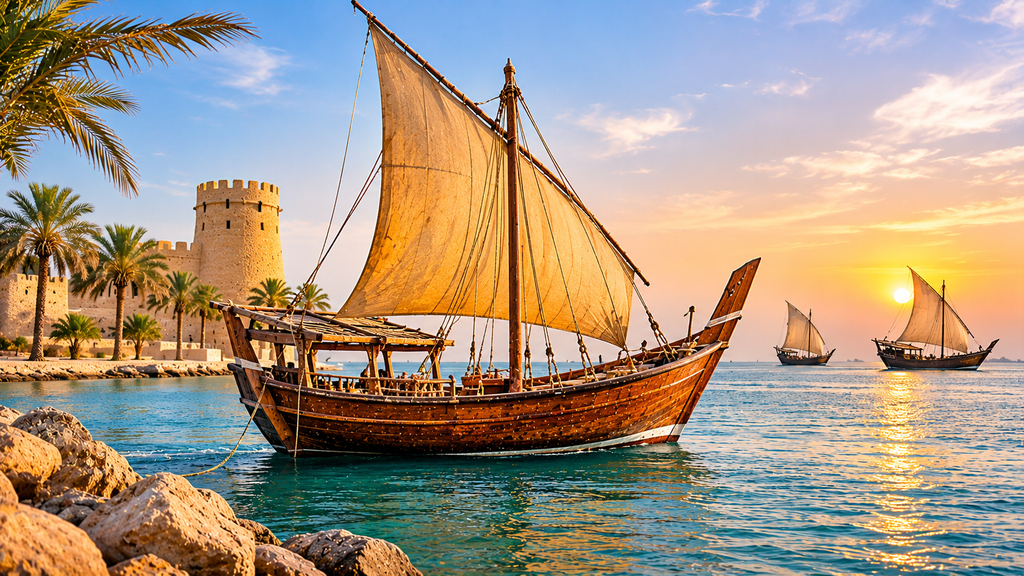
While large trading vessels connected distant ports, smaller wooden boats supported the everyday economies of many Gulf coastal communities.
Fishing and pearl diving were particularly important occupations before the expansion of modern industries.
For some families, these activities provided essential income and food.
The type of vessel used depended on local conditions, crew size and the nature of the work.
Fishing boats travelled to suitable marine areas, while pearl-diving vessels carried divers and supporting crew members to oyster beds.
Pearling became a major economic activity in several Gulf societies, particularly Bahrain, Qatar, Kuwait and parts of the present-day UAE.
The industry involved specialised knowledge of seasons, diving practices, marine environments and commercial networks.
Pearls obtained from oyster beds entered trading systems that connected Gulf merchants with international buyers.
Bahrain’s pearling heritage provides particularly strong historical evidence.
The UNESCO World Heritage property Pearling, Testimony of an Island Economy includes historic buildings in Muharraq, offshore oyster beds, part of the coastline and Qal’at Bu Mahir, associated with the departure of pearling vessels. UNESCO World Heritage Centre
UNESCO explains that pearling played a major role in Bahrain’s economy until the industry’s decline during the early twentieth century.
The development of cultured pearls, changing markets and broader economic pressures contributed to this transformation.
Traditional vessels also supported commercial activities connected with pearling.
Boats transported crews, supplies and equipment, while merchants organised the purchase and sale of harvested pearls.
The industry therefore supported occupations beyond diving itself, including boatbuilding, provisioning and trade.
Fishing was another important use of wooden vessels.
Coastal families depended on locally available marine resources, and boats allowed fishermen to operate beyond the immediate shoreline.
Fishing methods varied according to local environments and available equipment.
Traditional maritime life also developed its own cultural practices.
Sailors and pearl divers maintained songs and oral traditions associated with work, travel and community identity.
Sharjah Maritime Museum preserves aspects of this heritage through displays related to fishing, pearl diving, traditional sea songs and commercial voyages. Sharjah Museums Authority
| Maritime activity | Contribution to Gulf communities |
|---|---|
| Pearl diving | Produced valuable commodities for trade |
| Fishing | Provided food and commercial income |
| Boatbuilding | Supported specialised coastal employment |
| Sail and equipment preparation | Supplied essential maritime materials |
| Coastal transport | Connected neighbouring settlements |
| Pearl trading | Linked local industries with international buyers |
The history of Gulf ships is therefore closely connected to the livelihoods and cultural identity of coastal populations.
6. How Maritime Trade Helped Develop Gulf Ports and Commercial Cities
Traditional Arabian ships contributed to the development of ports that later became important centres of regional commerce.
When vessels regularly arrived with merchandise, coastal settlements required places for loading, unloading, storing and selling goods.
This encouraged the growth of waterfront businesses, trading districts and services supporting sailors and merchants.
Ports also created opportunities for craftsmen, transport workers and suppliers.
Goods arriving by sea could be transferred to inland commercial networks, while local products were prepared for export.
Over time, these relationships helped some coastal settlements expand into larger towns.
Bahrain was an important centre of maritime activity long before the modern period.
The archaeological site of Qal’at al-Bahrain documents the role of ancient Dilmun in commercial exchange.
Its historical significance demonstrates that the islands participated in long-distance maritime networks many centuries before the emergence of modern port infrastructure. UNESCO World Heritage Centre
Later, Muharraq and Manama became associated with pearling, trading and coastal commerce.
In Kuwait, maritime activities contributed to the development of a commercial economy involving regional and Indian Ocean trade.
Local boatbuilding traditions were connected with the need to transport goods and support coastal livelihoods.
In the UAE, Dubai Creek became an important setting for maritime commerce.
Its natural waterway provided access for trading vessels and supported the development of commercial districts on both sides.
The city’s historic Gold and Spice Souks reflect aspects of this earlier trading identity, even though modern commercial practices differ substantially from those of the sailing era.
Sharjah and other coastal settlements also developed through fishing, pearling and merchant activity.
Their maritime histories illustrate how access to the sea shaped local economies.
Oman provides another important perspective.
Historic ports such as Muscat, Sohar and Sur maintained connections with trading networks beyond the Arabian Gulf.
Sur became particularly associated with traditional wooden shipbuilding.
Although these ports are located on the Gulf of Oman or Arabian Sea rather than inside the Arabian Gulf, their maritime activities were connected to broader regional commerce.
This geographical distinction matters when discussing Gulf trade.
Ships could travel through the Strait of Hormuz between the Arabian Gulf and Gulf of Oman before continuing into the Indian Ocean.
As a result, the economic history of the Gulf cannot be separated entirely from wider maritime networks.
| Port or trading region | Historical maritime role |
|---|---|
| Bahrain | Ancient commerce and later pearling |
| Kuwait | Regional trade and wooden shipbuilding |
| Dubai Creek | Maritime commerce and specialist trading districts |
| Sharjah | Fishing, pearling and coastal trade |
| Muscat, Oman | Indian Ocean commercial connections |
| Sur, Oman | Traditional shipbuilding and seafaring |
| Sohar, Oman | Historic maritime trade |
Modern ports now rely on industrial infrastructure, container handling systems and advanced shipping technologies.
Nevertheless, their development forms part of a longer history in which access to the sea helped connect Arabian communities with international markets.
7. Why Traditional Boatbuilding and Navigation Skills Are Important to Arabian Heritage
The importance of historic sailing vessels extends beyond their economic contribution.
They represent generations of specialised knowledge developed through experience, craftsmanship and close observation of the marine environment.
Boatbuilding techniques, sailing practices and maritime traditions became part of the cultural identity of many coastal communities.
Learning to construct a wooden vessel required practical training.
Apprentices observed experienced craftsmen selecting timber, shaping components and assembling hulls.
Skills were developed through repetition and participation rather than formal engineering education alone.
Sailors also passed knowledge between generations.
Experienced captains understood seasonal weather, coastal routes and the handling characteristics of different vessels.
This information was essential in a period when modern navigation equipment was unavailable.
Maritime traditions also included language, songs and customs associated with life at sea.
Fishing and pearl diving required cooperation between crew members, creating shared experiences that influenced coastal culture.
However, the introduction of modern engines, industrial shipbuilding and new commercial practices changed many traditional occupations.
Wooden sailing vessels gradually became less important for long-distance cargo transportation.
Modern ships could carry larger quantities of merchandise and operate with less dependence on seasonal wind patterns.
Fibreglass and other materials also became increasingly common in smaller commercial and recreational boats.
These developments improved many aspects of transportation but reduced demand for certain traditional crafts.
As a result, specialist boatbuilding skills face challenges when fewer young people enter the profession.
Museums and cultural organisations have responded by documenting historical vessel designs and preserving examples of traditional workmanship.
The National Museum of Oman maintains collections related to maritime history, including models and reconstructions that demonstrate earlier construction methods.
Research involving boats in the Qatar Museums collection has also documented traditional sewn-vessel techniques and their connections to wider Indian Ocean craftsmanship. Wiley Online Library
These projects help preserve technical knowledge that might otherwise become difficult to recover.
Educational programmes can further support maritime heritage by explaining how different vessels were built and operated.
However, meaningful preservation should involve experienced craftspeople whenever possible.
A model displayed in a museum can explain a vessel’s appearance, but traditional boatbuilding also involves practical knowledge of materials, tools and construction methods.
| Maritime heritage element | Importance |
|---|---|
| Wooden boatbuilding | Preserves specialist construction skills |
| Sailing knowledge | Records traditional navigation practices |
| Maritime terminology | Maintains local language and vessel classifications |
| Sea songs | Preserves cultural expressions |
| Historic vessel models | Supports education and research |
| Craft apprenticeships | Encourages intergenerational knowledge transfer |
Protecting these traditions helps future generations understand the relationship between the sea and the development of Arabian society.
8. How Gulf Countries Are Preserving Traditional Ships for Future Generations
Across the Gulf, cultural institutions and heritage organisations are working to preserve maritime traditions through exhibitions, educational programmes, research and public events.
These activities help explain how wooden vessels contributed to trade, fishing and coastal livelihoods.
In the UAE, Sharjah Maritime Museum provides visitors with opportunities to explore traditional vessels and the region’s relationship with the sea.
Its collections include maritime equipment and displays related to fishing, pearl diving and trade.
Such institutions help connect historical objects with the experiences of the people who used them.
Qatar also celebrates traditional seafaring through the Katara Traditional Dhow Festival.
The event has featured different wooden vessel designs and demonstrations of maritime craftsmanship.
According to Qatar News Agency, the 2024 festival included displays illustrating vessel types used for trading, fishing, diving and transportation. QNA
These activities can introduce younger generations to a heritage that is less visible in everyday commercial life.
Oman continues to maintain an important connection with traditional boatbuilding.
Historic shipbuilding communities, including Sur, have attracted attention for their knowledge of wooden vessel construction.
The country’s museum collections also preserve evidence of early maritime technology and later sailing traditions.
In Bahrain, conservation of the historic pearling landscape provides another approach to maritime heritage.
The UNESCO-listed Pearling Path preserves buildings, coastal features and places associated with the industry.
Although the World Heritage property does not consist simply of preserved boats, it helps explain the economic and social environment in which pearling vessels operated.
Preserving maritime traditions requires more than maintaining individual objects.
Researchers need to document construction techniques, sailing practices and the historical functions of different designs.
Museums can collect oral histories from experienced boatbuilders and sailors, while universities may investigate vessel construction through archaeological and technical studies.
Restoration projects should also distinguish original historic vessels from modern replicas.
Reconstructions can be valuable educational tools, but they do not necessarily reproduce every feature of earlier ships.
Responsible heritage programmes should clearly explain the evidence used to recreate a vessel.
Practical steps for preserving Arabian maritime heritage include:
- Document traditional vessel designs: Record dimensions, materials, construction methods and regional terminology.
- Support skilled craftsmen: Encourage training and apprenticeships in traditional boatbuilding.
- Preserve historic examples: Protect surviving vessels using appropriate conservation methods.
- Expand museum education: Explain the role of ships in trade, fishing and pearling.
- Record maritime oral histories: Collect experiences from sailors, builders and coastal communities.
- Support heritage festivals: Create opportunities to demonstrate traditional skills.
- Encourage academic research: Study maritime archaeology and historical trade networks.
- Promote responsible cultural tourism: Help visitors understand coastal heritage without damaging historic sites.
The continued preservation of these traditions can strengthen cultural understanding while recognising the people whose knowledge sustained Arabian maritime economies.
Conclusion
The history of traditional Arabian ships reveals how maritime knowledge helped shape the commercial and cultural development of the Gulf.
From early trading networks linking Bahrain with ancient civilisations to wooden vessels carrying merchandise across the Indian Ocean, seafaring connected the Arabian Peninsula with distant communities.
Different boat designs supported different economic activities.
Large trading vessels carried cargo, while smaller boats served fishing, pearl diving and coastal transportation.
Their construction required specialised craftsmanship, and their operation depended on experienced sailors who understood seasonal winds, navigational techniques and marine conditions.
These activities contributed to the growth of important ports and trading settlements across the region.
They also influenced traditional occupations, cultural practices and community relationships.
Although modern shipping has replaced most historic sailing methods, wooden vessels remain important reminders of the Gulf’s maritime past.
Museums, heritage festivals and research initiatives continue preserving the knowledge associated with their construction and use.
Ultimately, traditional Arabian ships were more than a means of transportation. They helped create the commercial networks, maritime communities and cultural connections that shaped the history of the Gulf and its relationship with the wider world.
Do follow us on Instagram
Read More – The Ancient History of Traditional Arabian Markets and Souks