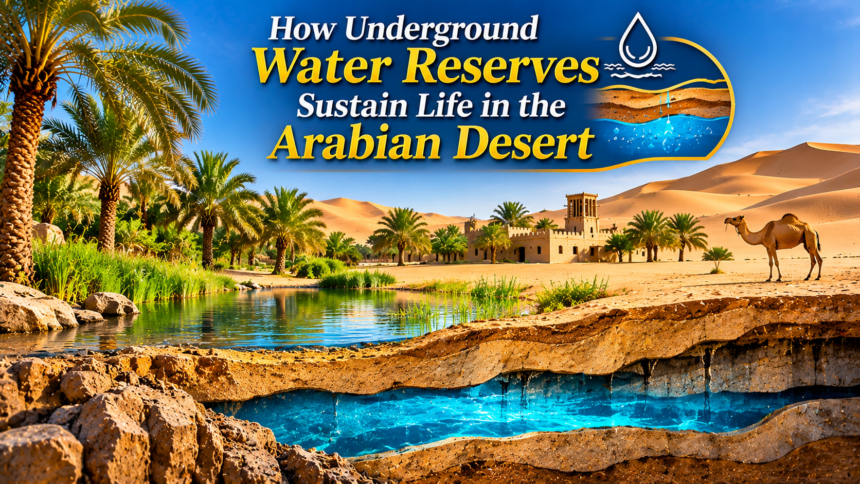
How Ancient Rainfall Created Hidden Water Reserves Beneath Arabia
The Arabian Desert is known for its enormous sand dunes, rocky mountains, dry valleys and extreme temperatures. Across much of the region, rainfall is limited, permanent rivers are rare, and summer heat creates difficult conditions for plants, animals and human settlements.
- 1. How Underground Water Reserves Exists Beneath the Arabian Desert
- 2. Ancient Rainfall Created Some of Arabia’s Largest Groundwater Reserves
- 3. How Oases and Natural Springs Support Life in the Desert
- 4. Traditional Wells and Aflaj Systems Made Desert Agriculture Possible
- 5. Groundwater Helps Sustain Wildlife and Desert Vegetation
- 6. Why Underground Water Is Essential for Arabian Agriculture and Modern Communities
- 7. Why Depletion, Salinity and Pollution Threaten Desert Aquifers
- 8. How Arabian Countries Can Protect Underground Water for Future Generations
Yet beneath this seemingly dry landscape lies one of the Arabian Peninsula’s most important natural resources: underground water.
Hidden within layers of rock, sand and gravel, these reserves have helped sustain life in the desert for thousands of years. They supply springs, support agricultural communities, provide water for wildlife and contribute to modern water systems across the Gulf.
For generations, people living in Arabia have depended on wells, oases and traditional irrigation channels to reach freshwater stored below the surface. These resources allowed settlements to develop in locations where permanent rivers were absent.
Today, underground water reserves in the Arabian Desert remain essential to agriculture, ecosystems and water security.
However, not all groundwater is the same. Some supplies are replenished by rainfall, while others contain ancient water that entered geological formations during much wetter climatic periods.
Scientists have discovered that parts of the peninsula contain extensive aquifer systems stretching beneath several countries. These systems store enormous quantities of water, but much of it is replaced very slowly.
A peer-reviewed study published in Hydrogeology Journal describes the Upper Mega Aquifer System as one of the Arabian Peninsula’s major groundwater systems, extending across multiple countries and containing important freshwater resources.
The challenge is that underground storage does not necessarily mean unlimited availability.
Excessive pumping, declining groundwater levels, increasing salinity and pollution can threaten these resources.
Understanding how underground water forms, moves and supports life reveals why careful management is vital to the future of the Arabian Desert.
1. How Underground Water Reserves Exists Beneath the Arabian Desert
At first glance, the idea of substantial water reserves beneath a desert may seem surprising.
However, a landscape does not need visible rivers or lakes to contain groundwater.
Water can accumulate within suitable underground geological formations, sometimes far below the surface.
These formations are known as aquifers.
An aquifer is a layer of rock or sediment that can store and transmit water through connected spaces, pores or fractures.
Contrary to a common misconception, groundwater does not usually exist as enormous open lakes beneath the desert. Much of it is held within the tiny spaces between sediment grains or within cracks and openings in rock.
When rain falls, some water flows across the surface, some evaporates, and some infiltrates into the soil.
Under suitable conditions, infiltrating water moves downward until it reaches the saturated zone, where spaces within the rock or sediment are filled with water.
The upper boundary of this saturated zone is commonly called the water table.
However, geological conditions vary considerably across Arabia.
Some aquifers lie close to the surface, while others are buried beneath thick layers of rock and sediment.
Deep aquifers may also be confined beneath relatively impermeable formations, allowing groundwater to remain under pressure.
The Arabian Peninsula contains several important groundwater systems, including sandstone aquifers, carbonate formations and shallow deposits associated with wadis.
Research published in Hydrogeology Journal identifies the Umm er Radhuma, Rus and Dammam formations among the important geological units associated with major groundwater systems on the Arabian Platform.
These formations differ in their capacity to store water and allow it to move.
For example, sandstone can contain interconnected pores between mineral grains.
Certain limestone formations may transmit water through fractures and openings enlarged by natural chemical processes.
Loose gravel and sand deposited in valleys can also provide useful groundwater storage.
Major types of desert aquifers
| Aquifer type | How it stores or transmits water | Arabian relevance |
|---|---|---|
| Sandstone aquifers | Interconnected pores within rock | Important deep groundwater reserves |
| Limestone aquifers | Pores, fractures and dissolved openings | Major regional geological systems |
| Wadi alluvial aquifers | Sand and gravel deposited in valleys | Local groundwater storage and recharge |
| Confined aquifers | Water trapped beneath less permeable layers | May contain pressurised groundwater |
| Shallow unconfined aquifers | Saturated sediments near the surface | Accessible through wells in suitable areas |
The existence of these formations explains how water can remain available beneath apparently lifeless desert terrain.
However, whether groundwater is usable depends on more than its presence.
Depth, salinity, pumping costs, geological conditions and the rate of natural replenishment all influence the value of a particular reserve.
2. Ancient Rainfall Created Some of Arabia’s Largest Groundwater Reserves
One of the most fascinating facts about desert groundwater is that some of it is much older than the communities using it today.
During certain prehistoric periods, parts of Arabia experienced wetter conditions than those found across much of the peninsula now.
Changes in regional climate and rainfall patterns allowed more water to enter underground geological formations.
Some of this water remained stored after the climate became drier.
This ancient resource is commonly described as fossil groundwater.
Fossil groundwater does not mean water formed from fossils. The term refers to water that entered an aquifer long ago, often during conditions different from the present climate.
In some locations, it may have remained underground for tens of thousands of years or longer.
Researchers studying the Arabian Peninsula’s Mega Aquifer System have used isotopic measurements, geological observations and satellite data to investigate the origins and ages of these reserves.
A study in the Journal of Hydrology found evidence of groundwater in the Rub’ al Khali aquifer system that entered the subsurface during wetter periods of the Pleistocene. Some estimated groundwater ages approached 970,000 years, depending on location and the dating method used.
This does not mean that all underground water in Arabia is nearly a million years old.
Different aquifers contain water with very different histories.
Shallow reserves may receive modern rainfall, while deeper formations can hold much older supplies.
How ancient groundwater accumulated
During wetter climatic periods, rainfall and surface runoff could infiltrate the ground through suitable geological layers.
Water moved slowly through interconnected pores and fractures.
As conditions became drier, the amount of new recharge declined in many locations.
The water already stored underground could remain for long periods, especially where geological conditions limited its movement.
This process helped create the large reserves that exist beneath parts of Saudi Arabia and neighbouring countries.
Why groundwater age matters
Water stored for thousands of years may be extremely valuable, but it is not necessarily renewable on a human timescale.
If pumping removes water much faster than rainfall can replace it, the reserve gradually declines.
For this reason, a large aquifer should not automatically be treated as a sustainable source of unlimited freshwater.
Ancient and modern groundwater compared
| Characteristic | Ancient groundwater | Recently recharged groundwater |
|---|---|---|
| Origin | Water that entered the ground in earlier climatic periods | Water supplied by relatively recent rainfall or runoff |
| Replenishment | Often extremely limited today | Depends on modern recharge conditions |
| Typical location | May occur in deep regional aquifers | Often found in shallow or actively recharged systems |
| Management concern | Long-term depletion | Balance between extraction and recharge |
| Importance | Strategic stored resource | Potentially renewable local supply |
The existence of ancient groundwater reveals an important connection between the Arabian Peninsula’s prehistoric climate and its modern water resources.
3. How Oases and Natural Springs Support Life in the Desert
Oases are among the most recognisable examples of how groundwater supports life in arid landscapes.
An oasis is an area where water availability allows vegetation and human activity to exist within an otherwise dry environment.
Some oases are supplied by natural springs, while others rely on wells or managed irrigation systems.
Where groundwater reaches or approaches the surface, it can support plants, animals and agricultural activity.
Historically, these locations were important because they provided reliable water in regions where rainfall was unpredictable.
Communities developed around them, establishing farms, houses, places of worship and commercial areas.
Date palms became particularly important in many Arabian oases.
Their growth helped support agricultural settlements, while harvested dates provided food and products for trade.
The presence of palms could also create shade and influence conditions for other crops.
However, not every oasis is naturally self-sustaining. Some depend on human-managed water systems, and their condition can deteriorate if groundwater levels decline.
Al-Ahsa Oasis in Saudi Arabia
One of the most significant examples is Al-Ahsa Oasis in Saudi Arabia’s Eastern Province.
This UNESCO World Heritage Site contains extensive palm groves, historic settlements, irrigation features and archaeological remains.
UNESCO describes it as an evolving cultural landscape with more than 2.5 million palm trees, demonstrating the relationship between water, agriculture and human settlement.
Al-Ahsa’s history shows how the availability of water helped support permanent communities in an otherwise arid region.
Its cultural importance extends beyond agriculture.
Markets, houses, mosques and historic infrastructure reveal how water resources contributed to the development of local society.
Natural springs and desert ecosystems
Springs may form where groundwater encounters a geological barrier or where the water table intersects the surface.
Some provide water throughout much of the year, while others vary seasonally or decline during prolonged drought.
Spring-fed habitats can support vegetation that would struggle to survive in the surrounding desert.
They may also provide drinking water or suitable conditions for birds, insects and other animals.
Nevertheless, springs are sensitive to changes in groundwater pressure.
Excessive extraction from connected aquifers can reduce spring discharge or cause flows to stop.
The importance of oases
| Feature | Contribution to desert life |
|---|---|
| Accessible freshwater | Supports settlement and agriculture |
| Date palm groves | Provide food, shade and agricultural income |
| Natural springs | Maintain selected wet habitats |
| Irrigation channels | Distribute water to cultivated areas |
| Vegetation | Provides habitat and local environmental benefits |
| Historic trading activity | Connects agricultural communities with wider markets |
Oases demonstrate that even a small area of dependable water can support complex relationships between people, plants and animals.
4. Traditional Wells and Aflaj Systems Made Desert Agriculture Possible
Long before modern pumping stations and extensive water pipelines, Arabian communities developed techniques to collect and distribute groundwater.
These systems were essential in regions where permanent rivers were rare.
Traditional wells allowed people to reach water stored beneath the surface.
Depending on local geology, wells could be relatively shallow or extend to considerable depths.
Water was raised using methods suited to local technology, including containers, ropes and animal-powered equipment.
The availability of wells influenced where settlements could develop and how much land could be cultivated.
However, obtaining water was only part of the challenge.
Communities also needed reliable ways to distribute it among farms and households.
One of the most remarkable examples of traditional water engineering is found in Oman.
The aflaj irrigation system
The falaj, with the plural aflaj, is a traditional water-distribution system used in Oman and other parts of the region.
These systems can collect water from underground sources, springs or surface runoff.
Channels then carry the water by gravity toward agricultural land and settlements.
Some channels run above ground, while others are constructed beneath the surface.
Underground channels can help protect water from direct exposure and reduce certain types of loss along the route.
However, the efficiency of a system depends on its construction, maintenance and local environmental conditions.
Five representative Omani aflaj irrigation systems were inscribed on the UNESCO World Heritage List in 2006.
UNESCO describes these sites as examples of a longstanding water-management tradition, representing thousands of systems that have supported Omani communities. UNESCO World Heritage Centre
Oman’s National Museum also documents the cultural importance of the technology and its historical development. nm.gov.om
Water sharing as a community responsibility
Traditional irrigation required more than engineering knowledge.
Communities developed rules for distributing limited supplies.
In some agricultural areas, water rights were organised through established time allocations.
Farmers could receive access according to customary arrangements, helping determine when different plots were irrigated.
Such practices connected water management with social cooperation.
They also demonstrated an understanding that water was a shared resource requiring careful organisation.
How traditional systems supported agriculture
| Water-management method | Main function |
|---|---|
| Hand-dug wells | Access underground reserves |
| Spring collection | Capture naturally emerging groundwater |
| Underground channels | Convey water toward settlements |
| Surface irrigation canals | Distribute water across agricultural land |
| Water-sharing schedules | Organise access among users |
| Community maintenance | Keep channels and related infrastructure functioning |
These practices allowed generations of Arabian farmers to cultivate land despite limited rainfall.
Their continued cultural importance offers lessons about cooperation, local knowledge and the careful use of scarce resources.
5. Groundwater Helps Sustain Wildlife and Desert Vegetation
Underground water does more than support farms and settlements.
It also plays an important role in natural ecosystems across the Arabian Peninsula.
In some places, groundwater provides moisture that plants can access even when the soil surface appears completely dry.
Vegetation with suitable root systems may reach deeper moisture reserves.
However, not all desert plants depend directly on groundwater.
Many survive mainly through adaptations to rainfall, such as rapid growth after storms, water-storage tissues or mechanisms that reduce evaporation.
The relationship between plants and underground moisture therefore varies widely.
How desert plants use water
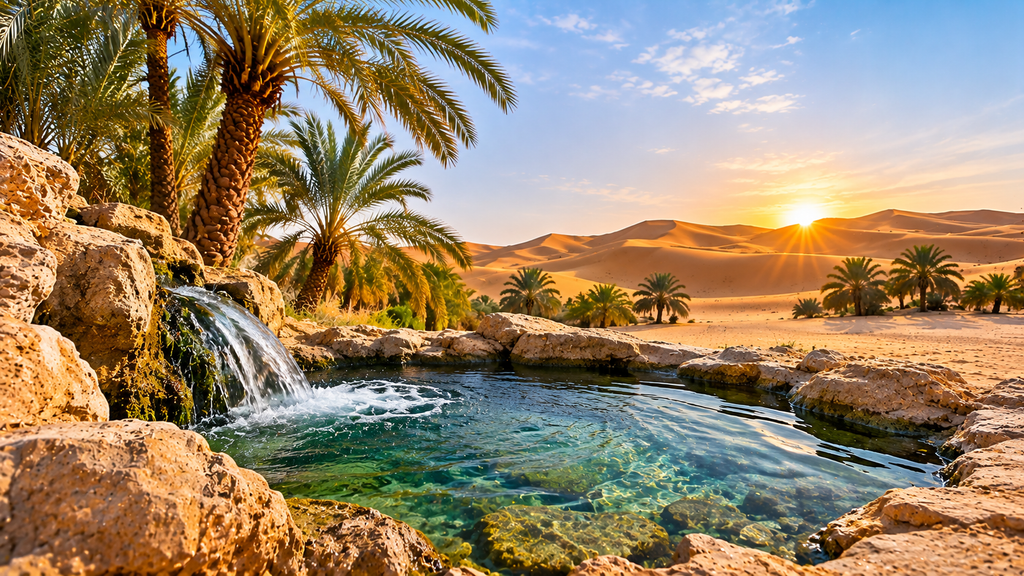
Some trees and shrubs develop extensive root systems that improve their access to moisture.
In suitable geological settings, these roots may reach the water table or the moist soil above it.
Plants that depend substantially on groundwater are known as phreatophytes.
Their survival can be affected when groundwater levels fall beyond the reach of their roots.
Other species grow in wadis where occasional runoff increases soil moisture.
These locations may support more vegetation than surrounding open desert.
The importance of freshwater habitats
Springs, shallow groundwater and moist valley sediments can create small but valuable habitats.
Such areas may support birds, insects, reptiles and mammals.
Vegetation provides shelter and food, while available water can attract wildlife from surrounding dry areas.
The loss of a spring or decline in a shallow water table may therefore affect several species.
This is especially important in ecosystems where suitable habitats are scattered across large distances.
The role of wadis
Wadis are valleys that may carry flowing water during or after rainfall.
Although many remain dry for long periods, they can contribute to groundwater recharge.
When runoff moves through a sandy or gravel-filled valley, part of it may infiltrate into the underlying sediments.
This process helps replenish some shallow aquifers.
Research by UAE University scientists has examined groundwater recharge in alluvial aquifers associated with wadis, demonstrating the importance of rainfall, geology and infiltration conditions.
Groundwater and desert biodiversity
| Ecosystem component | Relationship with groundwater |
|---|---|
| Deep-rooted vegetation | May access moisture below the surface |
| Oasis palm groves | Depend on accessible irrigation water |
| Springs | Provide local freshwater habitats |
| Wadi vegetation | Benefits from runoff and subsurface moisture |
| Birds and other wildlife | Use vegetation and water-dependent habitats |
| Soil organisms | Respond to available moisture and environmental conditions |
Protecting underground water sources can therefore contribute to biodiversity conservation.
However, successful conservation also requires protecting habitats from pollution, development and other forms of disturbance.
6. Why Underground Water Is Essential for Arabian Agriculture and Modern Communities
Agriculture is one of the largest users of groundwater in many parts of the Arabian Peninsula.
This dependence reflects the region’s limited rainfall and the absence of extensive permanent river systems.
In suitable areas, groundwater allows farmers to grow dates, vegetables, fodder crops and other agricultural products.
However, the amount of water required varies considerably according to crop type, climate, soil conditions and irrigation methods.
In hot environments, irrigation demand can be high because water is lost through evaporation and plant transpiration.
Modern pumping technology has made it possible to access deeper reserves and irrigate land that previously supported little cultivation.
This created new agricultural opportunities, particularly during the twentieth century.
However, large-scale extraction has also placed pressure on some aquifers.
Agriculture in Saudi Arabia
Saudi Arabia contains extensive groundwater systems that have historically supported farming.
During periods of agricultural expansion, deep wells provided water for irrigation projects in arid regions.
Some agricultural landscapes became recognisable from satellite imagery because of their circular, centre-pivot irrigation fields.
These systems helped increase domestic agricultural production.
However, reliance on ancient groundwater created long-term sustainability concerns.
Researchers studying the Saq aquifer system have documented groundwater depletion and differences between ancient reserves and areas receiving modern recharge.
This demonstrates why agricultural development must consider the rate at which underground water can be replaced.
The role of groundwater in the UAE
Groundwater also contributes significantly to water use in the United Arab Emirates.
In December 2023, the UAE Ministry of Energy and Infrastructure and Environment Agency – Abu Dhabi announced a national hydrogeological map and database.
The announcement estimated that groundwater supplied approximately 46% of the UAE’s total water demand at that time, compared with 42% from desalinated seawater.
These were national estimates for the period reported, not fixed percentages that necessarily apply today.
The data illustrates the continued importance of natural reserves even in a country with extensive desalination infrastructure.
Water for people and livestock
Historically, wells helped supply drinking water to families, travellers and livestock.
Today, groundwater may still contribute to municipal, agricultural or other uses, depending on the country and local water quality.
However, untreated groundwater is not automatically safe to drink.
It may contain excessive dissolved salts, naturally occurring minerals or contaminants introduced by human activities.
Testing and appropriate treatment are necessary before water can be considered suitable for drinking.
Groundwater uses across the region
| Use | Importance | Management consideration |
|---|---|---|
| Agriculture | Supports crop production | High irrigation demand |
| Livestock | Provides water for animals | Reliable access and water quality |
| Domestic supply | Contributes to local water systems | Testing and treatment |
| Public landscaping | Maintains planted areas | Avoiding unnecessary freshwater use |
| Industry | Supports selected processes | Efficiency and contamination control |
| Emergency reserves | May provide strategic storage | Long-term protection and monitoring |
The key challenge is ensuring that present-day benefits do not lead to irreversible depletion of resources needed by future generations.
7. Why Depletion, Salinity and Pollution Threaten Desert Aquifers
Although the Arabian Peninsula contains substantial groundwater reserves, many are under pressure.
The greatest challenge in some locations is that water is being extracted faster than natural processes can replace it.
This imbalance is especially serious where aquifers contain ancient water accumulated during much wetter periods.
When pumping exceeds recharge over long periods, groundwater levels can decline.
As the water table falls, wells may need to reach greater depths.
Pumping also becomes more expensive because additional energy may be required.
In extreme cases, wells or springs can stop providing useful quantities of water.
The danger of over-extraction
Research published in Hydrogeology Journal describes widespread exploitation and depletion within major Arabian aquifer systems.
The situation differs between locations.
Some mountain-front and wadi aquifers receive meaningful recharge during suitable rainfall events, while many deep regional reserves replenish extremely slowly.
This makes it important to distinguish renewable local supplies from largely non-renewable storage.
Increasing groundwater salinity
Salinity is another concern.
Groundwater naturally contains dissolved minerals acquired through contact with rocks and sediments.
In arid regions, evaporation and long-term water movement can contribute to high dissolved-salt concentrations.
Over-pumping may also alter underground flow patterns.
Near coastlines, excessive extraction can increase the risk of seawater intrusion into freshwater aquifers.
Irrigation can create further challenges when water evaporates and leaves salts in agricultural soils.
Abu Dhabi’s groundwater challenges
Environment Agency – Abu Dhabi has identified declining groundwater levels, rising salinity, pollution and depletion as important concerns.
The agency states that natural recharge in much of the emirate is extremely limited.
At 2023 Abu Dhabi regulatory document also reported that groundwater extraction in the emirate was approximately 24 times the natural recharge rate, based on the assessment referenced in that document. Abu Dhabi
This historical estimate should not be assumed to describe the exact current extraction rate.
Nevertheless, it illustrates the scale of the challenge identified by the authorities.
Pollution and water quality
Groundwater can become contaminated through unsuitable waste disposal, leaking infrastructure, agricultural chemicals or other sources.
Pollutants may enter shallow aquifers more readily where geological conditions allow rapid infiltration.
Once contamination reaches an aquifer, treatment and recovery can be difficult.
Underground water often moves slowly, which can make pollution persist for extended periods.
Major threats to groundwater
| Threat | Potential consequence |
|---|---|
| Excessive pumping | Falling water levels |
| Limited natural recharge | Long-term depletion |
| Seawater intrusion | Increasing salinity |
| Agricultural pollution | Deteriorating water quality |
| Industrial contamination | Risks to people and ecosystems |
| Poor well management | Uncontrolled extraction or contamination |
| Changing rainfall patterns | Greater uncertainty in future recharge |
Protecting groundwater requires both responsible extraction and measures to prevent deterioration in water quality.
8. How Arabian Countries Can Protect Underground Water for Future Generations
The future of water security in the Arabian Peninsula depends on managing groundwater alongside other water sources.
Although underground reserves have supported life for thousands of years, modern demand can exceed their natural ability to recover.
Governments, farmers, researchers and communities therefore have important roles in protecting these resources.
One priority is improving the information available about aquifers.
Scientists need to understand their geographical extent, storage capacity, water quality and recharge patterns.
Wells, monitoring stations, satellite observations and geological models can provide different kinds of evidence.
Combining these methods helps water authorities make better decisions.
Mapping underground reserves
The UAE’s national hydrogeological map and database is an example of efforts to improve water-resource information.
The project was developed to support sustainable extraction, protect reserves from pollution and inform land-use planning.
Accurate information is especially valuable where aquifers extend across administrative or national boundaries.
Managing agricultural water use
Improving irrigation efficiency is another important priority.
Different methods can reduce unnecessary water losses, although the actual savings depend on crop choice, irrigation scheduling, soil conditions and overall water demand.
Drip irrigation and soil-moisture monitoring may help deliver water more precisely.
However, increasing irrigation efficiency does not automatically reduce total groundwater extraction.
If farmers expand cultivated areas or switch to more water-intensive crops, overall use may remain high.
Policies must therefore consider total withdrawals as well as the efficiency of individual farms.
Managed aquifer recharge
Managed aquifer recharge involves deliberately adding suitable water to underground formations.
Depending on the location, this may use stormwater, treated water meeting appropriate standards or other managed supplies.
Water can be directed into infiltration basins or introduced through specially designed wells.
The goal may be to replenish local storage, improve water security or create reserves for future use.
However, recharge projects require careful technical assessment.
Injected or infiltrated water must be compatible with the aquifer and meet appropriate quality requirements.
Unsuitable projects could create contamination or other environmental problems.
A 2023 review in the journal Water examined managed aquifer recharge opportunities in the Middle East and North Africa, including examples from Saudi Arabia and the UAE.
Combining different water sources
Desalination and treated wastewater reuse can reduce pressure on groundwater when they replace withdrawals that would otherwise occur.
However, each method has its own costs and environmental considerations.
Desalination requires energy and brine management, while wastewater reuse depends on suitable treatment, monitoring and infrastructure.
The most effective approach usually involves managing several water sources together rather than depending entirely on one.
A practical roadmap for protecting underground reserves
- Monitor groundwater levels: Track changes in aquifer storage and well performance.
- Control excessive extraction: Align water use with realistic long-term management targets.
- Improve irrigation: Encourage appropriate crops, scheduling and efficient technology.
- Protect recharge zones: Reduce pollution and unnecessary disturbance in important infiltration areas.
- Expand treated wastewater reuse: Use appropriately treated water for suitable applications.
- Assess managed recharge projects: Evaluate geological suitability and water quality before implementation.
- Improve public awareness: Explain why groundwater conservation matters.
- Support regional research: Share information about aquifers that cross national boundaries.
Conclusion: The Hidden Water That Keeps the Arabian Desert Alive
The Arabian Desert may appear dry and empty at the surface, but its underground water systems reveal a very different story.
Beneath the sand, gravel and rock lie aquifers that have supported life across the peninsula for generations.
Some contain water replenished by recent rainfall, while others preserve ancient supplies accumulated during wetter climatic periods thousands of years ago.
These reserves have helped create oases, sustain date palm cultivation, support desert ecosystems and provide water to settlements.
Traditional wells and irrigation channels demonstrate how Arabian communities developed practical ways to use scarce water long before modern infrastructure.
Today, groundwater continues to support agriculture and other activities across Saudi Arabia, the UAE, Oman and neighbouring countries.
However, increasing demand has created important challenges.
Excessive extraction, declining water levels, salinity and contamination can threaten supplies that may take centuries or longer to replenish.
Protecting these resources will require scientific monitoring, efficient water use, appropriate regulation and investment in alternative supplies.
Ultimately, underground water reserves are among the Arabian Desert’s most valuable hidden resources. They have helped sustain life for thousands of years, and their careful management will remain essential to the region’s environmental and economic future.
Do follow us on Instagram
Read More – Why Is the Arabian Gulf One of the Warmest Seas in the World?