


Complete Guide for How to Build Credit Score in the UAE
Building a strong credit score in the UAE is an important part of managing your personal finances. Whether you are an employee, business owner, freelancer, or expatriate, your credit history can influence how financial institutions assess applications for credit cards, personal loans, car finance, mortgages, and other financial products.
- What Is a Credit Score in the UAE?
- Why Is a Good Credit Score Important in the UAE?
- How Is a Credit Score Calculated in the UAE?
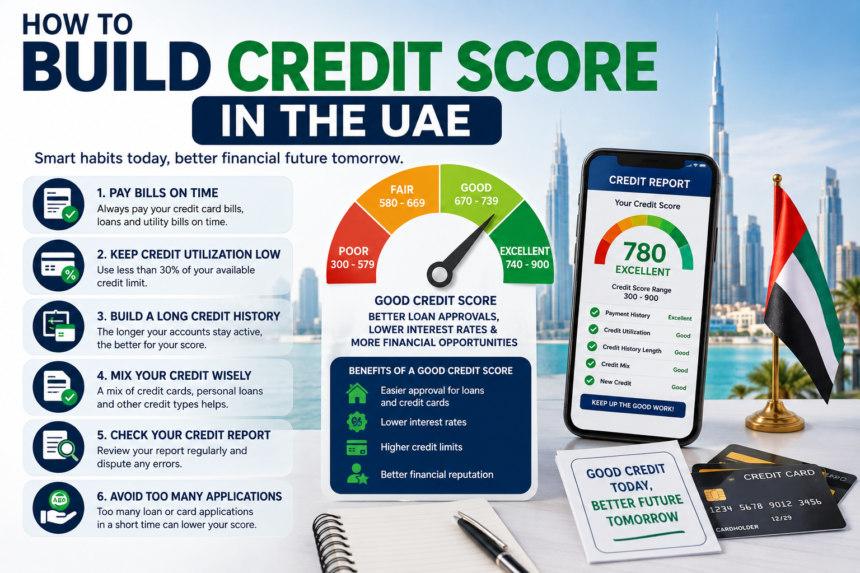
- 1. Pay Your Bills on Time
- 2. Keep Credit Card Balances Under Control
- 3. Avoid Taking Too Many Loans and Credit Cards
- 4. Build a Consistent Credit History
- 5. Check Your UAE Credit Report Regularly
- 6. Correct Errors on Your Credit Report
- 7. Avoid Bounced Cheques
- 8. Pay Off High-Cost Debt
- 9. Do Not Apply for Credit Too Frequently
- 10. Maintain a Healthy Debt-to-Income Position
- 11. Create an Emergency Fund
- 12. Be Careful When Closing Old Credit Accounts
- 13. Understand Credit as an Expat
- 14. Do Not Confuse Income With Creditworthiness
- 15. Create a Monthly Credit Management Routine
- Common Mistakes That Can Hurt Your Credit Profile
- How Long Does It Take to Build a Credit Score in the UAE?
- What Is a Good Credit Score in the UAE?
- Simple Credit-Building Plan for UAE Residents
- Credit Score vs Credit Report
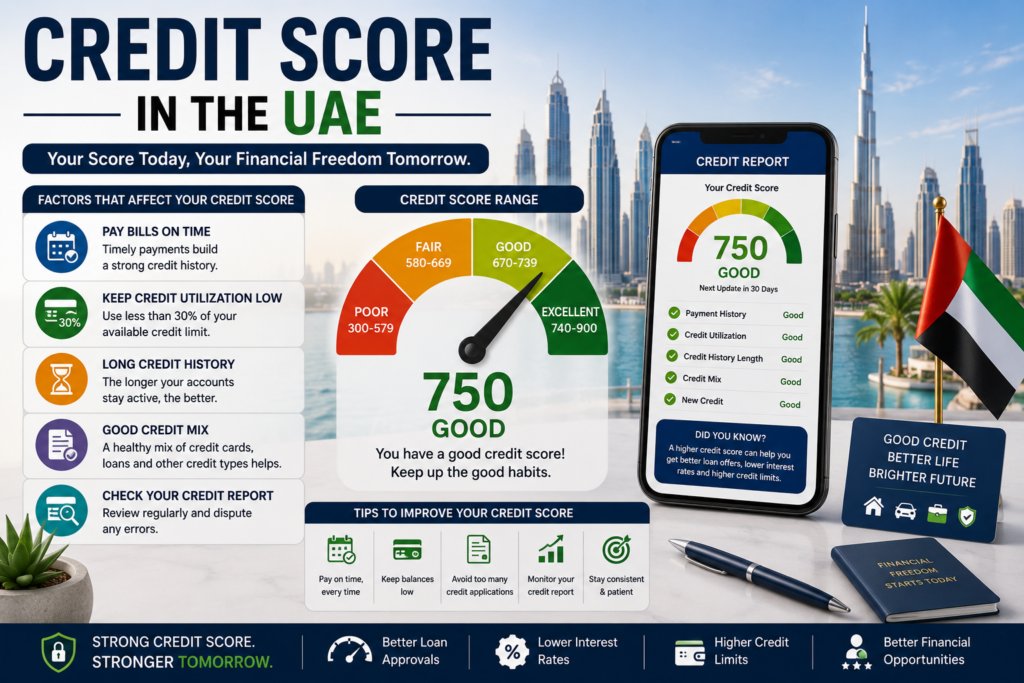
In the UAE, credit information is managed by Etihad Credit Bureau, which provides credit reports and credit scores for individuals and companies. A UAE credit score is a three-digit number ranging from 300 to 900. A higher score generally indicates a lower likelihood of missed payments and therefore lower credit risk.
For people new to the UAE, understanding how credit works can be especially important. Your financial habits, payment history, outstanding balances, number of credit accounts, and other information can contribute to your credit profile. Building a good score does not happen overnight, but consistent financial behavior can help strengthen your creditworthiness over time.
This guide explains how to build credit score in the UAE, how credit scores work, which financial habits can help, common mistakes to avoid, and what you can do if your score needs improvement.
What Is a Credit Score in the UAE?
A credit score is a numerical indicator of credit risk. Etihad Credit Bureau describes the UAE Credit Score as a three-digit number that predicts the likelihood that an individual or company will miss payments over the next 12 months. The score ranges from 300 to 900, with a higher score indicating lower risk.
Your credit score is generated using statistical models that consider multiple data points from your credit profile. It is therefore not determined by a single factor such as your salary or the number of credit cards you have.
The information behind your credit profile can include details relating to credit contracts, payment behavior, and other reported financial information. Etihad Credit Bureau says its credit-report data is collected from sources including banks, financial companies, telecom and utility providers, courts, and government entities.
This means that responsible financial behavior should be viewed as an ongoing process rather than something you do only when applying for a loan.
Why Is a Good Credit Score Important in the UAE?
A strong credit score can make it easier for financial institutions to assess your creditworthiness. It can be particularly useful when you need significant financing, such as a car loan, personal loan, mortgage, or credit card.
A good credit profile may help you:
- Improve your chances of obtaining credit.
- Demonstrate responsible payment behavior.
- Access financial products more easily.
- Potentially qualify for better financing terms.
- Manage borrowing more responsibly.
- Understand your overall financial health.
However, a good credit score does not guarantee that a bank or lender will approve an application. Each institution can use its own eligibility criteria, income requirements, affordability assessments, and internal policies.
How Is a Credit Score Calculated in the UAE?
Many people assume that credit scores are based only on whether they pay their credit card bills on time. Payment history is important, but it is not the only consideration.
According to Etihad Credit Bureau, factors influencing the UAE Credit Score include credit management, payment track record, and credit contracts. These relate to how you manage credit limits, whether you pay bills and loans on time, and how many loans and credit cards you currently have.
Other elements of your credit profile may also be reflected in your credit report. Therefore, improving your score should involve developing good overall financial habits rather than focusing on a single number.
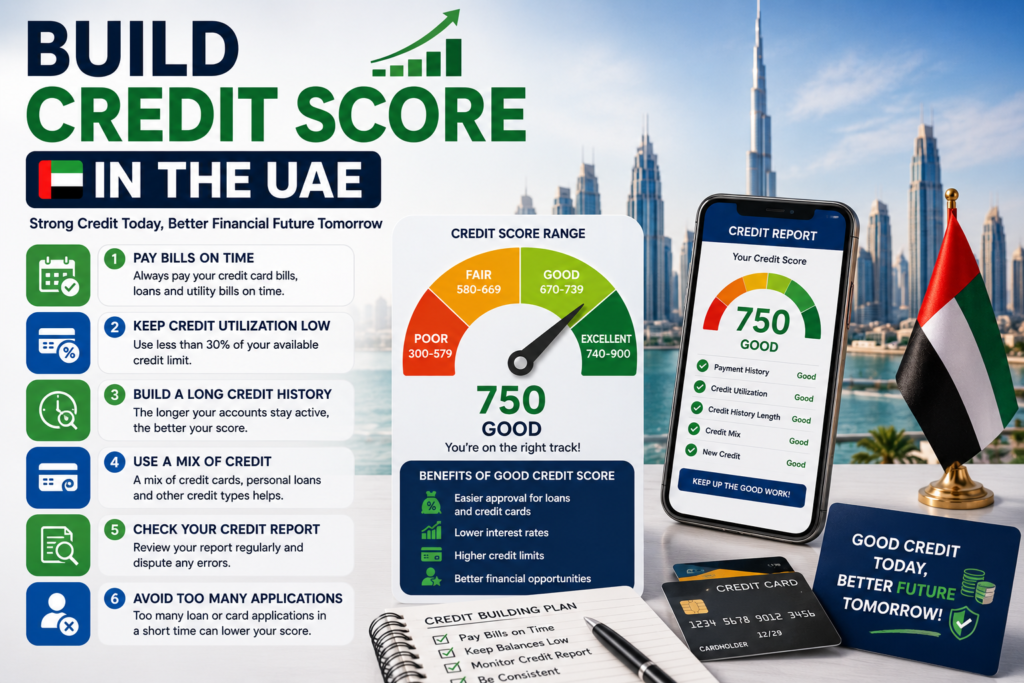
1. Pay Your Bills on Time
One of the most important steps to build credit score in the UAE is paying your financial obligations on or before their due dates.
Late payments can indicate that you are having difficulty managing your credit obligations. Repeated missed payments can therefore damage your financial profile.
Set up reminders or automatic payment arrangements where appropriate so that you do not accidentally miss due dates.
Make it a habit to check:
- Credit card payment dates.
- Personal loan installments.
- Car finance payments.
- Mortgage payments.
- Other reported financial obligations.
- Relevant utility or telecom bills.
Do not wait until the last day if you can avoid it. Paying early can help you maintain a consistent payment routine.
2. Keep Credit Card Balances Under Control
Using a credit card responsibly can be very different from using a credit card to finance an unaffordable lifestyle.
If your outstanding credit card balances remain high relative to your available limits, your credit profile may be viewed less favorably. Etihad Credit Bureau specifically recommends reducing outstanding balances and credit-card limit utilization as a behavior that can help improve your credit score.
For example, if you have a high credit limit but regularly use most of it, consider whether your spending can be reduced.
Good habits include:
- Paying more than the minimum when possible.
- Reducing outstanding balances.
- Avoiding unnecessary purchases.
- Keeping your overall credit usage manageable.
- Paying balances on time.
Do not increase your spending simply because your bank increases your credit limit.
3. Avoid Taking Too Many Loans and Credit Cards
Having multiple financial products does not automatically mean you have a better credit score.
Taking several loans or applying for multiple credit cards within a short period can increase your financial obligations. Etihad Credit Bureau advises reducing the number of credit cards and loans as one behavior that can contribute to better credit behavior.
Before applying for another financial product, ask yourself whether you genuinely need it.
Consider:
- The total monthly repayment.
- The interest or profit rate.
- Processing and other applicable fees.
- Your existing financial commitments.
- Whether your income can comfortably support the new payment.
A simple financial structure is often easier to manage than a collection of unnecessary credit accounts.
4. Build a Consistent Credit History
Credit history takes time to develop. If you are new to borrowing in the UAE, you may not immediately have a substantial credit history.
Etihad Credit Bureau notes that a score may not be available in some cases when there is insufficient information in the previous 24 months, when a borrower has less than six months of payment history, or when there has been no recent credit activity.
This means new residents should not expect to establish a strong credit profile instantly.
Instead, focus on consistency.
Use credit only when necessary and manageable, make payments on time, and avoid taking unnecessary risks simply to create a credit history.
5. Check Your UAE Credit Report Regularly
One of the easiest ways to understand your credit position is to review your credit report.
A credit report provides considerably more information than the score alone. Etihad Credit Bureau states that an individual credit report contains personal information, financial obligations and bills for the previous three years, along with the latest reported salary.
Reviewing your report can help you identify:
- Missed payments.
- Outstanding obligations.
- Credit accounts.
- Incorrect information.
- Unexpected entries.
- Changes in your reported financial information.
Checking your report is particularly useful before applying for major financing.
Etihad Credit Bureau currently provides access to individual Credit Reports and Scores through its online services, the Etihad Credit Bureau app, TAMM, and DubaiNow.
6. Correct Errors on Your Credit Report
Sometimes financial information may be inaccurate or outdated. If you find information that does not belong to you or appears incorrect, do not simply ignore it.
Etihad Credit Bureau provides a Data Correction service through which individuals can request correction of inaccurate information in their credit report.
When reviewing your report, check carefully for:
- Incorrect personal details.
- Accounts you do not recognize.
- Payments incorrectly shown as late.
- Incorrect outstanding balances.
- Closed accounts that appear incorrectly.
- Other information that does not match your records.
Keep supporting documents such as payment receipts, bank statements, loan closure documents, and correspondence with financial institutions when disputing an error.
7. Avoid Bounced Cheques
Bounced cheques can create financial and legal complications and may negatively affect your overall financial profile.
Etihad Credit Bureau specifically lists avoiding bounced cheques among the behaviors that can help improve credit behavior and positively affect the final credit score.
Before issuing a cheque, make sure you understand the payment date and have sufficient funds available.
Good cash-flow management is therefore an important part of maintaining a healthy financial profile.
8. Pay Off High-Cost Debt
If you already have significant debt, improving your credit score should not be your only goal. Your broader financial health also matters.
High-cost debt can reduce the amount of money available for savings and investments. It can also make monthly cash flow more difficult to manage.
Create a debt repayment strategy based on your circumstances.
You can begin by listing:
- Total outstanding balance.
- Monthly payment.
- Interest or profit rate.
- Remaining repayment period.
- Any applicable early-settlement or other charges.
Then prioritize debt repayment while continuing to meet all required minimum payments.
Avoid taking a new loan simply to cover unnecessary lifestyle expenses.
9. Do Not Apply for Credit Too Frequently
Every time you consider a new financial product, think carefully before submitting an application.
Multiple credit applications in a short period can create a pattern that lenders may consider when evaluating your financial behavior. More importantly, repeatedly applying for credit can encourage excessive borrowing.
Instead, compare available products first and apply only when the product genuinely fits your financial needs.
Before submitting an application, understand:
- Eligibility requirements.
- Required income.
- Fees.
- Interest or profit rates.
- Repayment obligations.
- Other terms and conditions.
10. Maintain a Healthy Debt-to-Income Position
Your income is an important part of your ability to manage debt, even though salary alone does not determine your credit score.
If a large percentage of your monthly income is already committed to loan and credit payments, taking on additional debt can create financial stress.
Before borrowing, calculate your total monthly debt commitments and compare them with your reliable income.
A strong financial plan should leave room for:
- Housing.
- Food.
- Transportation.
- Family responsibilities.
- Savings.
- Emergency expenses.
- Debt repayments.
- Long-term investments.
Never assume that a bank’s willingness to lend means you can comfortably afford the loan.
11. Create an Emergency Fund
An emergency fund can indirectly support better credit management.
Unexpected expenses can make it difficult to pay credit card bills or loan installments. Without savings, people may rely on additional borrowing to cover emergencies.
Aim to gradually build a cash reserve that can cover essential expenses during unexpected situations.
An emergency fund can help you avoid:
- Using credit cards for emergencies.
- Taking expensive personal loans.
- Missing payments because of temporary income problems.
- Selling investments at an inconvenient time.
The appropriate emergency fund depends on your income, expenses, employment stability, and family responsibilities.
12. Be Careful When Closing Old Credit Accounts
Closing a credit card is not always the best solution simply because you no longer use it.
Before closing an account, review your overall financial situation and understand how the closure may affect your available credit, existing obligations, and financial profile.
If a card has expensive fees or is no longer useful, closing it may still be reasonable. However, avoid making major credit-account changes without considering the wider consequences.
The goal should be to maintain a manageable set of useful financial products rather than collecting accounts unnecessarily.
13. Understand Credit as an Expat
For expatriates, building credit in the UAE can require additional patience.
Your previous credit history from another country does not necessarily function exactly like a UAE credit history. However, Etihad Credit Bureau currently offers a Foreign Credit Report service that can allow eligible borrowers with credit history from supported countries to provide that history to UAE lenders. The service is intended to help people who have been in the UAE for less than three years establish a clearer credit picture.
Supported countries listed by Etihad Credit Bureau include countries such as India, the United Kingdom, Australia, Germany, the Philippines, and others.
If you recently moved to the UAE, check whether this option applies to your circumstances before assuming that your international credit history cannot be considered.
14. Do Not Confuse Income With Creditworthiness
A high salary does not automatically mean you have a high credit score.
Someone earning AED 30,000 per month could have significant debt, missed payments, or high credit utilization. Meanwhile, someone earning less may have a more consistent repayment history and better-managed obligations.
Your income helps determine affordability, but responsible credit behavior is also important.
Focus on:
- Paying on time.
- Keeping balances manageable.
- Avoiding unnecessary debt.
- Monitoring your credit report.
- Maintaining stable financial habits.
15. Create a Monthly Credit Management Routine
Managing your credit should become part of your normal financial routine.
At the beginning or end of each month, review:
- Current credit card balances.
- Upcoming loan payments.
- Available credit.
- Bank account balances.
- Upcoming large expenses.
- Savings contributions.
- Outstanding bills.
A 15-minute monthly review can help you identify problems before they become expensive.
Common Mistakes That Can Hurt Your Credit Profile
Building a strong credit score is easier when you know what to avoid.
Common mistakes include:
- Missing credit card payments.
- Paying loans late.
- Maintaining very high outstanding balances.
- Taking unnecessary personal loans.
- Applying for multiple credit cards without a clear need.
- Ignoring your credit report.
- Failing to correct inaccurate information.
- Issuing cheques without sufficient funds.
- Using debt to maintain an expensive lifestyle.
- Ignoring financial obligations after changing jobs or moving countries.
Avoiding these behaviors can help you maintain more consistent financial habits.
How Long Does It Take to Build a Credit Score in the UAE?
There is no fixed number of days or months in which everyone can achieve a particular credit score.
Your credit profile develops from reported financial information and payment history. Etihad Credit Bureau notes that a minimum amount of credit history and other conditions are required for a score to be calculated. For example, new borrowers with less than six months of payment history may not have enough information for a score to be generated.
Therefore, building credit should be viewed as a long-term process.
Instead of looking for a quick way to increase your score, focus on developing habits that demonstrate responsible credit management over time.
What Is a Good Credit Score in the UAE?
The UAE credit score ranges from 300 to 900, with higher scores indicating lower predicted credit risk.
It is important not to become overly focused on a particular number. Financial institutions can have their own criteria when reviewing applications, and your credit score is only one part of the broader assessment.
Rather than asking only, “How can I get a higher credit score?” ask:
“How can I become a more financially responsible borrower?”
That mindset naturally encourages timely payments, lower balances, manageable debt, and better financial planning.
Simple Credit-Building Plan for UAE Residents
If you want a straightforward approach, follow this monthly plan:
Step 1: Check your obligations
Know exactly what you owe and when every payment is due.
Step 2: Pay on time
Never intentionally miss a required payment.
Step 3: Reduce balances
Work toward lowering outstanding credit card balances and expensive debt.
Step 4: Avoid unnecessary applications
Only apply for new credit when there is a genuine financial reason.
Step 5: Monitor your report
Review your credit information and look for errors.
Step 6: Build savings
Maintain an emergency fund so unexpected expenses do not automatically become new debt.
Step 7: Review your progress
Assess your debt, savings, spending, and credit behavior regularly.
Credit Score vs Credit Report
It is important to understand the difference between a credit score and a credit report.
A credit score is a three-digit number that summarizes predicted credit risk. A credit report provides much more detailed information about your financial obligations, payment history, and other credit-related information.
Think of the score as a quick financial indicator and the report as the detailed record behind it.
If your score changes, reviewing your report can help you understand the broader credit information associated with your profile.
Final Thoughts
Learning how to build credit score in the UAE is an important part of becoming financially secure. A strong credit profile is not created through one quick action. It develops through consistent habits such as paying bills on time, managing credit limits carefully, keeping debt under control, avoiding unnecessary borrowing, monitoring your credit report, and correcting inaccurate information.
For new UAE residents and expatriates, building credit can take time because a local credit history needs to develop. If you have an eligible international credit history, Etihad Credit Bureau’s Foreign Credit Report service may also provide a way for lenders to consider credit information from supported countries.
The most effective strategy is simple: borrow responsibly, pay on time, keep balances manageable, monitor your credit information, and plan for the long term.
Your credit score is only one part of your financial health, but responsible credit management can help you become a stronger borrower and make better financial decisions throughout your life in the UAE.
Do follow us on Instagram
Read More – Credit Cards in Dubai 2026 Complete Guide