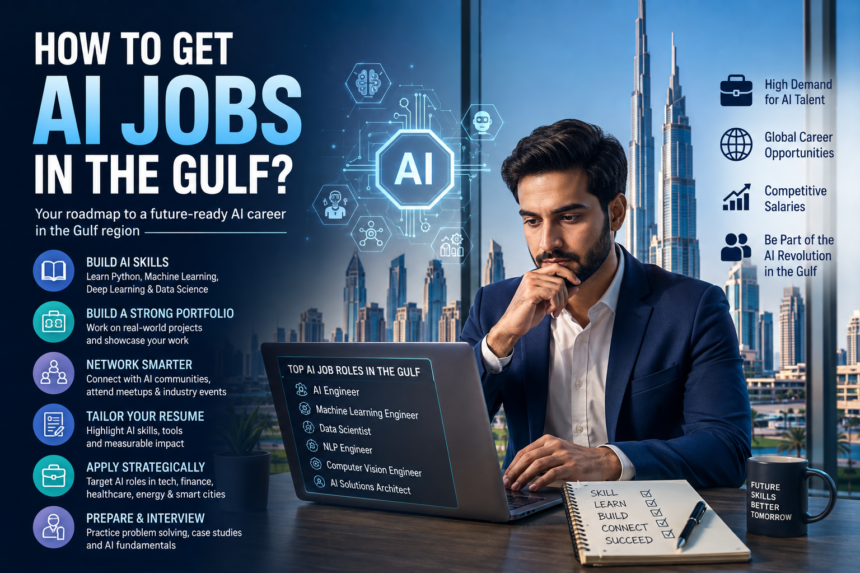
How to Get AI Jobs in the Gulf Without Guesswork
If you are wondering how to get AI jobs in the Gulf, the opportunity is becoming more visible across the United Arab Emirates, Saudi Arabia, Qatar and other GCC markets. Artificial intelligence is no longer limited to research laboratories or specialist technology companies. Employers are increasingly looking for people who can develop AI systems, deploy them, manage AI projects or use AI to improve everyday business operations.
- Why AI Jobs in the Gulf Are Growing
- What Kind of AI Jobs Can You Find in the Gulf?
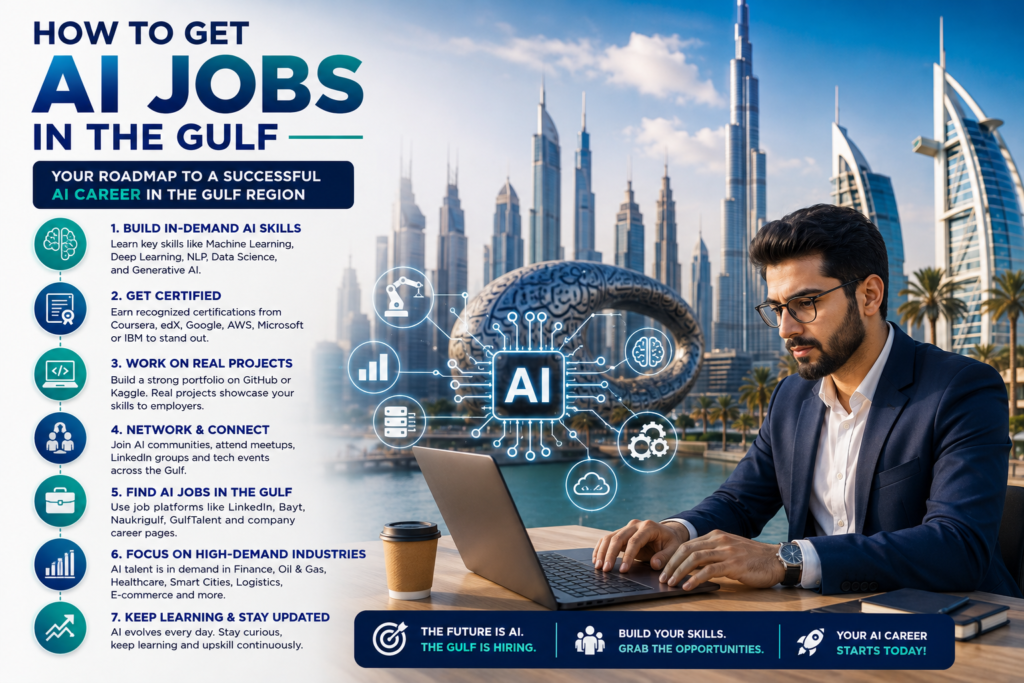
- How to Get AI Jobs in the Gulf
- The Most Important AI Skills To Learn
- Do You Need A Computer Science Degree?
- Build A Portfolio Before You Apply
- Create A Gulf Focused AI CV
- Use LinkedIn Strategically
- Where To Look For Gulf AI Jobs
- Target UAE And Saudi Arabia First
- Network Before You Need A Job
- Prepare For Technical Interviews
- Develop Business Skills Too
- Consider AI Roles Outside Engineering
- What If You Have No AI Experience?
- How To Stand Out From Other Applicants
- Do Certifications Help?
- AI Jobs And Salary Expectations
- The Future Of AI Careers In The Gulf
- Frequently Asked Questions
- Conclusion
Recent GulfTalent data shows that AI related skills or tools appeared in 3.4 percent of professional vacancies advertised in the UAE, Saudi Arabia and Qatar during the first half of 2026, up from 1.2 percent in 2022. Importantly, these roles are not all technical. AI is increasingly appearing in vacancies for sales, marketing, product management and consulting.
That creates opportunities for both experienced technology professionals and people transitioning from other careers.
The key is knowing which skills employers want, how to demonstrate those skills and where to look.
Why AI Jobs in the Gulf Are Growing
The Gulf is investing heavily in artificial intelligence and digital transformation.
The UAE has emerged as one of the fastest growing AI talent markets globally. PwC’s 2026 AI Jobs Barometer found that the share of UAE job postings requiring AI skills increased from 1 percent in 2021 to 3.2 percent in 2025, while the number of such postings increased by around 2,700 between 2024 and 2025.
Saudi Arabia is also building a large technology ecosystem around artificial intelligence, data and digital services.
Across the region, AI is being applied to areas such as:
- Financial services
- Healthcare
- Energy
- Government services
- Retail
- Logistics
- Manufacturing
- Real estate
- Telecommunications
- Cybersecurity
- Media
- Education
This matters because you do not necessarily need to work for an AI company to build an AI career.
A financial institution may need machine learning specialists.
A hospital may need healthcare AI professionals.
An energy company may need data scientists.
A retailer may need AI product managers.
A marketing agency may need professionals who understand generative AI.
The market is becoming broader.
What Kind of AI Jobs Can You Find in the Gulf?
Before applying for positions, understand the different types of AI careers.
AI is a large field rather than one specific job.
How to Get AI Jobs in the Gulf
AI and Machine Learning Engineer
These professionals build and deploy AI and machine learning systems.
Typical skills include:
- Python
- Machine learning
- Deep learning
- Model deployment
- Cloud platforms
- APIs
- Data processing
This is one of the more technical career paths.
Data Scientist
Data scientists use data to identify patterns and support business decisions.
They commonly work with:
- Python
- SQL
- Statistics
- Machine learning
- Data visualisation
- Predictive analytics
Strong business understanding can make a data scientist particularly valuable.
Generative AI Specialist
Generative AI has created newer opportunities around large language models, AI assistants, retrieval systems and automation.
Professionals may work on:
- Large language models
- Retrieval augmented generation
- AI agents
- Prompt design
- AI workflow automation
- Model evaluation
- AI applications
The field is developing quickly, so practical project experience is especially useful.
AI Product Manager
AI product managers sit between technology, business and customers.
They need to understand what AI can do, but they do not necessarily need to build models themselves.
They may define product requirements, coordinate engineering teams, study customer needs and measure product performance.
AI Consultant
Consultants help organisations identify where AI can create business value.
They may work on:
- AI strategy
- Automation
- Business transformation
- AI adoption
- Process optimisation
- Responsible AI
This career can be attractive to professionals coming from consulting, operations, finance or management.
AI Sales And Business Development
AI companies also need people who can sell technology.
A salesperson who understands AI can explain complex products to customers and connect technology with business outcomes.
This is one reason Gulf AI jobs increasingly extend beyond engineering.
The Most Important AI Skills To Learn
Knowing the job title is only the beginning.
You need skills that employers can recognise.
The ILO and UN ESCWA’s 2026 report on AI and employment in the Arab region identifies priorities ranging from basic AI literacy to advanced technical and governance capabilities.
For job seekers, the best approach is to develop skills at the right level for the career you want.
1. Python
Python remains one of the most useful programming languages for AI and data work.
If you want a technical AI role, learning Python is an excellent starting point.
2. SQL
AI systems depend heavily on data.
SQL helps professionals retrieve and analyse information stored in databases.
Even people outside pure data science can benefit from SQL.
3. Machine Learning
Learn the basic concepts before trying to master advanced models.
Understand:
- Supervised learning
- Unsupervised learning
- Classification
- Regression
- Model evaluation
- Overfitting
- Feature engineering
4. Generative AI
Understand how large language models work at a practical level.
Learn how to build useful applications rather than simply experimenting with chatbots.
5. Cloud Computing
AI workloads increasingly rely on cloud infrastructure.
Knowledge of platforms such as AWS, Microsoft Azure or Google Cloud can strengthen a technical profile.
6. Data Analysis
Learn how to clean, analyse and explain data.
Tools such as Excel, SQL, Python and visualisation platforms can help.
7. AI Governance
Responsible AI is becoming increasingly important.
Professionals should understand issues such as:
- Privacy
- Bias
- Security
- Transparency
- Data governance
- Model risk
- Compliance
This can be especially valuable in regulated industries.
Do You Need A Computer Science Degree?
Not always.
A computer science or engineering degree can be useful for highly technical AI roles, but the wider AI employment market is much broader.
A professional with a background in finance, healthcare, marketing, law or operations can develop AI expertise relevant to their industry.
For example, a finance professional could specialise in financial AI.
A doctor could explore healthcare AI.
A marketer could become an AI focused growth specialist.
A lawyer could develop expertise in AI governance and technology regulation.
This combination of domain knowledge and AI skills can be powerful.
The goal should not always be to become a machine learning engineer.
The goal is to become someone who understands how AI creates value within a specific environment.
Build A Portfolio Before You Apply
One of the biggest mistakes job seekers make is relying entirely on a CV.
AI is a practical field.
Employers want to know what you can actually do.
A portfolio can provide evidence.
You could build:
- An AI chatbot
- A recommendation system
- A data analytics dashboard
- A document analysis tool
- A customer service assistant
- An AI powered research application
- A predictive model
- An automation workflow
The project does not need to be revolutionary.
It needs to demonstrate your thinking.
Explain the problem.
Explain your approach.
Show the technology you used.
Explain the result.
Mention what you would improve.
This gives recruiters something concrete to evaluate.
Create A Gulf Focused AI CV
Your CV should make your AI abilities immediately visible.
Do not simply write:
“Interested in artificial intelligence.”
That statement is too general.
Instead, demonstrate skills through achievements.
For example:
“Built a Python based customer classification model using machine learning.”
Or:
“Developed an AI workflow that reduced manual research time.”
Or:
“Created a generative AI assistant for internal knowledge retrieval.”
Whenever possible, include measurable results.
A strong AI CV should make it easy for a recruiter to understand:
- Your technical skills
- Your industry experience
- Your AI projects
- Your education
- Your certifications
- Your business impact
- Your location or relocation availability
Use LinkedIn Strategically
For people searching for AI jobs in the Gulf, LinkedIn can be more than an online CV.
It can become a professional portfolio.
Make sure your profile includes relevant keywords naturally.
For example:
AI Engineer | Machine Learning | Python | Generative AI | Data Science
Your About section should explain what you do and what problems you solve.
Share useful content occasionally.
Discuss an AI project.
Explain something you learned.
Share an interesting industry development.
The objective is not to become an influencer.
The objective is to demonstrate genuine interest and knowledge.
Where To Look For Gulf AI Jobs
Do not depend on one job website.
Search through several channels.
Useful sources include:
- Company career pages
- Gulf recruitment platforms
- University career portals
- Professional communities
- Technology conferences
- Industry networking events
- Recruitment agencies
- Research institutions
You should also identify organisations investing heavily in AI.
The UAE’s growing AI market includes opportunities across technology, financial services, professional services, manufacturing, energy, consumer markets and healthcare. PwC reports that AI hiring has expanded across all these sectors.
This means your search should not be limited to companies with “AI” in their names.
Target UAE And Saudi Arabia First
The UAE and Saudi Arabia are particularly important markets for people exploring Gulf AI jobs.
The UAE has seen strong growth in AI related hiring and has positioned itself as a regional AI talent hub.
Saudi Arabia is also developing a major AI ecosystem through investments in digital infrastructure, data and technology.
However, Qatar, Kuwait, Bahrain and Oman should not automatically be ignored.
The right market depends on your specialisation.
A healthcare AI professional may find different opportunities from a cybersecurity specialist.
An AI product manager may have a broader set of options than a highly specialised research scientist.
Network Before You Need A Job
Networking is particularly important for specialised careers.
Many opportunities are discovered through professional relationships before they become obvious to the wider market.
Start by connecting with:
- AI engineers
- Data scientists
- Technology managers
- Recruiters
- Founders
- Researchers
- Product managers
- Industry professionals
Do not immediately ask everyone for a job.
Start with genuine conversations.
Ask thoughtful questions.
Learn about the market.
Discuss technology.
Attend relevant events.
Over time, your network can become a source of information, referrals and opportunities.
Prepare For Technical Interviews
Getting an interview is only half the challenge.
Technical AI interviews can involve several areas.
You may be asked about:
- Python
- Algorithms
- Data structures
- Statistics
- Machine learning
- SQL
- Model evaluation
- System design
- AI architecture
- Your previous projects
Do not only memorise answers.
Be prepared to explain your reasoning.
If you claim to have built an AI project, understand every major part of it.
Interviewers may ask why you selected a particular model, how you evaluated it, what went wrong and how you would improve it.
Your ability to explain decisions can be as important as the technology itself.
Develop Business Skills Too
Technical ability alone may not be enough.
The strongest AI professionals understand business problems.
Suppose a company wants to automate customer service.
A technical candidate might immediately discuss an LLM.
A stronger candidate may first ask:
What questions do customers ask?
What data is available?
What is the cost of the existing process?
What level of accuracy is required?
What happens when the AI makes a mistake?
How will success be measured?
This demonstrates business thinking.
GCC employers increasingly need professionals who can connect AI with productivity and business outcomes.
Consider AI Roles Outside Engineering
This is one of the most important points for career changers.
You can work with AI without becoming a programmer.
Potential roles include:
- AI project manager
- AI business analyst
- AI consultant
- AI product manager
- AI trainer
- AI adoption specialist
- AI sales specialist
- AI governance professional
- AI marketing specialist
- AI operations specialist
GulfTalent’s 2026 analysis found that only a minority of AI related vacancies directly involve building and training AI models, while many involve using AI, implementing AI solutions or selling AI products and services.
That significantly widens the career path.
What If You Have No AI Experience?
Start small.
Do not wait until you feel fully qualified.
A practical beginner roadmap could look like this:
Month one: Learn AI fundamentals.
Month two: Learn Python or another relevant technical skill.
Month three: Complete a practical AI project.
Month four: Build a second project related to your industry.
Month five: Improve your CV and LinkedIn profile.
Month six: Begin targeted applications and networking.
The exact timeline can vary.
The important principle is consistency.
How To Stand Out From Other Applicants
The Gulf AI market is becoming more competitive.
A generic CV saying “AI enthusiast” is unlikely to be enough.
Instead, build a clear professional identity.
For example:
Healthcare professional + AI
Finance professional + machine learning
Marketing professional + generative AI
Software engineer + AI infrastructure
Data analyst + AI automation
This combination makes your profile easier to understand.
It also gives recruiters a reason to remember you.
Do Certifications Help?
Certifications can help, especially when you are changing careers.
But certificates should support practical ability rather than replace it.
A certificate can show that you studied a subject.
A project can show that you applied it.
Ideally, have both.
Choose certifications that match your target career.
For cloud focused roles, consider recognised cloud certifications.
For data careers, choose reputable data and analytics programs.
For AI engineering, focus on machine learning, cloud AI and relevant technical credentials.
Avoid collecting certificates simply to fill space on your CV.
AI Jobs And Salary Expectations
Salary should not be the only reason to enter the field.
AI specialists can command strong compensation in some Gulf markets, but pay varies substantially according to experience, technical depth, industry, employer, seniority and location.
PwC’s 2026 UAE analysis reports that AI related skills are increasingly associated with wage premiums and that AI hiring has expanded rapidly across the economy.
Rather than chasing a particular salary number, focus on becoming difficult to replace.
Specialised technical skills, industry knowledge and proven business impact can strengthen your negotiating position over time.
The Future Of AI Careers In The Gulf
The AI employment market is still developing.
The ILO and UN ESCWA expect AI to reshape employment across Arab countries through 2035, while highlighting the importance of AI literacy, advanced technical skills and governance capabilities.
Research on the GCC workforce also points to significant changes in the skills employers will need, including growing demand for AI and machine learning specialists, data professionals, renewable energy specialists and cybersecurity experts.
This suggests that the opportunity will not be limited to one generation of technology.
AI will continue changing.
The tools will change.
Job titles will change.
The skills needed to succeed will also change.
That makes adaptability one of the most valuable career advantages.
Frequently Asked Questions
How can I get an AI job in the Gulf with no experience?
Start with AI fundamentals, build practical projects, develop a portfolio and target entry level or adjacent roles where your existing industry knowledge is useful.
Which Gulf country is best for AI jobs?
The UAE and Saudi Arabia currently offer significant AI related opportunities, but the best destination depends on your specialisation, experience and preferred industry.
Do I need a master’s degree for an AI job?
Not necessarily. Advanced research roles may require postgraduate qualifications, while many applied roles focus more heavily on practical skills and experience.
Can nontechnical professionals get AI jobs?
Yes. AI is increasingly used in marketing, sales, consulting, product management, operations and other business functions.
Which technical skills should I learn first?
For technical careers, Python, SQL, statistics, machine learning, data analysis and cloud computing are strong foundations.
Is generative AI a good career path?
Generative AI is creating opportunities across technical and nontechnical roles, but professionals should build broader AI and industry skills rather than depending on one rapidly changing job title.
Should I apply for jobs before moving to the Gulf?
Yes. Applying before relocating can help you understand demand, salary expectations and employer requirements before making a major move.
Conclusion
It is about understanding where AI is creating value and positioning yourself around that opportunity.
The Gulf job market is expanding beyond traditional technology roles. AI skills are appearing across finance, healthcare, energy, consulting, marketing, sales and other sectors. Current data from the UAE and wider Gulf indicates that AI demand is becoming a broader workforce trend rather than a niche technology phenomenon.
For job seekers, the winning strategy is practical.
Choose a career direction.
Learn the relevant skills.
Build real projects.
Create a strong CV.
Show your work online.
Network with professionals.
Prepare seriously for interviews.
Most importantly, combine AI knowledge with something else that makes you valuable.
That could be healthcare.
Finance.
Marketing.
Engineering.
Cybersecurity.
Operations.
Leadership.
The future Gulf workforce will need people who can use AI to solve real problems.
If you start building those abilities today, you will not simply be searching for an AI job.
You will be preparing for a career in an economy increasingly shaped by artificial intelligence.
follow us on Instagram
Read More – Future Skills for the GCC: 10 Powerful Skills Shaping Tomorrow’s Workforce