

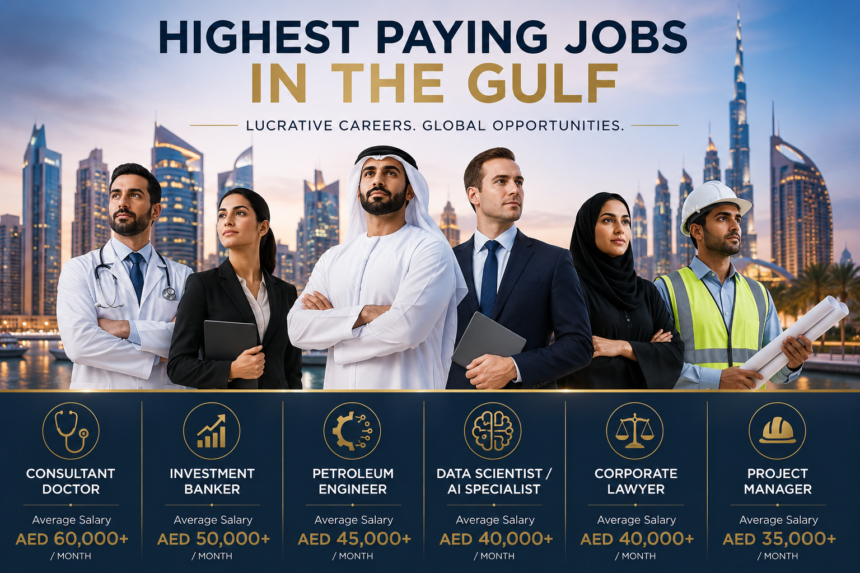
Highest Paying Jobs in GCC for Ambitious Professionals
The Gulf has become one of the world’s most attractive career destinations for experienced professionals. From Dubai and Abu Dhabi to Riyadh and Doha, employers are competing for specialists who can support ambitious growth in technology, healthcare, finance, energy, aviation and infrastructure
- Highest Paying Jobs in the Gulf in 2026
- 1. Chief Executive Officers and Senior Executives
- 2. Specialist Doctors and Surgeons
- 3. Investment Banking and Private Equity Professionals
- 4. AI and Machine Learning Specialists
- 5. Cybersecurity Leaders
- 6. Airline Pilots and Aviation Professionals
- 7. Legal Partners and Senior Corporate Lawyers
- 8. Oil, Gas and Energy Professionals
- 9. Real Estate Development and Investment Leaders
- 10. Technology Directors and Solution Architects
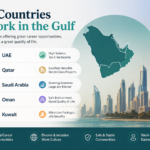
- Which Gulf Countries Offer the Best Career Opportunities?
- Skills That Can Increase Your Gulf Salary
- Experience Can Matter More Than Job Title
- Why AI Skills Are Becoming Valuable Across Traditional Careers
- How to Prepare for High Paying Gulf Jobs
- Frequently Asked Questions
- Conclusion
But finding the highest paying jobs in the Gulf is not simply about identifying a job title with a large salary. Compensation can vary significantly according to experience, qualifications, employer, country and whether the position includes housing, bonuses or other benefits.
Current 2026 salary data shows particularly strong compensation at senior levels in legal services, investment management, private banking, real estate development and technology. Hays’ 2026 GCC guide tracks salary expectations across almost 400 regional roles, reflecting the breadth of today’s Gulf employment market.
For professionals considering the UAE, Saudi Arabia, Qatar, Kuwait, Bahrain or Oman, these are some of the career paths worth watching.
Highest Paying Jobs in the Gulf in 2026
The Gulf employment market is changing.
Traditional high paying sectors such as oil and gas, medicine, aviation and banking remain important. But technology is creating another group of premium careers.
The UAE, for example, has become one of the world’s fastest growing AI talent markets. PwC reports continued growth in UAE job postings requiring AI skills, demonstrating how investment in digital transformation is translating into real talent demand.
This creates opportunities for professionals who combine specialised expertise with leadership experience.
1. Chief Executive Officers and Senior Executives
At the top of the corporate ladder are CEOs and other C suite executives.
Large companies operating across the GCC need leaders who can manage complex businesses, international teams and regional expansion.
Senior executives may include:
- Chief Executive Officers
- Chief Financial Officers
- Chief Technology Officers
- Chief Investment Officers
- Chief Development Officers
These positions can offer exceptional compensation, particularly in banking, investment, real estate, energy and technology.
UAE salary benchmarks show Chief Investment Officers and Chief Development Officers among the country’s highest paid roles.
However, these positions normally require many years of leadership experience.
Companies are not simply paying for a title.
They are paying for judgement, networks and the ability to make decisions involving significant capital and responsibility.
2. Specialist Doctors and Surgeons
Healthcare remains one of the strongest career sectors across the Gulf.
Specialist and consultant doctors can command significant compensation, particularly in private hospitals and advanced medical centres.
High value specialties can include:
- Neurosurgery
- Cardiology
- Orthopaedics
- Plastic surgery
- Oncology
- Anaesthesiology
- Dermatology
Compensation varies considerably depending on speciality, seniority, licensing, hospital and country.
The Gulf continues investing in advanced healthcare as countries work to expand specialist medical services and reduce the need for patients to travel abroad for complex treatment.
For doctors considering relocation, salary should not be the only factor.
Professional licensing requirements differ between GCC countries, and senior roles generally require recognised specialist qualifications and significant clinical experience.
3. Investment Banking and Private Equity Professionals
The Gulf’s financial sector has expanded dramatically.
Dubai International Financial Centre and Abu Dhabi Global Market have strengthened the UAE’s position as an international financial hub, while Riyadh continues developing its own financial ecosystem.
This has created opportunities across:
- Investment banking
- Private equity
- Asset management
- Mergers and acquisitions
- Wealth management
- Investment strategy
Senior professionals can receive substantial base salaries alongside performance related bonuses.
In UAE salary benchmarks, Vice President level investment banking compensation is already among the better evidenced high income financial roles, while heads of private banking and wealth management can sit considerably higher.
The highest rewards usually go to professionals who can combine technical financial expertise with strong client and deal networks.
4. AI and Machine Learning Specialists
Artificial intelligence has moved rapidly from an experimental technology into a strategic business priority.
Governments and companies across the Gulf are investing heavily in AI infrastructure, automation and digital transformation.
This is creating demand for roles including:
- AI engineers
- Machine learning specialists
- AI architects
- Data scientists
- MLOps specialists
- AI product leaders
PwC’s 2026 UAE analysis describes the country as one of the faster growing AI talent markets globally, with employers across sectors increasingly seeking people who can apply AI in practical business environments.
For younger professionals, AI is particularly interesting because it offers a potential route toward strong compensation without requiring decades to reach executive level.
The strongest candidates usually combine technical ability with practical business knowledge.
5. Cybersecurity Leaders
As Gulf economies become more digital, cybersecurity becomes more important.
Banks, government organisations, airlines, hospitals, energy companies and retailers all handle sensitive information.
A major cyber incident can disrupt operations and damage trust.
This creates opportunities for:
- Chief Information Security Officers
- Cybersecurity directors
- Security architects
- Cloud security specialists
- Penetration testers
- Governance and risk professionals
Cybersecurity professionals with experience protecting large organisations can command strong compensation because the cost of getting security wrong can be enormous.
The growth of AI also creates new security challenges, making specialists who understand both emerging technology and cyber risk increasingly valuable.
6. Airline Pilots and Aviation Professionals
The Gulf is home to some of the world’s most recognised aviation businesses.
Dubai, Abu Dhabi and Doha have become major international travel hubs connecting Asia, Europe, Africa and the Americas.
Experienced airline captains can therefore remain among the better paid professionals in the region.
Wide body aircraft experience is particularly valuable.
Pilots may also receive benefits beyond basic salary, depending on the airline and contract.
However, reaching captain level requires years of training and flying experience.
Aviation is highly regulated, and professionals need to maintain strict medical, licensing and operational standards throughout their careers.
For people passionate about aviation, the Gulf continues to provide an internationally connected career environment.
7. Legal Partners and Senior Corporate Lawyers
Legal careers do not always receive as much attention as technology or finance, but senior lawyers can earn some of the Gulf’s highest professional salaries.
UAE 2026 salary benchmarks place senior legal partners among the highest compensated roles, with some reported monthly ranges exceeding AED 100,000 at senior levels.
High paying areas include:
- Corporate law
- Mergers and acquisitions
- Banking and finance law
- International arbitration
- Real estate law
- Regulatory compliance
The region’s expanding investment environment creates constant demand for sophisticated legal expertise.
International companies entering Gulf markets also need professionals who can understand both regional regulations and cross border transactions.
For senior lawyers, reputation and specialist expertise can be particularly valuable.
8. Oil, Gas and Energy Professionals
Energy remains central to Gulf economies.
Saudi Arabia, the UAE, Qatar, Kuwait and Oman continue to play major roles in global energy markets.
This supports well compensated careers in:
- Petroleum engineering
- Reservoir engineering
- LNG operations
- Energy trading
- Project management
- Refinery operations
At the same time, the definition of an energy career is expanding.
Solar power, nuclear energy, green hydrogen, carbon management and energy storage are creating new opportunities.
This means engineers entering the sector today may eventually work across both conventional and renewable energy.
Professionals who understand large scale energy infrastructure while developing knowledge of new technologies could be particularly well positioned.
9. Real Estate Development and Investment Leaders
Dubai and Abu Dhabi remain major property markets, while Saudi Arabia’s large scale development ambitions have created new demand for experienced real estate professionals.
Senior positions include:
- Chief Development Officer
- Development Director
- Investment Director
- Real Estate Asset Manager
- Commercial Director
UAE salary data places Chief Development Officer positions among the highest compensated roles in the market.
These careers require much more than knowing how to sell property.
Development leaders may oversee land acquisition, feasibility studies, design, financing, construction and commercial strategy.
The size of Gulf development projects means professionals with experience managing complex assets can become extremely valuable.
10. Technology Directors and Solution Architects

Not every high paying technology career revolves around AI.
Companies still need professionals who can design and manage the wider technology infrastructure supporting their businesses.
Important roles include:
- Technology Director
- Solutions Architect
- Cloud Architect
- Enterprise Applications Head
- Digital Transformation Director
Hays salary data indicates that senior solutions and enterprise technology leadership roles can command substantial monthly packages in the UAE.
These professionals help organisations decide which technologies to adopt and how different systems should work together.
As Gulf businesses continue digitising, this combination of technical knowledge and strategic thinking becomes increasingly valuable.
Which Gulf Countries Offer the Best Career Opportunities?
There is no single best GCC country for every profession.
UAE remains particularly attractive for finance, technology, aviation, real estate, healthcare and professional services.
Saudi Arabia offers significant opportunities connected with infrastructure, tourism, construction, energy, technology and major development programmes.
Qatar remains important in energy, aviation, infrastructure and professional services, although current economic and geopolitical conditions can affect hiring and investment conditions.
Kuwait continues to offer careers in energy, finance, healthcare and government related sectors.
Bahrain has a long established financial services sector and growing technology ecosystem.
Oman offers opportunities in energy, tourism, logistics and infrastructure.
Professionals should therefore compare opportunities by industry rather than choosing a country based only on headline salaries.
Skills That Can Increase Your Gulf Salary
The highest salaries rarely come from qualifications alone.
Employers increasingly reward professionals who can demonstrate scarce and commercially valuable skills.
Important areas include:
- Artificial intelligence
- Cybersecurity
- Financial modelling
- Strategic leadership
- Data analytics
- Cloud architecture
- Project management
- Arabic language ability
- Regional market knowledge
- Business development
International certifications can also help in regulated or highly technical professions.
But experience remains critical.
A certificate may help someone enter a field.
The highest salaries usually go to professionals who can demonstrate what they have actually achieved.
Experience Can Matter More Than Job Title
Two people with the same title can earn completely different salaries.
A Sales Director managing a small local team may have a very different compensation package from a Sales Director responsible for several GCC markets.
The same applies to technology, healthcare and finance.
Salary is influenced by:
- Years of experience
- Company size
- Industry
- Revenue responsibility
- Team size
- Technical specialisation
- Regional experience
- Qualifications
This is why salary guides should always be treated as benchmarks rather than guarantees.
The package itself also matters.
Housing allowances, schooling, insurance, bonuses, flights and other benefits can significantly change the real value of an offer.
Why AI Skills Are Becoming Valuable Across Traditional Careers
One of the most important career developments in 2026 is that AI is no longer limited to technology departments.
Finance professionals use AI.
Marketers use AI.
Engineers use AI.
Healthcare organisations use AI.
Legal teams are experimenting with AI assisted research and document analysis.
PwC’s UAE data shows that demand for AI related skills is spreading across the economy rather than remaining confined to specialist technology companies.
This creates an important lesson for professionals.
You may not need to become an AI engineer.
But understanding how AI affects your profession could make your existing expertise more valuable.
How to Prepare for High Paying Gulf Jobs
Professionals hoping to enter the Gulf should approach the market strategically.
First, understand which country has the strongest demand for your speciality.
Second, build experience before chasing salary.
Third, develop skills that are difficult to replace.
Fourth, understand local licensing requirements where relevant.
Finally, build professional relationships.
Recruitment in the Gulf can be highly network driven, particularly for senior roles.
A strong professional reputation can create opportunities that never appear on public job boards.
Frequently Asked Questions
What are the highest paying jobs in the Gulf?
Senior executive leadership, specialist medicine, investment banking, private equity, legal partnerships, real estate development leadership, aviation, AI, cybersecurity and energy are among the strongest paying career areas.
Which Gulf country pays the highest salaries?
It depends on the profession. The UAE and Saudi Arabia offer many high paying opportunities, while Qatar can be competitive in sectors such as energy and aviation. Compensation should be compared using the complete employment package.
Are AI jobs well paid in the Gulf?
Yes, specialist AI talent is increasingly valuable. The UAE is experiencing significant growth in demand for AI skills as companies and government organisations expand digital adoption.
Do Gulf salaries include benefits?
Some employment packages include housing, medical insurance, annual flights, bonuses or education support. Packages vary considerably between employers.
Which skills will be valuable in Gulf careers in the future?
AI, cybersecurity, cloud computing, data analytics, finance, healthcare expertise, project leadership and specialised engineering are likely to remain important areas.
Conclusion
The highest paying jobs in the Gulf reflect the region’s changing economic ambitions.
Traditional sectors such as healthcare, banking, aviation and energy continue offering strong career opportunities. At the same time, artificial intelligence, cybersecurity, advanced technology and major real estate development are creating new routes toward premium compensation.
But salary alone should never determine a career decision.
The strongest opportunities usually appear where three things meet: specialised expertise, genuine market demand and proven experience.
For professionals willing to develop those qualities, the Gulf remains one of the world’s most interesting regions for building an international career.
follow us on Instagram
Read More – Major Global Events to Watch in 2026: 10 Powerful Moments