

Want a Gulf Tech Career? These 12 Roles Stand Out
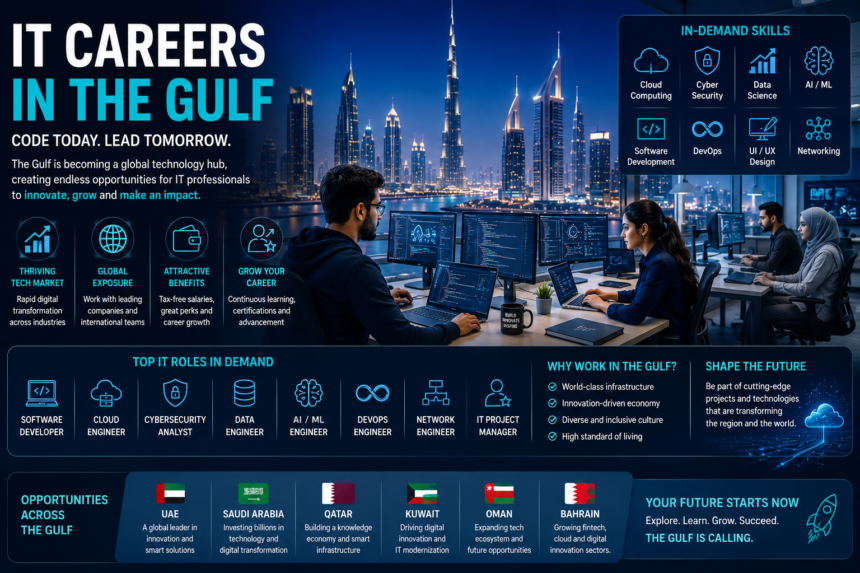
The Gulf is rapidly becoming one of the most interesting technology employment markets in the world. Governments are investing in artificial intelligence, companies are moving infrastructure to the cloud, banks are becoming digital platforms and businesses across every major industry are looking for people who can help them use technology more effectively.
- Why IT Careers in Gulf Are Growing
- 1. Artificial Intelligence Engineers
- 2. Machine Learning Engineers
- 3. Cybersecurity Specialists
- 4. Cloud Architects and Cloud Engineers
- 5. DevOps and DevSecOps Engineers
- 6. Software Developers
- 7. Data Engineers
- 8. Data Scientists and Analytics Professionals
- 9. Data Centre Infrastructure Engineers
- 10. IT Project and Programme Managers
- 11. Product Managers
- 12. ERP, SAP and Enterprise Technology Specialists
- IT Careers in Gulf at a Glance
- UAE Is One of the Strongest Gulf Technology Markets
- Saudi Arabia Is Building a Huge Technology Ecosystem
- Qatar Remains Relevant for Cybersecurity and Enterprise Technology
- Bahrain Is Strong for Fintech and Financial Technology
- Oman Offers Growing Digital Opportunities
- Kuwait Has Demand Across Banking, Energy and Enterprise IT
- AI Skills Are Becoming Valuable Beyond AI Jobs
- Technical Skills That Can Improve Your Gulf Career
- Certifications Can Strengthen Your Profile
- Build Projects That Employers Can See
- Fresh Graduates Should Focus on Employability
- Experienced Professionals Should Show Business Impact
- IT Salaries in Gulf Countries
- Compare the Complete Employment Package
- Communication Skills Matter More Than Many IT Professionals Expect
- Where to Find IT Jobs in Gulf Countries
- Do Not Depend Only on Dubai
- Watch for Fake Gulf Technology Jobs
- The Future of IT Careers in Gulf
- Frequently Asked Questions
- Conclusion
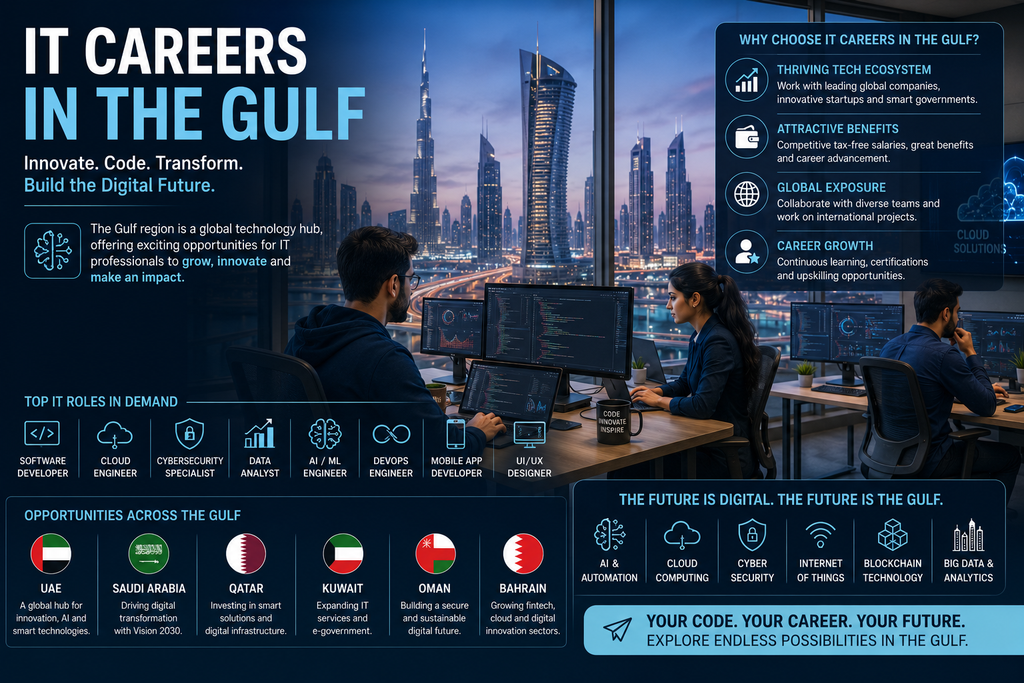
For professionals exploring IT Careers in Gulf, this creates opportunities far beyond traditional IT support. Artificial intelligence, cybersecurity, cloud architecture, data engineering, software development, DevOps and digital transformation are now among the most important career areas across the GCC.
The UAE provides one of the clearest examples. PwC’s 2026 AI Jobs Barometer found that the country is among the world’s fastest growing AI talent markets. AI related job postings increased from 1 percent of UAE vacancies in 2021 to 3.2 percent in 2025, while demand expanded across technology, financial services, manufacturing, energy and healthcare.
Technology hiring has also proved comparatively resilient despite a softer regional employment market. The Naukrigulf Hiring Index reported that IT and digital roles experienced the smallest decline among major sectors during April and May 2026, with technology role demand down only 3 percent year on year across the markets it tracks.
For job seekers, the message is clear. Gulf companies are not simply hiring more people who know technology. They are looking for specialists who can apply it to real business problems.
Why IT Careers in Gulf Are Growing
Technology growth in the GCC is being driven by several forces at the same time.
Governments want digital public services.
Banks need stronger cybersecurity.
Retailers want better ecommerce platforms.
Energy companies need data analytics.
Hospitals are adopting digital systems.
Airlines need software and cloud infrastructure.
Major projects in Saudi Arabia also need smart city technology, automation, data centres and digital operations.
Recruitment analysis for 2026 shows that software engineering, AI and data, cybersecurity and cloud infrastructure remain among the most active technology hiring areas in the UAE and Saudi Arabia.
At the same time, employers are becoming more selective.
They want people who can demonstrate real technical depth rather than simply list popular tools.
1. Artificial Intelligence Engineers
Artificial intelligence is one of the strongest growth areas for IT Careers in Gulf.
AI engineers may work on:
Machine learning
Generative AI
Computer vision
Natural language processing
Automation
Recommendation systems
Enterprise AI tools
The UAE has become particularly active in this area. PwC found that nearly 10 percent of technology, media and telecommunications job postings in the country required AI skills by 2025.
Saudi Arabia is also building strong demand. Current 2026 recruitment data identifies AI engineering among the most in demand technology roles, supported by public and private investment in smart cities, healthcare, logistics and digital infrastructure.
Strong candidates usually need more than familiarity with ChatGPT.
Useful skills can include:
Python
Machine learning frameworks
Data engineering
Model deployment
Cloud infrastructure
Prompt engineering
AI governance
2. Machine Learning Engineers
Machine learning engineers work more deeply with predictive models and intelligent systems.
Potential applications include:
Fraud detection
Customer recommendations
Financial risk analysis
Demand forecasting
Healthcare analytics
Logistics optimisation
The field requires strong technical foundations.
Python, statistics, algorithms, model training and deployment are all useful.
Employers increasingly value professionals who can take a machine learning model beyond experimentation and put it into production.
That difference matters.
Building a model in a notebook is one skill.
Creating a reliable system that thousands of customers can use is another.
3. Cybersecurity Specialists
Cybersecurity is becoming one of the most valuable technology career areas in the Gulf.
Banks, hospitals, governments, airlines and major companies all depend on secure digital systems.
Cybersecurity careers can include:
Security operations
Cloud security
Application security
Penetration testing
Governance and risk
Identity management
Incident response
AI security
The field is also becoming more specialised.
A recent Saudi job posting from Bupa Arabia, for example, sought a manager specifically responsible for application and AI security, showing how emerging AI systems are creating entirely new security responsibilities.
GCC recruitment analysis also identifies cybersecurity leaders among the five most in demand technology profiles in 2026.
4. Cloud Architects and Cloud Engineers
Cloud computing has become essential to modern business.
Companies increasingly rely on platforms such as:
AWS
Microsoft Azure
Google Cloud
Cloud professionals may design, migrate, secure and manage these environments.
Career options include:
Cloud engineer
Cloud architect
Cloud security engineer
Platform engineer
Infrastructure engineer
The demand is particularly strong because AI, digital services and data systems all need scalable infrastructure.
UAE employers are currently reporting shortages of specialists in cloud architecture alongside AI and machine learning, with many businesses planning to maintain or increase hiring during the second half of 2026.
5. DevOps and DevSecOps Engineers
Modern companies want software delivered quickly without sacrificing reliability or security.
That is where DevOps comes in.
DevOps engineers can work with:
Automation
Continuous integration
Continuous deployment
Cloud infrastructure
Containers
Monitoring
System reliability
Common technologies include Docker, Kubernetes, Git and cloud services.
DevSecOps adds security into the development process from the beginning rather than treating it as something added later.
Current GCC hiring analysis identifies cloud architects and DevSecOps engineers among the most heavily sought technology professionals in 2026.
This can be an excellent career path for professionals who enjoy programming, infrastructure and problem solving.
6. Software Developers
Software developers remain at the centre of the technology economy.
Companies need developers to build:
Web applications
Mobile apps
Enterprise platforms
Banking systems
Ecommerce platforms
Customer applications
Internal tools
Current technology job listings across the Gulf continue to show vacancies for software engineers, full stack developers, Java specialists and application support professionals in Dubai, Saudi Arabia, Qatar and other markets.
Useful technologies depend on the role.
They may include:
JavaScript
TypeScript
Python
Java
C Sharp
Go
React
Node.js
Strong developers should focus less on collecting programming languages and more on building reliable systems.
7. Data Engineers
Data engineering is becoming increasingly important because AI and analytics depend on reliable data.
Data engineers build:
Data pipelines
Databases
Data warehouses
Cloud data platforms
ETL systems
Streaming systems
Poor data creates poor decisions.
It also creates poor AI.
That makes data engineering one of the less glamorous but extremely valuable parts of the modern technology ecosystem.
Job seekers interested in AI should consider this field carefully.
Companies may have strong demand for professionals who can organise and move data before advanced models can even begin using it.
8. Data Scientists and Analytics Professionals
Data scientists help organisations turn information into useful decisions.
They may work across:
Banking
Retail
Healthcare
Energy
Logistics
Telecommunications
Government
Useful skills include:
Python
SQL
Statistics
Machine learning
Data visualisation
Business analysis
The most valuable data scientists understand the business problem as well as the mathematics.
A technically impressive model is not useful if company leaders cannot understand what action they should take because of it.
Communication therefore becomes a major career advantage.
9. Data Centre Infrastructure Engineers
Data centres are becoming one of the most important technology infrastructure areas in the Gulf.
Cloud computing and AI require enormous computing capacity.
That creates demand for specialists who understand:
Servers
Networking
Storage
Power systems
Cooling
Reliability
Data centre operations
Current GCC recruitment analysis specifically lists data centre infrastructure engineers among the top five most in demand technology roles in 2026.
This field can also attract professionals from electrical and mechanical engineering backgrounds who move toward mission critical digital infrastructure.
10. IT Project and Programme Managers
Not every IT career requires constant coding.
Technology programmes need people who can coordinate technical teams, budgets and business objectives.
Roles can include:
IT Project Manager
Technology Programme Manager
Digital Transformation Manager
PMO Manager
A project manager may coordinate:
Developers
Cybersecurity teams
Cloud specialists
Vendors
Business leaders
Consultants
Large digital transformation programmes across the GCC make these roles especially important.
Recruitment analysis identifies digital and technology programme directors among the most valuable senior technology profiles in the region.
Strong project managers combine organisation with enough technical knowledge to understand what their teams are actually building.
11. Product Managers
Product managers sit between technology, customers and business strategy.
They help decide:
What should be built
Who it is for
Which features matter
What should be prioritised
How success should be measured
Product management is particularly relevant within fintech companies, startups, ecommerce businesses and digital platforms.
A strong product manager does not necessarily need to be a senior developer.
But they should understand how technology products are designed and delivered.
They also need to understand customer behaviour.
12. ERP, SAP and Enterprise Technology Specialists
Gulf companies run large, complex operations.
That means enterprise software remains extremely important.
Career opportunities can include:
SAP consultant
Oracle consultant
ERP implementation specialist
Integration engineer
Enterprise applications manager
Current Gulf technology listings continue to show vacancies connected with SAP, Oracle and enterprise integration across the UAE and Saudi Arabia.
These careers can be especially valuable for experienced professionals who understand both business processes and technology.
A specialist who understands finance, supply chain or manufacturing alongside enterprise software can become particularly useful.
IT Careers in Gulf at a Glance
| Career | Key Skills |
|---|---|
| AI Engineer | Python, AI, model deployment |
| Machine Learning Engineer | ML, statistics, algorithms |
| Cybersecurity Specialist | Security, networks, cloud |
| Cloud Engineer | AWS, Azure, infrastructure |
| DevOps Engineer | Kubernetes, automation, CI CD |
| Software Developer | Programming and development |
| Data Engineer | SQL, pipelines, cloud data |
| Data Scientist | Analytics, Python, statistics |
| Data Centre Engineer | Infrastructure and reliability |
| IT Project Manager | Delivery and leadership |
| Product Manager | Product and customer strategy |
| ERP Specialist | SAP, Oracle, enterprise systems |
UAE Is One of the Strongest Gulf Technology Markets
The UAE stands out for diversity.
Dubai offers opportunities across:
Fintech
Ecommerce
Aviation
Startups
Banking
Retail
Technology consulting
Abu Dhabi has become particularly important in:
AI
Cloud infrastructure
Government digital transformation
Advanced technology
Cybersecurity
PwC’s 2026 analysis confirms that AI demand is spreading across every major UAE economic sector.
Even during a softer hiring environment in early 2026, technology roles remained more resilient than many other sectors.
For international IT professionals, this makes the UAE one of the broadest career markets in the GCC.
Saudi Arabia Is Building a Huge Technology Ecosystem
Saudi Arabia offers a different kind of opportunity.
Technology growth is closely connected with Vision 2030, infrastructure projects, financial services and large scale digital transformation.
Demand currently spans:
AI
Cloud
Cybersecurity
Data
Software engineering
Smart city technology
Digital government
Saudi technology hiring is also increasingly specialised.
Current 2026 recruitment analysis points to AI, cloud and cybersecurity as major growth areas, supported by large digital infrastructure investments.
Experienced professionals may find particularly strong opportunities in Riyadh and other major business centres.
Qatar Remains Relevant for Cybersecurity and Enterprise Technology
Qatar has a smaller technology market but still provides specialist opportunities.
Industries such as:
Telecommunications
Energy
Aviation
Financial services
Government
all require technology professionals.
Current job listings include cybersecurity, DevOps and AI related roles linked to Qatar based employers.
However, Qatar’s wider economy has faced significant pressure in 2026 from regional conflict and energy disruptions, so candidates should evaluate current economic conditions alongside individual job opportunities.
Bahrain Is Strong for Fintech and Financial Technology
Bahrain has a long established banking industry.
This makes technology careers connected with finance particularly relevant.
Opportunities can involve:
Fintech
Payments
Cybersecurity
Banking systems
Cloud infrastructure
Data
The country’s market is smaller than the UAE or Saudi Arabia.
Candidates may therefore benefit from specialising rather than applying broadly.
Oman Offers Growing Digital Opportunities
Oman’s technology market is smaller, but careers exist across:
Government digital services
Energy
Telecommunications
Banking
Enterprise IT
Current regional technology job listings show AI and digital roles across Oman alongside other GCC countries.
Professionals with enterprise systems, cybersecurity or digital transformation experience may find relevant opportunities.
Kuwait Has Demand Across Banking, Energy and Enterprise IT
Kuwait also offers technology careers linked with:
Banking
Oil and gas
Government
Telecommunications
Enterprise systems
Recent regional listings include IT security and network roles in Kuwait.
The market is smaller than Dubai or Riyadh, so targeting specific employers can be more effective than broad applications.
AI Skills Are Becoming Valuable Beyond AI Jobs
One of the biggest changes in 2026 is that AI knowledge matters even for professionals who are not AI engineers.
PwC found that UAE occupations highly exposed to AI increasingly require much broader skill sets. The most AI exposed roles required an average of 77 new skills compared with 22 among the least exposed occupations.
This means software developers may need AI knowledge.
Cybersecurity professionals may need AI security awareness.
Project managers may need to understand AI implementation.
Analysts may need AI assisted data workflows.
The message for professionals is not that everyone should become an AI engineer.
It is that everyone should understand how AI is changing their own field.
Technical Skills That Can Improve Your Gulf Career
Useful skills depend on the chosen path.
Important areas include:
- Python
- JavaScript
- SQL
- Cloud computing
- Cybersecurity
- Machine learning
- Data engineering
- DevOps
- APIs
- AI tools
Do not attempt to master everything simultaneously.
Choose a target career first.
Then build depth.
A strong cybersecurity specialist is usually more valuable than someone with shallow knowledge of ten unrelated technology areas.
Certifications Can Strengthen Your Profile
Relevant certifications can help, especially in:
Cloud
Cybersecurity
Networking
Project management
Enterprise software
Examples can include AWS, Azure, Cisco, security and SAP related credentials.
But certifications should support practical experience.
Employers want proof that you can solve real problems.
A cloud certificate is useful.
Having actually migrated infrastructure into the cloud is more convincing.
Build Projects That Employers Can See
Fresh graduates and career switchers should create evidence.
Build:
Web applications
AI projects
Dashboards
Cloud deployments
Security labs
Automation tools
GitHub projects
A portfolio shows what you can do.
It also gives you something useful to discuss in interviews.
The technology market is increasingly skills based.
A candidate who can show practical work may stand out from someone who relies only on academic qualifications.
Fresh Graduates Should Focus on Employability
The Gulf can be competitive for fresh IT graduates.
Employers can recruit internationally.
That means graduates need something beyond a degree.
A strong profile could include:
Internships
Technical projects
GitHub
Certifications
Communication skills
Hackathons
Open source contributions
Do not focus only on salary.
The first role should ideally create useful experience.
Two years of strong software, cloud or cybersecurity experience can dramatically improve your future market position.
Experienced Professionals Should Show Business Impact
Experienced candidates should avoid vague CV statements.
Instead of:
Worked on cybersecurity projects
write:
Led security remediation across 150 cloud applications and reduced high risk vulnerabilities.
Instead of:
Managed data systems
write:
Built a data platform supporting analytics across six business units.
The Gulf market values results.
Numbers help employers understand the scale of your work.
IT Salaries in Gulf Countries
Technology salaries vary considerably according to:
Country
Specialisation
Experience
Company
Industry
Leadership level
AI, cybersecurity, cloud and senior architecture roles can command strong compensation when talent supply is limited.
The UAE currently faces reported shortages in AI, cloud and machine learning specialists, which can improve negotiating power for experienced candidates.
But candidates should not trust generic salary claims.
A help desk technician and cloud architect are both IT professionals, yet their compensation can be completely different.
Research the exact job title.
Compare the Complete Employment Package
Gulf job packages may include:
Basic salary
Housing allowance
Medical insurance
Transport
Annual flights
Bonus
Education support
The total package matters.
A high salary in an expensive city can sometimes create less savings than a smaller salary with housing included.
Always compare realistic monthly income against realistic living costs.
Communication Skills Matter More Than Many IT Professionals Expect
Gulf workplaces are highly international.
Technology teams may include employees from many countries.
Engineers often need to communicate with:
Business managers
Clients
Government stakeholders
Vendors
Executives
Clear English is therefore extremely valuable.
Arabic can provide an additional advantage in government, customer facing and regional roles.
Technical expertise may help you get hired.
Communication often helps you get promoted.
Where to Find IT Jobs in Gulf Countries
Use multiple channels.
Search through:
Employer career pages
Technology recruiters
Job portals
Startup networks
Professional events
Current Gulf job platforms continue listing technology roles across all six GCC countries, ranging from AI and cybersecurity to software and IT infrastructure.
Do not apply blindly.
Focus on roles matching your skills.
Do Not Depend Only on Dubai
Many international technology professionals automatically search only Dubai.
That can limit opportunities.
A cybersecurity specialist may find an excellent role in Riyadh.
A banking technology professional may find Bahrain attractive.
An energy IT specialist may find opportunities in Qatar or Kuwait.
An enterprise technology professional may find Oman suitable.
Think about industry first and city second.
Watch for Fake Gulf Technology Jobs
Job scams can target international applicants.
Warning signs include:
Guaranteed employment
Jobs without interviews
Requests for upfront visa payments
Unrealistically high salaries
Recruiters using personal accounts
Pressure to send money immediately
Always verify the employer independently.
Do not rely only on information supplied by the person contacting you.
The Future of IT Careers in Gulf
The Gulf technology market is becoming more specialised.
The strongest areas in 2026 include:
AI
Data
Cybersecurity
Cloud
DevSecOps
Data centres
Digital transformation
Enterprise systems
GCC recruitment analysis shows that data centre infrastructure engineers, AI and machine learning engineers, cloud and DevSecOps specialists, cybersecurity leaders and digital programme directors are among the most sought after technology professionals today.
This suggests a major shift.
Companies increasingly want people who can build and operate digital infrastructure at scale.
Basic IT knowledge is no longer enough for premium careers.
Frequently Asked Questions
Are IT Careers in Gulf in demand in 2026?
Yes. Technology hiring remains comparatively resilient, with AI, cybersecurity, cloud, data and software roles among the strongest areas across the GCC.
Which Gulf country is best for IT jobs?
The UAE currently offers one of the most diverse technology markets, while Saudi Arabia offers strong growth linked with major transformation projects. Bahrain can be attractive for fintech, while Qatar, Kuwait and Oman provide more specialised opportunities.
Which IT jobs are growing fastest?
AI engineering, machine learning, cybersecurity, cloud architecture, DevSecOps, data engineering and data centre infrastructure are among the strongest growth areas.
Are AI jobs growing in the UAE?
Yes. UAE job postings requiring AI skills increased significantly between 2021 and 2025, with AI related vacancies reaching 3.2 percent of total postings by 2025.
Is Saudi Arabia good for technology careers?
Yes. Saudi Arabia is seeing strong demand in AI, cybersecurity, cloud and data as Vision 2030 and digital infrastructure investment continue shaping the market.
Can fresh graduates find IT jobs in the Gulf?
Yes, although competition is strong. Internships, projects, certifications and practical technical skills can improve employability considerably.
Do I need Arabic for Gulf IT jobs?
Not necessarily. English is widely used in many technology teams. Arabic can provide an advantage in government, local customer and regional product roles.
Conclusion
IT Careers in Gulf are becoming one of the region’s most important employment stories.
The UAE is building a strong AI and digital economy.
Saudi Arabia is creating technology demand through national transformation, smart cities and major infrastructure investment.
Bahrain continues to provide opportunities around finance and fintech.
Qatar, Kuwait and Oman offer specialist careers across energy, telecommunications, banking and enterprise IT.
But technology hiring is also becoming more demanding.
Employers increasingly want specialists in artificial intelligence, cybersecurity, cloud infrastructure, data engineering, DevOps and digital transformation rather than simply general IT knowledge.
PwC’s latest data shows just how quickly this change is happening. AI demand in the UAE has more than tripled as a share of job postings since 2021, while the skills required across AI exposed professions are expanding rapidly.
For job seekers, this creates a clear strategy.
Choose a technology field.
Build deep practical skills.
Create projects that prove your ability.
Develop strong communication.
Understand the industries hiring in each Gulf country.
And keep learning as technology changes.
The tools used today will evolve.
Programming languages will change.
AI systems will become more powerful.
But professionals who can combine technical expertise, adaptability and an understanding of real business problems will continue to have valuable opportunities across the Gulf’s expanding digital economy.
follow us on Instagram
Read More – Engineering Jobs in Gulf: 12 Amazing Careers for 2026