




Cost of Living in Oman for Expats and Families
The Cost of Living in Oman is one of the most important things to understand before accepting a job, relocating with family or planning a longer stay in the Sultanate. Oman can offer an attractive Gulf lifestyle, but the amount you need each month depends heavily on where you live, the size of your household and how you choose to spend your income.
- Cost of Living in Oman for Expats in 2026
- 1. Housing and Rent in Oman
- 2. Cost of Living in Muscat
- 3. Rent for Singles Versus Families
- 4. Electricity, Water and Utility Costs
- 5. Grocery Costs in Oman
- 6. How to Save on Groceries
- 7. Eating Out in Oman
- 8. Transport Costs in Oman
- 9. Is a Car Necessary in Oman
- 10. Mobile and Internet Costs
- 11. Healthcare Costs in Oman
- 12. Medical and Residency Expenses
- 13. Education Costs in Oman
- 14. Choosing a School Based on Budget
- 15. Cost of Living in Oman for a Single Professional
- 16. Cost of Living in Oman for Couples
- 17. Cost of Living in Oman for Families
- 18. Childcare and Domestic Help
- 19. Entertainment and Lifestyle Costs
- 20. Weekend Travel Costs
- 21. Clothing and Personal Shopping
- 22. VAT in Oman
- 23. Personal Income Tax and What Changes in 2028
- 24. Saving Money While Living in Oman
- 25. Employment Benefits That Reduce Living Costs
- 26. Building an Emergency Fund
- 27. Cost of Living in Muscat Versus Salalah
- 28. Cost of Living in Sohar
- 29. Inflation and Why Your Budget Should Change
- 30. How Much Salary Is Enough in Oman
- 31. How to Create a Monthly Oman Budget
- 32. Common Cost of Living Mistakes
- 33. Is Oman Affordable Compared With Other Gulf Countries
- Frequently Asked Questions About Cost of Living in Oman
- Conclusion
A single professional renting a modest apartment can have very different expenses from a family paying for a villa, private school, two cars and international health insurance.
Housing usually represents one of the largest parts of a household budget. Oman’s official consumer price index also gives housing, water, electricity, gas and other fuels the largest weighting among household spending categories at 31.7 percent. Food and non-alcoholic beverages account for around 20.6 percent of the index, while transport represents around 14.5 percent.
That provides a useful picture of where household spending tends to concentrate.
Inflation also matters. In April 2026, overall consumer inflation in Oman was 3.6 percent compared with April 2025. Food and non-alcoholic beverages were up 6.2 percent, transport was up 6 percent and restaurants and hotels were up 4.5 percent.
For expatriates, this means budgeting should be realistic and regularly updated rather than based on old cost-of-living articles.
Cost of Living in Oman for Expats in 2026
There is no single monthly amount that represents the Cost of Living in Oman for everyone.
Your budget depends on several factors:
Where you live
Whether you live alone or with family
Type of accommodation
Schooling
Transport
Healthcare coverage
Dining habits
Travel
Shopping
Lifestyle
Someone whose employer pays rent, health insurance and children’s school fees can save considerably more than another employee receiving a higher basic salary but paying all these expenses personally.
The complete compensation package is therefore more important than salary alone.
1. Housing and Rent in Oman
Housing is usually the largest single expense for expatriates.
Rental costs differ significantly between Muscat, Salalah, Sohar and smaller cities.
They also vary within Muscat itself.
Premium apartments or villas in popular residential developments naturally cost more than older apartments in less central locations.
Several factors influence rent:
Neighbourhood
Property size
Furnished or unfurnished status
Building age
Swimming pool
Gym
Security
Parking
Sea or mountain views
Maintenance
Nearby schools
Distance from work
For a single professional, a studio or one-bedroom apartment may be sufficient.
Families often need two or three bedrooms or a villa.
Before signing a lease, ask whether electricity, water, internet or maintenance are included.
A property with a lower advertised rent can become more expensive after utilities and commuting costs are added.
2. Cost of Living in Muscat
Muscat generally offers the widest range of employment, schools, healthcare and international amenities, but it can also have some of Oman’s higher housing costs.
The city is spread across a large area.
This means location is particularly important.
Living close to work can reduce transport costs and save time.
Families should also look closely at school locations because school runs can affect both fuel costs and daily routines.
A central apartment may cost more than a property farther away, but the difference can sometimes be justified if it removes a long commute.
Muscat is therefore best evaluated by total lifestyle cost rather than rent alone.
3. Rent for Singles Versus Families
Singles have much greater flexibility.
A single employee may choose:
Studio apartment
One-bedroom apartment
Shared accommodation where legally appropriate
Furnished serviced apartment
Families have more complicated requirements.
They may need:
Two or three bedrooms
Villa
Parking for multiple cars
School access
Children’s play areas
Larger kitchen
Storage
More bathrooms
A family should therefore build its budget around realistic housing needs rather than comparing itself with a single expatriate worker.
4. Electricity, Water and Utility Costs
Utilities are an important part of the Cost of Living in Oman, especially during summer.
Air conditioning is essential during the hotter months and can significantly affect electricity use.
Property size matters.
A large villa will normally require much more cooling than a one-bedroom apartment.
Before renting, ask the landlord or agent whether previous utility bills are available.
You should also understand:
Electricity billing
Water billing
Gas arrangements
Air-conditioning system
Maintenance responsibility
Building service charges
Oman’s consumer price index gives housing, water, electricity, gas and other fuels the largest spending weight, even though this category showed little price movement in the April 2026 inflation data.
That makes utilities relatively stable in price terms but still significant in household budgets.
5. Grocery Costs in Oman
Food spending can vary dramatically.
Oman has hypermarkets, supermarkets, smaller grocery stores and traditional markets.
Local and regional products can be relatively affordable, while imported premium items can raise the bill.
Common grocery categories include:
Rice
Flour
Bread
Milk
Eggs
Chicken
Fish
Meat
Fruit
Vegetables
Cleaning supplies
Baby products
Imported foods
Oman’s official CPI data shows food and non-alcoholic beverages account for more than 20 percent of consumer spending weight. In April 2026, this category was 6.2 percent more expensive than a year earlier.
For families, food is therefore an area where even small price increases can noticeably affect monthly spending.
6. How to Save on Groceries
Simple habits can reduce food expenses.
Buy regional products instead of imported premium brands.
Compare supermarkets.
Use promotions.
Purchase staples in larger quantities.
Cook at home regularly.
Avoid excessive food delivery.
Shop with a list.
Families can also save by planning meals in advance.
Buying without a plan often leads to more waste and repeated shopping trips.
Traditional markets can also provide good value for certain fresh products.
7. Eating Out in Oman
Oman has a broad dining scene ranging from inexpensive cafeterias to premium restaurants and hotel dining.
A casual local meal can be affordable.
Luxury dining can cost several times more.
Restaurant spending depends almost entirely on lifestyle.
Someone eating out once per week may maintain a reasonable budget.
Someone ordering delivery daily, drinking coffee at premium cafes and visiting hotels every weekend can easily spend much more.
Restaurants and hotels recorded a 4.5 percent year-on-year increase in the April 2026 consumer price report.
That makes dining one of the areas where lifestyle inflation can quickly reduce savings.
8. Transport Costs in Oman
Transport is another major household expense.
Oman’s official CPI gives transport a weight of around 14.5 percent of consumer spending. In April 2026, transport prices were 6 percent higher year on year.
For many expatriates, owning or leasing a car is the most practical option.
Muscat and other cities are relatively spread out.
A car can make commuting, school runs and weekend travel considerably easier.
Typical vehicle expenses include:
Purchase price
Finance payment
Insurance
Fuel
Registration
Maintenance
Tyres
Repairs
Parking
Car wash
These should all be included in your monthly budget.
9. Is a Car Necessary in Oman
Not for every resident, but it can make daily life much easier.
Singles living near work may use taxis or ride-hailing services.
Families often find a car more practical, particularly when children attend school.
Professionals living outside central Muscat may also depend more heavily on private transport.
Before buying a car, spend your first few weeks understanding your actual commuting needs.
Some new expatriates immediately purchase an expensive vehicle and later discover that a more basic option would have been sufficient.
10. Mobile and Internet Costs
Internet and mobile connectivity are essential expenses.
Most households will need:
Home broadband
Mobile data
Calls
Streaming subscriptions
Possibly extra data for family members
The overall communication component of Oman’s CPI has been relatively stable, with the 2025 communications index below its 2018 base level.
However, monthly expenses still depend on the plan selected.
Compare providers based on:
Data allowance
Internet speed
Contract length
Installation charges
International calls
Roaming
Device financing
Do not automatically choose the most expensive package.
11. Healthcare Costs in Oman
Healthcare can become a significant expense for expatriates if insurance is limited.
Many employers provide medical insurance, but coverage varies.
Before accepting a job, check whether the policy covers:
Hospitalisation
Outpatient care
Emergency treatment
Specialist visits
Prescription medicines
Maternity
Dental care
Optical care
Children
Pre-existing conditions
A cheap insurance policy may have low limits or a narrow hospital network.
Families should pay particular attention to maternity and paediatric coverage.
12. Medical and Residency Expenses
Residency can also involve medical costs.
Oman requires certain expatriate workers to complete medical fitness procedures during residency processing.
These costs may be covered by the employer, but employees should verify this.
If you are relocating with dependants, calculate family visa, medical and residence expenses separately.
These may not appear every month but should still be included in the annual household budget.
13. Education Costs in Oman
For families, education can be one of the most expensive parts of life in Oman.
Muscat has international schools offering curricula such as:
British
American
International Baccalaureate
Indian
Other international programmes
Parents should budget for much more than tuition.
Additional expenses can include:
Registration fee
Application fee
Books
Uniform
School bus
Devices
Meals
Activities
Trips
Extracurricular programmes
A strong employment package may include a school allowance.
That benefit can dramatically change the true value of the job.
14. Choosing a School Based on Budget
Families should first determine how much they can comfortably spend on education.
Then compare schools within that budget.
Do not select a school solely because it has the highest fees.
Consider:
Curriculum
Academic outcomes
Distance from home
Transport
Class sizes
Facilities
Extracurricular activities
University pathways
A school located close to home can reduce transportation cost and daily stress.
15. Cost of Living in Oman for a Single Professional
A single professional has the greatest ability to control costs.
A typical budget may include:
Rent
Utilities
Groceries
Transport
Mobile and internet
Health expenses
Dining
Entertainment
Flights home
Savings
The biggest savings usually come from controlling housing and car expenses.
Someone living in a reasonably priced apartment close to work may spend considerably less than a professional renting a luxury property and financing a premium vehicle.
16. Cost of Living in Oman for Couples
Couples can often share housing, utilities and transport expenses.
This can reduce per-person costs.
However, expenses can rise if both partners need separate cars or if one partner initially cannot work.
Couples relocating internationally should therefore keep an emergency fund.
Do not assume both incomes will begin immediately.
Residency, job searching or licensing can take time.
17. Cost of Living in Oman for Families
Families face the highest overall expenses.
Major categories include:
Larger home
Schooling
Health insurance
Groceries
Multiple mobile plans
Car costs
Children’s activities
Flights home
Dependent residency
Childcare
A family with two children in international school can have a completely different financial experience from a single expatriate on the same salary.
This is why family relocation decisions should be based on annual expenses rather than basic monthly spending alone.
18. Childcare and Domestic Help
Some families need childcare or domestic support.
Costs vary according to:
Live-in or part-time arrangements
Number of hours
Visa responsibility
Accommodation
Experience
Duties
Families should use lawful employment arrangements.
Do not rely on informal agreements that may create immigration or labour problems.
Childcare should also be compared with nursery and school options.
19. Entertainment and Lifestyle Costs
Entertainment spending is extremely flexible.
Oman offers:
Restaurants
Coffee shops
Shopping centres
Hotels
Beach resorts
Outdoor activities
Cinema
Diving
Camping
Mountain trips
Road trips
A resident who enjoys hiking, beaches and picnics may spend considerably less than someone who prefers luxury resorts and premium dining every weekend.
This is one area where Oman can be relatively lifestyle-friendly because many of its strongest experiences are nature-based.
20. Weekend Travel Costs
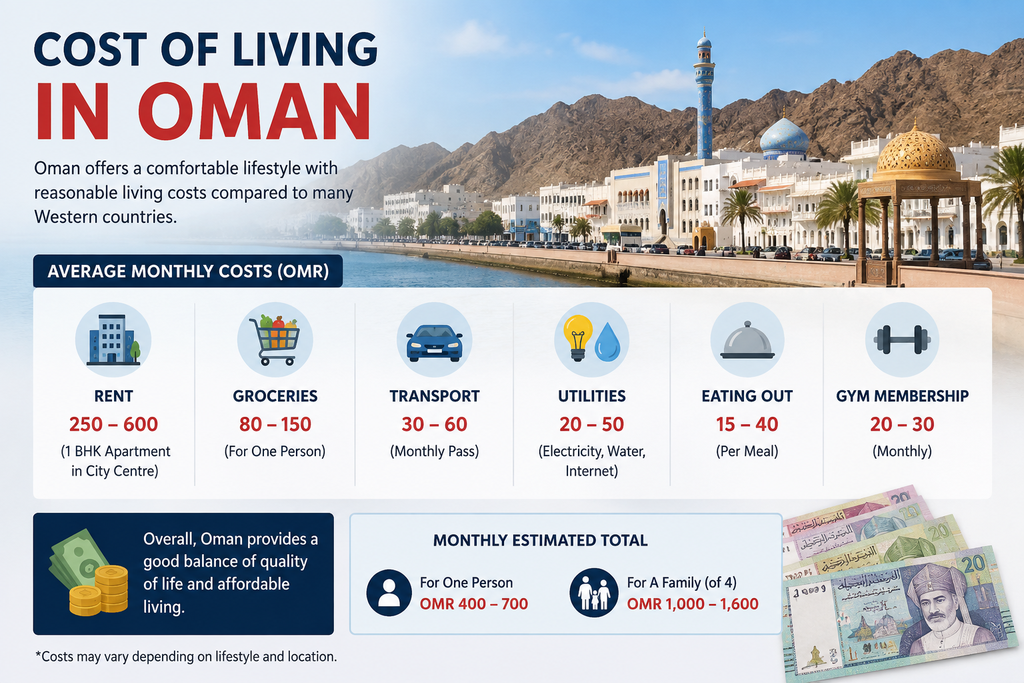
Domestic travel can become a regular part of expat life.
Popular weekend expenses may include:
Fuel
Hotel stays
Desert camps
Mountain resorts
Food
Adventure activities
Car maintenance
Entrance fees
A road trip to a beach or wadi can be relatively inexpensive.
A luxury mountain resort weekend can cost much more.
Setting a separate monthly leisure budget can prevent weekend spending from affecting savings goals.
21. Clothing and Personal Shopping
Clothing costs depend on shopping preferences.
International brands are widely available in Muscat.
Budget shoppers also have more affordable options.
Oman’s CPI data shows clothing and footwear had relatively low inflation in 2025, with the category increasing only modestly.
Residents can reduce shopping costs by avoiding unnecessary lifestyle spending, especially during the first months after relocating.
Moving to the Gulf often creates pressure to upgrade cars, clothes and housing too quickly.
That can reduce savings significantly.
22. VAT in Oman
Oman currently applies a standard VAT rate of 5 percent to most taxable goods and services.
The Tax Authority confirms that some supplies are zero-rated, while others are exempt. Residential property rental is among the exempt categories.
Examples of zero-rated areas include certain essential goods and international transport.
For everyday consumers, VAT means many purchases effectively cost slightly more than the pre-tax price.
When budgeting, include VAT in dining, shopping and various services rather than looking only at headline prices.
23. Personal Income Tax and What Changes in 2028
As of 2026, Oman’s new personal income tax has not yet taken effect.
However, Royal Decree 56/2025 introduced a Personal Income Tax Law that is scheduled to begin at the start of 2028.
The Tax Authority states that the tax will apply at a 5 percent rate on taxable income under the law for natural persons whose total annual income exceeds OMR 42,000, subject to the law’s exemptions and detailed rules.
This is important for high-income expatriates making long-term financial plans.
Older articles describing Oman as permanently free of personal income tax are therefore outdated.
For 2026 and 2027, the new personal income tax is not yet in effect, but anyone planning to stay beyond that should understand the upcoming change.
24. Saving Money While Living in Oman
Saving money is possible, but income alone does not determine savings.
Housing choice often has the biggest impact.
Other useful strategies include:
Live close to work
Choose a practical car
Cook at home
Avoid excessive delivery
Use supermarket promotions
Limit premium dining
Compare telecom plans
Negotiate employer benefits
Track spending
Maintain an emergency fund
A person earning less but receiving housing, insurance and school benefits may save more than someone with a higher salary but no allowances.
25. Employment Benefits That Reduce Living Costs
Before accepting an Oman job, check whether the employer provides:
Housing allowance
Company accommodation
Transport allowance
Car
Health insurance
Family insurance
School allowance
Annual flights
Phone allowance
Relocation costs
Visa costs
End-of-service benefits
These benefits should be converted into monetary value.
A job paying OMR 1,400 with housing and school support may offer better disposable income than a OMR 1,700 salary where the worker pays everything privately.
26. Building an Emergency Fund
Every expatriate should maintain emergency savings.
Three to six months of essential expenses is a useful target for many households.
Emergency savings can help if:
Employment ends
Visa status changes
A medical expense occurs
Family needs require travel
Car repairs become necessary
A rent deposit is required
International relocation can involve unexpected costs.
Having cash reserves provides flexibility.
27. Cost of Living in Muscat Versus Salalah
Muscat generally has a larger job market and broader range of premium housing, international schools and private healthcare.
Salalah can offer a quieter lifestyle.
However, costs should not be compared only by rent.
Consider:
Salary differences
School availability
Travel
Flights
Transport
Healthcare
Lifestyle
A lower rent does not automatically mean better financial value if career opportunities are limited.
28. Cost of Living in Sohar
Sohar can be attractive for professionals working in industrial, logistics or port-related sectors.
Housing may provide different value compared with premium Muscat locations.
The city can also reduce commute costs for employees working locally.
Families should still check school and healthcare availability before relocating.
If specialist services require frequent trips to Muscat, that can add both time and transport costs.
29. Inflation and Why Your Budget Should Change
A budget made two years ago may no longer be accurate.
Oman’s consumer inflation reached 3.6 percent year-on-year in April 2026. Food rose 6.2 percent, transport 6 percent and restaurants and hotels 4.5 percent.
That means residents should review budgets periodically.
If income remains unchanged while food, fuel and dining become more expensive, savings will naturally fall.
Tracking annual increases helps households make adjustments before financial pressure becomes serious.
30. How Much Salary Is Enough in Oman
There is no universal answer.
The right salary depends on what the employer covers.
Ask these questions:
Will I pay rent?
Do I have children?
Is school covered?
Do I need a car?
Is medical insurance included?
Will my spouse work?
How often will we travel?
What lifestyle do we expect?
A single person may live comfortably on a salary that would be insufficient for a family with two school-age children.
The correct calculation begins with your personal expenses, not someone else’s salary benchmark.
31. How to Create a Monthly Oman Budget
A useful monthly budget can be divided into four parts.
Essential fixed expenses
Rent
School
Car payment
Insurance
Internet
Essential variable expenses
Groceries
Fuel
Utilities
Healthcare
Lifestyle spending
Dining
Shopping
Entertainment
Travel
Savings
Emergency fund
Investment
Retirement
Future relocation
Sending money home
Savings should ideally be treated as a planned expense rather than whatever remains at the end of the month.
32. Common Cost of Living Mistakes
New expatriates often make similar mistakes.
Choosing expensive housing immediately
Buying an expensive car too soon
Ignoring school costs
Underestimating utility bills
Dining out constantly
Not checking insurance limits
Failing to budget for flights home
Not saving for annual visa expenses
Assuming salary equals disposable income
Using credit for lifestyle spending
The first six months should focus on understanding your real expenses.
33. Is Oman Affordable Compared With Other Gulf Countries
Oman can be competitive depending on housing and lifestyle.
But comparisons with Dubai, Doha, Riyadh or Bahrain should consider more than rent.
Look at:
Salary
Housing
Transport
School fees
Healthcare
Taxes
Entertainment
Employer allowances
Savings potential
Oman may suit residents who value outdoor activities and a calmer lifestyle, while another GCC market may offer a higher salary but also higher housing and entertainment costs.
The best financial destination is the one where income minus real expenses leaves the strongest balance.
Frequently Asked Questions About Cost of Living in Oman
Is the Cost of Living in Oman high?
The Cost of Living in Oman depends heavily on rent, family size, transport and education. Housing, food and transport are among the largest components of household spending according to Oman’s official consumer price structure.
What is VAT in Oman?
Oman currently applies a standard VAT rate of 5 percent on most taxable goods and services, while some supplies are zero-rated or exempt.
Does Oman have personal income tax in 2026?
The new personal income tax is not yet effective in 2026. It is scheduled to begin in 2028 at a 5 percent rate for taxable income under the law where total annual income exceeds OMR 42,000, subject to the law’s detailed rules and exemptions.
Is rent expensive in Muscat?
It depends on location and property type. Premium apartments and villas cost more, while older or less central areas can offer better value.
Are groceries expensive?
Costs vary according to shopping habits and the proportion of imported products purchased. Food inflation reached 6.2 percent year-on-year in April 2026, so households should update grocery budgets regularly.
Do expats need a car in Oman?
Not everyone does, but private transport can make daily life much easier because cities such as Muscat are spread out.
Is Oman affordable for families?
It can be, particularly when an employer covers housing, medical insurance and school fees. Families paying these privately need a much larger income.
Conclusion
The Cost of Living in Oman can be manageable for professionals and families who choose housing carefully and understand where their money will go.
Housing remains one of the biggest household expenses, followed by food and transport. Oman’s official CPI structure assigns 31.7 percent of spending weight to housing and utilities, 20.6 percent to food and 14.5 percent to transport.
Inflation also deserves attention. By April 2026, overall consumer prices were 3.6 percent higher than a year earlier, while food increased 6.2 percent and transport increased 6 percent.
For expatriates, the biggest financial decision is often not what salary to accept but what employment package to accept.
Housing allowance matters.
School allowance matters.
Medical insurance matters.
Transportation matters.
Annual flights matter.
A strong benefits package can reduce the Cost of Living in Oman dramatically.
Tax planning is also beginning to change. Oman currently charges 5 percent VAT on most taxable goods and services, while the new Personal Income Tax Law is scheduled to take effect from 2028 for qualifying higher-income individuals.
For anyone relocating in 2026, the smartest approach is to build a realistic budget before signing an employment contract.
Calculate rent.
Add utilities.
Estimate groceries.
Include transport.
Check school fees.
Understand insurance.
Budget for travel.
Create an emergency fund.
Then calculate how much remains for savings.
Oman can provide an attractive lifestyle without requiring luxury spending every weekend. Beaches, mountains, wadis, camping and road trips can also create leisure opportunities that are considerably more affordable than constantly relying on premium restaurants and hotels.
For a single professional, careful housing and transport choices can create strong savings potential.
For couples, sharing major costs can make life more manageable.
For families, school fees and accommodation become the key financial factors.
Ultimately, the Cost of Living in Oman is less about one average number and more about how well your income, benefits and lifestyle fit together.
A realistic budget makes it much easier to enjoy Oman for what it offers while still building financial stability for the future.
Follow us on Instagram
Read More – Oman Travel Guide: 12 Amazing Places and Tips for 2026