

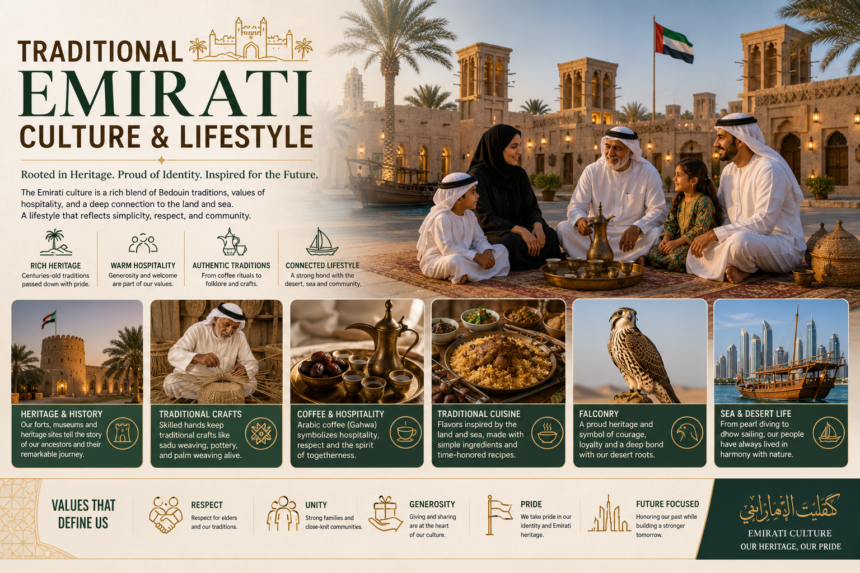
Traditional Emirati Culture and Lifestyle Guide to UAE Heritage and Traditions
What makes the UAE more than its modern skyline, luxury shopping malls, and futuristic cities? The answer lies in its rich traditional Emirati culture and lifestyle, shaped by centuries of Bedouin heritage, Islamic values, family traditions, seafaring, desert life, and close-knit communities. Although the United Arab Emirates has developed rapidly into one of the world’s most modern countries, many customs and traditions continue to play an important role in everyday life.
- The History of Emirati Culture
- Regional Cultural Differences Across the UAE
- Abu Dhabi and Al Ain: Desert, Oasis, and Tribal Heritage
- Dubai: Maritime Heritage and Cosmopolitan Influence
- Sharjah: Arts, Heritage, and Cultural Preservation
- Ajman and Umm Al Quwain: Coastal Traditions
- Ras Al Khaimah: Mountains, Agriculture, and Coastal Heritage
- Fujairah: Eastern Coast and Mountain Culture
- One National Identity, Many Regional Traditions
- Emirati Family Values and Community Life
- Traditional Emirati Hospitality
- Traditional Emirati Clothing
- Emirati Cuisine and Traditional Food
- The Importance of Dates in Emirati Culture
- Bedouin Heritage and Desert Lifestyle
- Falconry in Emirati Heritage
- Traditional Emirati Music and Dance
- Emirati Weddings and Celebrations
- Ramadan in Emirati Culture
- Emirati Traditional Architecture
- Traditional Emirati Handicrafts
- The Role of the Sea in Emirati Lifestyle
- Emirati Values in Modern UAE Society
- How the UAE Preserves Its Cultural Heritage
- Traditional Emirati Culture for Visitors
- Why Traditional Emirati Culture Still Matters
- Frequently Asked Questions About Traditional Emirati Culture and Lifestyle
For travellers, expatriates, and anyone interested in understanding the UAE beyond its modern attractions, learning about Emirati culture and traditions offers a deeper connection to the country. From traditional Emirati clothing and Arabic hospitality to local cuisine, family values, traditional celebrations, handicrafts, music, and desert heritage, the country’s culture reflects a strong connection between its past and present.
This guide explores traditional Emirati culture and lifestyle, explaining the customs, values, food, clothing, celebrations, social traditions, and heritage that have helped shape modern UAE identity. Whether you are visiting the UAE for the first time or living in the country, understanding these traditions can help you appreciate the cultural character of the Emirates.
The History of Emirati Culture
The culture of the UAE developed from the country’s natural environment and the communities that lived along its coast, in its oases, and across its deserts. Before the discovery and export of oil transformed the region’s economy, communities depended largely on activities such as fishing, pearl diving, trading, farming, herding, and date cultivation.
The desert played a particularly important role in shaping traditional Emirati life. Bedouin communities developed practical knowledge of desert travel, water sources, animal husbandry, navigation, and survival in a challenging environment. The sea was equally important for coastal communities, where fishing, maritime trade, and pearl diving supported families and connected the region with neighboring countries.
These different influences contributed to the diverse heritage that can be seen in traditional Emirati culture today. Modern cities may look very different from the villages and settlements of the past, but traditional values such as hospitality, family loyalty, generosity, respect, and community remain significant.
Regional Cultural Differences Across the UAE
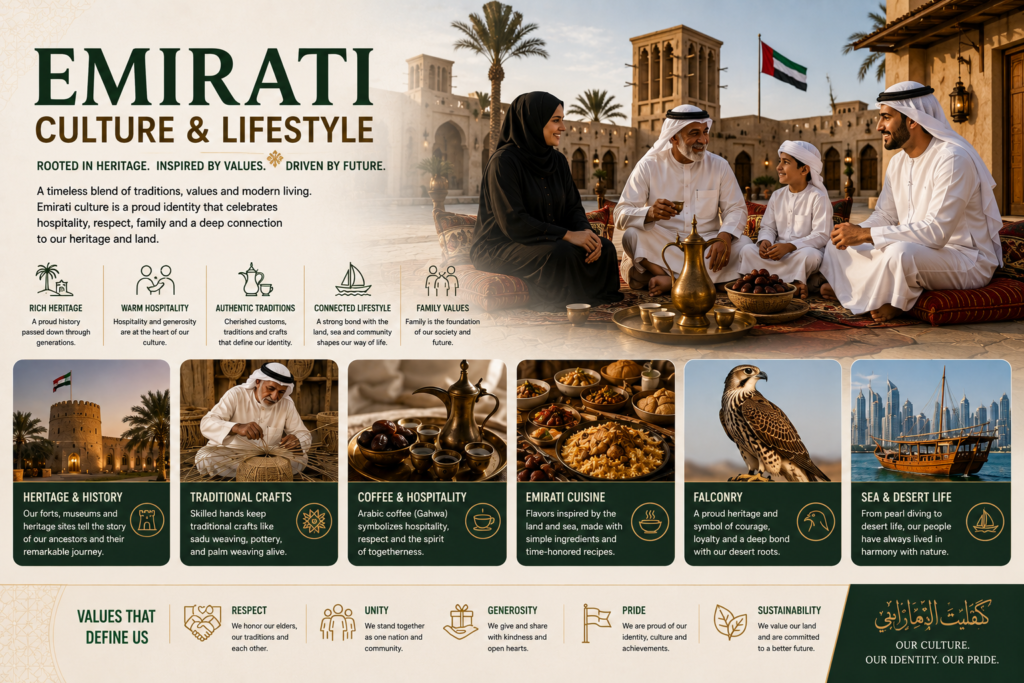
Although the seven emirates share a common national identity, traditional Emirati culture and lifestyle are not exactly the same everywhere. Geography, historical livelihoods, coastal or desert environments, and local communities have influenced the customs and traditions of each emirate. These regional differences add depth to UAE heritage while remaining connected through shared values such as hospitality, family, religion, and respect for tradition.
Abu Dhabi and Al Ain: Desert, Oasis, and Tribal Heritage
Abu Dhabi has strong connections with desert traditions, tribal history, and oasis life. The wider emirate includes extensive desert landscapes as well as the oasis city of Al Ain, where date palms and traditional falaj irrigation systems reflect the importance of agriculture and water management.
Traditional life in the Al Ain area was closely connected to oasis farming, particularly date cultivation. The region’s forts, traditional homes, palm gardens, and historic settlements provide an insight into how communities adapted to life in an arid environment.
The wider Abu Dhabi region also has strong connections with camel culture, falconry, poetry, traditional crafts, and desert activities. These traditions continue to feature in cultural festivals and heritage events.
Dubai: Maritime Heritage and Cosmopolitan Influence
Dubai is now one of the world’s most international cities, but its cultural history is deeply connected to the sea, fishing, pearl diving, trading, and small coastal settlements. Historic neighborhoods around areas such as Al Fahidi preserve elements of Dubai’s earlier architectural and commercial heritage.
Dubai’s traditional culture reflects the influence of merchants and maritime communities that interacted with people from across the Gulf and beyond. This history helped create a culture that was open to trade and cultural exchange.
Today, visitors can see the contrast between Dubai’s modern skyline and its traditional neighborhoods, souks, museums, heritage houses, and waterfront areas. The emirate demonstrates particularly clearly how Emirati heritage and modern lifestyle can exist side by side.
Sharjah: Arts, Heritage, and Cultural Preservation
Sharjah is widely associated with cultural and heritage preservation. The emirate has invested significantly in museums, historic areas, cultural institutions, traditional markets, and educational initiatives.
Traditional architecture and restored heritage buildings provide an opportunity to understand earlier Emirati lifestyles. The emirate’s cultural focus also extends to literature, arts, crafts, and traditional knowledge.
For visitors interested in UAE culture and heritage, Sharjah offers a particularly strong connection to the country’s history and cultural identity.
Ajman and Umm Al Quwain: Coastal Traditions
Ajman and Umm Al Quwain have historically maintained strong connections with the sea. Fishing, boat building, maritime trade, and pearl diving played important roles in the development of their coastal communities.
Traditional seafood dishes and maritime customs reflect this history. Historic forts, museums, old neighborhoods, and traditional boats can help visitors understand the importance of the sea in the everyday lives of earlier generations.
The smaller scale of these emirates can also provide a different cultural atmosphere from the highly urbanized areas of Dubai and Abu Dhabi.
Ras Al Khaimah: Mountains, Agriculture, and Coastal Heritage
Ras Al Khaimah has a distinctive geographical setting that includes mountains, valleys, agricultural areas, desert landscapes, and a long coastline. This variety influenced the traditional livelihoods and lifestyles of local communities.
The emirate’s heritage includes farming, date cultivation, fishing, livestock raising, and mountain-related traditions. Its historic forts and archaeological sites also highlight the long history of settlement in the region.
The Hajar Mountains have helped shape local identity and distinguish Ras Al Khaimah’s traditional environment from the flatter landscapes of many other parts of the UAE.
Fujairah: Eastern Coast and Mountain Culture
Fujairah is geographically distinctive because it lies along the Gulf of Oman on the UAE’s eastern coast and is backed by the Hajar Mountains. Its traditional culture has therefore been influenced by both maritime and mountain environments.
Fishing and agriculture have historically been important, while the mountainous landscape contributed to distinctive settlement patterns and farming practices. Traditional villages, forts, mosques, and agricultural areas offer insight into the emirate’s past.
Fujairah’s location on the eastern coast also contributed to historical connections with maritime routes outside the Arabian Gulf.
One National Identity, Many Regional Traditions
These regional differences should not be viewed as completely separate cultures. Instead, they represent different expressions of a broader Emirati cultural identity. A coastal community may emphasize fishing and pearl-diving heritage, while an inland community may have stronger connections with oasis farming, camels, and desert life.
Across the UAE, common cultural values continue to connect communities:
- Family and community relationships
- Hospitality and generosity
- Islamic traditions
- Respect for elders
- Arabic language and heritage
- Traditional food and celebrations
- Pride in national identity
- Preservation of historical customs
Understanding these regional differences makes it easier to appreciate the diversity within traditional Emirati culture and lifestyle. The UAE’s heritage is not defined by one single way of life; it is a collection of desert, oasis, mountain, and maritime traditions that have developed within a shared national identity.
Emirati Family Values and Community Life
Family is at the heart of traditional Emirati society. Historically, extended families often lived close to one another, creating strong social networks in which relatives supported each other. While modern lifestyles have changed household structures and living arrangements, family relationships continue to have an important place in Emirati society.
Respect for parents, grandparents, and older members of the community is strongly valued. Elders are often regarded as sources of knowledge and experience, and traditional stories, customs, and family histories can be passed from one generation to another through them.
Community relationships are also important. Social gatherings, weddings, religious occasions, family meals, and other events provide opportunities for relatives and friends to maintain close connections.
Important values associated with traditional Emirati lifestyle include:
- Respect for parents and elders
- Strong family relationships
- Generosity toward guests
- Community cooperation
- Respect for cultural traditions
- Hospitality and welcoming visitors
- Religious and moral values
- Pride in UAE heritage
Traditional Emirati Hospitality
One of the most recognizable features of Emirati culture is hospitality. Welcoming guests generously is considered an important social value, and visitors may be offered Arabic coffee, dates, tea, sweets, or meals depending on the occasion.
Arabic coffee, commonly known as gahwa, has a particularly important cultural role. It is traditionally served in small cups and may be flavored with cardamom and other spices. Serving coffee to guests is more than simply offering a drink; it represents generosity, welcome, and respect.
Dates are also closely associated with Emirati hospitality. They have been an important food in the Arabian Peninsula for centuries and remain a common offering to guests.
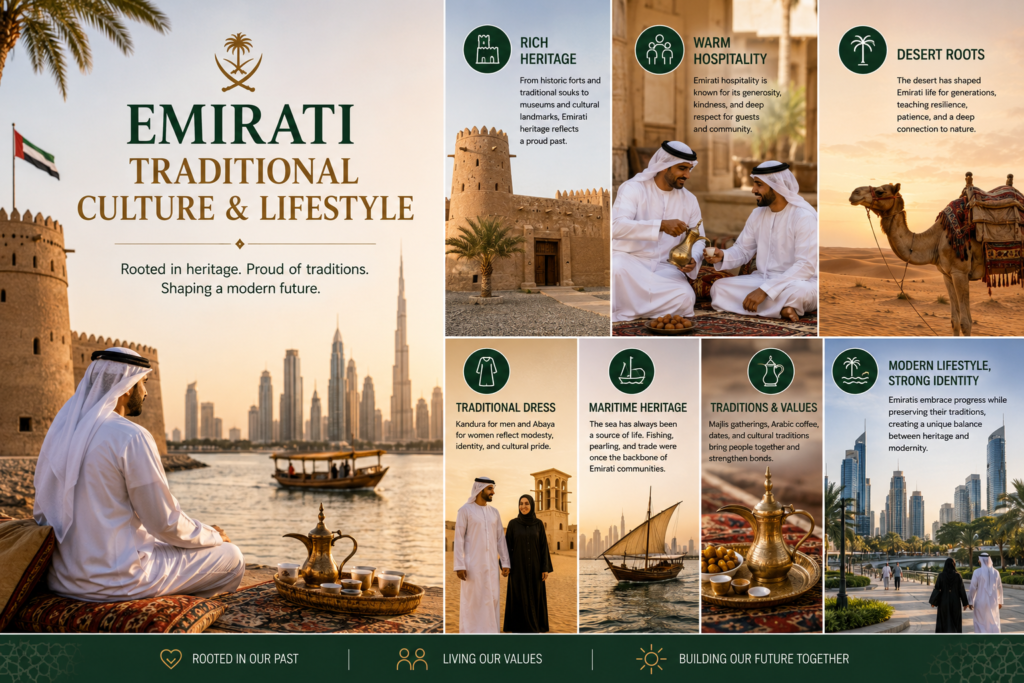
When visiting an Emirati home or attending a traditional gathering, guests may notice several customs connected with hospitality:
- Guests are welcomed warmly.
- Arabic coffee and dates are commonly offered.
- Food is often shared generously.
- Guests may be encouraged to eat and stay longer.
- Elders and guests are treated with particular respect.
This tradition of hospitality remains one of the defining characteristics of traditional UAE culture.
Traditional Emirati Clothing
Traditional clothing is another important part of Emirati identity. Although contemporary fashion is widespread, traditional garments remain especially visible during religious occasions, national celebrations, weddings, formal events, and cultural gatherings.
For men, the most recognizable traditional garment is the kandura, a long ankle-length robe that is generally white but can appear in other colors depending on the occasion and season. Men may also wear a head covering known as a ghutra, which can be secured with an agal.
Women’s traditional clothing includes the abaya, a loose-fitting outer garment commonly worn over other clothing when going out. Women may also wear a headscarf known as a shayla. Traditional Emirati women’s clothing can feature embroidery, decorative details, and elegant fabrics, particularly for special occasions.
Traditional clothing serves practical as well as cultural purposes. Loose-fitting garments are well suited to the region’s climate, while the clothing also reflects cultural values and social identity.
Emirati Cuisine and Traditional Food
Food is an essential part of Emirati lifestyle and culture. Traditional cuisine reflects the country’s history, environment, and connections with neighboring regions. Before modern transportation and refrigeration, people relied heavily on locally available ingredients and foods that could be preserved.
Rice, meat, fish, dates, wheat, vegetables, spices, and dairy products feature prominently in traditional Emirati cooking. Coastal communities naturally developed strong seafood traditions, while communities in inland and desert areas relied on livestock and preserved foods.
Some well-known traditional Emirati foods include:
Machboos
Machboos is a popular rice dish prepared with meat or seafood and flavored with spices. It is commonly served at family gatherings and special occasions.
Harees
Harees is made from wheat and meat cooked together until the mixture becomes smooth and creamy. It is particularly associated with Ramadan and festive occasions.
Thareed
Thareed combines bread with a flavorful stew containing vegetables and meat. It is a traditional dish with deep roots in Arabian cuisine.
Luqaimat
Luqaimat are small fried dumplings or sweet bites traditionally served with date syrup or other sweet toppings. They are especially popular during celebrations and gatherings.
Dates and Arabic Coffee
Dates and Arabic coffee remain among the most recognizable elements of Emirati hospitality and are commonly served to visitors.
Traditional Emirati food is not only about individual dishes. Meals are often connected with family gatherings, celebrations, hospitality, and community life.
The Importance of Dates in Emirati Culture
Date palms have been central to life in the Arabian Peninsula for generations. Date cultivation was particularly important around oasis communities, where palm trees provided food and other useful resources.
Dates are nutritious, easy to preserve, and well suited to the region’s climate. They have therefore played an important role in traditional diets.
Beyond their practical value, dates have cultural significance. They continue to be served during social gatherings, religious occasions, and visits between families and friends.
The date palm itself has become an important symbol of the UAE’s agricultural and cultural heritage.
Bedouin Heritage and Desert Lifestyle
To understand traditional Emirati culture, it is important to understand the influence of Bedouin life. Bedouin communities developed lifestyles adapted to the desert environment, with mobility, resourcefulness, hospitality, and strong tribal and family relationships playing important roles.
Camels were particularly valuable. They provided transportation and supported trade and daily life across desert environments. Camel culture continues to have an important place in UAE heritage through racing, breeding, festivals, and cultural events.
Traditional desert activities include:
- Camel riding and camel racing
- Falconry
- Desert navigation
- Poetry and storytelling
- Traditional handicrafts
- Date cultivation
- Livestock herding
Modern Emirati society is highly urbanized, but these traditions remain visible through heritage villages, museums, festivals, cultural programs, and family traditions.
Falconry in Emirati Heritage
Falconry has a long history in the Arabian Peninsula and remains an important part of UAE heritage. Traditionally, falcons were used for hunting and were highly valued for their speed, intelligence, and hunting ability.
Today, falconry is also considered a cultural heritage practice. Knowledge about caring for and training falcons can be passed between generations, helping maintain a connection with the country’s desert past.
Falconry is often associated with patience, skill, respect for nature, and the traditional relationship between people and the desert environment.
Traditional Emirati Music and Dance
Music and dance are important components of Emirati cultural celebrations. Traditional performances often appear during weddings, national celebrations, festivals, and other important occasions.
One of the best-known traditional performance styles is Al Ayala, in which performers stand in rows carrying slender bamboo canes while moving rhythmically to traditional music. The performance can represent unity, pride, and celebration.
Other forms of traditional music and poetry are connected with the country’s maritime and desert heritage. Oral storytelling and poetry have historically been important ways of preserving history, values, experiences, and social knowledge.
Traditional performances today help introduce younger generations and international visitors to the UAE’s cultural heritage.
Emirati Weddings and Celebrations
Weddings are among the most important social occasions in Emirati culture. Traditionally, weddings involve extended families and can include multiple gatherings and celebrations.
Although modern Emirati weddings may take place in sophisticated venues and incorporate contemporary styles, traditional elements remain significant.
Family involvement, hospitality, music, food, clothing, and ceremonial customs can all contribute to the celebration. Weddings provide an opportunity for families to come together and reinforce social relationships.
Other important occasions include:
- Ramadan
- Eid Al Fitr
- Eid Al Adha
- UAE National Day celebrations
- Family gatherings
- Religious and cultural events
These occasions combine religious values, family relationships, hospitality, and cultural traditions.
Ramadan in Emirati Culture
Ramadan holds a special place in Emirati life. During the holy month, Muslims fast from dawn until sunset and devote increased attention to prayer, reflection, charity, and family.
Iftar, the meal that breaks the daily fast, is an important social moment. Families and communities often gather together for meals after sunset.
Traditional foods, dates, water, Arabic coffee, soups, rice dishes, sweets, and other foods may form part of Ramadan gatherings.
Ramadan also highlights the importance of generosity and community in Emirati culture. Sharing food, helping others, giving charity, and spending time with family are central aspects of the season.
Emirati Traditional Architecture
Traditional Emirati architecture reflects the country’s climate and lifestyle before modern construction transformed the urban landscape.
Homes historically used materials available in the local environment, including coral stone, mud, palm materials, and other natural resources. Architectural features were designed to provide shade, ventilation, and protection from the intense heat.
Traditional houses often included courtyards that helped create cooler and more private spaces. Wind towers, particularly associated with older Gulf architecture, were designed to improve airflow inside buildings.
Today, restored heritage houses, forts, museums, and traditional villages allow visitors to see elements of historic Emirati architecture.
Traditional Emirati Handicrafts
Handicrafts are another important part of UAE heritage. Historically, people created useful objects from locally available materials.
Women traditionally practiced crafts such as talli, a form of decorative braid-making used in clothing, while palm leaves could be woven into baskets, mats, containers, and other household items.
Pottery, weaving, embroidery, metalwork, and other crafts also contributed to traditional communities.
These handicrafts demonstrate how traditional Emirati society combined creativity with practicality.
Common examples of traditional crafts include:
- Talli embroidery and braiding
- Palm-leaf weaving
- Basket making
- Pottery
- Traditional textile work
- Decorative crafts
The Role of the Sea in Emirati Lifestyle
While desert heritage is an important part of Emirati identity, the sea is equally significant. Coastal communities historically depended on fishing, maritime trade, and pearl diving.
Pearl diving was once a major economic activity in the Gulf. Divers faced difficult conditions while collecting oysters from the seabed, and entire communities could be involved in the seasonal pearl industry.
Fishing also provided an important source of food. Boats, navigation techniques, and maritime traditions became part of the cultural heritage of coastal communities.
The legacy of the sea can still be found in UAE museums, heritage festivals, traditional boats, cultural performances, and stories passed down through generations.
Emirati Values in Modern UAE Society
The UAE’s transformation into a modern economic and cultural center has changed many aspects of daily life. People now live in modern homes, work in global industries, use advanced technology, and participate in an increasingly international society.
However, traditional values continue to coexist with modern lifestyles.
Modern Emirati society demonstrates this balance in many ways. Young people may study at international universities, work in technology or finance, and use social media while still participating in family gatherings, religious celebrations, traditional festivals, and cultural events.
This combination of modern development and cultural preservation is one of the most interesting aspects of Emirati lifestyle.
How the UAE Preserves Its Cultural Heritage
Cultural preservation is an important part of maintaining national identity. Across the UAE, museums, heritage centers, festivals, educational programs, and cultural institutions provide opportunities to learn about the country’s history and traditions.
Heritage villages and restored historic sites can help visitors understand how communities lived before the rapid modernization of the UAE.
Cultural festivals may showcase traditional food, music, crafts, poetry, falconry, camel culture, and other aspects of national heritage.
Schools and community organizations can also play an important role by introducing younger generations to traditional practices.
Traditional Emirati Culture for Visitors
Visitors to the UAE can experience aspects of traditional culture in many different ways. Exploring museums, visiting heritage areas, attending cultural festivals, trying traditional food, and learning about local customs can make a trip more meaningful.
Visitors should also be aware of local etiquette. Respectful behavior is particularly important when visiting religious sites, traditional communities, or family-oriented cultural events.
Some useful cultural etiquette tips include:
- Dress respectfully, particularly at religious and traditional sites.
- Ask before photographing people.
- Respect local religious customs.
- Accept hospitality graciously.
- Use the right hand when offering or receiving food or items where appropriate.
- Avoid unnecessarily interrupting prayers or religious activities.
- Learn a few simple Arabic greetings.
- Show respect toward elders.
Understanding local customs helps visitors engage with Emirati culture respectfully rather than simply observing it as a tourist attraction.
Why Traditional Emirati Culture Still Matters
Traditional culture provides a connection between the UAE’s past, present, and future. The country has undergone extraordinary economic and technological development, but its identity is still closely connected to family, religion, hospitality, heritage, and community.
Traditional Emirati culture also helps younger generations understand the experiences of previous generations. Desert life, pearl diving, fishing, farming, craftsmanship, and traditional celebrations tell the story of how communities adapted to their environment and built their society.
For international residents, learning about these traditions can also encourage greater cultural understanding and appreciation.
Frequently Asked Questions About Traditional Emirati Culture and Lifestyle
Q1. What is traditional Emirati culture?
Ans: Traditional Emirati culture is shaped by Bedouin heritage, Islamic values, family traditions, desert life, maritime history, hospitality, traditional food, clothing, music, crafts, and community customs.
Q2. What are some important Emirati traditions?
Ans: Important traditions include Arabic hospitality, serving coffee and dates, traditional clothing, family gatherings, falconry, camel culture, traditional music and dance, poetry, handicrafts, and religious celebrations.
Q3. What is traditional Emirati clothing?
Ans: Men commonly wear the kandura with a ghutra and agal, while women commonly wear the abaya and shayla. Traditional clothing can vary according to occasion, personal preference, and region.
Q4. What food is traditionally eaten in the UAE?
Ans: Traditional Emirati cuisine includes dishes such as machboos, harees, thareed, and luqaimat, along with dates and Arabic coffee.
Q5. Why is hospitality important in Emirati culture?
Ans: Hospitality is an important social value and reflects generosity, respect, and the importance placed on welcoming guests and maintaining strong community relationships.
Q6. How has modern life affected Emirati traditions?
Ans: Modernization has transformed housing, employment, transportation, communication, and many aspects of everyday life. However, traditional values and cultural practices continue through family life, celebrations, festivals, education, and heritage programs.
Final Thoughts on Traditional Emirati Culture and Lifestyle
The traditional Emirati culture and lifestyle represent a fascinating combination of desert heritage, maritime history, Islamic values, family traditions, hospitality, and community spirit. From the simplicity of dates and Arabic coffee to the cultural significance of the kandura, abaya, falconry, traditional food, music, poetry, and handicrafts, every element tells part of the UAE’s story.
The country’s modern cities may be symbols of innovation and global connectivity, but beneath the skyscrapers is a cultural heritage that continues to influence Emirati identity. Understanding this heritage allows residents and visitors to appreciate the UAE from a different perspective—not simply as a modern destination, but as a country with a deep and evolving cultural history.
For anyone exploring the UAE, taking time to discover Emirati traditions, customs, food, clothing, family values, and heritage can make the experience considerably richer. The balance between preserving traditional identity and embracing modern development is one of the defining characteristics of life in the United Arab Emirates.
Do follow us on Instagram
Read More – Emirati Women’s Day 2026 Women Celebration Across the UAE