


Documents Gulf Expat Should Keep Ready Before Moving
Moving to the Gulf involves much more than packing clothes, booking a flight and starting a new job.
- Documents Gulf Expat Should Keep Ready at a Glance
- 1. Valid Passport
- 2. Work Visa and Work Permit Documents
- 3. Employment Contract
- 4. Educational Certificates
- 5. Professional Licences and Membership Records
- 6. Employment Experience Certificates
- 7. Medical Examination Records
- 8. Marriage Certificate
- 9. Children’s Birth Certificates
- 10. Police Clearance Certificate
- 11. Passport-Sized Photographs
- 12. Residence Card or National Expat ID
- 13. Health Insurance Documents
- 14. Driving Licence and Driving Records
- 15. Financial and Banking Documents
- Documents Families Should Prepare Before Moving
- Documents for Healthcare Professionals
- Documents for Teachers
- Documents for Engineers and Other Specialists
- Do Your Documents Need Attestation?
- What About Document Translation?
- Keep Original Documents Safe
- Create a Digital Document Vault
- Keep Expiry Dates in One Place
- Never Send Sensitive Documents to Unverified Recruiters
- Essential Documents for UAE Expats
- Essential Documents for Saudi Arabia Expats
- Essential Documents for Qatar Expats
- Essential Documents for Bahrain Expats
- Essential Documents for Oman Expats
- Essential Documents for Kuwait Expats
- The Best Document System for Gulf Expats
- A Final Document Checklist Before Flying
- Final Thoughts on Essential Documents Every Gulf Expat Should Keep Ready
Documents can determine how smoothly almost every part of expatriate life works.
Applying for a work visa may require your passport, photographs and employment documents. Starting a regulated profession can require authenticated educational certificates. Sponsoring a spouse or children may involve marriage and birth certificates. Renting a home, opening accounts, arranging healthcare and enrolling children in school can create additional paperwork.
This is why document preparation should begin before relocation.
The UAE, Saudi Arabia, Qatar, Bahrain, Oman and Kuwait have different immigration systems, and requirements can also vary according to nationality, profession, employer and visa category. There is no single document list that applies perfectly to every Gulf expatriate.
However, there is a core collection of records that most expats should organise.
Keeping originals, certified copies where required and secure digital backups can save considerable time later.
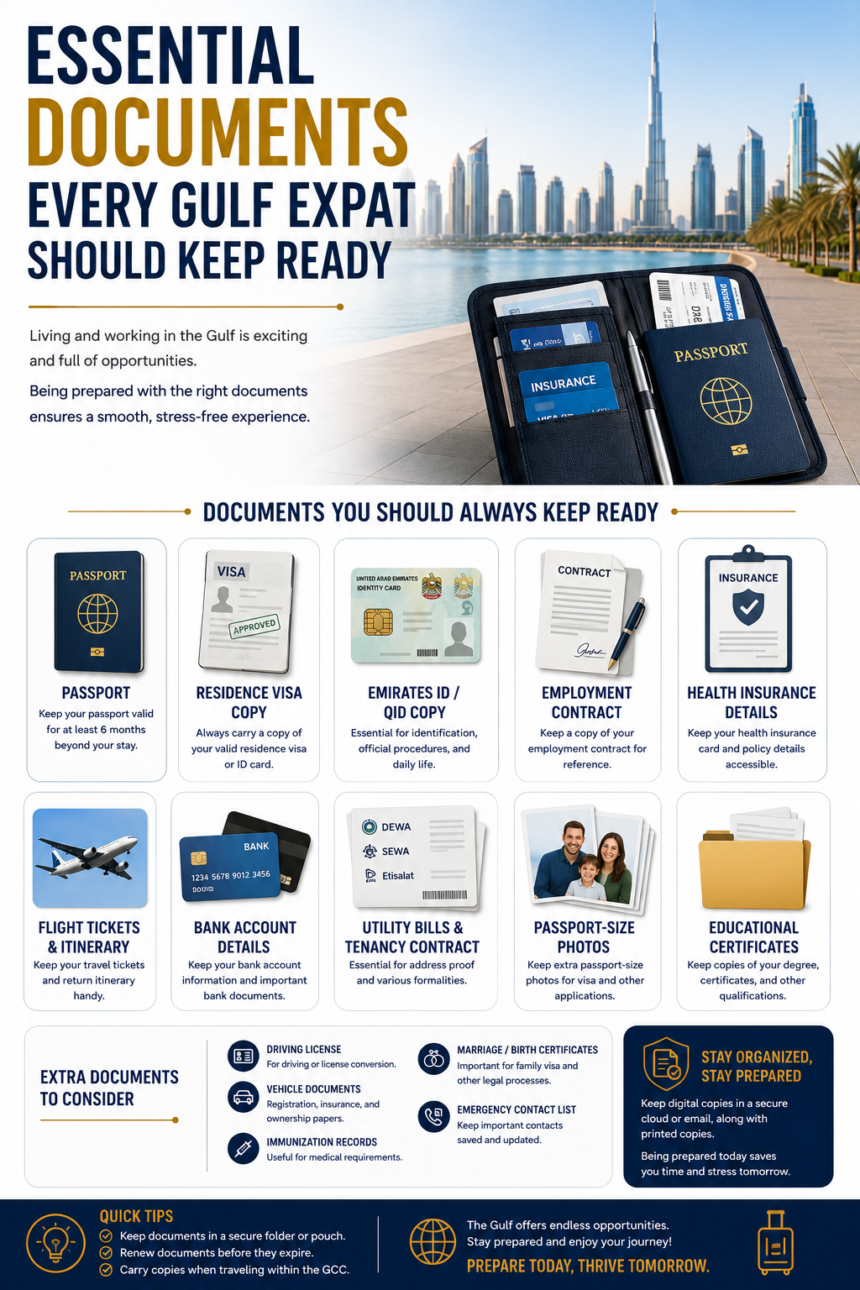
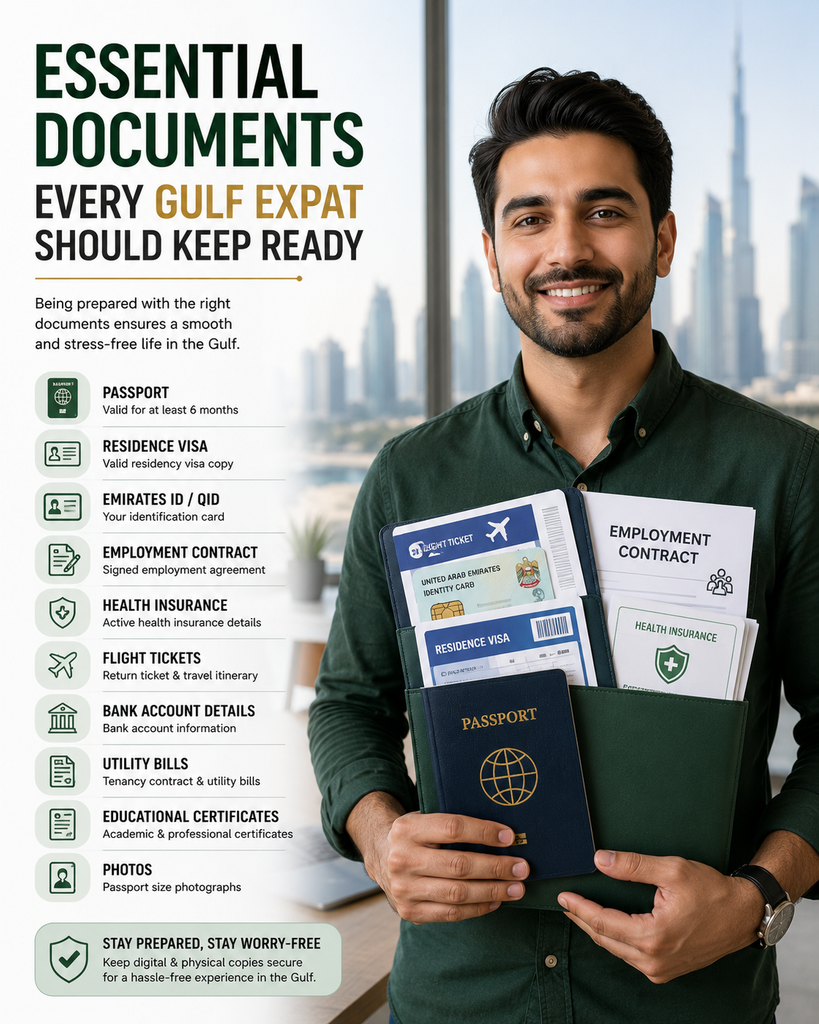
Here are 15 Essential Documents Every Gulf Expat Should Keep Ready before and after moving.
Documents Gulf Expat Should Keep Ready at a Glance
Some documents are essential for almost everyone, while others become important according to your employment or family situation.
| Document | Why It Matters | Who Should Prepare It |
|---|---|---|
| Passport | Immigration and identification | Everyone |
| Work visa/work permit records | Legal employment | Workers |
| Employment contract | Proof of employment terms | Workers |
| Educational certificates | Employment and professional licensing | Professionals |
| Experience certificates | Career verification | Workers |
| Medical records | Visa and healthcare procedures | Most expats |
| Marriage certificate | Family sponsorship | Married expats |
| Birth certificates | Child sponsorship and schooling | Parents |
| Police clearance | Some visa/employment processes | When required |
| Passport photographs | Immigration and administration | Everyone |
| Residence ID/card | Everyday identification after arrival | Residents |
| Health insurance records | Medical treatment | Residents |
| Driving licence | Driving/licence conversion | Drivers |
| Financial records | Banking, housing or sponsorship | When required |
| Digital document backups | Emergency replacement and access | Everyone |
The exact authentication, translation and validity requirements should always be checked with the relevant government authority or employer before submitting anything.
1. Valid Passport
Your passport is the most important document in your relocation file.
Almost every major immigration process begins with it.
Your employer may need a passport copy to arrange employment authorisation. Immigration authorities use passport information for visa and residence procedures, while banks, landlords, telecom providers and other organisations may request identification after arrival.
Do not wait until your passport is close to expiry before thinking about renewal.
Some Gulf immigration processes require a minimum period of remaining validity. The exact requirement varies according to the country and visa.
Check your passport several months before relocation.
Also check every detail.
Your name, date of birth, passport number and nationality must be entered accurately into visa applications.
Even a minor difference in spelling between a passport and another important document can create administrative complications.
Keep your original passport secure and maintain clear digital copies of the identification page.
If you receive a new passport while living abroad, keep records of the old passport as well, particularly if it contains visas or other important immigration information.
2. Work Visa and Work Permit Documents
A job offer alone does not automatically authorise someone to work in a Gulf country.
The appropriate employment and immigration process must be completed.
The terminology differs across GCC countries.
You may encounter terms such as work permit, employment visa, work visa, residence permit or residence card.
Saudi Arabia, for example, provides electronic permanent work visas for workers with long-term employment contracts.
Oman’s work visa is issued at the request and responsibility of the employer and is based on the appropriate Ministry of Labour authorisation.
Other GCC countries operate their own employment-residence systems.
Keep copies of every document connected with the process.
This can include the visa application, work permit, entry document, approval notices and final residence documentation.
Do not assume your employer will permanently retain every record for you.
You should maintain your own organised file.
3. Employment Contract
Every expatriate worker should keep their own copy of the employment contract.
This is not merely paperwork for HR.
It contains the conditions under which you agreed to work.
Important information can include salary, job title, allowances, working arrangements, leave and contract duration.
When relocating, compare the final employment contract with the original offer.
If the interview promised accommodation, transportation, annual flights or school support, check whether the relevant benefits appear in the formal documentation where appropriate.
Keep both the offer letter and final contract.
Digital copies are particularly useful because they can be accessed if physical documents are unavailable.
Employees should also retain significant amendments made later.
If your salary, position or benefits change, save the updated documentation rather than keeping only the original contract.
4. Educational Certificates
Degrees and educational certificates can become extremely important when moving for professional employment.
Some jobs require qualifications to be verified before an employee can complete employment, immigration or professional-licensing procedures.
This is particularly relevant to regulated or specialised professions.
Doctors, nurses, engineers, teachers and other professionals may face additional qualification-verification requirements depending on the country and occupation.
Bring your important academic records rather than assuming electronic screenshots will always be sufficient.
These may include:
- University degree
- Diploma
- Postgraduate degree
- Professional qualification
- Academic transcript
- School certificates where relevant
Depending on the destination and procedure, documents may need authentication, attestation or other verification.
Do this before relocation when possible.
Obtaining authenticated documents from another country after moving can be much more complicated.
5. Professional Licences and Membership Records
A university degree does not necessarily give you automatic permission to practise a regulated profession.
Certain careers require professional licensing.
Healthcare is one obvious example.
Doctors, dentists, nurses, pharmacists and other healthcare professionals may need approval from the relevant health regulator before working.
Other specialised occupations may also require approval from government or professional bodies.
Oman’s visa guidance, for example, notes that approval from relevant organisations can be required for occupations including teaching, media and medical work.
Professionals should therefore prepare records such as licences, registrations, certificates of good standing and professional membership documents when applicable.
Check whether any documents have expiration dates.
A qualification that remains academically valid forever may still be accompanied by a professional licence that requires regular renewal.
6. Employment Experience Certificates
Previous employment records can be useful throughout your Gulf career.
Some employers request experience certificates during recruitment.
Professional licensing authorities may also require evidence that you have worked in a particular role for a certain period.
A strong experience certificate should ideally contain clear information about your employer, job title and employment period.
If possible, obtain experience letters before leaving your current country.
Tracking down a former manager several years later can be surprisingly difficult.
Keep previous offer letters, promotion letters and relieving or service certificates where relevant.
These records can also strengthen future job applications after you have accumulated Gulf experience.
7. Medical Examination Records
Medical fitness examinations form part of various Gulf employment and residence procedures.
The exact tests and requirements differ according to country, nationality, profession and visa category.
Saudi Arabia’s current permanent work-visa procedure includes a medical examination as part of the process.
Oman’s work-visa requirements include a medical-examination document, and its health authorities operate medical-fitness procedures for expatriate workers.
Some examinations may need to be completed through approved facilities or systems.
Do not simply visit any clinic and assume the report will automatically be accepted.
Follow the official instructions provided for your visa category.
Keep copies of medical-fitness reports even after submission.
They may be useful if questions arise during later stages of the residence process.
8. Marriage Certificate
Married expatriates planning to bring a spouse should prepare their marriage certificate carefully.
A basic photocopy may not always be sufficient.
Family residence procedures can require authenticated or certified marriage documentation.
The exact requirements depend on the country.
Qatar’s official family-related documentation, for example, can require a certified marriage contract when an expatriate brings eligible family members.
Oman’s family-joining procedures also refer to authenticated marriage documentation in relevant cases.
This is why family paperwork should be prepared before the main employee relocates.
If the certificate requires authentication in the country where the marriage occurred, completing that process while still there may save significant time.
Keep the original, authenticated version where applicable and several clear copies.
Also create a secure digital scan.
9. Children’s Birth Certificates
Parents relocating with children should treat birth certificates as essential documents.
They can be needed to establish the relationship between parent and child during family residence procedures.
Schools may also request birth records during admission.
Qatar’s family-related immigration documentation includes certified birth certificates for children in relevant applications.
Other Gulf jurisdictions have their own requirements.
Parents should check whether certificates need authentication or translation.
Names are especially important.
The spelling of the child’s and parents’ names should be consistent with passport records wherever possible.
Differences in transliteration can sometimes create additional administrative work.
Keep a separate digital folder for each child containing passport, birth certificate, residence documents, school records and health information.
10. Police Clearance Certificate
A police clearance certificate, sometimes called a criminal-record or good-conduct certificate, may be requested in certain immigration, professional or employment procedures.
It is not universally required for every expatriate in every Gulf country.
That distinction is important.
Do not spend money obtaining documents simply because an unofficial online checklist says everyone needs them.
Instead, check your specific visa and professional requirements.
When required, a police clearance may need to come from your home country or a country where you previously lived.
It may also need authentication.
Because obtaining one internationally can take time, people entering professions or visa categories where police clearance is commonly requested should investigate the requirement early.
Keep a digital copy after issuance even if the original is submitted.
11. Passport-Sized Photographs
Passport photographs may feel old-fashioned in an increasingly digital immigration system, but they are still useful.
Saudi Arabia’s current permanent work-visa procedure, for example, lists a personal photograph with a white background among the required documents.
Oman’s work-visa procedure also requires a personal photo.
Specifications can vary.
The required background, dimensions and image quality may differ according to the authority.
Instead of printing dozens of one generic photograph, check the current requirements first.
It is useful to keep both printed photographs and a high-resolution digital version.
The digital file can then be resized according to future application requirements.
12. Residence Card or National Expat ID
Once you become a resident, your local identity document becomes extremely important.
The exact name differs by country.
Depending on where you live, you may use a residence card, national identification card or another resident identity document.
It can become part of everyday life.
You may need it for banking, healthcare, government services, mobile contracts and other administrative processes.
Protect it as carefully as your passport.
Take a clear digital copy of both sides.
If it is lost, report and replace it through the appropriate official process rather than relying indefinitely on a photograph.
Also monitor its expiry date.
Residence and employment documents often need to remain valid for continued access to services.
13. Health Insurance Documents
Do not rely only on an insurance card stored in a company HR system.
Keep your own insurance information.
Save:
- Policy number
- Insurer name
- Network details
- Emergency contact number
- Digital insurance card
- Policy expiry date
Families should keep separate information for every insured member.
Before visiting a hospital, check whether it is within your insurer’s network.
An excellent hospital may still become expensive if your particular policy does not cover treatment there.
If you have an ongoing medical condition, keep relevant medical records and prescription information separately from the insurance documents.
14. Driving Licence and Driving Records
If you expect to drive in the Gulf, bring your existing driving licence.
Depending on your destination and nationality, you may be eligible for licence exchange or may need to complete a local licensing process.
Rules differ considerably.
Do not assume that because your licence is accepted for a short visit it can also be used indefinitely after becoming a resident.
Bring the original licence and keep a digital copy.
If your country provides driving-history records and you believe they may be useful, obtain them before relocation.
International Driving Permits can be relevant to certain temporary situations but should not be confused with permanent resident licensing requirements.
Always check the rules of the specific Gulf country.
15. Financial and Banking Documents
Opening a bank account or completing other financial procedures can require identification, residence and employment information.
Depending on the bank or service, you may be asked for documents such as proof of salary, employment details or address information.
Keep recent financial records accessible during your first months.
These might include salary certificates, bank statements and proof of existing financial relationships where needed.
Family residence processes can sometimes involve financial evidence as well.
For example, some family-related applications may ask for employment or salary information.
Do not carry unnecessary confidential financial paperwork everywhere.
Keep sensitive documents securely stored and provide them only to legitimate organisations through trusted channels.
Documents Families Should Prepare Before Moving
Families usually need a larger document file than single professionals.
At minimum, parents should investigate whether they need passports, authenticated marriage documentation, children’s birth certificates, school records, vaccination information and medical documentation.
School paperwork deserves special attention.
If children are transferring internationally, bring their latest report cards and relevant academic records.
Older students may need additional documents to establish which year or grade they should enter.
Vaccination records can also be important for schools and healthcare providers.
Parents should prepare these records before leaving the child’s current school.
After relocating, requesting missing documentation across different time zones can slow the admission process.
Documents for Healthcare Professionals
Healthcare professionals often face additional documentation requirements because medicine is regulated.
A doctor or nurse should not assume that a job offer alone is sufficient to begin clinical work.
Depending on the country and profession, authorities may need to verify education, professional registration and experience.
Documents can include degrees, transcripts, professional licences, certificates of good standing and employment-experience records.
Verification procedures can take time.
Healthcare workers should therefore begin document preparation early and follow the requirements of the relevant health authority.
Never rely exclusively on a recruitment agency’s generic checklist when a government regulator publishes profession-specific requirements.
Documents for Teachers
Teachers can also face additional verification requirements.
Schools may ask for degrees, teaching qualifications, experience certificates and background documentation.
Some countries or employers may require educational documents to be authenticated.
Teachers moving with their own children then have two document processes to manage simultaneously: employment documentation and school-transfer records for the family.
Create separate folders.
One should contain your professional records.
Another should contain your children’s education documents.
This simple organisation can prevent important originals from being mixed together during the relocation process.
Documents for Engineers and Other Specialists
Engineers and technical professionals should keep comprehensive academic and employment records.
Certain roles may require registration, classification or approval depending on the jurisdiction and project.
Keep your degree, transcript, professional membership, experience certificates and major training certifications available.
The same principle applies to accountants, architects, legal professionals and other regulated or specialised workers.
Do not assume requirements will remain identical throughout your career.
A document that was unnecessary for your first job may become important when you move to a more senior position or another Gulf country.
Do Your Documents Need Attestation?
This is one of the most common questions Gulf expatriates ask.
The answer depends on the document and procedure.
Some academic, marriage and birth records may need authentication before being accepted for particular government procedures.
The process can involve authorities in the country where the document was issued and authorities representing or operating in the destination country.
But requirements vary.
Do not automatically send every document you own through an expensive attestation process.
First identify:
Which document is required?
Which authority will receive it?
What form of authentication does that authority require?
Then complete the correct process.
This can save both money and time.
What About Document Translation?
If an important document is issued in a language not accepted by the receiving authority, an official or certified translation may be necessary.
The requirements vary according to country and process.
Some applications may accept English.
Others may require Arabic documentation or translation.
Do not translate important legal documents yourself.
Where an official translation is required, use an appropriately recognised translation service according to the destination authority’s rules.
Keep both versions together.
A translated marriage certificate without the original document is not a replacement for the underlying record.
Keep Original Documents Safe
Your passport, educational certificates, marriage certificate and birth certificates can be difficult to replace.
Do not carry every original document in your everyday bag after settling in.
Create a secure home storage system.
A waterproof and fire-resistant document case can provide additional protection.
Keep frequently used identification separately from irreplaceable certificates.
If an organisation temporarily needs an original, understand why it is being requested and when it will be returned.
For employment documentation, employees should retain their own copies of contracts and important records.
In Oman, for example, official Ministry of Labour guidance specifically advises expatriate workers to keep their labour card and a copy of their employment contract.
Create a Digital Document Vault
Every Gulf expatriate should maintain a digital backup.
Scan documents clearly rather than taking poorly lit photographs.
A useful digital structure might look like:
01 Passport and Visa
02 Employment
03 Education
04 Medical
05 Insurance
06 Banking
07 Housing
08 Driving
09 Family
10 Emergency Documents
Use descriptive file names.
This makes documents much easier to locate during an urgent application.
Protect sensitive files with strong security and use a reputable encrypted storage solution.
Keep Expiry Dates in One Place
Expats manage more expiration dates than they often realise.
Your list may include:
- Passport
- Residence permit
- Work permit
- National/resident ID
- Health insurance
- Driving licence
- Professional licence
- Vehicle registration
- Rental agreement
- Children’s residence documents
Missing a renewal can create unnecessary costs and administrative problems.
Create a calendar containing every major expiry date.
Set reminders well in advance rather than waiting for the final week.
This is especially important for passports because renewing one can affect other records connected to the previous passport number.
Never Send Sensitive Documents to Unverified Recruiters
Document security matters.
Passports, national identity documents and certificates contain personal information that can potentially be misused.
Do not send a complete identity-document package to someone simply because they contact you through WhatsApp or social media offering a Gulf job.
Verify the company and recruiter first.
Use official company email addresses and recognised recruitment channels where possible.
Be especially cautious if someone requests passport copies, bank information and money before providing verifiable employment information.
A genuine recruitment process still requires personal information, but you should know who is receiving it and why.
Essential Documents for UAE Expats
Someone moving to the UAE for employment should generally expect their passport and employment documentation to play a central role in work-permit and residence procedures.
Professional qualifications may become important depending on the occupation.
Families should prepare marriage and birth documentation when relevant to sponsorship and other procedures.
After arrival, the Emirates ID becomes one of the most important pieces of everyday identification for UAE residents.
Keep digital copies of your visa-related documents, Emirates ID and employment contract.
The UAE’s increasingly digital government environment makes electronic records extremely useful, but that does not eliminate the need to protect important originals.
Essential Documents for Saudi Arabia Expats
Workers moving to Saudi Arabia should ensure their passport and employment details are accurate before the work-visa process begins.
Saudi Arabia’s current permanent work-visa procedure requires a valid passport and personal photograph and includes professional qualification approval, medical examination and biometric fingerprinting in the process.
Employees should retain their employment contract and residence-related documentation after arrival.
Professionals should also prepare educational and professional records when required for their occupation.
Families should separately investigate the current documentation required for dependant residence rather than assuming the worker’s employment documents automatically cover spouses and children.
Essential Documents for Qatar Expats
Qatar expats should prepare their passport and employment documentation before relocation.
For family-related immigration procedures, marriage and birth certificates can become particularly important.
Certified family records may be required depending on the application.
Employment and salary evidence can also matter for some family procedures.
This means someone planning to relocate their family later should prepare family documents before leaving their home country, even if they initially move to Doha alone.
Keep employment, residence and family records organised separately so that they can be submitted quickly when needed.
Essential Documents for Bahrain Expats
Workers moving to Bahrain should prepare their passport, employment information and any professional documents requested for their occupation.
After residence and employment procedures are completed, local identity documentation becomes important for everyday administrative life.
Families should also keep marriage, birth, school and healthcare records available.
Because immigration and labour procedures can change, use Bahrain’s official government and labour-market channels to confirm current document requirements for your particular visa.
Do not assume a checklist created for another GCC country applies automatically to Bahrain.
Essential Documents for Oman Expats
Oman’s current official work-visa service lists a passport copy, personal photo, work-permit copy and medical-examination copy among the required documents.
The visa is issued at the request and responsibility of the employer.
Certain professions can require additional approvals.
Family procedures create additional documentation requirements.
Oman’s family-joining guidance includes passport documentation and, where applicable, authenticated marriage records and supporting employment or salary information.
Workers should therefore prepare both professional and family documentation before relocation if they expect dependants to join them.
Essential Documents for Kuwait Expats
Kuwait expats should prepare their passport and employment documentation according to the work and residence category under which they are relocating.
Additional documents may be required during residence, healthcare or family procedures.
Workers in specialised professions should investigate whether qualifications or professional approvals need to be completed before employment.
Families should prepare authenticated civil-status documents where required.
As with every GCC country, requirements should be confirmed through current official channels because procedures can change according to visa category and government regulations.
The Best Document System for Gulf Expats
The easiest approach is to maintain three versions of important records.
| Version | Purpose |
|---|---|
| Original | Official verification when required |
| Physical copies | Routine applications and backup |
| Secure digital copy | Fast access and emergency recovery |
Do not keep all three versions in the same place.
If a bag containing your passport and every backup is lost, your backup system has failed.
Keep originals securely at home after relocation, carry only documents needed for the day and maintain encrypted digital copies that can be accessed independently.
For families, consider giving both responsible adults secure access to essential records.
A Final Document Checklist Before Flying
A week before relocation, review your documents one final time.
Confirm that your passport is valid and the name matches the employment documentation.
Check that the correct work-visa process has begun or been completed according to your employer’s instructions.
Make sure required degrees and professional documents have received the necessary authentication.
Families should confirm marriage and birth certificates.
Save your employment contract offline on your phone or computer.
Keep essential originals in your hand luggage rather than checked baggage where practical and lawful.
Make digital backups.
Finally, write down important contact information for your employer, accommodation and emergency contacts.
Your documents should be accessible even if your phone loses internet access immediately after landing.
Final Thoughts on Essential Documents Every Gulf Expat Should Keep Ready
Preparing documents may not be the most exciting part of moving to the Gulf, but it is one of the most important.
Start with your passport.
Then organise employment and work-visa documentation.
Prepare educational qualifications, professional licences and experience certificates according to your career.
Keep medical records and health-insurance information accessible.
If you are relocating with family, give marriage certificates, children’s birth certificates, school records and vaccination information the same level of attention as your employment documents.
After becoming a resident, protect your local residence card or identification document carefully.
Maintain copies of your driving licence, financial records and important contracts.
Most importantly, create both physical and digital backups.
The UAE, Saudi Arabia, Qatar, Bahrain, Oman and Kuwait have different procedures, so no online checklist should replace current instructions from the relevant government authority.
The smartest Gulf expat is not the person carrying the largest folder.
It is the person who has the right document, in the right format, properly verified and available when it is needed.
Prepare that system before moving, and many of the most stressful parts of Gulf relocation become considerably easier.
follow us on Instagram
Read More – Things to Know Before Moving to the Gulf: 15 Essential Tips for Expats