



Public vs Private Healthcare in Gulf Countries: Which Is Better for Expats?
Healthcare is one of the most important considerations for anyone planning to live and work in the Gulf. The UAE, Saudi Arabia, Qatar, Kuwait, Bahrain and Oman have invested heavily in hospitals, medical technology, specialist treatment and healthcare infrastructure, giving residents access to a combination of government and privately operated medical facilities.
- Public vs Private Healthcare in Gulf Countries at a Glance
- 1. Public Healthcare Is the Foundation of Gulf Health Systems
- 2. Private Healthcare Provides Greater Choice
- 3. Cost Is One of the Biggest Differences
- 4. Health Insurance Can Determine Where Expats Receive Treatment
- 5. Private Healthcare Can Offer Faster Routine Appointments
- 6. Public Hospitals Can Be Strong for Complex and Emergency Care
- Public vs Private Healthcare in the UAE
- Public vs Private Healthcare in Saudi Arabia
- Public vs Private Healthcare in Qatar
- Public vs Private Healthcare in Bahrain
- Public vs Private Healthcare in Oman
- Public vs Private Healthcare in Kuwait
- 7. Doctor Choice Can Be Greater in Private Healthcare
- 8. Private Healthcare Is Not Automatically Better Healthcare
- 9. Emergency Healthcare Requires a Different Approach
- 10. Families Need to Look Beyond Basic Insurance
- 11. Prescription Medicines and Pharmacies Are Widely Available
- 12. Most Expats Benefit From Understanding Both Systems
- Public vs Private Healthcare Costs for Expats
- Public vs Private Healthcare for Gulf Expats
- How to Choose the Right Healthcare Option
- Public vs Private Healthcare in Gulf Countries: Which Is Better?
- Final Thoughts on Public vs Private Healthcare in Gulf Countries
For expatriates, however, understanding the difference between public and private healthcare can initially be confusing. A government hospital may provide excellent specialist or emergency care, while a private hospital may be more convenient for routine appointments. Health insurance can determine which clinics you can visit, and the rules surrounding public healthcare access are different in each GCC country.
The choice is therefore not simply about deciding whether public or private hospitals are better. Patients need to consider eligibility, insurance coverage, waiting times, specialist availability, location, cost and the type of treatment required. Many Gulf residents ultimately use both systems, choosing different providers depending on their medical needs.
This guide explains Public vs Private Healthcare in Gulf Countries through 12 important differences and looks at how healthcare works for expatriates across the GCC.
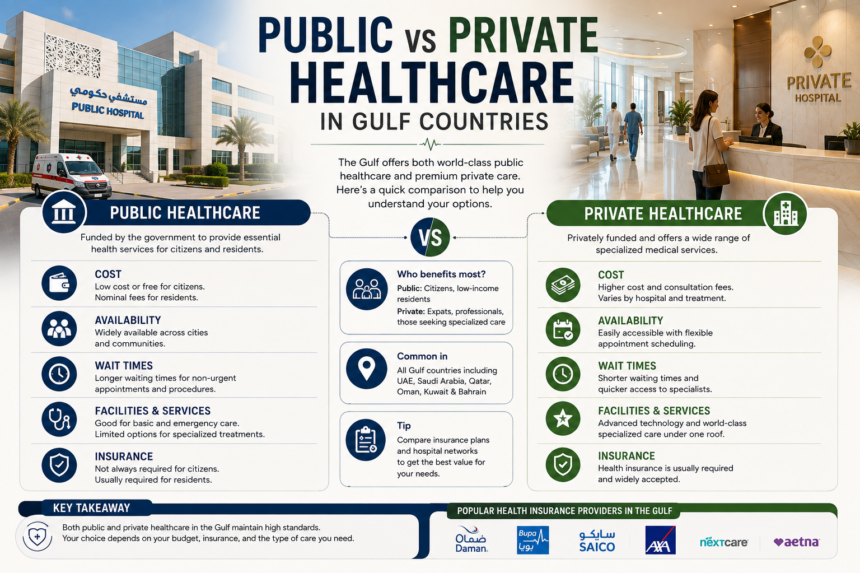
Public vs Private Healthcare in Gulf Countries at a Glance
Gulf healthcare systems combine substantial government investment with a rapidly expanding private medical sector. Public hospitals often form the backbone of national healthcare systems, particularly for emergency medicine and major specialist services, while private providers give residents additional choice and convenience.
| Factor | Public Healthcare | Private Healthcare |
|---|---|---|
| Main operator | Government health authorities | Private healthcare companies |
| Cost | Often subsidised for eligible patients | Usually insurance or self-payment |
| Access for expats | Depends on country and status | Generally available with payment or insurance |
| Appointment availability | Can vary by facility | Often greater scheduling flexibility |
| Emergency care | Major role | Available at many private hospitals |
| Specialist services | Strong in major government hospitals | Extensive in larger private hospitals |
| Insurance importance | Varies by country | Usually very important |
| Choice of provider | Can be more structured | Usually greater |
| Convenience | Depends on system and location | Often a major advantage |
| Best suited for | Public programmes, emergencies and specialist services | Routine care, convenience and insured treatment |
Neither sector should automatically be considered superior. The quality of care depends heavily on the individual hospital, doctor, specialty and country.
1. Public Healthcare Is the Foundation of Gulf Health Systems
Government healthcare systems play a central role throughout the GCC. Gulf governments have spent decades developing hospitals, primary healthcare centres, specialist institutions and emergency services, creating national systems that provide a large proportion of healthcare services.
Public hospitals are particularly important for major emergencies, complex specialist treatment, national vaccination programmes and public health initiatives. Large government medical institutions may also function as teaching and research centres and handle cases referred from smaller facilities.
The level of access available to expatriates varies between countries. Citizens generally receive the strongest government healthcare benefits, while foreign residents may need health cards, insurance, residence documents or payment to access particular services.
For expats, this means it is important to understand local eligibility rules instead of assuming that a residence visa automatically provides identical healthcare benefits to those available to citizens.
2. Private Healthcare Provides Greater Choice
The private healthcare sector has expanded rapidly across major Gulf cities. Dubai, Abu Dhabi, Riyadh, Jeddah, Doha, Manama, Muscat and Kuwait City all have private hospitals, specialist clinics, dental centres and diagnostic facilities serving both citizens and expatriates.
One of the biggest advantages is choice. Depending on insurance coverage, patients may be able to select from numerous hospitals, clinics and specialists. This can be particularly useful for routine consultations, dermatology, dentistry, physiotherapy, women’s health and other services where patients may prefer a particular doctor.
Private providers also compete through customer experience. Online appointments, multilingual staff, modern waiting areas, digital reports and extended operating hours have become common features across the sector.
However, greater choice can also mean higher costs. Without appropriate insurance, consultations, diagnostic tests and treatment at premium private hospitals can become expensive.
3. Cost Is One of the Biggest Differences
The financial difference between public and private healthcare is one of the first things expatriates should understand. Public systems receive significant government support, meaning eligible patients may receive treatment at subsidised rates or, depending on citizenship and local rules, without paying the full commercial cost of care.
Private healthcare operates differently. Patients generally pay through insurance or directly from their own money. The amount ultimately paid depends on the insurance plan, provider network, deductible, co-payment and treatment.
An inexpensive insurance policy does not necessarily provide unlimited access to every hospital. Some plans have restricted networks, while premium facilities may only be available through higher insurance categories.
Before accepting a Gulf employment package, expatriates should therefore examine the healthcare benefit rather than simply checking whether the contract says “medical insurance provided.” The quality and network of the policy can make a significant difference to everyday life.
4. Health Insurance Can Determine Where Expats Receive Treatment
Insurance is one of the most important parts of expatriate healthcare in the Gulf. In several GCC markets, private medical insurance is closely connected with employment and residency arrangements, while employers frequently provide health coverage as part of compensation packages.
A policy determines much more than whether treatment is covered. It can influence which hospitals are available, whether specialist consultations require referrals, how much the patient pays and whether dental, maternity, optical or mental-health services are included.
Before choosing between public and private care, residents should understand the details of their insurance. Important areas to check include:
- Hospital and clinic network
- Annual coverage limit
- Co-payment requirements
- Deductibles
- Emergency treatment
- Prescription medicine
- Specialist consultations
- Maternity benefits
- Dental and optical benefits
- Pre-existing condition rules
- International or regional coverage
Someone with comprehensive insurance may naturally use private hospitals for most routine healthcare. A resident with more limited coverage may rely more heavily on public services where eligible.
5. Private Healthcare Can Offer Faster Routine Appointments
Convenience is one of the reasons many expatriates choose private healthcare. Private hospitals and clinics often provide a wide selection of appointment times, and many operate during evenings and weekends.
This can be particularly valuable for professionals who do not want to take significant time away from work. Instead of arranging an appointment around limited clinic hours, patients may be able to visit after work or choose another branch closer to home.
Private providers have also invested heavily in digital booking systems. Appointments, laboratory results, prescriptions and follow-up consultations can increasingly be managed through mobile applications or online portals.
Public systems are also becoming more digital, but waiting times for non-urgent specialist appointments can vary depending on the country, facility and medical department. Patients should therefore compare the actual service available rather than assuming that one sector is always faster.
6. Public Hospitals Can Be Strong for Complex and Emergency Care
Private healthcare is often associated with convenience, but this does not mean government hospitals provide lower-quality medicine. Some of the Gulf’s most important specialist and emergency institutions operate within public healthcare systems.
Government hospitals frequently manage major trauma, complicated medical conditions and national specialist programmes. Public healthcare systems also play a critical role during large-scale emergencies and disease outbreaks.
For patients with complex conditions, the most appropriate specialist may therefore work within a government institution rather than a private hospital.
This is why comparing public and private healthcare purely according to waiting rooms or appointment speed can be misleading. Convenience and clinical capability are different considerations, and the best facility depends on the medical problem.
Public vs Private Healthcare in the UAE
The UAE has one of the region’s most developed mixed healthcare markets. Government authorities operate major public hospitals and health centres, while an extensive private healthcare sector provides services across Dubai, Abu Dhabi and the other emirates.
For expatriates, health insurance is particularly important. Coverage requirements and healthcare arrangements can vary by emirate, and employers commonly provide medical insurance for employees. The insurance network then determines which private hospitals and clinics can be accessed under the policy.
Dubai has an especially large private medical sector, giving residents considerable choice. International hospital groups, specialist clinics and independent medical centres operate throughout the emirate. This makes private care convenient for routine consultations, diagnostics and specialist appointments.
Public healthcare remains important, particularly for major medical services and emergency care. Residents should keep their insurance details easily accessible and understand which facilities are included before they actually need treatment.
Public vs Private Healthcare in Saudi Arabia
Saudi Arabia has an extensive public healthcare system alongside a rapidly growing private sector. Government healthcare infrastructure includes hospitals and primary healthcare facilities across the Kingdom, while private hospitals have expanded significantly in Riyadh, Jeddah, the Eastern Province and other major population centres.
Health insurance plays a major role for expatriates. Saudi Arabia’s Council of Health Insurance regulates mandatory health-insurance frameworks and maintains policies covering several categories of residents and visitors.
For many expatriate employees, private healthcare accessed through employer-provided insurance is therefore a major part of everyday medical care. The specific experience depends heavily on the insurance network because plans can provide access to different categories of hospitals and clinics.
Saudi Arabia’s continuing healthcare transformation is also increasing the role of private investment and public-private participation. This means residents can expect the relationship between government and private healthcare providers to continue evolving.
Public vs Private Healthcare in Qatar
Qatar provides one of the clearest examples of public and private healthcare operating side by side. Hamad Medical Corporation is the country’s major public healthcare provider, while Primary Health Care Corporation operates an extensive primary-care system.
Citizens and residents can apply for a government Health Card. A valid card provides access to PHCC health centres and Hamad Medical Corporation facilities, with eligible services offered at subsidised rates. This makes Qatar’s public system particularly relevant to expatriates rather than being a system used only by citizens.
Private hospitals and clinics provide another option, but private services are not covered by the government Health Card. Patients using private facilities therefore need appropriate insurance or must pay according to the provider’s charges.
For many Qatar residents, a practical healthcare strategy involves maintaining a valid Health Card while also understanding any private medical insurance provided through employment.
Public vs Private Healthcare in Bahrain
Bahrain has a well-established healthcare sector combining government hospitals and health centres with private hospitals and specialist clinics. Its relatively compact geography means many residents can reach major healthcare facilities without the long travel distances experienced in larger Gulf countries.
Government healthcare remains an important part of the national system, while private providers offer additional options for consultations, diagnostics and specialist care. For expatriates, insurance coverage and employment arrangements can influence which facilities are the most practical.
Private hospitals can appeal to residents who want greater appointment flexibility or have an insurance policy covering a broad network. Public facilities remain important for national healthcare delivery and major medical services.
As with the rest of the Gulf, patients should compare individual providers rather than judging the entire sector according to whether a facility is publicly or privately operated.
Public vs Private Healthcare in Oman
Oman’s Ministry of Health operates an extensive public healthcare network, while the private medical sector has become an increasingly important partner in the country’s healthcare strategy. The government has explicitly identified private healthcare as an active contributor to national health development and universal health coverage.
For Omani citizens, government healthcare forms the core of the system. Expatriates often use private clinics and hospitals, particularly when medical insurance is provided through their employer.
Muscat has the country’s largest concentration of private healthcare facilities, while government hospitals and health centres provide services throughout the Sultanate. Residents outside the capital may therefore experience a different balance between public and private options.
Oman is also working to strengthen cooperation between the two sectors. This means the future healthcare system is increasingly being viewed as a partnership rather than two completely separate networks.
Public vs Private Healthcare in Kuwait
Kuwait has a large government healthcare system supported by public hospitals, specialist centres and primary healthcare facilities. The country also has a substantial private medical sector serving citizens and its large expatriate population.
Foreign residents should pay particular attention to healthcare eligibility, insurance requirements and applicable fees. Access conditions for expatriates can differ from those applying to Kuwaiti citizens, making it important to understand the current rules associated with residence status.
Private hospitals provide another option for people seeking convenient appointments, specific specialists or facilities included within an insurance network. Many expatriates therefore use private healthcare when it is covered through employment.
As elsewhere in the GCC, the correct choice depends on the treatment required. Routine consultations may be convenient privately, while major government facilities remain an important part of Kuwait’s overall healthcare infrastructure.
7. Doctor Choice Can Be Greater in Private Healthcare
Private healthcare generally gives insured patients greater flexibility when choosing doctors. A patient may search for a particular specialist, language preference, hospital or appointment time and then book directly if the insurance policy permits it.
This can be valuable in a region with a highly international healthcare workforce. Gulf hospitals employ doctors and medical professionals from the Middle East, South Asia, Europe, North America and many other regions.
Language can therefore be an important factor for expatriates. English is widely used in private healthcare, while many facilities also employ Arabic, Hindi, Urdu, Malayalam, Tagalog and other language speakers.
Public healthcare systems also employ international professionals, but the process for selecting a particular specialist may be more structured around referrals and available appointments.
8. Private Healthcare Is Not Automatically Better Healthcare
Premium hospital interiors, private rooms and shorter waiting times can create the impression that private medicine must always provide superior clinical care. That is not necessarily true.
Healthcare quality depends on the doctor, medical team, specialty, hospital capabilities and individual condition. A major government hospital may have considerably more experience with certain complex conditions than a smaller private facility.
At the same time, a specialised private centre may provide excellent expertise in a particular field and offer faster access.
Patients should therefore focus on medical capability rather than branding alone. For significant treatment, researching the specialist and hospital department can be more important than deciding whether the facility is public or private.
9. Emergency Healthcare Requires a Different Approach
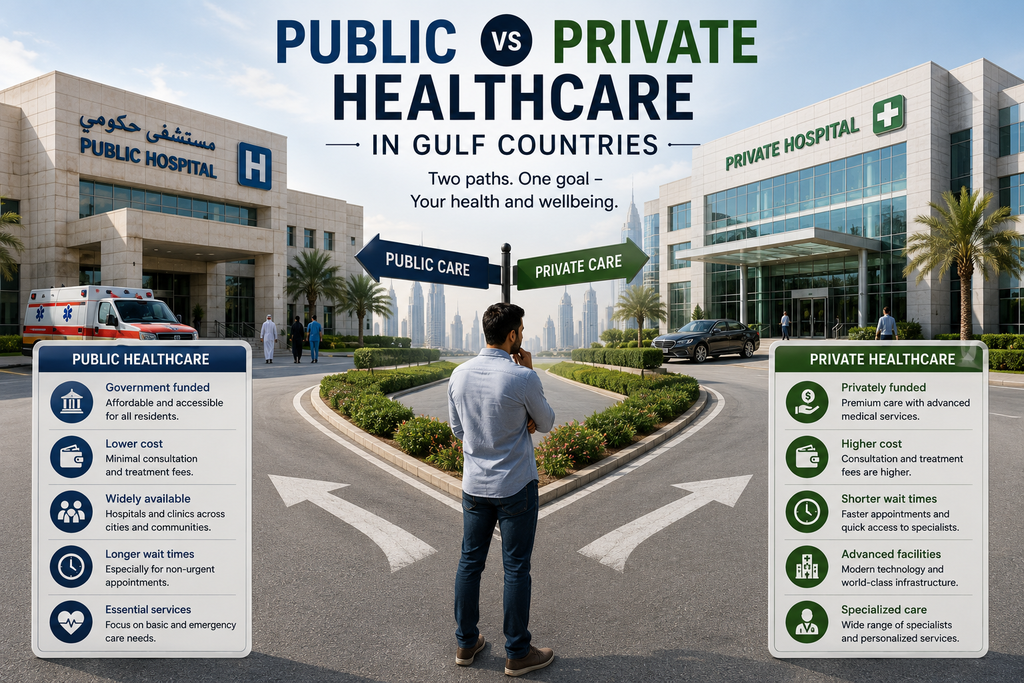
During a genuine medical emergency, the priority should be reaching appropriate emergency care rather than comparing routine healthcare benefits.
Public hospitals play a major role in emergency medicine throughout the Gulf, and many large private hospitals also operate emergency departments. Ambulance and emergency systems vary by country, so new residents should learn the national emergency number and identify major hospitals close to home.
Parents should pay particular attention to paediatric emergency options. Someone with a chronic medical condition should also know which nearby facility can manage their specific needs.
These preparations take only a short time but can become extremely important during an emergency.
10. Families Need to Look Beyond Basic Insurance
Healthcare becomes more complicated when an expatriate moves with a spouse and children. An employee may receive excellent insurance through work while dependent coverage is more limited or requires additional payment.
Families should examine maternity benefits, paediatric care, vaccinations, dental treatment, prescription coverage and specialist access. A low-cost policy that works perfectly well for a healthy single professional may be inadequate for a household with young children.
Maternity deserves particular attention because pregnancy and delivery costs can be significant in private hospitals. Waiting periods and coverage limits may also apply depending on the insurance policy.
Before relocating, families should understand whether dependents are insured automatically, whether the employer contributes to their coverage and which hospitals are included.
11. Prescription Medicines and Pharmacies Are Widely Available
Gulf cities generally have extensive pharmacy networks, making common prescription and non-prescription medicines relatively easy to obtain. However, medicines available without a prescription in one country may require a prescription in another.
Expats taking regular medication should check the local rules before moving. This is particularly important for controlled medicines, psychiatric medication and certain pain treatments because import and prescription regulations can be strict.
Carrying a doctor’s letter, prescription and appropriate medical documentation can help when travelling with necessary medication. Residents should also avoid assuming that a familiar brand will be available under the same name.
Public and private doctors can prescribe medicines, but insurance coverage for pharmacy purchases depends on the individual policy.
12. Most Expats Benefit From Understanding Both Systems
The most practical healthcare strategy for Gulf residents is often not choosing one system permanently. Instead, it is understanding how both public and private healthcare can be used.
A resident might visit a private clinic for a convenient routine consultation, use a government facility for a particular specialist service and attend the nearest appropriate hospital during an emergency. In Qatar, for example, maintaining a government Health Card can be valuable even for someone who also has private medical insurance.
The important thing is knowing your options before becoming ill. Residents should understand their insurance network, public healthcare eligibility and nearby medical facilities shortly after moving.
This preparation removes much of the confusion that can occur when healthcare is suddenly required.
Public vs Private Healthcare Costs for Expats
It is difficult to provide one reliable GCC-wide price because medical charges differ dramatically according to country, hospital, specialist, treatment and insurance policy.
Instead of comparing individual consultation prices, expatriates should focus on their potential annual healthcare exposure. A comprehensive employer policy with a broad hospital network may make private care inexpensive at the point of use, while someone with limited insurance can face significant co-payments.
The most useful questions are:
- What does my insurance actually cover?
- Which hospitals are inside my network?
- What percentage must I pay?
- Do I need a referral for specialists?
- Are medicines covered?
- Is emergency treatment covered everywhere?
- Are maternity, dental and optical services included?
- Can I use public healthcare?
- Does my family have the same coverage?
Answering these questions gives a much clearer picture than comparing advertised hospital consultation fees.
Public vs Private Healthcare for Gulf Expats
The best healthcare option changes according to individual circumstances. Someone with premium employer insurance in Dubai may use private hospitals almost exclusively because the policy provides excellent access. A Qatar resident may find significant value in maintaining a Health Card alongside private insurance.
A family may prioritise paediatric and maternity coverage, while an older resident may care more about specialist access and chronic-disease management. Someone living outside a major city may simply choose whichever high-quality facility is geographically closest.
Expats should therefore avoid choosing healthcare based entirely on reputation or price. Insurance network, doctor expertise, location and treatment requirements should all be considered together.
How to Choose the Right Healthcare Option
Before choosing a hospital or clinic, begin with the medical problem. Routine appointments and minor illnesses may be handled conveniently through a nearby private clinic, especially when it is covered by insurance. More complicated conditions may require a specialist centre or major government hospital.
Check insurance before booking non-emergency treatment because visiting an out-of-network provider can result in substantially higher personal costs. Patients should also confirm whether specialist treatment requires pre-authorisation.
For important procedures, a second medical opinion can be valuable regardless of whether the first consultation occurred in a public or private hospital.
The objective should always be finding appropriate medical care rather than automatically choosing the most expensive facility.
Public vs Private Healthcare in Gulf Countries: Which Is Better?
There is no universal winner. Public healthcare systems across the Gulf provide essential national services, emergency medicine and major specialist care, while government investment has created sophisticated hospitals and medical infrastructure.
Private healthcare adds convenience, provider choice and appointment flexibility. For expatriates with comprehensive insurance, these advantages can make private hospitals and clinics the natural choice for much of their routine healthcare.
The strongest approach is therefore to understand both systems. Know which government facilities you can access, which private hospitals your insurance covers and where to go during an emergency.
A good private insurance policy does not make public healthcare irrelevant, and access to public healthcare does not necessarily remove the value of private coverage.
Final Thoughts on Public vs Private Healthcare in Gulf Countries
Public vs Private Healthcare in Gulf Countries is less about identifying one superior system and more about understanding how the two sectors work together. Across the GCC, government hospitals remain central to national healthcare while private providers continue expanding their role in routine treatment, specialist medicine, diagnostics and patient convenience.
For expatriates, insurance is often the factor that shapes everyday healthcare decisions most strongly. A broad policy can provide access to an extensive private network, while limited coverage can significantly restrict hospital choice. Public healthcare eligibility also differs from one Gulf country to another, which is why residents should check the rules that apply specifically to their nationality and residence status.
The UAE provides a highly developed mixed healthcare environment with an extensive private sector. Saudi Arabia combines major government infrastructure with an expanding insured private market. Qatar allows residents to access subsidised public services through its Health Card while maintaining a substantial private sector. Bahrain combines public health services with accessible private facilities, Oman is strengthening cooperation between government and private healthcare, and Kuwait continues to operate a large public system alongside private providers.
For someone moving to the Gulf, the most important preparation is simple: understand your health insurance before arrival, identify the hospitals within your network, learn how the local public system works and keep emergency information accessible. Families should go further by checking dependent, maternity, paediatric and prescription coverage.
Healthcare should never be judged only by whether the hospital is public or private. The right choice is the facility that provides the appropriate medical expertise, reasonable access and suitable financial coverage when you need it.
follow us on Instagram
Read More – Free Ladies Nights in Oman: 12 Amazing Offers and Women-Only Experiences