



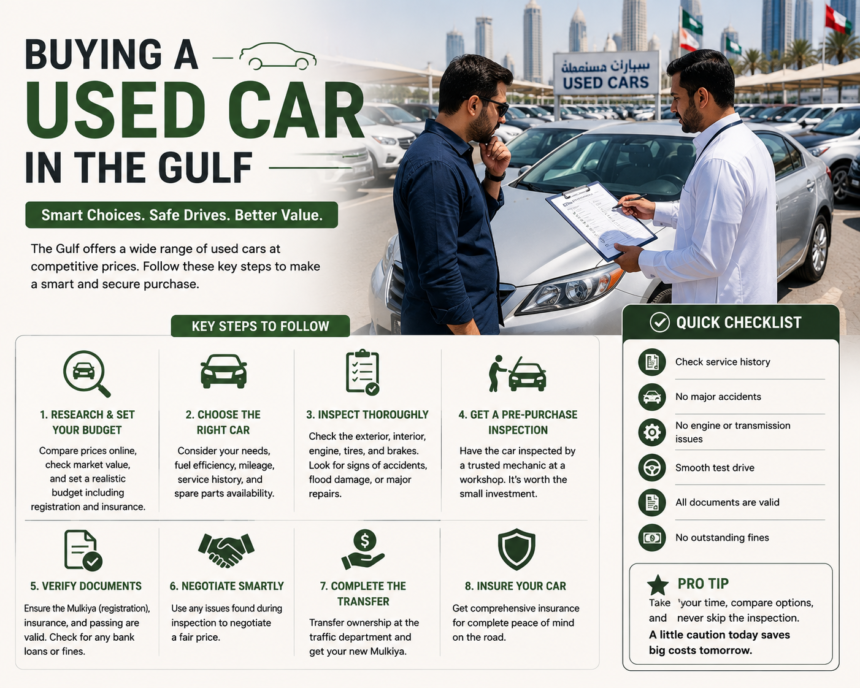
Buying a Used Car in the Gulf: Essential Checks Before You Pay
Buying a used car can be one of the smartest ways to get on the road after moving to the Gulf. New vehicles can require a significant upfront investment, while a carefully selected used car can provide reliable transportation at a much lower purchase price. In cities where driving is an important part of everyday life, owning the right car can also make commuting, shopping, family travel and weekend trips considerably easier.
- Buying a Used Car in the Gulf: Start With These 5 Questions
- Used Car Buying Checklist at a Glance
- 1. Set a Realistic Total Budget
- 2. Choose the Right Type of Car for Gulf Conditions
- 3. GCC Specification vs Imported Cars: Know the Difference
- 4. Check the Vehicle’s Service History
- 5. Investigate Accident History Carefully
- 6. Check the VIN or Chassis Number
- 7. Do Not Trust Mileage Without Evidence
- 8. Inspect the Engine When It Is Cold
- 9. Test the Air Conditioning Properly
- 10. Inspect the Tyres Carefully
- 11. Test Every Electronic Feature
- 12. Take a Proper Test Drive
- 13. Always Get an Independent Pre-Purchase Inspection
- 14. Check Insurance Before Finalising the Deal
- 15. Complete Ownership Transfer Through Official Channels
- Private Seller vs Used-Car Dealer
- Buying a Used Car in the UAE
- Buying a Used Car in Saudi Arabia
- Buying a Used Car in Qatar
- Buying a Used Car in Oman
- Buying a Used Car in Bahrain
- Buying a Used Car in Kuwait
- 10 Red Flags That Should Make You Reconsider
- Used Car Inspection Scorecard
- How Much Should You Negotiate?
- Should You Buy a Cheap Luxury Car?
- Should You Buy From a Friend?
- Final Checklist Before Paying
- Buying a Used Car in the Gulf: The Smartest Approach
- Final Thoughts on Buying a Used Car in the Gulf
The challenge is that a used car’s appearance does not tell you its complete story. A vehicle may look clean and well maintained while hiding accident repairs, mechanical problems, worn tyres or an incomplete service history. Gulf conditions add another consideration because extreme summer temperatures can place additional stress on batteries, cooling systems, air conditioning, tyres and other components.
The buying process also differs across the GCC. The UAE, Saudi Arabia, Qatar, Kuwait, Bahrain and Oman have their own vehicle registration, inspection, insurance and ownership-transfer procedures. A buyer therefore needs to check both the physical condition of the car and the legal documentation required in the country where it will be registered.
This Complete Guide to Buying a Used Car in the Gulf explains what to inspect, which questions to ask, what documents to verify and which warning signs should make you reconsider the deal.
Buying a Used Car in the Gulf: Start With These 5 Questions
Before opening hundreds of online listings, decide what you actually need. Many buyers waste time comparing vehicles that do not match their budget or lifestyle.
Ask yourself these five questions first:
- What is my total budget, including insurance and registration?
- How many kilometres will I drive each month?
- Do I mainly drive in the city or take long highway journeys?
- How long do I expect to keep the car?
- Do I need a small car, sedan, SUV or larger family vehicle?
Your answers immediately narrow the search. A single professional commuting through central Dubai has very different requirements from a family regularly travelling between Riyadh and other Saudi cities.
The goal is not to find the most impressive car within your purchase budget. It is to find a vehicle you can comfortably buy, maintain, insure and eventually resell.
Used Car Buying Checklist at a Glance
Before getting into the details, use this table as a quick overview of the most important areas to investigate.
| Check | What to Look For | Warning Sign |
|---|---|---|
| Service history | Regular documented maintenance | Missing records |
| Accident history | Previous damage and repairs | Major unexplained repairs |
| Mileage | Consistent with age and records | Suspiciously low mileage |
| Engine | Smooth start and operation | Smoke, leaks or unusual noise |
| Transmission | Smooth gear changes | Jerking or delayed shifts |
| Air conditioning | Strong cooling | Weak cooling in hot weather |
| Tyres | Even wear and good condition | Cracks or uneven wear |
| Bodywork | Consistent paint and panels | Different paint shades or gaps |
| Electronics | All systems working | Warning lights or faults |
| VIN/chassis | Matches documents | Number inconsistency |
| Ownership | Seller legally owns vehicle | Documentation mismatch |
| Test drive | Stable and predictable | Vibration, noise or pulling |
| Inspection | Independent professional check | Seller refuses inspection |
| Insurance | Obtain quote before purchase | Unexpectedly high premium |
| Transfer | Official ownership process | Seller suggests informal transfer |
You do not necessarily need to reject a car because of one small issue. The important question is whether the problem has been disclosed, properly repaired and reflected in the price.
1. Set a Realistic Total Budget
Your car budget should never equal only the advertised purchase price. After buying the vehicle, you may still need to pay for insurance, registration, inspection, ownership-transfer fees and immediate maintenance.
A used car advertised at an attractive price can quickly become expensive if it immediately needs four tyres, a battery, major servicing and air-conditioning repairs. Buyers should therefore keep part of their budget available after completing the purchase.
A practical way to think about the budget is:
Car Purchase Price + Registration + Insurance + Inspection + Immediate Repairs + Maintenance Reserve = Real Cost
For example, if you have allocated your entire available amount to the purchase price, you may be forced to delay necessary maintenance immediately after taking ownership.
Buying slightly below your maximum budget can therefore be much safer than purchasing the most expensive vehicle you can technically afford.
2. Choose the Right Type of Car for Gulf Conditions
The Gulf has excellent road networks, but your daily driving environment should determine the type of vehicle you buy. Someone who drives mainly between an apartment and office may not need a large SUV, while a family taking regular long-distance journeys may value additional space and comfort.
Fuel consumption also deserves attention. A large engine may be appealing when fuel prices appear manageable, but the difference becomes noticeable when covering substantial monthly distances.
Think about:
- Daily commuting distance
- Parking availability
- Family size
- Fuel consumption
- Highway usage
- Boot space
- Off-road requirements
- Maintenance costs
- Availability of spare parts
- Expected resale demand
Do not purchase a four-wheel-drive vehicle simply because you live in the Gulf. If you never leave paved roads, a reliable sedan or crossover may meet your needs at a lower overall cost.
3. GCC Specification vs Imported Cars: Know the Difference
One term buyers frequently encounter is GCC specification or GCC specs. It generally refers to vehicles originally supplied for Gulf markets rather than cars imported later from markets such as North America, Europe or East Asia.
An imported car is not automatically a bad car. Many imported vehicles can provide years of reliable service. The important issue is understanding exactly what you are buying and why it was imported.
Some imported used cars may have previously been involved in accidents or suffered other damage before being repaired and exported. Buyers therefore need to investigate history particularly carefully rather than assuming a low price represents a bargain.
Quick Comparison
| GCC-Spec Vehicle | Imported Vehicle |
|---|---|
| Originally supplied for regional market | Originally supplied elsewhere |
| History may be easier to trace locally | Overseas history may require additional research |
| Often familiar to local workshops | Specifications may differ |
| Generally easier for buyers to understand | Can offer attractive pricing |
| Strong local resale familiarity | Resale can depend on vehicle/history |
The specification should never replace an inspection. A poorly maintained GCC-spec car can be a worse purchase than a carefully maintained imported vehicle with transparent history.
4. Check the Vehicle’s Service History
Service history is one of the most valuable pieces of information available when evaluating a used car. Regular maintenance suggests that the previous owner took reasonable care of the vehicle, while long unexplained gaps deserve closer investigation.
Look for records showing routine oil changes, filters, brakes, tyres and major scheduled maintenance. For higher-mileage cars, check whether expensive components that normally require attention have already been replaced or serviced.
Dealer-maintained cars can be easier to investigate because records may exist within an authorised service network. Independent workshop records can also be useful when they contain clear dates, mileage and work performed.
Good Signs
- Consistent servicing intervals
- Invoices or digital service records
- Mileage progressing logically
- Major maintenance completed on schedule
- Same reputable workshop used regularly
Warning Signs
- No service history
- Several years missing from records
- Seller cannot explain maintenance
- Mileage inconsistencies
- Recent major repairs with no documentation
A missing service history does not prove that a vehicle is bad, but it increases uncertainty and should make the inspection even more important.
5. Investigate Accident History Carefully
Accident history is one of the biggest concerns in the Gulf used-car market. Minor cosmetic repairs are not necessarily a reason to reject a vehicle, but significant structural damage can affect safety, alignment and future resale value.
Inspect panel gaps around doors, the bonnet and boot. Look for differences in paint shade, overspray around rubber seals or unusually new body panels on an older vehicle.
A professional inspection can identify evidence that an inexperienced buyer may miss.
Ask the seller directly whether the car has been involved in an accident and what repairs were completed. A transparent seller should be able to explain known damage rather than avoiding the question.
Quick Tip: A perfectly shiny exterior is not proof of a clean history. Fresh paint can sometimes hide the exact information you need to investigate.
6. Check the VIN or Chassis Number
The Vehicle Identification Number, commonly called the VIN or chassis number, is essentially the car’s unique identity. It should match the official registration documentation.
Check the number physically on the vehicle and compare it carefully with the documents. Any inconsistency should be investigated before money changes hands.
The VIN can also be useful when researching a vehicle’s history, particularly for imported cars. Depending on the country of origin and available databases, historical records may reveal previous accidents, auction appearances or other useful information.
Never rely only on the registration plate when researching a used vehicle. Plates can change, while the VIN remains connected to the vehicle itself.
7. Do Not Trust Mileage Without Evidence
Low mileage makes a used car attractive, but the number displayed on the dashboard should be considered together with service records and the vehicle’s physical condition.
A relatively old vehicle showing unusually low mileage deserves additional investigation. Compare the odometer reading with workshop records, previous inspections and other available documentation.
Physical wear can provide clues as well. A car showing very low mileage but significant wear on the steering wheel, pedals, driver’s seat and interior controls may deserve closer examination.
At the same time, high mileage should not automatically eliminate a car. A well-maintained vehicle that has covered substantial highway kilometres can sometimes be a better purchase than a low-mileage vehicle that received poor maintenance.
Remember: Verified maintenance history is often more valuable than an impressively low number on the odometer.
8. Inspect the Engine When It Is Cold
If possible, inspect the car before the seller has warmed up the engine. A cold start can reveal issues that become less obvious once the vehicle reaches operating temperature.
Listen for unusual knocking, rattling or excessive vibration. Watch for warning lights and check whether they disappear normally after startup. Look underneath the car and around the engine bay for obvious fluid leaks.
Exhaust smoke can also provide useful clues, although diagnosis should be left to a qualified technician.
The engine bay does not need to look brand new. In fact, an unusually freshly cleaned engine immediately before a sale can make leaks more difficult to identify.
A professional mechanical inspection remains the best way to assess engine condition properly.
9. Test the Air Conditioning Properly
Air conditioning is not a minor luxury in the Gulf. During summer, it is one of the most important systems in the vehicle.
Turn the air conditioning on and allow it to operate properly during the inspection. Check whether cold air arrives quickly and consistently from the vents.
Test different fan speeds and climate-control settings. If the vehicle has rear air-conditioning vents, test those as well.
Weak cooling may result from something relatively simple, but it can also indicate a more expensive problem. Do not accept the explanation that “it only needs gas” without verification.
Gulf Used-Car Rule
If the air conditioning does not perform properly during the inspection, calculate the repair before buying rather than hoping the problem is cheap.
10. Inspect the Tyres Carefully
Extreme heat makes tyre condition particularly important in Gulf countries. Old, cracked or damaged tyres can become a serious safety problem, especially during long highway journeys.
Look at tread depth, sidewalls and wear patterns. All four tyres should be inspected rather than checking only the easiest one to see.
Uneven wear can sometimes indicate alignment, suspension or steering issues. A professional inspection can determine whether the problem is simply an alignment adjustment or something more serious.
Tyre age matters too. A tyre can still have visible tread while its condition has deteriorated with age and heat exposure.
If the vehicle requires a complete new set of tyres, include that expense when negotiating the purchase price.
11. Test Every Electronic Feature
Modern vehicles contain a large number of electronic systems, and small faults can become surprisingly expensive.
Spend several minutes testing the interior rather than simply starting the engine and immediately beginning the test drive.
2-Minute Electronics Check
Check:
- Power windows
- Central locking
- Mirrors
- Headlights
- Indicators
- Brake lights
- Parking sensors
- Reverse camera
- Infotainment system
- Bluetooth
- USB ports
- Dashboard controls
- Air-conditioning controls
- Electric seats
- Sunroof if fitted
- Keyless entry
- Both keys if available
Pay attention to dashboard warning lights. A warning light should not simply be dismissed because the seller says it is “only a sensor.”
Ask for the fault to be diagnosed.
12. Take a Proper Test Drive
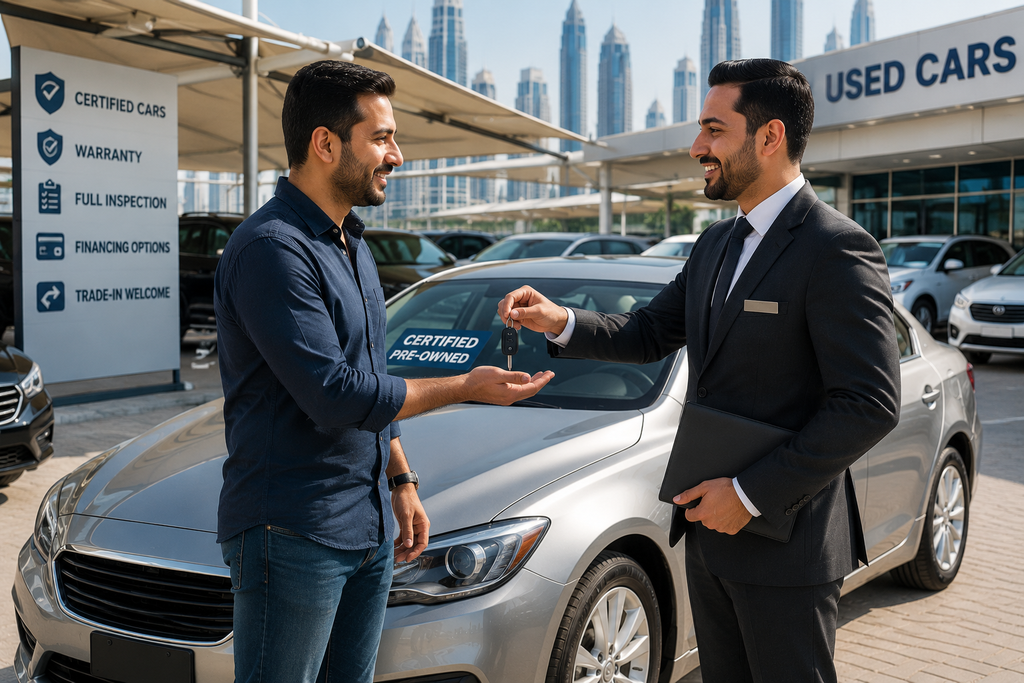
Never purchase a used car based only on a visual inspection. A proper test drive can reveal problems that are impossible to identify while the vehicle is parked.
Drive at different speeds where legally possible and pay attention to steering, braking, transmission behaviour and suspension. The vehicle should accelerate smoothly and track predictably.
Listen with the music turned off. Unusual noises over bumps, during braking or while turning can provide important clues.
During the Test Drive, Ask Yourself:
Steering: Does the vehicle pull noticeably to one side?
Brakes: Is there vibration or unusual noise?
Transmission: Are gear changes smooth?
Suspension: Does the car make knocking sounds over uneven surfaces?
Engine: Does acceleration feel consistent?
Temperature: Does the engine remain at normal operating temperature?
Air conditioning: Does cooling remain strong while driving?
If the seller refuses a reasonable test drive, consider it a warning sign.
13. Always Get an Independent Pre-Purchase Inspection
This may be the single most valuable step in the entire used-car buying process.
Even experienced drivers can miss mechanical or structural problems. A qualified technician has the equipment and knowledge to examine areas that are difficult to assess during a casual inspection.
A comprehensive pre-purchase inspection may evaluate the engine, transmission, suspension, brakes, tyres, electronics, chassis, body repairs and diagnostic fault codes.
The inspection does not need to prove that the car is perfect. Used vehicles naturally show wear. Its purpose is to tell you what you are actually buying.
Inspection Result: What Should You Do?
| Result | Recommended Action |
|---|---|
| Minor normal wear | Continue if price is fair |
| Tyres or brakes due soon | Negotiate the cost |
| Minor cosmetic repairs | Decide based on price |
| Mechanical repair required | Obtain repair estimate |
| Major accident damage | Consider walking away |
| Structural/chassis concern | Avoid unless expert advice strongly supports purchase |
| Seller refuses inspection | Walk away |
Spending a relatively small amount on an inspection can prevent a much larger financial mistake.
14. Check Insurance Before Finalising the Deal
Do not wait until after agreeing to purchase the vehicle before investigating insurance. Premiums can vary according to vehicle value, age, model, driver profile and type of coverage.
Some older vehicles may have different comprehensive-coverage options, while performance or luxury vehicles can cost considerably more to insure.
Obtain an insurance quotation before completing the purchase so the cost becomes part of your total budget.
Also understand the difference between basic third-party liability coverage and comprehensive insurance. The cheapest policy is not automatically the most appropriate option.
If several people in the household will drive the vehicle, confirm that the policy arrangements suit those drivers as well.
15. Complete Ownership Transfer Through Official Channels
Never treat payment as the final step. The vehicle must be legally transferred into the buyer’s name through the official process applicable in the country.
The seller’s identity and ownership information should match the vehicle documents. Outstanding legal or administrative issues should be resolved according to local procedures before the transfer is completed.
Government digital services have made vehicle transactions increasingly convenient across the Gulf, but procedures differ between countries.
The safest sequence is generally:
Inspect → Verify Documents → Agree Price → Arrange Insurance → Complete Official Transfer → Make/Confirm Payment According to the Safe Transaction Process
Avoid informal arrangements where someone suggests leaving the car registered under another person’s name temporarily.
Once you own the vehicle, the documentation should clearly reflect that fact.
Private Seller vs Used-Car Dealer
One of the first choices buyers face is whether to purchase from an individual or a professional dealer. Both options can work well, but they have different advantages.
| Private Seller | Used-Car Dealer |
|---|---|
| Price may be more negotiable | Larger selection in one location |
| You may meet the actual owner | Financing may be easier |
| Owner may know complete history | Some vehicles may include warranty |
| Requires more individual verification | Business reputation can be researched |
| Inspection remains essential | Inspection remains essential |
A dealer is not automatically safer, and a private seller is not automatically risky. The quality of the vehicle and transparency of its history matter more than the type of seller.
Buying a Used Car in the UAE
The UAE has one of the Gulf’s largest and most diverse used-car markets. Dubai, Abu Dhabi and Sharjah offer everything from affordable commuter vehicles to luxury and performance cars.
The enormous selection is an advantage, but it also means buyers need to compare carefully. Imported vehicles are common, and history checks become especially important when a car originated outside the GCC.
Buyers should verify vehicle information, inspection requirements, insurance and ownership-transfer procedures through the relevant emirate’s official systems. Dubai residents, for example, should use the applicable Roads and Transport Authority procedures when completing vehicle-related transactions.
The UAE’s active resale market can also make future resale value an important factor when choosing between models.
Buying a Used Car in Saudi Arabia
Saudi Arabia’s large geography makes vehicle reliability especially important. Residents may cover substantial distances between different parts of Riyadh or take long highway journeys between cities.
Before purchasing, buyers should verify the vehicle’s registration and complete the transfer through the appropriate official process. Saudi Arabia provides extensive digital government services for vehicle and traffic administration, making official verification an important part of the transaction.
Heat, mileage and maintenance history deserve particular attention because many vehicles accumulate significant highway kilometres.
A well-maintained car with clear records can therefore be a better purchase than a visually impressive vehicle with an uncertain history.
Buying a Used Car in Qatar
Qatar’s relatively compact geography means many used vehicles accumulate fewer long-distance kilometres than cars in much larger countries, but mileage alone should never determine condition.
Doha has an active market for used sedans, SUVs and luxury vehicles. Buyers should check registration, inspection requirements, insurance and ownership documents before completing the transaction.
Air conditioning and cooling systems remain particularly important because of the summer climate.
As with every Gulf market, a professional inspection is worth arranging even when the seller provides a clean-looking vehicle and extensive service records.
Buying a Used Car in Oman
Oman’s geography makes vehicle choice particularly interesting. A resident driving mainly within Muscat may have completely different requirements from someone who regularly travels through mountainous areas or more remote parts of the country.
Four-wheel-drive vehicles can be useful for certain lifestyles, but buyers should not assume every SUV has been used gently. Vehicles used regularly off-road require particularly careful suspension, underbody and drivetrain inspection.
For ordinary city driving, reliable sedans and crossovers can provide lower operating costs.
Long-distance drivers should prioritise mechanical reliability, tyre condition, cooling and a strong maintenance history.
Buying a Used Car in Bahrain
Bahrain’s compact road network means many residents do not need a large vehicle simply for long-distance travel. Small cars, sedans and crossovers can work well for everyday commuting.
Buyers should still check service history, accident repairs, registration and insurance carefully. Cross-border travel to Saudi Arabia can also influence vehicle choice for residents who regularly make the journey.
A car that performs perfectly for short city journeys should still be properly inspected before being relied upon for regular highway travel.
As elsewhere in the Gulf, ownership should be transferred through the official procedure rather than through informal arrangements.
Buying a Used Car in Kuwait
Kuwait has a strong car culture and a large market for used vehicles, including sedans, SUVs and larger four-wheel-drive models.
Extreme summer temperatures make cooling, air conditioning, tyres and battery condition particularly important. Buyers should also examine maintenance history carefully rather than choosing purely according to exterior condition.
Because driving is central to everyday life for many Kuwait residents, reliability should receive more weight than unnecessary luxury features.
A dependable vehicle that is affordable to maintain can provide much greater value than a prestigious model that repeatedly requires expensive repairs.
10 Red Flags That Should Make You Reconsider
A good used-car deal should survive reasonable questions and an independent inspection. Be cautious when you encounter several of these warning signs:
- The price is dramatically below similar vehicles.
- The seller refuses an independent inspection.
- The VIN does not match the documents.
- Service records are missing without explanation.
- Mileage appears inconsistent with vehicle wear.
- Dashboard warning lights remain illuminated.
- The seller provides unclear answers about accidents.
- Different body panels show obvious paint inconsistencies.
- The engine or transmission behaves unusually.
- The seller pressures you to pay immediately.
One red flag may have a reasonable explanation. Several together are usually a reason to look for another car.
The Gulf used-car market is large enough that walking away from a questionable vehicle is often the smartest decision.
Used Car Inspection Scorecard
If you are comparing several vehicles, use a simple scorecard instead of relying on memory.
| Category | Score Out of 5 |
|---|---|
| Service history | /5 |
| Accident history | /5 |
| Engine condition | /5 |
| Transmission | /5 |
| Air conditioning | /5 |
| Tyres and brakes | /5 |
| Interior/electronics | /5 |
| Exterior condition | /5 |
| Test drive | /5 |
| Price/value | /5 |
| Total | /50 |
A scorecard does not replace a professional inspection, but it helps buyers compare several cars more objectively.
A beautiful exterior should not cause you to forget that another less impressive-looking vehicle had better maintenance records, lower ownership costs and a stronger mechanical inspection.
How Much Should You Negotiate?
Negotiation should be based on evidence rather than simply offering an extremely low price. Research comparable vehicles with similar model years, mileage, specifications and condition before meeting the seller.
After the inspection, identify upcoming costs. If the car requires tyres, brakes or scheduled maintenance, calculate those expenses and use them during negotiation.
A reasonable negotiation sounds more like: “The inspection shows the tyres and brakes need replacement soon, so I need to account for those costs,” rather than simply asking for a large discount without explanation.
Sellers are more likely to take a serious buyer’s offer seriously when the price adjustment is supported by actual vehicle condition.
Should You Buy a Cheap Luxury Car?
Used luxury vehicles can be extremely tempting in Gulf markets. A car that was very expensive when new may become available several years later for the price of a much more ordinary new vehicle.
The purchase price, however, is only one part of luxury-car ownership. Parts, specialist servicing, tyres, insurance and electronic repairs may still reflect the vehicle’s original premium category.
Before buying, ask yourself whether you can comfortably maintain the car rather than simply whether you can afford to purchase it.
Cheap to buy does not always mean cheap to own.
For buyers with limited maintenance budgets, a simpler mainstream model with strong regional parts availability may provide better long-term value.
Should You Buy From a Friend?
Buying from someone you know can feel safer because there is greater personal trust, but friendship should never replace normal vehicle checks.
Ask for service records, verify the documents and arrange an inspection exactly as you would with a stranger. This protects both sides because the condition of the vehicle is documented before the sale.
Mechanical problems can develop unexpectedly even when the previous owner genuinely believed the car was in excellent condition.
Treating the transaction professionally reduces the chance of a later repair creating tension in the relationship.
Final Checklist Before Paying
Before transferring money, make sure you can confidently tick every important box.
Vehicle
- Engine inspected
- Transmission checked
- Air conditioning tested
- Tyres inspected
- Brakes checked
- Electronics tested
- Test drive completed
History
- VIN verified
- Service records reviewed
- Accident history investigated
- Mileage appears consistent
Financial
- Purchase price agreed
- Insurance cost checked
- Immediate repairs calculated
- Maintenance reserve available
Legal
- Seller identity verified
- Vehicle documents checked
- Ownership-transfer procedure confirmed
- Official transfer completed correctly
If one major area remains unclear, solve it before paying rather than hoping it will become easier after the purchase.
Buying a Used Car in the Gulf: The Smartest Approach
The safest used-car purchase is rarely the fastest one. Buyers who rush because they fear losing a particular deal are more likely to overlook warning signs or skip important checks.
Start by defining the type of vehicle you actually need and establishing a realistic total budget. Shortlist several cars rather than becoming emotionally attached to the first attractive listing.
Research the history, inspect the vehicle, take a proper test drive and arrange an independent pre-purchase inspection. Use the inspection findings to determine whether the asking price remains reasonable.
Then verify insurance and complete the ownership transfer through the correct official process.
This approach may require more effort, but the additional time spent before purchasing can save months of frustration afterwards.
Final Thoughts on Buying a Used Car in the Gulf
Buying a Used Car in the Gulf can be an excellent financial decision when the vehicle is selected carefully. The region has a large and diverse second-hand market, giving residents access to everything from affordable daily commuters to SUVs and premium vehicles at prices considerably below their original new-car cost.
The biggest mistake is allowing appearance or price to dominate the decision. A freshly polished car with low advertised mileage may still hide expensive problems, while an older vehicle with a few cosmetic marks but excellent maintenance records can provide years of dependable service.
Gulf conditions make certain checks particularly important. Air conditioning should work properly, tyres need to be suitable for extreme heat, cooling systems should be healthy and batteries require attention. Imported cars deserve careful history investigation, while every vehicle should have its VIN, ownership documents, mileage and accident history checked as thoroughly as possible.
Most importantly, never skip the independent inspection. A professional assessment gives you information that photographs, advertisements and a short conversation with the seller cannot provide.
The best used car is not necessarily the cheapest, newest or most luxurious option. It is the car with a transparent history, sound mechanical condition, manageable ownership costs and the right features for the life you actually live in the Gulf.
follow us on Instagram
Read More – Driving in the Gulf: 15 Essential Rules Every New Resident Should Know