



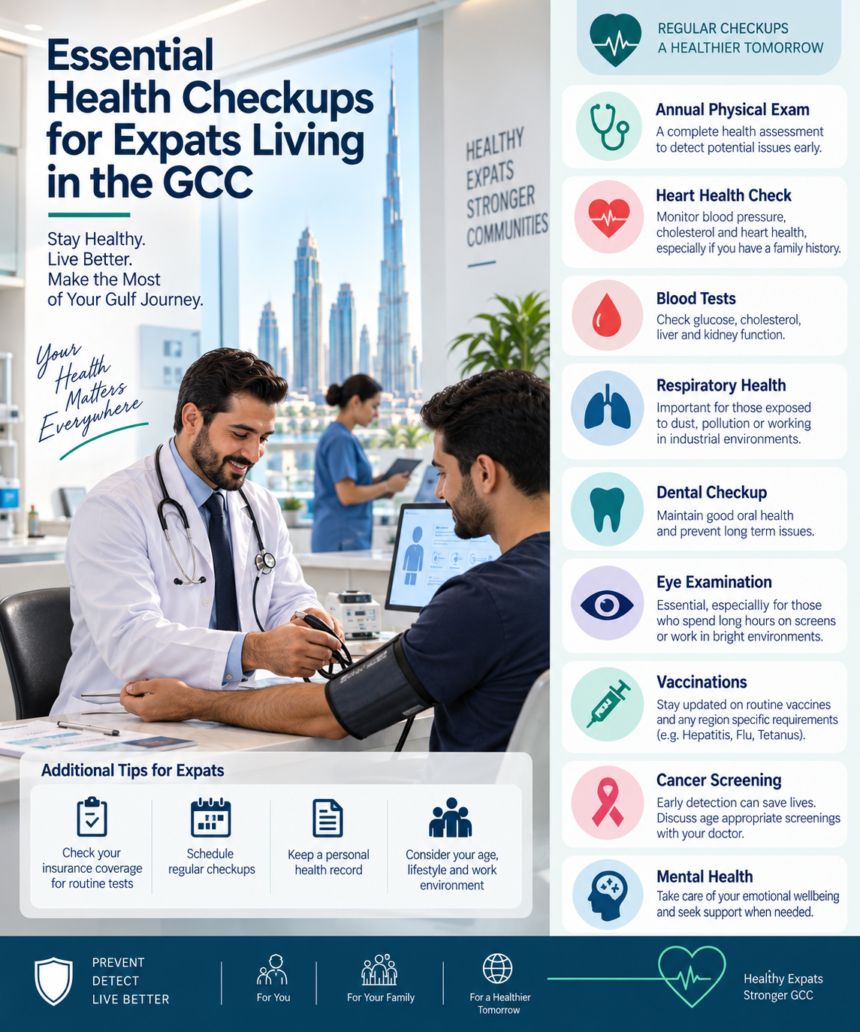
Residency Medical Tests and Routine Health Checkups
Living and working in the Gulf can bring major lifestyle changes. A new job may mean longer working hours, different eating habits, more time indoors during the hottest months and less physical activity than someone was accustomed to before relocating.
- Preventive Health Checkups for Expats in the GCC
- Residency Medical Tests and Routine Health Checkups
- 1. Blood Pressure Screening
- 2. Blood Sugar and Diabetes Screening
- 3. Cholesterol and Heart Health Assessment
- 4. Weight and Metabolic Health Assessment
- 5. Complete Blood Count and General Blood Tests
- 6. Liver and Kidney Health Tests
- 7. Cancer Screening
- 8. Dental Health Checkups
- 9. Eye and Vision Examinations
- 10. Vaccination Review
- 11. Women’s Preventive Health Screening
- 12. Men’s Preventive Health Screening
- Health Checkups for People With Chronic Conditions
- Mental Health and General Wellbeing
- Health Screening for Children and Families
- Medical Checkup Requirements Across GCC Countries
- Health Insurance Coverage for Preventive Checkups
- Choosing a Hospital or Clinic for Health Screening
- Preparing for a Health Checkup
- Medical Records for International Expats
- Common Health Screening Mistakes
- Practical Health Checkup Checklist for GCC Expats
- Building a Long-Term Preventive Healthcare Routine
- Final Thoughts on Health Checkups for GCC Expats
Healthcare should therefore be part of an expat’s long-term planning, not something considered only after symptoms appear.
The UAE, Saudi Arabia, Qatar, Kuwait, Bahrain and Oman have extensive healthcare systems with public hospitals, private hospitals, medical centres, laboratories and specialist clinics. Many expatriates also receive health insurance through their employers, making routine healthcare relatively accessible depending on the policy.
Regular health screening can help identify certain conditions before they begin causing obvious symptoms. Preventive care commonly includes monitoring blood pressure and evaluating risk factors for conditions such as diabetes and cardiovascular disease, while vaccinations and age-appropriate cancer screening can also form part of preventive healthcare.
However, there is an important distinction to understand.
A residency medical fitness examination is not the same as a comprehensive preventive health checkup.
Visa and residency tests are generally designed to meet public-health and immigration requirements. A personal preventive checkup is designed around an individual’s age, medical history, family history, symptoms and risk factors.
Expats should therefore not assume that passing a residency medical examination means they have received a complete assessment of their health.
Preventive Health Checkups for Expats in the GCC
Preventive healthcare focuses on identifying potential medical problems early and reducing future health risks.
For someone who feels completely healthy, visiting a doctor may seem unnecessary. However, several common conditions can develop without noticeable symptoms in their early stages.
High blood pressure is one example. Screening guidelines recommend blood-pressure measurement in adults because hypertension may otherwise remain undetected.
Diabetes, abnormal cholesterol and some cancers can also be detected through appropriately targeted screening before serious complications develop.
That does not mean every healthy adult needs an enormous package of laboratory tests every year.
The right screening schedule depends on factors including:
- Age
- Sex
- Family medical history
- Previous test results
- Weight
- Lifestyle
- Smoking history
- Existing health conditions
- Medication use
- Pregnancy plans
- Occupational risks
A doctor should help determine which tests are appropriate rather than simply ordering every test offered in a commercial health-check package.
For Gulf expats, preventive care can be particularly useful because people frequently change employers, insurers and even countries. Maintaining an ongoing record of health information creates continuity when the healthcare system around you changes.
Residency Medical Tests and Routine Health Checkups
Most Gulf countries have medical screening procedures connected to some categories of employment or residency.
The exact requirements vary.
For example, Emirates Health Services provides a medical fitness examination required for UAE residency, while Dubai Health states that the residency medical fitness process can include blood collection, chest X-ray and vaccinations for certain professional categories.
Qatar’s Ministry of Public Health provides medical examination services connected to residence status, while Bahrain describes expatriate medical checkups as compulsory for expatriates applying for work permits.
Oman provides post-arrival medical fitness examination services for workers obtaining or renewing residency cards, and Kuwait’s Ministry of Health provides an official appointment system for expatriate medical examinations.
Applicants travelling to GCC countries for employment or residence may also encounter Wafid, the Gulf Health Council’s programme for medical examinations of people seeking employment or residency in GCC states.
These tests serve a specific regulatory purpose.
They should not be confused with ongoing personal screening for blood pressure, cholesterol, diabetes, cancer risk, dental problems or other health concerns.
1. Blood Pressure Screening
Blood pressure is one of the simplest but most useful measurements in preventive healthcare.
High blood pressure can increase the risk of cardiovascular and kidney disease and may exist without obvious symptoms.
The US Preventive Services Task Force recommends screening adults aged 18 and older for hypertension. It suggests more frequent screening for people aged 40 and above and those at increased risk, while younger adults with previously normal readings and no increased risk may be screened less often.
A single elevated reading does not necessarily establish a diagnosis.
Blood pressure can temporarily rise because of stress, caffeine, physical activity or anxiety during a medical visit. Doctors may therefore recommend repeated measurements or monitoring outside the clinic before confirming hypertension.
For expats, it can be useful to know your usual blood-pressure range and keep previous readings available when changing doctors.
2. Blood Sugar and Diabetes Screening
Diabetes is another important area of preventive healthcare.
Screening may involve fasting blood glucose, HbA1c or another test selected by the doctor.
Not every person needs diabetes testing at the same frequency. Age, body weight, family history, previous pregnancy-related diabetes, blood pressure and other risk factors can influence the decision.
A preventive appointment provides an opportunity to discuss those risks.
People who already have diabetes need a different level of monitoring from people being screened for the first time. Diabetes management can involve regular glucose assessment as well as monitoring cholesterol, kidney health and eye health because the condition can affect several parts of the body.
New expats with diabetes should establish care soon after relocating rather than waiting until medication supplies begin running low.
3. Cholesterol and Heart Health Assessment
Heart health is influenced by more than a single test.
A doctor may consider:
- Blood pressure
- Cholesterol
- Blood sugar
- Weight
- Smoking
- Physical activity
- Diet
- Family history
- Existing medical conditions
A lipid profile can measure different forms of cholesterol and triglycerides, helping clinicians assess cardiovascular risk alongside other factors.
The result should be interpreted by a healthcare professional rather than viewed as an isolated number.
People with a strong family history of premature cardiovascular disease or other risk factors may require earlier or more frequent assessment than someone at lower risk.
New residents should also avoid assuming that a comprehensive cardiac scan or treadmill test is necessary simply because a health package includes one. Advanced investigations are generally most useful when there is a clinical reason for them.
4. Weight and Metabolic Health Assessment
Weight alone does not provide a complete picture of health, but changes in body weight and waist measurement can provide useful information when considered alongside other clinical factors.
Relocating to the Gulf can change daily routines significantly.
Some expats move from jobs involving considerable walking to office-based positions where most travel is by car. Extreme summer temperatures can also make outdoor exercise less convenient.
A health assessment can review:
- Weight changes
- Nutrition
- Physical activity
- Sleep
- Blood pressure
- Blood sugar
- Cholesterol
- Other metabolic risk factors
The purpose should not be to reach a cosmetic ideal.
The goal is to identify meaningful health risks and develop sustainable habits that work within the person’s actual Gulf lifestyle.
5. Complete Blood Count and General Blood Tests
A complete blood count, commonly called a CBC, measures different blood cells and can provide useful clinical information.
Doctors may use it when investigating issues such as anaemia, infection or certain blood-related conditions.
However, it should not automatically be treated as a test that every healthy person must repeat frequently without a reason.
Additional blood tests may be ordered depending on symptoms and medical history.
For example, someone experiencing persistent fatigue may require a different investigation from an asymptomatic person attending a routine preventive appointment.
This is another reason to choose health checkups based on medical need rather than the number of tests included in an advertised package.
6. Liver and Kidney Health Tests
The liver and kidneys perform essential functions, but screening requirements differ from person to person.
Doctors may pay particular attention to kidney function in people with conditions such as diabetes or high blood pressure.
Liver testing may be relevant for people taking certain medications, those with previous abnormal results, people with particular metabolic risk factors or patients with symptoms suggesting liver problems.
If you are taking long-term medication, ask whether periodic liver or kidney monitoring is appropriate.
Patients should also tell doctors about vitamins, herbal preparations and dietary supplements.
Products purchased without a prescription can still interact with medicines or influence laboratory results.
7. Cancer Screening
Cancer screening should be based primarily on age, sex, risk factors and recognised clinical guidelines.
Depending on the individual, preventive screening may include areas such as:
- Breast cancer
- Cervical cancer
- Colorectal cancer
- Lung cancer for selected high-risk individuals
- Other targeted screening based on medical history
Preventive-care recommendations include screening for several cancers in appropriate groups, but the appropriate age and interval vary according to the screening programme and individual risk.
Someone with a strong family history of a particular cancer may need a different approach from someone at average risk.
Expats who have already started a screening programme in their home country should bring previous results when relocating so their new doctor can maintain continuity rather than unnecessarily repeating tests.
8. Dental Health Checkups
Dental health is easy to neglect when adjusting to a new country.
Problems such as cavities and gum disease can progress before they become painful enough to force an appointment.
Regular dental assessment can help identify issues earlier and provide opportunities for preventive care.
Insurance is an important consideration because many basic Gulf medical insurance plans offer limited dental benefits or exclude routine treatment.
Before booking, check whether your plan covers:
- Dental consultations
- Cleaning
- X-rays
- Fillings
- Root canal treatment
- Emergency dental treatment
- Major restorative treatment
Even when routine dental care is not fully insured, maintaining preventive appointments may help avoid more complicated treatment later.
9. Eye and Vision Examinations
Vision changes can develop gradually, meaning people sometimes adjust without noticing how much their eyesight has changed.
Routine eye examinations can assess vision and identify whether glasses or contact-lens prescriptions need updating.
Medical eye examinations become especially important for people with certain conditions, including diabetes, because diabetes can increase the risk of eye disease.
People who spend long hours using screens may also experience eye strain, dryness or headaches. These symptoms should be discussed with an appropriate professional rather than automatically assuming they are caused only by screen exposure.
Anyone experiencing sudden vision loss, severe eye pain or other acute eye symptoms should seek prompt medical assessment rather than waiting for a routine eye examination.
10. Vaccination Review

Vaccination does not end in childhood.
Adults can require vaccinations or boosters depending on age, health status, occupation, travel history and national recommendations. CDC preventive-care guidance notes that adults need to keep vaccinations up to date because protection from some childhood vaccines can decrease over time and adult health risks change.
For internationally mobile expats, reviewing vaccination records can be especially useful.
People may have received vaccinations across several countries without maintaining a single complete record.
Bring available vaccination documents to a healthcare provider and ask whether anything needs updating according to your age, medical history, occupation and travel plans.
Parents should maintain complete vaccination records for children as well, particularly when moving between school systems and countries.
11. Women’s Preventive Health Screening
Women’s preventive healthcare changes through different stages of life.
Depending on age and personal circumstances, discussions with a doctor may cover:
- Cervical screening
- Breast screening
- Reproductive health
- Contraception
- Pregnancy planning
- Menstrual concerns
- Bone health
- Menopause
- Family medical history
Women planning pregnancy should consider a preconception appointment, particularly if they take regular medication or have an existing medical condition.
Insurance should also be reviewed before pregnancy because maternity benefits in Gulf health insurance policies can vary considerably.
Preventive women’s healthcare should be personalised rather than based on buying the largest available screening package.
12. Men’s Preventive Health Screening
Men’s preventive healthcare should similarly be based on age, symptoms and risk.
A general assessment may include cardiovascular risk factors, diabetes risk, weight, lifestyle and family history.
Prostate-related assessment is not a universal test that every man needs at every age. The advantages and limitations of screening should be discussed with a doctor based on individual circumstances.
Men should also avoid delaying medical assessment for symptoms simply because they feel generally healthy.
Changes in urinary habits, unexplained weight loss, persistent pain or other concerning symptoms deserve clinical assessment rather than waiting for the next routine checkup.
Health Checkups for People With Chronic Conditions
People living with chronic conditions need a more structured healthcare routine.
Conditions requiring ongoing monitoring can include:
- Diabetes
- Hypertension
- Asthma
- Heart disease
- Kidney disease
- Thyroid disorders
- Autoimmune conditions
Before relocating, obtain copies of recent medical records and make sure you have an adequate legal supply of medication for the transition period.
After arrival, identify an in-network doctor who can continue treatment.
Do not wait until the final few days of medication remain.
Medicine brand names can differ between countries, and certain medicines may be subject to specific import or prescribing controls.
Mental Health and General Wellbeing
A health checkup does not need to focus entirely on laboratory numbers.
Relocation can involve separation from family, workplace pressure, disrupted routines, financial responsibilities and adjustment to a new culture.
Sleep, mood, stress and general wellbeing are therefore appropriate subjects to discuss during healthcare appointments.
Persistent anxiety, low mood, severe sleep disruption or other mental health concerns deserve the same seriousness as physical symptoms.
Insurance coverage for mental healthcare differs between plans, so expats may need to check whether psychologists, psychiatrists or counselling services are included in their network.
Health Screening for Children and Families
Children do not require the same preventive screening as adults.
Their routine healthcare focuses more on growth, development, vaccinations and age-specific medical needs.
Parents should establish care with a paediatrician or family doctor soon after relocating.
Keep copies of:
- Vaccination records
- Allergy information
- Previous medical reports
- Current medications
- School health records
- Specialist reports
Children with asthma, allergies, diabetes or other ongoing conditions should establish local specialist care early.
Families should also identify the nearest suitable paediatric emergency department rather than searching for one for the first time during an emergency.
Medical Checkup Requirements Across GCC Countries
GCC medical examination systems have similarities, but procedures are not identical.
| Country | Residency or employment screening considerations |
|---|---|
| UAE | Medical fitness screening forms part of residency procedures for applicable expatriate residents |
| Saudi Arabia | GCC-bound applicants may encounter Wafid medical screening as part of work or residence processes |
| Qatar | Medical examinations form part of relevant residence procedures |
| Bahrain | Expatriate medical examinations are compulsory for applicable work-permit applicants |
| Oman | Medical fitness services apply to relevant residency issuance and renewal procedures |
| Kuwait | Expatriate medical examination appointments are provided through Ministry of Health services |
The Gulf Health Council’s Wafid programme also provides medical examination services for people seeking employment or residency in GCC countries.
Rules can vary according to visa category, occupation, age and residency status, and they can change over time.
Expats should therefore use official government information for their specific application rather than relying on another person’s previous visa experience.
Health Insurance Coverage for Preventive Checkups
Not every insurance policy pays for a comprehensive health screening.
Some employer policies include an annual preventive checkup, while others cover testing only when medically necessary.
Before booking a large package, check:
- Whether preventive screening is included
- Which clinic or hospital is in network
- Whether a GP referral is required
- Whether blood tests need prior approval
- Whether cancer screening is covered
- Whether dental and optical benefits are separate
- Whether there is a co-payment
- Whether the checkup uses part of an annual benefit limit
A clinic may advertise a convenient health package, but convenience and insurance coverage are separate questions.
Choosing a Hospital or Clinic for Health Screening
For basic preventive care, a reputable clinic with strong family medicine or internal medicine services may be sufficient.
More complex patients may benefit from a larger hospital where several specialists, laboratories and imaging services are available in one place.
Choose according to:
- Professional licensing
- Insurance network
- Doctor expertise
- Laboratory quality
- Specialist access
- Location
- Appointment availability
- Follow-up services
- Medical record systems
Continuity can be more valuable than constantly moving between facilities based on promotional health packages.
A doctor who understands your medical history can interpret changes over time rather than treating every test as an isolated result.
Preparing for a Health Checkup
Preparation can improve the usefulness of the appointment.
Bring:
- Emirates ID, residence card or other relevant identification
- Insurance information
- Current medication list
- Previous blood-test results
- Previous scans
- Vaccination records
- Family medical history where known
- Details of allergies
- Notes about symptoms
Ask the clinic whether fasting is actually required before blood tests.
Do not automatically fast for every health checkup unless instructed to do so.
Also tell the doctor about supplements and non-prescription products.
Medical Records for International Expats
Expats frequently move between hospitals, employers and countries.
Keeping personal medical records therefore becomes particularly important.
Maintain digital copies of:
- Major diagnoses
- Operations
- Laboratory results
- Imaging reports
- Allergy information
- Medication lists
- Vaccination records
- Cancer screening results
- Maternity records
- Specialist reports
Cloud storage or another secure digital system can be particularly useful when relocating.
Do not rely entirely on one hospital’s app because access could become more difficult after leaving the country.
Common Health Screening Mistakes
Assuming residency screening is a full health check
Visa medical examinations serve specific regulatory purposes.
Buying the largest test package
More tests do not automatically mean better preventive care.
Repeating tests unnecessarily
Bring previous results so your doctor can determine what actually needs repeating.
Ignoring family history
Family medical history can change which screenings are appropriate.
Waiting for symptoms
Some important risk factors can exist without obvious symptoms.
Ignoring dental and eye care
Preventive healthcare extends beyond blood tests.
Not checking insurance first
A screening package may not be covered simply because the hospital accepts your insurer.
Self-interpreting abnormal results
One laboratory value outside a reference range does not automatically mean disease. Results should be interpreted in clinical context.
Practical Health Checkup Checklist for GCC Expats
A useful preventive healthcare discussion can include:
| Health area | Assessment to discuss |
|---|---|
| Blood pressure | Routine measurement |
| Diabetes | Risk assessment and appropriate testing |
| Cholesterol | Cardiovascular risk-based screening |
| Weight/metabolic health | Lifestyle and risk assessment |
| Blood tests | When clinically appropriate |
| Liver/kidney function | Based on risks, medicines and conditions |
| Cancer screening | Age and risk appropriate |
| Dental health | Preventive dental review |
| Eye health | Vision and medical eye assessment where appropriate |
| Vaccinations | Adult vaccination review |
| Women’s health | Age and life-stage appropriate care |
| Men’s health | Age and risk appropriate care |
| Mental health | Sleep, stress and emotional wellbeing |
This checklist is a starting point, not a prescription.
An individual doctor may recommend fewer, additional or different tests according to your personal medical history.
Building a Long-Term Preventive Healthcare Routine
The most effective preventive healthcare strategy is not completing one enormous screening package after moving to the Gulf and then forgetting about healthcare for several years.
Build continuity.
Choose a reliable primary-care doctor.
Know your important numbers, including blood pressure and relevant previous test results.
Keep vaccinations and age-appropriate screening up to date.
Maintain dental and eye care.
Address persistent symptoms instead of repeatedly postponing them.
People with chronic conditions should have a clear follow-up schedule agreed with their medical team.
Whenever you change employers, check whether your insurance network has changed and whether your existing doctors remain covered.
And when moving between GCC countries, take copies of your medical records with you.
Final Thoughts on Health Checkups for GCC Expats
Health checkups for expats living in the GCC should serve one main purpose: helping people understand and manage their health before preventable problems become more difficult to address.
For most adults, useful preventive care begins with relatively simple measures such as blood pressure assessment, appropriate diabetes and cholesterol screening, vaccination review, dental care and age-appropriate cancer screening.
Additional laboratory and specialist tests should be selected according to individual risk rather than automatically added simply because a package is marketed as comprehensive.
It is equally important to understand the difference between mandatory expatriate medical fitness screening and personal preventive healthcare.
The UAE, Saudi Arabia, Qatar, Bahrain, Oman and Kuwait maintain medical examination processes connected to particular employment and residency arrangements, but those procedures are not substitutes for ongoing healthcare. Official requirements should always be checked for the specific country and residency category.
For expats, one of the best investments is continuity.
Keep your records. Know your insurance network. Find a doctor you trust. Understand your personal risk factors and follow an appropriate screening schedule developed with a healthcare professional.
Preventive healthcare is not about doing every possible medical test.
It is about doing the right tests, for the right person, at the right time.
Do follow us on Instagram
Read More – Choosing the Right Hospital or Clinic in the Gulf: Complete Expat Guide