



Mortgage Insurance and Property Protection
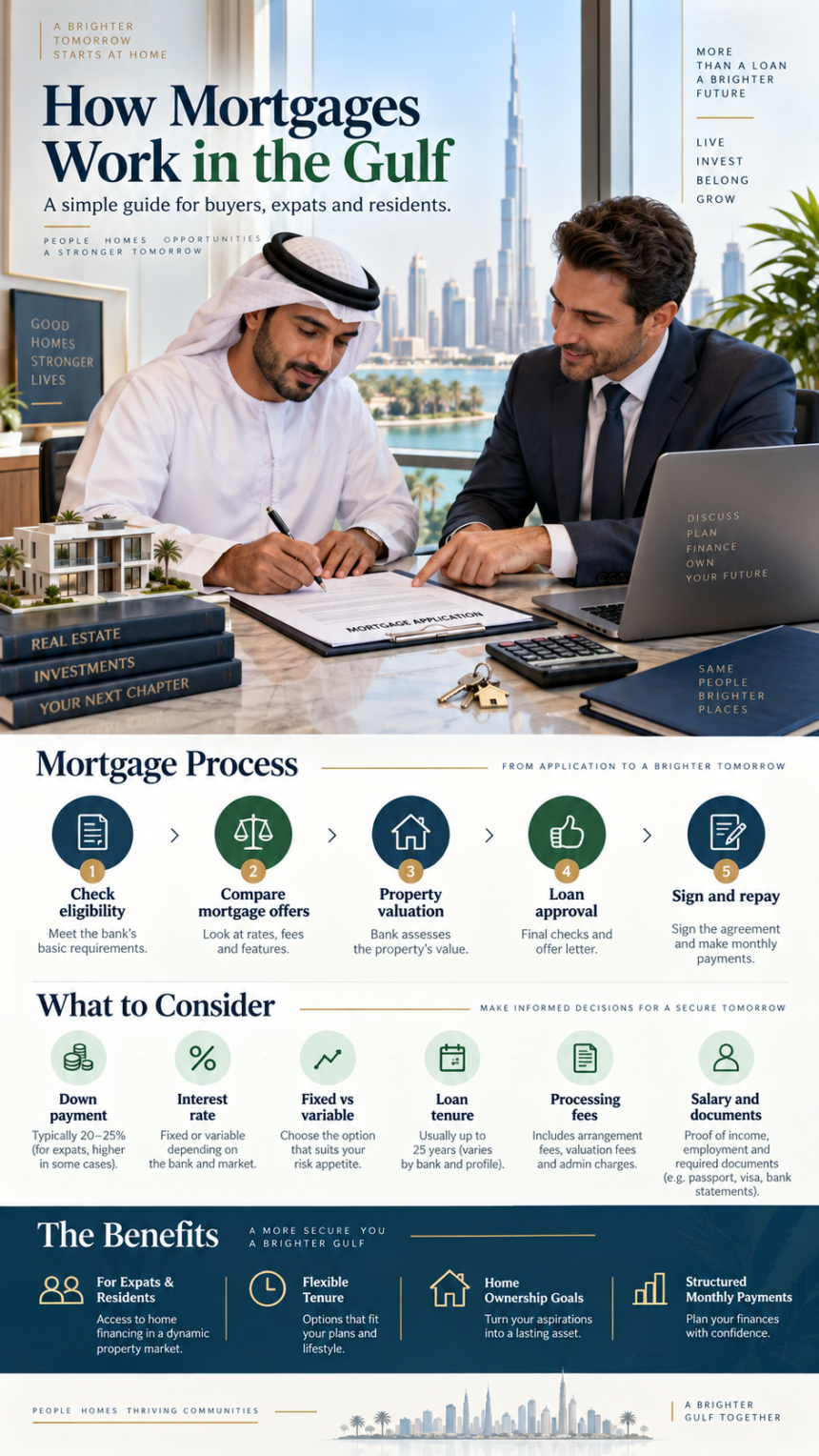
How Mortgages Work in the Gulf is an important subject for anyone planning to buy a home or investment property in the UAE, Saudi Arabia, Qatar, Bahrain, Oman or Kuwait. Mortgages and home-finance products allow buyers to purchase real estate without paying the entire property value in cash, but the amount a bank will finance, the deposit required and the repayment rules can vary considerably across GCC countries.
- How Mortgages Work in the Gulf: 2026 Overview
- 1. Understanding Mortgage and Home Finance
- 2. Mortgage Eligibility for GCC Residents and Expats
- 3. Down Payments and Loan-to-Value Ratios
- 4. Salary, Income and Affordability Assessments
- 5. Fixed and Variable Mortgage Rates
- 6. Mortgage Terms and Monthly Repayments
- 7. Mortgage Pre-Approval
- 8. Property Valuation and Bank Approval
- 9. Mortgage Fees and Additional Buying Costs
- 10. Islamic Home Finance and Conventional Mortgages
- 11. Early Settlement and Mortgage Refinancing
- 12. Mortgage Risks When Employment or Residency Changes
- Mortgages in the UAE
- Home Finance in Saudi Arabia
- Mortgages in Qatar
- Home Finance in Bahrain
- Housing Finance in Oman
- Housing Finance in Kuwait
- First Home and Investment Property Mortgages
- Mortgages for Expats in the GCC
- Buying Off-Plan Property With Finance
- Mortgage Affordability and Debt Burden
- Mortgage Insurance and Property Protection
- Choosing the Right Mortgage in the Gulf
- Common Mortgage Mistakes Gulf Buyers Should Avoid
- Practical GCC Mortgage Comparison Checklist
- Final Thoughts on Mortgages in the Gulf
The basic structure is familiar. A buyer contributes part of the purchase price, while a bank or licensed finance provider funds the remaining amount. The property generally acts as security for that financing until the debt has been repaid.
The details are where things become more complicated.
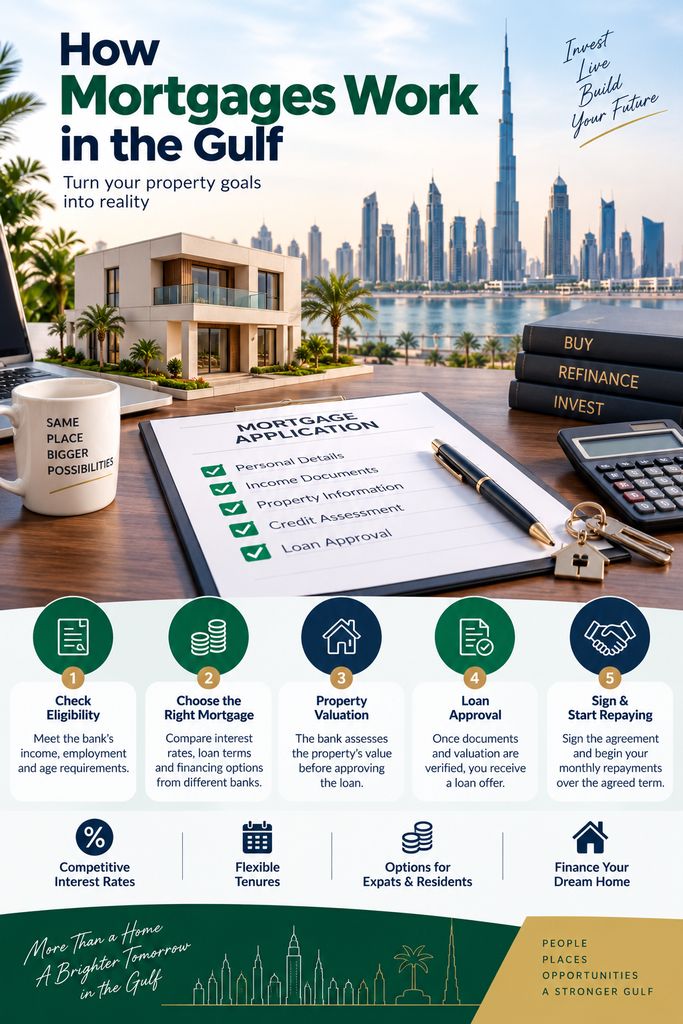
Banks examine salary, existing financial commitments, credit history, property value, age, employment and residency before approving a mortgage. Regulators may also impose limits on the loan-to-value ratio, debt burden and maximum repayment term.
The Gulf additionally provides both conventional mortgages and Islamic home-finance products, giving buyers different contractual structures to choose from.
For expatriates, another issue matters: long-term employment and residency. A mortgage can continue for 20 or 25 years, while an employment contract or residence visa may be much shorter.
Understanding affordability therefore matters more than simply asking how much the bank is willing to lend.
How Mortgages Work in the Gulf: 2026 Overview
Mortgage lending across the GCC is supervised by each country’s central bank or financial regulator.
| Country | Main regulator | Key mortgage consideration |
|---|---|---|
| UAE | Central Bank of the UAE | Clear LTV, debt-burden and mortgage-term limits |
| Saudi Arabia | Saudi Central Bank | Responsible lending and real estate finance rules |
| Qatar | Qatar Central Bank | Bank-level property finance within QCB credit framework |
| Bahrain | Central Bank of Bahrain | Regulated mortgage and housing-finance products |
| Oman | Central Bank of Oman | Housing finance subject to LTV and debt-service rules |
| Kuwait | Central Bank of Kuwait | Housing finance capped under retail-loan framework |
The biggest differences generally involve the amount a buyer can borrow, the required deposit and how much monthly income can safely be committed to debt.
The UAE has one of the clearest mortgage frameworks. For expatriates buying their first owner-occupied property worth AED 5 million or less, the maximum loan-to-value ratio is currently 80%, meaning the buyer normally needs at least 20% of the property value from their own funds. The maximum LTV falls to 70% for first homes worth more than AED 5 million and 60% for second or investment properties.
Oman takes a different approach. Its 2025 personal-finance framework permits a housing-loan LTV of up to 90%, subject to applicable debt-burden and eligibility requirements.
Kuwait, meanwhile, treats housing finance as a long-term personal-finance facility with a maximum amount of KWD 70,000 and a maximum repayment period of 15 years under the Central Bank’s current framework.
These examples demonstrate why Gulf mortgage rules should always be checked country by country.
1. Understanding Mortgage and Home Finance
A mortgage is a long-term loan secured against property.
The borrower pays part of the price through a deposit and finances the rest through a lender.
Imagine a property costs AED 1 million.
If a bank finances 80%, the mortgage would be AED 800,000 and the buyer would need at least AED 200,000 toward the purchase price, before considering registration and other transaction costs.
The borrower then repays the financed amount through regular instalments.
A conventional mortgage usually includes interest.
Islamic home finance uses a Sharia-compliant contractual structure instead of a conventional interest-bearing loan.
In both cases, buyers need to understand:
- Financing amount
- Property value
- Deposit
- Rate or profit structure
- Monthly instalment
- Mortgage term
- Early settlement conditions
- Total amount payable
Focusing only on the monthly instalment can be misleading.
A longer mortgage may produce a smaller monthly payment but a substantially higher total financing cost over the full term.
2. Mortgage Eligibility for GCC Residents and Expats
Banks do not approve mortgages solely because someone earns a salary.
Mortgage eligibility normally depends on several factors.
These can include:
- Monthly income
- Employment history
- Employer
- Age
- Nationality or residency
- Credit history
- Existing loans
- Credit-card obligations
- Property type
- Property location
- Down payment
Expats may face different conditions from citizens.
The UAE explicitly distinguishes between national and expatriate borrowers in its LTV framework. For first owner-occupied homes worth AED 5 million or less, nationals may receive financing of up to 85%, while expatriates are limited to 80%.
Individual banks can still apply stricter policies.
A regulatory maximum tells the bank how far it may go. It does not guarantee that a particular borrower will receive the full amount.
Someone with a high salary but heavy existing debt may receive less finance than another applicant with lower income but stronger disposable cash flow.
3. Down Payments and Loan-to-Value Ratios
Loan-to-value, usually shortened to LTV, shows how much of the property’s value the lender is willing to finance.
A higher LTV means a smaller deposit.
A lower LTV means the buyer must contribute more cash.
For example:
| Property value | LTV | Mortgage | Buyer contribution |
|---|---|---|---|
| AED 1,000,000 | 80% | AED 800,000 | AED 200,000 |
| AED 1,000,000 | 70% | AED 700,000 | AED 300,000 |
| AED 1,000,000 | 60% | AED 600,000 | AED 400,000 |
The UAE Central Bank also states that the buyer’s down payment should come from their own resources rather than being funded through another personal loan or credit card.
That is an important principle even outside the UAE.
Borrowing the deposit separately can leave the buyer carrying both a mortgage and unsecured debt before the home has even been purchased.
A larger deposit can also create greater protection against property-price declines because the owner begins with more equity.
4. Salary, Income and Affordability Assessments
Banks need to decide not only whether a borrower has sufficient income but whether enough income remains after other obligations.
This is often measured using a debt-burden or debt-service ratio.
The UAE mortgage framework states that the borrower’s total debt burden cannot generally exceed 50% and limits total mortgage financing to up to seven years of annual income for expatriates and eight years for UAE nationals.
Saudi Arabia uses a more detailed responsible-lending framework.
For customers earning SAR 15,000 per month or less, overall monthly finance obligations generally cannot exceed 55% of total monthly income, although qualifying beneficiaries of Ministry of Housing or Real Estate Development Fund mortgage programmes can reach 65%. Different rules apply to higher-income customers.
The Saudi regulator also requires creditors to examine credit records and assess whether the borrower can genuinely meet the monthly obligation before granting finance.
The safest personal budget is often stricter than the maximum regulatory ratio.
A household committing half its income to debt has much less flexibility when rent, school fees, medical costs or employment circumstances change.
5. Fixed and Variable Mortgage Rates
Mortgage pricing can generally be fixed, variable or a combination of both.
Fixed rate
The financing rate remains unchanged for an agreed period.
This creates predictable repayments.
However, many Gulf mortgage products fix the rate only for the first one, three or five years rather than for the full 20 or 25-year term.
Variable rate
The rate changes according to a reference benchmark plus the bank’s margin.
If the benchmark rises, mortgage repayments or financing costs can rise.
If it falls, they may decline.
Hybrid mortgage
Some mortgages begin with a fixed period and later move to a variable structure.
Buyers should always ask what happens after the introductory fixed rate ends.
A mortgage advertised with an attractive first-year rate may become substantially more expensive later.
Compare the long-term pricing formula rather than only the promotional rate.
6. Mortgage Terms and Monthly Repayments
Mortgage terms are considerably longer than personal loans.
In the UAE, the maximum mortgage term is currently 25 years.
The Central Bank also requires lenders to consider whether borrowers can continue servicing the mortgage if repayment extends beyond expected retirement age.
Oman’s housing-loan framework also allows long-term financing, with the Central Bank regulatory framework providing up to 25 years for housing finance.
Kuwait uses a shorter structure for its regulated housing-finance facility, with repayment limited to 15 years.
Choosing the term involves a trade-off.
A 25-year mortgage generally produces lower monthly repayments than a 15-year mortgage on the same amount.
However, the borrower remains in debt longer and can pay significantly more in total financing costs.
7. Mortgage Pre-Approval
Mortgage pre-approval can be extremely useful before searching seriously for property.
The lender reviews the applicant’s financial situation and gives an indication of how much finance may be available.
Banks may request:
- Passport
- Resident ID
- Visa
- Salary certificate
- Employment letter
- Bank statements
- Credit report
- Existing loan information
Pre-approval does not mean the final property is automatically approved.
The bank still needs to assess the actual property.
However, pre-approval helps the buyer understand a realistic price range.
Without it, buyers can waste time negotiating on properties they cannot finance.
It also helps identify credit or documentation problems before a purchase contract creates financial commitments.
8. Property Valuation and Bank Approval
Mortgage approval depends on both the borrower and the property.
Once the buyer selects a home, the lender generally arranges a professional valuation.
The bank may base its financing on the lower of the purchase price or its assessed property value.
Imagine the buyer agrees to purchase a home for AED 1.2 million but the bank values it at AED 1.1 million.
If the lender finances 80% of the valuation, it may provide only AED 880,000.
The buyer then needs to cover the difference from personal funds.
This is known informally as a valuation gap.
It can become a serious problem for buyers who use nearly all available cash for the expected deposit.
Always keep a buffer beyond the minimum down payment.
9. Mortgage Fees and Additional Buying Costs
The deposit is not the only upfront cost of buying property.
Additional expenses can include:
- Property registration
- Mortgage registration
- Bank arrangement fees
- Valuation
- Brokerage
- Insurance
- Legal or documentation costs
- Developer charges
These expenses vary by country and transaction.
Some can be financed in limited circumstances, while others must be paid in cash.
For this reason, a buyer with exactly enough savings for a 20% deposit may still not have enough money to complete the purchase.
Before making an offer, calculate:
Deposit + government fees + bank fees + valuation + brokerage + moving or setup costs.
Retaining an emergency fund after completion is also important.
Owning a property does not eliminate unexpected expenses.
10. Islamic Home Finance and Conventional Mortgages
Islamic home finance is widely available across Gulf countries.
Instead of lending money through a conventional interest-bearing contract, Islamic banks use Sharia-compliant structures.
Products can use arrangements such as Ijara, Murabaha or diminishing Musharaka, depending on the bank and market.
The exact legal structure differs, but the customer still needs to compare:
- Monthly payment
- Profit rate
- Total amount payable
- Down payment
- Finance period
- Early settlement
- Insurance or Takaful
A Sharia-compliant product should not be assumed to be cheaper simply because it uses a different structure.
Likewise, a conventional mortgage should not be judged solely by the advertised interest rate.
The most useful comparison is the total long-term financial cost.
11. Early Settlement and Mortgage Refinancing
A homeowner may eventually want to repay the mortgage early.
Reasons can include:
- Receiving a bonus
- Selling another asset
- Relocating
- Lowering monthly debt
- Refinancing with another bank
Early settlement can involve a fee depending on the country, lender and contract.
Refinancing involves replacing the current mortgage with another financing arrangement.
This can make sense when the new mortgage offers better pricing, but costs need to be included.
Refinancing expenses may include:
- Early settlement fee
- New valuation
- Bank processing
- Mortgage registration
- Administrative costs
A lower advertised rate does not automatically make refinancing worthwhile.
Calculate how long it will take for the monthly saving to recover the switching costs.
12. Mortgage Risks When Employment or Residency Changes
This issue is particularly important for expatriates.
A mortgage might continue for decades, while employment can change unexpectedly.
Before borrowing, understand what would happen if:
- You lose your job
- Salary falls
- You change employer
- You leave the country
- Your residence status changes
- You want to rent the property
Banks may have different policies around job changes and overseas borrowers.
A property owner who leaves the Gulf does not automatically stop owing the mortgage.
The debt remains until it has been settled or transferred according to the lender’s terms.
Expats should therefore avoid using their entire savings as a deposit.
Maintaining several months of emergency liquidity can provide essential protection during employment transitions.
Mortgages in the UAE
The UAE has one of the GCC’s most detailed mortgage regulatory systems.
For expatriates buying a first owner-occupied home, maximum LTV ratios are:
- Up to 80% for properties worth AED 5 million or less
- Up to 70% for properties above AED 5 million
For second homes and investment properties, expatriate mortgage financing is limited to 60% of the property value.
For UAE nationals, the maximum is 85% for a first home worth AED 5 million or less and 75% above AED 5 million. Second or investment properties have a maximum LTV of 65%.
The maximum mortgage term is 25 years.
The total debt-burden ratio cannot generally exceed 50%, while maximum mortgage financing is capped at seven years of annual income for expatriates and eight years for nationals.
These are maximum regulatory boundaries.
Banks remain free to apply stricter affordability requirements.
Home Finance in Saudi Arabia
Saudi Arabia’s property-finance market operates within SAMA’s Responsible Lending Principles for Individual Customers.
The framework explicitly applies to real estate finance as well as personal finance, vehicle finance and credit cards.
Lenders must evaluate creditworthiness, examine the applicant’s credit record and assess whether monthly commitments remain affordable.
Debt limits depend partly on income.
For borrowers earning SAR 15,000 per month or less, total finance obligations generally cannot exceed 55% of total monthly income, although eligible Ministry of Housing or Real Estate Development Fund mortgage beneficiaries may reach 65%.
For customers earning more than SAR 15,000 but less than SAR 25,000, total obligations may generally reach 65% under the applicable framework. For income of SAR 25,000 or above, the creditor’s policies and affordability assessment play a larger role.
This means there is no single mortgage affordability percentage that applies identically to every Saudi borrower.
Mortgages in Qatar
Qatar Central Bank regulates both residential and commercial property finance through its banking supervision framework.
QCB defines residential mortgage lending as bank financing secured against residential property, including owner-occupied property and qualifying residential assets generating rental income.
The country’s instructions also separately track financing to individuals for purchasing and constructing property, including finance linked to salary.
For buyers, the practical mortgage terms are usually determined by individual banks within the QCB framework.
These can include:
- Minimum salary
- Employer requirements
- Down payment
- Maximum property value
- Age at final payment
- QID validity
- Salary transfer
Expats should therefore compare several banks rather than assuming one Qatar-wide retail mortgage structure applies to every applicant.
Home Finance in Bahrain
Bahrain has both conventional and Islamic mortgage and housing-finance products.
The Central Bank of Bahrain regulates these products as part of the retail banking framework and explicitly includes mortgage and housing finance among financial products covered by its banking rules.
Individual lenders determine product eligibility according to income, employment, credit history, property value and other risk considerations within the regulatory environment.
Buyers should pay particular attention to:
- Down payment
- Maximum term
- Variable-rate formula
- Salary transfer
- Early settlement
- Insurance or Takaful
- Property valuation
Foreign buyers should also make sure the specific property can legally be owned by them before arranging financing.
Mortgage approval and property-ownership eligibility are separate questions.
Housing Finance in Oman
Oman’s 2025 Master Circular on personal loans and finance provides one of the clearest current housing-finance frameworks in the region.
The Central Bank allows housing finance with an LTV ratio of up to 90%, subject to the applicable eligibility and debt-burden requirements.
For housing loans, the value of land already owned by the borrower and qualifying government housing subsidies can be treated as part of the borrower’s contribution when calculating LTV. Registration and insurance costs may also be included in the property value for LTV calculations subject to debt-burden compliance.
The broader CBO framework permits housing finance for terms of up to 25 years and applies debt-service controls to household borrowing.
Buyers should still compare bank-specific rates, age conditions and employment requirements.
Housing Finance in Kuwait
Kuwait uses a distinctive housing-finance structure.
The Central Bank describes housing finance as long-term personal finance used for purchasing, constructing or renovating private housing.
The maximum housing-finance amount under the current framework is KWD 70,000, repayable over a maximum period of 15 years.
A customer may also qualify for consumer finance, with combined consumer and housing finance potentially reaching KWD 95,000 subject to the applicable rules.
Monthly debt-service obligations generally cannot exceed 40% of net salary for employees and 30% for retirees.
Unlike a typical percentage-based mortgage model, this framework places a clear absolute ceiling on qualifying housing finance.
First Home and Investment Property Mortgages
Banks often treat first homes differently from investment properties.
A first owner-occupied home usually represents a lower-risk relationship because the borrower intends to live in the property.
An investment property depends more heavily on rental income and market conditions.
The UAE makes this distinction explicit.
An expatriate buying a first home can receive up to 80% financing for qualifying properties below the AED 5 million threshold, while second and investment properties are limited to 60%.
That means an investor needs substantially more capital.
On an AED 2 million property:
First home at 80% LTV: potentially AED 400,000 minimum equity.
Investment property at 60% LTV: potentially AED 800,000 minimum equity.
The difference is significant.
Mortgages for Expats in the GCC
Expats should add several extra questions to the mortgage checklist.
Will the mortgage remain available if you change jobs?
Can you continue holding the property if you leave the country?
Can the property be rented?
Can repayments be made from abroad?
Does the bank require salary transfer?
What is the maximum age at the final instalment?
The UAE explicitly regulates mortgage lending to expatriates, making it one of the more straightforward Gulf markets for internationally mobile buyers.
Elsewhere, eligibility can depend much more heavily on nationality, property-ownership rights and individual bank policy.
Always confirm both ownership eligibility and mortgage eligibility before signing a property agreement.
Buying Off-Plan Property With Finance
Off-plan property carries additional financing risk because the building has not yet been completed.
In the UAE, the Central Bank limits mortgage LTV for off-plan property to 50% regardless of buyer category, property value or purpose.
Developers may separately offer payment plans that are not traditional bank mortgages.
Buyers should distinguish between:
- Developer instalment plan
- Construction-linked payments
- Bank mortgage
- Post-handover payment plan
A buyer planning to refinance developer payments with a bank mortgage at handover should not assume approval is guaranteed.
Income, valuation and banking rules can change before completion.
Mortgage Affordability and Debt Burden
The maximum amount a bank approves should not become the buyer’s automatic budget.
A safer affordability calculation considers:
Mortgage instalment + service charges + insurance + maintenance + existing debt + family expenses.
Homeowners also need an emergency reserve.
Someone using nearly every available dirham or riyal for the deposit may struggle when an air-conditioning system fails or employment changes.
A good mortgage leaves room for savings.
The goal is to own a home without allowing the home to dominate every financial decision for the next twenty years.
Mortgage Insurance and Property Protection
Mortgage transactions can involve several forms of insurance or Takaful.
These may include:
- Property insurance
- Life cover
- Mortgage protection
- Islamic Takaful arrangements
Requirements depend on the lender and product.
Property insurance protects the physical asset against qualifying risks.
Life or mortgage protection can help deal with the outstanding debt in specified circumstances such as death or disability, depending on the policy.
Do not assume every policy provides identical protection.
Read exclusions and understand who receives the benefit if a claim occurs.
Choosing the Right Mortgage in the Gulf
The lowest initial rate is not automatically the best mortgage.
Compare these features:
| Factor | What to check |
|---|---|
| LTV | Maximum financing available |
| Deposit | Cash required upfront |
| Initial rate | Fixed or variable |
| Reversion rate | Cost after promotional period |
| Mortgage term | Total repayment period |
| Monthly instalment | Current affordability |
| Total cost | Long-term financing expense |
| Fees | Processing and valuation |
| Early settlement | Cost of repaying early |
| Refinancing | Ability to switch lender |
| Salary transfer | Whether required |
| Job change | Impact on financing |
| Insurance | Required protection |
If two mortgages have similar monthly payments, the one with lower fees, clearer pricing and greater repayment flexibility may be the stronger choice.
Common Mortgage Mistakes Gulf Buyers Should Avoid
Buying at the maximum bank approval
Bank eligibility is not the same as personal affordability.
Using all savings for the deposit
Keep emergency cash after completion.
Ignoring the rate after the fixed period
A promotional mortgage can become significantly more expensive.
Forgetting transaction costs
The deposit is only part of the cash needed.
Taking a personal loan for the deposit
This increases leverage and can affect mortgage eligibility.
Ignoring valuation risk
The bank may value the property below the agreed purchase price.
Choosing a very long mortgage only for a lower monthly payment
Longer terms can increase total financing cost.
Not comparing Islamic and conventional options properly
Compare total repayment rather than labels.
Assuming mortgage approval guarantees the property purchase
Property and legal checks remain essential.
Ignoring relocation risk
This is particularly important for expatriates.
Practical GCC Mortgage Comparison Checklist
Before applying for home finance:
- Confirm property ownership eligibility
- Check your credit record
- Calculate existing monthly debt
- Establish a realistic property budget
- Build the deposit from personal savings
- Keep additional cash for buying costs
- Obtain mortgage pre-approval
- Compare several lenders
- Compare LTV ratios
- Review fixed and variable rates
- Check the rate after the introductory period
- Compare total repayment cost
- Understand the property valuation process
- Check early-settlement conditions
- Review insurance requirements
- Understand salary-transfer requirements
- Consider job and residency changes
- Maintain an emergency fund
- Read the full financing agreement before signing
Final Thoughts on Mortgages in the Gulf
Understanding How Mortgages Work in the Gulf becomes easier once buyers separate the process into three questions: how much cash is needed upfront, how much a bank is prepared to finance and how safely the monthly repayments fit within long-term household income.
The UAE has particularly clear rules. Expatriates can currently receive financing of up to 80% on a first owner-occupied home worth AED 5 million or less, while investment properties are limited to 60% financing. Mortgage terms can extend to 25 years, subject to debt-burden and affordability requirements.
Saudi Arabia uses a responsible-lending system that considers income, overall financial commitments and credit history, with specific allowances for qualifying housing-support beneficiaries.
Qatar regulates real estate finance through Qatar Central Bank while leaving individual lenders to apply product-specific salary, property and affordability requirements within that framework.
Bahrain provides both conventional mortgages and Islamic housing finance within its regulated retail-banking sector.
Oman permits housing finance of up to 90% LTV under its current framework, while long-term housing loans can extend to 25 years subject to eligibility and debt-service controls.
Kuwait takes a different approach, with regulated housing finance capped at KWD 70,000 and repayment limited to 15 years under the Central Bank framework.
For buyers, however, the most important mortgage limit is not necessarily the regulatory maximum.
It is the amount that still leaves enough income for everyday living, savings, family responsibilities and unexpected expenses.
A home can be a long-term financial asset, but a mortgage is also a long-term financial commitment.
The strongest buyers therefore do not simply ask, “How much can the bank lend me?”
They ask, “How much can I comfortably repay even if my circumstances become less favourable?”
That difference can turn a mortgage from a financial burden into a manageable path toward long-term property ownership.
Do follow us on Instagram
Read More – Commercial vs Residential Property Investment in Dubai: 12 Essential Differences in 2026