


Common Freehold and Leasehold Property Mistakes
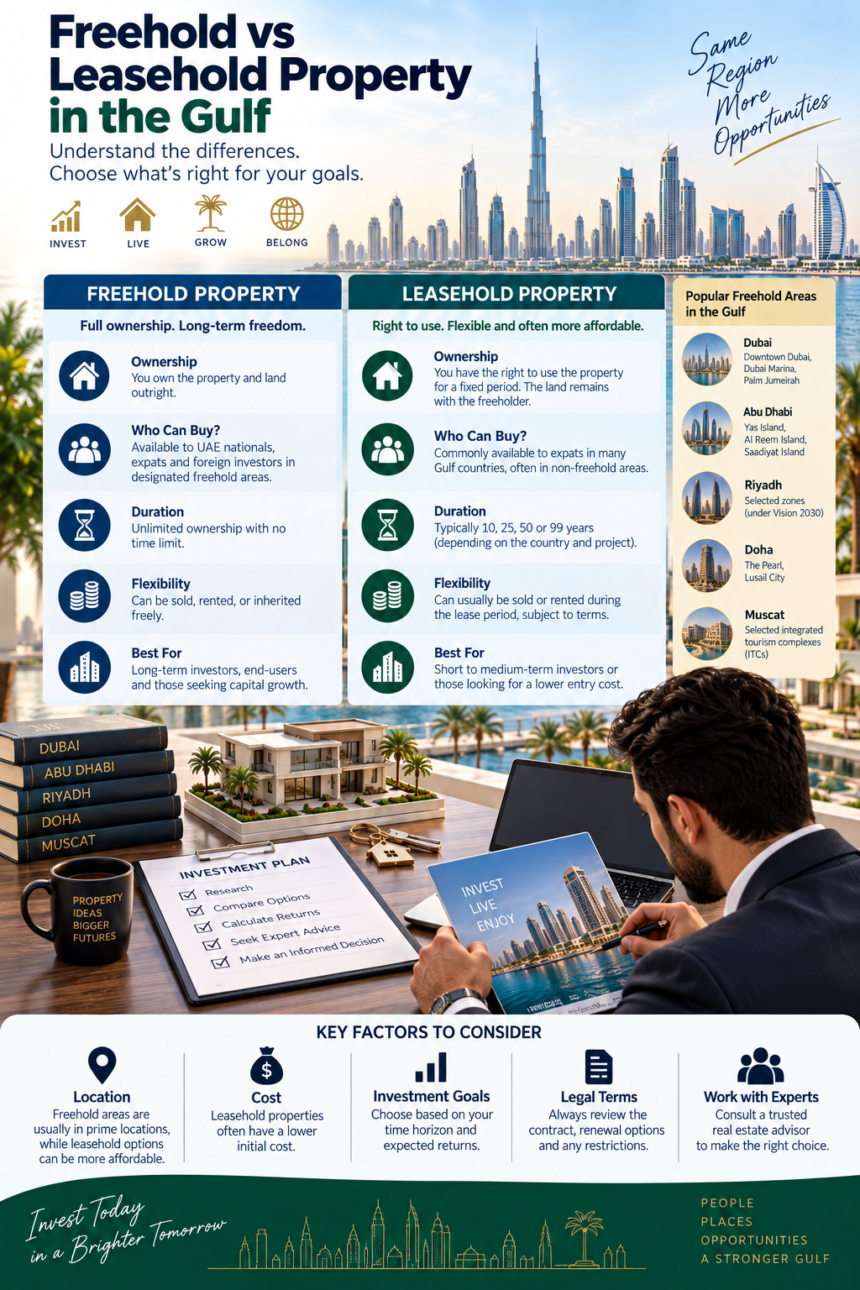
Freehold vs Leasehold Property in the Gulf is an important comparison for anyone planning to buy real estate in the UAE, Saudi Arabia, Qatar, Bahrain, Oman or Kuwait. The type of property right an investor receives can affect how long the property can be held, whether the land is included, how easily it can be sold, what happens on inheritance and whether foreign buyers are permitted to purchase in the first place.
- Freehold vs Leasehold Property in the Gulf: 2026 Overview
- Understanding Freehold Property Ownership
- Understanding Leasehold, Usufruct and Long-Term Property Rights
- 1. Ownership Duration
- 2. Ownership of Land and Buildings
- 3. Foreign Investor Eligibility
- 4. Property Resale and Transfer Rights
- 5. Inheritance and Family Ownership
- 6. Mortgage and Financing Options
- 7. Rental Income and Investment Returns
- 8. Property Modification and Development Rights
- 9. Service Charges and Ongoing Costs
- 10. Property Value and Capital Appreciation
- 11. Residency Benefits Linked to Property
- 12. Long-Term Investment Flexibility
- Freehold and Leasehold Property in the UAE
- Freehold and Long-Term Property Rights in Saudi Arabia
- Freehold and Usufruct Property in Qatar
- Foreign Property Ownership in Bahrain
- Freehold Property in Oman
- Property Ownership in Kuwait
- Freehold vs Leasehold for First-Time Gulf Investors
- Freehold vs Leasehold for Rental Property Investors
- Freehold vs Leasehold for Long-Term Family Ownership
- Important Due Diligence Before Buying
- Common Freehold and Leasehold Property Mistakes
- Practical Freehold vs Leasehold Comparison Checklist
- Final Thoughts on Freehold vs Leasehold Property in the Gulf
The terminology can also be confusing.
In everyday property marketing, “leasehold” is often used as a broad term for long-term property rights that do not provide permanent freehold title. Gulf property laws, however, frequently use more precise legal concepts such as usufruct, musataha and long-term lease rights.
These rights are not necessarily the same as an ordinary residential tenancy.
Dubai Land Department, for example, distinguishes a normal lease registered through Ejari from a usufruct or musataha right registered in the Real Estate Registration Department. Foreign nationals in designated Dubai areas can acquire freehold property as well as usufruct, musataha and long-term lease rights of up to 99 years.
Qatar follows another clearly defined model. Non-Qataris can acquire permanent freehold ownership in designated areas or usufruct rights for periods of up to 99 years, renewable for another similar period under the applicable legal framework.
The decision therefore requires more than asking whether a property is “freehold or leasehold.”
Investors need to understand the exact legal interest being registered.
Freehold vs Leasehold Property in the Gulf: 2026 Overview
The simplest distinction is that freehold ownership is generally permanent, while leasehold or similar long-term rights exist for a defined period.
| Feature | Freehold | Leasehold, Usufruct or Long-Term Right |
|---|---|---|
| Ownership period | Normally unlimited | Fixed contractual or legal period |
| Land ownership | Usually included where applicable | Usually remains with underlying owner |
| Property control | Generally greater | Subject to contract and legal restrictions |
| Resale | Usually straightforward | Remaining term affects resale |
| Inheritance | Normally transferable to heirs | Depends on right and remaining term |
| Financing | Often easier | Bank appetite may be narrower |
| Long-term appreciation | Usually stronger potential | Can be affected by declining remaining term |
| Foreign ownership | Limited to permitted areas in some GCC states | May provide additional foreign access |
| Expiry | No fixed expiry | Right eventually expires unless renewed |
| Best suited to | Long-term ownership and investment | Lower-cost access or specific investment structures |
These are general principles.
The legal treatment differs between GCC countries and can even differ between two developments in the same city.
Understanding Freehold Property Ownership
Freehold normally means the buyer receives ownership without a fixed expiry date.
In a typical freehold apartment, the investor owns the individual unit and a proportionate interest in the common property according to the relevant property regime.
For a villa or land plot, freehold can include ownership of the land itself.
The owner can normally:
- Sell the property
- Lease it
- Mortgage it
- Transfer it
- Leave it to heirs
- Use it subject to planning and community rules
Foreigners do not automatically have the right to acquire freehold property everywhere in the Gulf.
Dubai provides a clear example.
Dubai Land Department states that Emirati and GCC nationals can own throughout Dubai, while foreign nationals can own in designated freehold areas. Its property-status system identifies freehold locations as areas where purchase is permitted for all nationalities.
Dubai has also continued expanding freehold opportunities. In January 2025, DLD announced that 457 private plots along parts of Sheikh Zayed Road and in Al Jaddaf became eligible for conversion to freehold ownership for all nationalities.
Freehold therefore usually provides the strongest long-term ownership position, but only where the buyer is legally eligible to acquire it.
Understanding Leasehold, Usufruct and Long-Term Property Rights
The word leasehold needs careful treatment in Gulf property investment.
A standard rental agreement is not the same thing as a registered long-term real estate right.
Dubai Land Department specifically states that an ordinary lease is governed by landlord and tenant rules and registered through Ejari, while usufruct and musataha rights are registered in the real estate registry.
Usufruct generally gives someone the right to use and benefit from property owned by someone else for an agreed period.
This can include the right to occupy the property or generate rent from it, subject to the legal terms.
Musataha generally involves a stronger development-related right over land, allowing the holder to construct or use buildings on land owned by another party, subject to the agreement and local law.
Long-term leasehold can provide exclusive rights to use a property for many decades while legal ownership of the underlying land remains elsewhere.
These structures can provide meaningful investment rights, but investors must understand:
- The start date
- Expiry date
- Renewal rights
- Transferability
- Mortgage eligibility
- Development restrictions
- Compensation at expiry
- Inheritance provisions
Never assume that a “99-year property” is economically identical to permanent freehold.
1. Ownership Duration
The clearest difference is time.
Freehold normally has no contractual expiry.
The owner retains the property until they sell, transfer or otherwise dispose of it.
Long-term rights have an end date.
Dubai allows foreign nationals in designated areas to acquire long-term real estate interests, including usufruct and leases for periods of up to 99 years.
Qatar’s Ministry of Justice states that usufruct rights for non-Qataris may last up to 99 years and can be renewed for a similar term.
Duration matters increasingly as the right approaches expiry.
A property with 95 years remaining can look very different to investors and lenders from one with 20 years remaining.
This can influence:
- Resale value
- Mortgage availability
- Buyer demand
- Inheritance planning
Always calculate the remaining term, not only the original lease length.
2. Ownership of Land and Buildings
Freehold generally gives the buyer the strongest proprietary interest in both the property and, where applicable, the underlying land.
Leasehold or usufruct normally leaves the ultimate land ownership with another owner.
This distinction becomes particularly important with villas, commercial buildings and development land.
For an apartment investor, the practical difference may feel less obvious because both freehold and long-term-right holders can live in or rent out the unit.
Legally, however, their rights are different.
A freehold owner possesses the ownership interest itself.
A usufruct holder possesses the legal right to use and benefit from property for a specified period.
The difference can affect redevelopment, financing and long-term control.
3. Foreign Investor Eligibility
Foreign ownership is one of the main reasons freehold and long-term rights matter so much in the GCC.
Each country takes a different approach.
Dubai allows foreigners to buy freehold property in designated locations.
Qatar separates designated areas into freehold and usufruct zones for non-Qatari buyers.
Bahrain’s Survey and Land Registration Bureau publishes official maps showing areas and projects where non-Bahrainis are permitted to own property.
Oman allows non-Omani natural and legal persons to own qualifying real estate in licensed Integrated Tourism Complexes.
Saudi Arabia changed its framework significantly in 2026. Its new non-Saudi ownership system entered into force on January 22, 2026, with permitted ownership and other property rights tied to geographical areas and detailed controls under the new law.
This makes nationality one of the first questions an investor should address before comparing individual properties.
4. Property Resale and Transfer Rights
Freehold property usually has a broader resale market because the buyer acquires permanent ownership.
Long-term property rights can also be sold or transferred where legally permitted, but the remaining term becomes part of the transaction.
Dubai Land Department confirms that usufruct, musataha and qualifying long-term lease rights can be registered and transferred. Its FAQ states that usufruct, musataha or long-term lease rights may be sold within the remaining contract period.
Imagine two otherwise identical properties.
One is freehold.
The other has 27 years remaining on its long-term right.
A future buyer may value the second property more cautiously because ownership will eventually revert or expire under the underlying agreement.
That does not automatically make leasehold a poor investment.
A lower acquisition price and strong rental yield can compensate for the shorter ownership period.
The investor simply needs to incorporate the declining term into the valuation.
5. Inheritance and Family Ownership
Freehold ownership is generally easier to think about as a multi-generational family asset.
The owner holds the property permanently and can usually transfer it through inheritance according to applicable laws and estate procedures.
Long-term rights can also be inheritable.
Qatar’s Ministry of Justice specifically states that usufruct rights may pass through inheritance in permitted foreign ownership areas.
However, inheritance does not restart the original term.
If a 99-year usufruct has 45 years remaining when the owner dies, heirs normally inherit the remaining legal interest rather than a completely new 99-year term unless renewal rules provide otherwise.
Families buying property for future generations should therefore place more weight on freehold where available.
6. Mortgage and Financing Options
Banks usually prefer property rights that are clearly registered, transferable and easy to value.
Freehold property often meets those criteria most naturally.
Long-term rights can still be financeable, but lenders may consider:
- Remaining term
- Property location
- Legal transferability
- Valuation
- Expiry provisions
- Borrower age
- Loan period
A bank will generally not want a mortgage term that creates uncertainty near the expiry of the property right.
For example, financing a property with only 15 years left on its leasehold interest can be more difficult than financing an equivalent freehold property.
Investors relying on mortgages should therefore obtain financing guidance before paying a non-refundable deposit.
7. Rental Income and Investment Returns
Tenants usually care much less about whether their landlord owns the unit freehold or through a 99-year property right.
They care about:
- Location
- Rent
- Layout
- Building quality
- Amenities
- Maintenance
This means leasehold or usufruct property can still generate competitive rental income.
A leasehold property purchased at a significantly lower price than a comparable freehold asset may even produce a higher gross rental yield.
For example:
| Property | Price | Annual Rent | Gross Yield |
|---|---|---|---|
| Freehold unit | AED 1,200,000 | AED 78,000 | 6.5% |
| Long-term-right unit | AED 950,000 | AED 72,000 | 7.6% |
The cheaper property generates a higher initial yield.
However, the freehold property may retain stronger long-term resale characteristics.
Investors therefore need to decide whether they prioritise income today or ownership value decades from now.
8. Property Modification and Development Rights
Freehold does not give unlimited freedom.
Owners still need to comply with:
- Planning rules
- Building regulations
- Owners association rules
- Developer community regulations
- Municipal approvals
Long-term rights can add another layer.
The underlying usufruct, musataha or lease agreement may restrict construction, alterations or permitted uses.
Musataha rights can be particularly relevant to development land because they can permit construction on land owned by another party.
Investors considering land development should have the exact right reviewed professionally rather than treating the transaction as a normal lease.
9. Service Charges and Ongoing Costs

Both freehold and long-term property interests can create recurring costs.
These may include:
- Community service charges
- Building maintenance
- Property management
- Insurance
- Repairs
- Registration costs
Freehold does not mean cost-free ownership.
An apartment in a luxury development may carry significant annual service charges even after the mortgage has been completely repaid.
Leasehold arrangements can add other contractual charges, depending on the project.
Investors should ask whether there are:
- Ground rents
- Renewal fees
- Transfer fees
- Developer charges
- Administration fees
Always calculate net yield after recurring costs.
10. Property Value and Capital Appreciation
Freehold generally has an advantage for very long-term capital preservation because the ownership interest does not become shorter over time.
A high-quality freehold property in a successful neighbourhood can continue benefiting from land scarcity and demand decades later.
Long-term property rights behave differently.
The property itself may increase in market value because of location and rental growth, but the declining remaining ownership period can eventually work against that appreciation.
This effect may be small when a 99-year right still has 80 years remaining.
It can become far more important once the remaining period becomes much shorter.
Investors planning to hold property for 20 or 30 years should therefore model the eventual resale term.
11. Residency Benefits Linked to Property
Some Gulf states connect qualifying real estate ownership with residency.
Qatar provides a clear example.
Its Ministry of Justice states that qualifying property purchases worth at least QAR 730,000 can provide property-linked residency without a sponsor, while qualifying property worth QAR 3.65 million can provide additional permanent-residency-type benefits, subject to the applicable residence conditions.
The important point is that Qatar’s framework covers qualifying property ownership and utilisation rights within designated areas, rather than treating every property identically.
Residency rules can change independently from property rights.
Never assume that purchasing freehold automatically creates permanent immigration rights.
Check the current immigration programme separately.
12. Long-Term Investment Flexibility
Freehold normally provides the greatest flexibility.
An owner can potentially keep the property for life, leave it to heirs or sell whenever market conditions are favourable.
Long-term rights require more planning because the clock is always running.
That makes leasehold particularly suited to investors who:
- Have a defined investment horizon
- Prioritise rental yield
- Can buy at a meaningful discount
- Understand the remaining term
Freehold may be better for someone who:
- Wants generational ownership
- Values stronger resale liquidity
- Plans to hold for decades
- Wants maximum property control
Neither structure is automatically superior in every case.
Price matters.
A badly overpriced freehold property can be a worse investment than a sensibly priced long-term property right.
Freehold and Leasehold Property in the UAE
The UAE does not operate one identical ownership regime across every emirate, so buyers should check local rules.
Dubai has one of the clearest frameworks.
UAE and GCC nationals can generally own property across Dubai, while foreign nationals can acquire freehold property within areas designated for foreign ownership.
Foreign nationals in these designated areas may also acquire usufruct, musataha and long-term leasehold interests for periods of up to 99 years.
DLD treats ordinary tenancy differently from these registered real rights. Standard leases are governed by rental legislation and Ejari, whereas usufruct and musataha rights are registered through the real estate registration system.
For Dubai investors, this distinction is essential.
If a development is marketed as leasehold, ask exactly what DLD will register in your name and how many years remain.
Freehold and Long-Term Property Rights in Saudi Arabia
Saudi Arabia’s foreign property framework entered a new stage on January 22, 2026, when the new Real Estate Ownership System for Non-Saudis formally came into force.
Under the law, non-Saudis may own property or acquire other rights in rem within geographical areas determined under the regulatory framework.
The Council of Ministers can determine:
- Permitted geographical areas
- Types of rights available
- Maximum foreign ownership percentages
- Maximum usufruct periods
- Other ownership controls
A legally resident non-Saudi natural person may also own one residence outside the specified geographical areas, subject to the implementing rules and with special restrictions concerning Makkah and Madinah.
Saudi investors should therefore avoid using a simple UAE-style “freehold zone vs leasehold zone” model.
The new system is more dependent on the specific geography, ownership category and right being acquired.
Freehold and Usufruct Property in Qatar
Qatar provides perhaps the clearest GCC comparison between freehold and usufruct.
Its official Ministry of Justice framework divides permitted non-Qatari real estate locations into freehold areas and usufruct areas.
Freehold ownership is not limited to a specific term.
Usufruct rights can last for up to 99 years and can be renewed for a similar period. They may also pass through inheritance.
Qatar has historically designated nine areas for non-Qatari freehold ownership and 16 areas for usufruct, giving 25 designated ownership and utilisation locations under the framework announced through Cabinet Resolution No. 28 of 2020.
Non-Qataris can also own qualifying detached units such as apartments, shops and offices outside some of those areas under specified conditions.
For investors, Qatar demonstrates why the exact title matters.
Two properties in Doha can provide completely different legal ownership rights.
Foreign Property Ownership in Bahrain
Bahrain allows foreign ownership in officially approved areas and projects.
The Survey and Land Registration Bureau publishes maps identifying areas where non-Bahrainis are permitted to own real estate across the country’s governorates.
This makes the basic ownership check relatively straightforward.
However, investors should still confirm whether the specific development provides full ownership or another form of property interest.
The title document and official registration should determine the answer rather than estate agent terminology.
For foreign investors, approved freehold projects can offer a relatively clear long-term ownership structure.
Freehold Property in Oman
Oman provides foreign buyers with property ownership primarily through approved Integrated Tourism Complexes, or ITCs.
Official legislation permits Omani and non-Omani individuals and legal entities to own land or constructed units within licensed ITCs for accommodation or investment purposes.
Oman’s official Gov.om service confirms that buyers can register real estate ownership in qualifying tourist complexes and receive a title deed through the relevant government process.
The model continues to expand.
In March 2026, Oman announced a new Integrated Tourism Complex in Al Qurum, Muscat, containing residential units available for freehold ownership.
Investors should verify that a development has the necessary ITC or other qualifying legal status before assuming that foreign freehold ownership is available.
Property Ownership in Kuwait
Kuwait remains much more restrictive for many foreign property buyers than markets such as Dubai, Qatar or Bahrain.
Kuwait Direct Investment Promotion Authority lists Decree Law No. 7 of 2025 as amending the country’s law regulating real estate ownership by non-Kuwaitis.
Because eligibility can depend on nationality, legal status, investment structure and the applicable ownership law, non-Kuwaiti buyers should obtain current local legal advice before entering a transaction.
This is especially important because GCC nationals may have rights that differ from those available to other foreign nationals.
For many international investors, Kuwait should therefore not be treated as a simple freehold-versus-leasehold market.
Eligibility comes first.
Freehold vs Leasehold for First-Time Gulf Investors
For a first property investment, freehold is often easier to understand.
It offers:
- Permanent ownership
- Clear resale logic
- Easier inheritance planning
- Broad buyer appeal
A long-term-right property can still make sense when:
- The entry price is significantly lower
- The remaining term is long
- Rental yields are attractive
- The location has strong demand
- Transfer rights are clear
First-time investors should avoid buying leasehold solely because the advertised price looks cheaper.
Calculate the price difference relative to freehold alternatives.
Freehold vs Leasehold for Rental Property Investors
Rental investors should focus on net returns.
Tenants do not usually pay extra simply because the landlord has freehold title.
This can make leasehold or usufruct attractive where purchase prices are lower but achievable rents remain similar.
However, rental yield should be balanced against resale.
An investor earning strong rent for ten years may still face lower resale demand if the remaining legal term becomes noticeably shorter.
The best comparison uses total investment return, including both rental income and eventual sale value.
Freehold vs Leasehold for Long-Term Family Ownership
For families buying a home they intend to keep for decades, freehold normally provides greater certainty.
There is no expiry date to manage.
Inheritance is also easier conceptually because heirs acquire the ownership itself rather than only a diminishing contractual period.
A 99-year right can still effectively cover several generations when acquired early in its term.
However, families should understand what happens at expiry before describing it as permanent family ownership.
Important Due Diligence Before Buying
Before purchasing either type of property, verify:
- Legal owner
- Title type
- Exact property right
- Remaining term
- Expiry date
- Renewal terms
- Transfer rights
- Inheritance rights
- Mortgage eligibility
- Service charges
- Outstanding liabilities
- Foreign ownership eligibility
In Dubai, all real estate ownership and transfer transactions must be registered with Dubai Land Department for the rights to be formally recognised. DLD warns that unregistered property transactions are considered invalid.
The same principle applies throughout the Gulf: rely on official registration, not marketing promises.
Common Freehold and Leasehold Property Mistakes
Assuming leasehold means ordinary rent
Registered usufruct or long-term rights can be much stronger than a normal tenancy.
Ignoring the remaining term
A 99-year right purchased 40 years into its term is not a new 99-year interest.
Paying freehold prices for a leasehold asset
Compare similar properties.
Assuming foreigners can buy everywhere
Foreign ownership remains geographically restricted in several GCC markets.
Ignoring inheritance rules
Long-term family planning requires legal clarity.
Not checking mortgage eligibility
Banks can treat limited-term property differently.
Buying only for residency
Residency programmes and property ownership laws are separate frameworks.
Ignoring official registration
An agreement that is not properly registered can create serious legal risk.
Practical Freehold vs Leasehold Comparison Checklist
| Question | Freehold | Leasehold / Usufruct |
|---|---|---|
| Is ownership permanent? | Generally yes | No |
| Does the right expire? | No fixed expiry | Yes |
| Is the land included? | Usually where applicable | Usually not |
| Can it be inherited? | Generally yes | Usually subject to remaining term |
| Can it be sold? | Generally yes | Usually if transferable |
| Is mortgage finance available? | Often easier | Depends on remaining term |
| Can it generate rent? | Yes | Often yes |
| Is foreign ownership allowed? | Only where permitted | May be available in designated areas |
| Is long-term resale stronger? | Usually | Can weaken as term falls |
| Best for generations? | Usually stronger | Requires expiry planning |
| Potential entry price | Often higher | Can be lower |
| Potential rental yield | Depends on property | Can be attractive at lower purchase price |
Final Thoughts on Freehold vs Leasehold Property in the Gulf
Understanding Freehold vs Leasehold Property in the Gulf requires looking beyond the two labels.
Freehold generally gives investors the strongest and most permanent ownership position.
There is no fixed expiry, resale is usually easier to understand and the property can function more naturally as a long-term family asset.
Leasehold, usufruct and other long-term real estate rights can still be valuable investments.
They may provide lower entry prices, competitive rental yields and access to locations where permanent foreign freehold ownership is restricted.
The legal systems across the GCC, however, differ substantially.
Dubai allows foreign nationals to own freehold property in designated areas and also acquire registered usufruct, musataha and long-term lease rights of up to 99 years.
Saudi Arabia’s new non-Saudi ownership system took effect on January 22, 2026 and allows ownership or other real rights according to designated geographical areas and specific regulatory controls.
Qatar clearly separates permanent freehold areas from usufruct locations, with usufruct rights available for up to 99 years and renewable for a similar period.
Bahrain permits non-Bahraini ownership in officially designated areas and projects published by its land registration authority.
Oman allows qualifying foreign freehold ownership through licensed Integrated Tourism Complexes.
Kuwait remains a more restricted ownership market for many non-Kuwaiti investors, despite legal amendments introduced in 2025.
For most first-time investors seeking long-term security, freehold will usually be the simpler choice when legally available and reasonably priced.
Leasehold or usufruct can become attractive when the remaining term is long, the acquisition price is meaningfully lower and rental economics are strong.
The most important question is therefore not simply:
Is this property freehold or leasehold?
It is:
Exactly what legal property right will be registered in my name, how long will I own it, what can I do with it and what will a future buyer receive when I sell?
Answer those questions before paying a deposit, and the difference between freehold and leasehold becomes much easier to evaluate.
Do follow us on Instagram
Read More – Property Investment Basics for First-Time Gulf Investor: 12 Essential Steps in 2026