



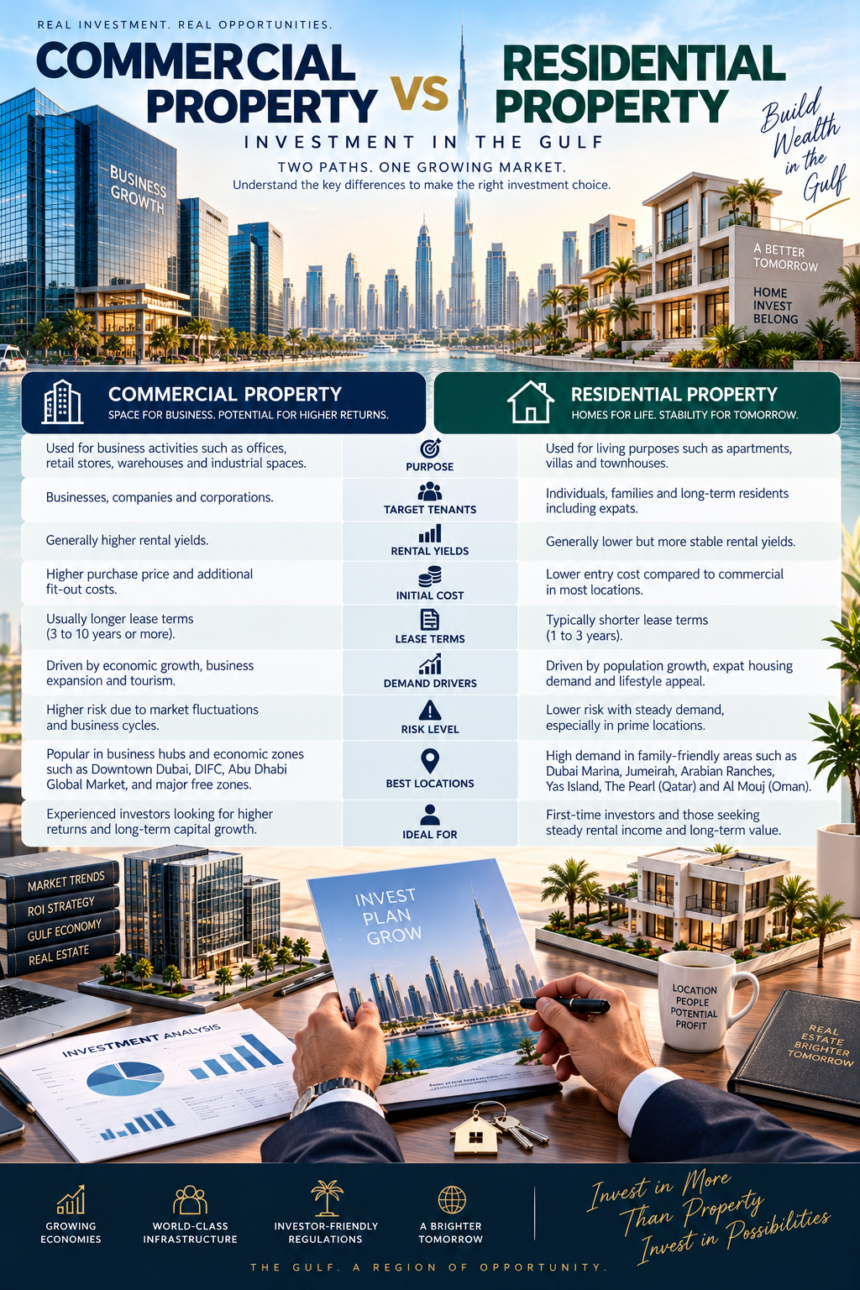
Gulf Property Investment: Commercial vs Residential Overview
Gulf Property Investment offers buyers two major routes: residential real estate such as apartments, villas and townhouses, or commercial assets such as offices, retail units and warehouses. Both can generate rental income and long-term growth, but their costs, tenants, risks and management requirements are very different.
- Commercial vs Residential Property: GCC Investment Overview
- Understanding Residential Property Investment
- Understanding Commercial Property Investment
- 1. Initial Investment and Purchase Price
- 2. Rental Income and Yield Potential
- 3. Tenant Demand
- 4. Lease Length and Income Stability
- 5. Vacancy Risk
- 6. Property Financing and Mortgages
- 7. Taxes and Regulatory Costs
- 8. Service Charges and Operating Expenses
- 9. Property Management Requirements
- 10. Capital Appreciation
- 11. Resale Liquidity
- 12. Economic and Market Risk
- Residential Property Investment in the UAE
- Commercial Property Investment in the UAE
- Residential and Commercial Property in Saudi Arabia
- Residential and Commercial Property in Qatar
- Residential and Commercial Property in Bahrain
- Property Investment in Oman
- Property Investment in Kuwait
- Apartments and Villas for Gulf Investors
- Offices and Retail Property for Gulf Investors
- Warehouses and Industrial Property
- Commercial Property for First-Time Investors
- Residential Property for First-Time Investors
- Choosing Property for Rental Income
- Choosing Property for Long-Term Growth
- Common Property Investment Mistakes
- Practical Gulf Property Comparison Checklist
- Final Thoughts on Gulf Property Investment
Residential property is usually easier for first-time investors because it has a broader tenant market, simpler management and more accessible mortgage options. Commercial property can offer longer leases and attractive rental returns, but vacancy periods may be longer and selecting the right location and tenant becomes more important.
The GCC should also not be treated as one property market. Dubai, Abu Dhabi, Riyadh, Doha, Manama, Muscat and Kuwait each have different demand patterns, ownership rules and investment conditions.
The best choice therefore depends on the investor’s budget, risk tolerance, financing needs and whether the main objective is rental income, capital growth or long-term diversification.
Commercial vs Residential Property: GCC Investment Overview
The basic differences become clearer when the two asset classes are compared directly.
| Factor | Residential Property | Commercial Property |
|---|---|---|
| Typical assets | Apartments, villas, townhouses | Offices, shops, warehouses |
| Tenant | Individuals and families | Businesses |
| Initial capital | Often lower | Can be higher |
| Tenant pool | Usually broader | More specialised |
| Lease periods | Generally shorter | Often longer |
| Management | Usually simpler | More complex |
| Vacancy | Often easier to resolve | Can last longer |
| Financing | Generally easier | More specialised |
| Yield potential | Moderate to strong | Can be higher |
| Resale liquidity | Usually stronger | Asset dependent |
| Economic sensitivity | Population and housing | Business conditions |
| Best for beginners | Often yes | Requires more research |
These are broad tendencies rather than guarantees.
A high-quality apartment in the wrong location can perform badly. A well-leased office in a prime business district can perform exceptionally well.
The individual asset matters more than its category.
Understanding Residential Property Investment
Residential property is real estate designed primarily for people to live in.
The main investment categories across the Gulf include:
- Studios
- Apartments
- Townhouses
- Villas
- Luxury residences
The investor usually earns money through rent and potentially through an increase in the property’s value.
Residential investing is relatively easy to understand.
The investor buys a home, finds a tenant and collects rent.
Demand comes from individuals, couples and families rather than businesses.
That broad customer base can provide an important advantage.
Even when the economy slows, people still need housing.
Demand can move between premium and affordable areas, but residential property rarely loses its entire potential tenant base.
Understanding Commercial Property Investment
Commercial real estate is primarily intended for business use.
Common Gulf investments include:
- Offices
- Retail units
- Warehouses
- Industrial buildings
- Clinics
- Business units
Commercial investment requires deeper analysis because businesses have more specific requirements than residential tenants.
A company choosing an office may care about:
- Business district
- Metro access
- Parking
- Building quality
- Floor efficiency
- Internet infrastructure
- Client access
A retailer may care more about visibility and footfall.
A warehouse tenant may require loading areas, ceiling height, power capacity and access to major transport routes.
This makes commercial investment more specialised, but the right property can produce attractive and relatively stable income.
1. Initial Investment and Purchase Price
Residential real estate generally offers more accessible entry points.
A new investor may begin with a studio or one-bedroom apartment rather than purchasing an entire commercial asset.
This allows investors with moderate capital to participate in major Gulf property markets.
Commercial property can require larger amounts.
Prime offices, retail shops and warehouses may involve substantial purchase prices.
However, commercial does not always mean more expensive.
A small office can sometimes cost less than a luxury apartment.
Investors therefore need to compare the total acquisition cost, not merely the category.
Include:
- Purchase price
- Registration
- Brokerage
- Financing fees
- Valuation
- Fit-out
- Service charges
- Tax where applicable
Commercial property can particularly require additional fit-out costs before it becomes suitable for a tenant.
2. Rental Income and Yield Potential

Yield is one of the most important reasons investors consider commercial property.
Businesses can sometimes pay higher rent relative to the purchase price, particularly for well-located offices, warehouses or retail units.
However, yield must be examined carefully.
Gross yield is calculated using annual rent divided by the purchase price.
Net yield deducts recurring expenses.
Suppose a property costs the equivalent of $500,000 and earns $40,000 annually.
Gross yield = 8%.
If maintenance, management, vacancy and service charges cost $10,000 annually, net income becomes $30,000.
The practical yield is therefore closer to 6%.
Residential apartments can also generate strong returns, particularly in affordable or mid-market communities.
The better question is not whether commercial property produces higher yields in theory.
It is whether the individual property’s net income justifies its risk.
3. Tenant Demand
Residential property usually wins on the size of the potential tenant market.
Cities such as Dubai, Abu Dhabi, Riyadh and Doha contain large populations of professionals and families requiring accommodation.
A well-priced apartment can appeal to a very broad audience.
Commercial properties depend on business demand.
An office only appeals to companies needing that location, size and building type.
That sounds like a disadvantage, but strong corporate markets can create exceptional demand.
Riyadh provides a powerful example. CBRE reported 98% occupancy in its Grade A office market in Q1 2026, supported by more than 780 international companies linked to the Regional Headquarters programme.
Knight Frank similarly reported strong GCC office conditions in late 2025, with double-digit rental growth in Saudi Arabia, Dubai and Abu Dhabi.
Commercial demand can therefore be very strong, but it is usually concentrated in the best locations and buildings.
4. Lease Length and Income Stability
Residential leases are generally relatively short.
Tenants may move because of:
- New employment
- Higher rents
- Family changes
- Buying a home
- Moving to another country
This creates more frequent leasing activity.
Commercial tenants often prefer longer leases.
Businesses invest money in:
- Fit-out
- Furniture
- Branding
- IT systems
- Staff relocation
Moving repeatedly can be expensive.
A good commercial tenant may therefore remain for several years.
This can provide the landlord with predictable income.
The quality of the tenant becomes important, however.
A five-year lease is useful only if the business remains financially capable of paying rent.
Commercial investors should therefore assess the tenant as carefully as the property.
5. Vacancy Risk
Vacancy affects both categories but can be more painful for commercial landlords.
A well-priced residential property may find another tenant relatively quickly because the potential tenant pool is broad.
Commercial vacancy can continue for much longer.
An office may stay empty because:
- Location is weak
- Layout is outdated
- Parking is poor
- Building quality is low
- Competing stock is newer
During vacancy, the owner continues paying operating costs.
This is particularly important in markets experiencing a flight to quality, where companies increasingly prefer modern Grade A buildings.
Qatar demonstrates this clearly. Knight Frank’s Q1 2026 review said office demand remained concentrated in prime locations such as West Bay and Lusail, while secondary areas faced greater pressure from vacancy and newer Grade A supply.
Commercial investors should therefore budget for longer vacancy periods than they expect.
6. Property Financing and Mortgages
Residential mortgage financing is generally easier for individual investors to understand and access.
Banks have established processes for financing apartments and villas.
Commercial lending can be more specialised.
A bank may examine:
- Property type
- Existing lease
- Tenant quality
- Location
- Rental income
- Borrower finances
- Commercial valuation
The required equity contribution may also be higher.
This can make commercial property more suitable for investors with stronger cash positions.
New investors relying heavily on bank finance may find residential property simpler.
Investors should always obtain financing guidance before paying a non-refundable deposit.
7. Taxes and Regulatory Costs
Property taxes and transaction costs vary across GCC countries, so there is no single Gulf-wide rule.
The UAE provides a particularly clear difference between commercial and residential real estate.
The Federal Tax Authority states that the sale or lease of commercial property is generally subject to 5% VAT.
Residential property is treated differently. The first supply of a qualifying new residential building within three years of completion is generally zero-rated, while later supplies are generally exempt.
This distinction can materially affect commercial property cash flow and accounting.
The FTA also states that an owner making taxable commercial-property supplies can generally recover qualifying VAT on related costs, while input VAT related to exempt residential supplies is generally not recoverable.
Other GCC countries have their own tax and fee regimes.
Investors should therefore obtain advice based on the country, ownership structure and specific property rather than assuming UAE treatment applies region-wide.
8. Service Charges and Operating Expenses
Both residential and commercial properties have ongoing costs.
Residential expenses may include:
- Building service charges
- Maintenance
- Property management
- Insurance
- Repairs
Commercial assets may involve additional costs related to:
- Facilities management
- Fit-out
- Business infrastructure
- Common areas
- Mechanical systems
- Specialist maintenance
Who pays individual expenses can depend on the lease.
Some commercial agreements transfer more operating responsibilities to tenants.
This can improve landlord cash flow.
However, investors should never calculate returns without reviewing the actual lease.
The headline rent tells only part of the story.
9. Property Management Requirements
Residential property is usually simpler to manage.
A landlord mainly needs to arrange leasing, rent collection, maintenance and renewals.
Commercial management can involve more negotiation.
Commercial leases may contain provisions covering:
- Fit-out periods
- Rent-free periods
- Break clauses
- Signage
- Maintenance
- Parking
- Permitted business activity
- Renewal options
Retail and industrial assets can be even more complex.
First-time investors seeking a relatively passive investment often find residential ownership easier.
Commercial assets can work well for investors willing to use specialised management.
10. Capital Appreciation
Property values can rise in both sectors, but the reasons are different.
Residential appreciation can be driven by:
- Population growth
- Housing demand
- Infrastructure
- New schools
- Lifestyle appeal
- Limited supply
Commercial appreciation is more heavily connected to:
- Rental income
- Occupancy
- Business growth
- Lease quality
- Tenant strength
- Scarcity of quality stock
Strong office demand can therefore push commercial property values rapidly higher.
Saudi Arabia illustrates this dynamic. Knight Frank reported Grade A Riyadh office rents reaching SAR 2,735 per square metre at the end of 2025, up 9.7% annually, with exceptionally low vacancy.
The same report also noted strong investor interest in Saudi residential property, showing that both sectors can perform simultaneously for different reasons.
11. Resale Liquidity
Residential property usually has a larger buyer market.
Possible purchasers include:
- Homeowners
- Investors
- Families
- Expats
- Local residents
Commercial property has a narrower audience.
Most buyers are investors or businesses.
That can make resale slower.
However, a commercial property with a long lease and strong tenant can become extremely attractive to income-focused investors.
Liquidity therefore depends partly on whether the property is vacant.
A leased high-quality office can be easier to sell than an empty outdated commercial unit.
Residential generally offers greater liquidity, but commercial income can create its own buyer demand.
12. Economic and Market Risk
Residential and commercial property respond differently to economic changes.
Residential property is linked strongly to:
- Employment
- Population
- Household income
- Housing supply
Commercial property is linked more directly to:
- Business growth
- Corporate expansion
- Retail spending
- Tourism
- Logistics
- Industrial production
Commercial property can therefore respond more quickly to economic cycles.
If businesses stop expanding, office demand can weaken even while population continues growing.
Residential can also face risk when large numbers of new units are delivered.
Investors should study both current demand and future construction pipelines.
Residential Property Investment in the UAE
The UAE, particularly Dubai and Abu Dhabi, provides one of the GCC’s deepest residential markets.
Apartments, townhouses and villas attract both investors and end users.
Demand is supported by international migration, employment and the country’s role as a regional business centre.
The market nevertheless changes by community.
A studio in an affordable district operates differently from a luxury waterfront villa.
Investors should compare:
- Purchase price
- Rent
- Service charges
- New supply
- Transport
- Tenant profile
Residential property remains one of the easiest Gulf investment categories for individual buyers.
Commercial Property Investment in the UAE
Commercial property has become particularly important in Dubai and Abu Dhabi.
CBRE reported during Q1 2026 that both office markets remained under tight supply conditions, supporting high occupancy and double-digit annual rental growth, with demand strongest for high-quality and well-located space.
This can create strong investment opportunities.
However, the market increasingly rewards quality.
Prime offices with strong transport links and efficient layouts may perform very differently from older secondary buildings.
Investors should therefore avoid assuming that rising citywide office rents will benefit every office equally.
Residential and Commercial Property in Saudi Arabia
Saudi Arabia provides one of the Gulf’s most interesting comparisons.
Residential property remains a major part of the market. Knight Frank reported that housing accounted for approximately 63% of Saudi real estate transaction value during H1 2025, with 93,700 residential deals worth SAR 77.5 billion.
Commercial property is benefiting from business expansion and the Regional Headquarters programme.
Riyadh Grade A office occupancy reached 98% in Q1 2026 according to CBRE.
Knight Frank has also identified a shortage of premium office stock as an important commercial investment opportunity.
For investors, residential offers exposure to housing demand, while commercial assets provide exposure to corporate and economic transformation.
Residential and Commercial Property in Qatar
Qatar illustrates why investors should not assume every GCC market is moving in the same direction.
Knight Frank reported 1,582 residential transactions worth around QAR 6.2 billion in Q1 2026. Transaction activity softened quarter-on-quarter, although it remained higher than a year earlier.
Residential rents also softened.
Average villa rents declined 8.9% year-on-year, while apartment rental rates experienced significant quarterly declines during the period.
Commercial conditions were also selective.
Average office rents declined 3.2% annually, but demand continued concentrating in prime West Bay and Lusail assets.
The lesson is important.
A weaker average market can still contain successful investments when the property is in a preferred location.
Residential and Commercial Property in Bahrain
Bahrain’s 2026 market has been more competitive.
CBRE reported 4,951 transactions during H1 2026, with overall transaction numbers declining sharply compared with H1 2025 amid regional uncertainty. Transaction value declined much less significantly, however.
Residential asking rents remained relatively stable, with average apartment rents down 1.2% and villas down 4.1%.
Commercial conditions also differ by sector.
CBRE’s previous H2 2025 analysis showed prime office rents stabilising after earlier declines, while tracked retail-centre occupancy stood at 63.3%.
For Bahrain investors, careful asset selection matters more than relying on a broad market boom.
Property Investment in Oman
Oman provides opportunities across residential, tourism-linked, office and industrial property.
For international individual investors, ownership eligibility is particularly important because foreign property ownership operates within specific legal frameworks and approved projects.
Residential assets can benefit from Muscat’s professional and expatriate population.
Commercial opportunities may be connected to logistics, tourism, industrial development and business activity.
First-time investors should focus on actual tenant demand rather than assuming that regional growth automatically supports every property.
Oman’s smaller market size can also mean less liquidity than larger centres such as Dubai or Riyadh.
Property Investment in Kuwait
Kuwait has an established property sector but operates differently from more internationally open real estate markets.
Foreign individual ownership can be more restricted, making eligibility an important first step.
Residential property remains a major part of the domestic market.
Commercial assets include offices, retail and investment buildings.
Investors considering Kuwait should verify legal ownership rights, financing and transaction conditions before analysing rental yields.
A potentially attractive commercial return has little value if the investor cannot legally acquire the property under the proposed ownership structure.
Apartments and Villas for Gulf Investors
Apartments can be particularly attractive to first-time residential investors because they generally require less capital.
Advantages can include:
- Broad tenant demand
- Smaller deposits
- Easier resale
- Lower maintenance responsibility
Villas require more capital but can attract longer-term family tenants.
They can also benefit from land value.
The right choice depends heavily on the city.
In densely populated business locations, apartments may dominate demand.
In family-oriented suburban communities, villas and townhouses can perform strongly.
Offices and Retail Property for Gulf Investors
Office investing has attracted greater attention because of strong business expansion across parts of the GCC.
High-quality office space is particularly important.
Knight Frank’s GCC office research has repeatedly highlighted occupier demand for modern, well-located and ESG-compliant buildings.
Retail investment requires different analysis.
Successful retail depends on:
- Footfall
- Spending power
- Visibility
- Parking
- Tenant brand
- Surrounding population
A retail unit inside a dominant destination can perform very differently from a shop in an underused development.
Warehouses and Industrial Property
Industrial and logistics property can offer attractive income but requires specialised knowledge.
Key considerations include:
- Road connectivity
- Ports
- Airports
- Industrial zones
- Loading access
- Power
- Building specifications
Regional investment in manufacturing, logistics and e-commerce has increased interest in industrial assets.
However, industrial property is not usually the easiest first investment.
An investor should understand the tenant’s operational needs before purchasing.
Commercial Property for First-Time Investors
Commercial property can work for a first-time investor when the asset is relatively straightforward.
A small leased office in an established business district may be understandable.
A specialised warehouse or complex retail investment requires much more knowledge.
First-time commercial investors should ideally look for:
- Existing tenant
- Clear lease
- Strong location
- Known operating costs
- Easy-to-understand layout
Avoid buying simply because the advertised yield looks high.
High yields can sometimes reflect higher risk.
Residential Property for First-Time Investors
Residential property remains the easier starting point for many individuals.
It offers a familiar product and larger tenant market.
A first-time investor can easily compare similar apartments within the same community.
The core calculation is also straightforward:
Purchase price + costs → rent → expenses → net return.
The most important factors remain location, purchase price and service charges.
A property bought at the wrong price can remain a weak investment even in a strong city.
Choosing Property for Rental Income
Investors prioritising income should focus on net yield and lease stability.
Commercial property can be attractive because businesses may sign longer leases.
Residential assets provide a broader tenant market.
One strategy is diversification.
Instead of placing all capital into one large commercial property, an investor might own several smaller residential units.
If one residential property becomes vacant, the others continue producing income.
A single commercial vacancy can eliminate the income from that entire asset.
Choosing Property for Long-Term Growth
Investors prioritising appreciation should focus on the future rather than today’s rent.
For residential property, look at:
- Population growth
- Infrastructure
- Schools
- Community development
- Supply
For commercial property, examine:
- Corporate growth
- Office supply
- Business districts
- Logistics investment
- Tenant demand
A prime office market with almost no vacancy can appear highly attractive today, but large future supply can eventually change conditions.
Similarly, a new residential community may deliver thousands of competing units.
Future supply matters almost as much as current demand.
Common Property Investment Mistakes
Choosing only by advertised yield
High gross yield does not guarantee strong net returns.
Ignoring vacancy
Every property should be modelled with some vacancy risk.
Buying commercial property without understanding the tenant
Commercial income is heavily dependent on business quality.
Ignoring service charges
Recurring costs can reduce residential returns significantly.
Buying residential property solely because the market recently increased
Past appreciation is not guaranteed.
Ignoring financing costs
Mortgage rates can change investment economics.
Using UAE tax assumptions across the GCC
Tax and registration rules differ.
Buying without an exit strategy
Know who may buy the asset later.
Practical Gulf Property Comparison Checklist
| Investment question | Residential | Commercial |
|---|---|---|
| Lower entry price | Usually | Sometimes |
| Broader tenant demand | Strong | More limited |
| Longer leases | Less common | More common |
| Easier mortgage finance | Usually | More specialised |
| Easier management | Usually | Less often |
| Vacancy risk | Moderate | Can be higher |
| Income potential | Strong | Potentially higher |
| Resale market | Broader | Narrower |
| Economic sensitivity | Lower | Often higher |
| First-time investor friendly | Generally | Select assets |
| Specialist knowledge | Moderate | High |
| Best for diversification | Strong | Strong with sufficient capital |
Final Thoughts on Gulf Property Investment
Gulf Property Investment can provide strong opportunities through both residential and commercial real estate, but neither category is automatically better.
Residential property is generally easier to finance, rent, manage and resell. This makes apartments, villas and townhouses a practical starting point for many individual investors.
Commercial property can provide longer leases and attractive income, especially in strong business districts, but it also requires more careful analysis of tenant quality, location and vacancy risk.
The strongest investment decision comes from looking beyond the property type. Compare the purchase price, net rental yield, financing cost, future supply, tenant demand and resale potential of the individual asset.
For most first-time investors, residential property is usually the simpler option. Investors with more capital and experience may find commercial property attractive for income and portfolio diversification.
The right Gulf property is ultimately the one that combines clear demand, manageable costs, realistic returns and a sensible exit strategy.
Do follow us on Instagram
Read More – Buying Gulf Property: 12 Essential Tips for Expats in 2026