

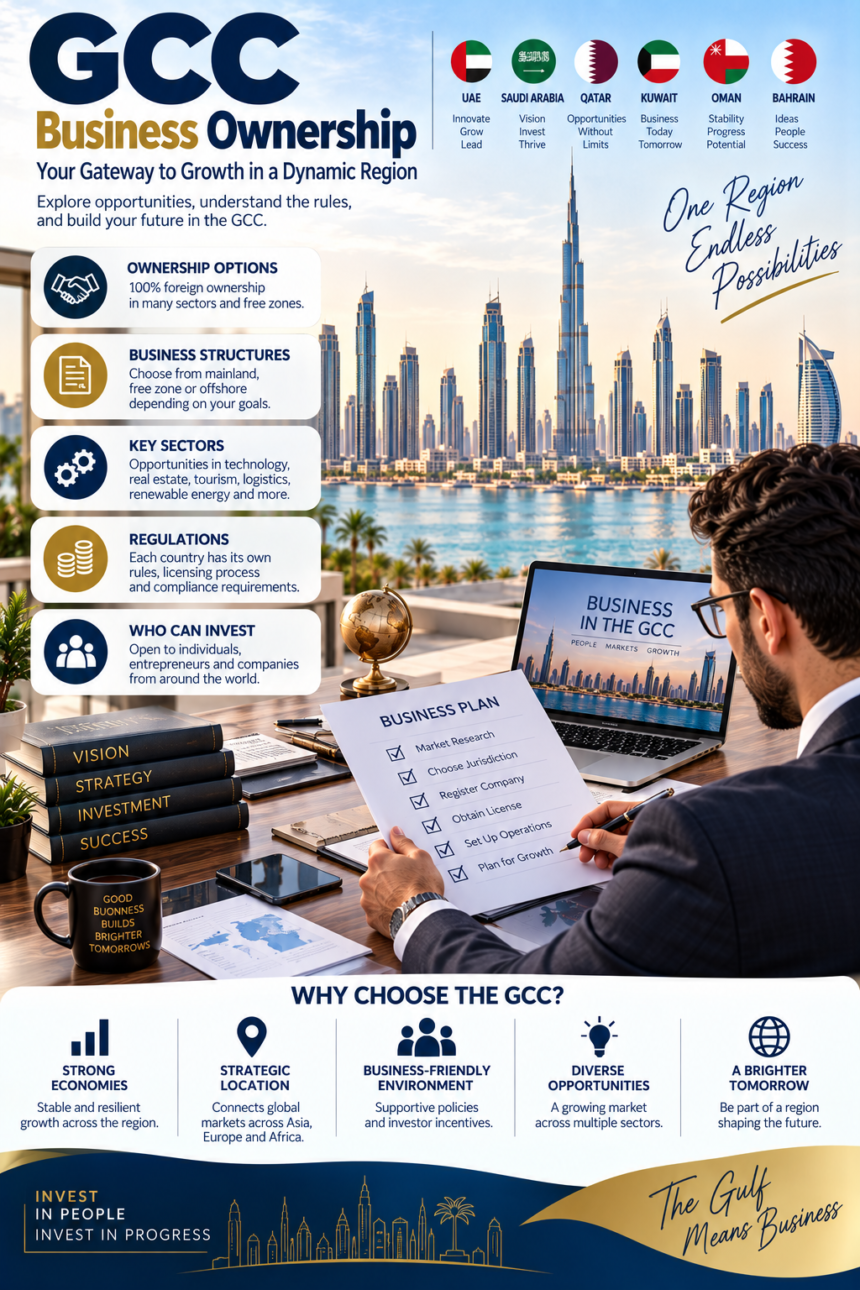
Understanding Foreign Business Ownership in the Gulf
GCC Business Ownership has become considerably more accessible to international entrepreneurs, with several Gulf countries now permitting 100% foreign ownership across many business activities. However, this does not mean an international investor can automatically open any type of company, in any sector, with full ownership anywhere in the Gulf.
- GCC Business Ownership: 2026 Overview
- Understanding Foreign Business Ownership in the Gulf
- 1. Foreign Ownership Percentage
- 2. Local Partner Requirements
- 3. Business Activity and Sector Restrictions
- 4. Choosing the Right Company Structure
- 5. Mainland and Free Zone Businesses
- 6. Investment Registration and Licensing
- 7. Foreign Company Branches
- 8. Capital and Financial Requirements
- 9. Business Address and Office Requirements
- 10. GCC National Ownership Rights
- 11. Banking, Tax and Financial Compliance
- 12. Ongoing Business Compliance
- Business Ownership in the UAE
- Business Ownership in Saudi Arabia
- Business Ownership in Qatar
- Business Ownership in Bahrain
- Business Ownership in Oman
- Business Ownership in Kuwait
- Comparing Foreign Business Ownership Across the GCC
- Best GCC Business Structure for Foreign Investors
- Common Business Ownership Mistakes
- GCC Business Setup Checklist
- Final Thoughts on GCC Business Ownership
The UAE, Saudi Arabia, Qatar, Bahrain, Oman and Kuwait each operate their own commercial laws, licensing systems and foreign-investment frameworks.
The UAE allows 100% foreign ownership of most mainland commercial companies and has long provided full foreign ownership in free zones. Saudi Arabia’s updated Investment Law uses an investor-registration framework and generally supports investment freedom, although individual activities can still carry restrictions. Qatar permits full foreign ownership in many sectors under its foreign-investment framework. Bahrain allows 100% foreign ownership for most business activities, while Oman permits full foreign ownership across most sectors.
Kuwait also provides a route to as much as 100% foreign ownership through its direct-investment framework, but the structure is more specific than simply opening an ordinary company.
For international entrepreneurs, the important question is therefore not simply whether a Gulf country allows foreign ownership.
The better questions are: Does my activity qualify? What company structure should I use? What approvals are required? Can I sell directly in the local market? And do I need an investment registration, local partner or special licence?
Understanding these differences can prevent costly business-setup mistakes.
GCC Business Ownership: 2026 Overview
Foreign ownership rules have become more investor-friendly across much of the GCC.
| Country | Foreign Ownership Position | Important Limitation |
|---|---|---|
| UAE | Up to 100% for most businesses | Strategic and regulated sectors can have restrictions |
| Saudi Arabia | Foreign investors can operate without local partners in many activities | Registration required and some activities are restricted |
| Qatar | Up to 100% in permitted sectors | Certain sectors remain excluded or require approval |
| Bahrain | 100% in most activities | Ownership depends on business activity |
| Oman | 100% in most sectors | Some activities have restrictions or special conditions |
| Kuwait | Up to 100% through qualifying direct-investment structures | KDIPA investment framework and approvals apply |
The table provides a useful starting point, but investors should never select a country based purely on the phrase “100% foreign ownership.”
Full ownership does not remove licensing requirements.
A foreign-owned healthcare company may still need health authority approval. A financial business may need central bank approval. An education company may require permission from the relevant education regulator.
Ownership and licensing are related, but they are not the same thing.
Understanding Foreign Business Ownership in the Gulf
Business ownership describes who legally holds the shares or equity in a company.
Imagine a limited liability company has one international shareholder who owns every share.
That company is 100% foreign owned.
Another company might have:
- Foreign investor: 70%
- Local investor: 30%
That is a foreign-majority company but not fully foreign owned.
Historically, foreign investors in several Gulf markets often needed a local shareholder to hold a majority interest.
Many of those rules have changed substantially.
The UAE Government confirms that its Commercial Companies Law removed the general requirement for a UAE national to hold 51% of mainland companies, allowing full foreign ownership for most activities. Certain businesses of strategic impact remain subject to special requirements.
Oman’s Ministry of Commerce, Industry and Investment Promotion similarly states that the Foreign Capital Investment Law permits 100% foreign ownership in most sectors.
However, business ownership remains only one part of establishing a company.
Investors must also consider the activity, location, legal form and licensing authority.
1. Foreign Ownership Percentage

The first step is identifying how much of the company a foreign investor can legally own.
In several GCC markets, the answer can now be 100%.
But the phrase “100% foreign ownership available” should not be interpreted as “100% foreign ownership automatically applies to every company.”
For example, the UAE allows complete foreign ownership of most mainland companies, but strategic activities can carry restrictions. Official UAE guidance identifies areas such as banking, insurance, telecommunications and certain security-related activities among sectors where specific requirements can apply.
Qatar’s Foreign Investment Law also allows fully foreign-owned companies in qualifying sectors. However, Invest Qatar notes exceptions including banking, insurance, exploitation of natural resources and commercial agencies.
Saudi Arabia follows an activity-based approach as well. The Ministry of Investment states that whether a local partner is required depends on the activity selected.
The correct approach is therefore:
Choose activity first, then confirm ownership percentage.
Do not choose the shareholder structure before confirming what the licence permits.
2. Local Partner Requirements
A local partner is a citizen or locally owned entity holding shares in the company alongside the foreign investor.
Local partnerships can still make strategic business sense even when they are not legally required.
A strong local partner can provide:
- Market knowledge
- Customer relationships
- Government-sector experience
- Industry contacts
- Local operational expertise
But the partnership should be commercial rather than created purely because the investor mistakenly believes it is legally mandatory.
In the UAE, the old general 51% Emirati ownership requirement no longer applies to most mainland commercial companies.
Saudi Arabia’s Ministry of Investment states clearly that some activities require a local partner while other activities can operate without one.
Bahrain’s Ministry of Industry and Commerce says foreign investors can own 100% of companies for most business activities, although the permitted percentage remains activity-specific.
This makes checking the actual licensed activity essential.
3. Business Activity and Sector Restrictions
The activity is one of the most important parts of any Gulf company application.
A business cannot simply register as “general business” and then carry out every type of commercial activity.
Typical licence categories can include:
- Consulting
- Technology
- Trading
- Construction
- E-commerce
- Marketing
- Logistics
- Manufacturing
- Hospitality
- Real estate services
- Professional services
Regulated activities require additional attention.
These can include:
- Banking
- Insurance
- Healthcare
- Financial services
- Education
- Telecommunications
- Defence
- Energy
- Professional engineering
A company may qualify for 100% foreign ownership generally but still need approval from a sector regulator.
Saudi Arabia’s updated Investment Law follows the principle of freedom of investment while maintaining a list of activities that are prohibited or restricted for foreign investors. Foreign investors seeking to engage in an excluded activity must obtain specific approval.
Investors should therefore check sector rules before committing capital.
4. Choosing the Right Company Structure
Ownership percentage and company structure are separate decisions.
Common structures across GCC markets include:
- Limited Liability Company
- Single-person company
- Joint stock company
- Partnership
- Foreign company branch
- Free zone company
The Limited Liability Company, or LLC, is one of the most commonly used structures for privately owned operating businesses.
Its popularity comes from separating the company’s liabilities from the shareholder’s personal liability, subject to applicable law and exceptions.
The UAE’s free zones, for example, can offer structures including LLCs, Free Zone Companies, Free Zone Establishments and branches of domestic or international businesses.
Qatar also allows several company forms including limited liability companies, single-person LLCs, partnerships and joint stock companies.
The correct legal form depends on:
- Number of shareholders
- Business activity
- Capital
- Liability
- Investment plans
- Future shareholders
- Whether the business is a branch of an existing company
A small consulting firm may need a very different structure from an industrial manufacturing project.
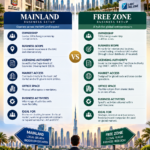
5. Mainland and Free Zone Businesses
This distinction is especially important in the UAE but similar special economic zones also exist elsewhere in the Gulf.
A mainland company is licensed through the relevant local economic authority and is generally designed to operate within the domestic market.
A free zone company is established inside a designated economic or industry-focused zone.
UAE free zones can provide:
- 100% foreign ownership
- Specialised infrastructure
- International trading access
- Industry-focused ecosystems
- Simplified establishment procedures
Current UAE government guidance confirms that free-zone companies may be completely foreign owned.
However, mainland-market access needs careful consideration.
UAE government guidance explains that a free-zone company’s ability to sell goods or services directly into the mainland can be subject to local licensing and approval requirements.
The UAE’s expansion of mainland foreign ownership means choosing a free zone solely because “I want to own 100%” is no longer sufficient reasoning.
Investors should instead compare:
Customer location, licence cost, office needs, business activity, visas and market access.
6. Investment Registration and Licensing
Business ownership does not begin and end with registering the company name.
A foreign investor may need several steps.
These can include:
- Investor registration
- Trade name reservation
- Initial approval
- Company incorporation
- Commercial registration
- Business licence
- Sector approvals
- Tax registration
- Labour registration
- Immigration or visa procedures
Saudi Arabia provides a useful example of why the distinction matters.
Under the updated Investment Law, a foreign investor must register with the Ministry of Investment before beginning investment activity. After receiving confirmation of completed registration, the investor can obtain commercial registration and the necessary licences from other authorities.
The Ministry’s current FAQ also confirms that investment-registration applications can be submitted electronically.
Different GCC countries organise these stages differently.
Investors should not assume a commercial registration alone gives permission to begin every activity.
7. Foreign Company Branches
An international company entering the Gulf does not always need to create an entirely separate shareholder-owned subsidiary.
A foreign company branch may be available.
A branch generally operates as an extension of the overseas parent company rather than as an entirely independent shareholder-owned entity.
This can make sense for established international businesses entering a new market.
The UAE permits branches of international companies under applicable licensing frameworks.
Its free-zone systems also commonly allow branches of international and local companies.
Kuwait’s direct-investment framework also provides foreign investors with the ability to establish a licensed foreign-company branch under Law No. 116 of 2013.
A branch should not automatically be considered easier or better.
The parent company’s liability, tax treatment, reporting and licence requirements must all be examined.
8. Capital and Financial Requirements
The phrase “no local partner required” does not mean “no capital requirements.”
Some company structures or regulated activities can require specified capital.
Others may have no general minimum but still require enough financial resources to satisfy regulators, banks or licensing authorities.
Investors should distinguish between:
Legal minimum capital
and
Real operating capital.
A company can satisfy the legal minimum and still fail because it lacks enough working capital for:
- Rent
- Salaries
- Marketing
- Stock
- Insurance
- Visas
- Technology
- Professional fees
Foreign investors should create at least a 12-month operating budget before choosing how much capital to inject.
The cheapest incorporation package is rarely the full cost of establishing a functioning company.
9. Business Address and Office Requirements
Most operating businesses require some form of registered commercial address.
The requirements depend on jurisdiction and business activity.
A consultancy may need only a small approved office or flexible workspace.
A restaurant needs premises approved for food operations.
A warehouse business needs a suitable industrial or logistics facility.
The UAE government states that mainland businesses must have a physical business address that complies with requirements from the relevant economic department and local planning authorities.
Free zones may offer:
- Flexi desks
- Shared offices
- Private offices
- Warehouses
- Industrial land
Do not choose a company package without checking whether the included workspace meets the actual licence requirements.
A very cheap licence can become expensive if the company later discovers it needs a much larger physical premises.
10. GCC National Ownership Rights
A GCC citizen may receive different treatment from a non-GCC foreign investor.
This distinction is important because “foreign investor” is not always one uniform category.
Saudi Arabia’s Ministry of Investment currently states that citizens of GCC countries and companies wholly owned by GCC nationals receive the systems and benefits provided to Saudi citizens directly, with applications handled through the Ministry of Commerce rather than the standard foreign investment-registration route.
This can materially simplify investment for Gulf nationals.
Similar GCC treaty rights and national rules can affect establishment opportunities elsewhere in the region.
However, investors should not assume every business activity is automatically open simply because the owner is a GCC citizen.
Sector licensing can still apply.
11. Banking, Tax and Financial Compliance
Registering the company is only the beginning.
An operating company normally also needs:
- Corporate bank account
- Accounting records
- Tax registrations where applicable
- Payroll systems
- Invoicing
- Financial statements
- Audit where required
Foreign ownership can sometimes increase bank due-diligence requirements.
Banks may request information on:
- Ultimate beneficial owners
- Source of funds
- Business model
- Expected transactions
- Customers
- Suppliers
- Overseas parent companies
This is particularly important for entrepreneurs establishing companies remotely.
Oman’s Ministry of Commerce has acknowledged that foreign shareholders and non-resident managers can sometimes face additional bank due-diligence requirements when opening corporate accounts, even after successful company registration.
A business licence therefore does not guarantee automatic banking approval.
12. Ongoing Business Compliance
The company is not finished once the licence is issued.
Businesses may need to maintain:
- Licence renewals
- Financial records
- Tax filings
- Employee registrations
- Labour compliance
- Beneficial ownership information
- Sector permits
- Office leases
- Insurance
- Corporate governance
Ignoring ongoing obligations can lead to penalties or licence suspension.
Foreign entrepreneurs should therefore include annual compliance expenses in their business plan.
A company that costs the equivalent of $5,000 to establish may cost considerably more to maintain each year after office, visas, accounting, tax and regulatory requirements are included.
The true cost is the annual operating cost, not only the setup fee.
Business Ownership in the UAE
The UAE has one of the GCC’s most flexible foreign business ownership systems.
Federal changes to the Commercial Companies Law removed the old general requirement that Emirati shareholders hold at least 51% of mainland companies.
As a result, foreign investors can now own 100% of most mainland commercial companies.
Certain strategic or regulated sectors remain subject to special rules, including areas such as banking, insurance, telecommunications and security-related activities.
The UAE also has a large free-zone ecosystem.
Free zones can provide complete foreign ownership and are often designed for specific industries such as:
- Technology
- Media
- Finance
- Logistics
- Commodities
- Manufacturing
However, mainland and free-zone companies have different operating frameworks.
The best choice depends on where the company’s customers are located and what activities it plans to perform.
For an entrepreneur selling primarily to UAE consumers, mainland establishment can be attractive.
A company focused on international trade, export, technology or specialised industries may prefer a free zone.
Business Ownership in Saudi Arabia
Saudi Arabia’s investment framework has changed significantly.
The updated Investment Law applies to local and foreign investors and introduces an investor-registration system administered by the Ministry of Investment.
Foreign investors must generally complete investment registration before commencing investment activity. Once registration is confirmed, the investor can proceed with commercial registration and other required licences.
Saudi Arabia’s system follows a general principle of investment freedom, but some activities remain restricted or require approval.
The Ministry of Investment also confirms that local-partner requirements depend on the selected activity. Some businesses can be carried out without a Saudi shareholder, while others require additional ownership conditions.
GCC nationals receive particularly favourable treatment. Saudi authorities currently consider qualifying GCC investors similar to local investors for investment-registration purposes.
Saudi Arabia is therefore much more open to international investors than the older “you always need a Saudi sponsor” perception suggests.
However, activity selection remains critical.
Business Ownership in Qatar
Qatar provides foreign investors with the ability to establish fully foreign-owned companies in qualifying sectors under Law No. 1 of 2019.
Invest Qatar states that the Foreign Investment Law provides for companies with up to 100% foreign ownership and includes protections allowing foreign investors to repatriate investment-related funds.
However, full ownership is not universal.
Invest Qatar identifies exceptions including:
- Banking
- Insurance
- Natural-resource exploitation
- Commercial agencies
- Other activities determined by the Council of Ministers
Its current guidance also notes that foreign investors may generally hold up to 49% in permitted sectors, with ownership capable of increasing to 100% with the appropriate approval.
This means Qatar investors should confirm whether full foreign ownership applies automatically to their activity or needs Ministry approval.
Company options include LLCs, single-person LLCs, partnerships and shareholding companies.
Business Ownership in Bahrain
Bahrain provides one of the Gulf’s relatively liberal business ownership environments.
The Ministry of Industry and Commerce states that foreigners can own 100% of companies established in Bahrain for most business activities.
Official company-establishment guidance also confirms that 100% ownership by foreign investors is available for several legal forms, subject to the activity being permitted.
However, the words “by activity” are important.
Some activities can have different nationality or ownership requirements.
Investors therefore need to check Bahrain’s Sijilat business requirements for their specific activity before deciding the ownership structure.
Common structures include:
- With Limited Liability Company
- Single Person Company
- Partnership
- Shareholding Company
- Foreign Company Branch
Bahrain also permits complete foreign ownership in industrial activities and promotes international investment in manufacturing.
Business Ownership in Oman
Oman has significantly liberalised foreign investment.
The Ministry of Commerce, Industry and Investment Promotion confirms that the Foreign Capital Investment Law, Royal Decree No. 50/2019, permits 100% foreign ownership in most sectors.
Foreign investors can complete company-establishment procedures through the Oman Business platform.
The platform supports foreign investor registration and allows businesses to choose the appropriate legal form and activities electronically.
However, full ownership is not completely unrestricted.
Official Ministry commentary notes that certain sectors or activities can require local participation or additional approvals. Examples can include specialised activities where sector-specific rules apply.
Oman also provides free zones and economic zones that can offer investors additional advantages depending on the project.
For foreign entrepreneurs, the important step is confirming the specific activity through Oman Business before finalising the company structure.
Business Ownership in Kuwait
Kuwait is slightly different from several neighbouring markets.
International investors can obtain up to 100% foreign ownership through Kuwait’s direct investment framework under Law No. 116 of 2013.
Kuwait Direct Investment Promotion Authority states that qualifying investors can establish a Kuwaiti company with up to 100% foreign equity. They may also establish a licensed branch of a foreign company or a representative office for market and feasibility studies.
The key phrase is through the KDIPA investment framework.
International entrepreneurs should not assume that every ordinary company registration automatically provides full foreign ownership.
KDIPA’s framework is designed for qualifying direct investments and can provide incentives including:
- Up to 100% foreign equity
- Foreign-company branches
- Potential tax incentives
- Customs exemptions
- Land allocation for qualifying projects
Kuwait therefore offers genuine full foreign ownership opportunities, but the pathway should be verified carefully before incorporation.
Comparing Foreign Business Ownership Across the GCC
| Factor | UAE | Saudi Arabia | Qatar | Bahrain | Oman | Kuwait |
|---|---|---|---|---|---|---|
| 100% foreign ownership available | Yes | Yes, depending on activity | Yes, qualifying sectors/approval | Yes, most activities | Yes, most sectors | Yes, through qualifying framework |
| Local partner always required | No | No | No | No | No | No under KDIPA route |
| Sector restrictions | Yes | Yes | Yes | Yes | Yes | Yes |
| Free/economic zones | Extensive | Available | Available | Available | Available | Available |
| Foreign branch possible | Yes | Yes | Yes | Yes | Yes | Yes under applicable rules |
| Activity approval important | Yes | Yes | Yes | Yes | Yes | Yes |
| GCC nationals can receive special treatment | Yes in applicable cases | Yes | Yes in applicable cases | Yes | Yes | Yes |
The main conclusion is clear.
The old assumption that international entrepreneurs automatically need a 51% Gulf national shareholder is no longer accurate across much of the GCC.
Foreign ownership has become substantially more liberal.
Yet each country still protects specific activities and strategic sectors.
Best GCC Business Structure for Foreign Investors
There is no single best company structure for every entrepreneur.
A mainland LLC can suit a company focused strongly on the domestic market.
A free-zone company can suit international trade, technology, consulting or specialised industries.
A foreign company branch can work for an established international company expanding regionally.
A joint venture with a local partner can make sense when the partner brings commercial value rather than simply fulfilling an assumed ownership requirement.
Before choosing, compare:
| Question | Why It Matters |
|---|---|
| Who are the customers? | Determines market access needs |
| What is the activity? | Determines licence and ownership |
| Is 100% ownership allowed? | Determines shareholder structure |
| Is local presence required? | Affects office costs |
| Will employees be hired? | Affects labour and visa setup |
| Will goods be imported? | Customs requirements matter |
| Is the activity regulated? | Additional approval may be needed |
| Will the company expand regionally? | Structure should support future growth |
Do not automatically choose the cheapest licence.
Choose the structure that allows the company to perform its intended business legally.
Common Business Ownership Mistakes
Assuming every GCC country has the same rules
Each country has separate company legislation.
Believing a local partner is always necessary
This is no longer true for many activities.
Assuming 100% foreign ownership applies to every sector
Strategic and regulated activities can still have restrictions.
Choosing a free zone only for foreign ownership
Mainland businesses can also be fully foreign owned in markets such as the UAE.
Ignoring market access
A free-zone company may need additional arrangements to trade directly in the domestic mainland market.
Selecting the wrong activity
Your licence determines what the company is legally allowed to do.
Focusing only on setup fees
Annual operating and compliance costs matter more.
Assuming company incorporation guarantees a bank account
Banks perform separate KYC and risk assessments.
Ignoring sector approvals
A trade licence does not replace healthcare, financial or other regulatory permissions.
Using outdated information
Gulf investment laws have changed considerably over recent years.
GCC Business Setup Checklist
Before establishing a Gulf company:
- Choose the target GCC country
- Define the exact business activity
- Check the permitted foreign ownership percentage
- Confirm whether a local partner is required
- Identify sector-specific restrictions
- Compare mainland and free-zone options
- Select the correct legal structure
- Check investor-registration requirements
- Review capital requirements
- Confirm office or address requirements
- Calculate establishment fees
- Calculate annual renewal costs
- Check employee visa rules
- Review banking requirements
- Understand tax obligations
- Confirm customs requirements if trading
- Identify required regulator approvals
- Prepare beneficial ownership information
- Plan accounting and compliance
- Verify everything through official government channels before paying setup fees
Final Thoughts on GCC Business Ownership
GCC Business Ownership has changed significantly as Gulf governments compete for international investment, entrepreneurs and multinational companies.
The UAE allows 100% foreign ownership across most mainland commercial activities while maintaining specific restrictions for strategic sectors. Its free zones continue to provide another fully foreign-owned business route.
Saudi Arabia operates under an updated Investment Law that requires foreign investor registration before business activity begins. Many businesses can operate without a Saudi partner, although ownership requirements remain dependent on the individual activity.
Qatar permits up to 100% foreign ownership under its Foreign Investment Law, subject to sector restrictions and the appropriate approvals.
Bahrain permits complete foreign ownership for most business activities, while retaining activity-specific requirements.
Oman allows 100% foreign ownership across most sectors under its Foreign Capital Investment Law, although selected activities can still require specific conditions or approval.
Kuwait provides qualifying international investors with a route to 100% ownership through the KDIPA direct-investment framework.
For entrepreneurs, this means the old question of “Do I need a Gulf national to own 51% of my business?” is increasingly outdated.
The more important questions are now about business activity, licensing, market access and regulatory compliance.
Before establishing a company, determine exactly what the business will sell, where its customers are located, which authority regulates the activity and whether full foreign ownership applies to that particular licence.
A company should not be structured merely to achieve 100% ownership.
It should be structured so that the investor can legally operate, hire employees, open a bank account, serve customers and expand the business without needing to restructure shortly after launch.
That is the real foundation of successful business ownership across the Gulf.
Do follow us on Instagram
Read More – Gulf Property Investment: Commercial vs Residential Property in the GCC