



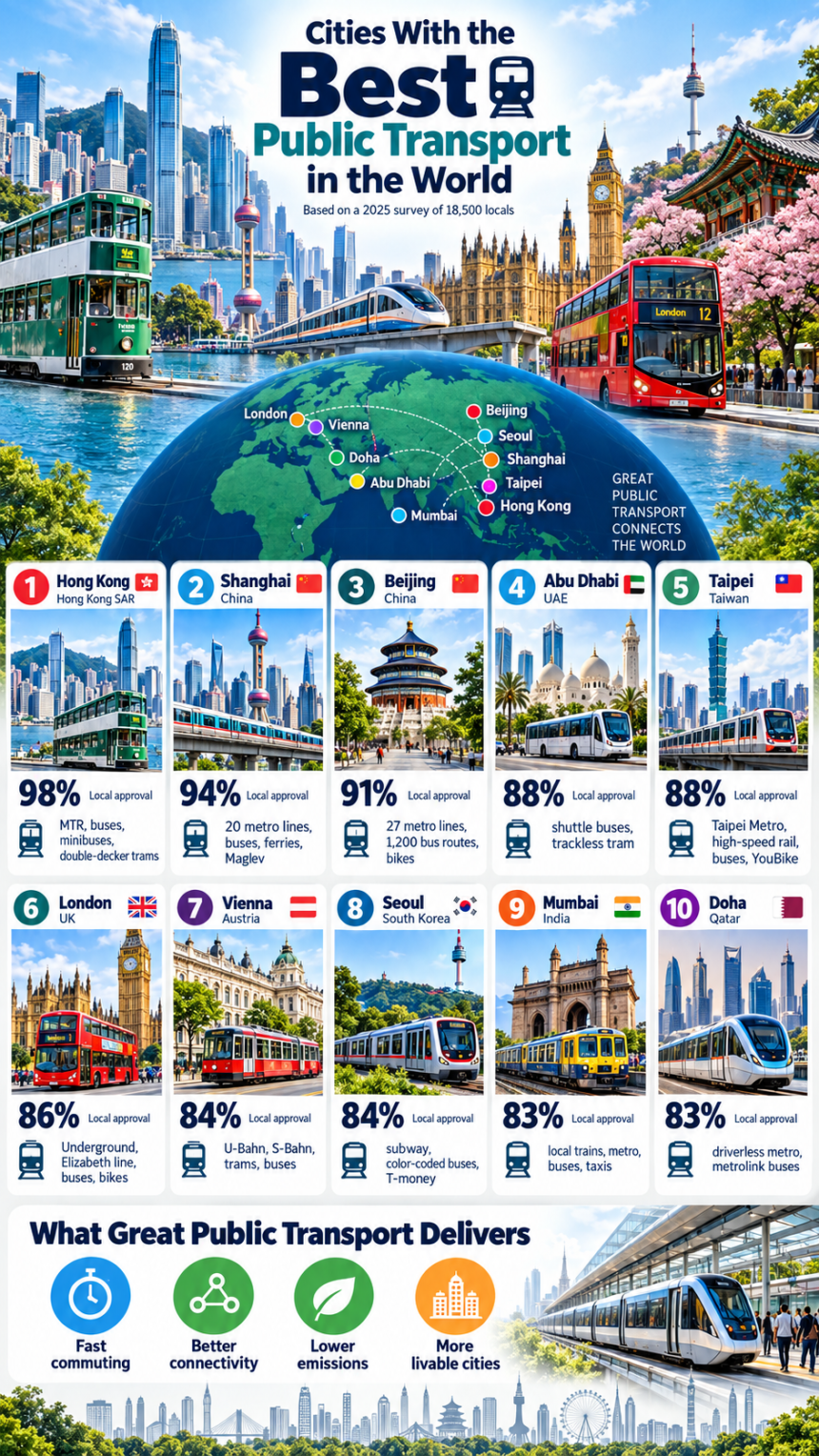
What Makes a Great Public Transport City
The Best Public Transport Cities in the world demonstrate that owning a private car does not have to be essential for everyday urban life. In cities such as Singapore, Tokyo, Hong Kong, Vienna and Zurich, trains, buses, trams and other services are so deeply integrated into daily routines that millions of people can commute, shop, study and explore without depending heavily on private vehicles.
- Best Public Transport Cities in the World
- What Makes a Great Public Transport City
- 1. Singapore
- 2. Tokyo
- 3. Hong Kong
- 4. Seoul
- 5. Vienna
- 6. Zurich
- 7. Paris
- 8. London
- 9. Berlin
- 10. Stockholm
- 11. Copenhagen
- 12. Oslo
- 13. Helsinki
- 14. Munich
- 15. New York City
- Best Public Transport Cities for Tourists
- Best Cities for Metro and Rail Travel
- Best Cities for Integrated Transport
- Public Transport Costs and Convenience
- What Gulf Cities Can Learn From Global Transport Leaders
- Common Features of Successful Transport Systems
- Final Thoughts on the Best Public Transport Cities
A strong public transport network is about much more than having a metro. The world’s leading systems combine frequent services, reliable connections, simple payment methods, good pedestrian access and enough coverage to connect residential neighbourhoods with commercial districts, airports, universities and major attractions. When those different pieces work together, public transport becomes the easiest choice rather than simply an alternative to driving.
There is no single universally accepted ranking of the world’s best transport systems because different studies measure different factors. The Oliver Wyman Forum’s Urban Mobility Readiness Index, for example, evaluates public transport using factors including density, efficiency and utilisation. Its latest globally comparable public-transit ranking places Singapore and Hong Kong at the top, followed by cities including Stockholm, Copenhagen, Paris, Vienna, Berlin and Zurich.
This guide uses that type of international benchmarking together with current transport-network information to highlight 15 cities where public transport is particularly important to daily urban life.
Best Public Transport Cities in the World
The cities below are not identical. Some excel because their metros are extraordinarily frequent, others because trains, trams and buses operate under one integrated ticketing system. A few stand out because public transport reaches almost every part of the metropolitan area.
| City | Country | Major Transport Strength |
|---|---|---|
| Singapore | Singapore | Highly integrated MRT and bus network |
| Tokyo | Japan | Massive, frequent urban rail system |
| Hong Kong | China | Dense rail network and easy connections |
| Seoul | South Korea | Integrated fares and extensive metro |
| Vienna | Austria | Metro, tram and bus integration |
| Zurich | Switzerland | Seamless multimodal regional network |
| Paris | France | Dense metro, RER and bus coverage |
| London | United Kingdom | Extensive multimodal network |
| Berlin | Germany | Strong rail, tram and bus connections |
| Stockholm | Sweden | Metro, buses, rail and ferries |
| Copenhagen | Denmark | Public transport plus cycling integration |
| Oslo | Norway | Metro, tram, bus, rail and ferries |
| Helsinki | Finland | Integrated regional mobility |
| Munich | Germany | Efficient U-Bahn and S-Bahn |
| New York City | United States | Large subway and bus network |
The Oliver Wyman public-transit benchmark places Singapore first, Hong Kong second, Stockholm third, Copenhagen fourth, Paris fifth and Vienna sixth among the cities assessed. Berlin, Zurich, Oslo and Tokyo also appear within its top ten for the public-transit category.
What Makes a Great Public Transport City
The largest network is not automatically the best network. Public transport becomes truly useful when different services work together and travellers can move from one mode to another without unnecessary complexity.
Several characteristics separate strong transport cities from average ones:
- Coverage: Stations and stops should reach residential as well as commercial districts.
- Frequency: Waiting 25 minutes for a train reduces the usefulness of the entire network.
- Integration: Metro, bus, tram and suburban rail should connect easily.
- Simple fares: Travellers should not need several confusing tickets for one journey.
- Reliability: Published schedules need to mean something.
- Accessibility: Stations should increasingly accommodate passengers with different mobility needs.
- Technology: Apps, contactless payment and live arrival information simplify travel.
- Airport connections: Direct public transport to airports reduces car and taxi dependence.
Cities performing well across several of these categories can make everyday urban movement dramatically easier.
1. Singapore
Singapore is one of the clearest examples of a city built around coordinated public transport. Its Mass Rapid Transit system connects major residential areas, employment centres, shopping districts and attractions, while an extensive bus network fills gaps between stations.
Singapore’s Land Transport Authority says the MRT network now has more than 170 stations across six lines covering around 240 kilometres, with more than three million passenger journeys each day. The LRT adds more than 40 stations and approximately 28 kilometres of additional rail infrastructure.
Frequency is another major advantage. Current LTA guidance says trains generally operate every two to three minutes during peak periods and around five to seven minutes during off-peak periods.
For visitors, the combination of MRT and buses makes many parts of Singapore easy to explore without renting a car. The city’s compact geography also helps because rail stations connect effectively with pedestrian areas and major urban developments.
Oliver Wyman’s international public-transit benchmark ranks Singapore first for public transport among the cities assessed, strengthening its position as one of the world’s leading examples of integrated urban mobility.
2. Tokyo
Tokyo’s public transport system can appear intimidating on a map, but its enormous scale is precisely what makes it remarkable. Tokyo Metro represents only part of the Greater Tokyo rail system, which also includes JR lines and numerous private railway operators connecting central Tokyo with an enormous metropolitan area.
Tokyo Metro alone currently operates 195 kilometres of routes and 180 stations. It recorded an average of approximately 7.04 million passengers per day in FY2025, demonstrating the extraordinary level of rail use in the Japanese capital.
Major stations handle passenger volumes that would be difficult to imagine in many other cities. Tokyo Metro reported average daily traffic of more than 529,000 passengers at Ikebukuro during FY2025, while interconnected Shibuya services recorded much higher combined passenger movements.
What makes Tokyo particularly effective is not merely scale but frequency. In central areas, missing one train rarely creates a serious problem because another frequently arrives soon afterwards.
For travellers, the first few journeys can require concentration because several operators share the urban rail market. Once the system becomes familiar, however, it allows visitors to explore an enormous city with little need for a car.
3. Hong Kong
Hong Kong combines very high urban density with an extremely strong rail network, creating conditions where public transport can compete successfully with private cars.
The MTR’s main railway network connects major areas across Hong Kong Island, Kowloon and the New Territories. Its current network includes nine major commuter rail lines alongside the Airport Express, providing direct connections between dense residential districts, business centres and important border and airport locations.
This density is one of the system’s biggest advantages. Stations frequently sit directly beneath or beside major shopping centres, residential developments and office complexes, allowing passengers to move between transport and everyday destinations with very little difficulty.
Hong Kong performs exceptionally strongly in international comparisons. The Oliver Wyman public-transit index places it second among the cities evaluated, behind only Singapore.
For tourists, Hong Kong’s combination of rail, buses, ferries and walkable commercial neighbourhoods means many major attractions can be visited efficiently without taxis.
4. Seoul
Seoul has built one of Asia’s most impressive integrated transport systems by combining a huge metro network with buses and a relatively simple transfer structure.
One of its strongest features is fare integration. Seoul Metropolitan Government explains that its integrated system can allow passengers to make multiple transfers while the fare is calculated according to the journey and transport modes used. Current rules allow up to five free transfers when the required conditions are met and passengers correctly tap their transport cards when entering and leaving services.
That integration matters because a successful journey does not always begin and end near subway stations. A commuter may take a neighbourhood bus to the metro, cross the city by rail and then complete the final section on another bus without treating each stage as a completely independent trip.
Seoul also performs strongly technologically. Digital maps, real-time information and widespread smart-card use make the network particularly manageable for residents and increasingly accessible for international visitors.
The city’s main challenge is scale. Subway stations and interchanges can be enormous, and transfers may involve significant walking. Even so, the overall system provides remarkable access across one of Asia’s largest metropolitan regions.
5. Vienna
Vienna consistently appears near the top of global quality-of-life discussions, and its public transport network is an important reason why everyday life can function comfortably without a car.
Wiener Linien, the city’s primary transport operator, says around 2.4 million passengers travel on its network every day. Its system includes five underground lines, 29 tram lines and 135 bus routes, supported by night services and weekend overnight metro operations.
Trams are particularly important in Vienna. Instead of relying exclusively on underground trains, the city maintains a large surface rail network that connects neighbourhoods where building additional metro infrastructure may be unnecessary.
This creates a layered transport system. The U-Bahn handles fast cross-city journeys, trams serve dense urban corridors and buses fill local gaps.
Vienna ranks sixth in Oliver Wyman’s public-transit category, placing it among the strongest European systems measured.
The network is particularly convenient for tourists because many historical districts and major attractions are accessible through metro or tram connections.
6. Zurich
Zurich demonstrates that a city does not need an enormous population to operate a world-class public transport system.
The Zurich Transport Network, known as ZVV, coordinates more than 30 transport companies and is Switzerland’s largest transport association. More than 600 million passenger journeys are made across the ZVV network annually.
The system’s biggest strength is integration. A ZVV ticket can provide access to trains, buses, trams and even boats within the relevant fare zones. Passengers can change between those transport modes while using the same zone-based ticketing framework.
This produces a public transport culture where suburban trains do not feel disconnected from urban trams or neighbourhood buses. They form different layers of the same journey.
Zurich ranks eighth in Oliver Wyman’s public-transit category.
For travellers, the system’s biggest advantages are predictability and coordination. Public transport can be expensive by international standards, but the quality of integration makes moving between the airport, city centre and surrounding region exceptionally straightforward.
7. Paris
Paris has one of the world’s most recognisable metro systems, but the broader public transport network extends far beyond the famous Métro signs seen throughout the city.
Residents and visitors can use the Métro, RER regional rail, suburban trains, trams and buses to move across Paris and the wider Île-de-France region. RATP’s current network information brings these different modes together within its journey-planning and mapping system.
Fare reform has also made some journeys easier to understand. From January 2026, a standard Metro-Train-RER ticket costs €2.55 and provides a flat fare for eligible journeys on the metro, RER, suburban train and funicular networks rather than changing according to distance within the applicable system.
Paris ranks fifth in Oliver Wyman’s public-transit category.
For tourists, the major strength is density. Central Paris has so many stations that walking to a metro entrance is often easy, while the RER provides faster connections for longer journeys across the metropolitan region.
8. London
London has one of the world’s most varied urban transport networks. The famous Underground is only one part of a system that includes buses, the London Overground, Docklands Light Railway, trams, commuter rail and river services.
Transport for London currently operates an Underground system with 11 lines, 272 stations and approximately 402 kilometres of route. The Tube can handle up to five million passenger journeys a day.
London’s bus system is equally significant. TfL manages around 9,000 buses across approximately 675 routes, with roughly 19,000 bus stops distributed around the city.
That coverage is important because many parts of London are not close to Underground stations. Buses provide the local connections that allow the rail network to function as part of a wider system.
Contactless fare payment has also made London easier for visitors because passengers can generally use compatible bank cards or devices rather than learning an entirely separate ticketing system.
London’s main weaknesses are cost and occasional disruption, but few global cities offer such a broad range of transport modes within one metropolitan system.
9. Berlin
Berlin has developed a network where different modes complement each other rather than competing for the same journeys.
The city combines:
- U-Bahn underground services
- S-Bahn suburban rail
- Trams
- Buses
- Ferries
- Night transport
BVG’s current network information provides combined maps covering S-Bahn and U-Bahn services alongside dedicated bus, tram, ferry and night networks.
This multimodal structure is particularly useful because Berlin is geographically spread out. A metro-only model would struggle to provide convenient access everywhere.
Trams remain especially important in eastern parts of the city, while buses connect areas without direct rail access.
Berlin ranks seventh in Oliver Wyman’s public-transit category, placing it among Europe’s strongest systems.
For visitors, the system is straightforward once the city’s fare zones are understood. A single trip can easily combine suburban rail, metro and tram without feeling like three unrelated transport systems.
10. Stockholm
Stockholm’s public transport system has to solve a geographic challenge that many other capitals do not face. The city is spread across islands, waterways and surrounding suburban areas, which makes integration especially important.
Its transport system combines metro services with commuter rail, buses and ferries. This gives residents several ways to travel depending on where they live and work rather than forcing every journey onto one central rail mode.
Stockholm ranks third in Oliver Wyman’s international public-transit category, behind Singapore and Hong Kong. It also performs strongly in sustainable mobility, where the wider transport system is assessed alongside environmental and urban-planning factors.
For tourists, the metro is often the most visible part of the network. Many stations have also become attractions in their own right because of extensive artwork and distinctive underground architecture.
The wider strength, however, is practical. Public transport continues beyond the central tourist districts into suburban communities, making car-free daily life possible for many residents.
11. Copenhagen
Copenhagen is often celebrated for cycling, but focusing only on bicycles overlooks the strength of its public transport network.
The Danish capital combines metro, suburban S-trains and buses with an urban environment designed to make transfers between walking, cycling and public transport relatively easy.
That combination is important. Successful transport cities do not necessarily attempt to make every journey by train. Instead, they make it possible for someone to cycle to a station, take a train into the city and walk the final section without encountering major barriers.
Oliver Wyman ranks Copenhagen fourth for public transit and fourth for sustainable mobility among the cities in its index.
The city’s automated metro also allows frequent services and creates useful connections between central Copenhagen, residential areas and the airport.
For travellers, Copenhagen demonstrates how public transport and cycling can strengthen each other rather than exist as competing systems.
12. Oslo
Oslo combines modern public transport with a strong environmental strategy. Its network includes metro, tram, bus, commuter rail and ferry services, allowing passengers to cross both dense urban neighbourhoods and waterfront areas without depending entirely on roads.
The city ranks ninth in Oliver Wyman’s public-transit category and second in the index’s sustainable mobility measure.
Like Stockholm, ferries play a more practical role than they do in many inland cities. Water transport is integrated into the wider mobility network rather than existing only as a tourist attraction.
Oslo also demonstrates the value of connecting transport policy with urban planning. Public transport, cycling infrastructure, pedestrian areas and restrictions on unnecessary car traffic work together to reduce dependence on private vehicles.
The city is smaller than Tokyo, London or Paris, but public transport quality should not be judged only by passenger volume. Oslo performs strongly because the available system suits the scale and geography of the city.
13. Helsinki
Helsinki is another Nordic city where transport planning extends beyond metro lines.
Its public transport system combines:
- Metro
- Trams
- Commuter trains
- Buses
- Ferries
This is especially useful for a city where the wider metropolitan region extends well beyond the compact central districts most visitors see.
Helsinki ranks first in the sustainable mobility category of Oliver Wyman’s Urban Mobility Readiness Index and twelfth for public transit.
The city’s strength comes from treating mobility as a connected service. A passenger may use a tram in the centre, commuter rail for a longer suburban journey and a bus for the final connection, all within an integrated regional framework.
For visitors, trams are particularly useful because many central attractions sit along routes that are easy to understand and provide a good view of the city while travelling.
14. Munich
Munich is one of Germany’s strongest examples of coordinated metropolitan transport.
The city uses the U-Bahn for fast urban journeys while the S-Bahn extends outward across the metropolitan area and provides important connections to suburbs and the airport region. Trams and buses fill the areas between major rail corridors.
Oliver Wyman ranks Munich sixth overall for sustainable mobility and fourteenth in its public-transit category.
One reason the network works effectively is the relationship between urban and regional travel. People living outside the historic centre can use suburban rail to enter Munich and then transfer to metro, tram or bus services for the final part of the journey.
This reduces the need for every commuter entering the city to bring a car into central districts.
For tourists, the combination of U-Bahn and S-Bahn covers most major destinations, while trams provide useful short-distance connections.
15. New York City
New York has a public transport system that is very different from the highly controlled, spotless networks associated with Singapore or Tokyo. It can be noisy, crowded and affected by ageing infrastructure, yet it remains one of the most important urban transit systems in the world.
Its greatest advantage is scale and necessity. The subway reaches large parts of Manhattan, Brooklyn, Queens and the Bronx, while buses provide additional neighbourhood coverage.
New York also stands out because much of its subway network operates around the clock. This is particularly important in a city with restaurants, healthcare, entertainment, logistics and other industries operating well beyond standard office hours.
Oliver Wyman ranks New York eleventh in its public-transit category.
The network may not always offer the smooth experience of Singapore or Zurich, but New York shows another side of successful public transport: a system can become so fundamental to urban life that the city itself would struggle to function without it.
Best Public Transport Cities for Tourists
Tourists have slightly different requirements from residents. A local commuter may understand complicated fare zones and network transfers, while a visitor usually wants a system that can be learned quickly.
The following cities are particularly easy to explore using public transport:
| City | Why It Works Well for Visitors |
|---|---|
| Singapore | Simple MRT network and strong airport links |
| Tokyo | Extensive rail coverage and frequent services |
| Hong Kong | Compact rail network around major attractions |
| Vienna | Easy metro and tram connections |
| Paris | Dense central metro network |
| London | Contactless payments and broad coverage |
| Zurich | Highly integrated rail and tram system |
| Copenhagen | Metro connection between airport and city |
| Seoul | Extensive network and integrated fares |
Visitors should still download the official transport app for the city whenever possible. Real-time information can help with platform changes, maintenance work and the fastest transfer options.
Best Cities for Metro and Rail Travel
If rail coverage is the priority, Tokyo, Singapore, Hong Kong, Seoul, Paris and London stand out.
Tokyo’s strength comes from the enormous combined ecosystem of metro, JR and private railway operators. Singapore offers a much simpler network but provides excellent frequency and coverage for a smaller city-state. Hong Kong’s density makes the MTR particularly effective, while Seoul combines extensive rail with integrated bus transfers.
European systems solve different urban problems. Paris provides very dense central metro coverage, whereas London combines the Tube with Overground, DLR and national rail services to serve a far larger metropolitan footprint.
The best rail network therefore depends partly on city geography. A compact city benefits from closely spaced stations, while a larger metropolitan area needs faster suburban services as well.
Best Cities for Integrated Transport
Rail alone does not create world-class public transport. Zurich and Vienna demonstrate how buses, trams and trains can operate as a coordinated network rather than separate services.
Zurich’s zone-based ticketing allows passengers to use trains, buses, trams and boats within the relevant zones. Vienna similarly combines five underground lines with a substantial tram and bus network carrying around 2.4 million passengers each day.
Seoul is another strong example because its fare system encourages transfers between different public transport services rather than financially penalising every change of vehicle.
These cities show that integration is often more valuable than simply building another metro line.
Public Transport Costs and Convenience
The cheapest public transport system is not necessarily the best, just as an expensive system is not automatically high quality.
Passengers ultimately judge value through several factors:
| Factor | Why It Matters |
|---|---|
| Fare level | Determines affordability |
| Frequency | Reduces waiting time |
| Coverage | Determines whether the network is genuinely useful |
| Reliability | Allows people to plan their day |
| Ticket integration | Makes transfers easier |
| Operating hours | Supports early and late workers |
| Digital payment | Simplifies occasional travel |
| Accessibility | Expands the number of people who can use the system |
Zurich, for example, can feel expensive compared with many Asian transport networks, but passengers receive a highly integrated system. Seoul offers comparatively affordable integrated travel, while London can be costly but provides enormous network coverage.
Price should therefore be considered alongside service quality.
What Gulf Cities Can Learn From Global Transport Leaders
Gulf cities including Dubai, Riyadh, Doha and Abu Dhabi are investing heavily in public transport, but the world’s established leaders show that infrastructure alone is not enough.
Building a metro is only the first stage. Successful cities also need buses and other services that connect passengers to stations.
Several lessons stand out:
- Make transfers simple. Seoul demonstrates how integrated fares can encourage multimodal journeys.
- Increase frequency. Singapore shows why short waiting times make rail more attractive.
- Connect neighbourhoods, not only landmarks. Public transport becomes truly useful when residents can use it for normal daily life.
- Integrate payment systems. Travellers should not need separate payment methods for every transport mode.
- Improve walking access. A railway station surrounded by roads and difficult pedestrian crossings loses much of its usefulness.
- Plan for long-term expansion. Growing cities need networks that can extend alongside new residential and commercial districts.
Dubai already appears in the Oliver Wyman urban mobility index and performs particularly strongly in technology adoption, although its public-transit ranking remains below many of the older European and Asian networks.
This suggests that Gulf cities have strong technological foundations but still have opportunities to improve overall network density and utilisation as their transport systems mature.
Common Features of Successful Transport Systems
Looking across the Best Public Transport Cities, several patterns repeatedly appear.
First, strong cities rarely depend on one transport mode. Singapore has buses supporting its MRT, Vienna combines underground trains with trams, London has an enormous bus network supporting rail, while Stockholm and Oslo even incorporate ferries into everyday mobility.
Second, good systems make transfers relatively painless. Integrated fares, clear signs and well-designed interchanges matter almost as much as vehicle speed.
Third, leading systems continue expanding. Singapore is building additional rail infrastructure, Madrid is extending its Metro, London continues modernising the Tube, and cities across Europe and Asia are investing in new trains, accessibility and digital services. Singapore’s LTA confirms that additional rail networks remain under development, while Madrid announced further Metro Line 1 expansion in July 2026.
The strongest public transport network is therefore never truly finished. Cities change, populations grow and travel patterns evolve.
Final Thoughts on the Best Public Transport Cities
The Best Public Transport Cities show that successful urban mobility comes from integration rather than simply infrastructure.
Singapore stands out for its highly coordinated MRT and bus system, frequent services and excellent island-wide connectivity. Hong Kong combines exceptional density with a rail system deeply integrated into the urban environment, while Tokyo demonstrates how an enormous network can move millions of people every day with remarkable frequency.
Seoul shows the value of fare integration between buses and rail. Vienna and Zurich demonstrate how trams, buses and trains can function as one system rather than separate services. Paris and London prove that historic cities can continue expanding and modernising transport networks built over more than a century.
The Nordic cities add another lesson. Stockholm, Copenhagen, Oslo and Helsinki combine strong public transport with walking, cycling and broader sustainability policies, showing that improving urban mobility does not have to mean replacing every car journey with a metro journey.
There is also no perfect transport system. London can be expensive, Tokyo can initially appear confusing, New York struggles with ageing infrastructure, and even highly efficient systems experience disruption. What separates these cities is that public transport remains capable of supporting everyday life on a massive scale.
For travellers, strong public transport can dramatically improve a destination. It reduces taxi costs, makes neighbourhood exploration easier and provides a closer view of how residents actually experience their city.
For city planners, the lesson is even more important. The goal should not simply be to build the longest metro or the most visually impressive station. The goal is to create a network where trains, buses, trams, walking routes, technology and payment systems work together so smoothly that leaving the car at home becomes the obvious choice.
That is what ultimately defines the world’s best public transport cities.
Do follow us on Instagram
Read More – GCC Business Etiquette: 12 Essential Rules for Successful Professionals