

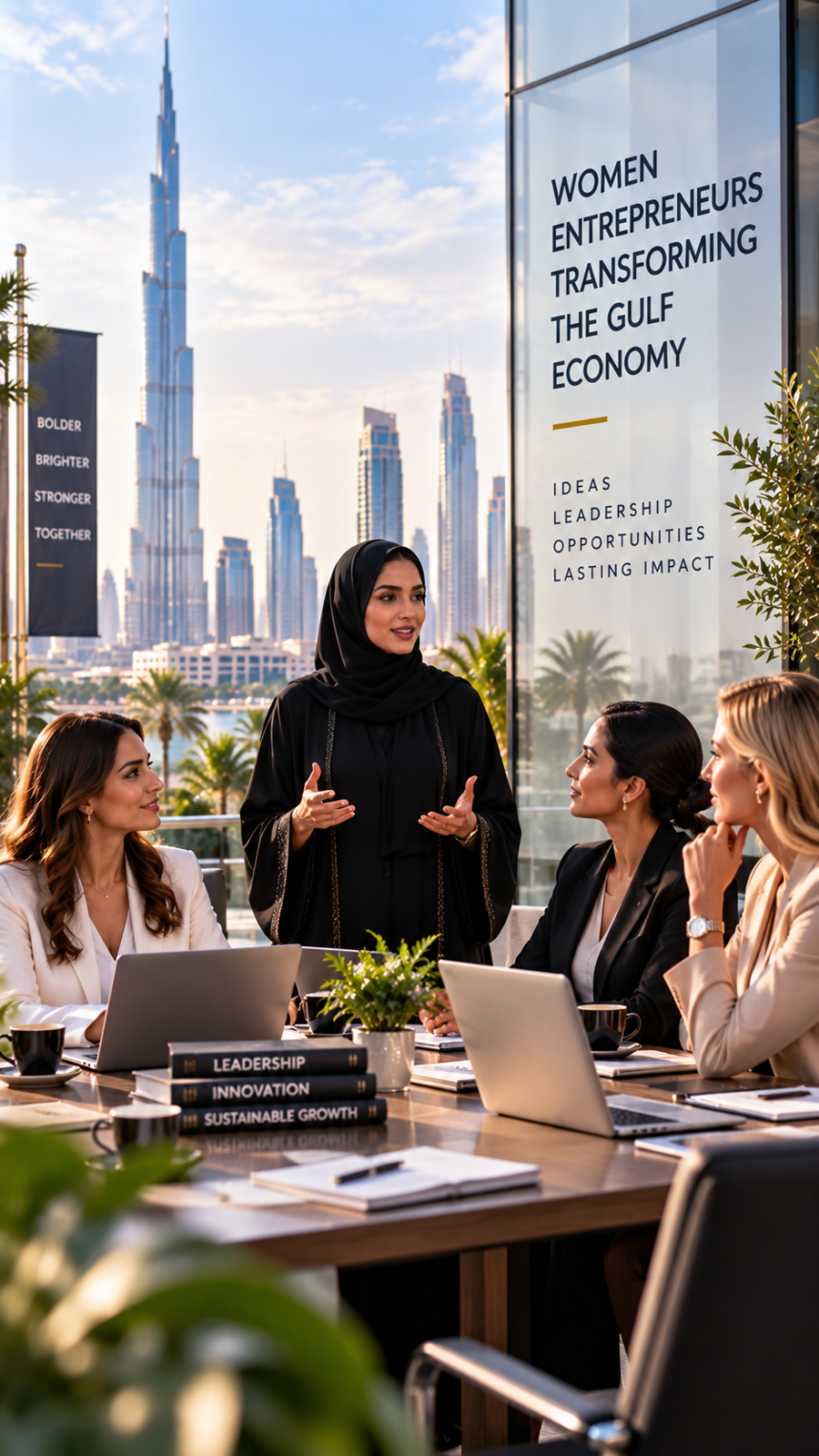
Women Entrepreneurship Across the Gulf
Gulf Women Entrepreneurs are becoming increasingly visible across the private sectors of the UAE, Saudi Arabia, Qatar, Bahrain, Oman and Kuwait. Women are launching companies, expanding family businesses, entering technology and industrial sectors, creating jobs and building brands that increasingly reach customers beyond their home markets.
- Gulf Women Entrepreneurs and the Changing GCC Economy
- Women Entrepreneurship Across the Gulf
- 1. Creating More Businesses Across the Private Sector
- 2. Generating Employment and New Career Opportunities
- 3. Supporting Economic Diversification
- 4. Moving Into Technology and Digital Business
- 5. Turning Small Businesses Into Scalable Companies
- 6. Expanding Leadership in Family Businesses
- 7. Increasing Participation in Investment and Finance
- 8. Growing Creative, Hospitality and Consumer Industries
- 9. Building Sustainable and Future-Focused Businesses
- 10. Creating Stronger Regional Business Networks
- 11. Expanding Opportunities Beyond Traditional Sectors
- 12. Inspiring the Next Generation of Entrepreneurs
- Women Entrepreneurs in the UAE
- Women Entrepreneurs in Saudi Arabia
- Women Entrepreneurs in Qatar
- Women Entrepreneurs in Bahrain
- Women Entrepreneurs in Oman
- Women Entrepreneurs in Kuwait
- Key Sectors Attracting Gulf Women Entrepreneurs
- The Importance of Funding and Investment
- Business Networks Supporting Female Entrepreneurs
- Challenges Women Entrepreneurs Still Face
- Opportunities for the Next Generation
- Gulf Women Entrepreneurship Comparison
- Practical Growth Checklist for Women-Led Businesses
- Final Thoughts on Gulf Women Entrepreneurs
The transformation is not limited to traditional small businesses. Women are now participating in areas including artificial intelligence, financial services, manufacturing, energy, hospitality, e-commerce, professional services and sustainable investment. At the same time, government programmes, chambers of commerce, SME authorities and private investors are creating more structured pathways for women to establish and expand businesses.
Recent developments show the scale of this shift. Saudi Arabia’s SME authority Monsha’at says the proportion associated with women-owned enterprises in its entrepreneurship indicators rose from 21% when the authority was established in 2016 to 42% in 2024. Separate Monsha’at data showed that women-owned enterprises accounted for 45% of commercial registrations issued during the second quarter of 2024.
In Abu Dhabi, meanwhile, 3,058 new economic licences were issued to Emirati businesswomen during the first half of 2026, an increase of 6.4% from the same period in 2025. These licences covered conventional businesses as well as freelance and specialised entrepreneurial activities.
These numbers do not mean that every barrier has disappeared. Access to capital, business networks, scaling opportunities and sector-specific expertise remain important challenges. However, the direction of change is clear: women are moving from being participants in Gulf economic development to becoming increasingly important business owners, employers and investors.
Gulf Women Entrepreneurs and the Changing GCC Economy
The rise of women-led businesses is closely connected with the wider transformation of Gulf economies. GCC governments are trying to increase private-sector activity, reduce dependence on hydrocarbons, develop technology-based industries and create more competitive SME ecosystems.
Women-owned businesses can contribute to each of these goals.
| Economic Area | Contribution of Women Entrepreneurs |
|---|---|
| SME growth | Creating new businesses and local brands |
| Employment | Hiring employees and developing specialist talent |
| Technology | Launching digital, AI and online businesses |
| Diversification | Expanding non-oil economic activity |
| Investment | Increasing female participation in capital and ownership |
| Tourism | Building hospitality, food and lifestyle businesses |
| Creative economy | Growing design, media and cultural businesses |
| Sustainability | Developing environmentally focused ventures |
| Regional trade | Expanding businesses across GCC markets |
| Innovation | Introducing new products, services and business models |
The significance goes beyond simply increasing the number of companies registered by women. A strong entrepreneurial ecosystem can create a multiplier effect because successful founders hire employees, purchase services from suppliers, mentor younger entrepreneurs and reinvest capital into new ventures.
That is why women’s entrepreneurship is increasingly viewed as an economic development issue rather than only a gender-participation issue.
Women Entrepreneurship Across the Gulf
The six GCC markets are developing women’s entrepreneurship at different speeds and through different systems, but several common patterns are emerging.
Women are increasingly represented in SME programmes, chambers of commerce, business councils and investment forums. The seventh GCC Businesswomen Forum held in Doha in November 2025 focused specifically on entrepreneurship, sustainable investment, the knowledge economy and moving women-led businesses from traditional models toward digital and innovative sectors.
The forum also launched the Gulf Businesswomen Platform, designed to connect businesswomen across GCC countries through a unified network and encourage regional partnerships, investment cooperation and knowledge exchange.
That regional dimension is important because a successful female entrepreneur in Dubai, Riyadh, Doha or Muscat no longer needs to think only about one domestic market. Digital commerce, regional logistics and GCC business networks are making cross-border growth increasingly realistic.
1. Creating More Businesses Across the Private Sector
One of the clearest contributions of women entrepreneurs is the creation of new companies.
Women-led enterprises now operate across sectors ranging from restaurants and fashion to financial technology, consulting, healthcare, industrial services and digital platforms. The diversity matters because it demonstrates that women’s entrepreneurship is moving beyond a narrow group of traditional business categories.
Saudi Arabia provides particularly strong evidence of this change. Monsha’at reports that women-owned businesses have expanded significantly since 2016, while its second-quarter 2024 SME data showed women-owned enterprises represented 45% of newly issued commercial registrations during that period.
Abu Dhabi’s 2026 licensing numbers also show continued momentum. More than 3,000 new licences were issued to Emirati businesswomen in only six months, covering different forms of commercial and professional activity.
Every new sustainable business creates additional economic activity through suppliers, rent, digital services, professional support and potentially employment.
2. Generating Employment and New Career Opportunities
Entrepreneurship has an economic impact beyond the founder.
A company that begins with one person can eventually hire marketing specialists, accountants, developers, salespeople, designers, technicians or operational staff. Growing women-led businesses therefore contribute to private-sector employment.
This effect can be particularly valuable in economies seeking to expand opportunities for younger citizens.
Saudi Arabia’s wider female employment indicators illustrate the changing labour environment surrounding entrepreneurship. GASTAT reported that the employment-to-population rate for Saudi women rose by three percentage points over the five years leading to the third quarter of 2025, reaching 29.7%.
Entrepreneurship adds another layer to that change because women are not only joining existing companies. They are increasingly creating workplaces themselves.
A successful business may also create opportunities that did not exist previously, particularly in new digital sectors where companies can hire remotely or operate with flexible working arrangements.
3. Supporting Economic Diversification
Every GCC country is attempting to broaden its economy beyond traditional hydrocarbons.
Women entrepreneurs are contributing to that process by building businesses in:
- Technology and software
- Tourism and hospitality
- Professional services
- Education
- Creative industries
- Healthcare
- E-commerce
- Renewable energy
- Manufacturing
- Financial services
This matters because diversification requires thousands of private companies, not only a handful of major government projects.
A tourism destination needs restaurants, digital booking companies, event businesses, designers and specialist service providers. A technology ecosystem needs startups, consultants, cybersecurity businesses and training companies. Manufacturing growth creates opportunities in logistics, equipment, maintenance and professional support.
Women-owned SMEs can participate throughout these supply chains.
The seventh Gulf Businesswomen Forum specifically connected women’s entrepreneurship with GCC goals around economic diversification, knowledge-based industries, sustainability and innovation.
4. Moving Into Technology and Digital Business
Technology is changing what entrepreneurship looks like for women across the region.
Digital businesses can sometimes reduce traditional barriers because they may require less physical infrastructure than manufacturing, retail or hospitality. A founder can launch an online service, software product or digital brand with a comparatively lean team and then sell beyond her domestic market.
The UAE’s current gender-balance strategy specifically includes entrepreneurship and financial participation among its economic priorities. It aims to increase women’s presence in entrepreneurship while strengthening economic participation and leadership.
Qatar has also used initiatives such as Women Technopreneurs to build women’s capabilities in technology and artificial intelligence, while its entrepreneurship ecosystem has increasingly focused on digital businesses and innovation.
Oman provides another indication of the shift. Official government commentary in February 2026 highlighted Omani women’s growing roles in cybersecurity, artificial intelligence, energy, minerals, engineering and medical technology.
The significance is clear: women are increasingly entering industries that will shape the next generation of Gulf economic growth.
5. Turning Small Businesses Into Scalable Companies
Many entrepreneurial journeys begin with small operations.
A home-based food company may become a restaurant group. An Instagram fashion brand may develop its own e-commerce platform and physical stores. A freelance professional may gradually build a consultancy employing several specialists.
This movement from small project to scalable company is particularly important because high-growth firms create more economic value than businesses that remain permanently at survival level.
The 2025 GCC Businesswomen Forum featured examples illustrating this path. Qatari entrepreneur Hessa Al Sulaiti discussed developing a home business into multiple restaurant concepts and hospitality operations, while other speakers described growth into technology and major corporate leadership.
Such examples matter because they change expectations. Entrepreneurship becomes less about creating additional personal income and more about building an organisation with employees, intellectual property, systems and regional expansion potential.
Support programmes should therefore focus not only on starting businesses but also on helping the strongest companies scale.
6. Expanding Leadership in Family Businesses
Family-owned companies remain an important part of Gulf economies.
As younger generations enter these businesses, women are increasingly taking leadership, board and executive roles rather than participating only informally.
This can influence how established Gulf companies approach technology, governance, international expansion and succession planning.
The GCC Businesswomen Forum highlighted Lujaina Haider of Oman as one example of this transition. Her professional journey developed from human resources into senior leadership and chairmanship within a major business organisation.
Family-business leadership matters because these companies can be significantly larger than typical startups.
A woman moving into senior leadership of an established enterprise can influence hundreds of employees, major investment decisions and substantial supplier networks.
This means women’s economic participation should not be measured only by startup statistics. Leadership and ownership within established Gulf companies are equally important.
7. Increasing Participation in Investment and Finance
Starting businesses is one part of entrepreneurship. Financing their growth is another.
Women founders may need capital for inventory, technology, employees, new locations or international expansion. Access to investment therefore becomes increasingly important as women-led companies become more ambitious.
Qatar Development Bank’s research into female entrepreneurship found that women business owners used a mix of personal savings, personal borrowing and commercial finance, highlighting the importance of access to structured business funding.
The UAE has also launched an Investment Readiness Acceleration programme specifically designed to help women-led startups improve their ability to secure funding, enter new sectors and communicate effectively with investors.
The next stage of development is likely to involve more women not only receiving investment but also becoming angel investors, fund managers and active participants in capital allocation.
That shift could create a reinforcing cycle where successful women entrepreneurs invest in the next generation of founders.
8. Growing Creative, Hospitality and Consumer Industries
Consumer-facing industries have historically provided important entry points for female entrepreneurship, and they remain economically significant.
Fashion, beauty, food, design, retail and hospitality can become highly scalable sectors when brands are professionally managed.
Qatar’s Arabian Women Exhibition in 2025 brought together more than 140 notable female entrepreneurs from Qatar across 200 domestic and international booths, illustrating the commercial scale that women’s creative and consumer businesses can reach.
These industries also connect directly with Gulf tourism growth.
A successful local restaurant, fashion label, design company or cultural brand contributes not only to retail spending but also to the identity visitors associate with a destination.
The opportunity is therefore to help promising consumer businesses develop stronger branding, technology, supply chains and international distribution rather than viewing them as permanently small lifestyle enterprises.
9. Building Sustainable and Future-Focused Businesses
Sustainability is becoming a larger part of GCC economic policy, and women entrepreneurs are increasingly participating in that transition.
Opportunities are emerging in:
- Renewable energy
- Sustainable fashion
- Food technology
- Recycling
- Green construction
- Environmental consulting
- Sustainable tourism
The Gulf Businesswomen Forum placed sustainable investment at the centre of its 2025 programme and encouraged women entrepreneurs to move into green-economy and future-focused sectors.
The launch of the regional Gulf Businesswomen Platform was also positioned around creating investment partnerships connected with sustainability and the green economy.
This creates an opportunity for female founders to participate in sectors receiving increasing government and investor attention rather than concentrating only on highly competitive traditional SME categories.
10. Creating Stronger Regional Business Networks
Networks matter because founders rarely build successful companies alone.
They need customers, investors, suppliers, mentors, employees and professional advisers. Regional networks can be particularly valuable in the Gulf because neighbouring markets are geographically close but operate under separate business systems.
The Gulf Businesswomen Platform launched in 2025 aims to make those connections easier by linking businesswomen throughout the GCC. Organisers said it is intended to expand the investment base of Gulf women, facilitate knowledge sharing and create new partnerships.
This can help a founder in Bahrain identify partners in Saudi Arabia, an Omani business enter the UAE, or a Qatari entrepreneur explore opportunities with companies elsewhere in the Gulf.
Regional networking also increases visibility.
Instead of being known only inside one domestic market, successful female entrepreneurs can develop reputations across the wider GCC business community.
11. Expanding Opportunities Beyond Traditional Sectors
One of the most important transformations is not simply that more women are becoming entrepreneurs. It is that the industries in which they participate are expanding.
Oman’s Foreign Ministry highlighted this change in February 2026, pointing to women working in areas including energy, minerals, cybersecurity, artificial intelligence, chemical engineering and medical-equipment engineering. The government described women’s participation in such sectors as part of a broader national move toward knowledge, innovation and sustainability.
The GCC Businesswomen Forum similarly emphasised moving women-led investments toward technology, renewable energy, tourism and other promising sectors.
This shift matters economically because future growth will increasingly occur in sectors requiring technical skills, intellectual property and specialised knowledge.
Participation in those industries allows women entrepreneurs to contribute directly to higher-productivity economic activity.
12. Inspiring the Next Generation of Entrepreneurs
Entrepreneurial success can change expectations.
When younger women see founders building technology companies, restaurant groups, industrial ventures or professional-service businesses, entrepreneurship becomes a more realistic career path.
That role-model effect can be difficult to measure, but it has long-term importance.
Government and private-sector programmes increasingly recognise this. Monsha’at’s Empowering Female Entrepreneurs programme aims not only to support existing founders but also to promote an entrepreneurial mindset and increase women’s participation in entrepreneurship services.
The UAE’s Ramadan Riyada Majlis in March 2026 similarly brought together established female entrepreneurs and business leaders to exchange experiences and encourage new economic initiatives.
Successful founders can therefore have an impact far beyond their own companies by mentoring, investing and showing younger professionals what is possible.
Women Entrepreneurs in the UAE
The UAE has developed one of the Gulf’s most active environments for female entrepreneurship.
The country’s Gender Balance Council Strategy 2026 explicitly includes economic participation, entrepreneurship and financial inclusion as a strategic pillar. Its objectives include increasing women’s participation and leadership in the economy while expanding their presence in entrepreneurship.
Recent Abu Dhabi data shows measurable growth. During the first six months of 2026, ADRA issued 3,058 new economic licences to Emirati businesswomen, compared with 2,873 during the corresponding period of 2025. The Mobdea licensing category, designed in part to help UAE women convert creative activity into formal business, also continued to grow.
The UAE also provides women founders with access to free zones, mainland companies, accelerators, investors and international networks. Programmes such as the Investment Readiness Acceleration initiative specifically target the challenge of preparing women-led startups for funding.
Dubai and Abu Dhabi are particularly important because women can build businesses serving both domestic and international customers from the same base.
Women Entrepreneurs in Saudi Arabia
Saudi Arabia has experienced one of the most visible transformations in women’s entrepreneurship.
Monsha’at says indicators connected with female-owned businesses increased from 21% in 2016 to 42% in 2024. The authority also reported that 45% of commercial registrations issued during Q2 2024 were for women-owned businesses.
The authority operates an Empowering Female Entrepreneurs programme designed to improve access to entrepreneurship services, business development opportunities and market participation. It also aims to identify and address regulatory and infrastructure barriers affecting female founders.
The change is occurring alongside broader increases in women’s economic participation. GASTAT’s labour-market data showed continued improvement in female employment indicators through 2025.
The next opportunity lies in moving more women-led businesses into high-growth sectors such as technology, tourism, advanced services and manufacturing while helping promising SMEs expand beyond the startup stage.
Women Entrepreneurs in Qatar
Qatar’s ecosystem combines female entrepreneurship programmes with an active Businesswomen Forum and chamber network.
Research by Qatar Development Bank has examined the motivations, sectors, financing methods and challenges faced by female founders. Its entrepreneurship study found women active particularly in areas including food and beverage, fashion and retail while also highlighting the need for continued financing and ecosystem support.
The country is also encouraging movement into technology. Initiatives such as Women Technopreneurs have focused on entrepreneurship, technology and artificial intelligence.
Qatar Chamber has played a major role in creating networking platforms. The country hosted the seventh GCC Businesswomen Forum in November 2025 and supports the Qatari Businesswomen Forum as a platform for business cooperation.
The growing emphasis on sustainable investment and digital businesses fits closely with Qatar’s broader diversification ambitions.
Women Entrepreneurs in Bahrain
Bahrain’s compact business environment and established financial-services sector create a strong setting for women-led SMEs and professional businesses.
Tamkeen provides one of the clearest indicators of female participation in enterprise-support programmes. Its 2025 Annual Plan reported that of more than 8,700 enterprises receiving support during the underlying reporting period, 44% were fully or partially owned by women.
Bahrain also has a long-established businesswomen community. The Global Women Economic Forum and Exhibition held in Manama in January 2025 brought together female business leaders and focused on public-private partnerships, innovation and economic growth.
Women entrepreneurs can benefit from Bahrain’s relatively small geographic size, strong banking ecosystem and close access to the Saudi market.
The opportunity is increasingly to help strong Bahraini businesses scale regionally rather than viewing the domestic market as their final destination.
Women Entrepreneurs in Oman
Oman’s women entrepreneurs are becoming increasingly visible in both SME activity and non-traditional industries.
Data from OPAZ showed that 754 Omani women were investors in establishments within special economic zones, free zones and industrial cities by the end of the first half of 2025, alongside 143 non-Omani resident women investors. The same data identified 574 SMEs owned or managed by Omani women across the zones overseen by the authority.
The Sultanate is also developing better data around female entrepreneurship. Its official open-data platform now includes a dedicated Omani Women Entrepreneurs dataset covering women-founded startups, licensed craft enterprises and home-based businesses.
Importantly, women’s participation is broadening beyond conventional SME categories. Official commentary in 2026 highlighted women working in AI, cybersecurity, engineering, medical technologies, minerals and energy.
This creates a stronger foundation for women-led businesses aligned with Oman Vision 2040’s focus on innovation and economic diversification.
Women Entrepreneurs in Kuwait
Kuwait has a long-established private business culture and a strong consumer market, giving female entrepreneurs opportunities across retail, professional services, technology, food, creative industries and other sectors.
Women from Kuwait also participate in the broader GCC businesswomen ecosystem, including forums and regional initiatives organised by the Federation of Gulf Chambers and national chambers. The 2025 Gulf Businesswomen Forum was explicitly designed to connect female entrepreneurs from all GCC member states and build stronger investment partnerships across the region.
For Kuwaiti founders, regional expansion can be especially important because the domestic market is relatively small compared with Saudi Arabia. Digital businesses and scalable consumer brands can use Kuwait as an initial base before expanding into neighbouring GCC economies.
Continued development of financing, accelerators, mentoring and cross-border networks can help more women-led Kuwaiti businesses reach that stage.
Key Sectors Attracting Gulf Women Entrepreneurs
Women entrepreneurs are increasingly active across a much wider economic landscape than the traditional image of female-owned small businesses suggests.
| Sector | Why It Offers Opportunity |
|---|---|
| Technology | Scalable digital products and services |
| E-commerce | Lower barriers to regional customer access |
| Food and hospitality | Strong Gulf tourism and consumer demand |
| Fashion and design | Growing regional brands and creative economy |
| Professional services | Demand for consulting and specialist expertise |
| Healthcare | Expanding private healthcare markets |
| Education | Demand for training and digital learning |
| Sustainability | Government focus on green investment |
| Tourism | Major national tourism-development strategies |
| Manufacturing | Diversification and local production initiatives |
| Fintech | Rapid digitisation of Gulf financial services |
| Media and content | Expanding digital and creative industries |
The strongest opportunities may increasingly lie where several sectors overlap, such as technology combined with healthcare, sustainability combined with manufacturing, or tourism combined with digital commerce.
This allows founders to build companies that solve specific regional problems rather than simply copying existing business models.
The Importance of Funding and Investment
Access to capital remains one of the most important issues for entrepreneurs of any gender, but women-led businesses can face additional difficulties when they lack established investor networks or collateral.
Funding needs also change as businesses grow. A founder may be able to finance the first stage through savings but require external capital when opening a second location, hiring a technology team or entering another GCC country.
A healthy funding ecosystem should therefore provide several options:
- Bank financing for established SMEs
- Angel investment for early-stage companies
- Venture capital for scalable startups
- Government-backed SME programmes
- Grants or incentives for selected sectors
- Accelerator programmes
- Investment-readiness training
The UAE’s women-focused investment-readiness initiative is one example of moving beyond basic entrepreneurship training and addressing the more difficult question of how promising companies attract capital.
The next major milestone for the Gulf will be increasing the number of women-led businesses receiving substantial growth investment rather than only startup support.
Business Networks Supporting Female Entrepreneurs
Networks can determine how quickly founders gain access to customers, mentors and capital.
The Gulf now has several layers of support, including national chambers, businesswomen committees, entrepreneurship authorities and regional platforms.
The Gulf Businesswomen Platform launched during the 2025 Doha forum is particularly significant because it attempts to connect women entrepreneurs across national borders rather than keeping business communities separated by country.
These networks can help women:
- Identify business partners
- Find suppliers
- Meet investors
- Exchange market knowledge
- Enter new GCC countries
- Learn from experienced founders
Networking becomes especially valuable when a company is ready for regional growth. Knowing how another market operates can save months of trial and error.
Challenges Women Entrepreneurs Still Face
Progress should not hide the challenges that remain.
Funding is one major issue, especially when businesses move beyond the small-enterprise stage. Founders may also need stronger access to specialist mentors, investor networks and procurement opportunities.
Scaling is another challenge. Launching a small company and building a regional business require different capabilities.
| Challenge | What Can Help |
|---|---|
| Access to funding | Investment readiness and diverse financing |
| Limited networks | Chambers, accelerators and regional platforms |
| Scaling operations | Management training and digital systems |
| Entering new markets | GCC partnerships and local market advice |
| Technical skills | Sector-specific training |
| Finding talent | Strong recruitment and retention strategies |
| Visibility | Trade exhibitions and business media |
| Investor confidence | Better governance and financial reporting |
Family responsibilities can also influence entrepreneurship decisions, making flexible business structures and technology particularly valuable.
The goal should not be to create permanent special treatment for women-owned companies. It should be to remove unnecessary barriers so that businesses can compete on the quality of their products, leadership and execution.
Opportunities for the Next Generation
The next generation of Gulf women entrepreneurs will enter a very different environment from founders who started businesses twenty years ago.
They will have greater access to digital platforms, entrepreneurship education, regional networks and business structures that support full ownership across many activities.
Future opportunities are likely to be especially strong in:
- Artificial intelligence
- Cybersecurity
- Health technology
- Financial technology
- Clean energy
- Advanced manufacturing
- E-commerce
- Tourism technology
- Education technology
- Creative industries
The key shift will be from participation to scale.
Success should increasingly be measured by how many women-led businesses develop valuable intellectual property, export products, raise growth capital and employ large teams.
Gulf Women Entrepreneurship Comparison
| GCC Country | Notable Current Development |
|---|---|
| UAE | 3,058 new Abu Dhabi licences for Emirati women in H1 2026 |
| Saudi Arabia | Strong growth in women-owned enterprises and commercial registrations |
| Qatar | Active businesswomen forums and technology entrepreneurship programmes |
| Bahrain | 44% of enterprises supported in Tamkeen’s cited period were fully or partly women-owned |
| Oman | 754 Omani women investing in OPAZ economic zones by H1 2025 |
| Kuwait | Growing participation through domestic and regional entrepreneurship networks |
The numbers are not directly comparable because each source measures a different part of the economy. They nevertheless illustrate that women’s entrepreneurship is becoming a visible part of SME and investment policy throughout the region.
Practical Growth Checklist for Women-Led Businesses
Female founders planning to build scalable Gulf businesses should think beyond the initial company registration and focus on the systems required for sustainable expansion.
- Validate genuine customer demand before investing heavily.
- Choose a business structure capable of supporting future growth.
- Separate personal and business finances from the beginning.
- Maintain accurate accounting and financial reports.
- Build a strong professional network rather than relying only on social media.
- Use government SME programmes where they provide real commercial value.
- Develop digital systems before operations become difficult to manage.
- Understand the funding options available at different growth stages.
- Hire based on capabilities rather than keeping every role with the founder.
- Protect trademarks, technology and other intellectual property.
- Consider neighbouring GCC markets once domestic demand is proven.
- Join chambers, business councils and sector organisations.
- Build governance before outside investors require it.
- Focus on profitability as well as revenue growth.
- Develop a long-term brand rather than chasing short-lived trends.
The strongest businesses will ultimately be those that can compete independently and expand because customers genuinely value what they provide.
Final Thoughts on Gulf Women Entrepreneurs
Gulf Women Entrepreneurs are becoming an increasingly important part of the GCC’s economic transformation. Their contribution can now be seen in company formation, employment, technology, hospitality, professional services, industrial activity and regional investment.
The UAE continues building dedicated policies around entrepreneurship and economic participation, while Abu Dhabi recorded 3,058 new licences for Emirati women during the first half of 2026.
Saudi Arabia has recorded particularly strong changes, with Monsha’at reporting significant growth in women-owned businesses and women accounting for a substantial share of new commercial registrations in its recent SME data.
Qatar is strengthening women’s entrepreneurship through business forums, technology initiatives and regional networking platforms, while Bahrain has seen significant female ownership among enterprises receiving Tamkeen support.
Oman provides another important example, with hundreds of women investing through special economic zones and growing participation in advanced technical sectors.
Across the wider region, the launch of the Gulf Businesswomen Platform shows that the next phase is likely to become more regional. Rather than building businesses only for domestic markets, female entrepreneurs can increasingly form partnerships, attract investment and expand across the GCC.
The greatest economic opportunity is therefore not simply increasing the number of women who register businesses. It is helping promising founders move from small enterprises to scalable, innovative and professionally managed companies.
When a woman-led startup becomes an employer, exporter or regional brand, its impact extends far beyond the founder. It creates jobs, purchases from suppliers, develops skills, attracts capital and demonstrates what is possible to the entrepreneurs who follow.
That is why the rise of women entrepreneurs is becoming more than a social change within the Gulf. It is increasingly part of how GCC economies diversify, innovate and build their next generation of private-sector growth.
Do follow us on Instagram
Read More – GCC Business Investment: 12 Powerful Benefits for Global Companies