

How Entrepreneurship Changed Across the Gulf
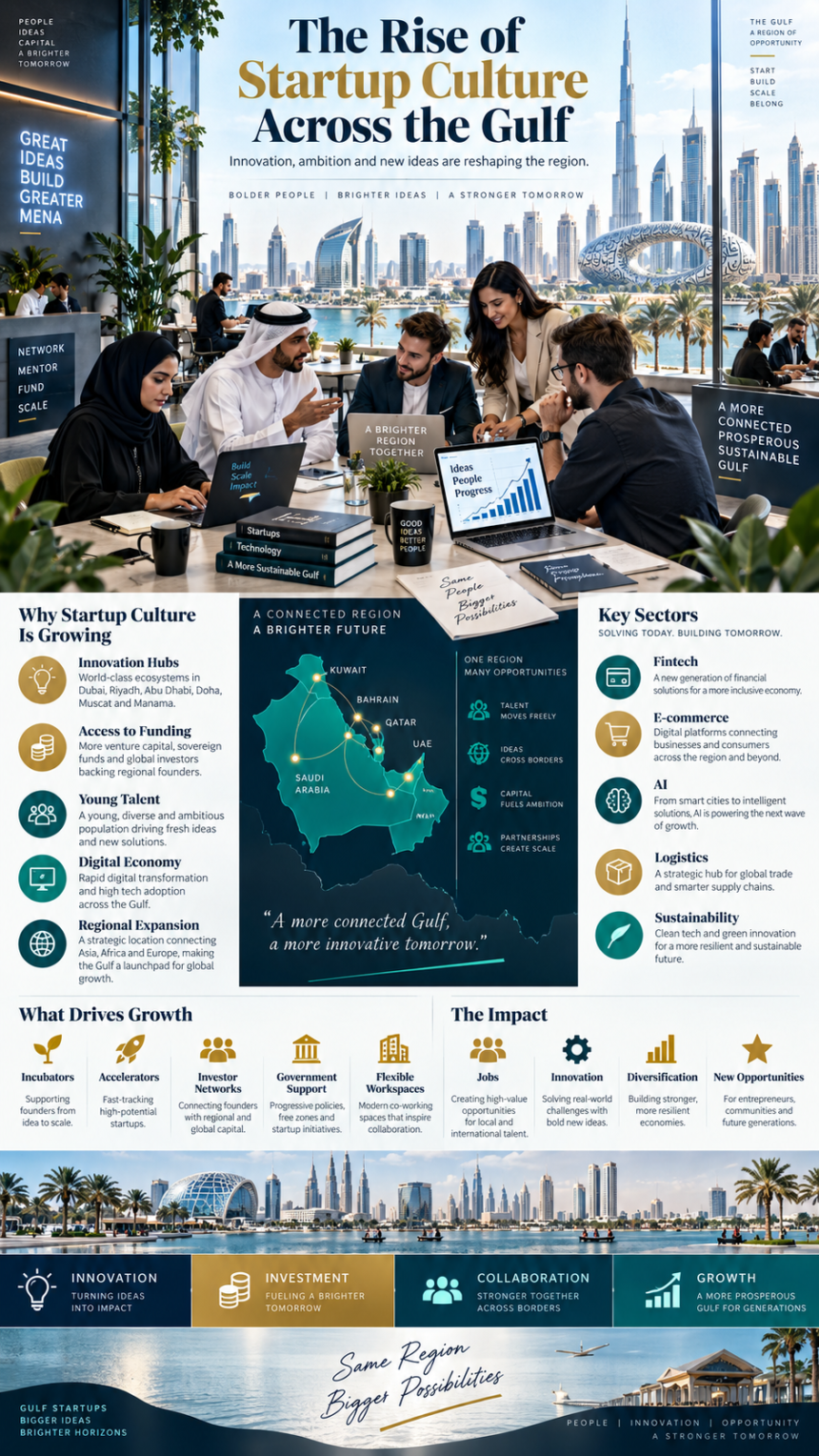
Gulf Startup Culture has developed rapidly from a relatively small entrepreneurial movement into an increasingly important part of the economies of the UAE, Saudi Arabia, Qatar, Bahrain, Oman and Kuwait. Across the region, founders are building companies in artificial intelligence, financial technology, e-commerce, healthcare, logistics, software, sustainability and other industries that barely existed as major startup categories a generation ago.
- Gulf Startup Culture and the New GCC Economy
- How Entrepreneurship Changed Across the Gulf
- 1. Governments Made Startups an Economic Priority
- 2. Venture Capital Became More Accessible
- 3. Technology Created New Business Opportunities
- 4. Accelerators and Incubators Built Founder Communities
- 5. Younger Generations Are Choosing Entrepreneurship
- 6. Business Setup Became Faster and More Flexible
- 7. International Founders Entered Gulf Markets
- 8. Large Companies Started Working With Startups
- 9. Regional Events Created Stronger Startup Networks
- 10. New Funding Models Helped Businesses Scale
- 11. Startups Became Part of Economic Diversification
- 12. Gulf Startups Began Thinking Globally
- Startup Culture in the UAE
- Startup Culture in Saudi Arabia
- Startup Culture in Qatar
- Startup Culture in Bahrain
- Startup Culture in Oman
- Startup Culture in Kuwait
- Industries Driving Gulf Startup Growth
- From Small Business to Scalable Startup
- The Role of Venture Capital in the Gulf
- Women and Young Founders in the Startup Economy
- Challenges Facing Gulf Startups
- What the Next Generation of Gulf Startups May Look Like
- Gulf Startup Growth Checklist
- Final Thoughts on Gulf Startup Culture
This change reflects a wider transformation in how Gulf governments think about economic development. Large infrastructure projects and multinational investment remain important, but policymakers increasingly recognise that future growth also requires thousands of smaller innovative companies capable of creating products, employing skilled workers and developing new technologies.
The UAE’s National Agenda for Entrepreneurship, for example, aims to strengthen the country as a global entrepreneurship destination and includes initiatives covering innovation, financing, digital transformation, business support and market access. The agenda sets long-term ambitions including significantly expanding the country’s entrepreneurial base and helping more startups reach major international scale.
Saudi Arabia has taken a similar approach. The Small and Medium Enterprises General Authority, Monsha’at, was established specifically to develop the SME sector and aims to increase its contribution to GDP from 20% to 35% as part of Saudi Vision 2030.
The result is a Gulf business environment where becoming an entrepreneur is increasingly treated as a serious career and investment path rather than simply an alternative to traditional employment.
Gulf Startup Culture and the New GCC Economy
The rise of startups is closely connected with the Gulf’s broader shift toward knowledge-based and diversified economies. Technology businesses, digital platforms and innovative SMEs can grow without depending directly on hydrocarbons, making them attractive to countries preparing for a more diverse economic future.
Several forces are driving the movement at the same time:
| Startup Driver | Impact on the GCC Ecosystem |
|---|---|
| Government policy | Makes entrepreneurship a national economic priority |
| Venture capital | Helps promising businesses finance growth |
| Accelerators | Provide mentoring, networks and market access |
| Digital infrastructure | Makes technology businesses easier to launch |
| Foreign founders | Add talent and international experience |
| Economic diversification | Creates opportunities in new industries |
| Corporate partnerships | Give startups access to major customers |
| Startup events | Connect founders, investors and governments |
| Easier company formation | Reduces barriers to market entry |
| Regional scale | Allows startups to expand across GCC markets |
The importance of these factors is not that every new company becomes a technology unicorn. Most startups will remain small, some will close and others may become profitable medium-sized businesses rather than globally recognised brands.
A healthy startup culture requires all of these outcomes. Entrepreneurship depends on experimentation, and economic value can still be created by companies that grow steadily without becoming billion-dollar businesses.
How Entrepreneurship Changed Across the Gulf
Entrepreneurship itself is not new to the Gulf. Trading families, merchants and small business owners have operated throughout the region for generations.
What has changed is the type of business founders are building and the infrastructure available to support them.
Traditional businesses were often based around retail, contracting, distribution, property or professional services. Today’s startup ecosystem increasingly includes companies designed to scale through technology.
A modern Gulf founder might develop:
- A fintech payment platform
- An AI software company
- A logistics marketplace
- A health technology application
- A cybersecurity platform
- An online education business
- A climate technology startup
The difference is important. A traditional company often grows by opening additional physical locations or hiring more employees, while a technology startup can sometimes serve thousands of additional customers without increasing costs at the same rate.
That possibility of rapid scale is why startups attract venture capital and government attention.
1. Governments Made Startups an Economic Priority
Perhaps the biggest reason startup culture has expanded is that governments actively decided to support it.
The UAE’s entrepreneurship strategy includes support around access to capital, digital transformation, innovation, skills development and stronger demand for SME products and services. The Ministry of Economy also identifies more than ten key government programmes and numerous accelerators supporting entrepreneurs.
Saudi Arabia’s Monsha’at performs a similar role by developing entrepreneurship programmes, supporting innovation, diversifying financing options and connecting SMEs with technology, markets and investment opportunities.
This represents an important change in economic policy. Startups are no longer seen only as very small businesses that need basic financing. They are increasingly viewed as potential drivers of productivity, innovation and private-sector employment.
Government involvement can take many forms, including grants, accelerators, regulatory reforms, government procurement programmes and investment incentives.
The strongest ecosystems usually combine public support with private competition rather than expecting government programmes to create successful companies on their own.
2. Venture Capital Became More Accessible
Startups require a different type of financing from many traditional businesses.
A restaurant or retail company may borrow against expected cash flow, but a technology startup can spend several years developing a product before generating meaningful profit. Venture capital was designed partly to finance this type of high-risk, high-growth business.
The Gulf venture capital ecosystem has expanded substantially as local funds, international investors, sovereign-backed programmes and corporate investment arms have entered the market.
Qatar provides one of the strongest current examples. Qatar Development Bank’s Startup Qatar Investment Program offers eligible technology startups funding of up to $1.1 million at the launch stage and up to $5.5 million for growth-stage support, alongside licensing and business-support incentives.
Invest Qatar also introduced a VC Funding Module in June 2026 that allows startups to explore participating venture funds and submit pitches directly. Many participating funds are supported by Qatar Investment Authority’s $3 billion Fund of Funds programme.
The presence of more capital does not guarantee funding for every founder. Investors still expect credible teams, strong markets and scalable business models.
However, founders now have more potential financing routes than were available during the Gulf’s earlier startup years.
3. Technology Created New Business Opportunities
Technology reduced the cost of starting many types of business.
Cloud computing allows a small team to access computing infrastructure that once required substantial investment. Digital payments make online commerce easier, while social media gives founders direct access to customers.
Artificial intelligence is creating another major wave.
Startups can now build products around:
- AI assistants
- Business automation
- Data analytics
- Cybersecurity
- Smart cities
- Healthcare technology
- Financial technology
- Education technology
Saudi Arabia is increasingly connecting its entrepreneurship policy with emerging technology. Monsha’at’s Innovation Centers are designed to support entrepreneurs working with new technologies and help startups move from initial products toward market-ready solutions.
At LEAP 2026 in Riyadh, Monsha’at also promoted its Startup Gateway, technology adoption programmes and AI-focused incubation initiatives.
The opportunity is particularly significant because Gulf governments and major companies are themselves investing heavily in digital transformation, creating large potential customers for local technology startups.
4. Accelerators and Incubators Built Founder Communities
Starting a company can be difficult when founders have no access to experienced entrepreneurs, lawyers, investors or potential customers.
Accelerators and incubators help reduce that isolation.
These organisations typically provide combinations of:
- Mentorship
- Office space
- Investor introductions
- Business training
- Technical support
- Networking
- Market-access assistance
Saudi Arabia’s Monsha’at operates Business Accelerators designed to support startups over intensive three-to-six-month periods. The programme provides workspaces, consultancy, training, financial support and connections with investors.
Kuwait’s National Fund for SME Development similarly supports a network of incubators, accelerators, shared workspaces and innovation centres. Its incubation programmes are designed to help entrepreneurs develop commercially viable businesses with technical, administrative and financial support.
The most valuable element can sometimes be community rather than training. Founders benefit from meeting other people facing similar problems with hiring, product development, regulation and fundraising.
5. Younger Generations Are Choosing Entrepreneurship
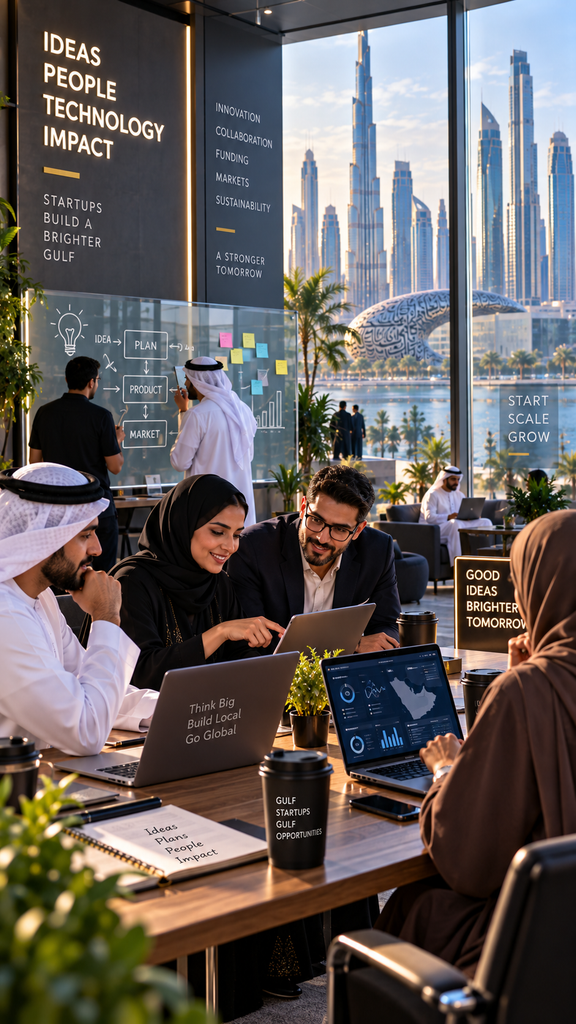
A cultural shift is taking place alongside the financial and regulatory changes.
For previous generations, joining government, banking, oil and gas or a major family company could represent the most attractive career path. These careers remain important, but younger professionals increasingly see entrepreneurship as another realistic option.
Several factors encourage this shift. Social media has made founders more visible, universities increasingly teach entrepreneurship, startup competitions reward business ideas and government programmes provide practical support.
The UAE’s national entrepreneurship agenda specifically aims to strengthen entrepreneurial culture across society and encourage younger generations to establish businesses.
Saudi initiatives also focus heavily on creating an entrepreneurial community rather than simply financing existing SMEs. Monsha’at describes increasing the number of new startups and promoting entrepreneurship as one of its strategic priorities.
Entrepreneurship therefore increasingly carries social status as well as financial opportunity.
6. Business Setup Became Faster and More Flexible
Startup culture cannot develop easily if registering a company takes months or requires unnecessarily complicated structures.
Across the Gulf, governments have gradually digitised company formation, licensing and investor services.
Oman provides a useful example. Its Ministry of Commerce reported in February 2026 that nine integrated digital platforms were operating to support investors and entrepreneurs as part of wider reforms designed to improve the business environment.
The Oman Business Platform has also expanded self-service digital company procedures, reducing the need for entrepreneurs to handle every administrative step in person.
The UAE offers a wide range of mainland, free-zone and specialised startup environments, while 100% foreign ownership across many activities has made it easier for international entrepreneurs to control their companies directly. The Ministry of Economy identifies full foreign ownership, entrepreneur Golden Visas and free zones among the major enablers of the country’s entrepreneurship ecosystem.
Less administrative friction gives founders more time to focus on customers and products.
7. International Founders Entered Gulf Markets
The Gulf startup ecosystem is not limited to citizens of GCC countries.
Cities such as Dubai, Riyadh, Doha and Manama increasingly compete for international founders who can bring ideas, technology and experience from other markets.
The UAE has been particularly successful in developing an international entrepreneurial community through free zones, residency programmes and global connectivity. Its entrepreneurship strategy explicitly includes attracting international technology startups.
Qatar’s Startup Qatar programme is also designed partly to attract technology startups to establish or expand operations in the country, offering funding, licensing support and entrepreneur visa assistance.
International founders strengthen the ecosystem because they bring connections to other markets, while Gulf founders benefit from interacting with entrepreneurs from different business cultures.
The result is an increasingly global startup environment rather than a purely domestic one.
8. Large Companies Started Working With Startups
A startup ecosystem becomes stronger when large companies become customers and partners rather than viewing young businesses only as experiments.
Corporate contracts can provide startups with revenue, credibility and access to larger markets.
Saudi Arabia has been actively encouraging this connection. In April 2026, Monsha’at brought together enabling organisations to discuss ways of increasing contracts between major companies and innovative enterprises, with the goal of turning new technologies into practical commercial opportunities.
Corporate-startup partnerships can involve:
- Pilot programmes
- Technology procurement
- Joint development
- Investment
- Distribution
- Data partnerships
This is particularly important in the Gulf because many industries are dominated by large private groups, government entities or major corporations.
A startup that gains one significant enterprise customer can sometimes grow faster than one relying entirely on thousands of individual consumers.
9. Regional Events Created Stronger Startup Networks
Startup ecosystems grow through repeated interaction.
Large events such as technology conferences, demo days and investor forums bring together founders who would otherwise struggle to meet one another.
Riyadh’s LEAP has become an important technology gathering, while Web Summit Qatar has strengthened Doha’s profile in the international startup community. The 2026 edition of Web Summit Qatar was also used by Qatar Development Bank and Ooredoo to announce the development of Digital & Beyond Ventures, transforming an incubator relationship into a joint investment platform for startups.
Saudi Arabia’s Monsha’at reported that its Business Weeks initiative attracted 12,697 beneficiaries during the first half of 2026, involving 240 organisations and 218 entrepreneurship networking events.
Events matter because founders need more than funding. They need customers, employees, mentors and partners.
A strong ecosystem creates repeated opportunities for those connections to happen.
10. New Funding Models Helped Businesses Scale
Bank loans and venture capital are no longer the only financing options available.
Across the GCC, entrepreneurs can increasingly access combinations of government-backed financing, angel investment, venture capital, accelerator funding and specialised SME programmes.
Saudi Arabia’s 2026 Funding Week illustrates how broad the financing discussion has become. The programme involved 62 participating organisations and more than 1,200 consultation sessions covering venture capital, lending, crowdfunding, financial literacy, fintech and preparation for capital-market listings.
Saudi startups can also benefit from the Estrdad initiative, which refunds selected government fees to eligible SMEs established during the qualifying period. By June 2026, more than SAR 143 million had been refunded to over 5,600 businesses.
This variety matters because different startups require different capital structures.
A software company may need equity investment, while a profitable food business might be better suited to debt financing.
11. Startups Became Part of Economic Diversification
The Gulf’s startup boom cannot be separated from national diversification strategies.
Governments want stronger private sectors capable of generating growth in industries beyond oil and gas.
Startups fit naturally into this strategy because they can experiment with new technologies and business models much faster than large institutions.
Oman’s Ministry of Commerce now explicitly lists startups as an investment opportunity alongside sectors such as logistics, ICT, tourism and education. Its current investment platform describes the country’s startup ecosystem as supported by incubators, accelerators and funding initiatives aimed at technology-driven business models.
Bahrain similarly promotes startups as part of its investment proposition, highlighting businesses across software, e-commerce, cybersecurity, health technology and fintech. Bahrain EDB says the number of startups in its tracked ecosystem grew at a compound annual rate of 46.2% over a recent three-year period.
Startup policy is therefore increasingly part of mainstream economic policy rather than a separate youth programme.
12. Gulf Startups Began Thinking Globally
The most important long-term shift may be ambition.
Earlier generations of Gulf entrepreneurs often built successful companies around local distribution or domestic demand. Today’s technology startups increasingly launch with the expectation of eventually serving several countries.
The GCC itself provides a useful first expansion market because the six countries are geographically close and share several business characteristics.
A startup might begin in Dubai, expand into Riyadh, enter Doha and then move into larger markets in North Africa, South Asia or Europe.
The UAE’s Scale Up Platform specifically supports high-growth SMEs through areas including global expansion, exports, digital transformation and financing, with an explicit focus on helping potential future unicorns scale internationally.
For the Gulf to produce more globally recognised companies, this ability to grow beyond one domestic market will be essential.
Startup Culture in the UAE
The UAE currently has one of the region’s most mature startup ecosystems.
Several factors contribute to its position: international talent, free zones, venture capital, accelerators, strong digital infrastructure and relatively easy access to international markets.
The Ministry of Economy describes entrepreneurship as a strategic national priority and lists more than ten government programmes and eleven or more accelerators supporting startups and entrepreneurs. It also highlights full foreign ownership and entrepreneur Golden Visas as important ecosystem advantages.
The National Agenda for Entrepreneurship aims to make the UAE an entrepreneurial nation by 2031, with initiatives covering financing, innovation, human capital, digital transformation and easier business formation.
Dubai remains particularly strong in fintech, e-commerce, software and international startup activity, while Abu Dhabi has developed significant technology and investment ecosystems of its own.
The UAE’s challenge now is less about convincing people to launch startups and more about helping successful companies grow into larger global businesses.
Startup Culture in Saudi Arabia
Saudi Arabia’s startup ecosystem has expanded rapidly alongside Vision 2030.
The size of the domestic market gives Saudi startups an important advantage because a company can build substantial revenue without leaving the Kingdom immediately.
Monsha’at sits at the centre of much of the public support ecosystem. Its strategic target is to increase the SME contribution to GDP from 20% to 35%, and its programmes include accelerators, innovation centres, advisory support, networking and financing initiatives.
Activity in 2026 demonstrates the scale of founder engagement. Monsha’at’s Business Weeks attracted more than 12,000 beneficiaries during the first six months of the year, while Funding Week alone drew more than 3,700 participants.
Riyadh’s technology events and growing investor base are also making the city increasingly important for regional startups.
For many founders, Saudi Arabia is no longer simply a market they enter later. It is becoming a place where the company itself can be built.
Startup Culture in Qatar
Qatar is using investment capital and international events to accelerate its startup ecosystem.
Qatar Development Bank currently provides several financing and investment programmes, with close to QAR 140 million invested in startups through capital committed and deployed.
The Startup Qatar Investment Program is particularly significant because it combines financial support with licensing and operational incentives. Eligible companies can access launch-stage support of up to $1.1 million and growth funding of up to $5.5 million.
Qatar is also strengthening the connection between founders and international investors. The Invest Qatar Gateway’s VC Funding Module allows companies to identify and pitch participating venture funds, including funds linked to QIA’s $3 billion Fund of Funds initiative.
Web Summit Qatar has added international visibility, helping Doha connect its local ecosystem with global founders and investors.
Startup Culture in Bahrain
Bahrain has built a compact but active startup ecosystem, particularly around fintech and digital businesses.
Bahrain EDB describes software development, e-commerce, cybersecurity, health and fintech among the sectors driving startup growth. It also highlights 100% foreign ownership, cost competitiveness and a network of incubators, investors and support organisations.
The ecosystem includes organisations such as Bahrain Development Bank, Tamkeen and Bahrain FinTech Bay alongside private accelerators and investment funds.
One of Bahrain’s advantages is that founders can access a relatively small domestic ecosystem while remaining close to the much larger Saudi market.
The country’s financial-services history also provides a useful foundation for fintech companies because banks, regulators and financial specialists are already concentrated locally.
For Bahrain, the opportunity is to continue turning successful local startups into regional companies.
Startup Culture in Oman
Oman’s startup ecosystem is developing alongside the country’s broader economic diversification strategy.
The Ministry of Commerce, Industry and Investment Promotion now identifies startups as an official investment opportunity and highlights incubators, accelerators and funding programmes supporting technology-driven business models.
Digitalisation is also making entrepreneurship easier. The government reported nine integrated platforms serving investors and entrepreneurs by early 2026, while the Oman Business Platform continues expanding digital self-service options for company procedures.
Oman has particularly interesting startup opportunities in areas connected to its wider economic strengths, including:
- Logistics
- Tourism
- Renewable energy
- Fisheries
- Mining
- ICT
The startup ecosystem is smaller than the UAE or Saudi Arabia, but this can also create opportunities for founders solving specifically Omani or regional problems that larger international startups may overlook.
Startup Culture in Kuwait
Kuwait has a strong consumer market and a long entrepreneurial tradition, although its formal technology startup ecosystem is still developing compared with some neighbouring markets.
The National Fund for SME Development plays an important role. Its mission is to build an innovative ecosystem for entrepreneurs, create private-sector employment and increase SME participation in the economy. The Fund was established with capital of KD 2 billion and can finance up to 80% of capital for qualifying projects submitted by Kuwaiti nationals.
It also supports incubators, business accelerators, innovation centres and shared workspaces designed to help founders develop sustainable businesses.
Kuwaiti founders have strong opportunities in e-commerce, fintech, food technology, consumer platforms and digital services.
Regional expansion is particularly important because Kuwait’s domestic population is smaller than Saudi Arabia’s. Startups that prove their model locally often need to think about the wider GCC relatively early.
Industries Driving Gulf Startup Growth
The new generation of Gulf startups is spreading across a much wider group of sectors than early entrepreneurship ecosystems.
| Startup Sector | Why It Is Growing |
|---|---|
| Fintech | Rapid adoption of digital banking and payments |
| Artificial intelligence | Government and corporate investment in AI |
| E-commerce | Young, digitally connected consumers |
| Logistics technology | Strong regional trade and delivery demand |
| Healthtech | Expanding private healthcare and digital services |
| Edtech | Demand for flexible digital education |
| Cybersecurity | Increasing digital infrastructure creates security needs |
| Climate technology | Sustainability and clean-energy investment |
| Proptech | Large Gulf property markets |
| Tourism technology | Major regional tourism development |
| Food technology | Strong consumer and hospitality sectors |
| Software as a service | Businesses need productivity and automation tools |
The most promising businesses often combine two or more trends. A logistics startup using AI, for example, may benefit from both e-commerce growth and demand for advanced automation.
From Small Business to Scalable Startup
Not every new company is a startup in the venture-capital sense.
A small traditional business usually aims to become profitable by selling goods or services within a defined market. A scalable startup is often designed around a business model that can expand much faster than its costs.
This distinction matters when choosing funding.
| Traditional SME | Scalable Startup |
|---|---|
| Focuses on steady profitability | Often prioritises rapid growth |
| May use bank finance | Frequently uses equity investment |
| Usually expands gradually | Designed for regional or global scale |
| Established business model | Often tests a newer model |
| Cash flow is central | Early losses may be accepted during growth |
Neither approach is automatically better.
A profitable family-owned SME can create substantial economic value. The danger comes when founders try to operate a traditional business using venture-capital expectations or accept outside investment without understanding the pressure for rapid growth.
The funding model should match the business.
The Role of Venture Capital in the Gulf
Venture capital has become one of the most visible symbols of startup culture, but it should not be treated as the ultimate goal.
Investment is useful when capital allows a company to grow faster than it could through revenue alone. The founder gives investors a share of ownership in exchange for funding and, ideally, expertise and networks.
Strong investors can help companies with recruitment, market entry and future fundraising.
However, venture capital creates pressure. Investors expect significant growth and usually need an eventual exit through acquisition, secondary share sales or public markets.
Founders should therefore ask whether the company genuinely needs external equity before raising money.
The healthiest Gulf startup ecosystem will be one where entrepreneurs can choose between venture capital, bank financing, government programmes and bootstrapped growth rather than believing every successful startup must continuously raise investment.
Women and Young Founders in the Startup Economy
The Gulf startup movement is also expanding the range of people participating in business ownership.
Young founders can enter digital businesses with less initial capital than would be required to establish a large traditional company. Women entrepreneurs are similarly becoming increasingly visible in technology, e-commerce and professional services.
Digital entrepreneurship can provide flexibility because a founder may begin with a small team and operate without major physical infrastructure.
Government programmes across the GCC are also encouraging wider participation in entrepreneurship through training, accelerators and funding initiatives.
The long-term importance lies in normalising company creation as a career path for different parts of society rather than entrepreneurship remaining concentrated among people from established business families.
Challenges Facing Gulf Startups
The ecosystem has grown quickly, but founders still face substantial challenges.
Funding gaps can appear between early seed investment and larger growth rounds. A startup may find enough capital to launch but struggle when it needs significantly more money to expand across several countries.
Market fragmentation is another challenge. The GCC looks like one region from outside, but each country has separate licences, taxes, employment regulations and consumer behaviour.
Talent can also become expensive in technology sectors because startups compete with large companies and government-backed projects for skilled engineers and managers.
Other common challenges include:
- High customer acquisition costs
- Dependence on government or corporate contracts
- Difficulty expanding internationally
- Weak startup governance
- Founder disagreements
- Competition for skilled employees
- Limited exit opportunities
Startup culture becomes sustainable only when the ecosystem learns how to help companies survive these difficult middle stages.
What the Next Generation of Gulf Startups May Look Like
The next wave of Gulf entrepreneurship is likely to be more technical and internationally focused.
Artificial intelligence will become increasingly important, but the biggest opportunities may come from applying AI to real regional problems rather than simply launching generic AI applications.
Gulf founders could build solutions around water efficiency, logistics, energy, financial services, Arabic-language technology, tourism, healthcare and urban infrastructure.
More startups may also emerge from universities, research centres and large companies as technical employees develop commercially valuable ideas.
Regional acquisitions could increase as stronger Gulf technology companies begin buying smaller competitors rather than relying entirely on organic growth.
The most important change may be psychological. Founders increasingly believe that companies created in Riyadh, Dubai, Doha, Manama, Muscat or Kuwait City can eventually compete internationally.
Gulf Startup Growth Checklist
Entrepreneurs planning to build a scalable business in the GCC should focus on fundamentals before chasing publicity or investment.
- Solve a genuine customer problem before developing unnecessary features.
- Test whether customers will actually pay.
- Choose the correct country and licensing structure.
- Keep founder agreements clear from the beginning.
- Protect important intellectual property.
- Maintain accurate financial records.
- Understand the difference between revenue and cash flow.
- Choose funding that matches the company’s growth strategy.
- Join accelerators only when they provide relevant value.
- Build relationships with customers before seeking large investment rounds.
- Recruit employees carefully because early hires shape company culture.
- Plan regional expansion one market at a time.
- Understand tax and regulatory differences across GCC states.
- Build strong cybersecurity practices from the beginning.
- Track meaningful business metrics rather than social-media attention.
- Prepare governance systems before major investors require them.
- Use government programmes where they solve real business needs.
- Build for long-term customer value rather than fundraising headlines.
A successful startup is ultimately a company, not a pitch deck. Funding, awards and media attention only matter when they help build a sustainable business.
Final Thoughts on Gulf Startup Culture
Gulf Startup Culture has moved from the margins of the business economy toward the centre of regional diversification strategies.
The UAE has created an extensive entrepreneurship ecosystem built around free zones, accelerators, international talent and a national agenda designed to expand the number and scale of entrepreneurial companies.
Saudi Arabia is using Monsha’at, business accelerators, technology programmes and financing initiatives to increase SME participation in the economy and create a stronger entrepreneurial community. More than 12,000 people participated in Monsha’at Business Weeks during the first half of 2026 alone.
Qatar is increasingly using capital as an ecosystem-building tool. Startup Qatar offers funding of up to $5.5 million for eligible growth-stage companies, while the Invest Qatar Gateway connects startups with venture funds linked to QIA’s $3 billion Fund of Funds programme.
Bahrain continues building a startup-friendly environment around fintech, technology and cost competitiveness, while Oman is strengthening entrepreneurship through incubators, accelerators and increasingly digital business services.
Kuwait has built public support through its National Fund for SME Development, which provides financing and supports incubators, accelerators and innovation centres.
The next stage will be more demanding than simply increasing the number of startups.
Gulf ecosystems now need to produce companies that can survive difficult markets, attract skilled employees, develop original technology and expand internationally. They also need more successful exits so founders and early investors can recycle capital and experience into another generation of businesses.
That cycle is what transforms a collection of startups into a mature entrepreneurial economy.
The Gulf has already built much of the infrastructure required for that transition: capital, digital connectivity, government support, international talent and ambitious domestic markets. The challenge is turning those advantages into more durable, innovative and globally competitive companies created within the region itself.
If that continues, startups will become more than a fashionable part of the Gulf business landscape. They will become one of the engines shaping its next economic era.
Do follow us on Instagram
Read More – Gulf Business Hub: 12 Powerful Reasons for Global Success