


Why Artificial Intelligence Is Growing Across the GCC
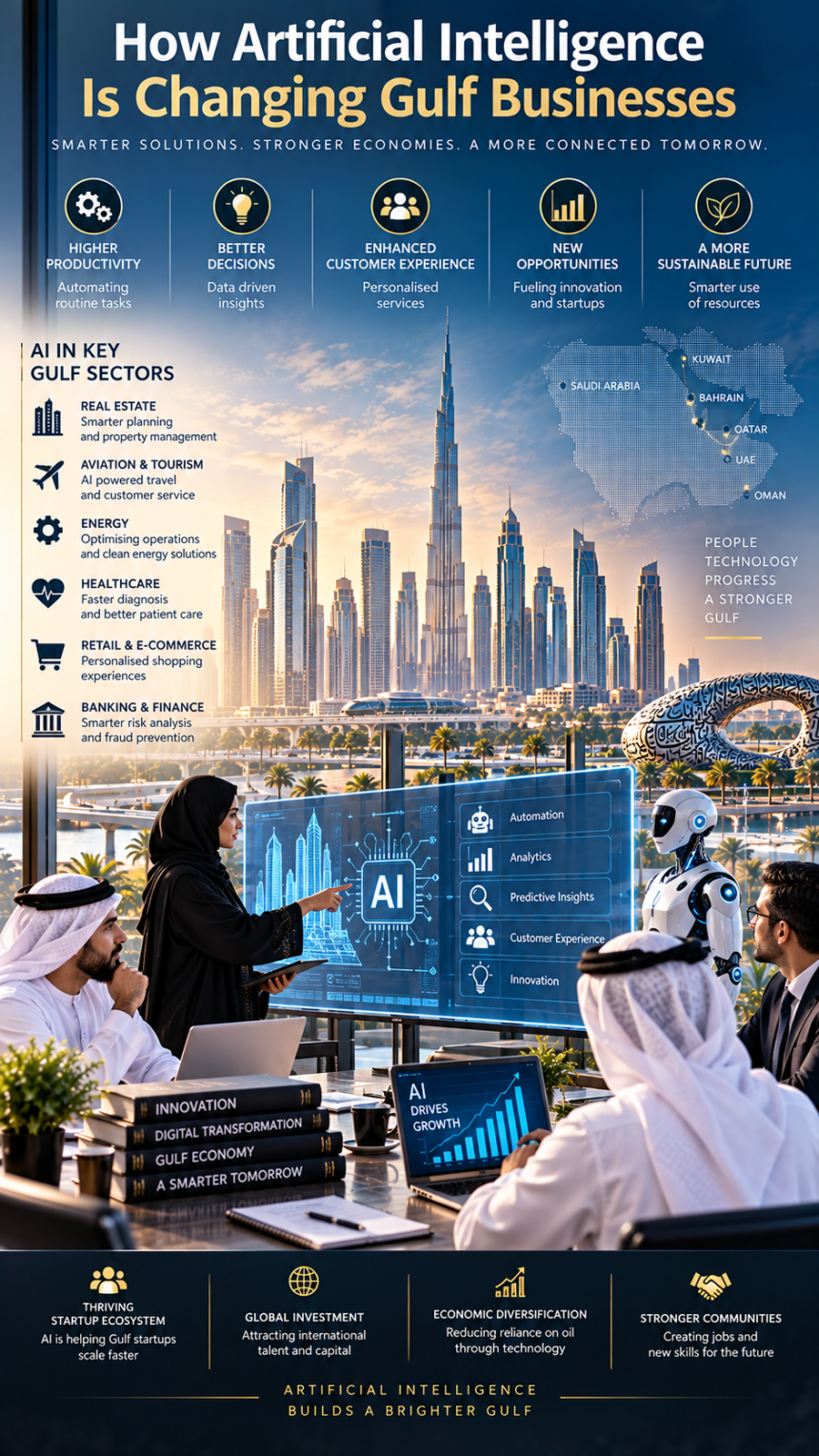
AI in Gulf Business is moving rapidly from experimentation to everyday commercial use. Companies across the UAE, Saudi Arabia, Qatar, Bahrain, Oman and Kuwait are increasingly using artificial intelligence to automate administrative work, analyse business data, communicate with customers, improve logistics, detect fraud and support employees.
- AI in Gulf Business and the New Digital Economy
- Why Artificial Intelligence Is Growing Across the GCC
- 1. Automating Repetitive Business Tasks
- 2. Transforming Customer Service
- 3. Improving Business Decisions With Data
- 4. Changing Marketing and Sales
- 5. Making Banking and Finance Smarter
- 6. Transforming Logistics and Supply Chains
- 7. Creating Smarter Factories
- 8. Changing Healthcare Businesses
- 9. Improving Recruitment and Workforce Management
- 10. Creating New AI Startups and Business Models
- 11. Strengthening Cybersecurity and Risk Management
- 12. Changing the Skills Gulf Employees Need
- Artificial Intelligence in the UAE
- Artificial Intelligence in Saudi Arabia
- Artificial Intelligence in Qatar
- Artificial Intelligence in Bahrain
- Artificial Intelligence in Oman
- Artificial Intelligence in Kuwait
- Industries Most Affected by AI in the Gulf
- AI Opportunities for Small and Medium Businesses
- Risks Businesses Need to Manage
- Building a Practical AI Strategy
- AI in Gulf Business Checklist
- The Future of Artificial Intelligence Across the GCC
- Final Thoughts on AI in Gulf Business
The change is happening at the same time as Gulf governments invest heavily in digital infrastructure, cloud computing, data centres, AI skills and technology companies. This means artificial intelligence is not developing as an isolated software trend. It is becoming part of wider economic strategies designed to create more productive, technology-driven and diversified economies.
The UAE’s National Strategy for Artificial Intelligence 2031, for example, aims to position the country among the world’s leading AI nations while encouraging adoption across both government and private-sector activities. Priority areas identified in the strategy include energy, logistics and transportation, tourism, healthcare and cybersecurity.
Saudi Arabia is following an equally ambitious path. Its National Strategy for Data and AI aims to build a globally competitive data-driven economy, while PIF-backed HUMAIN is developing capabilities across the AI stack, including data centres, cloud infrastructure, advanced models and applications.
For businesses, however, the most important question is much simpler: how can AI improve everyday operations and create measurable commercial value?
AI in Gulf Business and the New Digital Economy
Artificial intelligence can affect almost every department inside a modern company. Some applications are already practical for smaller businesses, while others require major investments in data, infrastructure and specialist talent.
| Business Area | How AI Is Being Used |
|---|---|
| Customer service | Chatbots, virtual assistants and automated support |
| Marketing | Content creation, targeting and campaign analysis |
| Sales | Lead scoring, forecasting and personalised offers |
| Finance | Fraud detection, forecasting and document processing |
| Logistics | Route planning, inventory and demand forecasting |
| Manufacturing | Predictive maintenance and quality control |
| Healthcare | Diagnostics, workflow support and medical data analysis |
| HR | Recruitment support and workforce analytics |
| Cybersecurity | Threat detection and unusual activity monitoring |
| Management | Data analysis, forecasting and decision support |
| Retail | Recommendations, pricing and inventory planning |
| Administration | Document summaries, translation and routine automation |
The strongest commercial results usually come from applying AI to a specific problem rather than introducing it simply because the technology is fashionable.
A logistics company may need better demand forecasting, while a hotel may want faster customer support. A manufacturer may gain more value from predictive maintenance, and a professional services company might begin with document analysis and administrative automation.
The technology is the same broad category, but the business case is completely different.
Why Artificial Intelligence Is Growing Across the GCC
The Gulf has several advantages that make rapid AI adoption possible. Governments are willing to invest, digital infrastructure is expanding, major corporations have capital available for transformation, and the region contains large sectors such as energy, aviation, logistics, finance and healthcare where data-driven technologies can create significant efficiencies.
The GCC is also actively discussing artificial intelligence at a regional level. Kuwait’s commerce minister highlighted AI and the digital economy among the areas that should form part of deeper Gulf economic integration, reflecting the technology’s growing importance beyond individual national strategies.
Another important factor is competition. Gulf cities increasingly compete for international technology companies, data centres, engineers, startups and investment. This encourages governments to improve regulation, infrastructure and incentives faster than they might otherwise.
Businesses benefit from this competition because it creates more cloud services, specialist suppliers, startup partners and skilled professionals throughout the region.
1. Automating Repetitive Business Tasks
One of the easiest ways for companies to begin using AI is to automate work that employees currently perform repeatedly.
Administrative teams spend significant amounts of time preparing reports, classifying documents, responding to routine emails, entering information and searching through internal files. Generative AI and intelligent automation can reduce some of this workload.
A company might use AI to prepare a first draft of a weekly report, summarise a long contract or organise customer enquiries before an employee reviews them. This does not necessarily eliminate the role of the employee. Instead, it can allow staff to spend more time on work requiring judgement and customer interaction.
The safest approach is usually human plus AI, rather than completely unsupervised automation. Employees remain responsible for checking accuracy, protecting confidential information and making final decisions.
For SMEs, this may be one of the most valuable opportunities because it does not always require building expensive custom AI systems.
2. Transforming Customer Service
Customer expectations across Gulf markets are increasing rapidly. People expect fast responses through websites, mobile applications, social media and messaging platforms, sometimes outside traditional working hours.
AI-powered customer service can help companies handle this demand.
A virtual assistant can answer common questions about:
- Business hours
- Delivery status
- Product availability
- Appointments
- Returns
- Account information
More advanced systems can identify customer intent, route complex enquiries to the correct department and help human agents find relevant information faster.
Bahrain already provides examples of AI-powered virtual-assistant development within government services, alongside intelligent document verification and automated response systems. Its AI roadmap also focuses on expanding AI adoption across both public and private sectors.
Businesses should nevertheless make it easy for customers to reach a human when the issue becomes complicated. A chatbot that traps an angry customer in endless automated replies can damage the customer experience rather than improve it.
3. Improving Business Decisions With Data
Companies generate enormous quantities of information through sales, invoices, websites, customer interactions, inventory and financial systems. The challenge is turning that information into useful decisions.
AI can identify patterns that would be difficult to detect manually.
A retailer might analyse purchase behaviour to predict which products will sell next month. A hotel group can examine booking patterns, seasonality and events to improve revenue planning, while a logistics company might forecast which routes will experience higher demand.
Bahrain’s current AI initiatives include an intelligent business and economic data analytics system, demonstrating how data analysis is becoming an important practical application of artificial intelligence.
However, AI cannot repair bad information automatically. If customer records are incomplete or different departments use inconsistent data, sophisticated models can produce unreliable results.
Good AI begins with good data management.
4. Changing Marketing and Sales
Marketing is one of the areas where businesses have adopted generative AI particularly quickly.
Teams can use AI to help prepare:
- Social media ideas
- Advertising concepts
- Email drafts
- Product descriptions
- Customer segments
- Campaign summaries
AI can also analyse customer behaviour and help companies personalise offers more precisely.
A property company might show customers different developments based on previous searches, while an e-commerce business can recommend products based on browsing and purchasing patterns.
The technology can improve speed considerably, but companies still need human brand judgement. Automatically generating hundreds of generic posts does not create a strong marketing strategy.
Another risk involves customer trust. Personalisation should not become intrusive, and businesses need to understand applicable privacy and data-protection requirements when analysing customer information.
The strongest marketing teams will likely use AI for speed and analysis while humans remain responsible for strategy, originality and brand identity.
5. Making Banking and Finance Smarter
Financial services are particularly suited to artificial intelligence because banks and financial companies process huge volumes of structured data.
AI can support:
- Fraud detection
- Credit analysis
- Compliance
- Customer service
- Risk monitoring
- Financial forecasting
- Document processing
Unusual transactions can be identified much faster than through purely manual review. Financial institutions can also automate parts of onboarding and document verification while maintaining human oversight for higher-risk decisions.
Bahrain’s Digital Economy Strategy specifically includes AI and emerging technologies as part of strengthening its position in finance and fintech, while the Central Bank’s regulatory sandbox provides an environment for testing innovative financial products.
Qatar’s current investment incentives similarly target financial technology and data-driven innovation as part of its economic strategy.
The financial sector also illustrates why responsible AI matters. Decisions involving credit, fraud investigations or customer accounts can have serious consequences, making explainability and governance particularly important.
6. Transforming Logistics and Supply Chains
The Gulf is one of the world’s major aviation, shipping and logistics regions, making supply chains an obvious area for AI investment.
Artificial intelligence can help logistics companies improve:
- Route planning
- Delivery schedules
- Inventory levels
- Warehouse management
- Fuel efficiency
- Demand forecasting
- Fleet maintenance
Imagine a distributor supplying hundreds of stores around the GCC. Instead of simply replenishing products according to last month’s sales, AI can combine seasonal patterns, promotional campaigns, store location and historical demand to predict what each branch is likely to need.
Qatar specifically includes automation and advanced logistics among the areas supported by its investment incentives programme.
The UAE’s national AI strategy also identifies logistics and transportation as priority sectors for AI transformation.
This is particularly important in a region where logistics is not only a domestic industry but also part of the Gulf’s wider role connecting Asia, Europe and Africa.
7. Creating Smarter Factories

Manufacturing is another sector where AI can create measurable financial value.
Industrial companies can use sensors and AI systems to monitor equipment continuously rather than waiting for machinery to fail. This approach, known as predictive maintenance, can identify warning signs before a serious breakdown occurs.
Artificial intelligence can also support quality control by analysing images of products and identifying defects more consistently than manual inspection alone.
Oman is actively encouraging this transformation through its Smart Production Factories project, which supports manufacturers adopting advanced industrial technologies including automation and artificial intelligence. The programme has included factory assessments, transformation planning and the development of local industrial digital capabilities.
AI can additionally improve energy management, production scheduling and supply-chain planning.
For Gulf countries trying to increase advanced manufacturing, these technologies are strategically important because they can help new factories compete on productivity rather than only on labour costs.
8. Changing Healthcare Businesses
Healthcare provides some of the most promising and sensitive AI applications.
Artificial intelligence can support medical imaging, diagnostic analysis, patient scheduling, hospital administration and clinical research. It can also help medical professionals review large quantities of information more efficiently.
Kuwait provides a practical regional example. Its Ministry of Health has been integrating AI into areas including medical imaging, surgery, research and hospital workflows, with the objective of improving diagnostic accuracy and operational efficiency.
The UAE also identifies healthcare as one of its priority sectors for AI transformation.
However, healthcare requires particularly strong safeguards. An inaccurate marketing recommendation might waste advertising money, while an inaccurate medical recommendation could affect someone’s health.
AI should therefore assist qualified medical professionals rather than replace clinical judgement where significant decisions are involved.
9. Improving Recruitment and Workforce Management
Artificial intelligence is changing how companies search for employees and manage large workforces.
Recruitment systems can help companies organise applications, identify relevant skills and communicate with candidates. HR teams can also use analytics to understand workforce trends such as turnover, absence patterns and training requirements.
However, companies need to be careful about allowing AI to make employment decisions automatically. Historical hiring data can contain bias, and an automated system may reproduce those patterns.
The better approach is to use AI to support recruiters while keeping humans responsible for final hiring decisions.
AI also creates an interesting contradiction for HR departments: the technology can automate some tasks while simultaneously creating demand for entirely new skills.
Companies increasingly need:
- Data specialists
- AI engineers
- Cybersecurity professionals
- AI product managers
- Governance specialists
- Employees who can work effectively with AI tools
Workforce development is therefore becoming as important as purchasing the technology itself.
10. Creating New AI Startups and Business Models
Artificial intelligence is not only changing existing companies. It is creating entirely new companies.
Gulf startups are developing AI solutions for Arabic language processing, finance, logistics, healthcare, real estate and enterprise software.
Saudi Arabia has taken an especially ambitious approach through HUMAIN, which was launched by PIF in May 2025 to operate across the entire AI value chain. Its activities include next-generation data centres, cloud services, models and applications, including the Arabic-focused ALLAM model developed with SDAIA.
PIF describes HUMAIN as part of Saudi Arabia’s effort to create local intellectual property, high-technology employment and a globally competitive AI ecosystem.
Qatar’s incentives programme is also actively seeking investment in artificial intelligence, cloud computing and cybersecurity, helping create an environment where technology firms can establish regional operations.
Over time, the most important Gulf AI companies may be those that solve problems specific to the region rather than simply copying international products.
11. Strengthening Cybersecurity and Risk Management
Artificial intelligence creates cybersecurity opportunities and cybersecurity risks at the same time.
Security teams can use AI to monitor networks, detect unusual behaviour and investigate threats faster than manual systems. This is useful because companies may process millions of digital events every day.
However, attackers can also use AI to create more convincing phishing messages, automate attacks and produce fake audio or images.
Cybersecurity therefore needs to develop alongside AI adoption.
The UAE includes cybersecurity among its priority AI sectors, while Bahrain’s AI policy places significant emphasis on secure and responsible deployment.
Kuwait has similarly emphasised the connection between cybersecurity, artificial intelligence and economic competitiveness as digital transformation accelerates.
Companies should not treat AI security as an IT department issue only. Boards and senior managers increasingly need to understand where AI systems access sensitive data and what happens if those systems fail or are compromised.
12. Changing the Skills Gulf Employees Need
The largest AI investment can fail if employees do not know how to use the technology.
Companies therefore need two types of skills. The first involves technical specialists who build and govern AI systems. The second involves ordinary employees who understand how to use AI effectively within their existing roles.
Bahrain has made AI skills a national priority. Its current initiatives include a programme targeting the training of 50,000 Bahrainis in AI by 2030, alongside more than 70 AI-related academic programmes and specialist talent initiatives.
Saudi Arabia’s national AI strategy similarly places talent, education and ecosystem development among its foundations.
The future workforce will not necessarily consist of everyone becoming an AI engineer. Accountants, marketers, lawyers, designers and managers will increasingly need to understand how to work with intelligent systems while recognising their limitations.
The competitive advantage will come from combining human expertise with technology.
Artificial Intelligence in the UAE
The UAE has been one of the Gulf’s earliest and most visible adopters of artificial intelligence.
Its National Strategy for Artificial Intelligence 2031 sets the ambition of becoming one of the world’s leading AI nations and identifies infrastructure, talent, governance, regulation and international collaboration as important foundations.
The strategy highlights several priority sectors:
- Energy and resources
- Logistics and transport
- Tourism and hospitality
- Healthcare
- Cybersecurity
The UAE also describes itself as a global digital-economy hub and continues encouraging investment in big data, advanced technology and artificial intelligence through modern infrastructure and business regulation.
For businesses, Dubai and Abu Dhabi provide particularly strong ecosystems involving technology companies, international investors, cloud providers, startups and major corporate customers.
The country’s next challenge is moving beyond experimentation and ensuring companies can demonstrate measurable productivity gains from AI adoption.
Artificial Intelligence in Saudi Arabia
Saudi Arabia is investing at much larger scale in AI infrastructure and localisation.
SDAIA’s National Strategy for Data and AI aims to position the Kingdom as an international leader in data-driven economic development and to create an ecosystem combining infrastructure, governance, incentives and practical applications.
The establishment of HUMAIN significantly expanded this ambition. The PIF-backed company is designed to operate across data centres, cloud computing, advanced models and AI applications while attracting international technology partnerships.
Saudi Arabia is also creating industrial opportunities around AI infrastructure itself. PIF investment materials identify opportunities in areas such as data-centre cooling, power systems and server infrastructure as domestic AI capacity expands.
This means AI is becoming more than a software industry in Saudi Arabia. It is creating demand across construction, manufacturing, energy infrastructure, cloud computing and professional services.
Artificial Intelligence in Qatar
Qatar is positioning artificial intelligence as part of a broader investment and digital-economy strategy.
Invest Qatar’s current incentives programme specifically targets investments in artificial intelligence, cybersecurity, cloud computing and data-driven innovation.
This is significant because international technology companies deciding where to establish regional operations increasingly compare Gulf markets based on infrastructure, incentives, access to customers and government support.
AI can also support sectors where Qatar already possesses strong economic advantages, including energy, aviation, logistics, finance and major infrastructure.
For businesses, the opportunity lies both in adopting AI internally and in supplying AI solutions to companies and government organisations undergoing digital transformation.
Artificial Intelligence in Bahrain
Bahrain is developing a particularly strong framework around responsible AI adoption.
The country launched its National Policy for the Use of Artificial Intelligence in July 2025 and adopted the GCC Guiding Manual on the Ethical Use of AI. The policy is intended to support economic growth and government efficiency while maintaining security, transparency and responsible data practices.
By mid-2026, Bahrain was also developing its broader National AI Strategy while expanding skills programmes, applied research and public-private collaboration.
The country’s financial-services ecosystem creates particularly strong opportunities around fintech, regulatory technology and data analysis.
Bahrain’s relatively compact market can also make it an effective location for pilot projects before technologies are expanded to larger GCC markets.
Artificial Intelligence in Oman
Oman’s AI development is closely connected with industrial and business digitalisation.
The country’s Ministry of Commerce identifies artificial intelligence, cloud computing and cybersecurity as growth areas within the ICT sector.
Its Smart Production Factories initiative is helping manufacturers evaluate readiness for advanced industrial technologies and prepare digital-transformation plans.
Oman is also expanding AI within investor services. Government plans include greater use of artificial intelligence and machine learning in digital business platforms to provide proactive assistance, investment guidance and personalised information to entrepreneurs.
For Oman, AI can be particularly useful in industries connected with logistics, ports, manufacturing, energy, tourism and natural resources.
Artificial Intelligence in Kuwait
Kuwait’s AI development is increasingly connected with its wider digital transformation and Vision 2035 objectives.
In March 2025, Kuwait signed a strategic partnership with Microsoft designed to accelerate digital transformation and expand artificial intelligence applications while supporting economic diversification, entrepreneurship and innovation.
The oil sector is already providing practical examples. Kuwait Oil Company established an Artificial Intelligence Innovation Center in 2025 to use advanced technologies to reduce costs, improve decision-making and strengthen operational efficiency.
Kuwait National Petroleum Company subsequently launched an executive digital-transformation programme involving 24 initiatives, with artificial intelligence and data-based working methods forming part of the strategy.
Kuwait Chamber has also been examining AI readiness in the private sector. Its current guidance notes that many SMEs still face challenges around data readiness, skills, governance and financial capacity when moving from experimentation to sustainable AI adoption.
Industries Most Affected by AI in the Gulf
Some GCC industries are likely to experience AI transformation earlier than others because they generate large quantities of data or already invest heavily in technology.
| Industry | Major AI Opportunity |
|---|---|
| Banking | Fraud detection and customer analytics |
| Energy | Predictive maintenance and operational optimisation |
| Retail | Personalisation and demand forecasting |
| Logistics | Routing and supply-chain planning |
| Aviation | Operations, maintenance and customer service |
| Healthcare | Diagnostics and hospital efficiency |
| Manufacturing | Smart factories and quality control |
| Real estate | Pricing, customer matching and property management |
| Tourism | Personalised visitor services |
| Government services | Automation and intelligent assistants |
| Professional services | Research and document analysis |
| Cybersecurity | Faster threat detection |
The greatest transformation may occur where AI connects with industries the Gulf already does particularly well. AI applied to energy, logistics, finance and aviation can create local expertise that may later be exported internationally.
AI Opportunities for Small and Medium Businesses
AI is not only for large corporations with enormous technology budgets.
Modern cloud-based tools give SMEs access to capabilities that previously required dedicated technical teams.
A small business can begin by using AI for practical tasks such as customer-service drafts, document summaries, translation, sales analysis or internal knowledge searches.
The key is to begin with a clear business problem.
A useful approach is:
- Identify one repetitive or expensive process.
- Measure how much time or money it currently requires.
- Test an AI-assisted workflow with a small team.
- Keep human review in place.
- Measure the actual improvement.
- Expand only if the results justify it.
Kuwait Chamber’s current AI-readiness work highlights exactly why this structured approach matters. SMEs can struggle with data quality, skills and governance even when AI tools themselves are widely available.
Buying software is easy. Integrating it successfully into a business is much harder.
Risks Businesses Need to Manage
Artificial intelligence creates commercial opportunities, but companies should not underestimate the risks.
Incorrect information is one of the most immediate problems. Generative AI systems can produce confident answers that are factually wrong, making human verification essential for important work.
Data privacy is another concern. Employees should not automatically upload confidential company documents, client information or sensitive financial records into public AI systems.
Cybersecurity risks can grow as more systems become connected, while bias can create problems when AI influences hiring, lending or other decisions affecting people.
Businesses also need to think about intellectual property. AI-generated material can create questions around ownership, originality and use of third-party material.
A basic governance framework should therefore define:
| Risk | Business Response |
|---|---|
| Inaccurate outputs | Require human verification |
| Confidentiality | Set clear rules for sensitive data |
| Cybersecurity | Control system access and monitoring |
| Bias | Review high-impact decisions |
| Legal compliance | Check applicable local regulations |
| Vendor dependence | Understand where data is stored |
| Employee misuse | Provide training and policies |
| Reputation | Do not automate sensitive communication blindly |
Responsible adoption is not an obstacle to innovation. It is what allows companies to use AI at larger scale safely.
Building a Practical AI Strategy
Businesses do not need a hundred-page AI strategy before experimenting, but they do need more than a collection of random software subscriptions.
A practical strategy begins with business objectives.
Management should ask where the company loses the most time, where customers experience delays, where forecasting is weak and where employees perform repetitive work.
The next step is prioritisation. Projects should be ranked according to expected commercial benefit, technical difficulty and risk.
A useful framework is:
High value + low risk: implement first.
High value + high risk: test carefully with strong governance.
Low value + low risk: experiment only if inexpensive.
Low value + high risk: avoid.
Companies should also define who owns each AI system, who verifies results and how performance will be measured.
Without those responsibilities, AI projects can remain interesting experiments without ever improving profitability.
AI in Gulf Business Checklist
Before expanding AI across a GCC company, management should review the following points:
- Define the business problem before selecting technology.
- Identify measurable targets such as time saved or reduced costs.
- Review the quality of existing company data.
- Decide which information must remain confidential.
- Check local privacy and regulatory requirements.
- Start with a controlled pilot rather than company-wide deployment.
- Keep human review for important decisions.
- Train employees on both capabilities and limitations.
- Create clear rules around generative AI use.
- Review cybersecurity before connecting AI to sensitive systems.
- Understand where third-party AI providers store data.
- Check contracts and intellectual-property terms.
- Measure results after implementation.
- Stop projects that do not create measurable value.
- Update workflows instead of simply adding AI on top of inefficient processes.
- Build internal AI knowledge rather than relying completely on suppliers.
- Review systems regularly as technology and regulations change.
The most important item is measurement. If management cannot explain whether a project saved money, improved revenue or increased service quality, it may not be creating genuine business value.
The Future of Artificial Intelligence Across the GCC
The next stage of Gulf AI development is likely to move beyond simple chatbots and content generation.
Businesses will increasingly use systems that can perform several connected tasks, analyse company information and interact with business software. These more autonomous AI agents could change administrative workflows significantly.
Industrial AI is likely to become more important as Saudi Arabia, the UAE and Oman expand manufacturing and advanced industries. Finance and healthcare will continue developing specialised applications, while logistics companies may increasingly combine AI with robotics and automated warehouses.
Infrastructure will become another major sector in its own right. Saudi Arabia’s investment in HUMAIN demonstrates how demand for AI can create opportunities in data centres, cloud computing, server infrastructure, cooling systems and electricity supply rather than only software.
At the same time, regulation and governance will become more important. Bahrain’s national policy and the wider GCC ethical framework already demonstrate that Gulf governments want AI adoption to develop alongside responsible-use standards.
The winners are unlikely to be companies that simply adopt the largest number of AI tools. They will be businesses that use the technology to improve specific processes while maintaining trust, security and human accountability.
Final Thoughts on AI in Gulf Business
AI in Gulf Business is beginning to influence almost every major sector of the regional economy. The technology is helping companies automate repetitive tasks, analyse data, improve customer service, optimise logistics and develop entirely new products.
The UAE has positioned AI at the centre of its long-term technology strategy, with a national objective of becoming a leading AI economy by 2031 and priority applications across sectors including logistics, healthcare and cybersecurity.
Saudi Arabia is investing at much greater infrastructure scale through SDAIA’s national strategy and HUMAIN, which is building capabilities across data centres, cloud infrastructure, AI models and commercial applications.
Qatar is actively attracting AI companies through investment incentives targeting artificial intelligence, cybersecurity, cloud computing and data-driven technology.
Bahrain has created a national AI policy, is developing a broader national strategy and aims to train 50,000 Bahrainis in AI by 2030.
Oman is connecting AI with industrial transformation, investor services and the growth of its digital economy, while Kuwait is applying the technology in areas ranging from energy to healthcare and has strengthened its wider digital strategy through international technology partnerships.
The next challenge is turning this enthusiasm into measurable productivity.
Businesses should not introduce artificial intelligence simply because competitors are talking about it. They should identify expensive, slow or repetitive processes and determine whether AI can genuinely improve them.
That means starting with business problems rather than technology.
Companies also need to remember that AI does not eliminate the importance of people. Employees still provide judgement, relationships, creativity, accountability and understanding of local markets. Those human capabilities become even more important when technology can produce information extremely quickly.
The most successful Gulf businesses are therefore likely to follow a hybrid model. Artificial intelligence will handle more analysis and routine execution, while people remain responsible for strategy, trust and important decisions.
That combination could become one of the strongest drivers of productivity and business transformation across the GCC over the coming decade.
Do follow us on Instagram
Read More – Gulf Startup Culture: 12 Powerful Drivers of Entrepreneurial Success