

Arabian Gulf Trade History and the Origins of Maritime Commerce
Arabian Gulf Trade History stretches back thousands of years before modern skylines, container terminals, airports or oil exports transformed the region. Long before Dubai became an international business centre or Gulf energy shipments became important to the global economy, communities along these shores were already participating in commercial networks linking Mesopotamia, the Arabian Peninsula, India, East Africa and later China and the Mediterranean.
- Arabian Gulf Trade History and the Origins of Maritime Commerce
- Why Geography Made the Gulf a Natural Trading Region
- 1. Bronze Age Trade Connected Mesopotamia, Arabia and the Indus Valley
- 2. Dilmun Became an Ancient Commercial Centre
- 3. Magan Supplied Copper to the Ancient World
- 4. Gulf Trade Expanded Through the Classical and Early Islamic Eras
- 5. Islamic Maritime Networks Connected the Gulf With Asia and Africa
- 6. Qalhat and Julfar Became Powerful Medieval Ports
- 7. Hormuz Controlled One of the World’s Most Important Sea Routes
- 8. Portuguese Expansion Changed Gulf Maritime Politics
- 9. Dhows Connected Arabia With India and East Africa
- 10. Pearling Became a Foundation of the Gulf Economy
- 11. Oil Changed the Scale of Gulf Trade
- 12. Modern Ports Turned the Gulf Into a Global Logistics Hub
- Important Goods Traded Through the Arabian Gulf
- The Role of Bahrain in Gulf Trade
- The Role of Oman in Gulf Trade
- The Role of the UAE in Gulf Trade
- The Role of Qatar in Gulf Trade
- The Role of Kuwait in Gulf Trade
- How Trade Shaped Gulf Cities and Society
- From Pearling Ports to Global Commercial Centres
- Arabian Gulf Trade History Timeline
- Why the Gulf Remains Important to World Trade
- Final Thoughts on Arabian Gulf Trade History
Archaeology shows that the Gulf was not an isolated desert coastline. Its islands, ports and coastal settlements became important exchange points because maritime transport could connect distant civilisations more efficiently than many dangerous overland routes. Bahrain’s ancient Dilmun civilisation, Oman’s copper-producing Magan region, the trading settlements of the modern UAE and Kuwait’s Failaka Island all participated in networks that existed thousands of years ago. UNESCO describes ancient Dilmun as an important commercial hub linking Mesopotamia with the Indus Valley, while archaeological evidence from Oman shows that Magan exported copper to Mesopotamia by the late third millennium BCE.
The products changed over time, but the fundamental role of the Gulf remained remarkably consistent. Copper, pearls, dates, incense, horses and textiles were eventually joined by oil, petrochemicals, manufactured goods, financial services and containerised cargo.
The modern Gulf’s importance to international trade is therefore not a completely new development. It is the latest phase of one of the world’s oldest continuing traditions of maritime exchange.
Arabian Gulf Trade History and the Origins of Maritime Commerce
Understanding Gulf trade requires looking beyond today’s national borders. Ancient merchants did not operate within the political map that defines the GCC today. They moved between ports, islands and commercial centres according to access to water, markets, resources and safe maritime routes.
Bahrain’s Qal’at al-Bahrain provides one of the clearest archaeological records. The site contains evidence of occupation from around 2300 BCE through the Islamic and later periods. UNESCO identifies it as the ancient harbour and capital of Dilmun and describes its role in linking Mesopotamia and the Indus Valley during early periods and later connecting trade toward China and the Mediterranean.
Failaka Island in modern Kuwait provides another important piece of the story. Archaeological evidence shows that the island formed part of the Dilmun commercial world and occupied a strategic maritime position connecting Mesopotamia with the wider Gulf. UNESCO’s tentative-list documentation notes encounters between Mesopotamian, Harappan, Magan and Iranian trading cultures on the island.
These sites show that trade was not an occasional activity. It helped shape settlements, political power and social organisation.
Why Geography Made the Gulf a Natural Trading Region
The Gulf sits between some of the world’s oldest centres of civilisation.
To the north lay Mesopotamia. To the east were Persia and the routes leading toward the Indus Valley and India. Oman provided access toward the Arabian Sea and wider Indian Ocean, while inland routes connected coastal settlements with the Arabian Peninsula.
Sea travel could often move heavier cargo more efficiently than caravans crossing difficult desert terrain.
This explains why ports and islands became commercially important even when their local populations were relatively small. A strategically positioned settlement could prosper by storing, transferring, taxing and redistributing goods travelling between larger markets.
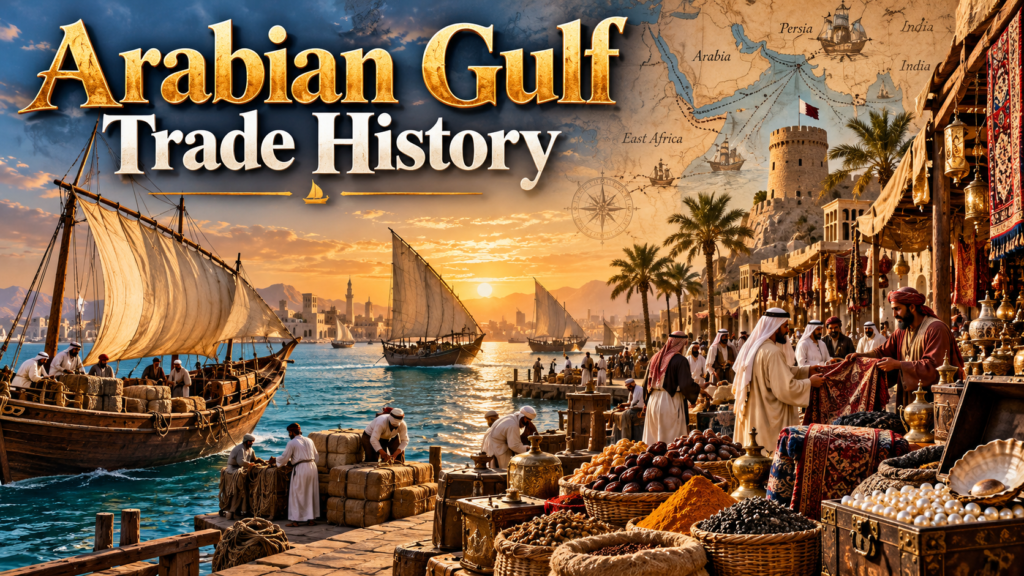
That basic geographic advantage survived every technological change that followed. Sailing ships became steamships and eventually container vessels, but the Gulf remained positioned between major Asian, African and European commercial zones.
Modern ports did not create this geographic advantage. They industrialised something merchants had understood for thousands of years.
1. Bronze Age Trade Connected Mesopotamia, Arabia and the Indus Valley
By the third millennium BCE, maritime trade already connected several sophisticated societies around the Gulf and Indian Ocean.
Mesopotamian records referred to regions known as Dilmun, Magan and Meluhha. These names are generally associated with Bahrain and the wider Gulf, the Oman Peninsula and the Indus civilisation respectively.
Archaeological evidence from India’s Dholavira confirms that Harappan trade extended toward Magan and Mesopotamia. The city was strategically connected with sources of copper, shell, stone and other materials and participated in external commercial networks.
On the Arabian side, Umm an-Nar in modern Abu Dhabi provides evidence of similar connections. UNESCO documentation describes the settlement as an important fishing and trading post and notes archaeological evidence linking Arabia with Mesopotamia, Baluchistan and the Indus Valley. Copper was one of the central commodities within these third-millennium networks.
Trade therefore existed across extraordinary distances long before modern navigation.
Goods moved because different regions possessed different resources. Mesopotamian cities needed materials that were unavailable locally, while communities around the Gulf gained access to manufactured goods, agricultural products and other commodities through exchange.
2. Dilmun Became an Ancient Commercial Centre
Dilmun occupies a central position in the early history of Gulf trade.
Its strategic importance came partly from geography. Bahrain sat between southern Mesopotamia and maritime routes extending through the Gulf toward Oman and the Indus Valley.
Qal’at al-Bahrain became a major centre of this system. UNESCO describes Dilmun as one of the most important ancient civilisations of the region and identifies its capital as a commercial hub linking maritime trade with local agriculture.
Dilmun’s value was not necessarily based on producing every commodity that passed through it. Its power came partly from acting as an intermediary.
This is an economic model that appears repeatedly throughout Gulf history. Ports prosper by becoming places where goods arrive, are stored, exchanged and redistributed.
Failaka Island demonstrates how widely the Dilmun commercial network extended. Located near the northern Gulf, it connected maritime routes with Mesopotamian markets and provided an important point within the movement of goods between ancient civilisations.
Modern transshipment hubs may use container cranes instead of ancient vessels, but the commercial logic is surprisingly similar.
3. Magan Supplied Copper to the Ancient World
Oman played another major role through the ancient region known as Magan.
Copper was among the most valuable industrial materials of the Bronze Age. When combined with tin, it could be used to manufacture bronze tools and weapons.
UNESCO’s description of the archaeological sites of Bat, Al-Khutm and Al-Ayn states that Mesopotamian cuneiform records identified Magan as an important copper-extraction centre by the late third millennium BCE. The metal was exported toward Mesopotamia and possibly the Indus Valley.
This trade had consequences beyond commerce.
Archaeological evidence at Bat indicates growing social complexity and higher living standards connected with long-distance exchange. Trade was helping transform local societies thousands of years before oil wealth would create another dramatic economic shift.
The Oman Peninsula therefore provides an early example of a pattern that continues in the Gulf today: natural resources entering international markets while trade revenues support wider economic and social development.
The resource was copper rather than petroleum, but the relationship between geography, commodities and external demand was already clearly visible.
4. Gulf Trade Expanded Through the Classical and Early Islamic Eras
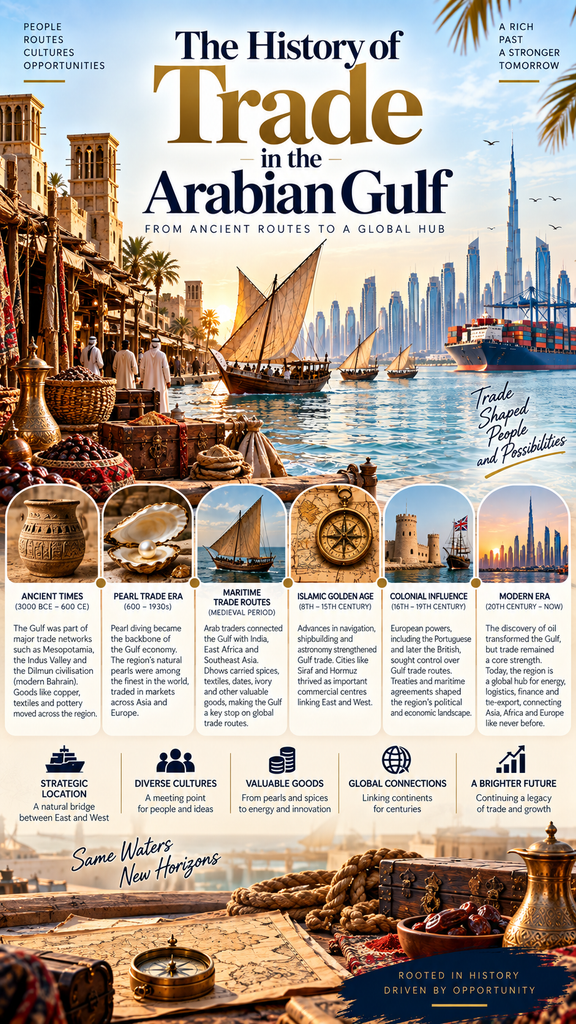
Trade networks changed as political powers rose and fell, but commercial exchange around the Gulf continued.
Bahrain remained connected to wider international markets long after the peak of Dilmun. UNESCO records commercial links from the region toward China and the Mediterranean during later historical periods.
Pearls also became increasingly important. Gulf waters contained rich natural oyster beds, creating a commodity that could be transported easily and sold at high value across distant luxury markets.
Qatar’s historical records show how old this relationship was. Visit Qatar notes evidence of pearls dating deep into prehistory and describes pearl trading relationships that eventually connected the peninsula with India, Persia, the Ottoman world, Europe, Asia and North America.
As Islam spread from the Arabian Peninsula during the seventh century, new political and commercial connections strengthened links between the Gulf, Iraq and the broader Islamic world.
The Indian Ocean became one of the great commercial spaces of the medieval period, and Gulf merchants participated actively within it.
5. Islamic Maritime Networks Connected the Gulf With Asia and Africa
The rise of major Islamic cities created strong demand for luxury goods, food, textiles and raw materials.
Basra became an important northern Gulf gateway, while ports farther south connected ships heading toward India, East Africa and Southeast Asia.
Maritime commerce depended on knowledge of seasonal winds. Indian Ocean sailors understood monsoon patterns and could time voyages so winds helped carry ships between Arabia and India before reversing for the return journey.
Ports throughout Oman benefited especially from this wider Indian Ocean system.
Oman’s Land of Frankincense demonstrates the relationship between inland production and maritime trade. UNESCO identifies Khor Rori and later Al-Baleed as major ports through which frankincense and other products entered international commercial routes. Finds from China at Al-Baleed demonstrate how extensive those connections eventually became.
Trade was not simply moving products. Sailors, merchants and migrants also carried languages, food traditions, technologies and religious ideas.
Gulf port cities became culturally diverse precisely because commerce brought different societies into repeated contact.
6. Qalhat and Julfar Became Powerful Medieval Ports
Several important Arabian ports flourished during the medieval period.
One was Qalhat on Oman’s eastern coast. Between roughly the 11th and 15th centuries, it developed into a major commercial centre under the princes of Hormuz.
UNESCO describes Qalhat as a trade centre connecting Arabia with India, East Africa, China and Southeast Asia. Its exports included horses, dates, incense and pearls, while archaeological finds demonstrate the cosmopolitan character of the city.
Another important centre was Julfar, associated with present-day Ras Al Khaimah.
UNESCO’s tentative listing for Julfar describes it as a major Gulf trading centre and pearl-fishing hub with commercial connections extending across the Indian Ocean to East Africa and Southeast Asia. Archaeologists have found Chinese Ming porcelain and Southeast Asian ceramics, providing physical evidence of these long-distance connections.
Julfar also illustrates how environmental conditions influenced trade. As coastal lagoons silted up, commercial activity shifted between different harbour locations.
Successful ports therefore needed more than merchants. Geography, water access and safe anchorage directly influenced which cities prospered.
7. Hormuz Controlled One of the World’s Most Important Sea Routes
The Kingdom of Hormuz became one of the most powerful commercial systems in the medieval Gulf.
Its influence grew partly because of its ability to control trade around the Strait of Hormuz, the narrow maritime entrance connecting the Gulf with the Arabian Sea.
Qalhat operated as an important Arabian centre within this wider kingdom. UNESCO describes it as a trade hub that benefited enormously from its geopolitical position and served as a secondary capital of Hormuz.
Commercial networks extended to India, China, Southeast Asia and East Africa.
Arabian horses were especially valuable exports. Dates, pearls and incense also moved through the system, while imported ceramics, textiles and luxury products arrived from Asia.
Hormuz demonstrated an important principle that remains relevant today: controlling the infrastructure and geography through which trade passes can create enormous economic power even when many of the goods originate somewhere else.
Ports, customs revenues and shipping routes became sources of political influence.
8. Portuguese Expansion Changed Gulf Maritime Politics
European involvement in Gulf maritime trade increased dramatically after Portuguese sailors established a sea route around Africa to India at the end of the 15th century.
Portugal wanted greater control over the commercial routes connecting Europe with Asian markets.
This brought military pressure to existing Gulf trading centres.
Qalhat was attacked during Portuguese expansion and eventually declined. UNESCO records that Portuguese attacks contributed to the city’s abandonment during the 16th century.
Portuguese influence also extended through Hormuz and other Gulf locations. Qatar’s historical account notes that Portuguese forces and merchants became involved in regional competition during the 16th and early 17th centuries as they attempted to influence maritime trade.
European intervention did not create Gulf trade. It was largely motivated by a desire to gain access to commercial systems that already existed.
The arrival of Portuguese naval power therefore marked a new political phase rather than the beginning of international commerce.
9. Dhows Connected Arabia With India and East Africa
Traditional wooden sailing vessels commonly described as dhows became one of the great symbols of Gulf maritime commerce.
Different vessel types were built for different routes and cargoes, but together they supported an extensive network connecting Gulf ports with India, East Africa and other parts of the Indian Ocean.
Merchants transported dates, pearls and regional products outward while bringing textiles, timber, spices, rice and other goods back toward Arabia.
These voyages helped create relationships that remain visible in Gulf society.
South Asian communities, East African connections, food traditions, architecture and vocabulary all reflect centuries of commercial interaction around the Indian Ocean.
The dhow economy also required substantial knowledge.
Sailors needed to understand winds, stars, coastlines and seasonal weather. Shipbuilders needed access to suitable timber and generations of practical craftsmanship.
Maritime trade was therefore supported by an entire economy of captains, merchants, sailors, craftsmen, financiers and port workers.
10. Pearling Became a Foundation of the Gulf Economy
Before oil, natural pearls were among the most important exports produced along the Arabian Gulf.
Pearling supported communities in Bahrain, Qatar, Kuwait and the coastal emirates of what became the UAE. Divers spent long periods at sea during demanding seasonal expeditions, while merchants financed fleets and sold valuable pearls into international markets.
Bahrain became particularly famous.
UNESCO describes its pearling heritage as the last complete surviving example of an island economy shaped by the industry. The Gulf pearl trade reached exceptional prosperity during the late 19th and early 20th centuries, with wealth from the trade reflected in Muharraq’s merchant houses, stores and urban development.
Qatar’s history followed a similar pattern. Pearls became an important export and reached markets in India, Persia and the Ottoman world before expanding toward Europe, Asia and North America.
The industry supported far more than divers.
It involved boat owners, captains, merchants, financiers, rope makers, shipbuilders and traders. Entire coastal communities depended on the annual pearling cycle.
This made the collapse particularly painful.
During the 1930s, cheaper cultured pearls developed in Japan severely damaged demand for natural Gulf pearls. UNESCO describes the resulting decline in Bahrain as sudden and catastrophic for the traditional pearling economy.
11. Oil Changed the Scale of Gulf Trade
The decline of pearling occurred around the same period that another commodity was beginning to transform Gulf economies: petroleum.
Oil did not create the region’s commercial culture, but it radically increased the scale of capital available for development.
Export infrastructure, roads, ports, electricity systems and modern cities expanded as petroleum revenues increased.
Qatar provides a clear example of the transition. Oil was first struck there in 1939, during a period when the pearling economy was already suffering severe difficulties. Commercial benefits became much more visible after exports developed in the following years.
Dubai’s path shows how trade remained important even alongside oil. The UAE Government notes that Dubai Creek had already made the city a centre for fishing, pearling and maritime trade and that Dubai had become a successful port city by the beginning of the 20th century. Oil exports beginning in 1969 then financed a new period of development.
This distinction is important.
Oil revenues helped modernise Gulf economies, but several Gulf cities already possessed strong merchant traditions and maritime commercial cultures before petroleum.
12. Modern Ports Turned the Gulf Into a Global Logistics Hub
The final major transformation came with industrial-scale ports, container shipping and aviation.
Instead of moving cargo mainly through traditional wooden vessels, modern Gulf states built ports capable of handling enormous international container and bulk shipments.
Dubai developed from a Creek-centred port economy into one of the world’s major commercial and re-export centres. The same basic advantage that had benefited ancient Dilmun and medieval Hormuz was being used again: strategic geography combined with infrastructure.
Elsewhere, Saudi Arabian Gulf ports, Bahrain, Qatar and Kuwait developed major commercial facilities, while Oman’s Sohar, Salalah and Duqm strengthened connections between Arabia and global maritime routes.
The Gulf trading model also expanded beyond physical goods.
Modern commerce now includes:
- Financial services
- Aviation
- Tourism
- Technology
- Professional services
- E-commerce
- Digital trade
This evolution represents continuity rather than complete replacement. Gulf economies are still earning value by connecting markets, but the tools and scale have changed dramatically.
Important Goods Traded Through the Arabian Gulf
Different periods of Gulf history can often be understood through the commodities that moved across the region.
| Period | Important Trade Goods |
|---|---|
| Bronze Age | Copper, stone, shell and manufactured goods |
| Ancient Dilmun | Copper and goods moving between Mesopotamia and the Indus |
| Classical era | Pearls, incense, dates and luxury products |
| Medieval era | Horses, dates, pearls, spices, ceramics and incense |
| Early modern period | Pearls, textiles, spices, dates and timber |
| 19th and early 20th centuries | Pearls, dates, textiles and re-exported goods |
| Oil era | Crude oil, fuels and petroleum products |
| Modern economy | Petrochemicals, containers, manufactured goods and services |
The table demonstrates a remarkable ability to adapt.
Trade did not disappear when one commodity became less important. New products and markets replaced older ones.
This flexibility is one reason maritime commerce remained central to Gulf economic life across such a long historical period.
The Role of Bahrain in Gulf Trade
Bahrain occupies one of the longest continuously documented positions in Gulf commercial history.
Its ancient Dilmun civilisation became a commercial intermediary between Mesopotamia and wider maritime networks thousands of years ago. Qal’at al-Bahrain preserves archaeological evidence of that role across several historical eras.
Centuries later, pearling again made Bahrain globally significant.
Merchant families accumulated wealth from natural pearls, while Muharraq developed commercial buildings and houses directly connected with the industry. UNESCO states that Gulf pearling reached its greatest prosperity around the end of the 19th and beginning of the 20th centuries.
Bahrain therefore represents an extraordinary example of commercial continuity.
The products changed, but the island repeatedly used its geographic position and maritime knowledge to participate in international trade.
The Role of Oman in Gulf Trade
Oman’s commercial history combines mineral resources, incense, maritime trade and strategic ports.
Ancient Magan supplied copper to Mesopotamian markets. Dhofar later became internationally important through frankincense, which moved through ports such as Khor Rori and Al-Baleed toward distant markets.
During the medieval period, Qalhat became one of the most important commercial cities on the eastern Arabian coast. It connected Arabia with India, China, Southeast Asia and East Africa and became especially important in the trade of horses, dates, incense and pearls.
This combination explains why Oman should not be viewed only through the Gulf itself.
Its coastline also faces directly toward the Arabian Sea and Indian Ocean, giving Omani merchants access to maritime worlds stretching far beyond the Strait of Hormuz.
The Role of the UAE in Gulf Trade
Trade has deep archaeological roots in the territory of the modern UAE.
Umm an-Nar provides evidence of Bronze Age exchange connected with copper and maritime networks extending toward Mesopotamia and the Indus region.
During the Islamic era, Julfar became one of the most important trading and pearling centres on the southern Gulf coast, with commercial connections reaching China, Southeast Asia and East Africa.
Dubai later developed around another natural maritime advantage: the Creek.
The Creek served as a harbour supporting fishing, pearling and trade, helping Dubai emerge as a successful port city before the oil era.
The modern UAE’s position in aviation, logistics and re-export trade therefore builds upon commercial patterns that existed on this coastline long before the federation was established.
The Role of Qatar in Gulf Trade
Qatar’s historic economy was closely connected with the sea.
Pearls became one of its major commercial products, while coastal settlements participated in wider Gulf maritime networks.
Visit Qatar records that pearl trading linked Qatar with India, Persia and the Ottoman world before the industry expanded further into European, Asian and North American markets during its boom years.
The 1930s brought severe economic pressure as cultured pearls weakened the traditional industry. The beginning of petroleum exploration then opened another economic chapter, with oil discovered in 1939 and exports contributing to economic recovery after World War II.
Qatar’s history therefore reflects the larger Gulf transition from pearling and maritime commerce to hydrocarbon exports and eventually a diversified international economy.
The Role of Kuwait in Gulf Trade
Kuwait’s location near the northern end of the Gulf placed it close to trade routes leading toward Mesopotamia.
Failaka Island shows that these connections stretch back thousands of years. As part of the wider Dilmun world, the island linked Gulf shipping with Mesopotamian civilisation and preserves archaeological evidence of contacts with communities from Magan and the Indus Valley.
In later centuries, Kuwait became known for maritime trade and shipbuilding, with merchant vessels travelling into the Indian Ocean.
Trade linked Kuwait with ports in India and East Africa while its position near Iraq helped connect maritime shipping with northern regional markets.
Like other Gulf societies, Kuwait later experienced enormous transformation through oil, but merchant traditions remained an important part of its commercial identity.
How Trade Shaped Gulf Cities and Society
Trade did more than create wealth. It influenced how Gulf communities were organised.
Merchant families became economically influential. Shipbuilding and sailing created specialist occupations, while pearl merchants and financiers developed systems for funding long maritime expeditions.
Markets developed around ports because imported goods needed places where they could be bought and sold.
Trade also created cultural diversity.
Ports naturally attracted sailors and merchants from different backgrounds. Medieval Qalhat contained Arab, Persian, Indian and African communities, demonstrating how commercial centres could become cosmopolitan long before the modern era.
Modern Gulf cities remain highly international for a similar reason.
Commercial opportunity attracts people.
From Pearling Ports to Global Commercial Centres
The physical appearance of Gulf trade has changed almost beyond recognition.
A pearl diver leaving Muharraq or Doha a century ago would struggle to imagine today’s container ports, cargo aircraft and automated warehouses.
Yet the economic function remains familiar.
The Gulf still connects producers and consumers across continents.
Ancient Dilmun transferred goods between Mesopotamia and the Indus. Medieval Qalhat connected Arabia with India, China and East Africa. Dubai today performs a comparable intermediary role at vastly greater scale.
This continuity explains why historical trade matters when trying to understand today’s Gulf economy.
Modern commercial success did not emerge from an empty landscape. It grew in societies where maritime trade had shaped livelihoods and political relationships for centuries.
Arabian Gulf Trade History Timeline
| Period | Major Trade Development |
|---|---|
| 5th to 3rd millennium BCE | Early exchange develops between Arabia and Mesopotamia |
| 3rd millennium BCE | Dilmun and Magan become major parts of Bronze Age trade |
| 2300 BCE onward | Qal’at al-Bahrain develops as an important trading port |
| Ancient and classical periods | Pearls, incense and regional goods expand in importance |
| 7th century onward | Islamic maritime networks connect Gulf ports with wider markets |
| 11th to 15th centuries | Qalhat flourishes under the Kingdom of Hormuz |
| Medieval Islamic period | Julfar becomes a major trading and pearling centre |
| 16th century | Portuguese naval expansion reshapes regional power |
| 18th and 19th centuries | European influence and Indian Ocean trade increase |
| Late 19th to early 20th centuries | Natural pearling reaches exceptional prosperity |
| 1930s | Cultured pearls contribute to collapse of traditional pearl economy |
| Mid-20th century | Oil exports transform Gulf economies |
| Late 20th century onward | Modern ports, aviation and logistics create global hubs |
The dates simplify a highly complex history, but they demonstrate how one commercial era flowed into another.
The region repeatedly adapted when technology, political power or international demand changed.
Why the Gulf Remains Important to World Trade
The Gulf remains strategically important for many of the same reasons that attracted merchants thousands of years ago.
Its geography places it near major Asian, African and European markets. The Strait of Hormuz continues to connect Gulf shipping with the Arabian Sea and Indian Ocean, while modern transport infrastructure has dramatically increased the volume and speed of commerce.
The difference is scale.
Ancient merchants moved copper, ceramics and pearls in sailing vessels. Modern ships can carry thousands of containers, while tankers transport enormous quantities of energy products.
Air transport adds another dimension, allowing Gulf cities to connect passengers and high-value goods across continents within hours.
The region has also expanded into services. International finance, technology, tourism and professional business are now important parts of its commercial role.
The Gulf remains a crossroads, but the crossroads now operates on a global industrial scale.
Final Thoughts on Arabian Gulf Trade History
Arabian Gulf Trade History reveals that today’s commercial centres are part of a much older story.
Thousands of years ago, Dilmun connected Mesopotamia with the Indus world. Bahrain’s archaeological landscape still preserves evidence of the commercial system that made the civilisation powerful.
At the same time, Magan in the Oman Peninsula exported copper toward Mesopotamia, demonstrating that long-distance resource trade was already influencing Arabian societies during the Bronze Age.
Later ports extended these connections dramatically. Qalhat became a cosmopolitan commercial centre trading with India, East Africa, China and Southeast Asia, while Julfar developed into a major lower-Gulf port and pearling centre with links across the Indian Ocean.
Pearls eventually became one of the defining commodities of the Arabian Gulf. Bahrain’s surviving pearling landscape shows how deeply the industry shaped economic and social life until cheaper cultured pearls contributed to its collapse during the 1930s.
Oil then changed the scale of everything.
Ports became larger, cities expanded and Gulf economies gained the resources to build modern infrastructure. Yet the transition was not from isolation to global trade. It was from one form of global trade to another.
Dubai illustrates this particularly well. Its Creek had already made it a centre for pearling and maritime commerce before oil, while petroleum revenues later accelerated infrastructure and economic development.
That longer perspective changes how the modern Gulf should be understood.
The container terminals, airports, financial centres and logistics companies of the 21st century are technologically new, but the commercial instinct behind them is ancient. Communities around the Gulf have been connecting markets, moving valuable commodities and building relationships across the sea for thousands of years.
Copper gave way to pearls. Pearls gave way to petroleum. Petroleum wealth helped finance ports, airlines, industrial zones and diversified modern economies.
The commodities changed, ships changed and political borders changed, but one feature remained remarkably consistent: the Arabian Gulf continued to function as a bridge between major economic regions of the world.
That continuity is what makes the history of Gulf trade so important. Modern global commerce in the region is not simply a consequence of oil or rapid 20th-century development. It is the latest chapter in a trading history extending back to some of the earliest organised maritime networks known to archaeology.
Do follow us on Instagram
Read More – GCC Career Industries: 12 Powerful Sectors for Long-Term Success