


GCC National Day Dates at a Glance
Flags covering city streets, buildings illuminated in national colours, traditional performances, fireworks and families gathering late into the evening make national days some of the most visually exciting celebrations in the Arabian Gulf.
- What National Days Mean Across the GCC
- GCC National Day Dates at a Glance
- UAE Eid Al Etihad Celebrations
- Saudi National Day Celebrations
- Qatar National Day Celebrations
- Bahrain National Day Celebrations
- Oman National Day Celebrations
- Kuwait National and Liberation Day Celebrations
- Why Flags Transform Gulf Cities
- Fireworks, Air Shows and Public Spectacles
- Traditional Music and Heritage Performances
- How Families Celebrate National Days
- National Day Food, Markets and Shopping
- How Buildings and Landmarks Join the Celebrations
- What Visitors Should Know During GCC National Days
- Traffic and Transport During Major Celebrations
- Are National Days Public Holidays?
- Best National Day Experiences for Families
- How Modern Celebrations Preserve Gulf Heritage
- Final Thoughts on National Day Celebrations Across GCC Countries
National Day Celebrations Across GCC Countries take place at different times of the year, but they share many themes. The UAE celebrates the union of the emirates, Saudi Arabia remembers the unification of the Kingdom, Qatar honours its founder and national unity, Bahrain fills December with national festivities, Oman marks the founding of the Al Busaidi state, and Kuwait combines National Day with the deeply significant anniversary of liberation.
These are not simply days for fireworks. Heritage villages, traditional dances, military ceremonies, national songs, flags, family gatherings and cultural exhibitions connect modern Gulf countries with the stories that shaped them.
For visitors, travelling during a national celebration can therefore offer something unavailable on an ordinary holiday: the opportunity to see national identity expressed publicly across an entire city.
What National Days Mean Across the GCC
Each GCC national day has its own historical meaning.
The UAE’s Eid Al Etihad commemorates the formation of the federation on 2 December 1971. Saudi National Day marks the unification of the Kingdom under King Abdulaziz and the adoption of the name Kingdom of Saudi Arabia in 1932. Qatar National Day, celebrated on 18 December, honours the country’s unification under founder Sheikh Jassim bin Mohammed bin Thani in 1878.
Oman’s current National Day is 20 November. Sultan Haitham bin Tarik announced that the date would be celebrated annually in remembrance of the establishment of the Al Busaidi state in 1744 under Imam Ahmed bin Said Al Busaidi.
Kuwait’s National Day is celebrated on 25 February, while Liberation Day follows on 26 February. Kuwait became independent on 19 June 1961, but National Day was later moved to February 25 to coincide with the anniversary of Sheikh Abdullah Al-Salem Al-Sabah’s accession.
The history differs, but the common themes are pride, identity, national unity and remembrance.
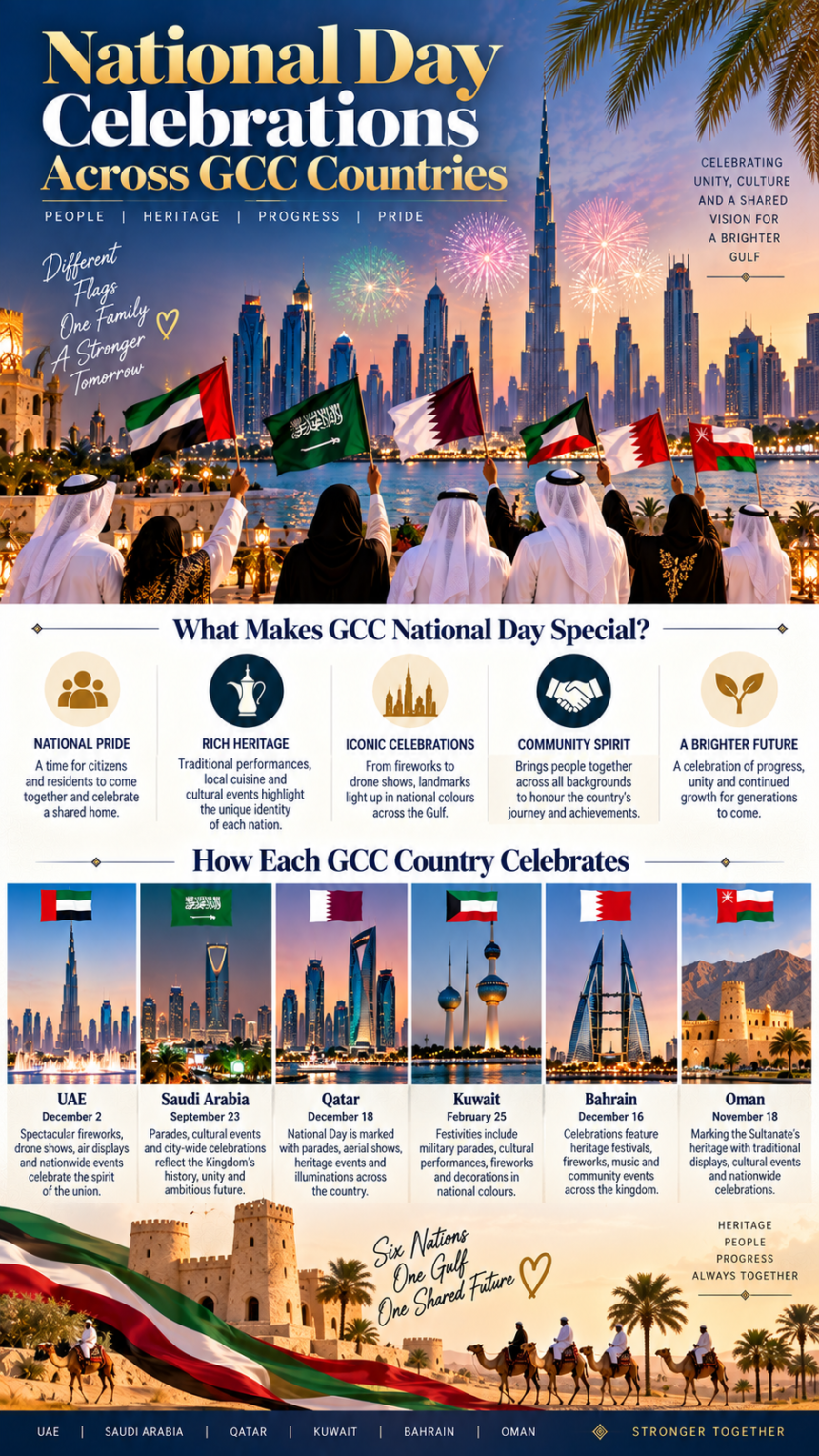
GCC National Day Dates at a Glance
| GCC Country | Main National Celebration | Annual Date |
|---|---|---|
| UAE | Eid Al Etihad | 2 December |
| Saudi Arabia | Saudi National Day | 23 September |
| Qatar | Qatar National Day | 18 December |
| Bahrain | National Day | 16 December |
| Oman | National Day | 20 November |
| Kuwait | National Day | 25 February |
| Kuwait | Liberation Day | 26 February |
The UAE also provides a public holiday on December 3 following National Day, while Bahrain’s official tourism information lists December 16 and 17 as National Day holidays. Kuwait declared February 25 and 26 public holidays for the 2026 National and Liberation Day celebrations.
Oman’s National Day itself is now November 20, but official holiday dates can be announced separately. In 2025, for example, the National Day holiday for government and private-sector employees was set for November 26 and 27.
UAE Eid Al Etihad Celebrations
The UAE’s national celebration is officially known as Eid Al Etihad, meaning the Celebration of the Union.
It takes place on December 2 and marks the moment in 1971 when the emirates came together under one flag. The official Eid Al Etihad platform describes the occasion as a celebration of unity across generations and communities, honouring the country’s heritage while looking towards its future.
Celebrations extend across all seven emirates.
Abu Dhabi traditionally becomes an important centre for the official ceremony, while Dubai, Sharjah, Ajman, Umm Al Quwain, Ras Al Khaimah and Fujairah organise their own community events, performances and public activities.
Recent official celebrations have included community viewing locations across the UAE, national music, cultural programmes and ceremonies combining modern production with stories from Emirati history. The 2025 official ceremony was staged at Zayed National Museum under the theme “United.”
One of the clearest signs that Eid Al Etihad has arrived is the transformation of public spaces. UAE flags appear along major roads, homes display national colours and landmarks are illuminated in red, green, white and black.
Visitors can expect: fireworks, heritage performances, concerts, family events, national songs, flags and busy waterfront or entertainment districts.
Saudi National Day Celebrations
Saudi National Day is celebrated every year on September 23.
The date commemorates the unification of the Kingdom under King Abdulaziz and the proclamation of the Kingdom of Saudi Arabia in 1932. Visit Saudi distinguishes the occasion from Founding Day on February 22, which focuses on the establishment of the First Saudi State in 1727.
Green becomes almost impossible to miss during National Day.
Saudi flags cover buildings and streets, landmarks glow in the national colour and people wear green clothing, scarves or accessories. Families gather in public spaces while cars decorated with flags move through city streets.
Official tourism guidance lists fireworks, air shows, concerts, traditional dances, parades, cultural events and themed installations among common National Day activities. Shopping centres and businesses also introduce promotions around the holiday.
The largest programmes are often found in Riyadh, Jeddah and Dammam, although celebrations take place throughout the Kingdom.
For international travellers, Saudi National Day offers a particularly visible combination of contemporary national identity and traditional culture.
Qatar National Day Celebrations
Qatar National Day takes place on December 18.
Also known as Founder’s Day, it commemorates Qatar’s unification in 1878 and the leadership of Sheikh Jassim bin Mohammed bin Thani. Visit Qatar describes the occasion as a celebration of loyalty, solidarity and national pride.
The Doha Corniche has historically been one of the most recognisable National Day locations, particularly for major ceremonial events. Visit Qatar also identifies Darb Al Saai, Katara Cultural Village and major entertainment destinations among places associated with National Day celebrations.
Public programmes can include military and civil defence parades, aerial displays, cultural events and evening spectacles. Qatar’s official tourism material describes national celebrations featuring parades and air shows before fireworks illuminate Doha at night.
Darb Al Saai is particularly important for visitors interested in Qatari heritage. National celebrations there have traditionally included cultural exhibits, traditional activities and programmes explaining the country’s history and identity.
Homes and vehicles are also decorated in Qatar’s distinctive maroon and white colours.
Bahrain National Day Celebrations
Bahrain’s National Day is celebrated on December 16, with December 17 also listed as a National Day public holiday.
December becomes a broader celebration season across the Kingdom rather than simply a one-night event.
Red and white decorations appear throughout public spaces, shopping districts and entertainment venues. Bahrain Tourism’s recent National Day programmes have included traditional Bahraini music, family entertainment, markets, children’s crafts, performances and major fireworks displays.
Fireworks have become one of the most recognisable parts of the celebration. Bahrain Tourism’s 2025 programme scheduled a major fireworks and drone show on December 16 at Bahrain International Circuit as part of the Celebrate Bahrain season.
Shopping centres and community venues also participate.
Recent celebrations have featured traditional band and ardha performances, henna, children’s activities and red-and-white National Day decorations, showing how heritage continues alongside contemporary entertainment.
Because Bahrain is geographically compact, visitors can often experience several different National Day activities without travelling long distances.
Oman National Day Celebrations
Oman now celebrates its National Day annually on November 20.
Sultan Haitham bin Tarik announced the date in honour of the establishment of the Al Busaidi state in 1744 by Imam Ahmed bin Said Al Busaidi. The day reflects pride in Oman’s long history as well as the country’s modern development.
National colours become prominent across Muscat and other governorates, while government bodies, schools, businesses and communities organise patriotic activities.
Military ceremonies have an important place in the official celebrations. On November 20, 2025, Sultan Haitham attended a Grand Military Parade at Al Fateh Square in Muscat. It included military formations, the Royal Anthem and a 21-gun salute.
Cultural celebrations are equally significant.
Official National Day events have featured patriotic music, poetry and visual presentations, while community celebrations around Oman often include traditional arts and performances.
Visitors may therefore encounter a more traditional style of national celebration than the large-scale entertainment districts associated with some other Gulf capitals.
Kuwait National and Liberation Day Celebrations
Kuwait’s national celebration is unusual because two major dates come together.
National Day falls on February 25, followed immediately by Liberation Day on February 26. National Day celebrates the modern state and its independence story, while Liberation Day remembers Kuwait’s liberation from the Iraqi occupation in 1991.
The celebrations begin well before February 25.
In 2026, Kuwait officially launched the national celebration period on February 1 with flag-raising ceremonies across all six governorates. The year marked the country’s 65th National Day and 35th Liberation Day.
Kuwaiti flags appear throughout streets, government buildings, homes and businesses. The entire month can feel festive, particularly as February’s relatively mild winter weather makes outdoor gatherings easier.
Liberation Day also has a more reflective dimension. Official commemorations remember those who lost their lives defending the country and the nations that participated in Kuwait’s liberation.
This gives Kuwait’s February festivities a combination of celebration, remembrance and national unity.
Why Flags Transform Gulf Cities
The national flag is probably the most universal visual symbol across all six GCC celebrations.
In Saudi Arabia, green dominates streets and landmarks. Qatar becomes covered in maroon and white, while Bahrain’s red and white colours appear on buildings, markets and decorations.
Kuwait uses green, white, red and black across public displays. Oman carries red, white and green, while the UAE’s red, green, white and black flag appears almost everywhere before December 2.
Flags are not restricted to government buildings.
Residents place them on balconies and homes, shopping centres create elaborate installations and vehicles sometimes carry small national flags. In Qatar, official tourism information notes that people decorate cars and homes with flags and other patriotic symbols during National Day.
For photographers, these weeks can provide some of the most colourful urban scenes of the entire year.
Fireworks, Air Shows and Public Spectacles
Fireworks have become closely associated with modern Gulf national celebrations.
Large displays can attract thousands of spectators to waterfronts, major parks and entertainment districts. Bahrain’s tourism authority describes fireworks as one of the major highlights of its Celebrate Bahrain National Day season.
Saudi National Day programming similarly includes fireworks and air shows alongside concerts and parades.
Qatar has combined ceremonial parades and air displays with evening fireworks during its December celebrations.
In the UAE, celebrations vary between emirates and from year to year. Recent Eid Al Etihad programmes have spread activities across multiple community locations, making the occasion a nationwide celebration rather than a single central event.
Visitors should check each year’s official programme rather than assuming that fireworks will take place at the same venue and time as the previous year.
Traditional Music and Heritage Performances
The most meaningful National Day experiences are often not the largest fireworks displays.
Traditional music, poetry and dance connect the celebrations with local heritage.
Saudi celebrations frequently feature traditional dances alongside cultural exhibitions. Bahrain’s National Day programmes have included traditional Bahraini bands and ardha performances. Oman regularly incorporates traditional arts, patriotic music and poetry into national celebrations.
The UAE uses its national celebration to highlight Emirati heritage and the history of the union. The official Eid Al Etihad ceremony places strong emphasis on identity, belonging and stories from the country’s past.
For travellers, heritage villages and cultural centres may therefore provide a deeper National Day experience than simply watching an evening show.
How Families Celebrate National Days
National days are strongly family-oriented across the GCC.
Parents take children to public celebrations, parks, fireworks displays and cultural programmes. Families may dress children in national colours or traditional clothes, decorate cars and spend the evening together at a waterfront or entertainment area.
Shopping malls also organise activities specifically for younger visitors.
Bahrain’s recent National Day programming, for example, has included face painting, traditional crafts, character experiences and other children’s activities alongside music and markets.
The holiday itself often creates additional opportunities for family time because schools, government institutions and many businesses close.
This is why public locations can become exceptionally busy in the evening.
National Day Food, Markets and Shopping
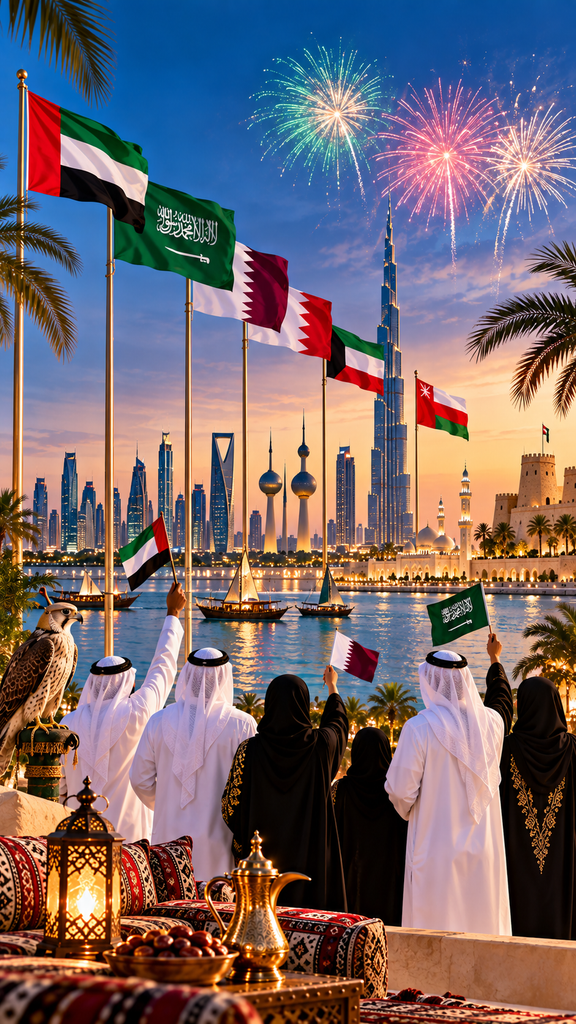
Food and retail have become major parts of Gulf national celebrations.
Hotels and restaurants may create themed menus, while food markets and festivals bring together local dishes and modern street-food concepts.
Shopping centres frequently decorate entire interiors in national colours and organise performances or children’s entertainment. Retailers often introduce National Day promotions, particularly in Saudi Arabia and other large GCC markets.
Visit Saudi explicitly identifies sales and promotions as a common part of its National Day period.
Traditional markets can provide a different experience. Rather than only buying discounted products, visitors can see local crafts, traditional clothing, perfumes, food and cultural demonstrations.
For a more meaningful visit, combine one major modern event with one heritage-focused experience.
How Buildings and Landmarks Join the Celebrations
Architecture becomes part of the celebration itself.
Skyscrapers, bridges, government buildings and commercial towers may be illuminated in national colours. Digital screens show flags and patriotic messages, while public roads receive large-scale decorations.
These displays are particularly dramatic after dark.
Modern Gulf capitals are well suited to this style of celebration because large façades, waterfront skylines and monumental public spaces can be transformed using projection, LED lighting and drone technology.
Yet the strongest displays often combine modern technology with national symbols rather than replacing tradition entirely.
A futuristic skyline glowing in national colours can sit only a short drive from a heritage village where traditional musicians and craftspeople are performing.
What Visitors Should Know During GCC National Days
National Day can be an excellent time to visit, but it requires additional planning.
Popular waterfronts, fireworks locations and shopping centres can become extremely crowded. Hotels near major event areas may also experience stronger demand.
Visitors should check the official programme shortly before travelling because events, road closures and fireworks locations change annually.
A practical National Day plan should include:
- Confirm official event locations and timings.
- Book accommodation early around major celebration zones.
- Use public transport where possible.
- Arrive well before large fireworks or parades.
- Expect security checks at major events.
- Keep children close in crowded locations.
- Carry only essential belongings.
- Check road closures before driving.
- Avoid stopping vehicles in unsafe places for photographs.
- Respect barriers around ceremonial or military events.
- Dress comfortably for long periods outside.
- Follow local authority instructions.
Most celebrations welcome residents and international visitors, making National Day a good opportunity to experience Gulf culture in a public setting.
Traffic and Transport During Major Celebrations
Traffic can become one of the biggest challenges.
Saudi Arabia’s official National Day travel guidance recommends using public transport or ride-sharing around major event locations because roads can become congested.
The same logic applies throughout the GCC.
Fireworks areas, Corniches and entertainment districts may require temporary road closures. Parking spaces can fill several hours before an event begins, and departure immediately after fireworks may take much longer than expected.
Metro systems can be particularly useful in Dubai, Doha and Riyadh where event locations are accessible by public transport.
Families using taxis or ride-hailing should consider walking a short distance away from the densest crowd before requesting a vehicle.
Are National Days Public Holidays?
Yes, although the exact arrangements differ.
The UAE lists December 2 and 3 as National Day public holidays for both public and private sectors. Bahrain’s official tourism website lists December 16 and 17 as National Day holidays.
Saudi National Day on September 23 is generally an official one-day holiday, although arrangements may vary when the date interacts with weekends or official announcements.
Qatar National Day on December 18 is also an official holiday.
Kuwait provides holidays around both February 25 and 26. For 2026, the Civil Service Commission confirmed both dates as official holidays for ministries, government bodies and public institutions.
Oman’s holiday dates can be announced separately from its November 20 National Day itself, so visitors should check the year’s official announcement.
Best National Day Experiences for Families
National Day celebrations can be especially good for families because many public events are free or designed for a broad audience.
| Experience | Why Families May Enjoy It |
|---|---|
| Fireworks | Easy visual highlight for all ages |
| Heritage villages | Children can discover local culture |
| Traditional performances | Music and dance create an accessible cultural experience |
| Public parks | More relaxed than major city centres |
| Family festivals | Often include crafts and children’s activities |
| Museums | Help explain the history behind the celebration |
| National decorations | Good for photography and evening walks |
Young children may find large fireworks zones overwhelming, so quieter community celebrations can sometimes be more enjoyable.
Arriving early also gives families more space before crowds reach their peak.
How Modern Celebrations Preserve Gulf Heritage
National Day celebrations across the Gulf increasingly use drones, projections, large concerts and sophisticated light shows.
That might appear very different from traditional celebrations, but heritage remains central to many official programmes.
Saudi Arabia combines modern entertainment with traditional dances and heritage activities. Qatar links its National Day directly to the legacy of its founder. Bahrain places traditional musicians and crafts alongside fireworks and family entertainment.
Oman’s official ceremonies use military tradition, national poetry and patriotic music, while the UAE’s Eid Al Etihad programme presents the country’s history of union through contemporary large-scale productions.
This balance explains why national celebrations can appeal both to citizens deeply familiar with the history and visitors encountering Gulf culture for the first time.
Final Thoughts on National Day Celebrations Across GCC Countries
National Day Celebrations Across GCC Countries reveal how each Gulf nation tells its own story.
The UAE celebrates Eid Al Etihad on December 2, remembering the creation of the federation in 1971 and transforming all seven emirates with flags, cultural programmes and national events.
Saudi Arabia celebrates on September 23, marking the unification of the Kingdom with green flags, traditional dances, concerts, fireworks and large-scale city events.
Qatar celebrates on December 18, honouring founder Sheikh Jassim bin Mohammed bin Thani and expressing national pride through Darb Al Saai, cultural events, parades and public celebrations.
Bahrain’s December 16 celebrations bring red-and-white decorations, traditional performances, festivals and fireworks across the Kingdom, with December 17 also observed as a National Day holiday.
Oman’s National Day is now November 20, commemorating the founding of the Al Busaidi state in 1744. Military ceremonies, music, poetry and community celebrations connect modern Oman with its long history.
Finally, Kuwait celebrates National Day on February 25 and Liberation Day on February 26, creating two consecutive days that combine national pride with remembrance of the country’s liberation in 1991.
The colours, dates and histories may differ, but the wider message is remarkably consistent. Across the GCC, National Day is a moment when public spaces become extensions of national identity and families, institutions and communities come together to celebrate where their country has come from and where it hopes to go next.
Do follow us on Instagram
Read More – Eid Traditions Across the Arabian Gulf: 15 Beautiful Customs