


How Gulf Cities Are Becoming Smarter at a Glance
A smarter city is not simply one filled with screens, sensors and futuristic vehicles. The real test is whether technology makes everyday life easier. Can residents complete government services without visiting an office? Can public transport respond more effectively to demand? Can planners understand how neighbourhoods will work before construction begins?
- What Makes a Gulf City Smart?
- How Gulf Cities Are Becoming Smarter at a Glance
- AI Is Moving From Experiments to Everyday City Operations
- Dubai Is Building a More Connected Digital City
- Abu Dhabi Is Moving Towards AI-Native Government
- Riyadh Is Transforming Urban Mobility
- Doha Is Connecting Infrastructure Through Smart Technology
- Manama Is Making Government Services Digital First
- Muscat Is Using Technology to Improve Municipal Services
- Kuwait City Is Expanding Digital Government Services
- Smart Public Transport Is Changing Gulf Mobility
- Data Is Becoming New Infrastructure for Gulf Cities
- Digital Government Is Reducing Paperwork and Queues
- Smart Technology Is Supporting Greener Cities
- Digital Twins Are Changing Urban Planning
- How AI Could Improve Everyday Life in Gulf Cities
- Cybersecurity and Privacy Matter More in Smart Cities
- Are Smart Cities Better for Residents?
- What Comes Next for Smart Cities Across the GCC?
- Final Thoughts on How Gulf Cities Are Becoming Smarter
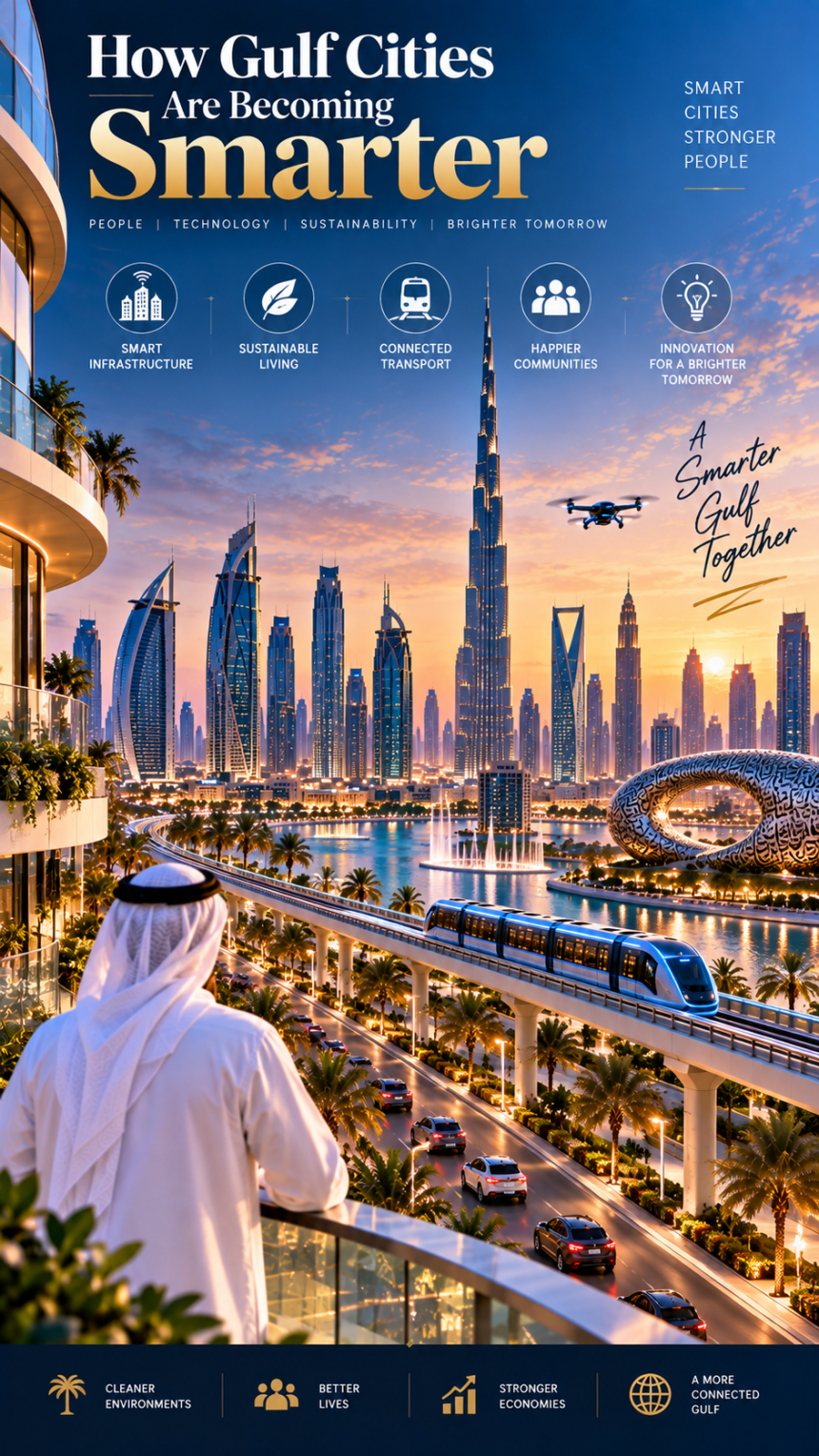
These questions are increasingly shaping cities across the Arabian Gulf. How Gulf Cities Are Becoming Smarter can be seen in the rapid expansion of artificial intelligence, digital government platforms, automated transport, connected buildings, open data, smart utilities and technology-led urban planning.
Dubai is integrating government services and data into increasingly unified systems. Abu Dhabi is working towards becoming an AI-native government. Riyadh has built one of the world’s largest driverless Metro networks. Doha is connecting smart infrastructure through national digital programmes, while Bahrain, Oman and Kuwait are rapidly moving government services onto digital platforms.
Across the GCC, the wider objective is becoming clear. Technology is being treated less as a separate industry and more as infrastructure that affects transport, housing, government, sustainability and quality of life.
What Makes a Gulf City Smart?
A smart city uses technology and data to improve how the city works.
That can include sensors that monitor utilities, artificial intelligence that predicts transport demand, apps that replace government paperwork, digital maps used by planners or systems that automatically adjust lighting and irrigation.
The important word is useful.
A city does not become smarter simply because it installs thousands of connected devices. The technology needs to solve an actual urban problem.
Examples include reducing unnecessary traffic, detecting infrastructure problems earlier, simplifying business licences, improving emergency response or helping residents understand public services through one digital platform.
The GCC Secretary General said in May 2026 that Gulf states had made major progress in urban planning and smart infrastructure, linking these developments with sustainability, innovation and improved quality of life.
That wider focus is why smart-city development is increasingly becoming part of national economic and urban strategies rather than a collection of isolated technology projects.
How Gulf Cities Are Becoming Smarter at a Glance
| City | Major Smart-City Direction | Examples |
|---|---|---|
| Dubai | AI, data and smart mobility | Unified services, AI transport management, autonomous taxis |
| Abu Dhabi | AI-native government | TAMM, digital planning, sovereign cloud |
| Riyadh | Integrated urban mobility | Driverless Metro, buses, open data and digital twins |
| Doha | Connected infrastructure | TASMU, Digital Agenda 2030, IoT-enabled districts |
| Manama | Digital-first public services | eKey 2.0, National Portal, MyGov |
| Muscat | Smart municipal services | Digital transactions, smart irrigation and municipal apps |
| Kuwait City | Integrated e-government | Sahel, Wasel and expanding digital services |
These systems are developing at different speeds, and not every planned project is already fully operational. The common direction, however, is towards more connected and data-driven urban management.
AI Is Moving From Experiments to Everyday City Operations
Artificial intelligence used to appear mainly in innovation labs and pilot programmes. That is changing.
Gulf governments are increasingly using AI in real operations, from transport management to government services and city planning.
Dubai’s Roads and Transport Authority, for example, is using AI-powered operational dashboards to manage its bus network. In June 2026, RTA said its technology had contributed to a 68 percent reduction in early bus departures, while other tools were being used to predict cancelled journeys and manage responses to Metro disruptions.
Abu Dhabi has gone further by making AI central to its government strategy. By late 2025, the emirate said more than 100 AI use cases were already operating across more than 40 government entities.
This represents an important transition.
The question is no longer whether Gulf cities will use AI. It is increasingly about which decisions AI should support, how systems share information and where human oversight remains necessary.
Dubai Is Building a More Connected Digital City
Dubai’s smart-city strategy increasingly revolves around making separate government services behave like one connected system.
In April 2026, Dubai directed government entities to integrate individual and business services into a unified digital platform within one year. The wider goal is to make the city operate through connected data and increasingly proactive AI systems.
Data is a critical part of that approach.
In July 2026, Dubai released an updated Data Manual designed to improve how government bodies manage, share and use information. Digital Dubai described data as a strategic asset supporting decision-making, AI applications and digital transformation.
Transport is another highly visible part of Dubai’s technology strategy.
RTA officially launched fully autonomous taxi operations using Baidu Apollo Go vehicles in February 2026, representing another step towards driverless mobility becoming part of the city’s transport ecosystem rather than remaining only a demonstration project.
RTA is also applying AI to operational control, staff development and digital services.
For residents, the most important change may eventually be less visible: fewer separate apps, fewer forms and more services that already understand what a user needs.
Abu Dhabi Is Moving Towards AI-Native Government
Abu Dhabi is approaching smart-city development through government transformation as much as physical infrastructure.
Its Government Digital Strategy 2025-2027 aims to make Abu Dhabi the world’s first fully AI-native government by 2027. The programme is backed by AED13 billion and includes plans for complete sovereign-cloud adoption, full process digitisation and automation, stronger data integration and more than 200 AI solutions.
The idea of an AI-native government goes beyond putting a chatbot on an existing website.
Abu Dhabi’s TAMM 4.0 strategy is designed around proactive services. Instead of requiring a resident to understand which department handles a particular life event, AI systems are intended to coordinate services across government entities and provide personalised guidance.
The city’s physical planning is also becoming more digital.
In June 2026, the Department of Municipalities and Transport launched advanced planning technologies that combine data, systems and urban design tools to help planners make earlier and better-informed decisions about communities.
This illustrates an important smart-city shift. Digital government and physical city planning are increasingly becoming part of the same ecosystem.
Riyadh Is Transforming Urban Mobility
Riyadh’s most visible smart-city transformation can be seen in public transport.
The Riyadh Metro forms part of the King Abdulaziz Public Transport Project and includes six fully automated Metro lines alongside bus and bus rapid transit systems. RCRC’s current open-data platform also publishes Metro information that can be viewed geographically and integrated with other city datasets.
Saudi Vision 2030’s 2025 annual report describes the network as one of the world’s largest driverless Metro systems and says the Riyadh Metro carried more than 150 million passengers in 2025, with on-time performance reported at 99.7 percent.
Transport, however, is only one layer.
Riyadh Municipality has also demonstrated digital-twin technology and smart-city solutions designed to support urban management and future planning. Digital twins create virtual representations of real places, allowing planners to combine infrastructure and spatial information before making changes in the physical city.
The Royal Commission’s open-data portal now contains more than 180 datasets covering categories including traffic, Metro and buses, urban indicators, sustainability and heritage.
For a city expanding as quickly as Riyadh, data becomes essential because traditional planning methods alone may struggle to keep pace with growth.
Doha Is Connecting Infrastructure Through Smart Technology
Doha’s smart-city direction is closely connected to Qatar Digital Agenda 2030.
The national strategy is structured around six areas: digital infrastructure, digital government, digital technologies, digital innovation, the digital economy and digital society.
The TASMU Smart Qatar programme provides another layer. It develops national digital infrastructure and platforms intended to allow data sharing and smart solutions across important sectors.
One of the clearest physical examples can be found in Msheireb Downtown Doha.
The district says its smart infrastructure includes approximately 430 kilometres of fibre-optic cable, more than 5,000 Wi-Fi points and over 650,000 IoT devices monitoring smart buildings, homes and city systems. It also uses smart utility meters, automated parking technology and an integrated command and control centre.
These numbers illustrate what connected urban infrastructure actually means.
The technology is not simply visible on a phone screen. Sensors and communication networks operate behind the buildings, transport systems and utilities that residents use every day.
Manama Is Making Government Services Digital First
Bahrain’s smart-city transformation is particularly visible in digital identity and government services.
The Kingdom operates a Digital-First Public Services policy that requires government entities to design services digitally before considering other delivery channels. Bahrain’s National Portal acts as a central access point for government e-services.
A key part of this infrastructure is eKey, Bahrain’s national digital identity system.
In July 2026, eKey 2.0 received the Digital Identity Innovation Award at the Bahrain Smart Cities Summit. The system is designed to provide secure access to government and private-sector digital services.
Bahrain is also consolidating government apps. The Information and eGovernment Authority’s 2026 updates show services being moved into MyGov as part of an application-merger plan.
This may sound less futuristic than autonomous taxis, but it can have a larger daily impact.
A secure digital identity means residents can access services, make applications and complete transactions without repeatedly proving who they are to different government organisations.
Muscat Is Using Technology to Improve Municipal Services
Oman’s smart-city approach combines national digital government programmes with practical municipal technology.
The National Programme for Government Digital Transformation, known as Tahawul, reported overall performance of 94 percent by the end of 2025. It said 2,277 government services had been fully digitalised and 217 digital systems, portals and applications had been developed.
Muscat itself completed 234,251 digital transactions between January and October 2025 and digitalised nine additional government services during the period.
The more interesting examples are not necessarily conventional e-government.
Muscat’s projects have included smart mosquito traps, smart electronic traps for stray animals, modern irrigation systems, development of the Baladiati application and upgrades to municipal digital platforms.
Oman also operates a national Smart Cities Platform focused on areas including environment, energy, transport, education and the economy. The platform is designed around real-time data and technology that can support improved public services and more sustainable communities.
This demonstrates how smart-city technology can solve very local problems rather than always focusing on spectacular megaprojects.
Kuwait City Is Expanding Digital Government Services
Kuwait’s smart transformation is increasingly visible through the Sahel government application.
Kuwait Government Online describes Sahel as the country’s official e-government app, providing citizens and residents with a single mobile platform for transactions, payments, application tracking and official notifications.
The scale becomes clearer when looking at individual services.
Kuwait’s Public Authority for Housing Welfare said that in May 2026 alone, 25,548 housing transactions were completed electronically through Sahel and the authority’s website.
Kuwait is also developing Wasel, a government platform intended to unify communication between public authorities and residents. The platform includes request tracking and intelligent analysis of government service feedback and social-media content.
At the infrastructure level, Kuwait’s communications regulator says continued investment in digital systems and telecommunications infrastructure is part of the country’s broader digital transformation.
The direction is similar to the rest of the Gulf: fewer isolated government systems and more integrated digital access.
Smart Public Transport Is Changing Gulf Mobility
Transport is one of the easiest places for residents to notice smart-city technology.
Riyadh has a fully automated Metro network. Dubai is introducing autonomous taxis while using AI in everyday bus operations. Doha has built modern connected transport infrastructure around its expanding urban districts.
The significance extends beyond convenience.
Efficient public transport can reduce dependence on private cars, improve access to jobs and reduce pressure on roads as Gulf populations grow.
AI also makes transport systems more responsive.
Instead of simply running a fixed timetable and analysing problems later, operators can increasingly use live data to predict disruptions, manage vehicle movements and adjust operations.
Dubai’s AI-powered bus dashboards are a good example. They analyse operational behaviour and help staff respond to problems such as early departures, cancellations and Metro disruptions in real time.
The smartest transport system may ultimately be the one passengers barely notice because it simply works more reliably.
Data Is Becoming New Infrastructure for Gulf Cities
Roads, electricity and water are traditional city infrastructure.
In smart cities, data increasingly belongs on the same list.
Every public transport journey, digital government transaction, smart meter and sensor can generate information. When those datasets are governed and shared properly, they can help cities understand how people move, where services are under pressure and what infrastructure may be needed next.
Dubai’s updated Data Manual formalises how government information should be governed and shared. Riyadh’s open-data platform provides access to datasets covering transport, sustainability, urban indicators and other subjects.
Qatar’s TASMU programme similarly describes data sharing as part of the critical digital infrastructure needed for national smart solutions.
The challenge is ensuring that useful data does not become uncontrolled data.
Governance, security and privacy therefore become as important as collection itself.
Digital Government Is Reducing Paperwork and Queues
Some of the most useful smart-city improvements are also the least dramatic.
A resident who can renew a permit, pay a fee or submit a request from a phone does not need to drive to a government building, search for parking or wait in a queue.
Bahrain’s digital-first policy is built around exactly this principle. Kuwait’s Sahel app provides one central place for many transactions, while Muscat and other Omani governorates are continuing to move services online.
Dubai and Abu Dhabi are attempting to go further.
The next stage is not simply putting an existing form online. It is removing the need for the form entirely when government systems already hold the required information.
This transition from digital forms to proactive services may eventually become one of the biggest differences between ordinary e-government and truly smart government.
Smart Technology Is Supporting Greener Cities
Smart-city technology also plays a role in sustainability.
Connected irrigation can reduce unnecessary water use. Smart meters can show how energy is consumed. Transport data can help cities improve public transit, while sensors can support more efficient building operations.
Msheireb Downtown Doha uses thousands of smart utility meters alongside connected building systems. Muscat has introduced modern irrigation technologies as part of its municipal digital transformation.
The sustainability benefit depends on how the technology is actually used.
Installing sensors does not automatically make a city green. Their value comes when information leads to lower consumption, better maintenance or smarter infrastructure decisions.
This distinction will become increasingly important as Gulf cities manage population growth alongside water, energy and climate pressures.
Digital Twins Are Changing Urban Planning
A digital twin is essentially a digital representation of a real system or place.
For cities, this can mean combining buildings, roads, infrastructure and real-time information inside a virtual model.
Riyadh Municipality has highlighted digital-twin technologies as part of its smart-city work, while Abu Dhabi is developing new digital planning tools that connect data and design earlier in the urban-planning process.
This can allow planners to test questions before committing money to construction.
How will a new road affect traffic? Where will future schools be needed? Will buildings create difficult pedestrian conditions? How might a neighbourhood respond to population growth?
A digital model cannot predict everything, but it gives planners a more powerful environment for testing alternatives.
How AI Could Improve Everyday Life in Gulf Cities
The most successful AI may eventually become almost invisible.
Instead of asking a government chatbot the same questions repeatedly, services could be triggered automatically when a person’s circumstances change.
Traffic systems could identify congestion before it spreads across several roads. Maintenance teams could receive warnings before equipment fails. Public transport schedules could respond more intelligently to demand.
Abu Dhabi’s AI-native strategy already describes proactive services in which systems monitor relevant life events and trigger government support without requiring conventional applications.
Dubai is similarly moving towards government systems integrated through AI and unified data.
The technology becomes valuable when it removes complexity rather than adding another app residents have to understand.
Cybersecurity and Privacy Matter More in Smart Cities
A highly connected city also creates new risks.
When transport systems, digital identities, payments, government records and physical infrastructure become interconnected, protecting those networks becomes critical.
A cybersecurity problem in a smart city can potentially affect far more than one website.
Abu Dhabi’s digital strategy explicitly includes cybersecurity frameworks alongside cloud adoption and AI. Qatar’s Digital Agenda similarly places secure digital infrastructure among its strategic foundations.
Digital identity requires similar trust. Bahrain’s eKey platform is designed around secure access because a convenient digital service becomes useless if residents do not trust the authentication system.
Smart-city competition should therefore not become a race to collect the most data.
The more connected a city becomes, the more seriously it must treat privacy, security, governance and system resilience.
Are Smart Cities Better for Residents?
Technology alone cannot answer this question.
A smart city should eventually save residents time, reduce friction and create more reliable urban services.
People should notice easier transport, quicker government transactions, safer infrastructure, better planning and more responsive public services.
However, a city filled with sensors can still have poor pedestrian access. An impressive government application is less helpful to people who struggle with digital literacy. AI can improve efficiency while also creating new questions about transparency and accountability.
The strongest Gulf smart-city strategies increasingly acknowledge this human side.
Dubai frames digital transformation around quality of life and seamless services. Abu Dhabi describes its AI strategy as human-centred, while Qatar’s TASMU programme explicitly connects digital transformation with residents’ quality of life.
That is the standard smart cities ultimately need to meet.
What Comes Next for Smart Cities Across the GCC?
The next stage is likely to involve much deeper integration.
Instead of transport having one smart system and government services another, cities will increasingly connect data across sectors.
AI will become more proactive. Autonomous transport will move from limited trials towards wider operations. Digital twins may become standard planning tools, while government services could increasingly happen automatically in the background.
Oman has already moved into a new 2026-2030 phase of its national digital transformation programme. Qatar’s Digital Agenda runs towards 2030, while Abu Dhabi has set 2027 as the target for its AI-native government transformation.
The largest change may therefore be conceptual.
Today, residents still think of a transport app, government app and municipal app as separate services. The future smart city may make many of those boundaries less visible.
Final Thoughts on How Gulf Cities Are Becoming Smarter
How Gulf Cities Are Becoming Smarter is best understood through everyday systems rather than futuristic architecture.
Dubai is integrating government data, AI and autonomous mobility while moving towards a more unified digital-service model. Abu Dhabi is attempting an even deeper transformation by building an AI-native government supported by cloud infrastructure, predictive services and digital urban planning.
Riyadh is using automated Metro infrastructure, open data and digital-twin technology to manage the demands of a rapidly growing city. Doha is combining national programmes such as TASMU and Digital Agenda 2030 with connected districts such as Msheireb Downtown.
Bahrain is building around digital-first government and secure digital identity. Muscat is applying smart technology to practical municipal services including irrigation and urban management, while Kuwait is expanding platforms such as Sahel and Wasel to create simpler connections between residents and government.
The future of Gulf smart cities will not be decided by which city installs the most sensors or launches the most impressive application.
The real measure will be simpler: whether technology reduces wasted time, makes transport more reliable, creates more sustainable neighbourhoods and helps residents interact with their city more easily.
If that remains the priority, becoming smarter will mean more than becoming more digital. It will mean becoming more liveable.
Do follow us on Instagram
Read More – Wedding Traditions Across GCC Countries: 15 Beautiful Customs