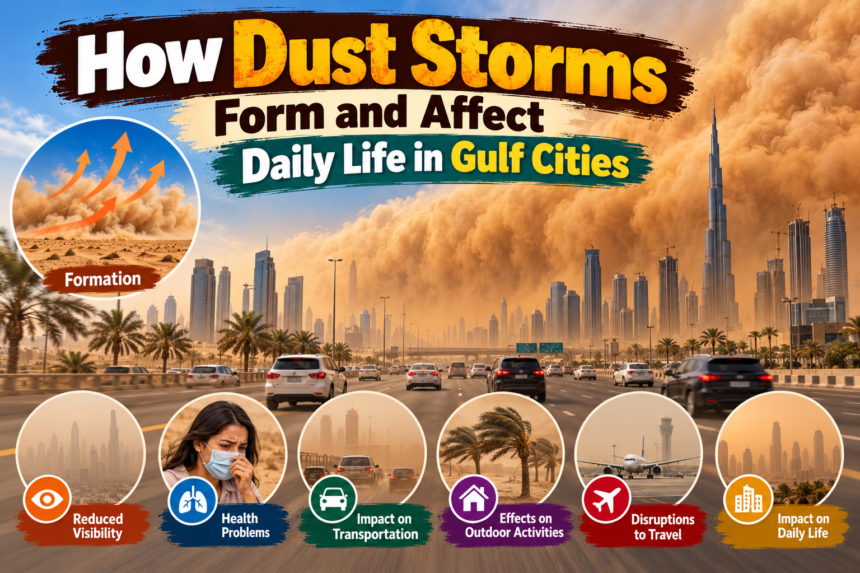
Important Facts About How Dust Storms Form and Affect Gulf Cities
Dust storms are a familiar weather feature in many parts of the Gulf region. A clear blue sky can suddenly become covered by a layer of dust, the air may turn yellow or brown, and distant buildings can disappear behind a thick cloud of airborne particles. For people living in cities such as Dubai, Abu Dhabi, Riyadh, Doha, Kuwait City, Manama, and Muscat, these weather events can affect daily routines in several ways.
- 1. What Is a Dust Storm?
- 2. How Do Dust Storms Form?
- 3. Why Are Dust Storms Common in Gulf Cities?
- 4. Eight Important Facts About Dust Storms in the Gulf
- 5. How Dust Storms Affect Human Health
- 6. The Impact of Dust Storms on Daily Life in Gulf Cities
- 7. How Dust Storms Affect Buildings, Environment, and Infrastructure
- 8. How Residents Can Stay Safe During a Dust Storm
- 9. Safe Driving Tips During Dusty Weather
- 10. What Gulf Cities Are Doing to Monitor and Manage Dust Storms
- 11. The Future of Dust Storm Management in the Gulf
- Conclusion: Understanding Dust Storms Makes Gulf Life Safer
- Frequently Asked Questions (FAQs)
A dust storm is more than a natural change in the weather. It can reduce visibility on roads, affect outdoor activities, increase the amount of dust entering buildings, disturb flights, and create health concerns, particularly for people with breathing problems.
The Gulf region is especially exposed because it is surrounded by dry deserts and semi-arid landscapes. Strong winds can lift loose soil and sand from these areas and carry fine particles across long distances. Some dust comes from nearby deserts, while other particles travel from places such as Iraq, Iran, and parts of North Africa.
Although dust storms cannot always be prevented, understanding how they form and how to prepare for them can make everyday life safer and more comfortable.
In this article, we explore how dust storms form and affect daily life in Gulf cities, the role of seasonal winds, their effects on health and transport, and practical steps residents can take during dusty weather.
1. What Is a Dust Storm?
A dust storm is a weather event in which strong winds lift large amounts of loose dust and soil from the ground into the atmosphere. The particles spread through the air, sometimes creating a thick cloud that reduces visibility and changes the appearance of the sky.
Dust storms are common in dry and semi-dry regions where soil is exposed and vegetation is limited. The Arabian Peninsula is one of the world’s important dust-producing regions, making the Gulf particularly exposed to this natural weather condition.
The World Meteorological Organization (WMO) explains that sand and dust storms happen when strong winds lift particles from dry ground and transport them through the atmosphere. These particles can travel hundreds or even thousands of kilometres, affecting areas far from their original source.
How They Happen
- Strong Winds or Gust Fronts: Fast-moving air from weather systems, cold fronts, or thunderstorm downdrafts (known as haboobs) generate enough force to pick up soil particles.
- Dry and Arid Conditions: Extended droughts, extreme heat waves, and low humidity dry out the top layer of soil, making it light and easy to lift.
- Lack of Vegetation: Plants, grass, and tree roots act like natural glue that anchors the soil. Without vegetation, the ground has nothing to hold it in place
Dust storm vs. sandstorm: Is there a difference?
People often use the words dust storm and sandstorm to describe the same event. However, there is a difference between the particles involved.
- Dust: Fine particles that can remain in the atmosphere for long periods and travel over considerable distances.
- Sand: Larger and heavier grains that usually move closer to the ground.
- Blowing dust: Dust raised by wind that may reduce visibility without developing into a severe dust storm.
- Dust haze: Fine particles remaining in the air after an earlier dust event.
A storm can contain both sand and dust. The amount of each depends on the ground surface, wind strength, and local weather conditions.
For city residents, the main concern is often reduced air quality and visibility rather than the size of the particles alone.
2. How Do Dust Storms Form?
Dust storms form when strong winds move across dry, exposed land and lift loose particles into the air. However, several natural conditions usually work together to create a major event.
Understanding this process makes it easier to see why dust storms are common across Gulf countries.
Step 1: The ground becomes dry
The first important condition is exposed, dry soil.
When an area receives little rainfall, the ground can lose moisture. If vegetation is sparse, there may be fewer roots and plants to hold the soil in place.
Dry desert surfaces, exposed river plains, dried lake beds, and degraded land can all become sources of airborne dust.
Step 2: Strong winds begin to develop
Winds become stronger because of changing atmospheric pressure, weather fronts, thunderstorms, or other weather systems.
When strong winds pass over loose soil, they begin to move particles across the surface. The wind must be strong enough to overcome the forces keeping the particles in place.
Step 3: Dust particles become airborne
Larger grains may bounce or roll along the ground. Their movement can knock smaller particles loose, helping fine dust rise into the air.
Turbulence and rising air currents can then lift the smaller particles higher into the atmosphere.
Step 4: Dust spreads across large areas
Once airborne, fine dust can be carried by wind over long distances. A storm that begins far from a city may eventually affect its roads, buildings, airports, and neighbourhoods.
Step 5: Dust settles or is removed from the air
Eventually, particles return to the ground through gravity or are washed out of the atmosphere by rainfall.
Larger particles usually settle more quickly, while the smallest particles can remain airborne for longer periods.
This explains why some Gulf cities may continue to experience dusty air even after the strongest winds have passed.
The World Health Organization (WHO) and WMO describe sand and dust storms as events shaped by wind, exposed surfaces, atmospheric conditions, and the movement of particles through the atmosphere.
3. Why Are Dust Storms Common in Gulf Cities?
The Gulf region has geographical and climatic conditions that make it vulnerable to dust storms. Much of the Arabian Peninsula is covered by deserts, dry plains, and areas that receive limited rainfall.
The region also experiences strong seasonal winds and changing weather systems that can move dust from one country to another.
The role of Shamal winds
One of the best-known winds associated with dust events in the Gulf is the Shamal.
Shamal is a northwesterly wind that affects parts of the Arabian Peninsula and the northern Gulf. It can carry dust and sand from areas including Iraq towards Kuwait, Saudi Arabia, Qatar, Bahrain, and the UAE.
Summer Shamal events are particularly important because strong winds can transport dust across the Gulf for extended periods.
The World Bank’s report Sand and Dust Storms in the Middle East and North Africa Region: Sources, Costs, and Solutions identifies summer Shamal winds as an important factor behind dust storms in the region.
Other sources of dust
Dust affecting Gulf cities does not always come from the nearest desert. Research has identified several local and regional source areas that can affect the Arabian Peninsula.
These include:
- The Empty Quarter in the Arabian Peninsula.
- The Mesopotamian floodplain in southern Iraq.
- Dry regions around the Iraq–Syria border.
- Parts of Iran, including coastal desert areas.
- The Sistan and Balochistan regions.
- Areas of North Africa that contribute to wider dust movement.
A study published in the Journal of Atmospheric and Solar-Terrestrial Physics in 2022 identified ten major dust source hotspots affecting the Arabian Peninsula, including both local and distant regions.
This means that a city can experience dusty weather even when its immediate surroundings are not experiencing a strong local storm.
When do dust storms usually occur?
Dust storms can happen at different times of the year, depending on local weather conditions.
Across parts of the Gulf, late spring and summer are important periods because strong winds, dry ground, and Shamal conditions can favour dust movement. However, frontal systems and other weather patterns can also produce dust events during other seasons.
The exact timing varies between countries and years. Residents should therefore follow local meteorological forecasts instead of assuming dust storms only happen during summer.
4. Eight Important Facts About Dust Storms in the Gulf
Dust storms may look similar from one city to another, but their causes and effects can differ. Here are eight important facts that help explain this natural phenomenon.
Fact 1: Dust can travel across national borders. Fine particles can remain in the atmosphere and move hundreds or thousands of kilometres with suitable winds. A dust event in one country can therefore affect another.
Fact 2: The Arabian Peninsula has several dust source areas. The Empty Quarter is an important local source, but dust can also arrive from Iraq, Iran, and other regional areas.
Fact 3: Shamal winds play an important role. Strong northwesterly winds can transport dust across the northern Gulf and towards several coastal cities.
Fact 4: Dust storms can happen without rain. Unlike thunderstorms, dust storms do not require rainfall. Strong winds over dry, exposed land can be enough to raise dust.
Fact 5: Visibility can fall quickly. A sudden increase in airborne dust can make it difficult to see roads, buildings, vehicles, and other objects at a distance.
Fact 6: Small particles can remain in the air after a storm. Even when the strongest winds have stopped, fine dust may continue to affect outdoor and indoor air quality.
Fact 7: Human activities can increase dust emissions. Land degradation, removal of vegetation, poorly managed construction areas, and unsustainable land practices can expose soil to wind erosion. The WHO estimates that around 25% of global dust emissions originate from human activities.
Fact 8: Forecasting and early warnings can reduce risks. Weather observations, satellite images, air-quality monitoring, and prediction models help authorities issue warnings before or during dust events.
These facts show that dust storms are not simply local weather problems. They are connected to wider environmental conditions, regional wind patterns, land management, and public preparedness.
5. How Dust Storms Affect Human Health
One of the most important effects of dust storms is their impact on air quality.
When dust particles enter the atmosphere, people can breathe them into their respiratory system. The smallest particles can travel deeper into the lungs than larger grains.
The amount of exposure and the health effects depend on particle size, concentration, duration, and individual health conditions.
Common short-term effects
During a dusty period, some people may experience:
- Coughing and sneezing.
- Irritation in the nose and throat.
- Itchy or watery eyes.
- Runny nose.
- Breathing discomfort.
- Worsening of existing asthma symptoms.
- Increased difficulty for people with certain respiratory conditions.
People with asthma, chronic lung disease, heart conditions, older adults, and children may need to take extra care during periods of poor air quality.
The WHO identifies respiratory and cardiovascular health as major areas of concern during sand and dust storm episodes. It also notes that more research is needed to understand the full range of long-term health effects.
Why people with asthma should be careful
Dust exposure can trigger symptoms in people with asthma. A person may experience coughing, chest tightness, wheezing, or shortness of breath.
People with asthma or another respiratory condition should follow the treatment and prevention plan provided by their healthcare professional. They should also pay attention to local air-quality warnings and avoid unnecessary outdoor exposure when dust levels are high.
If someone experiences severe breathing difficulty, chest pain, fainting, or other serious symptoms, they should seek urgent medical help.
Protecting children and older adults
Children may spend time playing outdoors or travelling to school, while older adults may have health conditions that make polluted air harder to tolerate.
During a dust storm, parents and caregivers should consider moving outdoor activities indoors and following advice from local health and weather authorities.
6. The Impact of Dust Storms on Daily Life in Gulf Cities
Dust storms can change ordinary routines within a short period. Residents may need to postpone outdoor activities, change travel plans, clean their homes, or avoid spending unnecessary time outside.
Here are some of the ways dust storms affect everyday life.
1. Road travel and driving conditions
Reduced visibility is one of the most immediate problems during a dust storm.
Drivers may struggle to see vehicles ahead, road signs, traffic signals, lane markings, and pedestrians. Strong winds can also move loose sand onto roads.
Highways and open roads may be particularly affected because vehicles have fewer nearby structures to provide shelter from the wind.
This can lead to:
- Slower traffic.
- Longer journey times.
- Increased risk of road accidents.
- Delays in deliveries and public transport.
- Temporary restrictions or closures on affected roads.
Oman’s Directorate General of Meteorology warns that dust events can disrupt land, sea, and air navigation, particularly when visibility becomes very low.
2. Flights and airport operations
Airports depend on suitable visibility and weather conditions for safe operations. A strong dust storm can affect aircraft movement, airport activities, and flight schedules.
Some flights may be delayed, diverted, or cancelled depending on conditions at the departure airport, destination, and along the route.
For passengers, this can mean changes to travel plans, missed connections, and longer waiting times.
The best approach is to check airline notifications and airport updates rather than travelling to the airport based only on an earlier schedule.
3. School and outdoor activities
Schools, sports clubs, and outdoor activity centres may need to adjust their schedules when dust levels become high.
Physical education classes, playground activities, outdoor competitions, and community events may be moved indoors or postponed.
Parents may also need to change plans for children who normally walk to school or take part in outdoor activities.
4. Shopping and daily errands
People may avoid going outside during severe dust events. This can affect visits to supermarkets, local markets, restaurants, and shopping areas.
Delivery services may also experience delays when roads become difficult to use.
Residents often plan essential shopping before an expected storm so they do not need to travel unnecessarily during poor visibility.
5. Cleaning and home maintenance
One of the most noticeable effects of dust storms is the amount of dust that collects on surfaces.
Fine particles may enter homes through doors, windows, ventilation systems, or small openings. They can settle on furniture, floors, electronics, balconies, and cars.
After a storm, residents may need to clean:
- Windows and balconies.
- Outdoor furniture.
- Air-conditioning filters.
- Car interiors and exteriors.
- Doorways and entrance areas.
- Surfaces exposed to outdoor air.
Keeping windows closed during a storm and maintaining suitable air filters can reduce the amount of dust entering indoor spaces.
6. Work and business activities
Dust storms may affect construction projects, outdoor maintenance, delivery work, tourism, and other activities that depend on safe outdoor conditions.
Workers who spend long periods outside may be exposed to higher dust levels. Employers should follow local occupational safety requirements and provide suitable protection and alternative arrangements when needed.
Businesses may also face lower customer visits, delivery delays, and changes to operating schedules.
7. Outdoor tourism and recreation
Desert safaris, beach activities, sightseeing, outdoor dining, and sporting events may be affected by poor visibility and dusty air.
Tour operators may need to postpone activities or change locations when weather conditions become unsuitable.
Visitors should check official forecasts and follow the instructions of activity providers rather than attempting outdoor trips during severe conditions.
7. How Dust Storms Affect Buildings, Environment, and Infrastructure
Dust storms also affect the physical environment of Gulf cities.
Dust on buildings and roads
Dust settles on building surfaces, signs, vehicles, roads, and outdoor equipment. After a major event, cleaning teams may need to remove large amounts of material from public spaces.
Dust can also enter mechanical systems and increase the need for filter maintenance.
Effects on solar panels
Solar panels need sunlight to generate electricity. When dust covers their surfaces, less sunlight may reach the solar cells, reducing energy production until the panels are cleaned.
This is an important issue for Gulf cities that are investing in solar energy.
However, cleaning must be planned carefully. Excessive water use or unsuitable cleaning materials may create additional problems.
Effects on plants and ecosystems
Dust deposition can cover leaves, affect how much sunlight reaches plant surfaces, and change soil conditions.
The effect is not always negative. Mineral dust also carries nutrients and contributes to natural processes in land and ocean ecosystems. The overall impact depends on the dust’s composition, the amount deposited, and the environment receiving it.
In some cases, large dust events can affect coral reefs and other sensitive ecosystems.
Effects on water quality
Dust can settle on rooftops, outdoor water storage areas, and exposed surfaces. When rain occurs after a dusty period, some of this material may be washed into drainage systems and water bodies.
Proper maintenance of water storage and treatment facilities is therefore important.
The World Bank’s regional report discusses the environmental and economic impacts of dust, including damage to infrastructure, transport disruption, and effects on agriculture.
8. How Residents Can Stay Safe During a Dust Storm
Preparing before a dust storm can help reduce exposure and avoid unnecessary risks. Residents should follow local weather alerts and public safety instructions, especially during severe events.
Before a dust storm
A little preparation can make a difference.
- Check official weather forecasts and dust warnings.
- Keep windows and doors in good condition.
- Maintain air-conditioner filters.
- Keep essential medicines available.
- Avoid planning unnecessary outdoor activities when a warning has been issued.
- Make sure children and older family members understand basic safety steps.
- Keep vehicle lights and windscreen wipers in working condition.
During a dust storm
When dust becomes intense, reducing exposure should be the main priority.
Stay indoors: Avoid unnecessary outdoor activity and keep windows and doors closed.
Use suitable indoor air filtration: Where possible, remain in an air-conditioned room with clean filters. Follow the equipment manufacturer’s guidance for air circulation and filtration.
Protect your eyes: Avoid rubbing irritated eyes. If you must go outside, suitable protective eyewear can help reduce direct exposure to dust.
Wear a suitable mask when necessary: If you need to go outside, a well-fitting particulate respirator, such as an N95-type mask, can reduce inhalation of airborne particles when correctly fitted. A loose cloth covering should not be treated as equivalent protection.
Avoid heavy exercise: Running, cycling, and strenuous outdoor activity can increase the amount of air you breathe in.
Follow official warnings: Local meteorological and emergency authorities may provide specific instructions based on the storm’s severity.
Oman’s Civil Aviation Authority recommends closing windows, using an indoor air purifier where available, avoiding unnecessary travel, and reducing vehicle speed when visibility is affected.
After a dust storm
Conditions may improve gradually rather than immediately.
- Continue checking local air-quality updates.
- Avoid cleaning activities that send settled dust back into the air.
- Use damp cleaning methods for surfaces where suitable.
- Replace or clean filters according to the manufacturer’s guidance.
- Check vehicles and outdoor equipment.
- Seek medical advice if breathing problems or other worrying symptoms continue.
For detailed health advice, follow guidance from local health authorities and the WHO.
9. Safe Driving Tips During Dusty Weather
Driving during a dust storm can be dangerous because visibility may change quickly. A road that was clear a few minutes earlier may become difficult to see.
Here are practical safety steps for motorists:
- Check weather alerts before beginning a long journey.
- Reduce speed when visibility starts to fall.
- Keep a safe distance from the vehicle in front.
- Use appropriate vehicle lights as conditions require.
- Avoid sudden braking or sudden lane changes.
- Do not attempt to overtake when visibility is poor.
- Follow road closures and police instructions.
- Avoid stopping in an active traffic lane or an exposed unsafe location.
If visibility becomes dangerously low, find a safe place away from moving traffic and follow local road-safety guidance. Do not continue driving simply because you are close to your destination.
Truck drivers, delivery riders, taxi drivers, and people travelling on long desert highways should take particular care.
10. What Gulf Cities Are Doing to Monitor and Manage Dust Storms
Dust storms cannot be stopped completely because they are influenced by natural weather systems. However, monitoring, forecasting, public warnings, and land management can help reduce their effects.
Weather monitoring and forecasting
Meteorological departments use weather stations, satellite observations, wind measurements, and computer models to monitor dust movement.
These tools help predict where dust may travel and when visibility may become poor.
The World Meteorological Organization coordinates international work through its Sand and Dust Storm Warning Advisory and Assessment System (SDS-WAS). The system supports improved monitoring, forecasting, and information-sharing between countries.
Regional cooperation
Dust does not follow national borders. A storm that begins in one country can affect air quality and transport in another.
Regional cooperation helps authorities share observations, improve predictions, and prepare public warnings.
Saudi Arabia’s National Center for Meteorology hosts a WMO Regional Center for Sand and Dust Storms that provides dust forecasts and supports regional monitoring.
Public information and alerts
Governments and weather authorities share warnings through official websites, applications, television, radio, and other communication channels.
In the UAE, the official government emergency information portal directs residents to National Emergency Crisis and Disaster Management Authority guidance and National Center of Meteorology updates for sandstorms.
Residents should rely on official sources rather than unverified social media messages when making safety decisions.
Better land management
Human activities can increase the amount of exposed soil in some places. Protecting vegetation, restoring degraded land, and managing construction sites responsibly can help reduce avoidable local dust emissions.
These measures cannot prevent every storm, but they can contribute to better environmental management.
11. The Future of Dust Storm Management in the Gulf
As Gulf cities continue to grow, preparing for dust storms will remain an important part of urban planning and environmental management.
Future efforts may focus on several areas.
Improved early-warning technology: Better forecasts can give residents, airports, transport operators, and emergency teams more time to prepare.
Advanced air-quality monitoring: More monitoring stations can help cities understand changes in particulate pollution and identify areas that need public health attention.
Smart transport systems: Weather information connected to road management systems can help authorities issue timely warnings and manage traffic during poor visibility.
Greener urban planning: Suitable native vegetation and responsible land management can help reduce erosion in selected areas, although planting must be appropriate for local water conditions.
Better building design: Effective sealing, suitable ventilation, and well-maintained filters can help reduce the amount of outdoor dust entering buildings.
Regional scientific cooperation: Sharing satellite data, research, and weather observations can improve understanding of dust sources and movement across borders.
The goal is not to eliminate a natural weather event completely. It is to help cities and residents prepare for it, reduce unnecessary exposure, and limit disruption.
Conclusion: Understanding Dust Storms Makes Gulf Life Safer
Dust storms are a natural part of life across many Gulf cities. They form when strong winds lift loose particles from dry land and carry them through the atmosphere. Seasonal Shamal winds, weather fronts, exposed soil, and regional dust sources all contribute to the phenomenon.
Their effects can reach almost every part of daily life. They may affect breathing, reduce visibility, delay flights, disrupt road travel, change school and work schedules, and create additional cleaning and maintenance needs.
Although residents cannot control the weather, they can take practical steps to stay safe. Checking official warnings, staying indoors during severe events, maintaining indoor air filters, avoiding unnecessary travel, and following road-safety advice can help reduce risks.
Governments, meteorological agencies, businesses, and communities also have important roles in monitoring dust, improving early warnings, protecting vulnerable people, and managing land responsibly.
Dust storms are more than clouds of sand in the sky. They are a reminder of how closely weather, the environment, public health, and everyday life are connected in the Gulf region.
Frequently Asked Questions (FAQs)
1. Why are dust storms common in Gulf cities?
Many Gulf cities are surrounded by dry desert and semi-arid landscapes. Strong winds can lift loose particles from these areas and transport them across the region. Seasonal Shamal winds and other weather systems also contribute to dust events.
2. During which months do dust storms occur in the Gulf?
Dust storms can happen throughout the year, but late spring and summer are important periods in parts of the Gulf because of dry conditions and Shamal winds. The timing varies by country and weather system.
3. What causes a dust storm?
Dust storms develop when strong winds pass over dry, loose soil and lift particles into the atmosphere. Weather fronts, pressure systems, thunderstorms, drought, and exposed land can all contribute.
4. How do dust storms affect human health?
Airborne particles can irritate the eyes, nose, and throat and may cause coughing or breathing discomfort. Dust can also worsen asthma and other existing respiratory conditions. People with health concerns should follow advice from their healthcare providers and local authorities.
5. Are dust storms dangerous for drivers?
Yes. Dust can reduce visibility and make it difficult to see vehicles, signs, and road markings. Drivers should slow down, maintain a safe distance, avoid unnecessary journeys, and follow official road-safety instructions.
6. How can residents protect themselves during a dust storm?
Stay indoors when possible, close windows and doors, use suitable indoor air filtration, avoid heavy outdoor activity, and follow weather warnings. A well-fitting particulate respirator can help reduce exposure when going outside is unavoidable.
7. Can dust storms affect flights in the Gulf?
Yes. Poor visibility and strong winds can affect airport operations. Flights may be delayed, diverted, or cancelled depending on local weather and operational conditions.
8. Can dust storms be prevented?
Natural dust storms cannot be completely prevented. However, better land management, vegetation protection, early-warning systems, weather monitoring, and public awareness can help reduce some emissions and limit their effects.
Do follow us on Instagram
Read More – The Benefits of Learning Arabic for Everyday Life in the Gulf