

Oil and Gas Will Still Matter for Decades
For generations, oil and gas transformed the Arabian Gulf. Hydrocarbon revenues financed roads, airports, hospitals, universities, modern cities and some of the world’s largest sovereign wealth funds. They also connected relatively small Gulf economies with global energy markets.
- What Does a Post-Oil Economy Really Mean for the GCC?
- How Far Has Gulf Economic Diversification Already Progressed?
- GCC Post-Oil Economy Strategies at a Glance
- Saudi Arabia Is Building New Industries Through Vision 2030
- The UAE Is Expanding an Already Diversified Economy
- Qatar Is Building Beyond LNG Without Abandoning Gas
- Oman Is Developing Tourism, Logistics, Mining and Green Energy
- Bahrain Shows What Early Diversification Can Look Like
- Kuwait Is Accelerating Its Vision 2035 Transformation
- Tourism Is Becoming a Major Gulf Economic Industry
- Technology and AI Are Creating New Sources of Growth
- Manufacturing Is Moving Higher Up the Value Chain
- Logistics Is Turning Geography Into an Economic Advantage
- Financial Services and Fintech Are Expanding
- Renewable Energy and Green Hydrogen Could Create New Export Industries
- Sovereign Wealth Funds Are Helping Build New Sectors
- The Private Sector Will Decide Whether Diversification Succeeds
- New Skills and Jobs Are Essential for the Post-Oil Economy
- Why Foreign Investment Matters to Gulf Diversification
- Oil and Gas Will Still Matter for Decades
- Major Challenges Facing the GCC Post-Oil Economy
- What Could the Gulf Economy Look Like by 2030?
- Final Thoughts on How the GCC Is Preparing for a Post-Oil Economy
Today, another economic transformation is taking place.
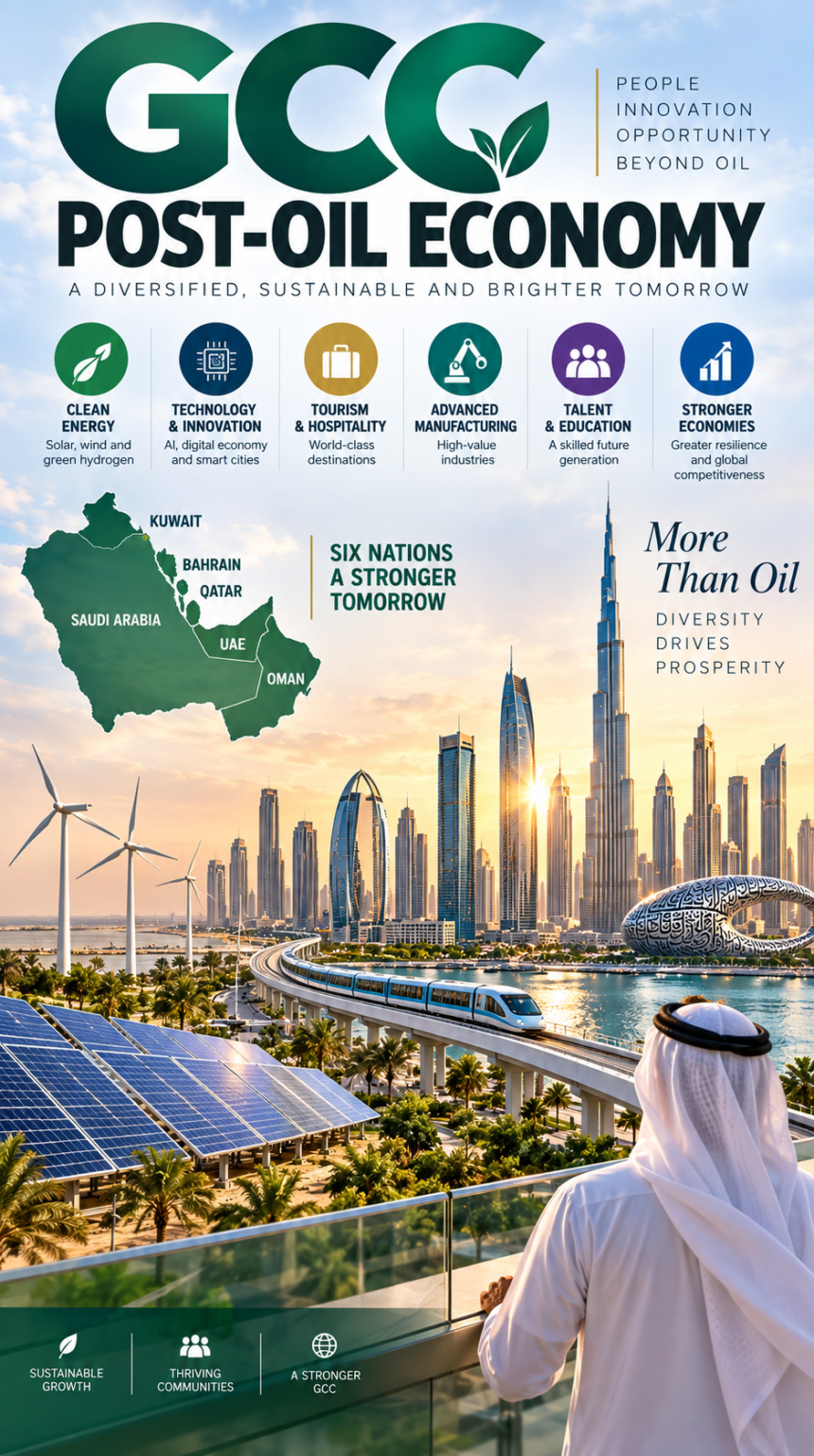
The GCC Post-Oil Economy is being built through tourism, manufacturing, artificial intelligence, logistics, financial services, aviation, renewable energy, entertainment, mining, digital businesses and private investment.
This does not mean Saudi Arabia, the UAE, Qatar, Kuwait, Oman and Bahrain expect oil and gas to disappear in the near future. Several GCC countries are continuing to invest heavily in hydrocarbon production because global energy demand remains important to their economies.
The strategy is instead about making national prosperity less dependent on what happens to the price of a barrel of oil.
That process is already visible. The World Bank reported that non-hydrocarbon activity across the GCC grew by around 3.9 percent in 2024 despite a contraction in the hydrocarbon sector. Its late-2025 Gulf Economic Update said diversification momentum had strengthened, although hydrocarbons still remained central to fiscal revenues and exports.
The transition is therefore real, but unfinished.
What Does a Post-Oil Economy Really Mean for the GCC?
The phrase “post-oil economy” can be misleading.
It does not necessarily describe a Gulf without oil.
A more realistic definition is an economy capable of generating jobs, government revenue, exports and investment from many industries rather than depending overwhelmingly on hydrocarbons.
A diversified economy might earn income from international tourists, financial services, artificial intelligence companies, factories, ports, airlines, renewable electricity, cloud computing or entertainment alongside oil and gas.
Diversification also needs to extend beyond GDP.
A country can have large non-oil sectors while government finances still depend heavily on hydrocarbon revenue. Similarly, a country may produce many services domestically while its exports remain dominated by oil, gas or petrochemicals.
The World Bank therefore describes diversification as multidimensional, involving the structure of domestic production, fiscal revenue and exports.
That distinction is critical when measuring Gulf progress.
How Far Has Gulf Economic Diversification Already Progressed?
The region has made clear progress, but countries are moving at different speeds.
The World Bank’s December 2025 review concluded that diversification across the GCC had advanced moderately over the previous decade, with more recent momentum looking particularly promising. It also warned that hydrocarbons still dominate government finances in much of the region.
Bahrain and the UAE entered the current period with relatively diversified economic structures. Saudi Arabia is undergoing one of the world’s largest state-led transformation programmes, while Oman has placed diversification at the centre of Vision 2040.
Qatar is expanding non-hydrocarbon activities while simultaneously increasing LNG production through the North Field expansion. Kuwait is pursuing structural reform and major infrastructure projects under Vision 2035.
In Saudi Arabia, non-oil activities now account for more than half of total output according to the Vision 2030 Annual Report 2025. The same report put the private sector’s contribution to GDP at 51 percent in 2025, compared with a 65 percent target for 2030.
These figures demonstrate that diversification is no longer simply a future objective.
GCC Post-Oil Economy Strategies at a Glance
| Country | Main Economic Strategy | Important Diversification Areas |
|---|---|---|
| UAE | We the UAE 2031, D33 and emirate-level plans | Trade, tourism, finance, technology, aviation, manufacturing |
| Saudi Arabia | Vision 2030 | Tourism, entertainment, manufacturing, logistics, mining, technology |
| Qatar | National Vision 2030 and Third National Development Strategy | Manufacturing, tourism, services, logistics, innovation |
| Bahrain | Economic Vision 2030 | Finance, ICT, manufacturing, logistics, tourism |
| Oman | Oman Vision 2040 | Logistics, tourism, mining, manufacturing, fisheries, green hydrogen |
| Kuwait | New Kuwait Vision 2035 | Finance, trade, logistics, tourism, infrastructure, digital economy |
The details differ, but several themes repeat across almost every national strategy: strengthen the private sector, attract foreign capital, develop local skills, increase exports and create industries capable of competing internationally.
Saudi Arabia Is Building New Industries Through Vision 2030
No Gulf diversification programme has attracted more international attention than Saudi Vision 2030.
Launched in 2016, the strategy is attempting to change the structure of an economy historically shaped by oil revenues.
Investment has moved into tourism, entertainment, sport, culture, mining, logistics, manufacturing, financial services and technology.
Saudi Arabia’s 2025 Vision report says the economy has surpassed US$1 trillion and that non-oil activities now contribute more than half of total output. Real non-oil GDP has expanded substantially since the beginning of the transformation programme.
The private sector is also expected to take a larger role.
Its contribution to GDP reached 51 percent in 2025 against the Vision 2030 target of 65 percent. Investment has expanded across tourism, technology, entertainment and special economic zones, while logistics centres and industrial cities are helping develop trade and manufacturing.
The Public Investment Fund has played an unusually important role by providing early capital for industries that previously had limited presence in the Kingdom.
However, the next stage may rely more heavily on private investors.
The IMF’s 2026 assessment welcomed Saudi Arabia’s recalibrated PIF strategy, which places greater emphasis on selective capital allocation and encouraging more private-sector participation.
That transition matters. Government investment can create a new industry, but sustainable diversification ultimately requires businesses that can operate competitively without permanent state support.
The UAE Is Expanding an Already Diversified Economy
The UAE entered the current diversification era from a different starting position.
Dubai had already developed major tourism, aviation, logistics, trade, property and financial industries decades before the current wave of Gulf transformation.
Abu Dhabi has since accelerated investment in technology, advanced manufacturing, renewable energy, finance and cultural tourism while retaining a major hydrocarbon industry.
The national We the UAE 2031 vision aims to double GDP from AED1.49 trillion to AED3 trillion, increase non-oil exports to AED800 billion and raise foreign trade to AED4 trillion. It also targets a tourism contribution to GDP of AED450 billion.
Dubai’s D33 Economic Agenda adds another layer.
D33 aims to double Dubai’s economy by 2033, raise foreign direct investment significantly, strengthen advanced manufacturing and exports, place Dubai among the world’s leading logistics and financial centres and generate an average AED100 billion annually from digital transformation.
This illustrates the UAE’s diversification model.
Rather than moving from oil directly into one replacement industry, the country is attempting to build multiple global economic hubs simultaneously.
Qatar Is Building Beyond LNG Without Abandoning Gas
Qatar demonstrates why “post-oil” does not necessarily mean abandoning hydrocarbons.
The country remains one of the world’s most important LNG producers and is expanding gas output through the North Field development.
At the same time, its Third National Development Strategy 2024-2030 aims to build stronger non-hydrocarbon industries.
The strategy targets average economic growth of around 4 percent annually through 2030 while supporting diversification sectors, specialised economic clusters and an innovation ecosystem led increasingly by the private sector.
Qatar also targets approximately 4 percent annual non-hydrocarbon GDP growth and wants SME contributions to non-hydrocarbon GDP to expand at around a 6 percent compound annual rate.
Manufacturing is receiving greater attention.
The Qatar National Manufacturing Strategy 2024-2030 focuses on expanding industrial capabilities, strengthening competitiveness and diversifying the country’s production base.
Qatar’s model is therefore less about replacing gas than using today’s hydrocarbon strength to finance a wider economy for tomorrow.
Oman Is Developing Tourism, Logistics, Mining and Green Energy
Oman’s diversification strategy is particularly important because its hydrocarbon reserves and fiscal capacity are smaller than those of several GCC neighbours.
Oman Vision 2040 sets a long-term target for non-oil activities to contribute more than 90 percent of GDP. Its broader strategy calls for a diversified economy based on technology, knowledge, innovation and stronger private-sector investment.
The country is pursuing multiple economic clusters rather than depending on one new sector.
Current initiatives include mining and mineral processing, tourism, fisheries, agriculture, logistics, manufacturing and renewable-energy supply chains. Oman Vision 2040’s recent implementation reporting highlights projects including mining clusters, cold-chain logistics in Duqm, tourism development in A’Dakhiliyah and potential domestic solar-panel manufacturing connected to green hydrogen.
The green hydrogen industry could become particularly important.
Oman’s large areas of land, strong solar and wind resources and ports facing international shipping routes provide advantages for producing hydrogen-derived fuels for export.
Non-oil growth is already becoming increasingly important. Oman Vision 2040 reporting said non-oil sectors grew at an average annual rate of 4.1 percent between 2021 and 2024.
Bahrain Shows What Early Diversification Can Look Like
Bahrain began reducing its dependence on oil earlier than most GCC economies.
It developed regional financial services in the twentieth century and later expanded aluminium manufacturing, logistics, tourism and digital industries.
Bahrain EDB said in 2025 that non-oil activities accounted for approximately 86 percent of GDP, making it one of the GCC’s most diversified economic structures.
Five sectors receive particular investment attention:
financial services, information and communication technology, manufacturing, logistics and tourism.
The country is also strengthening its digital economy. Bahrain’s National Digital Economy Strategy includes initiatives designed to improve digital investment, emerging technology adoption and innovation across sectors.
Bahrain’s challenge differs from that of larger Gulf economies.
Its domestic market and land area are small, so competitiveness depends heavily on regional connectivity, regulations, skilled workers and access to the wider GCC market.
That makes services and high-value industries especially important.
Kuwait Is Accelerating Its Vision 2035 Transformation
Kuwait possesses enormous financial reserves and one of the world’s oldest sovereign wealth funds, but diversification has historically progressed more slowly than in some neighbouring economies.
That makes the implementation of New Kuwait Vision 2035 particularly significant.
The strategy aims to strengthen Kuwait’s position as a financial and commercial hub while developing a more diverse and sustainable economy. Current reforms cover infrastructure, investment, digital commerce and private-sector participation.
Large infrastructure projects are central to the plan.
Development of Mubarak Al-Kabeer Port and the Northern Economic Zone is intended to strengthen logistics and trade connections, while airport expansion and other projects aim to improve Kuwait’s regional competitiveness.
Tourism is also receiving renewed attention.
The Visit Kuwait platform and partnerships with aviation companies are being used to encourage stopover tourism and position Kuwait more strongly on the regional tourism map.
Digital transformation provides another route. Kuwait has described digitalisation as a national necessity for Vision 2035 and is modernising infrastructure and government systems accordingly.
Kuwait therefore has substantial resources for diversification. The larger challenge is translating strategy and capital into implementation at sufficient speed.
Tourism Is Becoming a Major Gulf Economic Industry
Tourism may be the most visible symbol of diversification.
Dubai demonstrated years ago that a Gulf city could create a large international visitor economy without relying on natural greenery, historic European-style centres or traditional beach-tourism models.
Other GCC states are now developing their own approaches.
Saudi Arabia has opened major destinations and invested heavily in AlUla, the Red Sea, entertainment, sport and cultural events. Qatar used the infrastructure and international profile created around the FIFA World Cup to support a longer-term tourism industry.
Oman is developing its mountains, coastline, heritage and adventure tourism, while Bahrain is positioning itself around events, culture and short regional trips. Kuwait is increasing tourism promotion, and Abu Dhabi continues expanding museums, entertainment districts and luxury hospitality.
Tourism matters because its economic effect reaches beyond hotels.
Visitors spend on aviation, restaurants, taxis, retail, entertainment, cultural attractions and local services, spreading economic activity across many businesses.
Technology and AI Are Creating New Sources of Growth
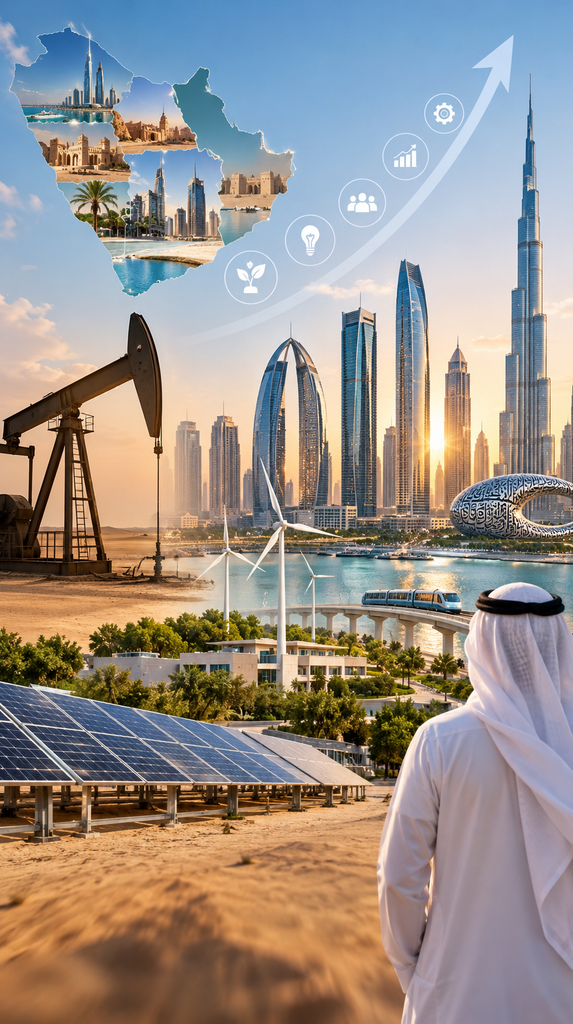
The GCC’s diversification plans increasingly involve building a digital economy rather than simply traditional non-oil sectors.
The World Bank said in December 2025 that all GCC states had advanced telecommunications networks, with 5G coverage exceeding 90 percent. It also highlighted expanding data centres, computing infrastructure and AI investment, particularly in Saudi Arabia and the UAE.
AI can contribute economically in several ways.
Technology companies create skilled jobs. Cloud and data-centre investment attracts capital. Digital government can reduce the cost of doing business, while fintech can expand financial services.
More importantly, AI can increase productivity in existing sectors such as logistics, healthcare, manufacturing and finance.
Bahrain is building a national digital-economy strategy. Qatar’s development plans target stronger digital competitiveness. Dubai expects digital transformation to make a major economic contribution under D33.
This shows that diversification increasingly means transforming old industries as well as creating entirely new ones.
Manufacturing Is Moving Higher Up the Value Chain
Industrial development is another major part of Gulf economic planning.
Historically, GCC manufacturing often focused on industries directly connected with inexpensive energy or hydrocarbons, particularly petrochemicals, aluminium and fertilisers.
Those industries remain important, but diversification strategies increasingly target advanced manufacturing.
Saudi Arabia is expanding industries linked to vehicles, defence, pharmaceuticals and mining. The UAE is investing in aerospace, food production, advanced technology and clean-energy manufacturing.
Qatar has launched a national manufacturing strategy intended to improve industrial competitiveness and develop more sophisticated production.
Oman’s diversification programme is focusing on adding value to domestic minerals and other natural resources rather than exporting everything in relatively unprocessed form.
The objective is straightforward: manufacture more of the final product locally and retain more economic value inside the country.
Logistics Is Turning Geography Into an Economic Advantage
The Gulf sits between Europe, Asia and Africa, close to some of the world’s most important shipping and aviation routes.
Diversification strategies are attempting to convert that location into long-term economic value.
Dubai built a global logistics industry around Jebel Ali, Emirates and Dubai International Airport. Abu Dhabi has expanded Khalifa Port and Etihad Airways.
Saudi Arabia wants to develop Riyadh and its ports into stronger international logistics hubs. Oman uses ports including Salalah, Sohar and Duqm to connect maritime routes outside the Strait of Hormuz.
Bahrain markets access to Saudi Arabia and the wider GCC as a major advantage for logistics companies.
Kuwait hopes Mubarak Al-Kabeer Port and its northern developments can support its ambition to become a commercial hub.
Logistics is attractive because it connects other sectors. Manufacturing needs ports. Tourism needs airports. E-commerce needs warehouses and distribution networks.
A successful logistics industry can therefore become economic infrastructure for diversification itself.
Financial Services and Fintech Are Expanding
Finance is another sector in which the Gulf has clear ambitions.
Dubai International Financial Centre has helped establish the UAE as an international financial hub, while Abu Dhabi Global Market has grown rapidly in asset management, fintech and international financial services.
Bahrain has decades of experience as a Gulf financial centre and continues investing in fintech and digital finance. Its economic plans place financial services among five priority non-oil sectors.
Saudi Arabia is expanding Riyadh’s role in financial markets while encouraging international companies to establish regional headquarters in the Kingdom.
Fintech also creates opportunities for smaller businesses because payment platforms, digital banking and online investment services can be scaled more easily than conventional physical infrastructure.
Strong capital markets are particularly important as governments try to shift more responsibility for economic growth from public spending towards private investment.
Renewable Energy and Green Hydrogen Could Create New Export Industries
The Gulf’s energy expertise may remain an advantage even in a lower-carbon global economy.
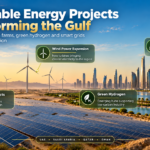
The UAE, Saudi Arabia and Oman are investing heavily in solar, wind, battery storage and green hydrogen.
The opportunity extends beyond replacing electricity generated from gas.
Renewable power could support industries such as green aluminium, low-carbon steel, hydrogen and ammonia.
Oman’s diversification strategy has already linked local solar-panel manufacturing with expected demand from the green-hydrogen sector.
Saudi Arabia’s NEOM hydrogen development similarly aims to create an exportable fuel using renewable electricity.
This creates an important possibility for the GCC.
The region may not move from being an energy exporter to a non-energy exporter. Instead, it could remain an important global energy supplier while changing what forms of energy it sells.
Sovereign Wealth Funds Are Helping Build New Sectors
Oil wealth is itself being used to reduce future dependence on oil.
This is one of the most interesting parts of Gulf diversification.
Sovereign wealth funds including Saudi Arabia’s PIF, Abu Dhabi’s ADIA and Mubadala, Qatar Investment Authority, Kuwait Investment Authority and Oman’s investment institutions hold enormous portfolios.
Historically, sovereign funds primarily protected national wealth by investing oil revenues internationally.
Their role is now becoming more complex.
Some funds invest domestically in infrastructure, new industries and businesses designed to accelerate diversification. Others use international investments to gain returns, technology, partnerships and global market access.
An IMF study published in 2025 found that inward cross-border investment had a significant positive relationship with GCC non-hydrocarbon GDP growth and that its medium-term effect was substantially larger than domestic investment in the study’s estimates.
The opportunity is considerable, but so is the need for discipline. Investments must eventually produce economic value rather than functioning primarily as expensive national showcases.
The Private Sector Will Decide Whether Diversification Succeeds
Government can construct airports, industrial zones and tourism attractions.
It cannot sustainably operate every restaurant, technology company, factory or logistics business.
That is why nearly every GCC economic vision gives the private sector a larger role.
Saudi Arabia wants private-sector GDP contribution to reach 65 percent by 2030. Qatar’s development strategy explicitly calls for the private sector to provide more services and drive growth. Oman Vision 2040 describes an empowered private sector as a central economic objective.
Private companies also create an important test of economic viability.
A government can fund a new industry during its early stages. If private investors later enter because they expect competitive returns, the sector has a better chance of becoming self-sustaining.
This is why regulatory reform, access to finance and easier business formation can be just as important as billion-dollar megaprojects.
New Skills and Jobs Are Essential for the Post-Oil Economy
Diversification changes what workers need to know.
An economy built around AI, advanced manufacturing, finance and renewable energy requires software engineers, technicians, researchers, financial specialists, designers, hospitality professionals and highly trained managers.
Nationalisation programmes are therefore increasingly connected with economic diversification.
The objective is not simply to employ more citizens. It is to ensure citizens can fill productive private-sector jobs in industries governments are trying to create.
Qatar wants skilled workers to represent 46 percent of its workforce and aims to increase the number of Qataris employed in private and public-private sectors.
Oman Vision 2040 similarly places employment, skills and an adaptable labour market at the centre of economic development.
Saudi Arabia’s transformation has also coincided with stronger labour-market participation, including major gains in female participation. The IMF highlighted these labour reforms when assessing Vision 2030 progress in 2026.
Education therefore becomes an economic policy, not just a social one.
Why Foreign Investment Matters to Gulf Diversification
Foreign investment brings more than money.
International companies can bring management experience, technology, global customers, supply chains and specialised knowledge.
That is why GCC countries compete intensely for regional headquarters, factories, financial institutions and technology companies.
Dubai’s D33 agenda aims for AED650 billion in FDI over a decade, supported by programmes designed to reduce business costs and attract international firms.
Kuwait is modernising legislation and introducing mechanisms such as regulatory sandboxes to create a stronger environment for digital businesses and entrepreneurs.
Saudi Arabia has created special economic zones and strengthened its position as a regional headquarters location.
The competition itself may benefit the wider region by pushing governments to improve regulations and infrastructure.
Oil and Gas Will Still Matter for Decades
Preparing for a post-oil economy does not mean the GCC is preparing to stop producing oil and gas tomorrow.
Qatar is expanding LNG capacity.
Saudi Arabia remains one of the world’s leading oil producers.
The UAE continues increasing hydrocarbon capacity while simultaneously becoming a major renewable-energy investor.
Kuwait’s 2026 economic strategy continues to emphasise improving the long-term value obtained from its petroleum resources even while Vision 2035 promotes a more diverse economy.
This may appear contradictory, but the logic is understandable.
Hydrocarbon income can finance infrastructure and investment required for diversification while global demand still exists.
The difficult question is how effectively today’s energy income is converted into assets, industries and human capabilities capable of generating tomorrow’s income.
Major Challenges Facing the GCC Post-Oil Economy
Diversification is expensive and complicated.
Some new industries may never become globally competitive. Large projects can consume considerable capital, and governments must decide which investments deserve priority.
Oil-price volatility remains another risk. Lower prices can reduce the revenues available to fund diversification at exactly the moment economic reform becomes more important.
The IMF and World Bank continue to emphasise fiscal discipline alongside diversification. The World Bank has warned that hydrocarbons remain central to fiscal positions even as non-oil activity expands.
There is also intense competition within the GCC.
Dubai, Riyadh, Doha, Manama, Muscat and Kuwait City all want international companies, tourists, investment and talented workers.
Another challenge is productivity.
Creating jobs alone is not enough. New industries must produce economic value that can compete internationally.
Finally, successful diversification requires a balance between government direction and private enterprise. Too little state investment can make difficult transformations impossible, but too much can crowd out businesses that need to become the long-term engine of growth.
What Could the Gulf Economy Look Like by 2030?
By 2030, oil and gas will probably remain extremely important.
What should look different is everything around them.
Saudi Arabia could have substantially larger tourism, entertainment, mining, logistics and technology industries, with private companies responsible for more economic activity.
The UAE aims to have a significantly larger economy supported by non-oil exports, international trade, finance, tourism, technology and advanced manufacturing.
Qatar expects the North Field expansion to reinforce its LNG leadership while its Third National Development Strategy develops stronger non-hydrocarbon clusters and private businesses.
Oman aims for non-oil activities to represent approximately 83.9 percent of GDP by 2030 on the way towards a target above 90 percent by 2040.
Bahrain will continue building on an economy already dominated by non-oil sectors, while Kuwait’s progress will depend heavily on how rapidly major Vision 2035 reforms and infrastructure projects are implemented.
The broader regional economy could therefore become more connected as well as more diversified.
Tourists may move between several GCC destinations, regional rail and logistics infrastructure may strengthen trade, and companies may increasingly treat the six states as one interconnected market.
Final Thoughts on How the GCC Is Preparing for a Post-Oil Economy
The GCC Post-Oil Economy is not being built because the Gulf suddenly expects oil to disappear.
It is being built because depending too heavily on one commodity creates economic risk.
Saudi Arabia is using Vision 2030 to create industries that barely existed at scale a decade ago. Non-oil activities now account for more than half of its output, and policymakers are increasingly focusing on private-sector-led growth.
The UAE is expanding an already diversified economy through technology, finance, tourism, manufacturing and international trade, with We the UAE 2031 targeting AED3 trillion in GDP and AED800 billion in non-oil exports.
Qatar is building manufacturing, tourism and private-sector activity while continuing to expand LNG production. Oman is developing mining, logistics, tourism, manufacturing and green hydrogen under a Vision 2040 strategy that ultimately targets more than 90 percent non-oil GDP.
Bahrain offers an example of an economy where non-oil sectors already account for the overwhelming majority of output, led by finance, manufacturing, ICT, logistics and tourism.
Kuwait has substantial financial resources and is now pushing Vision 2035 through infrastructure, tourism, digitalisation, investment reforms and plans to strengthen its position as a regional financial and commercial centre.
The region still has considerable work ahead. The World Bank’s assessment is an important reminder that diversification has progressed, but hydrocarbon revenues continue to exert enormous influence over Gulf economies.
The real measure of success will therefore not be how many spectacular projects the GCC builds.
It will be whether tourism companies, technology startups, factories, banks, logistics groups, renewable-energy businesses and other private industries can continue creating jobs, exports and tax revenue even during periods when oil prices are weak.
If that happens, the Gulf will not simply have prepared for a world after oil.
It will have used the wealth created by one economic era to build the foundations of the next one.
Do follow us on Instagram
Read More – Renewable Energy Projects Transforming the Gulf