



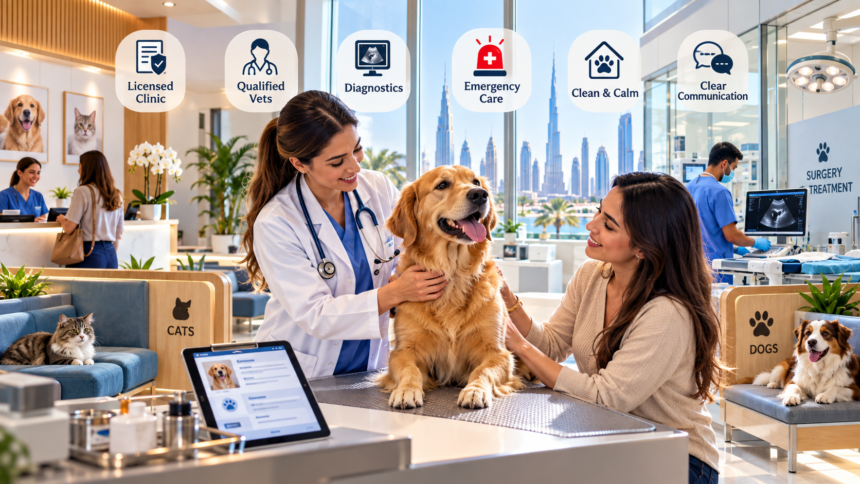
Why Choosing the Right Veterinary Clinic in Gulf Matters
Finding the right veterinary clinic in Gulf countries is an important decision for anyone living with a dog, cat, bird or other companion animal. A clinic is not only a place to visit when a pet becomes sick. It can become an important part of your pet’s long term healthcare routine.
- What Should You Look for in a Veterinary Clinic
- 1. Check the Veterinary Team and Qualifications
- 2. Choose a Clinic That Understands Your Pet
- 3. Consider the Clinic’s Location
- 4. Ask About Emergency and After Hours Care
- 5. Look at the Diagnostic Facilities
- 6. Check Preventive Healthcare Services
- 7. Ask About Pet Dental Care
- 8. Compare Prices Without Choosing on Price Alone
- 9. Look for Clear Communication
- 10. Consider Cleanliness and Pet-Friendly Design
- 11. Check Whether the Clinic Offers Specialist Referrals
- 12. Read Reviews Carefully
- How Do You Know if a Clinic Is Right for Your Pet
- Veterinary Care in the UAE
- Veterinary Care in Saudi Arabia
- Veterinary Care in Qatar
- Veterinary Care in Bahrain
- Veterinary Care in Oman
- Veterinary Care in Kuwait
- What Should You Ask During Your First Visit
- What If Your Pet Needs Emergency Care
- How Often Should Your Pet Visit a Veterinarian
- Common Mistakes Pet Owners Make
- Quick Veterinary Clinic Comparison Checklist
- What Makes a Good Long Term Veterinary Relationship
- Final Thoughts on Choosing a Veterinary Clinic in Gulf
Regular veterinary care can include vaccinations, preventive examinations, dental care, parasite control, nutrition advice, diagnostic testing and treatment for illnesses or injuries. The right clinic should therefore be able to provide dependable care while making both the pet and owner feel comfortable.
The Gulf is home to a growing number of pet owners, particularly in major cities such as Dubai, Abu Dhabi, Riyadh, Doha, Manama, Muscat and Kuwait City. Veterinary services can range from small neighbourhood practices to large animal hospitals offering specialist departments and advanced diagnostic equipment.
This means having more choices is useful, but it can also make the decision more complicated.
Instead of choosing a clinic simply because it is nearby or has attractive reviews, pet owners should look at several practical factors.
What Should You Look for in a Veterinary Clinic
A good veterinary clinic should match your pet’s needs rather than simply offer the longest list of services.
Before making a decision, consider these areas:
| Factor | Why It Matters |
|---|---|
| Qualified veterinary team | Ensures professional medical care |
| Emergency services | Important during sudden illness or injury |
| Location | Makes regular and urgent visits easier |
| Diagnostic facilities | Helps identify health problems |
| Preventive care | Supports long term pet health |
| Specialist access | Useful for complex conditions |
| Clean environment | Important for infection control |
| Communication | Helps owners understand treatment |
| Transparent pricing | Makes healthcare costs easier to manage |
| After hours support | Valuable when problems occur outside normal hours |
A clinic does not necessarily need to provide every specialist service itself.
What matters is whether it can provide appropriate primary care and refer your pet to a suitable specialist when necessary.
1. Check the Veterinary Team and Qualifications
The first thing to investigate is who will actually care for your pet.
Look for information about the veterinarians working at the clinic and their areas of experience. Some may have particular interests in surgery, dermatology, internal medicine, dentistry, emergency medicine or exotic animals.
If your pet has a specific medical need, ask whether the veterinarian regularly treats similar cases.
Questions worth asking include:
- What qualifications do the veterinarians have?
- How much experience do they have with my type of pet?
- Are there veterinarians with specialist interests?
- Who handles surgery?
- Is there access to specialist referral services?
Professional licensing requirements vary between Gulf countries, so owners should use clinics operating under the relevant local veterinary regulations.
A professional website or clinic profile can provide useful background, but owners should also feel comfortable asking the clinic directly about qualifications and services.
2. Choose a Clinic That Understands Your Pet
Not every veterinary practice is equally suited to every animal.
A clinic may primarily treat dogs and cats, while another may have experience with birds, rabbits, reptiles or other exotic pets.
This distinction matters.
A bird, rabbit or reptile can have very different healthcare requirements from a dog or cat.
Before registering your pet, ask:
| Pet Type | What to Check |
|---|---|
| Dog | Vaccinations, surgery, dental and emergency care |
| Cat | Preventive care, dental services and diagnostics |
| Rabbit | Dental, gastrointestinal and specialised care |
| Bird | Avian veterinary experience |
| Reptile | Exotic animal expertise |
| Senior pet | Chronic disease and diagnostic monitoring |
If the clinic does not regularly treat your type of animal, ask where they recommend going for specialist care.
3. Consider the Clinic’s Location
Location becomes especially important during emergencies.
A clinic that is 15 minutes away may be much more practical than one across the city, particularly if your pet suddenly becomes seriously unwell.
However, proximity should not be the only factor.
A nearby clinic without emergency services may not be useful when your pet requires overnight monitoring or surgery.
Think about two separate needs:
Routine care
Vaccinations, checkups and minor illnesses can usually be handled by a convenient local clinic.
Emergency care
Serious injuries, poisoning, breathing difficulties or sudden deterioration may require a hospital with emergency facilities.
Some pet owners therefore use a local clinic for routine care while keeping the details of a larger emergency hospital available.
4. Ask About Emergency and After Hours Care
One of the most important questions to ask before your pet becomes sick is:
What happens if my pet needs help at midnight?
Not every veterinary clinic operates 24 hours.
Some clinics have emergency teams, while others direct clients to another hospital after closing.
Find out:
- Is emergency care available?
- What are the clinic’s opening hours?
- Is there an after hours telephone number?
- Can pets be admitted overnight?
- Is there an intensive care facility?
- Where are emergency cases referred?
Write the emergency contact information somewhere easily accessible.
Saving it in your phone is useful, but keeping a printed version at home can also help when someone else is caring for your pet.
5. Look at the Diagnostic Facilities
Modern veterinary medicine can involve much more than a physical examination.
Depending on the clinic, diagnostic services may include:
- Blood testing
- Urine testing
- X rays
- Ultrasound
- Microscopy
- Laboratory testing
- ECG
- Endoscopy
- Advanced imaging through referral
You do not need a clinic with every possible machine.
Instead, consider whether the clinic has the equipment appropriate for your pet’s likely needs and whether it has reliable referral arrangements for advanced diagnostics.
For example, a general clinic may handle vaccinations and routine blood tests while referring complicated imaging cases to a specialist hospital.
6. Check Preventive Healthcare Services
Preventive care is one of the most important reasons to establish a relationship with a veterinary clinic.
Regular appointments can help monitor your pet’s health before a small problem becomes a major one.
Depending on the animal, preventive care may include:
- Vaccinations
- Parasite prevention
- Dental examinations
- Weight monitoring
- Nutrition advice
- Routine blood tests
- Microchipping
- Reproductive health
- Senior pet screening
The exact schedule depends on the animal, age, lifestyle and veterinary advice.
Pets that spend significant time outdoors may have different parasite and vaccination considerations from pets that live entirely indoors.
This is particularly relevant in Gulf climates, where high temperatures can also affect how owners manage exercise, hydration and outdoor exposure.
7. Ask About Pet Dental Care
Dental health is sometimes overlooked by pet owners.
Dental disease can affect eating, comfort and overall health.
A good veterinary clinic should be able to examine your pet’s teeth and gums during routine visits and explain whether professional cleaning or further treatment is required.
Ask whether the clinic provides:
- Dental examinations
- Professional cleaning
- Dental X rays where appropriate
- Dental surgery
- Home dental care advice
Your veterinarian can also explain how frequently your pet should receive dental checks.
Do not wait until your pet stops eating before considering oral health.
8. Compare Prices Without Choosing on Price Alone
Veterinary costs can vary significantly depending on the clinic, treatment, equipment and complexity of the case.
Before registering, ask for general pricing information for routine services.
You can compare:
| Service | What to Ask |
|---|---|
| Consultation | Standard consultation fee |
| Vaccination | Which vaccines are included |
| Blood test | Basic or comprehensive panel |
| Dental cleaning | Whether anaesthesia is included |
| Surgery | What the estimate covers |
| Emergency visit | Consultation and after hours charges |
| Hospitalisation | Daily monitoring and treatment costs |
| Imaging | Separate scan and consultation fees |
Do not automatically choose the cheapest clinic.
At the same time, expensive does not automatically mean better.
The goal is to understand what you are paying for and whether the clinic communicates costs clearly.
For major procedures, ask for a written estimate whenever possible.
9. Look for Clear Communication
Good veterinary care also depends on communication.
Pet owners need to understand what is happening, particularly when a diagnosis or treatment plan is complicated.
A veterinarian should ideally explain:
- What they think is wrong
- Which tests are recommended
- Why a test is necessary
- What treatment options exist
- Possible risks
- Expected recovery
- Follow up requirements
You should feel comfortable asking questions.
If you do not understand a medical term, ask the veterinarian to explain it in simpler language.
A strong clinic should make owners feel informed rather than pressured.
10. Consider Cleanliness and Pet-Friendly Design
Take a few minutes to observe the clinic environment.
Does the reception area look clean?
Are animals handled calmly?
Are sick animals separated where appropriate?
Is equipment stored properly?
Does the team appear organised?
A veterinary clinic can never be completely free from the realities of treating sick animals, but basic cleanliness and organisation should be visible.
A well-designed waiting area can also reduce stress.
Some clinics separate cats and dogs or provide quieter spaces for nervous animals.
This can be especially useful for cats, which may become stressed in busy environments.
11. Check Whether the Clinic Offers Specialist Referrals
No clinic can treat every possible condition.
A good primary veterinarian should recognise when a case requires specialist expertise.
Ask whether the clinic has referral relationships with:
- Veterinary surgeons
- Dermatologists
- Ophthalmologists
- Cardiologists
- Neurologists
- Oncologists
- Rehabilitation specialists
- Emergency hospitals
This can make a major difference when your pet develops a complex condition.
The best clinic for your pet may not be the one that does everything itself.
It may be the one that knows when another professional is needed.
12. Read Reviews Carefully
Online reviews can help, but they should not be your only source of information.
Look for patterns rather than focusing on one extremely positive or negative comment.
Pay attention to reviews discussing:
- Veterinary communication
- Waiting times
- Treatment quality
- Emergency handling
- Pricing transparency
- Staff behaviour
- Follow up care
A single complaint does not necessarily reveal the quality of an entire clinic.
Likewise, dozens of positive reviews do not guarantee that every pet will have the same experience.
Use reviews as one part of your research.
How Do You Know if a Clinic Is Right for Your Pet
Sometimes the easiest way to evaluate a clinic is to make an initial routine appointment.
A vaccination or general health check can give you an opportunity to observe how the clinic works without waiting for a medical emergency.
During the visit, ask yourself:
Does the veterinarian listen carefully?
Are my questions answered clearly?
Does the team handle my pet gently?
Are treatment options explained?
Are costs communicated clearly?
Does my pet appear comfortable around the staff?
These observations can tell you more than an online advertisement.
Veterinary Care in the UAE
The UAE has a large and growing pet care market, particularly in Dubai and Abu Dhabi.
Pet owners can find general veterinary clinics, animal hospitals, specialist practices, grooming facilities and emergency services.
The UAE’s Ministry of Climate Change and Environment regulates veterinary medicine and animal health matters at the federal level, while local authorities also play important roles.
Dubai Municipality provides veterinary and animal-related services and regulates several aspects of animal welfare and veterinary activity in the emirate.
When selecting a clinic, owners should confirm that the facility operates legally and that veterinary professionals are appropriately licensed.
What UAE Pet Owners Should Check
- Clinic licensing
- Veterinary qualifications
- Emergency arrangements
- Vaccination services
- Microchip services
- Pet travel documentation
- Specialist referrals
- Pricing
- After hours support
Pet owners who travel internationally should also ask whether the clinic can assist with health certificates and other travel documentation.
Veterinary Care in Saudi Arabia
Saudi Arabia has an expanding pet care sector, particularly in Riyadh, Jeddah and other major urban centres.
Pet owners can find general practices as well as hospitals offering diagnostic, surgical and specialist services.
When choosing a clinic, owners should verify that veterinarians and facilities meet the applicable Saudi regulatory requirements.
Questions for Saudi Pet Owners
Does the clinic handle my type of pet?
Is emergency care available?
Can laboratory testing be completed on site?
Does the clinic provide vaccination records?
Can it support international pet travel if needed?
The availability of advanced services can differ significantly between cities, so owners in smaller communities may need to identify referral hospitals in larger urban centres.
Veterinary Care in Qatar
Qatar has a growing pet ownership community, especially in Doha.
Veterinary clinics and animal hospitals provide services ranging from routine preventive care to surgery and diagnostic testing.
Pet owners should check whether a clinic is licensed and whether the veterinary professionals are appropriately registered under Qatar’s regulatory system.
For owners with pets requiring specialist treatment, it is worth asking whether the clinic provides referrals or has access to specialists.
Doha’s concentration of services can make it easier to find specialised veterinary care compared with smaller communities.
Veterinary Care in Bahrain
Bahrain offers veterinary services through clinics and animal care facilities, particularly around Manama and other populated areas.
Owners should compare clinics based on the specific needs of their pets.
For routine care, a smaller practice may be perfectly suitable.
For complicated surgery, overnight hospitalisation or specialist treatment, a larger facility may be more appropriate.
Bahrain Pet Care Questions
- Does the clinic provide emergency support?
- Are vaccinations available?
- Can it perform laboratory testing?
- Does it handle exotic animals?
- Does it provide travel documentation?
- Where are complex cases referred?
Understanding the referral network can be particularly useful when choosing a long-term veterinarian.
Veterinary Care in Oman
Oman has veterinary services in Muscat and other urban areas, with options varying by location.
Pet owners living outside major cities should pay particular attention to emergency planning.
A clinic may be suitable for routine appointments but may not provide overnight emergency treatment.
Before choosing a primary veterinarian, identify the nearest facility capable of handling serious emergencies.
This is especially important for owners living in areas where travel times can be longer.
Veterinary Care in Kuwait
Kuwait has a growing network of private veterinary clinics and animal care facilities.
Pet owners should compare the range of services, veterinary experience, diagnostic facilities and emergency arrangements.
For pets with chronic conditions, continuity of care can be particularly valuable.
Ask whether the clinic maintains detailed medical records and whether the same veterinary team can monitor your pet over time.
What Should You Ask During Your First Visit
A first appointment is an opportunity to establish a relationship.
You can prepare questions in advance.
About your pet
- Is my pet’s weight healthy?
- Are vaccinations up to date?
- Does my pet need parasite prevention?
- Should I change the diet?
- Are there any signs I should monitor?
About the clinic
- Who will normally treat my pet?
- What happens during emergencies?
- Do you provide after hours support?
- Which specialists do you refer to?
- Can I access my pet’s medical records?
About costs
- What does a routine consultation cost?
- How are major procedures estimated?
- Are emergency charges different?
- Is payment required before treatment?
Writing down the answers can make it easier to compare clinics.
What If Your Pet Needs Emergency Care
A pet emergency can be stressful, particularly if you have never used a veterinary hospital before.
Some warning signs that require urgent professional assessment can include:
- Difficulty breathing
- Severe bleeding
- Loss of consciousness
- Seizures
- Suspected poisoning
- Serious trauma
- Sudden inability to stand
- Severe abdominal swelling
- Repeated vomiting with weakness
Do not rely on online advice to manage a potentially serious emergency.
Call a veterinary professional or emergency animal hospital and follow their instructions.
Keep an Emergency Pet Kit Ready
At home, keep:
- Your veterinarian’s number
- Emergency clinic details
- Pet medical records
- Vaccination records
- Medication information
- Microchip details
- Transport carrier
- Basic pet first aid supplies
Having these details ready can save valuable time.
How Often Should Your Pet Visit a Veterinarian
There is no single schedule that applies to every animal.
Young pets, senior animals and pets with chronic conditions may require more frequent monitoring.
Healthy adult pets may have different preventive care schedules.
Your veterinarian can recommend an appropriate timetable based on:
- Age
- Breed
- Lifestyle
- Existing conditions
- Vaccination history
- Diet
- Activity level
Regular checkups are useful because some conditions may not produce obvious symptoms in the early stages.
A pet can appear perfectly healthy while still having an underlying problem.
Common Mistakes Pet Owners Make
Choosing a clinic only because it is close is one common mistake.
Location matters, but expertise and emergency access matter too.
Another mistake is waiting until an emergency to discover that the regular clinic does not provide after hours care.
Pet owners also sometimes focus entirely on consultation prices without considering the full treatment package.
Other common mistakes include:
- Ignoring preventive care
- Skipping dental checks
- Not keeping vaccination records
- Failing to update contact information
- Using online advice instead of veterinary assessment
- Not asking about medication side effects
- Changing food suddenly without guidance
- Ignoring changes in behaviour
- Waiting too long before seeking help
A good relationship with a veterinarian can help prevent many of these problems.
Quick Veterinary Clinic Comparison Checklist
| Question | Yes or No |
|---|---|
| Is the clinic appropriately licensed? | |
| Are veterinarians qualified and registered? | |
| Does the clinic treat your type of pet? | |
| Is emergency care available? | |
| Is there after hours support? | |
| Are diagnostic tests available? | |
| Are specialist referrals available? | |
| Are prices explained clearly? | |
| Is the clinic clean and organised? | |
| Does the team communicate well? | |
| Are medical records maintained? | |
| Is the location practical for emergencies? |
You can use this checklist when comparing two or three clinics before making a decision.
What Makes a Good Long Term Veterinary Relationship
Choosing a clinic is only the beginning.
The strongest pet healthcare relationships develop over time.
When the same veterinary team knows your pet’s history, they can more easily identify changes in weight, behaviour, appetite or test results.
This can be especially valuable for senior pets.
A long-term veterinarian may also become familiar with your pet’s normal behaviour.
That means small changes can become easier to identify.
For example, a pet that has always been energetic but suddenly becomes unusually quiet may need attention even if there are no obvious physical symptoms.
Medical history provides context.
Final Thoughts on Choosing a Veterinary Clinic in Gulf
Choosing the right veterinary clinic in Gulf countries should be approached as a long-term decision rather than a simple search for the closest practice.
Start by checking whether the clinic is properly licensed and whether its veterinarians are qualified to provide the services your pet needs.
Then look beyond basic consultations.
Consider emergency care, diagnostics, preventive healthcare, specialist referrals, communication, cleanliness and pricing transparency.
The best clinic for one pet may not be the best clinic for another.
A young indoor cat may need regular vaccinations, dental care and preventive examinations.
A senior dog may require blood testing, imaging and chronic disease monitoring.
A rabbit, bird or reptile may need a veterinarian with specialist knowledge.
Your pet’s individual needs should therefore guide the decision.
Location also matters.
In the Gulf’s large metropolitan areas, traffic and travel time can become significant factors. Having a dependable clinic relatively close to home can make routine appointments easier, while knowing the location of a 24 hour emergency facility can provide additional peace of mind.
Most importantly, do not wait for an emergency to research veterinary care.
Choose a primary clinic while your pet is healthy.
Arrange a routine checkup.
Ask questions.
Understand the clinic’s emergency procedures.
Keep your pet’s medical records organised.
Once you find a veterinary team that communicates clearly, handles your pet gently and provides appropriate professional care, maintaining that relationship can become one of the most valuable parts of your pet’s long-term wellbeing.
For pet owners across the UAE, Saudi Arabia, Qatar, Bahrain, Oman and Kuwait, the goal is not simply to find a clinic that can treat illness.
It is to find a professional healthcare partner that can help your pet stay healthy, recognise problems early and provide appropriate care when circumstances change.
That is what makes choosing the right Veterinary Clinic in Gulf an important decision for every responsible pet owner.
Do follow us on Instagram
Read More – How to Choose the Right Veterinary Clinic in Dubai for Your Pet