


Why the End of the A380 Era Will Matter for Dubai
For nearly two decades, the Emirates Airbus A380 has been one of the most recognisable symbols of global aviation. The enormous double-decker aircraft helped define Dubai’s rise as an international aviation hub, transformed the way Emirates handled high-volume long-haul routes and became closely associated with some of the airline’s most famous passenger experiences, including its onboard lounge and First Class shower suites.
- Emirates A380 Retirement: What Has Actually Been Announced?
- Why the Airbus A380 Became So Important to Emirates
- Why Emirates Cannot Keep the A380 Flying Forever
- Emirates Is Still Spending Billions Upgrading the A380
- Premium Economy Is Giving the A380 a New Role
- What Will Replace the Emirates A380?
- Why the Boeing 777X Matters So Much to Emirates
- Emirates Is Building Long-Term A380 Maintenance Capability
- Could the A380 Really Keep Flying Until 2040?
- What Happens to Emirates A380s After Retirement?
- What the Emirates A380 Retirement Means for Passengers
- Why the End of the A380 Era Will Matter for Dubai
- Why Airlines Around the World Moved Away From Very Large Aircraft
- Could Emirates Ever Order Another Aircraft as Large as the A380?
- How the A380 Could Become Even More Iconic as Retirement Approaches
- Emirates A380 Retirement Does Not Mean Goodbye Yet
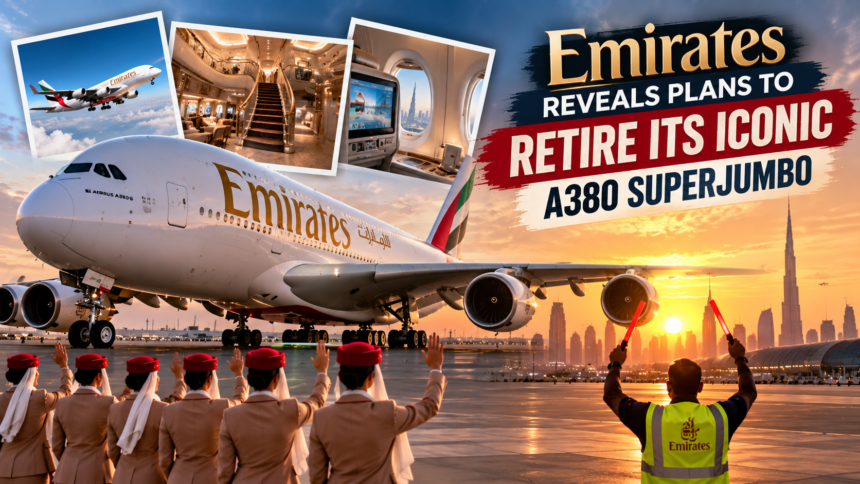
Now, however, Emirates has publicly acknowledged that the Emirates A380 retirement is part of its long-term fleet strategy.
The airline expects the superjumbo to remain in service for many more years, but senior executives have indicated that the fleet could be phased out around 2040. The reason is not a sudden decline in demand for the aircraft. Instead, ageing airframes, increasingly complex maintenance requirements, spare-parts availability and the efficiency advantages of newer twin-engine aircraft will eventually make continued operation more difficult.
That creates an unusual situation for Emirates. The airline is preparing for the A380’s eventual retirement while simultaneously investing billions of dollars in cabin upgrades, engine maintenance capability and long-term technical support to keep the aircraft flying through much of the next decade.
The result is not an immediate goodbye. It is the beginning of a very long farewell.
For passengers, aviation enthusiasts and anyone interested in Dubai’s growth as a global travel hub, the story matters because the A380 is more than another aircraft type in the Emirates fleet. It became part of the airline’s identity and one of the strongest visual symbols associated with Dubai International Airport.
Here is what the retirement plan really means, why the A380 cannot remain in service forever, what could replace it and why Emirates is still spending heavily on an aircraft it ultimately plans to phase out.
Emirates A380 Retirement: What Has Actually Been Announced?
The most important point is simple: the Emirates A380 is not disappearing soon.
The airline expects the superjumbo to remain in service until approximately 2040, with the fleet likely shrinking gradually rather than being retired all at once. Emirates deputy president and chief operations officer Adel Al Redha has discussed the challenges of keeping such a large, ageing aircraft fleet operating indefinitely, particularly as maintenance becomes more complicated and expensive.
Emirates currently operates the world’s largest A380 fleet by a significant margin. The airline has around 116 aircraft in its broader A380 inventory, although not every aircraft is operating at the same time because some are undergoing maintenance, retrofits or other technical work.
| Key A380 Detail | Current Position |
|---|---|
| Expected final phase-out | Around 2040 |
| Emirates A380 fleet | Around 116 aircraft |
| Approximate number actively operating | Around 90 |
| Remaining aircraft | Maintenance, retrofit or technical work |
| Main future flagship | Boeing 777X |
| Direct capacity replacement available | No |
| Retrofit programme | Ongoing |
| Engine support | Extending into the 2040s |
The key word is phase-out.
Aircraft retirement usually happens in stages. Emirates will not simply stop flying every A380 on the same date. Older aircraft may leave the fleet first, while recently refurbished or technically stronger examples remain in service for longer.
That means the final years of A380 operations could look very different from the fleet today. Emirates may increasingly concentrate the aircraft on routes where demand is high enough to justify such enormous capacity.
What passengers should understand
For anyone planning to fly Emirates during the next several years, there is no reason to assume the A380 experience is about to disappear. The aircraft remains central to many major long-haul routes and will continue operating across the airline’s global network.
The retirement announcement is therefore more about long-term fleet planning than an immediate operational change.
Why the Airbus A380 Became So Important to Emirates
Few airline-aircraft relationships have been as closely connected as Emirates and the Airbus A380.
When Airbus designed the A380, the idea was that major global hubs would need extremely large aircraft to carry increasing numbers of passengers between heavily congested airports. Emirates became the airline that embraced that concept more successfully than anyone else.
Dubai’s geographic position made the strategy particularly effective.
The city sits between Europe, Asia and Africa, allowing Emirates to connect passengers travelling between continents through a single hub. Large numbers of passengers could arrive in Dubai on one flight and then continue to dozens of destinations across the network.
The A380 fitted that hub-and-spoke model unusually well.
Why the aircraft worked for Emirates
- Dubai developed into a major international connecting hub.
- Emirates concentrated large passenger flows through DXB.
- The airline operated high-demand long-haul routes.
- The A380 could carry hundreds of passengers on a single flight.
- Premium cabins gave Emirates a powerful marketing advantage.
- Dubai International invested heavily in A380 infrastructure.
Other airlines often struggled with the superjumbo because filling more than 500 seats consistently can be difficult.
Emirates had a different problem. On many routes, particularly between Dubai and cities such as London, Sydney or Bangkok, the challenge was not finding passengers but providing enough capacity.
That made the A380 unusually valuable.
The aircraft also became a brand symbol
The A380 was not merely large. Emirates turned it into an experience.
Its onboard lounge gave Business and First Class passengers a social space that looked more like part of a luxury hotel than a conventional aircraft cabin.
Its First Class shower suites became one of commercial aviation’s most famous premium features.
Even Economy passengers often associated the aircraft with a quieter and more spacious-feeling cabin than many conventional widebody jets.
Over time, the A380 became deeply connected with the Emirates image: large scale, long-haul travel and premium service.
Why Emirates Cannot Keep the A380 Flying Forever
The biggest challenge facing the A380 is not passenger demand. It is the economics and engineering of ageing aircraft.
Airbus ended production of the A380 after airlines increasingly shifted towards smaller, more efficient twin-engine widebody aircraft. The final A380 was delivered in 2021.
Once production stops, long-term fleet management becomes more complicated.
Maintenance becomes increasingly demanding
As aircraft age, they require deeper structural inspections, more component replacements and more expensive maintenance checks.
Emirates can keep an A380 technically airworthy for many years, but the economic question eventually becomes whether continuing that work makes financial sense.
A large four-engine aircraft also has more systems and components that require maintenance than a modern twinjet.
Four engines increase costs
The A380 was designed during a period when four-engine long-haul aircraft were still common.
Modern aircraft such as the Boeing 777X and Airbus A350 rely on two extremely powerful engines instead.
Fewer engines generally mean:
- Lower fuel consumption
- Reduced maintenance complexity
- Fewer engine overhauls
- Lower operating costs
- Better environmental performance
For an airline operating more than 100 A380s, those differences become enormous when multiplied across thousands of flights.
Spare parts become more important
Because no new A380s are being produced, operators must increasingly depend on existing inventories, specialised suppliers and components removed from retired aircraft.
This does not mean parts suddenly disappear. Airlines can plan many years ahead and maintain significant inventories.
However, the cost and complexity usually increase as the active global fleet becomes smaller.
Long-Term A380 Challenges
| Challenge | Why It Matters |
|---|---|
| Production has ended | No new aircraft or production pipeline |
| Four-engine design | Higher fuel and maintenance costs |
| Ageing fleet | More intensive inspections required |
| Parts availability | Increasing importance over time |
| Newer twinjets | Better efficiency |
| Huge capacity | Difficult to replace directly |
| Special infrastructure | Requires suitable airport facilities |
Ultimately, even a successful aircraft reaches the point where replacement becomes economically logical.
For Emirates, the challenge is finding that point without losing too much of the passenger capacity the A380 currently provides.
Emirates Is Still Spending Billions Upgrading the A380
At first glance, there seems to be a contradiction.
Why would Emirates invest billions of dollars upgrading an aircraft it already knows will eventually be retired?
The answer is time.
If the A380 continues flying until around 2040, many aircraft still have more than a decade of commercial service remaining.
That is long enough for a major cabin refurbishment to make economic sense.
Emirates has been carrying out one of the airline industry’s largest retrofit programmes, covering both A380s and Boeing 777s.
The programme includes dozens of aircraft receiving full cabin overhauls.
What is changing onboard
Upgraded aircraft can receive:
- Premium Economy cabins
- Refreshed Economy seats
- Improved Business Class seating
- New entertainment screens
- Updated cabin finishes
- Improved connectivity
- Refurbished onboard lounges
- New carpets and interior materials
These changes help Emirates maintain a competitive product while waiting for newer aircraft to enter the fleet.
Why retrofit instead of simply waiting for new aircraft?
Aircraft-delivery schedules are not always predictable.
The Boeing 777X programme has faced repeated delays, while Emirates still needs to operate its existing network every day.
Retrofitting older aircraft allows the airline to improve the passenger experience without waiting years for replacement jets.
There is also a revenue argument.
A modern Premium Economy cabin can generate more revenue than standard Economy while giving passengers a lower-cost alternative to Business Class.
That means an upgraded A380 can continue generating value even in the later stages of its operational life.
Premium Economy Is Giving the A380 a New Role
One of the biggest changes inside the Emirates A380 fleet is the expansion of Premium Economy.
The cabin sits between Economy and Business Class, offering larger seats, additional legroom and a more premium service without the much higher pricing of Business Class.
Emirates has been installing Premium Economy across increasing numbers of A380s as part of its retrofit programme.
That changes the economics of the aircraft.
Instead of relying only on Economy, Business and First Class, Emirates can now sell a fourth product to travellers willing to pay more for comfort.
Why Premium Economy works well on the A380
The aircraft has an enormous cabin footprint.
That gives Emirates flexibility to redesign seating layouts while still carrying large numbers of passengers.
One recently retrofitted two-class A380 was converted into a three-class configuration featuring Business Class, Premium Economy and Economy.
The result gives Emirates more ways to match different passenger budgets.
How the A380 Cabin Can Be Structured
| Cabin | Typical Purpose |
|---|---|
| First Class | Highest level of luxury |
| Business Class | Premium long-haul travel |
| Premium Economy | More comfort at lower cost than Business |
| Economy | High-capacity core cabin |
| Onboard lounge | Social space for eligible premium passengers |
| Shower suites | Selected First Class aircraft |
Configurations vary between aircraft, but the strategy is consistent: maximise the value of the remaining years.
Premium Economy also helps Emirates keep the A380 competitive against newer aircraft operated by rival airlines.
What Will Replace the Emirates A380?
The obvious answer is the Boeing 777X, but there is one major problem.
The 777X is not as large as the A380.
Even the 777-9, the largest version of Boeing’s next-generation 777 family, cannot directly reproduce the passenger capacity of a fully loaded A380.
That means Emirates will not simply replace one A380 with one 777X and maintain exactly the same seat count.
Instead, the airline will need to use a combination of strategies.
Possible replacement strategy
- Deploy 777Xs on high-demand routes.
- Increase flight frequency where airport slots allow.
- Use Airbus A350s on thinner long-haul routes.
- Adjust schedules according to demand.
- Reallocate aircraft across the network.
- Use multiple departures instead of one very large flight.
The A350 will also play a significant role.
Emirates has already started receiving Airbus A350 aircraft, giving the airline a modern twin-engine jet suited to medium and long-haul operations.
Future Emirates Fleet Roles
| Aircraft | Likely Role |
|---|---|
| Airbus A380 | Highest-capacity long-haul routes |
| Boeing 777X | Future long-haul flagship |
| Airbus A350 | Efficient medium and long-haul services |
| Boeing 787 | Potential network flexibility |
| Boeing 777 | Continued major role during transition |
The biggest challenge will come at slot-constrained airports.
If Emirates currently operates one A380 carrying hundreds of passengers into an airport where additional slots are difficult to obtain, replacing that capacity with smaller aircraft may not be simple.
That is one reason the A380 remains so valuable today.
Why the Boeing 777X Matters So Much to Emirates
The 777X is central to Emirates’ post-A380 future.
Emirates has placed large orders for the type because it needs an aircraft capable of carrying substantial passenger numbers efficiently across long distances.
The 777-9 will be one of the largest twin-engine passenger aircraft ever operated commercially.
It is expected to offer better fuel efficiency than older widebody aircraft while retaining significant range and passenger capacity.
However, the programme has experienced repeated delays.
That matters because every delay forces Emirates to keep existing aircraft flying longer.
Why 777X delays affect the A380
If replacement aircraft arrive later than expected, Emirates cannot simply remove older jets from the fleet without reducing capacity.
Keeping the A380 operational therefore becomes strategically important.
The airline must balance three things at once:
- Maintaining enough aircraft to serve demand
- Upgrading existing cabins
- Preparing for the arrival of next-generation aircraft
This balancing act helps explain why the A380 retirement timeline extends so far into the future.
Emirates Is Building Long-Term A380 Maintenance Capability
One of the strongest signs that the A380 will remain important for many years is Emirates’ maintenance investment.
The airline has been working to increase its ability to maintain and overhaul A380 engines internally.
That includes agreements connected to Rolls-Royce Trent 900 engines used on part of the fleet.
Building internal maintenance capability gives Emirates more control over:
- Engine overhaul schedules
- Repair costs
- Spare-parts planning
- Technical expertise
- Fleet availability
This matters increasingly as the global A380 fleet shrinks.
If fewer airlines operate the aircraft, fewer third-party maintenance organisations may find it worthwhile to maintain extensive A380 capability.
Emirates is large enough to justify developing much of that expertise itself.
Scale gives Emirates an advantage
An airline operating five A380s would struggle to justify building a dedicated technical ecosystem around them.
Emirates operates more than 100.
That scale changes the economics.
Dedicated engineering teams, spare-parts inventories and specialised maintenance infrastructure become worthwhile because the airline can spread those costs across a huge fleet.
This may allow Emirates to keep its A380s operating longer than many smaller carriers.
Could the A380 Really Keep Flying Until 2040?
Yes, although the exact timeline will depend on economics rather than simply aircraft age.
Commercial aircraft can remain in service for decades when properly maintained.
The bigger question is whether doing so remains financially sensible.
Several factors will influence the final retirement date.
Maintenance costs
If heavy checks become significantly more expensive, Emirates may accelerate retirement.
Spare-parts availability
A healthy parts supply will help keep aircraft flying. Shortages or high costs could speed up the phase-out.
777X deliveries
The faster replacement aircraft arrive, the more flexibility Emirates will have to reduce its A380 fleet.
Passenger demand
If A380 routes remain consistently full, keeping the aircraft operating may continue to make commercial sense.
Fuel costs
Higher fuel prices generally hurt older four-engine aircraft more than efficient twinjets.
Environmental requirements
Future emissions regulations could also influence fleet economics.
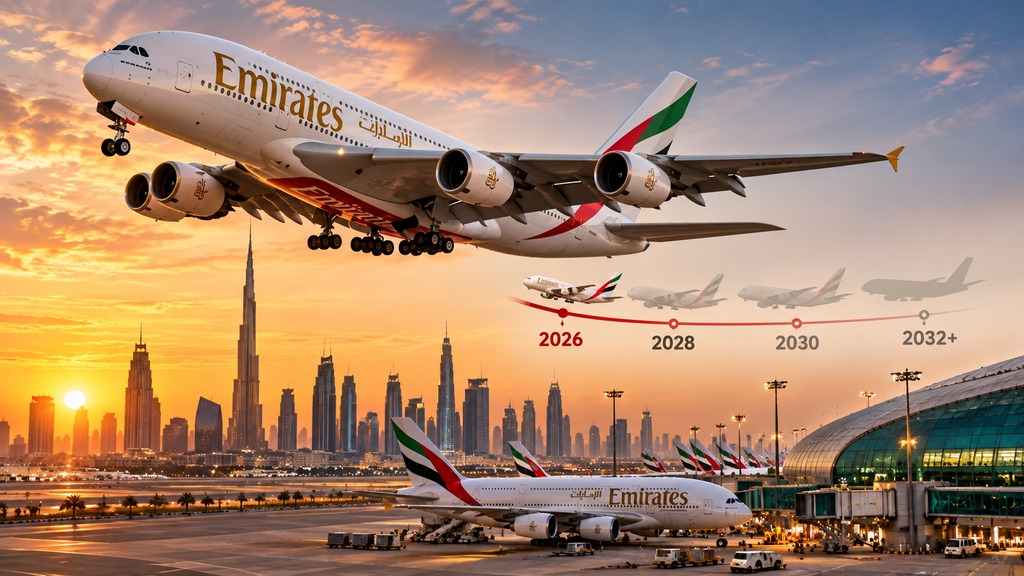
Possible A380 Timeline
| Period | Likely Development |
|---|---|
| 2026–2030 | Major retrofit and continued widespread operation |
| 2030–2034 | New aircraft gradually take more routes |
| 2034–2037 | Older A380s may leave fleet faster |
| 2037–2040 | Remaining fleet becomes increasingly concentrated |
| Around 2040 | Final phase-out expected |
This is an illustrative timeline rather than a confirmed aircraft-by-aircraft schedule.
Emirates has discussed the approximate end point, but individual aircraft retirement dates will depend on maintenance condition and operational demand.
What Happens to Emirates A380s After Retirement?
Retirement does not necessarily mean an aircraft is immediately destroyed.
A retired A380 can still have significant value.
Some aircraft may be used as sources of spare parts for remaining operational jets.
Engines, landing gear, cabin components and other equipment can be removed, inspected and reused where regulations allow.
This can help keep the final operating aircraft flying.
Parts donor role
As the global A380 fleet shrinks, retired Emirates aircraft could become increasingly useful as sources of components.
This creates a practical cycle:
- Older aircraft leave service.
- Useful components are removed.
- Those components support younger aircraft.
- Remaining A380s continue operating longer.
Emirates has also explored creative reuse.
Materials removed from retired or refurbished aircraft have been turned into luggage, furniture, collectibles and other products.
That means parts of an aircraft can continue to exist long after its final flight.
What Can Be Reused?
- Leather
- Seat fabrics
- Interior panels
- Cabin equipment
- Aluminium
- Lounge components
- Decorative materials
- Serviceable aircraft parts
This approach also supports the airline’s broader sustainability efforts by reducing waste.
What the Emirates A380 Retirement Means for Passengers
For passengers, the most important message is that the A380 experience remains widely available.
There is still plenty of time to fly on the aircraft.
Emirates continues to deploy A380s on many major routes connecting Dubai with Europe, Asia, Australia and North America.
Travellers who specifically enjoy the A380 can often identify the aircraft during booking.
Why passengers choose the A380
Economy passengers often like the sense of space created by the aircraft’s wide fuselage.
Premium Economy provides a more comfortable middle option.
Business Class passengers may have access to the onboard lounge.
First Class passengers on selected aircraft can experience private suites and shower facilities.
Passenger Appeal by Cabin
| Cabin | Why Travellers Choose It |
|---|---|
| Economy | Spacious-feeling widebody cabin |
| Premium Economy | More room without Business Class pricing |
| Business | Lie-flat seats and lounge access |
| First | Suites and onboard shower facilities |
The retirement plan could eventually increase interest among aviation enthusiasts who want to experience the aircraft before it disappears.
For now, however, there is no urgency.
The aircraft is expected to remain part of Emirates for many years.
Why the End of the A380 Era Will Matter for Dubai
The A380 has become deeply connected with Dubai itself.
For millions of travellers, arriving at Dubai International Airport and seeing multiple Emirates A380 tails parked at the terminal became part of the journey.
DXB developed extensive infrastructure specifically around the aircraft.
Dedicated gates, boarding bridges and terminal facilities were designed to handle the enormous number of passengers moving through each A380 flight.
The aircraft therefore became part of Dubai’s aviation architecture as well as Emirates’ fleet strategy.
It also represented Dubai’s ambitions
The A380 was large, ambitious and global.
Those qualities matched the way Dubai positioned itself during its rapid growth into an international tourism and business destination.
The aircraft helped Emirates connect Dubai with major global cities while bringing millions of visitors through the emirate.
When the final Emirates A380 eventually leaves service, it will mark the end of a distinctive period in Dubai’s aviation history.
Why Airlines Around the World Moved Away From Very Large Aircraft
The wider aviation industry moved in a different direction from the one Airbus expected when developing the A380.
Airbus originally believed growing passenger demand would increase the need for very large aircraft connecting major hubs.
Instead, improvements in twin-engine aircraft changed airline economics.
Jets such as the Boeing 787 and Airbus A350 allowed airlines to fly long distances efficiently with fewer passengers.
That encouraged more point-to-point routes.
Instead of flying from City A to a giant hub and then connecting to City B, airlines could increasingly operate direct services between smaller city pairs.
Why twinjets became more attractive
- Lower fuel consumption
- Lower maintenance requirements
- Greater route flexibility
- Easier capacity management
- Improved long-range performance
The A380 can be extremely efficient when nearly full.
The problem is that filling such a large aircraft consistently can be difficult.
Emirates managed that challenge better than almost any other airline.
That is why the A380 remained a success within Emirates even as the wider market turned away from very large four-engine jets.
Could Emirates Ever Order Another Aircraft as Large as the A380?
At the moment, there is no direct modern equivalent.
Airbus no longer produces the A380, and no manufacturer has announced plans for another passenger aircraft of similar size.
The industry’s focus remains on efficient twin-engine widebodies.
That means Emirates may never again operate a passenger aircraft with exactly the same capacity.
This could eventually change how the airline schedules its busiest routes.
Instead of one extremely large departure, Emirates may operate more flights using smaller aircraft.
That can provide passengers with more departure times but may also increase pressure on airport slots.
The future fleet is therefore likely to be more flexible but less visually dramatic.
How the A380 Could Become Even More Iconic as Retirement Approaches
Aircraft often become more emotionally important once people know they will eventually disappear.
The Boeing 747 experienced something similar.
For decades, it was simply another major long-haul aircraft. As airlines began retiring it, passenger interest increased.
The A380 could follow the same path.
Aviation enthusiasts may increasingly choose A380 flights deliberately.
Special farewell flights could eventually appear.
Final routes may become highly sought after.
Emirates could also preserve at least one aircraft for display or heritage purposes, although no specific final-retirement plan has been announced.
The airline has such a strong historical connection with the aircraft that preserving part of that story would make sense.
Emirates A380 Retirement Does Not Mean Goodbye Yet
The headline may sound dramatic, but the practical reality is far less immediate.
Yes, Emirates expects to retire its A380 fleet around 2040.
Yes, the aircraft will eventually become too expensive and complicated to operate compared with newer twin-engine alternatives.
But Emirates is also investing billions of dollars in keeping the A380 relevant.
It is upgrading cabins, installing Premium Economy, improving entertainment systems, refreshing lounges and developing long-term maintenance capabilities.
Those are not the actions of an airline preparing to stop flying the aircraft next year.
They are the actions of an airline preparing to extract another decade or more of value from one of the most important aircraft in its history.
The Boeing 777X and Airbus A350 will gradually take on larger roles.
Some A380s will eventually leave the fleet.
Others will continue flying until the late 2030s.
Eventually, one final Emirates A380 will complete the aircraft type’s last commercial service for the airline.
When that day arrives, it will be significant not only for Emirates but for Dubai and global aviation.
Until then, the superjumbo remains very much alive.
For passengers, the Emirates A380 retirement is therefore not an immediate goodbye. It is the beginning of a long final chapter for an aircraft that changed the way Emirates connected Dubai with the world.
Do follow us on Instagram
Read More – What Will be Global Village Reopening Date? The Exact Date Revealed