


Emirates Nairobi A350 Upgrade: What Is Changing?
Emirates is giving one of its most popular African routes a significant upgrade, with passengers travelling between Dubai and Nairobi set to experience the airline’s newest aircraft and one of its most important cabin products for the first time.
- Emirates Nairobi A350 Upgrade: What Is Changing?
- Premium Economy Is Coming to Kenya for the First Time
- Business and Economy Are Also Getting Major Improvements
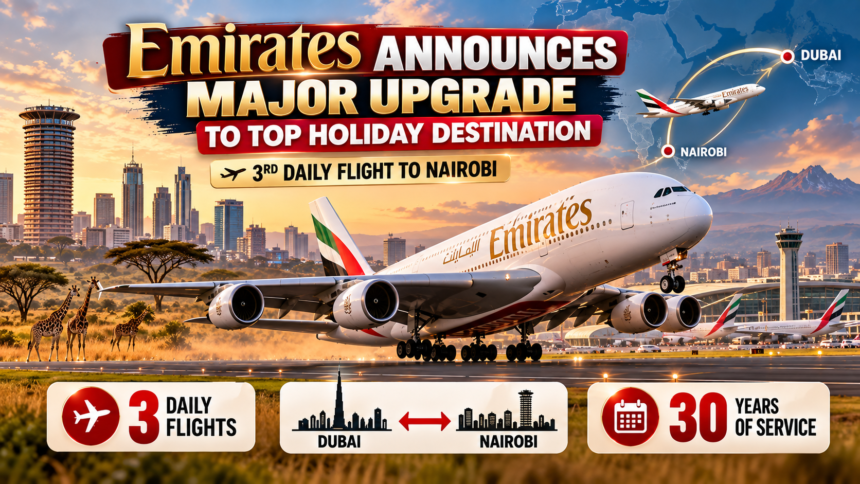
- Emirates Now Operates Three Daily Flights Between Dubai and Nairobi
- Why Nairobi Is Such an Important Holiday Destination
- Emirates Has Been Flying to Nairobi for More Than 30 Years
- How the A350 Upgrade Could Benefit Dubai Travellers
- The A350 Is Becoming a Bigger Part of the Emirates Network
- What Travellers Should Check Before Booking
- A350 vs Boeing 777: What Changes for Nairobi Passengers?
- What the Upgrade Means for Kenya Tourism
- Why This Emirates Upgrade Matters
From October 25, 2026, Emirates will deploy its Airbus A350 on flights EK717 and EK718 between Dubai International Airport and Nairobi’s Jomo Kenyatta International Airport. The change will make Nairobi the 32nd destination served by the Emirates A350 and, importantly for travellers, will introduce Emirates Premium Economy to Kenya for the first time.
The upgraded aircraft will offer Business Class, Premium Economy and Economy Class across a three-cabin configuration, with Emirates saying the A350 has been designed around brighter interiors, additional passenger space, improved connectivity and its latest inflight technology.
The change comes only months after Emirates expanded its Nairobi operation to three daily flights, giving the route 21 weekly services between Kenya and Dubai. That expansion reflects growing demand for both business and leisure travel and strengthens Dubai’s role as an important connecting hub for passengers travelling between Kenya, Europe, Asia, Australia and the Americas.
For passengers considering a holiday in Kenya, the aircraft upgrade is particularly interesting. Nairobi is not only Kenya’s capital but also a gateway to some of the country’s most popular safari regions, while the city itself offers national parks, museums, restaurants, nightlife and cultural attractions. Emirates describes Nairobi as both a major destination in its own right and a starting point for wider Kenyan adventures.
Here is everything travellers need to know about the Emirates Nairobi A350 upgrade, including the new cabin experience, Premium Economy, flight timings, connectivity and why the route matters so much to the airline.
Emirates Nairobi A350 Upgrade: What Is Changing?
The biggest change is the aircraft itself.
From October 25, Emirates will replace the Boeing 777 currently operating EK717 and EK718 with its newer Airbus A350. The aircraft represents the latest generation of the Emirates fleet and has been introduced gradually across destinations in Europe, Asia, Africa and the Middle East.
The A350 operating to Nairobi will accommodate 298 passengers across three cabins, giving travellers a choice between Business Class, Premium Economy and Economy Class.
| Upgrade Detail | What Travellers Can Expect |
|---|---|
| Start date | October 25, 2026 |
| Route | Dubai–Nairobi |
| Flights | EK717 and EK718 |
| Aircraft | Airbus A350 |
| Total passengers | 298 |
| Cabins | Business, Premium Economy, Economy |
| Premium Economy in Kenya | Available for first time |
| Nairobi A350 status | Emirates’ 32nd A350 destination |
This is not simply an aircraft swap.
Passengers will experience a different cabin layout, newer seating, improved entertainment screens and updated interior design. Premium Economy will also create an entirely new travel option for passengers who want more comfort than Economy but do not need the price or space of Business Class.
Why October 25 matters
The change begins with the winter travel schedule, a period when demand between Dubai, East Africa and international connecting markets can be particularly strong.
Travellers booking EK717 or EK718 on or after the change should therefore check the aircraft information when selecting flights, especially if they are specifically interested in Premium Economy.
Other daily Emirates services between Dubai and Nairobi may continue using different aircraft, meaning not every Nairobi flight will necessarily offer exactly the same cabin experience.
Premium Economy Is Coming to Kenya for the First Time
For many passengers, Premium Economy will be the biggest part of the upgrade.
Emirates has been expanding the cabin across its global network as more A350s and retrofitted aircraft enter service. Nairobi becomes the first Kenyan destination to receive the product, creating a new middle ground between Economy and Business Class.
The airline describes its Premium Economy experience as comparable in some respects to Business Class products found on other carriers, although it remains a separate cabin category.
Passengers receive larger leather reclining seats with more legroom, adjustable headrests and additional personal space.
Premium Economy features include:
- Wider reclining leather seats
- Generous seat pitch
- Adjustable headrests
- Additional legroom
- In-seat charging
- Side cocktail table
- 13.3-inch personal screen
- Pillow and blanket
- Amenity kits on selected flights
- Upgraded food and beverage presentation
Emirates has confirmed that amenity kits will be provided on the Dubai–Nairobi route. Premium Economy passengers will also be offered Chandon Vintage Brut 2017, which Emirates markets as an exclusive sparkling-wine option within the cabin.
Who could benefit most from Premium Economy?
The cabin may be particularly attractive for travellers flying onward from Nairobi through Dubai to Europe, North America, Asia or Australia.
A five-hour regional journey between Nairobi and Dubai may not require Business Class for every passenger, but Premium Economy offers more personal space without moving into the airline’s highest cabin categories.
Families, older travellers and business passengers paying their own fares may also find the middle-tier option attractive.
Cabin Comparison
| Cabin | Best For | Key Benefit |
|---|---|---|
| Economy | Budget-conscious travellers | Lower fare and latest A350 cabin |
| Premium Economy | Longer journeys and extra comfort | More space without Business pricing |
| Business Class | Premium and corporate travellers | Lie-flat seat and direct aisle access |
The addition of Premium Economy also gives Emirates greater flexibility to serve customers with different budgets, which is increasingly important on leisure-heavy routes.
Business and Economy Are Also Getting Major Improvements
Premium Economy may be the headline attraction, but passengers travelling in Business and Economy will also see substantial changes.
The A350 has been designed with an updated Emirates cabin style, using lighter colours and modern technology compared with many older aircraft.
Business Class
Business Class uses a 1-2-1 seating configuration, meaning every passenger has direct aisle access. This is especially useful for solo travellers because nobody needs to climb over another passenger to leave their seat.
Seats convert into fully flat beds and use cream-coloured leather finishes, while personal minibar space and wireless charging are included.
A self-service snack area is located towards the back of the Business Class cabin, allowing passengers to access refreshments during the flight rather than waiting for a scheduled meal service.
Business Class highlights include:
- 1-2-1 seating
- Direct aisle access
- Fully lie-flat seats
- Personal minibar
- Wireless charging
- Increased privacy
- Self-service snack area
These features make the A350 particularly suitable for travellers making longer connecting journeys through Dubai.
Economy Class
Economy also receives a refreshed design.
Emirates says the cabin uses a combination of sky blue, bronze and cream tones with lighter wood finishes, creating a brighter interior than some older aircraft.
The A350’s newer cabin technology and entertainment system should also improve the experience for passengers who spend several hours onboard.
Rather than treating Economy as an afterthought, Emirates has been using newer aircraft deliveries to update features across all cabin categories.
What Changes Across the Aircraft?
| Feature | Older Aircraft Experience | A350 Upgrade |
|---|---|---|
| Cabin design | Varies by aircraft age | New-generation interior |
| Premium Economy | Not previously on Kenya route | Available |
| Business aisle access | Depends on configuration | Every seat has access |
| Connectivity | Older systems on some aircraft | Newer technology |
| Entertainment | Aircraft-dependent | Latest-generation screens |
| Cabin atmosphere | Conventional | Brighter, newer materials |
Passengers should remember that exact products can vary by aircraft and route, but the A350 generally represents one of the newest experiences in the Emirates fleet.
Emirates Now Operates Three Daily Flights Between Dubai and Nairobi
The aircraft upgrade arrives shortly after Emirates made another major change to the route.
In July 2026, Emirates launched its third daily Nairobi flight, taking the route to 21 weekly services between Dubai and Kenya.
The additional flight was introduced to meet growing demand and improve connections through Dubai.
EK717 currently departs Dubai during the early morning and arrives in Nairobi shortly after 5am, while EK718 leaves Nairobi in the morning and arrives in Dubai shortly after 1pm. Emirates says these timings have been structured to improve onward connections with markets in Europe and the United States.
Current EK717 and EK718 Schedule
| Flight | Route | Departure | Arrival |
|---|---|---|---|
| EK717 | Dubai to Nairobi | 1.20am | 5.25am |
| EK718 | Nairobi to Dubai | 7.10am | 1.15pm |
Emirates lists the journey at approximately five hours and five minutes, although schedules can change depending on season and operational conditions.
Why the timing matters
An early arrival into Nairobi allows leisure travellers to begin their trip on the same day rather than losing most of the day to travel.
Passengers continuing from Nairobi can also use Kenya Airways connections to destinations elsewhere in East Africa.
Emirates and Kenya Airways already have an interline partnership that supports onward travel to destinations including Rwanda, Kilimanjaro, Mozambique and Burundi. More than 31,000 passengers had used that partnership by late 2025, according to Emirates.
For passengers travelling in the opposite direction, the return timing into Dubai is designed to connect with onward flights towards major European cities.
That gives Nairobi travellers access to significantly more destinations without requiring a separate airline ticket for every part of the journey.
Why Nairobi Is Such an Important Holiday Destination

Nairobi plays two roles for international travellers.
It is a major destination itself, but it is also one of Africa’s most important gateways for safari and wildlife tourism.
Emirates describes Nairobi as a city where modern urban life exists alongside wildlife attractions, museums and cultural experiences. Nairobi National Park is particularly unusual because visitors can see wildlife close to one of Africa’s largest cities.
The wider city also includes popular visitor attractions such as the Nairobi National Museum, Karen Blixen Museum and City Market.
Why travellers choose Nairobi
- Safari access
- Nairobi National Park
- Cultural attractions
- Museums
- Restaurants
- Nightlife
- Business travel
- Regional connections
- Gateway to wider Kenya
For many holidaymakers, Nairobi is only the first part of a longer itinerary.
From the capital, travellers can continue to major Kenyan safari regions, coastal resorts and nature destinations.
This gives Emirates a mix of passenger demand that includes tourism, business travel, family visits and international connecting traffic.
Nairobi Trip Styles
| Traveller Type | Typical Reason for Visiting |
|---|---|
| Safari traveller | Wildlife and national parks |
| City-break visitor | Nairobi attractions and dining |
| Business traveller | Kenya’s commercial capital |
| Family visitor | Visiting friends and relatives |
| Regional traveller | Connections across East Africa |
| International tourist | Starting point for wider Kenya |
The route’s growing passenger numbers also help explain why Emirates is willing to introduce one of its newest aircraft.
Aircraft upgrades are typically deployed where airlines believe demand can support newer or more premium products.
Emirates Has Been Flying to Nairobi for More Than 30 Years
The relationship between Emirates and Kenya is not new.
Emirates began flying to Nairobi in October 1995, meaning the airline passed the 30-year milestone on the route in 2025.
Over the first three decades, Emirates carried more than 6.6 million passengers between Dubai and Nairobi across more than 34,250 flights.
That history makes the A350 upgrade more significant.
It represents a modernisation of one of Emirates’ longest-running African routes rather than the launch of an experimental new destination.
Emirates Nairobi Timeline
| Year | Milestone |
|---|---|
| 1995 | Emirates begins Nairobi service |
| 2025 | Route reaches 30 years |
| 2025 | More than 6.6 million passengers carried over three decades |
| 2026 | Third daily flight introduced |
| October 25, 2026 | A350 begins operating EK717/718 |
| October 2026 | Premium Economy reaches Kenya for first time |
The route has also become increasingly important for connecting passengers.
Emirates said inbound travel to Kenya in the year before its 30th anniversary included strong traffic from markets such as South Korea, China, Thailand, Australia and the United States.
Outbound travellers from Kenya were using Dubai to reach destinations including Shanghai, Beijing, Melbourne, Sydney, Seattle, New York and Washington.
This shows why the Nairobi route is about much more than traffic between Kenya and the UAE alone.
Dubai acts as the connecting point.
How the A350 Upgrade Could Benefit Dubai Travellers
For UAE residents, Nairobi is one of the more accessible long-haul leisure destinations from Dubai.
The direct flight takes roughly five hours, making Kenya possible for a longer weekend, short safari break or more extended holiday.
The upgraded A350 could make the journey more attractive, particularly for travellers who previously felt they had to choose between Economy and a much more expensive Business Class ticket.
Premium Economy provides another option.
Potential advantages for Dubai-based travellers include:
- Direct flight from DXB
- Around five-hour journey
- Newer aircraft
- Premium Economy option
- Improved Business Class
- Easier safari access
- Early arrival into Nairobi
- Multiple daily frequencies
The third daily flight also makes planning easier because passengers have more departure-time flexibility.
Someone who misses one service or wants a different connection may have more options than when Emirates operated only two flights per day.
For families, schedule choice can make a significant difference.
Some travellers prefer overnight or early-morning departures so that children can sleep during the journey, while others may prefer daytime travel.
Three daily services create more choice.
The A350 Is Becoming a Bigger Part of the Emirates Network
Nairobi becoming the 32nd A350 destination shows how quickly the aircraft is spreading through the Emirates network.
Emirates is using the A350 as part of a wider fleet transformation.
The airline has historically relied heavily on Airbus A380s and Boeing 777s, but newer A350 deliveries are giving it greater flexibility to serve routes that may not require an A380’s enormous capacity.
Why the A350 matters
The aircraft can offer:
- Lower fuel consumption than older aircraft
- Modern cabin technology
- Long-range capability
- Flexible route deployment
- Premium Economy
- More efficient capacity
That makes the A350 useful on markets where Emirates wants to offer a premium product without deploying its largest aircraft.
Nairobi is a good example.
The route has enough demand to support three daily flights, but Emirates can match capacity across different services rather than putting the same large aircraft on every departure.
Emirates Fleet Roles
| Aircraft | Main Strength |
|---|---|
| Airbus A380 | Very high-capacity routes |
| Boeing 777 | Core long-haul network |
| Airbus A350 | New-generation flexible widebody |
| Future Boeing 777X | Next-generation flagship |
The A350 also supports Emirates’ broader strategy of gradually modernising its onboard product while older aircraft undergo refurbishment.
That means passengers can increasingly experience similar cabin standards across different aircraft types.
What Travellers Should Check Before Booking
Passengers specifically interested in the new A350 should pay close attention to their flight number.
The aircraft will initially operate EK717 and EK718, meaning other daily Nairobi flights may continue using Boeing 777s or other configurations.
Booking only by route without checking the flight number could therefore result in a different aircraft.
Before booking, check:
- Flight number
- Aircraft type
- Available cabin classes
- Seat map
- Premium Economy availability
- Departure time
- Baggage allowance
- Connection time
- Ticket-change conditions
Emirates has also introduced more flexible booking conditions.
The airline says tickets booked after August 10, 2026 include unlimited free date changes when travelling to Dubai and one complimentary date change for other destinations, alongside reduced refund fees depending on fare conditions.
Passengers should still check the exact conditions attached to their ticket because fare rules can vary.
If Premium Economy is your priority
Search specifically for EK717 or EK718 after October 25 and confirm that Premium Economy appears among the available cabin choices.
Aircraft substitutions can occasionally happen for operational reasons, so no airline can guarantee the exact aircraft in every circumstance.
A350 vs Boeing 777: What Changes for Nairobi Passengers?
The Boeing 777 remains an important part of Emirates’ Nairobi operation, but the A350 provides a different passenger experience.
The most obvious difference on EK717 and EK718 will be Premium Economy.
The aircraft also uses Emirates’ latest design language and newer onboard technology.
Simple Comparison
| Feature | Existing Boeing 777 Service | New A350 EK717/718 |
|---|---|---|
| Premium Economy | Depends on specific aircraft | Yes |
| Business layout | Can vary | 1-2-1 |
| Direct aisle access | Configuration-dependent | Every Business seat |
| Cabin generation | Depends on aircraft | Latest generation |
| Total cabin types | Varies | Three |
| Connectivity | Aircraft-dependent | Enhanced |
| Interior | Varies | New Emirates A350 design |
This does not mean every Boeing 777 is an inferior experience.
Emirates has been retrofitting many 777s with new cabins, including Premium Economy.
However, the A350 represents a purpose-built new-generation aircraft rather than a refurbishment of an older airframe.
For travellers who enjoy trying newer aircraft types, that alone may influence which daily flight they choose.
What the Upgrade Means for Kenya Tourism
The aircraft change also has a broader tourism dimension.
Emirates has repeatedly said its additional Nairobi capacity is intended to support Kenya’s ambitions to grow international visitor arrivals.
When the third daily flight was announced, the airline said improved access from global markets could support Kenya’s target of attracting five million international tourists by 2030.
More flight capacity can help tourism in several ways.
Potential benefits include:
- More available seats
- Easier connections
- Increased premium capacity
- Better access from international markets
- More tourism spending
- Improved regional connectivity
Dubai is particularly useful as a connecting hub because Emirates serves travellers from many countries that do not have large numbers of direct flights to Kenya.
Passengers can fly from Asia, Europe or the Americas to Dubai and then connect onwards to Nairobi.
The new A350 therefore serves more than the UAE–Kenya market.
It is part of a global connecting network.
Why This Emirates Upgrade Matters
On the surface, replacing one aircraft with another may sound like a relatively small operational change.
In reality, the Nairobi upgrade reflects several larger shifts happening at Emirates.
The airline is adding newer aircraft, expanding Premium Economy, modernising its cabin products and increasing capacity on routes where passenger demand is growing.
Nairobi brings all of those trends together.
The route has existed for more than 30 years, has grown to three daily flights and now becomes one of the first destinations in Africa to receive the airline’s latest-generation aircraft.
For passengers, the biggest practical difference is choice.
Economy travellers receive a newer cabin.
Premium Economy becomes available in Kenya for the first time.
Business Class passengers gain direct aisle access from every seat on the A350.
And travellers have three daily Emirates departures to choose from between Nairobi and Dubai.
For holidaymakers, the upgrade makes one of East Africa’s most important tourism gateways easier and potentially more comfortable to reach from Dubai.
For Kenya, the additional premium capacity and improved international connectivity could support tourism growth.
And for Emirates, the move represents another step in the gradual transformation of its global fleet.
From October 25, 2026, passengers booked on EK717 and EK718 will be among the first travellers on the Dubai–Nairobi route to experience Emirates’ Airbus A350 and the first in Kenya to access the airline’s Premium Economy cabin.
That makes the Emirates Nairobi A350 upgrade far more than an aircraft change. It is a significant improvement to one of the airline’s longest-standing and increasingly important African routes.
Do follow us on Instagram
Read More – Dubai Is Getting Four Etihad Rail Stations – Here’s Where