



How Parking Works in Dubai: Quick Driver Checklist
Understanding how parking works in Dubai is important for residents, tourists and anyone planning to drive in the city. Dubai has a large network of paid public parking spaces, private car parks, shopping-mall parking, multi-storey facilities and developer-operated parking zones, and the rules can vary depending on where and when you park.
- How Parking Works in Dubai for Public Parking Spaces
- Dubai Parking Zones A, B, C and D Explained
- How Standard and Premium Parking Work in Dubai
- Dubai Parking Peak and Off-Peak Hours
- Is Parking Free on Sundays in Dubai?
- How to Pay for Parking in Dubai
- What the Parking Zone Code Means
- How Long Can You Park in Dubai Public Parking?
- How Multi-Storey Parking Works in Dubai
- Dubai World Trade Centre Event Parking Can Cost More
- Parking at Dubai Malls, Hotels and Private Developments
- How Parking Works in Dubai for Rental Cars
- Dubai Parking Fines Drivers Should Know
- How Seasonal Parking Permits Work
- How Residents Can Reduce Parking Costs in Dubai
- Common Mistakes Drivers Make With Dubai Parking
- How Parking Works in Dubai: Quick Driver Checklist
The biggest change drivers need to understand is Dubai’s variable parking tariff system. Since April 4, 2025, public parking has been divided into Standard Parking and Premium Parking, with higher charges applying during specific peak periods. Premium parking generally covers high-demand locations, including busy commercial districts and spaces close to public transport infrastructure.
For most public parking, the normal chargeable hours run from 8am to 10pm from Monday to Saturday, while Sundays and official public holidays are generally free unless a specific facility, event zone or private parking operator states otherwise. Multi-storey car parks operate under separate rules and can remain chargeable 24 hours a day.
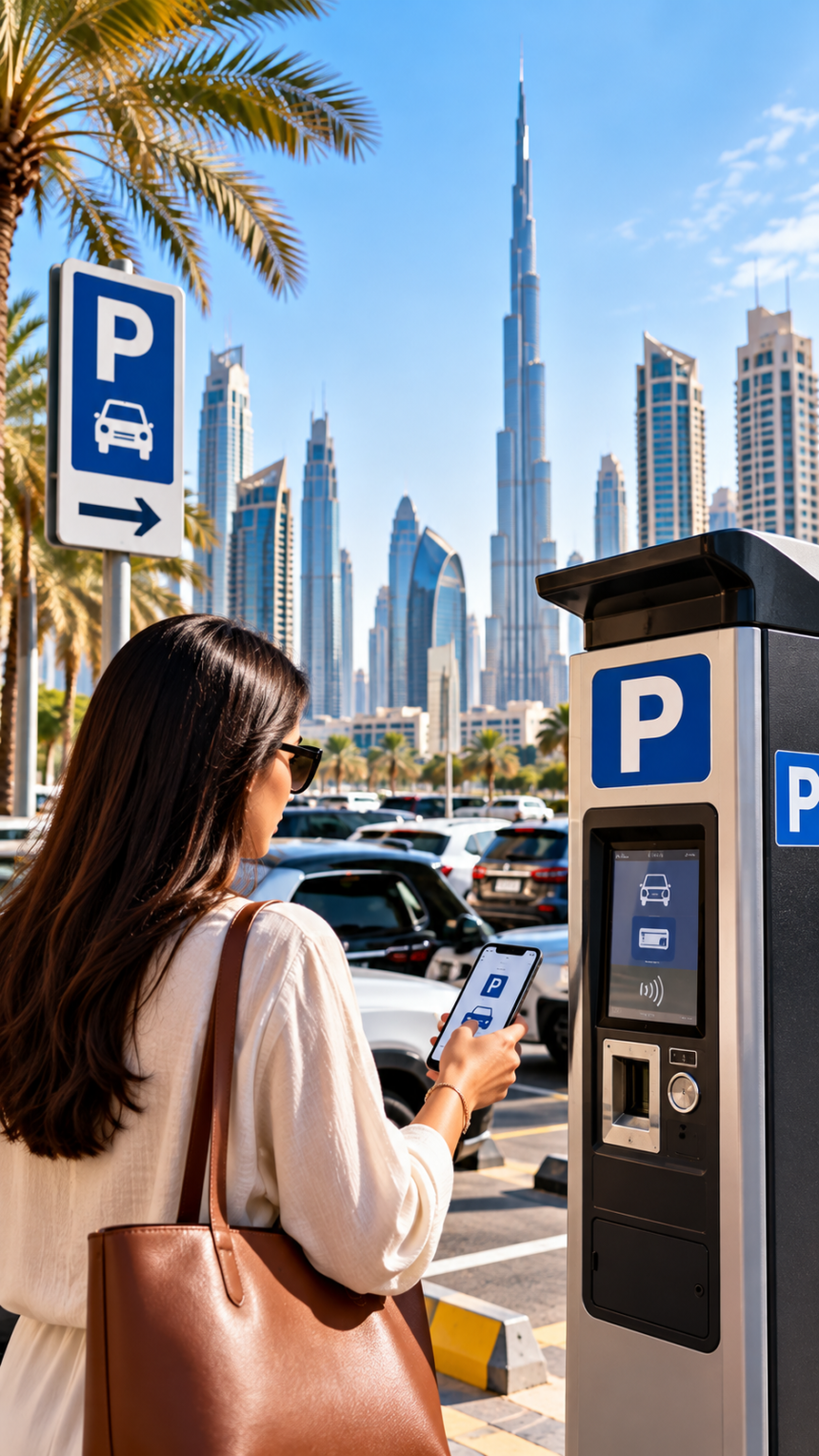
Drivers can pay through the RTA Dubai app, Parkin app, SMS, WhatsApp, parking machines and other digital channels. The most important habit is to check the parking sign before leaving the vehicle because the zone code, tariff category and permitted duration can change from one street to another.
How Parking Works in Dubai for Public Parking Spaces
Dubai’s paid public parking network is managed through a zone-based system.
When you park in a regulated public space, you will normally see a sign showing:
- Parking zone code
- Operating hours
- Applicable tariff
- Maximum permitted stay
- Payment instructions
- Whether the area is Standard or Premium Parking
You must pay for the correct vehicle and the correct zone before leaving the car.
Unlike some cities, you generally do not need to display a paper ticket on the dashboard because Dubai’s parking system has become largely digital. RTA completed the transition to electronic parking tickets across its public parking machines, meaning vehicle details are entered directly into the payment system.
Parking inspectors can therefore check whether a vehicle has a valid paid session electronically.
This is why entering the correct licence plate is extremely important.
If one digit or plate code is wrong, the system may treat the actual vehicle as unpaid even though money was deducted.
Drivers should also remember that a parking payment is linked to a specific zone and duration. Paying in one area does not necessarily give you permission to move the vehicle to another zone without checking its parking rules.
Dubai Parking Zones A, B, C and D Explained
Dubai’s traditional public parking system includes four main zone types: A, B, C and D.
These zones historically reflected whether parking was on-street or located in a parking plot.
Zone A
Zone A generally covers roadside or on-street parking in busier commercial areas.
Under the current system, Zone A can be classified either as Standard A or Premium AP.
Standard Zone A historically charges:
- AED 2 for 30 minutes
- AED 4 for 1 hour
- AED 8 for 2 hours
- AED 12 for 3 hours
- AED 16 for 4 hours
Under variable pricing, Premium Zone AP can rise to AED 6 per hour during peak periods.
Zone B
Zone B generally refers to parking plots rather than roadside parking.
The traditional off-peak rate begins at AED 3 per hour, and drivers may also have a daily option depending on the specific area.
Current Standard Zone B peak pricing can rise to AED 4 per hour, while Premium BP reaches AED 6 per hour during peak periods.
Zone C
Zone C is another on-street parking category and historically offered lower hourly rates than Zone A.
Traditional off-peak pricing begins at AED 2 for one hour, with increasing charges for longer stays.
Premium CP spaces can cost AED 6 per hour during peak periods.
Zone D
Zone D generally refers to parking plots in areas where longer stays may be possible.
Traditional rates begin at AED 2 per hour, with daily payment options available in applicable locations.
Premium DP parking can cost AED 6 per hour during peak periods.
The easiest approach is not to memorise every price.
Always read the sign where you actually park because it shows the exact code and tariff applicable to that space.
How Standard and Premium Parking Work in Dubai
Dubai introduced variable parking tariffs on April 4, 2025.
The objective was to improve parking turnover in busy locations and encourage drivers to use spaces more efficiently during periods of high demand.
Around 40% of Parkin’s public parking portfolio was initially categorised as Premium Parking, with the rest classified as Standard Parking.
Standard Parking
Standard parking applies to regular public spaces outside the higher-demand Premium category.
During peak periods, Standard parking across Zones A to D generally costs AED 4 per hour, subject to the detailed zone structure.
During off-peak periods, the traditional zone-specific rates remain in place.
Premium Parking
Premium spaces are located in high-demand, densely populated or commercially important locations, including some areas close to public transport.
During peak hours, Premium public parking costs AED 6 per hour across the main public parking zones.
Premium areas are identified with dedicated signage.
Do not assume that two spaces on nearby streets necessarily cost the same amount.
One may be Standard while another is Premium.
This makes checking the sign before payment more important than ever.
Dubai Parking Peak and Off-Peak Hours
Variable parking rates do not apply equally throughout the entire day.
Current peak periods are:
8am to 10am
and
4pm to 8pm
These six hours are treated as the higher-demand periods from Monday to Saturday.
Off-peak hours are generally:
10am to 4pm
and
8pm to 10pm
During off-peak periods, the older zone-based tariffs remain in place.
That means the price of the exact same parking space can change depending on when you use it.
For example, one Premium parking space may cost AED 6 per hour at 5pm but follow its lower off-peak zone tariff later in the evening.
For residents who have flexibility, changing journey times can therefore reduce parking costs.
This is particularly relevant for people who regularly park near offices, Metro stations or busy commercial areas.
Is Parking Free on Sundays in Dubai?
For most standard public parking areas, Sunday remains the weekly free-parking day.
The variable tariff system specifically excludes Sundays and official public holidays from peak pricing, while Dubai’s established public parking rules generally make normal roadside public parking free on Sundays and designated public holidays.
However, there are important exceptions.
You may still need to pay at:
- Multi-storey car parks
- Private developer parking
- Shopping centres
- Hotels
- Airport parking
- Event parking
- Special zones
Do not assume that every parking space in Dubai becomes free because it is Sunday.
The rule mainly applies to regular public parking unless signage says otherwise.
Public-holiday parking arrangements can also occasionally be announced separately by RTA.
Drivers should check official announcements during Eid, National Day and other major holidays.
How to Pay for Parking in Dubai
Dubai provides several ways to pay for public parking.
RTA currently lists payment through:
- RTA Dubai app
- Parkin app
- SMS
- DubaiNow
- Parking machines
- Other approved digital channels
RTA Dubai app
The RTA Dubai app is useful for residents because vehicle details can be saved and parking sessions can be managed digitally.
You select the vehicle, location and required duration before paying.
Parkin app
The Parkin app also allows users to pay for parking and manage parking-related services.
Parkin’s online payment system includes zone selection, vehicle selection and the ability for eligible wallet users to schedule a future parking session.
SMS parking
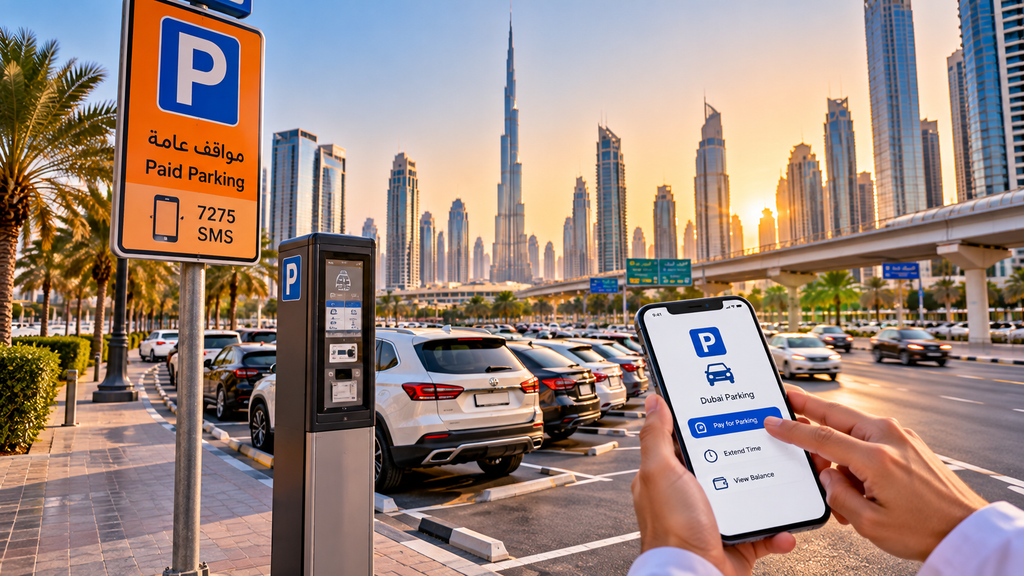
Drivers can pay using mParking by sending the vehicle and zone details to 7275.
The exact message format depends on the licence plate and parking zone.
When payment is successful, a confirmation message is sent.
Do not assume payment succeeded merely because you sent the SMS. Make sure you receive confirmation.
WhatsApp parking
RTA also supports parking payments through Mahboub on WhatsApp.
The official number is:
+971 58 8009090
RTA states that users can follow a similar format to SMS by entering their plate number, zone and parking duration.
RTA notes that WhatsApp can also save the additional 30 fils normally associated with standard SMS payment.
What the Parking Zone Code Means
Every regulated public parking area has a zone code.
You may see a code such as a number followed by a letter.
The letter usually identifies the parking category, while the number identifies the specific location.
For example, a sign might show a code ending in A, C or another tariff category.
When paying by SMS or another digital method, entering this code correctly is essential.
If you park in one zone but accidentally pay another nearby zone, your vehicle may still be considered unpaid.
Do not rely only on where you parked yesterday
Parking classifications can change.
A street can be reclassified as Premium, or new parking management rules may be introduced.
Check the current sign every time you are unsure.
Dubai has installed thousands of parking information signs displaying zone details, operating hours and payment options.
These signs are the most reliable information for the individual space you are using.
How Long Can You Park in Dubai Public Parking?
Maximum parking duration depends on the zone.
Traditional on-street parking spaces in Zones A and C generally have shorter maximum stays, historically capped at four consecutive hours. Off-street Zones B and D can allow longer parking, including daily tariff options.
This distinction is important.
Paying repeatedly does not necessarily mean you can remain indefinitely in a space with a fixed maximum stay.
If the sign says the maximum is four hours, staying beyond that limit can result in a fine even if you attempt to continue paying.
Before parking for a long workday, check whether you are using:
- Short-stay roadside parking
- Long-stay parking plot
- Multi-storey parking
- Seasonal permit area
For long-term daily parking, a parking plot or seasonal permit may be more practical than repeatedly renewing a short-stay street session.
How Multi-Storey Parking Works in Dubai
Dubai also has multi-storey public car parks.
These operate differently from ordinary roadside parking.
Under the current published policy, Parkin-operated multi-storey car parks charge AED 5 per hour, 24 hours a day and 365 days a year.
Customers staying for more than eight hours within a 24-hour period are subject to a maximum charge of AED 40 under the published tariff.
That means Sundays and public holidays do not automatically make multi-storey facilities free.
They operate continuously and can be useful when:
- Street parking is full
- You need longer parking
- You want covered parking
- You are visiting busy commercial districts
Always check the particular facility because private multi-storey car parks may use different tariffs.
Dubai World Trade Centre Event Parking Can Cost More
One of the most important exceptions to normal public parking rates applies around major events.
Dubai introduced a Grand Events Parking tariff around Dubai World Trade Centre.
During qualifying major events, designated spaces in the immediate DWTC area can cost AED 25 per hour between 8am and 10pm.
This is dramatically higher than normal public parking.
The purpose is to manage demand when large exhibitions and conferences attract significant vehicle traffic.
Visitors attending major events should therefore check parking costs before driving directly to the venue.
Depending on the event, Metro may be significantly cheaper and easier.
World Trade Centre Metro Station provides direct access to the exhibition district, making public transport a practical alternative during large events.
Parking at Dubai Malls, Hotels and Private Developments
Not every parking area in Dubai follows RTA public parking tariffs.
Private developers can operate their own systems.
This includes parking at:
- Shopping malls
- Hotels
- Residential developments
- Business districts
- Hospitals
- Private attractions
Some malls provide several free hours before charging.
Others may offer free parking on weekdays but charge during weekends or major events.
Hotels may provide valet parking, free guest parking or paid visitor parking.
Developer-operated zones can also have their own variable pricing structures.
Parkin manages a growing portfolio of private developer parking as well as public spaces, and some developer spaces are subject to variable tariffs.
The important rule is simple:
Check the sign or entry barrier rather than assuming public-parking rules apply.
How Parking Works in Dubai for Rental Cars
Tourists renting cars can use Dubai’s public parking system normally.
You do not need to own a Dubai-registered vehicle to pay for a public parking session.
However, when using SMS or an app, make sure the correct:
- Emirate
- Plate code
- Plate number
- Zone
- Duration
are entered.
Some rental vehicles may have plates from Dubai, while others may come from another emirate.
The payment method must reflect the actual registration plate.
Parking fines are normally passed to the renter
If a parking violation is issued while you have the vehicle, the rental company may later charge:
- The fine
- An administration fee
according to your contract.
That means a AED 150 parking fine can ultimately cost more once the rental company’s processing charges are added.
Before returning the car, check whether there are outstanding fines if your rental provider offers that facility.
Dubai Parking Fines Drivers Should Know
Parking without paying can be significantly more expensive than paying the actual parking fee.
RTA currently lists a AED 150 fine for failing to pay the required public parking charge.
Other common parking fines include:
| Violation | Fine |
|---|---|
| Parking without paying | AED 150 |
| Exceeding paid parking duration | AED 100 |
| Exceeding maximum allowed parking time | AED 100 |
| Misusing a parking area | AED 200 |
| Parking on a pavement | AED 200 |
| Parking in a prohibited position within public parking | AED 200 |
| Vehicle without licence plates | AED 1,000 |
| Unauthorised parking in People of Determination space | AED 1,000 |
| Parking in a space reserved for another party | AED 1,000 |
These amounts are published by RTA.
The People of Determination parking fine is particularly important.
Never use an accessible parking bay simply because other parking is unavailable.
These spaces are reserved for authorised users and can carry substantially higher penalties than normal parking violations.
How Seasonal Parking Permits Work
Residents or workers who park regularly in paid public areas may benefit from seasonal parking permits.
RTA offers different categories of seasonal parking access.
A general permit can cover designated parking areas marked A, B, C and D, while another category is limited primarily to B and D areas.
For Dubai-registered vehicles under the same traffic file, RTA currently allows up to three vehicles to be linked to some seasonal permits, although only one can use the permit at a time. Plates from other emirates and company vehicles face additional restrictions.
A seasonal permit can make sense if you regularly park:
- Near work
- In the same commercial district
- Near your residence
- For long periods each day
However, permits do not automatically cover every parking facility.
Certain areas and special zones may be excluded.
Before purchasing one, check whether the parking spaces you actually use are covered by the permit category.
How Residents Can Reduce Parking Costs in Dubai
Parking expenses can add up quickly when combined with fuel, Salik and car ownership costs.
Planning can reduce unnecessary spending.
Choose accommodation with parking included
Before renting an apartment, confirm how many parking spaces are included.
A lower-rent building with no reliable parking may create additional daily costs.
Check workplace parking
Do not assume your office provides free employee parking.
Some business districts have expensive paid parking.
Ask before accepting a job or choosing accommodation nearby.
Use public transport in expensive areas
Places such as Downtown Dubai, DIFC and World Trade Centre can become costly or congested during busy periods.
Metro may be cheaper than paying for parking and Salik.
Avoid Premium peak periods where practical
If you have flexible working hours, arriving outside the 8am–10am peak period can reduce the cost of Premium parking.
The same applies to the 4pm–8pm evening peak.
Use seasonal permits when the maths works
If you pay for parking every working day, calculate the monthly total and compare it with available seasonal parking products.
The cheapest option depends on your specific zone and how often you use it.
Common Mistakes Drivers Make With Dubai Parking
One common mistake is assuming every public parking space costs the same amount.
Dubai now has Standard and Premium parking, and rates can change between peak and off-peak periods.
Another mistake is paying for the wrong zone.
Always read the nearest sign rather than guessing the code from a nearby street.
Drivers also sometimes send an SMS but fail to check for confirmation.
If the payment did not process correctly, you may still receive a fine.
Another common mistake is assuming Sunday means every car park is free.
Regular public parking is generally free on Sunday, but multi-storey, mall, hotel, airport and private facilities may continue charging.
Drivers should also avoid letting a parking session expire by only a few minutes.
Exceeding the paid duration can result in a AED 100 fine.
Finally, never use accessible parking, reserved spaces, pavements or prohibited areas simply because normal spaces are full.
The fines can be far higher than the cost of finding another car park.
How Parking Works in Dubai: Quick Driver Checklist
Before leaving your vehicle, check these details:
| Question | What to Check |
|---|---|
| Is parking paid? | Read the nearest sign |
| Which zone? | Confirm exact zone code |
| Standard or Premium? | Check parking classification |
| Peak period? | 8–10am and 4–8pm, Mon–Sat |
| Off-peak period? | 10am–4pm and 8–10pm |
| Sunday? | Most regular public parking free |
| Public holiday? | Usually free public parking, but verify |
| Multi-storey car park? | Typically chargeable 24/7 |
| Payment options | App, SMS, WhatsApp, machine and other digital channels |
| Maximum stay? | Check zone restrictions |
| Confirmation received? | Verify before leaving vehicle |
| Accessible space? | Use only with proper authorisation |
Understanding how parking works in Dubai becomes much easier once you stop thinking of the city as having one universal parking rate.
Public parking is organised by zones and is now divided between Standard and Premium categories. Since April 4, 2025, Premium spaces can cost AED 6 per hour during the peak periods from 8am to 10am and 4pm to 8pm, while Standard peak parking is generally AED 4 per hour. Off-peak prices follow the established zone tariff structure.
Regular public parking is generally charged from Monday to Saturday, with Sunday and official public holidays usually free. Multi-storey facilities, developer parking, airports, malls and special-event zones can operate under different rules.
The easiest way to avoid problems is simple.
Read the nearest parking sign.
Enter the correct vehicle and zone.
Pay for enough time.
Check that payment was confirmed.
And never assume that a rule applying on one street automatically applies to the next.
Dubai’s parking system is highly digital and increasingly flexible, but drivers still need to pay attention to location, timing and signage to avoid unnecessary fines.
Do follow us on Instagram
Read More – Dubai Lifestyle: 15 Things Expats Love About Life in Dubai