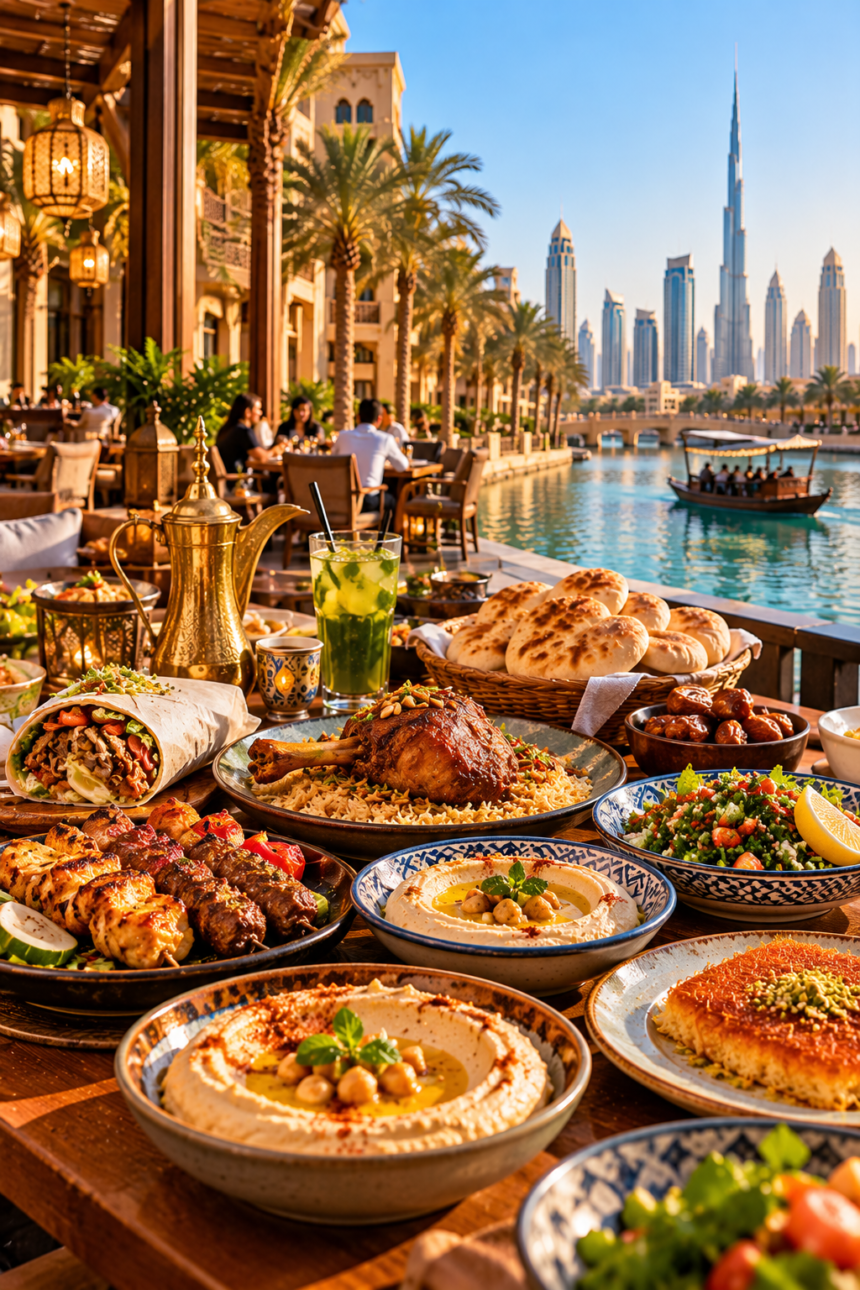
Where to Find Dubai’s 9 Unofficial Foods Without Falling Into Tourist Traps
Move to Dubai, spend a few weeks eating your way around the city and something funny happens: certain foods start following you everywhere. A shawarma appears on almost every late-night plan. Karak becomes a default order. Manakish turns into breakfast, lunch or an emergency snack. Then someone insists you have not really experienced the city until you have tried luqaimat, machboos or a proper plate of biryani.
- Unofficial Foods of Dubai at a Glance
- 1. Shawarma Is Basically Dubai’s Universal Fast Food
- 2. Karak Chai Will Probably Become Part of Your Routine
- 3. Manakish Is the Flatbread You Will Start Ordering Without Thinking
- 4. Biryani Reflects the South Asian Side of Dubai’s Food Identity
- 5. Machboos Is One of the Emirati Dishes Every New Resident Should Try
- 6. Regag Is the Crispy Emirati Bread You Should Eat Fresh
- 7. Luqaimat Are Almost Impossible to Stop Eating
- 8. Kunafa Is the Dessert You Order Even When You Said You Were Full
- 9. A Camel Burger Is the “Okay, I’m Definitely in Dubai” Order
- Which Unofficial Foods of Dubai Should You Try First?
- Where Old Dubai Fits Into the Food Story
- Why Dubai Does Not Really Have Just One Signature Food
- A Dubai Food Beginner’s Checklist
- How to Eat Your Way Around Dubai Without Spending a Fortune
- New in Town? These Foods Are Part of Learning Dubai
These are the unofficial foods of Dubai: not an official culinary list, and not all originally Emirati, but dishes that have become deeply woven into everyday life in a city shaped by Emirati traditions and communities from across the Middle East, South Asia and beyond.
Dubai Tourism describes the city as a culinary melting pot influenced by nearly 200 nationalities, with Old Dubai in particular reflecting decades of Emirati, Arab, Iranian, Indian, Pakistani and other food traditions. That mix explains why defining “Dubai food” is much more interesting than simply naming one national cuisine.
So, if you are new in town, start here. These nine foods are the ones you are going to see, smell, order, debate and probably crave sooner than you expect.
Unofficial Foods of Dubai at a Glance
Before getting into the details, here is the fast version.
| Food | What It Is | Best Moment to Try It |
|---|---|---|
| Shawarma | Meat, sauce, pickles and bread | Late night or quick lunch |
| Karak chai | Strong milk tea with spices | Any time, honestly |
| Manakish | Levantine flatbread with toppings | Breakfast or snack |
| Biryani | Aromatic spiced rice with meat or vegetables | Big lunch |
| Machboos | Gulf-style spiced rice dish | Emirati lunch or dinner |
| Regag | Thin crispy Emirati bread | Breakfast or light snack |
| Luqaimat | Fried dumplings with date syrup | Dessert |
| Kunafa | Sweet pastry with cheese or cream | After dinner |
| Camel burger | Modern Emirati speciality | When you want something different |
If this is your first week in Dubai, you do not need to try all nine in one day. But by the time you have lived here for a while, there is a good chance most of them will have appeared somewhere in your food routine.
1. Shawarma Is Basically Dubai’s Universal Fast Food
If there is one food you will struggle to avoid in Dubai, it is shawarma.
The formula is simple: seasoned meat cooked on a vertical rotisserie, shaved into thin slices and wrapped in bread with sauces, pickles and sometimes fries. Chicken is everywhere, while beef and mixed-meat versions are also common.
Visit Dubai describes shawarma as one of the city’s comfort-food classics, built around spiced meat, fresh bread, pickles and tangy sauces.
What makes shawarma feel particularly “Dubai” is not that it originated here. It is the way it fits into daily life.
You can order one from a tiny neighbourhood cafeteria, grab another after midnight, find premium restaurant interpretations and still end up arguing with friends over which AED10-ish version is actually the best.
How should a first-timer order it?
Start with a chicken shawarma with garlic sauce and pickles. If fries are offered inside the wrap, do not overthink it.
Once you have tried a few, you will start noticing differences in bread, meat texture, garlic sauce, spice level and pickle ratio. That is usually when casual shawarma consumption turns into opinions.
Dubai newcomer challenge: Try one from an old-school cafeteria and another from a polished modern restaurant. The cheaper one may win.
2. Karak Chai Will Probably Become Part of Your Routine
Technically, karak is a drink rather than a food, but leaving it off this list would make no sense.
Karak chai is strong tea cooked with milk and spices such as cardamom and sometimes ginger or saffron. Visit Dubai explains that its name is connected to the Hindi word “kadak”, meaning strong, and describes the drink as a legacy of longstanding trade and cultural links between the UAE and India.
In practical Dubai life, karak is everywhere.
People stop for it on the way to work. Drivers pull up beside cafeterias and order without getting out. Friends meet for karak instead of coffee. Some people drink it in the middle of summer, which tells you everything you need to know about its popularity.
A simple cup can be inexpensive, while newer cafés have turned karak into something much more elaborate with saffron, pistachio, rose and other flavours.
Visit Dubai goes so far as to say a trip to the city is hardly complete without experiencing karak chai.
What should you order first?
Go basic: regular karak.
After that, try saffron karak if you want something more aromatic.
First-time warning: It can be sweeter than you expect. If you do not like very sweet tea, ask whether the café can reduce the sugar.
3. Manakish Is the Flatbread You Will Start Ordering Without Thinking
Dubai has plenty of complicated restaurant food, but sometimes what you actually want is bread covered in zaatar and cheese.
That is where manakish comes in.
Manakish is a Levantine flatbread baked with toppings that can range from zaatar and olive oil to cheese, minced meat or combinations of several ingredients.
Visit Dubai describes manakish as a simple flatbread that has evolved into a pizza-like dish with a wide variety of toppings.
It works at almost any time of day.
Breakfast? Cheese manakish.
Quick lunch? Zaatar and cheese.
Need something cheap after work? Manakish again.
The reason newcomers tend to adopt it quickly is that it feels familiar enough to understand immediately but different enough to become addictive.
Best first order: Half zaatar, half cheese if the bakery allows it.
That gives you the sharp herbal taste of zaatar and the softer richness of melted cheese without forcing you to choose sides.
Interactive question: Are you team zaatar or team cheese? You may have a strong answer within a month of living here.
4. Biryani Reflects the South Asian Side of Dubai’s Food Identity
You cannot really explain everyday food in Dubai without acknowledging the enormous influence of South Asian communities.
Indian food is widely available across the city, and Visit Dubai specifically highlights Dubai’s deep culinary relationship with India and the breadth of Indian restaurants operating across different price points.
Biryani may be one of the clearest examples.
At its simplest, it is aromatic rice layered or cooked with meat, seafood or vegetables and flavoured with spices. But ask five people what makes a proper biryani and you may receive ten answers.
Hyderabadi biryani has its loyalists.
Pakistani versions have theirs.
Malabar biryani brings a different rice, spice and regional character.
Then there are restaurant-specific interpretations that ignore all neat boundaries.
In Dubai, that variety is the point.
What should a newcomer do?
Do not try one biryani and decide whether you like biryani.
Try at least three styles.
Start with a chicken or mutton biryani, then compare it with a Malabar-style version or another regional preparation.
The rice should be aromatic, the meat should feel integrated into the dish rather than dropped on top, and the spices should be layered rather than simply hot.
Best occasion: Friday lunch when you have nowhere urgent to be afterwards.
5. Machboos Is One of the Emirati Dishes Every New Resident Should Try
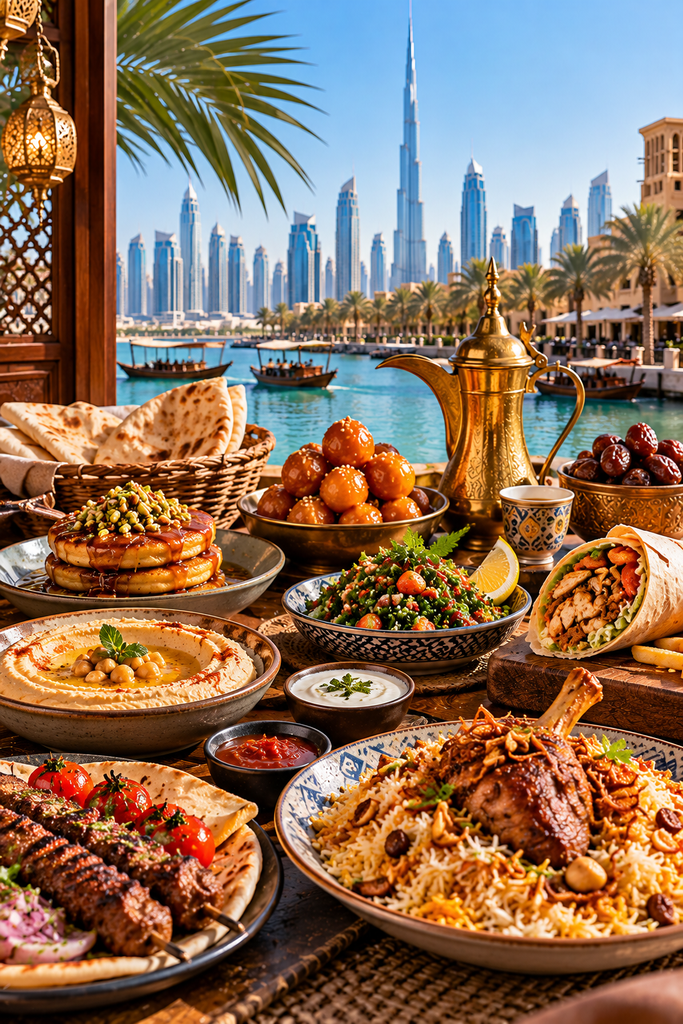
If shawarma and biryani show how international Dubai is, machboos brings you back to the Gulf.
Machboos is a fragrant rice dish usually prepared with chicken, lamb or seafood and seasoned with a blend of spices. Its exact preparation varies between homes and restaurants, but rice, meat and deep aromatic seasoning form the core.
Visit Dubai’s food guide describes machboos as Emirati comfort food, with rice cooked together with meat and spices for a deeply flavoured result.
This is one of the dishes worth seeking out deliberately rather than waiting to stumble across it.
Head to an Emirati restaurant and order it as part of a wider meal. If you are with several people, add breads, salads and another traditional dish so you can compare flavours.
What does it taste like?
Think aromatic rather than aggressively spicy.
Spices can include cardamom, cinnamon, cloves, dried lime and saffron depending on the recipe.
The result is comforting, filling and much more nuanced than the phrase “rice and meat” makes it sound.
Newcomer tip: If you genuinely want to understand Dubai’s food culture, do not spend six months eating only international restaurant chains. Make time for Emirati food early.
6. Regag Is the Crispy Emirati Bread You Should Eat Fresh
Regag looks simple until you start eating it.
The traditional Emirati bread is extremely thin and crisp, cooked on a hot surface and served plain or filled with ingredients such as cheese, egg, honey or mahyawa, a salty fish-based sauce.
Visit Dubai highlights regag as an Emirati favourite and notes that it can be served with cheese, egg, honey or mahyawa.
The fun part is watching it being prepared.
Batter is spread thinly across the hot cooking surface, cooks quickly and becomes almost paper-like around the edges.
Eat it immediately.
Once you have tried the classic versions, you will also notice contemporary cafés experimenting with fillings and toppings.
Best first version: Cheese and egg if you want savoury, or honey if you want something sweeter.
Feeling adventurous? Try it with mahyawa.
That salty, fermented flavour is much more distinctive and gives you a stronger taste of regional food traditions.
7. Luqaimat Are Almost Impossible to Stop Eating
You may plan to eat three luqaimat.
That plan rarely survives contact with the plate.
Luqaimat are small fried dough dumplings with a crisp exterior and soft centre, commonly flavoured with cardamom and saffron before being finished with date syrup or molasses and sesame.
Visit Dubai describes them as a classic Emirati sweet and a regular feature of Arabian dessert spreads.
They are especially visible during Ramadan and cultural events, but you can find them throughout the year.
Freshness matters.
A warm luqaimat with a crisp shell is a completely different experience from one that has been sitting around too long.
First-timer move: Order a portion for the table.
What happens next: Everyone says they are full. The plate disappears anyway.
They also make a useful entry point into Emirati desserts because the flavours are familiar enough to be instantly enjoyable: fried dough, sweetness, cardamom and date syrup.
8. Kunafa Is the Dessert You Order Even When You Said You Were Full
Kunafa is one of those desserts that sounds unusual until you taste it.
It typically combines fine pastry strands or semolina-style layers with soft cheese or cream, then adds sweet syrup and often pistachio.
Visit Dubai describes the classic appeal as the contrast between sweet syrup and a savoury, gooey cheese centre.
In Dubai, kunafa appears at dedicated sweet shops, restaurants, malls and late-night dessert stops.
You will find different regional styles too.
Some are crisp.
Some are softer.
Some lean heavily into cheese.
Others are creamier.
Then modern dessert shops start adding chocolate, pistachio spreads and increasingly extravagant toppings.
Where should beginners start?
Traditional cheese kunafa served warm.
Do that before trying the social-media versions covered in everything imaginable.
Important question: Crunchy top or soft kunafa?
You may discover this is another food debate people take surprisingly seriously.
9. A Camel Burger Is the “Okay, I’m Definitely in Dubai” Order
Camel is not an everyday meal for most Dubai residents, which is exactly why it earns a place on this list.
It is one of the foods visitors often want to try because it connects a modern restaurant format with an ingredient that has long-standing cultural importance in the region.
Visit Dubai notes that camel can be served in several ways, including with rice and in burgers. It also identifies Local House in Al Fahidi as the restaurant that helped popularise the camel burger in Dubai.
A camel burger is therefore a good “new in town” experience.
It looks familiar.
The bun is familiar.
The format is familiar.
Then the meat gives it a very specific local story.
Depending on preparation, camel meat can be fairly lean, so sauces and seasoning play an important role.
Should you order one every week?
Probably not.
Should you try it once?
Definitely if you are curious about modern interpretations of Emirati ingredients.
For an even more unusual follow-up, some places also serve camel milk or camel-milk desserts.
Which Unofficial Foods of Dubai Should You Try First?
If nine dishes sound like too much, use your personality to decide.
You want something safe and familiar: Start with shawarma.
You live on tea and coffee: Go straight to karak.
You love bakery food: Try manakish and regag.
You want a serious meal: Pick biryani or machboos.
You have a sweet tooth: Luqaimat and kunafa should be first.
You want the story to tell people back home: Order the camel burger.
A good first-time food crawl could actually be extremely simple.
Start the morning with karak and manakish. Have machboos for lunch. Grab a shawarma later in the afternoon, then finish the evening with luqaimat or kunafa.
That is already a surprisingly good introduction to the way different food cultures overlap in Dubai.
Where Old Dubai Fits Into the Food Story
If you are serious about understanding the unofficial foods of Dubai, spend some time in Old Dubai.
Bur Dubai, Deira, Al Fahidi and the neighbourhoods around Dubai Creek preserve a much more visible version of the city’s long-standing food culture.
Visit Dubai describes Old Dubai as the place where much of the city’s culinary story developed, shaped by Emirati traditions alongside foods brought through trade and migration. It specifically highlights inexpensive and authentic restaurants across Bur Dubai and Deira and notes that Old Dubai food tours were recognised as a standout global travel experience for 2026.
Here, a meal can move across cultures within a few streets.
You might begin with Emirati breakfast, pick up Indian snacks, pass Iranian kebab restaurants, stop for Syrian food and finish with an Arabic sweet.
That mixture is not an exception to Dubai’s food identity.
It is the identity.
Why Dubai Does Not Really Have Just One Signature Food
Ask someone to name the signature food of Naples and pizza arrives quickly.
Ask about Dubai and the answer becomes complicated.
That is because modern Dubai grew through trade, migration and constant movement. Emirati cuisine provides the local foundation, but the city’s everyday eating habits also reflect Arab, Indian, Pakistani, Iranian, Filipino and many other communities.
Visit Dubai describes the city as home to food influences from nearly 200 nationalities, which helps explain why dishes such as shawarma, karak and biryani feel almost as inseparable from everyday Dubai life as explicitly Emirati foods such as machboos, regag and luqaimat.
So the phrase “unofficial foods of Dubai” is useful precisely because it does not claim all nine dishes were invented here.
They were not.
Instead, these are foods that help explain what eating in Dubai actually feels like.
A Dubai Food Beginner’s Checklist
How many have you already tried?
- Shawarma
- Karak chai
- Manakish
- Biryani
- Machboos
- Regag
- Luqaimat
- Kunafa
- Camel burger
Score 0–2: You really are new in town.
Score 3–5: You are getting there.
Score 6–8: Dubai has clearly started influencing your eating habits.
Score 9: You have earned the right to start arguing about where to find the best shawarma.
How to Eat Your Way Around Dubai Without Spending a Fortune
One of the best things about this list is that many of its foods do not require expensive restaurants.
Shawarma, karak and manakish are traditionally associated with casual neighbourhood cafés and bakeries. Biryani can range from budget cafeteria portions to premium restaurant versions. Luqaimat and kunafa can also be found at both inexpensive sweet shops and elaborate dining venues.
Use that range to your advantage.
Do not assume the most expensive version is automatically the most authentic or satisfying.
Some of Dubai’s most memorable everyday food comes from restaurants with plastic menus, fluorescent lights and queues of people who already know exactly what they are ordering.
Save your fine-dining budget for another night.
This particular food tour is more fun when you mix polished restaurants with places you almost walked past.
New in Town? These Foods Are Part of Learning Dubai
The best way to understand Dubai is not only through skyscrapers, malls and famous attractions.
It is also through the foods people eat between everything else.
A paper cup of karak during a drive.
A shawarma after midnight.
A box of manakish carried into the office.
A big biryani shared at lunch.
Machboos at an Emirati restaurant.
Fresh regag prepared in front of you.
Luqaimat that disappear before anyone admits how many they ate.
A warm tray of kunafa.
And, at least once, a camel burger simply because you are in Dubai and you can.
These unofficial foods of Dubai tell the story of a city that does not belong to only one culinary tradition. Emirati heritage remains at the centre, but decades of migration and cultural exchange have added layers of flavours that residents eventually start treating as part of everyday life.
That is why newcomers should not worry too much about finding the single “most authentic Dubai dish”.
Start eating.
The city will explain itself from there.
Do follow us on Instagram
Read More – 105 Top-Rated Business Lunch Deals in Dubai for 2026, Listed Out by Area