How Multicultural Communities Shape Everyday Life in the GCC
The Gulf Cooperation Council (GCC) is home to some of the most culturally diverse communities in the world. The GCC includes six countries: Saudi Arabia, the United Arab Emirates (UAE), Qatar, Kuwait, Bahrain, and Oman. These countries have their own traditions, languages, customs, and national identities, but their cities are also home to people from many different parts of the world.
- 1. Why the GCC Has Become So Multicultural
- 2. Food: A Daily Celebration of Different Cultures
- 3. Language and Communication in Multicultural Communities
- 4. Festivals, Religious Traditions and Shared Celebrations
- 5. How Multicultural Communities Influence Workplaces
- 6. Education and the Next Generation
- 7. Family Life, Friendships and Community Support
- 8. Shopping, Fashion and Everyday Consumer Habits
- 9. Tourism and the Cultural Identity of Gulf Cities
- 10. The Positive Impact of Multicultural Communities
- 11. Challenges of Living in Multicultural Communities
- 12. How Each GCC Country Experiences Cultural Diversity
- 13. How Gulf Cities Can Build More Inclusive Communities
- Conclusion
- Frequently Asked Questions (FAQs)
Over the years, international trade, economic growth, tourism, and migration have brought people from South Asia, Southeast Asia, Africa, Europe, and other regions to the Gulf. They have come to work, study, build businesses, raise families, and explore new opportunities. Their presence has influenced everyday life in many ways, from the food people eat and the languages they speak to the way businesses operate and communities celebrate important occasions.
In cities such as Dubai, Abu Dhabi, Doha, Riyadh, Manama, Kuwait City, and Muscat, people from different backgrounds often share workplaces, residential areas, shopping centres, schools, restaurants, and public spaces.
However, multicultural life is not only about enjoying different foods or meeting people from other countries. It also involves learning about different customs, respecting local traditions, and making sure that people from different backgrounds can participate in community life.
This article explores how multicultural communities shape everyday life across the GCC, the benefits of cultural diversity, the challenges communities face, and how Gulf cities can build more welcoming and connected societies.
1. Why the GCC Has Become So Multicultural
The multicultural nature of the Gulf has developed over many centuries. Long before modern cities appeared, merchants travelled across the Arabian Peninsula and connected Gulf ports with India, East Africa, Persia, and other parts of Asia.
Trade helped create relationships between different communities. Sailors, merchants, craftspeople, and travellers exchanged goods, knowledge, languages, and traditions. Coastal settlements grew around activities such as fishing, pearl diving, boatbuilding, and international commerce.
During the twentieth century, the growth of the oil and gas industries changed the region’s economic direction. Governments invested in roads, ports, airports, housing, hospitals, schools, and commercial facilities. As economies expanded, businesses needed workers with different skills.
People arrived to work in construction, healthcare, education, hospitality, finance, technology, transport, retail, and other industries. Over time, many cities became home to large international communities.
The International Labour Organization has documented the importance of migrant workers to Gulf labour markets and the need to consider their access to social protection.
Several factors have contributed to cultural diversity across the GCC:
- Employment opportunities: Businesses recruit people with different skills and professional backgrounds.
- International trade: Long-standing commercial connections link Gulf cities with other regions.
- Education: Students and teachers travel for study, research, and professional development.
- Tourism: Visitors bring different languages, interests, and cultural experiences.
- Business and investment: International companies establish offices and recruit employees from many countries.
- Family and community networks: Residents build social connections through relatives, friendships, schools, and local organisations.
These factors have helped shape the modern Gulf while local traditions and national identities remain important parts of everyday life.
2. Food: A Daily Celebration of Different Cultures
Food is one of the clearest examples of how multicultural communities shape life in Gulf cities. Restaurants, cafés, supermarkets, food markets, and home kitchens reflect a mixture of local traditions and international influences.
Traditional Gulf dishes remain important. People enjoy meals such as machboos, harees, grilled seafood, dates, and other foods connected with regional hospitality. Arabic coffee and traditional sweets also have an important place in social gatherings.
At the same time, international communities have helped make many other cuisines part of everyday dining. In major Gulf cities, residents can often find Indian biryani, Pakistani kebabs, Filipino adobo, Lebanese mezze, Turkish grilled dishes, Chinese noodles, Japanese sushi, and European-style bakery products.
This variety gives residents more choices and allows people to experience other cultures through food.
How multicultural food culture affects everyday life
- More dining options: Residents can choose between traditional restaurants, international cafés, street food, and modern dining experiences.
- Cultural exchange: People learn about other communities by tasting their dishes and discovering the stories behind them.
- Business opportunities: Restaurants, food delivery companies, catering services, and speciality grocery shops serve diverse customers.
- Family connections: People living abroad can find familiar ingredients and prepare dishes associated with home.
- Shared celebrations: Friends and colleagues may exchange food during festivals, birthdays, and other special occasions.
Food also creates opportunities for small businesses. A family restaurant may serve traditional dishes from its home country, while a local café may combine regional flavours with international recipes.
However, cultural food traditions should not be reduced to stereotypes. Not everyone from a particular country eats the same food, and personal preferences vary. The most interesting part of multicultural food culture is the opportunity to discover something new while respecting the traditions behind it.
3. Language and Communication in Multicultural Communities
Language plays an important role in daily life across the GCC. Arabic is the official language in each of the six member countries, and it remains central to local culture, government, education, and public life.
However, international communities have introduced many other languages into workplaces, shops, schools, and residential areas.
English is widely used in international business and communication, particularly in major commercial centres. Depending on the location, residents may also hear Hindi, Urdu, Malayalam, Tamil, Bengali, Tagalog, Mandarin, French, and many other languages.
Abu Dhabi’s official information about its population highlights the presence of more than 200 nationalities and the use of many languages in daily life.
This linguistic diversity can make communication more flexible, but it can also create difficulties.
For example, a customer may prefer speaking in their first language when discussing a service or asking for help. An employer may need to explain workplace safety instructions to employees who speak different languages. Schools may support students who are learning Arabic or English while continuing to develop their home languages.
Multicultural communities can improve communication by:
- Using clear and simple language.
- Providing translations for important information when needed.
- Learning basic greetings in other languages.
- Respecting Arabic as the official language and learning about its cultural importance.
- Avoiding jokes or comments that make fun of someone’s accent.
- Using visual instructions when language differences create safety concerns.
Language learning can also build friendships. Even a simple greeting in another person’s language can make an interaction warmer and show interest in their culture.
4. Festivals, Religious Traditions and Shared Celebrations
Religious and cultural celebrations are an important part of life across the GCC. They offer opportunities for families and communities to maintain traditions, spend time together, and share meaningful experiences.
Ramadan and Eid are especially important across the region. During Ramadan, many Muslim families fast during daylight hours, gather for iftar, and take part in charitable and community activities. Eid celebrations bring families and friends together for meals, visits, gifts, and other traditions.
People from different backgrounds may learn about Ramadan by joining an iftar invitation, visiting cultural events, or understanding changes in working hours and daily routines during the holy month.
International communities also celebrate their own religious and cultural occasions. Depending on the country and local arrangements, residents may mark Diwali, Christmas, Lunar New Year, Onam, Vaisakhi, and other festivals through family gatherings, community events, religious services, or public celebrations.
The UAE provides examples of organised efforts to support religious coexistence. Its official information on tolerance describes a diverse population with multiple faith communities and places of worship.
How celebrations bring people together
- Neighbours may exchange food or greetings.
- Workplaces may organise cultural activities.
- Schools may teach students about different traditions.
- Families can introduce children to other cultures.
- Community events can create opportunities for friendship.
- Religious gatherings can provide support and a sense of belonging.
It is important to remember that the rules and public recognition of religious events differ across GCC countries. Residents and visitors should respect local laws and customs when attending celebrations.
When approached with respect, cultural and religious events can help people understand one another without requiring them to give up their own beliefs.
5. How Multicultural Communities Influence Workplaces
Workplaces are among the places where cultural diversity is most visible in the GCC. International companies, hospitals, hotels, construction firms, schools, shops, and technology businesses often employ people with different nationalities and professional experiences.
A single workplace may include employees who speak different languages, follow different traditions, and have received their education in different countries.
This diversity can benefit organisations by bringing together a wider range of knowledge and experiences. Employees may introduce new ideas, explain customer needs in different markets, and help companies communicate with international clients.
For example, a hotel in Dubai may employ people who can communicate with guests from Asia, Europe, Africa, and the Middle East. A logistics company in Saudi Arabia may depend on staff with knowledge of international shipping, languages, and regional markets.
Multicultural workplaces can support:
- International customer service: Employees may help customers who speak different languages.
- New ideas: People with different experiences may approach a problem in different ways.
- Market knowledge: Employees can help companies understand international customers.
- Team learning: Workers can share professional skills and practical knowledge.
- Business connections: Diverse teams may support relationships with international partners.
However, diversity alone does not guarantee a positive workplace. Employers need fair recruitment, clear communication, equal respect, suitable training, and safe working conditions.
Cultural differences should never be used as an excuse for discrimination or unfair treatment. A strong workplace values people for their skills, contributions, and professional conduct.
6. Education and the Next Generation
Schools, colleges, and universities are important places where children and young adults experience cultural diversity.
In international schools across the GCC, students may study alongside classmates from many countries. They learn different languages, encounter different family traditions, and discover that people can share common interests even when their backgrounds are different.
Teachers can help students understand cultural differences through history, literature, languages, art, and classroom activities. Group projects also encourage children to cooperate with people who may have different perspectives.
For families who have moved to a Gulf country, schools can help children adjust to a new environment. At the same time, parents may want their children to maintain their home languages and understand the traditions of their family.
Benefits of multicultural education
- Greater awareness of different cultures.
- Opportunities to learn additional languages.
- Better preparation for international workplaces.
- Development of communication and teamwork skills.
- More opportunities to challenge stereotypes.
- Friendships across cultural backgrounds.
There can also be challenges. Children may experience language difficulties, differences in teaching styles, or the stress of moving between countries. School fees and access to suitable education may also affect families differently.
Schools can support students by creating inclusive classrooms, providing language assistance, encouraging respectful discussion, and ensuring that bullying based on nationality, religion, or language is taken seriously.
Education can help young people develop a more complete understanding of the world while maintaining respect for their own communities.
7. Family Life, Friendships and Community Support
Multicultural communities influence the way people build friendships and maintain social relationships.
In many Gulf cities, residents form connections through workplaces, schools, neighbourhoods, sports clubs, religious organisations, cultural associations, and shared hobbies. Some people develop close friendships with colleagues from different countries, while others meet neighbours through children, community events, or local activities.
Family remains important across the GCC, and traditional family gatherings continue to play a major role in social life. At the same time, international residents often build support networks with friends who understand the experience of living away from their home country.
These networks can help people adjust to a new city, find information, share childcare advice, or celebrate important occasions.
Multicultural friendships may also influence everyday habits. People may try new foods, learn unfamiliar greetings, discover different forms of music, or take part in activities they had not experienced before.
However, social integration does not happen automatically. People can live in the same city for years while having limited contact with communities outside their own language or social group.
Cities can encourage stronger connections through:
- Public festivals and cultural events.
- Community sports and recreational activities.
- Libraries, parks, and shared public spaces.
- Volunteering and neighbourhood programmes.
- Language exchanges and educational workshops.
- Family-friendly community gatherings.
These activities create opportunities for people to interact naturally and develop friendships beyond their immediate social circles.
8. Shopping, Fashion and Everyday Consumer Habits
Multicultural communities also influence shopping habits and the products available in Gulf cities.
Supermarkets and speciality shops often stock ingredients, spices, clothing, cosmetics, books, and household products for different communities. Shopping centres may include international fashion brands alongside regional businesses and traditional products.
A resident in Doha might buy local dates for a family gathering, purchase South Asian spices for a home-cooked meal, and shop for international clothing brands in the same week.
Fashion is another area where local traditions and international influences exist side by side. Traditional clothing remains important during religious events, weddings, and family celebrations, while modern styles reflect global trends.
Businesses respond to these varied needs by offering different products, sizes, designs, languages, and services.
This diversity can create benefits such as:
- More choices for consumers.
- Greater demand for speciality products.
- Opportunities for small retailers and online sellers.
- New ideas for design and product development.
- More cultural exchange through shopping and markets.
At the same time, companies need to understand local customs and consumer preferences. A product that is popular in one market may not be suitable for every customer or location.
Successful businesses learn about their customers instead of assuming that nationality alone determines what people like.
9. Tourism and the Cultural Identity of Gulf Cities
Tourism gives visitors opportunities to experience the cultural diversity of the GCC. Modern Gulf cities often combine traditional markets, museums, historic neighbourhoods, international restaurants, and contemporary attractions.
Visitors to Dubai may explore historic areas near Dubai Creek before visiting a modern business district. In Doha, visitors can experience museums, waterfront spaces, traditional markets, and international sporting events. Muscat offers opportunities to explore Omani architecture, traditional souks, coastal landscapes, and local food.
Multicultural communities can help tourism businesses serve visitors from different backgrounds. Employees who speak several languages may explain local customs, assist travellers, and help guests feel more comfortable.
International residents also contribute to the range of restaurants, festivals, art events, and cultural activities available in many cities.
However, tourism should not present the Gulf as a single, uniform culture. Each country has its own history, traditions, dialects, architecture, and social customs.
Tourism businesses should respect local communities, protect historic sites, and represent cultural traditions accurately. Visitors should also learn basic local etiquette, particularly when visiting religious sites or traditional neighbourhoods.
A strong cultural tourism experience allows visitors to enjoy international diversity while understanding the local heritage that gives each city its identity.
Historical Places Tell Local Stories
Old forts, traditional houses, museums, and historic markets help tourists understand how Gulf communities lived before the discovery of oil transformed the region. Traditional fishing, pearl diving, and maritime trade remain important parts of the Gulf’s historical story. Protecting these places helps preserve memories that could otherwise disappear as cities continue to grow.
Local Traditions Create Unique Experiences
Cultural identity is visible in everyday activities, including Arabic coffee traditions, serving dates to guests, wearing traditional clothing, and showing hospitality. Visitors can experience these customs through local tours, cultural centres, traditional markets, and community events. Such experiences help tourists understand that Gulf culture is not limited to historical buildings; it is also reflected in people’s daily lives.
Tourism Encourages Cultural Understanding
Tourists and residents come from diverse backgrounds. Meaningful cultural experiences can reduce misunderstandings, encourage mutual respect, and present a more complete picture of Gulf society.
10. The Positive Impact of Multicultural Communities
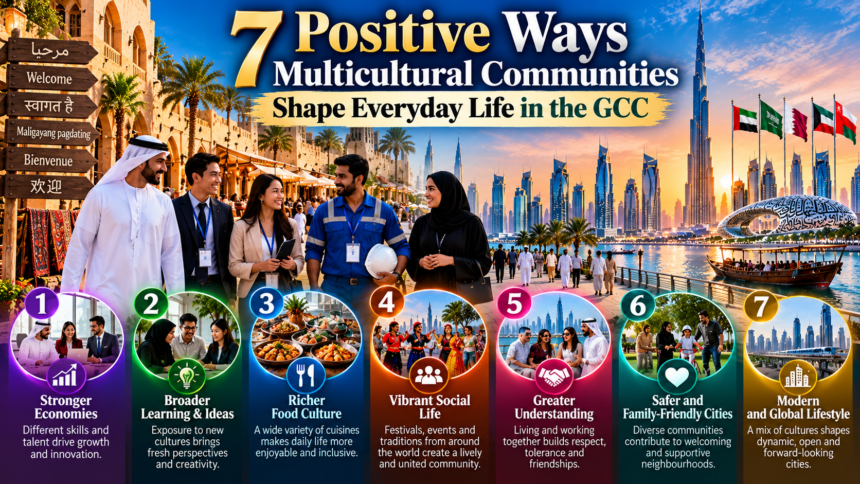
Cultural diversity can create many benefits for residents, businesses, and the wider economy.
Greater cultural understanding
People can learn about different traditions, beliefs, and ways of life through everyday conversations and shared activities.
Stronger business connections
International employees and entrepreneurs may bring language skills, market knowledge, and professional relationships that help businesses reach new customers.
More creative ideas
Teams with different experiences may approach problems from different angles and develop new products or services.
Wider food and entertainment choices
Restaurants, music, art, festivals, and cultural events can offer residents more ways to enjoy their free time.
Better language learning opportunities
Daily contact with different languages may encourage people to learn useful words and improve their communication skills.
Support for tourism and local businesses
International restaurants, cultural events, specialist shops, and visitor services can create employment and attract customers.
Greater global awareness
Children and adults can gain a better understanding of international issues and learn to communicate with people whose experiences differ from their own.
These benefits are strongest when communities have meaningful opportunities to interact and when people are treated fairly regardless of their background.
11. Challenges of Living in Multicultural Communities
Although cultural diversity offers many benefits, it can also create challenges. Understanding these issues is important for building stronger communities.
Language barriers
People may misunderstand instructions, public information, or workplace rules when information is not available in a language they understand.
Cultural misunderstandings
Different customs around greetings, personal space, communication, or social behaviour may lead to confusion. Learning about local etiquette can reduce these problems.
Social separation
People may spend most of their time with others who speak the same language or share similar backgrounds. This can limit interaction between communities.
Unequal access to services
Residents may experience different levels of access to healthcare, housing, education, and social support depending on their income, employment, and legal status.
Employment and living conditions
Some migrant workers face difficulties involving wages, recruitment costs, accommodation, access to healthcare, or the ability to change jobs. The International Labour Organization has highlighted the importance of social protection for migrant workers in GCC countries.
Stereotypes and discrimination
Negative assumptions about nationality, religion, language, or occupation can damage relationships and create unfair treatment.
These issues should be addressed through clear communication, fair employment practices, effective enforcement of relevant laws, and accessible information about rights and services.
A multicultural society is not automatically an equal society. Genuine inclusion requires practical efforts to make sure people are respected and can participate in daily life.
12. How Each GCC Country Experiences Cultural Diversity
The six GCC countries share some features, but their populations, histories, laws, and social environments differ.
United Arab Emirates
The UAE is known for its highly international population, particularly in major cities such as Dubai and Abu Dhabi. International business, tourism, education, and trade bring people from many backgrounds into daily contact.
The UAE’s official information highlights its cultural heritage, Islamic values, and diverse expatriate population.
Saudi Arabia
Saudi Arabia’s cultural life is strongly connected to Arab and Islamic traditions. International workers and visitors also contribute to the daily life of cities such as Riyadh and Jeddah. Economic development, tourism, and international business are creating additional opportunities for cultural exchange.
Qatar
Doha brings together local traditions and international communities working in energy, education, finance, hospitality, sports, and other industries. International schools, workplaces, and cultural events provide opportunities for people to interact.
Kuwait
Kuwait has a long history of trade and international connections. Its modern communities include people from different countries who contribute to healthcare, education, retail, construction, hospitality, and other sectors.
Bahrain
Bahrain’s maritime and trading history has helped connect the country with different regions. Manama’s business environment, financial services, and international workforce contribute to its diverse social life.
Oman
Oman has historic connections with East Africa, India, and other parts of the Indian Ocean. Its culture reflects local traditions and long-standing maritime relationships, while international workers and visitors contribute to modern life in Muscat and other cities.
The experience of diversity varies within each country. Capital cities and major commercial centres may offer different opportunities for cultural interaction than smaller towns or rural communities.
13. How Gulf Cities Can Build More Inclusive Communities
Building inclusive communities requires more than celebrating food, music, and festivals. It involves making everyday life safer, fairer, and more welcoming for people from different backgrounds.
Governments, employers, schools, community organisations, and residents all have a role to play.
Useful steps include:
- Improve public information: Make important instructions clear and accessible to residents with different language skills.
- Encourage respectful workplaces: Apply fair recruitment practices, provide suitable training, and address discrimination.
- Support cultural learning: Organise activities that help residents understand local traditions and the cultures of their neighbours.
- Improve access to services: Help people understand how to access healthcare, education, housing support, and relevant legal information.
- Create shared public spaces: Parks, libraries, sports facilities, and community centres can encourage interaction.
- Protect workers’ rights: Employers should follow labour laws and provide safe working conditions and fair treatment.
- Respect local traditions: Cultural exchange should include learning about the history, language, and customs of the country where people live.
Residents can contribute by listening carefully, avoiding stereotypes, respecting religious practices, and treating others with kindness.
Inclusion does not mean that everyone must follow the same traditions. It means people can maintain their identities while respecting the rules and values of the wider community.
Conclusion
Multicultural communities have become an important part of everyday life across the GCC. Through migration, trade, tourism, education, and international business, people from different backgrounds have helped shape the region’s food, languages, workplaces, shopping habits, celebrations, and social relationships.
At the same time, local Arab and Islamic traditions remain central to the identity of Gulf countries. The region’s cultural character comes from the interaction between these long-standing traditions and the many international communities that now call Gulf cities home.
Cultural diversity can create valuable opportunities for learning, business, friendship, and creativity. However, these benefits depend on mutual respect, fair treatment, effective communication, and meaningful opportunities for people to participate in community life.
Challenges involving language barriers, social separation, unequal access to services, and workers’ rights should not be ignored. They require practical solutions from governments, employers, community organisations, and residents.
As Gulf cities continue to develop, their success will depend not only on modern buildings and economic growth but also on the quality of relationships between the people who live there. By respecting local traditions and encouraging understanding across cultures, communities can create a more welcoming and connected future.
Frequently Asked Questions (FAQs)
1. What does multiculturalism mean everyday life in the GCC?
Multiculturalism in the GCC refers to the presence of people from different countries, languages, religions, and cultural backgrounds living and working across Saudi Arabia, the UAE, Qatar, Bahrain, Kuwait, and Oman.
2. Why are Gulf cities so culturally diverse?
Economic growth, international trade, employment opportunities, education, tourism, and investment have attracted people from many parts of the world. Their contributions have helped shape the social and economic life of Gulf cities.
3. How does cultural diversity influence food in the GCC?
International communities have introduced a wide range of restaurants, ingredients, and cooking traditions. Residents can enjoy local Gulf dishes alongside South Asian, African, European, East Asian, and other cuisines.
4. How do multicultural communities benefit businesses?
They can provide language skills, international market knowledge, different professional experiences, and a better understanding of customer needs. Cultural diversity can also support tourism, restaurants, retail, and other services.
5. What challenges do multicultural communities face?
Common challenges include language barriers, cultural misunderstandings, social separation, discrimination, unequal access to services, and difficulties experienced by some migrant workers.
6. How can residents respect different cultures in Gulf cities?
Residents can learn about local customs, listen to people from different backgrounds, avoid stereotypes, respect religious practices, and communicate politely. They should also follow the laws and social rules of the country where they live.
7. Does multiculturalism change traditional Gulf culture?
Cultural interaction can influence food, fashion, business, language, and entertainment. However, local traditions, Arabic language, family relationships, and Islamic values remain important. The effect of cultural exchange differs across communities and countries.
8. How can Gulf cities become more inclusive?
Cities can improve access to public information, support fair workplaces, protect workers’ rights, provide language assistance, organise community activities, and create shared public spaces where residents can interact respectfully.
Do follow us on Instagram
Read More – How Gulf Cities Become As Global Business Hubs