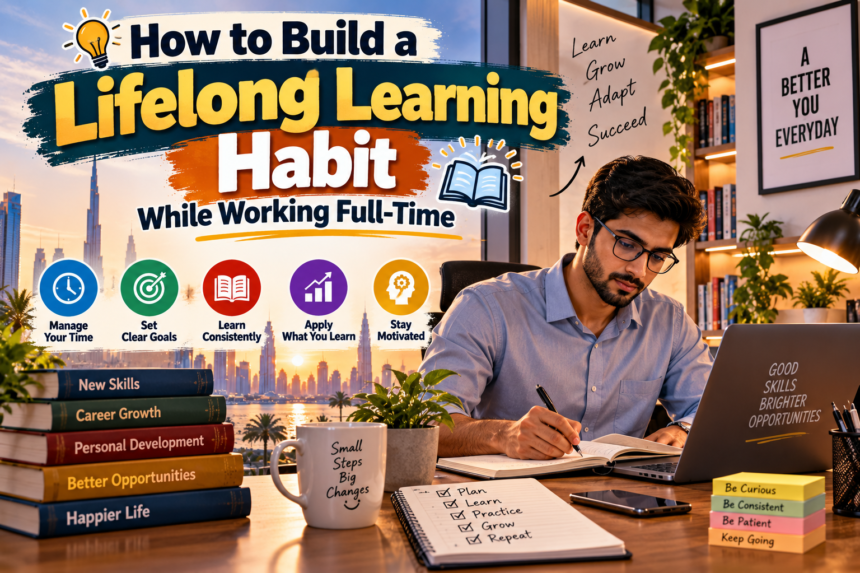
Practical Ways to Build a Lifelong Learning Habit While Working Full-Time
Working full-time can make it difficult to find time for personal development. Between office hours, meetings, deadlines, family responsibilities, and everyday tasks, learning something new may feel like another job. Many professionals want to improve their skills, explore new interests, or prepare for better career opportunities, but they struggle to make learning part of their daily routine.
- 1. Understand Why Lifelong Learning Matters
- 2. Set Clear and Realistic Learning Goals
- 3. Start Small Instead of Studying for Hours
- 4. Create a Learning Schedule Around Your Work Routine
- 5. Choose Learning Resources That Match Your Goals
- 6. Use Effective Learning Methods to Remember More
- 7. Connect Learning With Your Current Job
- 8. Make Learning Part of Your Daily Routine
- 9. Reduce Distractions and Protect Your Learning Time
- 10. Track Your Progress and Celebrate Small Achievements
- 11. Avoid Burnout and Maintain a Healthy Work-Life Balance
- 12. Stay Curious and Learn Beyond Your Job
- A Practical 30-Day Plan to Build a Lifelong Learning Habit
- Common Mistakes to Avoid When Learning While Working Full-Time
- Conclusion: Make Learning a Part of Your Life, Not Another Burden
- Frequently Asked Questions (FAQs)
The good news is that lifelong learning does not require you to spend several hours studying every day. You do not need to leave your job, join multiple courses, or sacrifice your personal life. What matters most is building a realistic learning habit that fits your schedule and continues over time.
Lifelong learning means developing knowledge, skills, and abilities throughout life. It can happen through formal education, online courses, workplace experience, reading, conversations, personal projects, and everyday activities. UNESCO recognises adult learning as an important part of lifelong learning because it supports participation in society and the world of work.
For full-time employees, this habit can help keep professional knowledge relevant, improve confidence, support career development, and make it easier to adapt to changing work requirements.
In this article, we will explore 12 practical ways to build a lifelong learning habit while working full-time, along with time-management tips, useful learning methods, a weekly schedule, and ways to stay motivated without feeling overwhelmed.
1. Understand Why Lifelong Learning Matters
Before creating a learning schedule, understand why you want to continue learning. A clear reason can make it easier to stay consistent, particularly on busy days when studying feels difficult.
Technology, workplace expectations, customer needs, and business processes continue to change. Skills that were useful several years ago may need updating, while new tools and methods may become important in your industry.
For example, a software developer may need to learn new programming frameworks. A marketing professional may want to understand digital advertising and data analysis. A customer service employee may benefit from learning communication techniques and customer relationship tools.
The OECD’s Education at a Glance 2026 explains that technological change, artificial intelligence, and labour-market transformation are increasing the importance of adult learning and skills development. It also highlights that learning participation is not equal, with time commitments from work and family among the barriers people face.
Lifelong learning can support you in several ways:
- Career development: Build skills that may help you take on new responsibilities.
- Professional confidence: Understand new tools and processes used in your industry.
- Adaptability: Become more comfortable with changes in technology and workplace practices.
- Personal growth: Explore subjects outside your current profession.
- Problem-solving: Learn different ways to approach everyday challenges.
- Independence: Develop the ability to find information and learn without always depending on others.
Career and Economic Survival
- Stying Relvant: Industries, tools, and regulations evolve constantly; continuous learning ensures your skills and do not become outdated.
- Jon Mobility and Security: Proactive learners adapt faster to automation and opening doors to promotions, leadership roles, and new career paths.
- Higher Value: Worker who consistently upadate their capabilities are more valued by employers and see stronger long-term income growth.
You do not have to learn something only because it is popular. Choose subjects that support your personal interests, professional goals, or future plans.
2. Set Clear and Realistic Learning Goals
A common mistake people make is attempting to pursue too many learning activities simultaneously. They might try to learn a new language, read several books, improve their communication skills, and prepare for a professional certification—all at the same time. Managing such an approach alongside a full-time job is extremely difficult.
Instead, you could choose a single topic as your learning goal and focus on that.
For example, rather than writing “I want to improve my technical skills”, set a goal such as: “I will learn the fundamentals of React and build a small project within eight weeks.”
A clear goal tells you what to study, how to measure progress, and what you are working towards.
Use the SMART goal method
A useful way to organise learning goals is the SMART method:
- Specific: Decide exactly what you want to learn.
- Measurable: Choose a way to check your progress.
- Achievable: Make sure the goal fits your available time.
- Relevant: Connect it to your professional or personal interests.
- Time-bound: Set a reasonable deadline.
Here are some examples:
| General Goal | More Specific Learning Goal |
|---|---|
| Improve communication | Practise a five-minute presentation every week |
| Learn programming | Complete three JavaScript lessons each week |
| Improve English | Learn and practise ten useful words each week |
| Understand finance | Study one personal finance topic every weekend |
| Learn digital marketing | Complete one practical lesson every week |
Avoid setting deadlines that create unnecessary pressure. Your goal should encourage progress, not make learning feel like another source of stress.
It is also useful to review your goals every month. You may discover that your interests have changed or that a different skill has become more important.
3. Start Small Instead of Studying for Hours
When you work full-time, your energy and free time may change from one day to another. After a long working day, sitting down for a two-hour study session may not always be realistic.
That is why starting small can be effective.
You can begin with just 15 to 30 minutes of learning each day. Read a few pages, watch a short educational lesson, practise a skill, or revise something you learned earlier.
Small learning sessions are easier to fit into a busy routine than large sessions that require extensive preparation.
For example:
- Spend 15 minutes reading an industry-related article.
- Watch a 20-minute tutorial during a suitable break.
- Practise a new language for 10 minutes.
- Solve two programming problems.
- Listen to an educational podcast during your commute, where appropriate.
- Write a short summary of something you learned.
The aim is to create a routine that you can repeat.
Do not worry about completing an entire course quickly. Focus on building a habit of returning to learning regularly. Over time, these smaller sessions can add up to meaningful progress.
However, remember that some skills require longer periods of focused practice. You can use short sessions for regular learning and reserve a longer block at the weekend for projects, exercises, or deeper study.
4. Create a Learning Schedule Around Your Work Routine
A learning habit becomes easier to maintain when you decide in advance when it will happen.
Instead of waiting for free time to appear, identify small periods in your existing schedule that are suitable for learning.
You do not necessarily need to wake up very early or stay awake late at night. Choose a time when you can concentrate without affecting your sleep, health, or responsibilities.
Find suitable learning times
Some possible options include:
Before work: Spend 15–20 minutes reading, revising vocabulary, or studying a short lesson.
During breaks: Use a suitable break for a short educational video or practice exercise, without interfering with rest or meal time.
After work: Study for 20–30 minutes after relaxing and completing essential responsibilities.
On weekends: Reserve one longer session for practical work, project development, or reviewing the week’s learning.
Example weekly learning schedule
| Day | Learning Activity | Suggested Time |
|---|---|---|
| Monday | Read an article or book chapter | 20 minutes |
| Tuesday | Watch a learning lesson | 25 minutes |
| Wednesday | Practise a new skill | 30 minutes |
| Thursday | Revise previous lessons | 20 minutes |
| Friday | Take a short quiz or recall key ideas | 15 minutes |
| Saturday | Work on a practical project | 60 minutes |
| Sunday | Review progress and plan the next week | 20 minutes |
This is only an example. Adjust it according to your work hours and personal commitments.
The OECD has highlighted that more than two in five adults who do not participate in training report a lack of time because of work or family responsibilities. Flexible learning routines can help address this difficulty.
The best schedule is not the one that looks impressive. It is the one you can realistically follow.
5. Choose Learning Resources That Match Your Goals
There are many ways to learn today. You can use books, online courses, educational videos, podcasts, workshops, professional communities, and practical projects.
However, having access to too many resources can sometimes create confusion. You may spend more time searching for the perfect course than actually learning.
Choose a small number of trustworthy resources and follow them consistently.
Useful learning resources
Online courses: Platforms such as Coursera, edX, Udemy, and LinkedIn Learning provide courses on technology, business, communication, management, and other subjects. Check the course content, instructor details, cost, and level before enrolling.
Books and e-books: Books can provide a deeper understanding of topics than short social media posts. You can also use public library resources where available.
Educational videos: Video lessons are useful for visual demonstrations, software tutorials, and practical explanations.
Podcasts: Podcasts can help you explore topics while walking, travelling, or doing other tasks that do not require full attention.
Professional communities: Online groups, workshops, and industry discussions can help you learn from people with practical experience.
Workplace training: Ask whether your organisation offers internal training, mentoring, or access to professional development resources.
Choose resources based on what you need to learn rather than how popular a platform or instructor appears to be.
6. Use Effective Learning Methods to Remember More
Spending time studying does not always mean that you will remember what you have learned. A person may watch several hours of tutorials and still struggle to explain the subject or use it independently.
To make learning more effective, use methods that encourage you to recall and apply information.
Practise active recall
Active recall means trying to remember information without looking at your notes.
After completing a lesson, close the book or video and ask yourself:
- What were the main ideas?
- Can I explain the topic in simple language?
- Which examples do I remember?
- What questions can I answer without help?
For example, after learning about JavaScript functions, try explaining what a function does and write a small example from memory.
Use spaced repetition
Instead of studying a topic once and forgetting about it, review it at different intervals.
You might revise a lesson:
- On the day you learn it.
- The next day.
- Three days later.
- One week later.
- Two weeks later.
The exact intervals can change depending on the topic and how well you remember it.
Research published in Nature Reviews Psychology discusses how spacing learning sessions and practising retrieval can improve long-term learning and memory across different settings.
Learn by doing
Practical application makes learning more meaningful.
For example:
- A developer can build a small application.
- A marketing professional can create a sample campaign.
- A language learner can practise real conversations.
- An accountant can work through example financial statements.
- A manager can practise preparing a project plan.
Learning becomes more useful when you move beyond watching or reading and begin applying what you know.
7. Connect Learning With Your Current Job
One of the easiest ways to make learning part of your working life is to connect it with tasks you already perform.
When you learn something that can be applied to your job, you have a practical reason to practise it.
For example, an employee who regularly prepares reports might learn spreadsheet formulas and data visualisation. A customer support professional might study conflict management and communication techniques. A software developer might explore testing tools or a framework used by the team.
Here are some examples across different careers:
| Profession | Useful Learning Areas |
|---|---|
| Software developer | Programming, testing, cloud tools, cybersecurity |
| Marketing professional | SEO, analytics, content strategy, advertising |
| Customer service employee | Communication, CRM tools, problem-solving |
| Accountant | Financial software, reporting, tax-related updates |
| Manager | Leadership, project management, decision-making |
| Teacher | Digital learning tools, teaching methods, subject updates |
| Sales professional | Negotiation, customer needs, product knowledge |
You can also learn from your daily work. Ask experienced colleagues how they solve problems, observe how meetings are conducted, and request feedback on your performance.
Workplace learning does not always require a formal course. It can happen through observation, practice, discussions, and reflection.
UNESCO recognises formal, non-formal, and informal learning as parts of lifelong learning. This means that structured courses are only one way to develop knowledge and skills.
8. Make Learning Part of Your Daily Routine
A habit becomes easier to maintain when you connect it with an activity you already do regularly.
For example, you may decide to read a few pages after breakfast, revise vocabulary after dinner, or listen to a useful podcast during your commute.
This approach helps reduce the effort required to decide when to study.
Try habit stacking
Habit stacking means connecting a new habit with an existing routine.
Examples:
- After morning tea, read five pages of a professional book.
- After reaching home, revise one lesson before starting entertainment.
- After completing dinner, practise a new language for ten minutes.
- After finishing a weekly team meeting, write down one thing you learned.
- Before going to bed, review three important points from the day.
Choose activities that fit naturally into your life.
It is also helpful to keep learning materials ready. Save your course links, keep your notebook nearby, and organise your study space. The easier it is to begin, the less likely you are to postpone learning.
9. Reduce Distractions and Protect Your Learning Time
One challenge of modern life is the constant flow of notifications, messages, emails, and social media content.
Even a short learning session can become unproductive if you repeatedly switch between different tasks.
To improve concentration, create a simple learning environment.
- Put your mobile phone on silent or focus mode.
- Close unnecessary browser tabs.
- Keep only the materials related to your current topic.
- Set a clear goal for each learning session.
- Use a timer to manage your study period.
- Take short breaks when you need them.
- Choose a quiet place whenever possible.
You can also use the Pomodoro technique. In a common version, you work for 25 minutes and then take a short break of around five minutes. After several rounds, take a longer break.
This method is not suitable for every task, but it can help people who find it difficult to begin or maintain concentration.
Avoid trying to study while handling several demanding activities at once. Listening to a lesson while completing complex work tasks may reduce your understanding of both.
Give learning your attention for the short period you have chosen.
10. Track Your Progress and Celebrate Small Achievements
When you are working full-time, it may sometimes feel as though you are making very little progress. Tracking what you learn can help you see how far you have come.
You do not need complicated software. A notebook, spreadsheet, calendar, or simple checklist can be enough.
Record details such as:
- What topic did you study?
- How much time did you spend?
- What new idea did you understand?
- What practical task did you complete?
- What do you need to revise?
- What should you learn next?
Example learning tracker
| Week | Learning Goal | Activity Completed | Progress |
|---|---|---|---|
| Week 1 | Learn basic Excel formulas | Practised SUM and AVERAGE | Completed |
| Week 2 | Understand data organisation | Created a sample worksheet | Completed |
| Week 3 | Learn charts | Created three chart types | In progress |
| Week 4 | Build a small report | Prepared a sample report | Planned |
At the end of each month, review your progress.
You may discover that you have completed several lessons, finished a book, improved your presentation skills, or built a project that you could not complete earlier.
Celebrate these achievements. They do not need to be major milestones. Consistent small improvements are worth recognising.
11. Avoid Burnout and Maintain a Healthy Work-Life Balance
Lifelong learning should improve your life, not make it unnecessarily stressful.
Some people become so focused on career development that they fill every free hour with courses, books, and practice sessions. Over time, this can lead to tiredness, frustration, and a loss of motivation.
Remember that working full-time already requires energy and concentration. Rest, sleep, exercise, relationships, and personal time are also important.
Here are some ways to maintain balance:
- Set reasonable daily learning limits.
- Avoid staying awake late every night to complete courses.
- Take breaks when you feel mentally tired.
- Keep at least some free time for family and hobbies.
- Do not compare your progress with people who have different schedules.
- Reduce your study workload during unusually busy work periods.
- Take a planned break when you need one.
It is acceptable to study less during a demanding week. A flexible habit is more likely to last than a strict plan that leaves no room for real-life responsibilities.
You should also understand that lifelong learning does not mean learning something new every single day. Reviewing, practising, reflecting, and resting are all parts of a sustainable learning process.
12. Stay Curious and Learn Beyond Your Job
Professional development is important, but lifelong learning should not be limited to your current career.
Learning outside your profession can introduce you to new interests, useful knowledge, and different ways of thinking.
For example, a software developer may enjoy photography, personal finance, history, or cooking. A teacher may want to learn about digital design or a new language. A business professional may explore psychology, environmental issues, or creative writing.
You can learn about:
- Financial planning and money management.
- Health, fitness, and nutrition.
- Communication and public speaking.
- History, geography, and culture.
- Languages and literature.
- Technology and artificial intelligence.
- Creative skills such as photography and design.
- Leadership and personal development.
Learning beyond your job can also make your everyday life more interesting.
The ILO’s report on lifelong learning describes learning as an activity that takes place throughout life in educational, workplace, family, and wider social settings. It is not limited to formal qualifications or professional training.
Stay curious. Explore subjects because they interest you, not only because they appear on a job description.
A Practical 30-Day Plan to Build a Lifelong Learning Habit
Starting a new routine can feel difficult, especially when your work schedule is already full. A simple 30-day plan can help you begin without taking on too much at once.
The following plan focuses on building consistency rather than completing a large course within one month.
| Week | Main Focus | Activities |
|---|---|---|
| Week 1 | Choose and start | Select one learning goal, choose one resource, and study for 15 minutes on most days |
| Week 2 | Build consistency | Follow a regular study time and practise recalling previous lessons |
| Week 3 | Apply knowledge | Complete a small exercise, practical task, or mini-project |
| Week 4 | Review and improve | Check your progress, identify gaps, and plan the next month’s learning |
Daily 20-minute learning routine
You can also divide a short study session into three parts:
First 5 minutes: Revise something you learned earlier.
Next 10 minutes: Study one new idea or complete a small lesson.
Final 5 minutes: Write a short summary or test yourself without looking at your notes.
This simple routine works well for many types of learning, although practical subjects may sometimes require longer sessions.
At the end of the 30 days, ask yourself:
- Did I follow my learning routine regularly?
- Which learning activities were most useful?
- Can I explain what I have learned?
- Did I apply any new skill in my work or personal life?
- What should I focus on next month?
Use your answers to improve the next month’s plan.
Common Mistakes to Avoid When Learning While Working Full-Time
Even with a good plan, some habits can make lifelong learning harder to maintain.
Trying to learn too many subjects at once: Focus on one main goal before adding another major course.
Choosing courses without a clear purpose: Understand why a course is useful before spending time or money on it.
Only watching videos: Practise, take notes, solve problems, and apply what you learn.
Ignoring revision: Reviewing earlier lessons helps you remember important information.
Comparing yourself with others: Your schedule, responsibilities, and learning speed may be different.
Waiting for free time: Set aside a realistic learning period instead of waiting for a completely free day.
Giving up after missing a session: Missing one day does not mean you have failed. Return to your routine when you can.
Collecting certificates without building skills: A certificate can show course completion, but the ability to use what you learned is equally important.
Conclusion: Make Learning a Part of Your Life, Not Another Burden
Building a lifelong learning habit while working full-time may seem difficult, but it becomes manageable when you start small and create a realistic routine.
You do not need to spend several hours studying every day. Begin with one clear goal, choose useful learning resources, organise your schedule, and practise regularly. Use methods such as active recall, spaced revision, and practical projects to remember and apply new knowledge.
Connect learning with your current job, but also make time for subjects that interest you personally. Track your progress, recognise small achievements, and protect your health and personal time.
The most important thing is consistency. A short learning session repeated regularly can be more useful than an ambitious schedule that you cannot maintain.
Lifelong learning is not about knowing everything. It is about staying curious, improving step by step, and remaining open to new ideas throughout your life.
Start with just 15 minutes today. Choose one subject, learn one useful idea, and take the first step towards making learning a permanent part of your routine.
Frequently Asked Questions (FAQs)
1. What does lifelong learning mean?
Lifelong learning means continuously developing knowledge, skills, and abilities throughout life. It includes formal education, online courses, workplace training, reading, practical experience, and independent learning.
2. How can I find time to learn while working full-time?
Start with 15–30 minutes a day and choose a regular time that fits your routine. You can learn before work, after work, during a suitable break, or at weekends. Keep your schedule flexible enough to manage busy days.
3. What should I learn while working full-time?
Choose skills that support your career goals or personal interests. Examples include communication, digital skills, programming, project management, financial literacy, languages, leadership, and industry-related knowledge.
4. Is 30 minutes of learning a day enough?
Thirty minutes can be a useful starting point for building a habit. It allows you to study a short lesson, revise information, or practise a skill. More time may be needed for complex subjects or practical projects.
5. Which learning method is most effective for busy professionals?
A combination of short focused sessions, active recall, spaced revision, and practical application can be useful. The best approach depends on the skill you are learning and the time available.
6. How do I stay motivated to learn after a long working day?
Set small goals, study subjects that interest you, and avoid making your schedule too demanding. You can also connect learning with your career goals and track your progress to recognise improvements.
7. Can lifelong learning help with career growth?
Lifelong learning can help professionals update their knowledge, develop relevant skills, adapt to workplace changes, and prepare for new responsibilities. However, career outcomes also depend on experience, performance, opportunities, and other factors.
8. Do I need certificates to prove that I am learning?
No. Certificates can be useful for certain professional goals, but they are not the only way to demonstrate learning. Practical projects, work samples, improved performance, and the ability to explain or apply a skill can also show your progress.
9. How can I avoid burnout while learning?
Set realistic study limits, take regular breaks, maintain adequate sleep, and protect time for personal responsibilities. Reduce your learning workload during busy periods instead of forcing yourself to follow an unrealistic schedule.
10. How can I turn learning into a permanent habit?
Connect learning with an existing daily routine, set clear goals, use a simple tracker, revise regularly, and focus on progress rather than perfection. When you miss a session, return to your routine without feeling discouraged.
Do follow us on Instagram
Read More – How Dust Storms Form and Affect Daily Life in Gulf Cities