What Science Says About Noise Levels and Health Risks
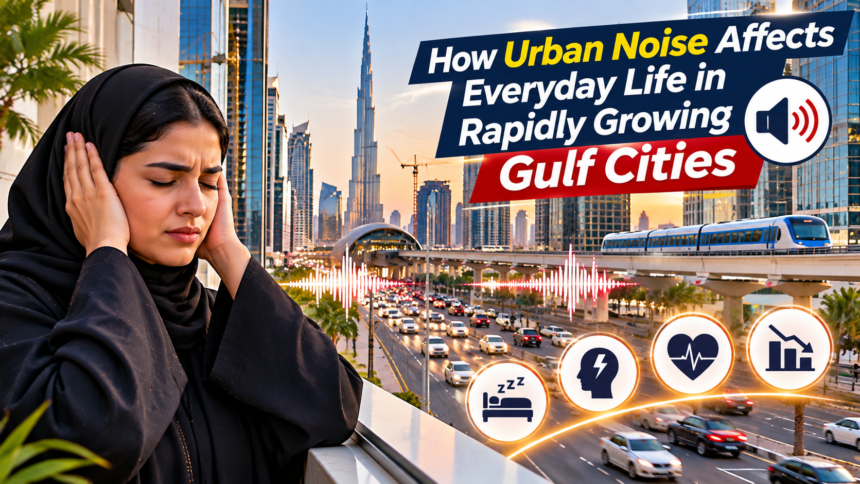
The sound of construction machinery outside a Dubai apartment, heavy traffic along a busy road in Riyadh or aircraft passing over a residential neighbourhood can seem like ordinary features of city life. Yet when these sounds become frequent, unpredictable or difficult to escape, they can affect how people sleep, work, study and relax.
- Why Urban Noise in Gulf Cities Is Becoming an Important Issue
- 7 Hidden Ways Urban Noise Affects Everyday Life
- What Science Says About Noise Levels and Health Risks
- Dubai, Abu Dhabi and Riyadh: How Cities Are Managing Noise
- How Urban Noise Affects Housing, Work and Property Decisions
- Can Better Urban Design Create Quieter Gulf Cities?
- Practical Ways Residents Can Reduce Everyday Noise Exposure
- The Future of Urban Noise Management in Gulf Cities and FAQs
Urban Noise in Gulf Cities is an increasingly relevant urban planning and public health issue as major metropolitan areas expand their residential developments, transportation networks and commercial activities.
Cities across the UAE, Saudi Arabia, Qatar and other Gulf countries are investing in infrastructure, housing, tourism and economic development. These projects provide opportunities for residents and businesses, but they can also generate additional environmental noise.
Busy highways, construction projects, industrial equipment, outdoor entertainment and building ventilation systems all contribute to the sound environments experienced by urban residents.
The challenge is particularly complicated in mixed-use neighbourhoods where apartments, offices, restaurants and commercial facilities operate close to one another.
A resident may enjoy the convenience of living near shops and transportation but experience unwanted sound from traffic, deliveries or late-night activity.
Environmental noise is not simply a matter of personal preference.
The World Health Organization identifies excessive exposure as a risk factor associated with sleep disturbance, stress, cardiovascular health problems and other effects.
The United Nations Environment Programme has also highlighted urban noise as an environmental concern that deserves greater attention in city planning.
Gulf authorities are already taking measures to understand and manage the issue.
Environment Agency – Abu Dhabi has carried out environmental noise mapping and monitoring, while Dubai has published noise-control requirements for construction and other activities.
Saudi Arabia has also established environmental noise regulations governing relevant activities and compliance requirements.
However, it is important not to assume that every Gulf city is becoming noisier at the same rate.
Comprehensive, comparable long-term noise measurements across all GCC cities remain limited. Urban expansion may increase certain noise sources, but actual exposure depends on traffic patterns, building design, regulations and neighbourhood characteristics.
Understanding how noise affects everyday life can help residents, property developers and policymakers make more informed decisions about the future of urban living.
Why Urban Noise in Gulf Cities Is Becoming an Important Issue
Environmental noise refers to unwanted or potentially harmful sound generated by activities such as transportation, construction, industry and entertainment.
Unlike a brief loud sound, persistent exposure can become part of a person’s everyday environment.
The impact depends on intensity, duration, timing and the characteristics of the sound.
The Relationship Between Urban Growth and Noise
As cities expand, more transportation routes, residential buildings and commercial facilities may operate within a relatively small area.
Construction activity can generate temporary but substantial noise during building projects.
Road traffic may produce continuous background sound throughout the day and evening.
However, new infrastructure can also reduce exposure when it includes suitable traffic management, acoustic barriers and effective planning.
Different Sources of Urban Noise
Traffic is among the major sources of environmental noise in cities.
Other sources include mechanical equipment, building work, rail systems, aircraft and recreational activities.
Even ordinary residential equipment, such as air-conditioning machinery, can become disruptive when poorly positioned or maintained.
Common Urban Noise Sources
| Noise Source | Typical Location | Possible Impact |
|---|---|---|
| Road Traffic | Highways and Main Roads | Persistent Background Noise |
| Construction | Developing Neighbourhoods | Intermittent Loud Activity |
| Aircraft | Airport-Adjacent Areas | Sudden Noise Events |
| Commercial Activity | Mixed-Use Districts | Evening Disturbance |
| Mechanical Equipment | Residential and Commercial Buildings | Continuous Humming |
| Industrial Operations | Industrial Zones | Machinery Noise |
| Outdoor Entertainment | Event and Leisure Areas | Periodic High Sound Levels |
Why Location Matters
Two apartments within the same neighbourhood can experience very different sound conditions.
A home facing a main road may receive more traffic noise than an apartment overlooking an internal courtyard.
Building height, window design and nearby structures can also affect how sound reaches residents.
Noise exposure should therefore be assessed at the property or street level rather than assumed from the city’s overall reputation.
7 Hidden Ways Urban Noise Affects Everyday Life
The consequences of environmental noise extend beyond the immediate annoyance caused by a loud sound.
Long-term exposure can influence different aspects of daily life, although individual responses and health risks vary.
1. Disrupted Sleep
Traffic, construction and other disturbances may interrupt sleep or make it more difficult to fall asleep.
Even when a person does not fully awaken, recurring noise can interfere with normal sleep patterns.
Poor sleep can affect energy, attention and daily functioning.
2. Increased Stress
Unwanted noise can create irritation and a reduced sense of control over one’s surroundings.
A person who cannot escape a recurring sound may find it difficult to relax at home.
However, the psychological response varies depending on individual circumstances and the type of noise.
3. Difficulty Concentrating
Background sound can interfere with reading, studying and tasks requiring sustained attention.
This is particularly relevant for people who work from home or study in residential environments.
Sudden interruptions may be especially distracting.
4. Effects on Cardiovascular Health
WHO guidance identifies long-term environmental noise exposure as a risk factor associated with cardiovascular outcomes, including ischaemic heart disease and hypertension.
These associations concern population-level risk and do not mean that a noisy neighbourhood will necessarily cause disease in an individual.
5. Reduced Comfort at Home
Residents may avoid opening windows, using balconies or spending time outdoors because of nearby noise.
This can change how a property is used.
A home with attractive facilities may still feel uncomfortable when unwanted sound frequently enters living spaces.
6. Interference With Communication
Loud environments can make conversations harder to understand.
People may need to speak more loudly or repeat instructions.
In schools, workplaces and public spaces, this can reduce communication quality.
7. Greater Pressure on Vulnerable Groups
Children, older adults and people with certain health needs may be particularly affected by disruptive sound environments.
Children’s concentration and learning can be affected by noise exposure, while people who need uninterrupted rest may find nighttime disturbances especially difficult.
Seven Impacts Compared
| Impact | Everyday Example | Main Concern |
|---|---|---|
| Sleep Disturbance | Traffic at Night | Interrupted Rest |
| Stress | Persistent Construction | Reduced Comfort |
| Concentration | Noise During Study | Distraction |
| Cardiovascular Risk | Long-Term Transport Exposure | Population-Level Health Risk |
| Residential Comfort | Unusable Balcony | Reduced Enjoyment |
| Communication | Loud Background Sound | Difficulty Understanding |
| Vulnerable Residents | Noise Near Schools | Learning and Well-Being |
The severity of each effect depends on exposure rather than the mere presence of sound.
What Science Says About Noise Levels and Health Risks
Noise is commonly measured in decibels, abbreviated as dB.
Environmental assessments frequently use A-weighted decibels, written dB(A), to approximate how human hearing responds to different sound frequencies.
However, a single decibel reading does not describe a person’s full exposure.
Understanding Different Measurements
An instantaneous reading captures sound at a particular moment.
Other measurements assess average exposure over a defined period.
For example, the Lden indicator combines day, evening and night exposure with adjustments that give additional weight to evening and nighttime noise.
The Lnight indicator measures average nighttime exposure over an extended period.
These indicators are used in environmental health studies because recurring exposure can matter more than a brief isolated sound.
WHO Environmental Noise Recommendations
The WHO’s 2018 Environmental Noise Guidelines for the European Region recommend reducing average road traffic exposure below 53 dB Lden.
For nighttime road traffic, the recommended level is below 45 dB Lnight.
These are health-based recommendations, not universally applicable legal limits in every Gulf jurisdiction.
The guidelines also use different values for railway and aircraft noise.
Selected WHO Transport Noise Recommendations
| Source | Average Exposure | Night Exposure |
|---|---|---|
| Road Traffic | Below 53 dB Lden | Below 45 dB Lnight |
| Railway Noise | Below 54 dB Lden | Below 44 dB Lnight |
| Aircraft Noise | Below 45 dB Lden | Below 40 dB Lnight |
The values use different long-term noise indicators and should not be compared directly with a momentary reading from a mobile phone.
Why Noise Can Affect Health
Noise may disrupt sleep and activate physiological stress responses.
Research has associated persistent exposure with effects involving cardiovascular health, concentration and well-being.
The WHO’s 2024 environmental noise guidance identifies risks involving hypertension, ischaemic heart disease, sleep disturbance, tinnitus and cognitive impairment.
However, the strength of evidence and exposure-response relationships differ by outcome and noise source.
What This Means for Residents
A person should not interpret one loud event as proof of long-term health damage.
The more relevant questions concern how often the noise occurs, how long it lasts and whether it interferes with sleep or everyday activities.
If noise regularly disrupts rest or causes distress, residents may benefit from documenting the problem and seeking appropriate environmental or health advice.
Dubai, Abu Dhabi and Riyadh: How Cities Are Managing Noise

Gulf authorities use a combination of environmental regulations, monitoring and planning requirements to manage unwanted noise.
However, the rules differ between jurisdictions, activity types and regulatory authorities.
Dubai’s Construction Noise Requirements
Dubai Municipality has issued guidance requiring construction companies and consultants to comply with applicable daytime and nighttime noise-control requirements.
A February 2025 Dubai Development Authority circular states that construction activities under its jurisdiction are permitted between 7 a.m. and 8 p.m. and identifies approved residential noise levels of 45–60 dB(A).
These requirements should not be treated as a universal rule applying identically to every construction site in Dubai.
Site-specific permits, competent authorities and the type of construction activity can affect applicable conditions.
Dubai’s 2025 Public Health Law also provides for environmental and health standards concerning the built environment, including permissible noise levels.
Abu Dhabi’s Environmental Noise Mapping
Environment Agency – Abu Dhabi has undertaken research to understand where environmental noise affects residents.
An agency report described a study using 22 monitoring devices across 20 locations.
The collected information was combined with modelling data involving traffic, construction sites and population concentrations.
The resulting maps helped identify areas affected by higher noise levels and informed potential mitigation measures.
In November 2024, the agency and Abu Dhabi Public Health Centre also launched a public consultation concerning air quality and noise.
These activities demonstrate how noise management can involve scientific monitoring and community participation.
Saudi Arabia’s Noise Regulations
Saudi Arabia has established an executive regulation for noise under its Environmental Law.
The framework addresses noise measurement, environmental permits, compliance responsibilities and circumstances requiring noise modelling or mitigation plans.
A revised regulation published in September 2024 includes provisions concerning permitted noise levels, monitoring and violations.
However, regulatory limits depend on the activity and applicable classification.
A construction site, industrial operation and residential neighbourhood should not be assumed to have identical noise requirements.
Qatar: Evidence From School Environments
A 2021 study published in Transportation Research Procedia examined traffic-related noise near schools in Doha.
Researchers found that measured noise levels were positively associated with traffic volumes and exceeded the reference values considered in the study.
This provides evidence of a specific urban concern involving schools and road traffic.
However, it does not establish the average current noise exposure of all Doha residents or prove that conditions have worsened since the study.
Regional Approaches Compared
| Location | Documented Approach | Main Purpose |
|---|---|---|
| Dubai | Construction controls and environmental standards | Managing disturbance |
| Abu Dhabi | Noise monitoring and mapping | Identifying affected areas |
| Saudi Arabia | National environmental noise regulation | Compliance and mitigation |
| Doha | Academic traffic-noise research | Understanding exposure near schools |
The common challenge is to support urban activity while protecting residents from excessive and avoidable disturbance.
How Urban Noise Affects Housing, Work and Property Decisions
Noise can influence where people choose to live, how they use their homes and whether a workplace is comfortable.
However, its economic consequences are often difficult to separate from other location characteristics.
A property beside a busy road may offer convenient transport connections while also exposing residents to traffic sound.
Noise and Residential Preferences
People considering a new home often compare rent, commuting distance, schools and facilities.
Noise is another important consideration.
A prospective tenant might visit a property during a quiet afternoon without realising that nearby traffic becomes much louder during evening periods.
Similarly, an apartment may experience intermittent construction activity that is not obvious during a short viewing.
The Importance of Building Design
Windows, walls, ceilings and ventilation systems influence the amount of outdoor noise entering a property.
Suitable glazing, well-sealed openings and appropriate mechanical equipment can reduce some forms of disturbance.
However, advertised soundproofing features should not be assumed effective without suitable technical assessment.
Remote Work and Productivity
Employees working from home may need environments suitable for calls, reading and detailed tasks.
Unwanted sound can interrupt concentration and make conversations difficult.
Some workers may use headphones or choose quieter rooms, but these solutions do not address the external source of the disturbance.
Businesses and Customer Experience
Restaurants, hotels, offices and leisure venues also need to manage their acoustic environments.
Excessive background sound can affect conversations and overall comfort.
Businesses may benefit from acoustic planning that considers sound absorption, equipment placement and the relationship between indoor and outdoor activity.
The Hidden Economic Costs
Noise can create indirect expenses through building upgrades, altered work arrangements or changes in residential preferences.
For example, a household may choose to install improved windows or relocate to a quieter property.
These decisions can involve significant costs, but they should not be treated as proof that every noisy property has a measurable price discount.
Illustrative Acoustic Improvement Budget
| Expense | Hypothetical Amount |
|---|---|
| Window Sealing and Repairs | AED 1,200 |
| Acoustic Curtains | AED 1,500 |
| Bedroom Door Improvements | AED 900 |
| Professional Acoustic Assessment | AED 2,500 |
| Illustrative Total | AED 6,100 |
The figures are fictional and do not represent actual supplier quotations or guaranteed noise reductions.
Different noise problems require different treatments. Heavy low-frequency traffic noise, for example, may not be resolved by curtains alone.
What Property Buyers and Tenants Should Check
- Visit the area at different times of day.
- Observe nearby roads and construction activity.
- Check the positioning of bedrooms and windows.
- Ask about planned developments where information is available.
- Listen for mechanical equipment and ventilation noise.
- Examine the quality of windows and external openings.
- Review building management arrangements for complaints.
- Seek technical advice if noise is a major concern.
These steps can help households assess noise before making a substantial housing commitment.
Can Better Urban Design Create Quieter Gulf Cities?
City planning can reduce exposure to unwanted sound through transport design, building layouts and suitable public spaces.
Noise management is most effective when considered before construction rather than treated entirely as a problem to resolve afterwards.
Traffic Management
Road traffic is a major urban noise source.
Traffic volume, vehicle speed, road surfaces and vehicle type can affect sound levels.
Better transport planning may reduce unnecessary congestion and manage exposure near residential areas.
However, a quieter vehicle does not eliminate all road noise because tyres and road surfaces also generate sound.
Acoustic Barriers
Sound barriers can reduce noise reaching nearby properties when designed and positioned appropriately.
Their effectiveness depends on height, materials, distance and the relationship between the noise source and receiver.
Poorly designed barriers may deliver limited benefits.
Urban Green Spaces
Parks, gardens and landscaped areas can provide environments away from major traffic corridors.
The United Nations Environment Programme identifies green spaces and vegetation as potential components of healthier urban soundscapes.
However, plants alone do not reliably block heavy traffic noise.
Dense vegetation and landscaping may contribute to improved sound environments, especially when combined with physical barriers and thoughtful site design.
Building Orientation
Architects can position bedrooms and quieter spaces away from major roads or mechanical equipment.
Internal courtyards may provide alternative outdoor environments, depending on surrounding buildings and sound reflections.
These considerations can be particularly useful in high-density developments.
Construction Planning
Construction noise may be temporary, but large projects can continue for extended periods.
Developers can reduce disturbance through suitable working schedules, equipment selection, maintenance and communication with nearby residents.
Monitoring can help identify whether an activity is exceeding applicable conditions.
Smart Monitoring Systems
Acoustic sensors can collect information about environmental sound levels.
Combined with suitable modelling, monitoring can help authorities identify recurring problems and evaluate interventions.
However, data needs careful interpretation. A sensor records sound levels but may not automatically identify the responsible source.
Urban Noise Solutions Compared
| Solution | Potential Benefit | Limitation |
|---|---|---|
| Traffic Planning | Reduced transport-related exposure | Requires wider coordination |
| Acoustic Barriers | Shields certain locations | Design-dependent |
| Green Spaces | Quieter recreational environments | Limited sound blocking alone |
| Building Orientation | Protects sensitive rooms | Most effective during design |
| Construction Controls | Reduces avoidable disturbance | Requires enforcement |
| Noise Mapping | Identifies exposure patterns | Needs reliable measurements |
| Improved Building Materials | Reduces indoor sound | Installation and cost |
Quieter cities require cooperation between planning authorities, developers, businesses and residents.
Practical Ways Residents Can Reduce Everyday Noise Exposure
Residents cannot control every sound produced by a growing city, but they can take steps to understand and manage disturbances.
The most suitable response depends on whether the noise comes from traffic, construction, neighbours or equipment within the building.
Identify the Source
Before spending money on soundproofing, residents should identify where the noise originates.
Traffic noise entering through windows requires a different solution from vibration caused by building machinery.
If the source remains uncertain, a qualified acoustic professional may help assess the problem.
Improve Bedroom Conditions
Bedrooms are particularly important because nighttime disturbance can affect sleep.
Checking window seals, closing unnecessary openings and addressing rattling fixtures may reduce some noise.
However, products marketed as soundproofing solutions vary considerably in effectiveness.
Residents should avoid assuming that inexpensive decorative materials will block substantial outdoor noise.
Use Quieter Areas of the Home
Where possible, activities requiring concentration can be moved away from the loudest external wall.
A room facing an internal courtyard may be quieter than one facing a busy road.
However, this depends on the actual building layout and surrounding environment.
Document Persistent Disturbances
If noise regularly interferes with sleep or daily activities, residents can record the date, time, duration and apparent source.
Such information may help building management or the relevant authority assess a complaint.
Mobile phone sound-meter applications can provide rough indications, but they should not be treated as substitutes for calibrated professional measurements when establishing legal compliance.
Contact the Appropriate Authority
The correct complaint channel depends on the emirate, municipality, regulator and type of activity.
Building management may be the first contact for internal mechanical noise.
Construction-related complaints may need to be directed to the relevant municipal or development authority.
Residents should use official reporting channels and avoid assuming that all complaints are governed by one nationwide threshold.
Resident Noise Management Checklist
- Identify the main noise source.
- Record when disturbances occur.
- Check doors, windows and ventilation equipment.
- Consider moving quiet activities to less exposed rooms.
- Review building management rules.
- Use official complaint channels when appropriate.
- Avoid confrontation over disputed noise measurements.
- Seek qualified acoustic advice for persistent problems.
- Consider sleep or health advice if ongoing disturbance affects well-being.
- Check noise conditions before moving to a new property.
Personal measures may improve comfort, but persistent environmental problems often require action by property managers, businesses or authorities.
The Future of Urban Noise Management in Gulf Cities and FAQs
As Gulf cities continue to develop, noise management is likely to remain an important consideration in urban design.
Large infrastructure projects, new residential communities and changing transportation patterns create both challenges and opportunities.
The central objective is not to eliminate sound from urban life.
Cities naturally contain conversation, movement, recreation and economic activity. The priority is to reduce excessive and avoidable exposure while preserving lively, accessible public spaces.
A Greater Focus on Acoustic Comfort
Future residential developments may place more emphasis on acoustic design alongside energy efficiency, cooling and indoor air quality.
Appropriate planning can help reduce the need for expensive modifications after buildings are occupied.
However, acoustic performance should be measured rather than assumed from marketing claims.
Using Data to Guide Planning
Abu Dhabi’s environmental noise mapping provides an example of how monitoring can inform public decisions.
More consistent measurements could help planners evaluate the effects of roads, construction and other urban activities.
However, publicly available GCC-wide information is not yet sufficient to make reliable comparisons between all major Gulf cities.
Designing for Everyday Well-Being
Quiet courtyards, well-positioned residential buildings, suitable public parks and improved transport systems can contribute to better living environments.
The most effective interventions will depend on local conditions and the communities affected.
Frequently Asked Questions
What is urban noise pollution?
Urban noise pollution refers to unwanted or potentially harmful sound generated by activities such as traffic, construction, industry and entertainment.
Why is urban noise relevant in Gulf cities?
Expanding transport networks, residential developments and commercial activity can create noise sources that affect nearby communities.
Can urban noise affect sleep?
Yes. Environmental noise can disturb sleep, particularly when it occurs repeatedly at night.
Does traffic noise affect cardiovascular health?
Research reviewed by the WHO associates long-term exposure to certain environmental noise levels with increased cardiovascular health risks.
What noise level does the WHO recommend for road traffic?
The WHO’s 2018 European environmental noise guidelines recommend average road traffic exposure below 53 dB Lden and nighttime exposure below 45 dB Lnight.
Are these WHO levels legally binding in the UAE?
No. They are health-based recommendations. Applicable legal limits depend on the relevant local rules and activity.
Does Dubai regulate construction noise?
Yes. Dubai has noise-control requirements, although the applicable working hours and limits depend on the competent authority and project conditions.
Is Abu Dhabi monitoring environmental noise?
Yes. Environment Agency – Abu Dhabi has undertaken environmental noise mapping and monitoring initiatives.
Can trees reduce traffic noise?
Vegetation can contribute to improved sound environments, but its physical noise-reduction effect depends on density, placement and other conditions.
Are noise-cancelling headphones a complete solution?
No. They may help with selected sounds but do not eliminate environmental exposure or address the underlying source.
Can urban noise affect property choices?
Yes. Noise may influence residential comfort and location preferences, although property values also depend on numerous other factors.
How can residents report excessive noise?
Residents should contact the relevant building manager, municipality or competent environmental authority, depending on the source and location.
Final Thoughts
Urban noise is an important but sometimes overlooked part of everyday life in rapidly developing Gulf cities.
Transportation, construction, commercial activities and building equipment can generate sound that affects residential comfort, workplace concentration and sleep.
Scientific research also identifies environmental noise as a potential public health concern when exposure is sufficiently high or persistent.
For cities such as Dubai, Abu Dhabi, Riyadh and Doha, the challenge is to support growth while ensuring that residents can enjoy comfortable living environments.
Existing noise-control regulations, environmental monitoring and urban planning practices provide tools for addressing this challenge.
However, successful management requires accurate measurements, effective implementation and recognition that noise conditions vary between neighbourhoods and buildings.
Residents can take practical steps to reduce some exposure, but lasting improvements often depend on decisions made by developers, transport planners and public authorities.
Ultimately, Urban Noise in Gulf Cities is not simply a question of how loud a city becomes.
It is about how urban environments are designed, managed and maintained so that economic activity can coexist with healthy, comfortable everyday living.
Do follow us on Instagram
Read More – Why More Families Are Choosing Screen-Free Entertainment: 7 Powerful Benefits