The Arabian Leopard: Conservation Challenges and Hope for One of the World’s Rarest Big Cats
The Arabian leopard is one of the most beautiful and rare wild animals of the Arabian Peninsula. Known for its spotted golden coat, strong body, and ability to survive in difficult mountain environments, this magnificent big cat has been part of the region’s natural heritage for thousands of years.
- 1. What Is the Arabian Leopard?
- 2. The Historical Home of the Arabian Leopard
- 3. Where Can Arabian Leopards Still Be Found?
- 4. Natural Habitat and Lifestyle of the Arabian Leopard
- 5. What Does the Arabian Leopard Eat?
- 6. Why Is the Arabian Leopard Critically Endangered?
- 7. Saudi Arabia’s Efforts to Protect the Arabian Leopard
- 8. Conservation Breeding Is Bringing New Hope
- 9. Restoring Natural Habitats for a Possible Return to the Wild
- 10. International Partnerships Are Strengthening Conservation Work
- 11. Why Local Communities Matter in Arabian Leopard Conservation
- 12. International Arabian Leopard Day Raises Global Awareness
- 13. What Can Individuals Do to Help Protect the Arabian Leopard?
- Conclusion: There Is Still Hope for the Arabian Leopard
- Frequently Asked Questions (FAQs)
Once found across large parts of the Arabian Peninsula, the Arabian leopard now faces a serious threat of extinction. Habitat loss, hunting, a shortage of natural prey, and conflict with humans have caused its population to decline. Today, it is classified as Critically Endangered, making its protection an urgent conservation priority.
Saudi Arabia, Oman, and Yemen have historically provided important habitats for this animal. In Saudi Arabia, it was once found in the western mountain regions, particularly the Asir and Hijaz Mountains. Although there have been no confirmed sightings in the country since 1997, conservation organisations are working to protect its future and restore suitable habitats.
The Royal Commission for AlUla (RCU) is leading important conservation and breeding efforts in Saudi Arabia. These projects bring together scientists, wildlife experts, international organisations, and local communities to give this rare animal a chance to survive.
This article explores the Arabian leopard, its conservation challenges, and the hope for its future, including its habitat, behaviour, threats, breeding programmes, and the efforts being made to protect one of the Arabian Peninsula’s most valuable wild species.
1. What Is the Arabian Leopard?
The Arabian leopard, scientifically known as Panthera pardus nimr, is a subspecies of leopard native to the Arabian Peninsula.
It belongs to the cat family and is known for its ability to live in dry and mountainous environments. Compared with some other leopard subspecies, it is smaller in size and has a relatively pale coat that helps it blend into rocky landscapes.
And the weight of male Arabian Leopard is around 30-38 kg, while female Arabian Leopard weight is smaller as compare to male, female Leopard weight is around 20-25 kg.
Its body is covered with dark spots and rosette-shaped markings. These markings provide natural camouflage, making it difficult to see the animal among rocks and mountain vegetation.
Some important characteristics include:
- A golden-yellow or pale sandy coat.
- Dark spots and rosette-shaped markings.
- Strong legs that help it climb steep rocky areas.
- Sharp claws and powerful jaws.
- Excellent eyesight and hearing.
- A long tail that helps maintain balance.
The Arabian leopard is generally solitary, meaning it usually lives and hunts alone. It is also a secretive animal and often avoids human activity.
According to the IUCN Cat Specialist Group, the Arabian leopard is among the smallest leopard subspecies. Its survival depends on suitable habitats, enough wild prey, and safe areas where it can reproduce and raise its young.
2. The Historical Home of the Arabian Leopard
For thousands of years, the Arabian leopard lived in different parts of the Arabian Peninsula. Its historical range included mountainous regions of Saudi Arabia, Oman, and Yemen, as well as areas where suitable habitats and prey were available.
In Saudi Arabia, the leopard was historically associated with the western mountain ranges, especially the Asir and Hijaz Mountains.
These areas contain rocky slopes, valleys, natural shelters, and different types of vegetation. Such landscapes provide hiding places and opportunities for hunting.
The leopard also has a connection with the cultural history of AlUla. Ancient rock carvings in the region show images of leopards, providing evidence of the animal’s long relationship with the landscape and the people who lived there.
A report published by the Saudi Press Agency in February 2026 highlighted these historic rock inscriptions and described the leopard as an important symbol of AlUla’s natural and cultural heritage.
However, the animal’s range has become much smaller.
The IUCN Cat Specialist Group reports that its last confirmed sighting in Saudi Arabia was in 1997. Despite later surveys, no recent wild populations have been confirmed in the country. This means Saudi Arabia is currently working to restore a species that was once part of its natural environment.
3. Where Can Arabian Leopards Still Be Found?
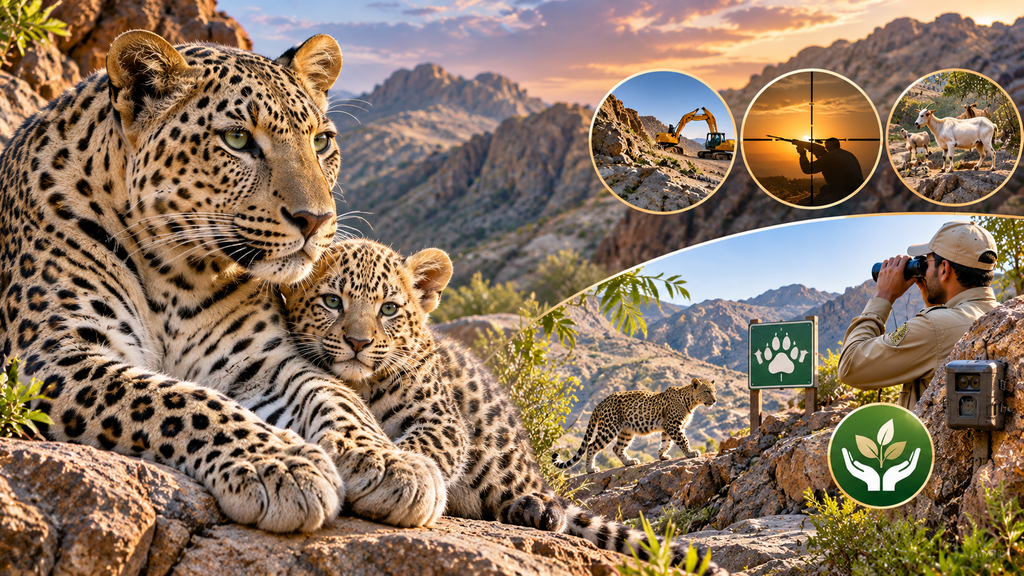
Today, the Arabian leopard survives in a very small part of its historical range.
The strongest confirmed wild populations are found in two main areas:
Oman: The leopard survives mainly in the Dhofar Mountains in southern Oman. Areas such as Jabal Samhan, Jabal Al Qamar, and Jabal Al Qara provide important habitats.
Yemen: Small populations remain in parts of the western and southern mountain regions. However, conservation work is difficult because of habitat damage, illegal hunting, and ongoing conflict.
The IUCN Cat Specialist Group estimates that around 100 to 120 Arabian leopards may remain in the wild across the Arabian Peninsula, with approximately 70 to 84 mature individuals. It identifies Oman and Yemen as the main areas with confirmed wild populations. The exact number is uncertain, and estimates should not be treated as a complete count.
Saudi Arabia is also an important part of the species’ conservation story because of its historical range and the breeding and habitat restoration projects being developed there.
Protecting the remaining wild populations while preparing suitable habitats for possible future reintroduction is essential for the long-term survival of the species.
4. Natural Habitat and Lifestyle of the Arabian Leopard
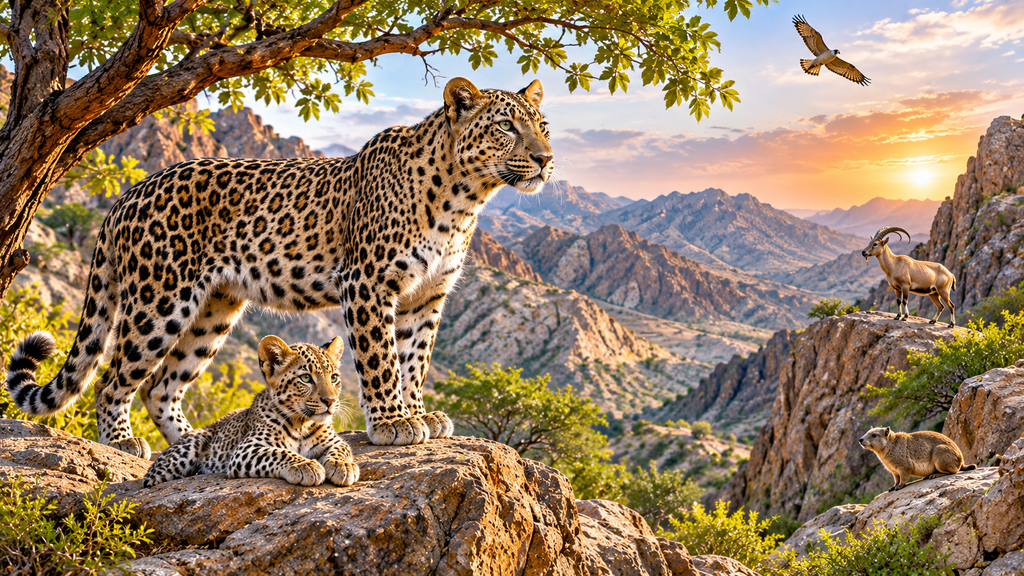
The Arabian leopard is well adapted to dry and difficult landscapes. It mainly lives in mountainous and rocky environments, where natural shelters allow it to hide, rest, and hunt.
They mainly hunt animals for food. Their natural diet includes mountain animals and small creatures such as Nubian ibex, Arabian gazelles, rock hyraxes, hares, birds, and reptiles.
Unlike many people imagine, its habitat is not limited to open desert. It can live in rugged mountains, dry valleys, semi-desert areas, and certain greener environments where enough food and shelter are available.
The leopard is a skilled climber and can move across steep rocky slopes. Its pale coat helps it blend into the surroundings, making it easier to approach prey without being noticed.
It is generally most active around sunrise, sunset, and during the night, although camera traps have recorded activity at other times.
The Arabian leopard usually lives alone, except during mating or when a mother is raising her cubs.
Female leopards give birth in sheltered places where their young are protected from danger. Cubs depend on their mothers for food, safety, and learning hunting skills.
Protecting these natural environments is important because a leopard needs a large area to find food, move safely, and raise its young.
5. What Does the Arabian Leopard Eat?
The Arabian leopard is a carnivore, which means it mainly eats other animals.
Its diet depends on what is available in its habitat. It can hunt different types of mammals, birds, and smaller animals.
Some of its natural prey includes:
- Nubian ibex.
- Arabian gazelles.
- Rock hyraxes.
- Cape hares.
- Porcupines.
- Rodents.
- Birds.
In some areas, baboons may also form part of its diet.
Rock hyraxes are particularly important in places where larger wild animals are less common. The leopard may also hunt goats, cattle, or camels when natural prey becomes difficult to find.
This creates a connection between wildlife conservation and local communities. When wild prey populations decline, leopards may move closer to livestock areas in search of food.
Protecting the leopard therefore requires more than protecting the animal itself. It also means restoring the natural food chain and maintaining healthy ecosystems.
6. Why Is the Arabian Leopard Critically Endangered?
The Arabian leopard has experienced a serious decline because of several threats. Human activities have reduced its habitat, affected its food supply, and increased the risk of conflict.
Some of the most important conservation challenges include:
Habitat Loss and Fragmentation
Road construction, urban growth, mining, quarrying, and agricultural expansion can damage natural habitats.
When mountains and valleys become separated by development, leopards may find it difficult to move between suitable areas. This can isolate small populations and make breeding more difficult.
Shortage of Natural Prey
Overhunting and habitat degradation can reduce the number of animals available for leopards to hunt.
When natural prey becomes scarce, leopards may approach farms and settlements in search of livestock.
Illegal Hunting
Some leopards have been killed because of fear, conflict with livestock owners, or illegal hunting.
A small population cannot easily recover when adult animals are lost, particularly because each individual is important for breeding.
Conflict with Livestock Owners
When a leopard attacks domestic animals, farmers and livestock owners may feel that their livelihoods are threatened.
In some situations, this has resulted in retaliatory killing. Finding ways to protect livestock and support affected communities is therefore an important part of conservation.
Illegal Wildlife Trade
The capture and sale of wild leopards for private collections and the illegal wildlife trade create additional pressure on an already small population.
The IUCN Cat Specialist Group identifies habitat destruction, prey loss, illegal killing, and capture for trade among the main threats facing the species.
7. Saudi Arabia’s Efforts to Protect the Arabian Leopard
Saudi Arabia has made the Arabian leopard an important part of its wildlife conservation efforts.
The Royal Commission for AlUla is leading a long-term programme to protect the species and restore the natural environment in which it historically lived.
Its work includes several connected activities:
Habitat restoration: Improving natural landscapes so that they can support wildlife.
Prey restoration: Reintroducing suitable native animals, including Arabian oryx, gazelles, and Nubian ibex, to help rebuild the leopard’s natural food supply.
Conservation breeding: Supporting carefully managed breeding to maintain a healthy population and protect genetic diversity.
Scientific research: Working with wildlife experts to improve knowledge about animal health, behaviour, and conservation needs.
Public awareness: Helping communities and visitors understand why the Arabian leopard needs protection.
These activities show that conservation is not limited to keeping animals in protected facilities. It requires preparing natural environments where wildlife can eventually survive independently.
8. Conservation Breeding Is Bringing New Hope
One of the most important parts of the Arabian leopard recovery programme is conservation breeding.
Because wild numbers are extremely low, carefully managed breeding can help protect the species from disappearing completely.
Saudi Arabia’s Arabian Leopard Conservation Breeding Centre in Taif is an important facility for this work. It provides professional animal care, veterinary supervision, breeding management, and monitoring.
The Royal Commission for AlUla reported that six Arabian leopard cubs were born during 2025. This was an encouraging achievement for the programme, which continues to focus on the health and genetic diversity of the managed population.
The centre also received membership in the European Association of Zoos and Aquaria (EAZA) in January 2025, becoming the first institution of its kind in Saudi Arabia to receive this recognition. The announcement highlighted improvements in breeding and animal care since RCU took responsibility for the programme in 2020.
However, breeding alone cannot save the Arabian leopard. The young animals will also need suitable habitats and enough natural prey if future reintroduction into the wild is to succeed.
9. Restoring Natural Habitats for a Possible Return to the Wild
One of the biggest goals of Arabian leopard conservation is to restore suitable natural environments.
A leopard cannot survive in the wild simply because it has been born in a breeding centre. It needs large, connected landscapes, enough food, safe shelter, and protection from human threats.
In AlUla, conservation projects are working to improve natural ecosystems before any future leopard reintroduction takes place.
A partnership update published by the Smithsonian’s National Zoo in September 2026 reported that RCU’s wider restoration programme includes plans for more than one million native plant seedlings and the release of more than 1,700 animals as part of wildlife restoration work. These activities aim to rebuild healthy ecosystems and support prey populations.
Such projects may help improve:
- Natural vegetation and plant cover.
- Food supplies for native herbivores.
- Safe movement between habitats.
- Biodiversity in protected areas.
- The balance between predators and prey.
Reintroducing a top predator requires careful scientific planning. The habitat and prey base must be ready first, or released animals may not survive.
10. International Partnerships Are Strengthening Conservation Work
Saving the Arabian leopard requires cooperation between countries and conservation organisations.
Since the animal’s remaining wild populations are spread across the region, no single country can solve every conservation challenge alone.
Saudi Arabia has developed partnerships with international experts, research institutions, and wildlife organisations.
An important partnership involves the Royal Commission for AlUla and the Smithsonian’s National Zoo and Conservation Biology Institute.
In February 2026, the organisations announced a major step in their long-term collaboration. The partnership focuses on animal care, genetic research, professional training, conservation science, and public awareness.
In September 2026, the Smithsonian and RCU also began construction of a new Arabian leopard exhibit in Washington, D.C. It is planned to open in winter 2029 and will introduce visitors to the species and the conservation work taking place in Saudi Arabia.
Other organisations, including Panthera and the IUCN, contribute scientific knowledge and conservation expertise.
These partnerships help improve breeding methods, train future wildlife specialists, and share information across borders.
11. Why Local Communities Matter in Arabian Leopard Conservation
Conservation cannot succeed without the support of people who live near wildlife habitats.
Local communities understand their surroundings and can help identify environmental changes, animal movements, and possible threats.
In areas where leopards may attack livestock, farmers and herders need practical ways to protect their animals.
Helpful approaches can include:
- Improving livestock shelters and night protection.
- Using suitable fencing and secure enclosures.
- Avoiding grazing in areas where attacks are more likely.
- Reporting wildlife sightings to authorised conservation teams.
- Supporting awareness and education programmes.
- Developing fair compensation systems where appropriate.
The IUCN Cat Specialist Group notes that livestock compensation schemes, protected areas, and legal protection have helped support conservation in parts of the leopard’s range.
When communities see a direct benefit from protecting wildlife, they may be more willing to support long-term conservation.
The aim should be to create a balance where people can protect their livelihoods while allowing wildlife to survive.
12. International Arabian Leopard Day Raises Global Awareness
Every year on 10 February, the world observes International Day of the Arabian Leopard.
The day was officially designated by the United Nations General Assembly in June 2023, following efforts led by Saudi Arabia and the Royal Commission for AlUla.
It provides an opportunity to raise awareness about the species and encourage cooperation in its protection. <Cite refs={[“turn331053view0″,”turn361843search2”]}/>
Activities connected with this day may include:
- Wildlife education programmes.
- School awareness campaigns.
- Conservation events and public walks.
- Scientific discussions.
- Social media campaigns.
- Community activities.
- Presentations about the leopard’s habitat and behaviour.
In 2026, the Royal Commission for AlUla supported a global campaign called The Journey of Hope, focusing on education, community engagement, and long-term conservation.
The day reminds people that protecting endangered animals is a shared responsibility.
13. What Can Individuals Do to Help Protect the Arabian Leopard?
Wildlife conservation is not limited to scientists, governments, or environmental organisations. Ordinary people can also support the protection of endangered animals.
Even small actions can help create greater public awareness and encourage responsible behaviour.
Here are some useful ways to contribute:
- Learn about the species: Understand its habitat, behaviour, and conservation challenges.
- Support responsible organisations: Follow the work of trusted wildlife conservation groups.
- Share reliable information: Help others understand why the Arabian leopard needs protection.
- Avoid wildlife products: Never buy animal skins or products connected with illegal wildlife trade.
- Respect protected areas: Follow local rules when visiting nature reserves.
- Support local communities: Choose responsible tourism activities that benefit people and nature.
- Encourage young people: Teach children about endangered animals and the importance of biodiversity.
People interested in conservation careers can also explore wildlife biology, veterinary science, environmental research, habitat restoration, and animal care.
Conclusion: There Is Still Hope for the Arabian Leopard
The Arabian leopard is one of the most threatened wild cats in the world. Its decline shows how habitat destruction, hunting, prey shortages, and human-wildlife conflict can affect even the strongest predators.
However, its future is not without hope.
Saudi Arabia’s conservation breeding programme, AlUla’s habitat restoration work, international partnerships, scientific research, and community awareness initiatives are important steps towards protecting the species.
The birth of new cubs in breeding centres is encouraging, but the real long-term goal is to restore healthy natural environments where Arabian leopards can live and reproduce safely in the wild.
This will require patience, funding, scientific knowledge, and cooperation across the Arabian Peninsula.
The Arabian leopard is more than a rare wild animal. It is a symbol of the region’s natural heritage. Protecting it means preserving the mountains, wildlife, and ecological balance that future generations deserve to inherit.
Frequently Asked Questions (FAQs)
1. What is the Arabian leopard?
The Arabian leopard is a rare leopard subspecies scientifically known as Panthera pardus nimr. It is native to the Arabian Peninsula and is recognised for its pale coat and ability to live in rocky mountain habitats.
2. Is the Arabian leopard endangered?
Yes. The Arabian leopard is classified as Critically Endangered by the IUCN because of its small population and continued threats to its survival.
3. How many Arabian leopards remain in the wild?
The IUCN Cat Specialist Group gives an estimate of around 100–120 individuals across the Arabian Peninsula, but the exact number is uncertain. Most confirmed wild populations are in Oman and Yemen.
4. Can Arabian leopards still be found in Saudi Arabia?
The leopard historically lived in Saudi Arabia’s Asir and Hijaz Mountains. However, the last confirmed sighting was in 1997, and no functional wild population has been confirmed in recent surveys.
5. What does the Arabian leopard eat?
Its natural prey includes Nubian ibex, gazelles, rock hyraxes, hares, porcupines, rodents, and birds. It may also prey on livestock when wild food becomes scarce.
6. Why is the Arabian leopard critically endangered?
The main threats include habitat loss, road construction, overgrazing, mining, shortage of natural prey, illegal hunting, and conflict with livestock owners.
7. What is Saudi Arabia doing to protect the Arabian leopard?
The Royal Commission for AlUla supports conservation breeding, habitat restoration, wildlife surveys, scientific research, prey restoration, and public awareness programmes.
8. Where is the Arabian leopard breeding centre in Saudi Arabia?
The Arabian Leopard Conservation Breeding Centre is located in Taif. It supports breeding, veterinary care, animal monitoring, and efforts to maintain genetic diversity.
Do follow us on Instagram
Read More – Traditional Famous Food of Abu Dhabi