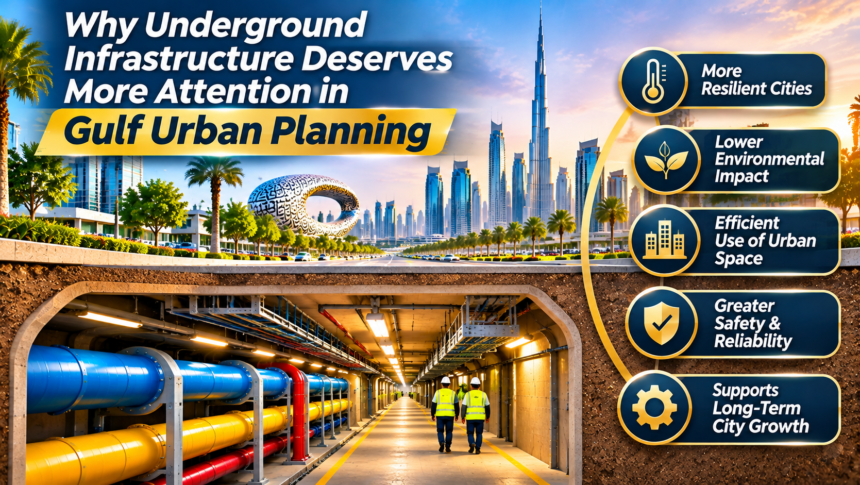
Why Underground Infrastructure Deserves More Attention in Gulf Urban Planning
Across the Arabian Gulf, ambitious urban development is transforming city skylines with residential towers, commercial districts, modern transport networks, and large public spaces. From Dubai and Abu Dhabi to Riyadh, Doha, Muscat, Manama, and Kuwait City, governments and developers are investing in infrastructure designed to accommodate growing populations and changing economic needs. Yet some of the most important systems supporting these cities remain largely invisible.
- 1. Why Underground Infrastructure Is the Hidden Foundation of Gulf Cities
- 2. How Underground Drainage Could Improve Flood Resilience in the Gulf
- 3. Why Underground Metro Networks and Transport Corridors Matter
- 4. How District Cooling, Electricity, and Digital Networks Depend on Underground Planning
- 5. How Digital Twins and Underground Mapping Could Reduce Construction Risks
- 6. The Environmental, Financial, and Engineering Challenges of Building Underground
- 7. The Future of Underground Infrastructure in Gulf Urban Planning
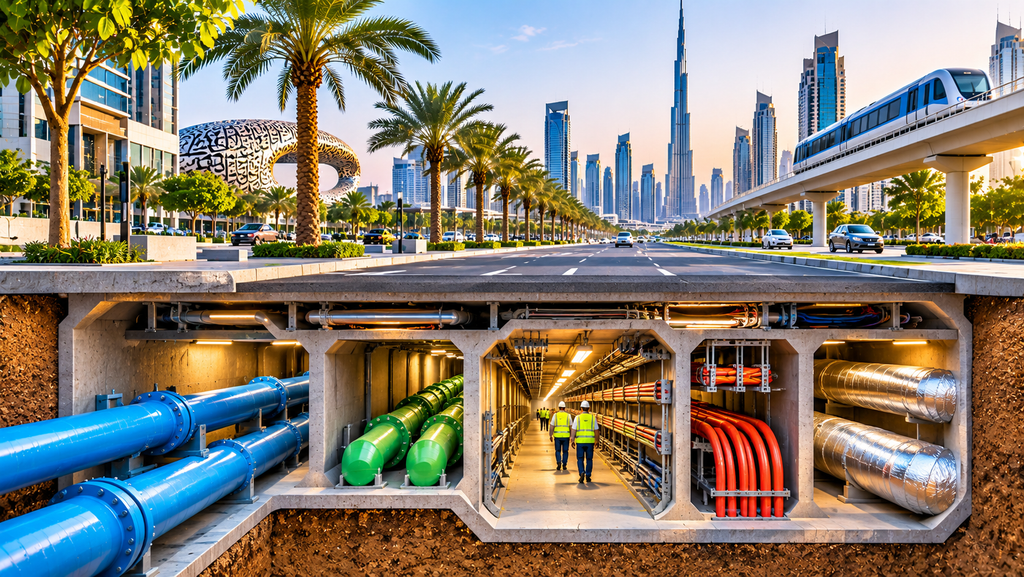
Underground infrastructure in Gulf urban planning includes the water pipelines, electricity cables, telecommunications networks, drainage tunnels, sewage systems, district cooling pipes, and transport corridors that operate beneath streets and buildings.
These networks rarely attract the same public attention as skyscrapers, new roads, or major real estate developments. However, their reliability can determine whether neighbourhoods have continuous water supplies, whether transport operates efficiently, and whether cities remain functional during extreme weather.
In the Gulf, underground planning presents particular challenges. High temperatures, varying groundwater conditions, coastal salinity, rapid construction, and occasional intense rainfall can affect how infrastructure is designed and maintained.
Dubai’s multibillion-dirham stormwater programme and major metro investments demonstrate the scale of underground development. Riyadh’s groundwater-management networks provide another example of how subsurface engineering supports urban resilience.
However, building more tunnels and pipelines is not automatically the best solution. Underground construction can be expensive, technically complicated, and disruptive to existing utilities.
The real opportunity lies in treating the space beneath cities as a valuable, carefully managed part of urban development rather than an area considered only after buildings and roads have been designed.
1. Why Underground Infrastructure Is the Hidden Foundation of Gulf Cities
Modern cities depend on interconnected systems that deliver essential services to residents and businesses.
Many of these systems operate underground because buried networks can protect certain assets from surface activity, reduce visual clutter, and support efficient utility distribution.
However, underground space is limited and must accommodate multiple competing uses.
What Exists Beneath a Modern City?
A typical urban district may contain drinking-water pipelines, electricity cables, telecommunications ducts, sewer networks, stormwater drains, and cooling-water distribution pipes.
Larger developments may also include underground railway tunnels, pedestrian connections, utility chambers, and parking facilities.
These systems require different installation depths, safety clearances, inspection procedures, and maintenance arrangements.
Consequently, underground planning involves more than placing infrastructure beneath roads.
It requires understanding how different networks interact throughout their operating lives.
The Problem of Competing Infrastructure
A road corridor may appear spacious at ground level while containing numerous buried services.
Installing a new pipeline can become difficult if existing cables, sewers, or structural foundations occupy the intended route.
Poorly coordinated construction can cause utility damage, delays, and expensive redesign.
As cities expand, these challenges may increase because new infrastructure must connect with older networks.
The Main Underground Infrastructure Systems
| Infrastructure | Main Function | Planning Consideration |
|---|---|---|
| Drinking-Water Pipelines | Supply buildings and public facilities | Leakage, pressure and access |
| Sewer Networks | Collect wastewater | Capacity and maintenance |
| Stormwater Drainage | Manage rainfall runoff | Flood resilience |
| Electricity Cables | Distribute electrical power | Safety and thermal conditions |
| Telecommunications Ducts | Support digital connectivity | Space for expansion |
| District Cooling Pipelines | Deliver chilled water | Thermal performance and pumping |
| Metro Tunnels | Support mass transportation | Ground conditions and connections |
| Utility Tunnels | Accommodate selected shared services | Cost, access and safety |
Why Planning Must Begin Early
Underground infrastructure is easier to coordinate when its requirements are considered during the earliest stages of development.
Once buildings, foundations, and roads are completed, installing additional services can become more complicated.
Early planning can help preserve suitable corridors, reduce unnecessary excavation, and establish realistic capacity for future demand.
However, initial designs must remain adaptable because population growth and technology requirements may change.
2. How Underground Drainage Could Improve Flood Resilience in the Gulf
Stormwater infrastructure has become an important subject in Gulf urban planning.
Although many cities experience limited annual rainfall, occasional storms can create substantial runoff.
Large paved areas can accelerate water movement, while inadequate drainage can contribute to local flooding.
Why Dry Cities Still Need Major Drainage Networks
Arid climates do not eliminate the possibility of extreme rainfall.
Roads, tunnels, building entrances, and underground facilities can be vulnerable when intense runoff exceeds drainage capacity.
Flood protection therefore requires appropriate collection points, conveyance systems, pumping equipment, and safe discharge arrangements.
Underground drainage networks are one part of this wider system.
However, they must be designed using realistic rainfall and runoff scenarios.
Dubai’s Tasreef Programme
Dubai’s AED30 billion Tasreef programme represents a major investment in stormwater infrastructure.
Launched in 2024, the initiative aims to increase drainage capacity by 700%, with work planned in phases through 2033.
Its development includes underground drainage networks, deep tunnels, and associated infrastructure.
In October 2026, Dubai Municipality announced additional contracts covering the expansion of drainage networks across several residential, commercial, and tourism districts.
These investments demonstrate how underground infrastructure can be central to long-term urban resilience.
However, a planned increase in drainage capacity is not the same as a guarantee that flooding will never occur.
Riyadh’s Groundwater and Drainage Experience
Riyadh also provides lessons in managing water beneath urban areas.
The Royal Commission for Riyadh City has documented more than 500 kilometres of underground groundwater drainage networks associated with efforts to manage elevated groundwater conditions.
Such conditions can affect basements, foundations, and the surrounding urban environment.
Groundwater drainage and stormwater drainage perform different functions, although both require careful subsurface planning.
Flood-Management Approaches Compared
| Approach | Main Purpose | Limitation |
|---|---|---|
| Underground Storm Drains | Convey runoff | Limited by design capacity |
| Deep Drainage Tunnels | Manage large flows | High construction cost |
| Pumping Stations | Move water where gravity flow is insufficient | Power and maintenance dependence |
| Detention Basins | Temporarily store runoff | Require land and safe overflow |
| Permeable Surfaces | Encourage suitable infiltration | Site-specific soil conditions |
| Flood Monitoring Sensors | Support operational awareness | Cannot create additional drainage capacity |
Why Drainage Requires an Integrated Approach
Buried pipes alone cannot address every flood risk.
Surface grading, building entrances, road design, emergency procedures, and appropriate maintenance all influence outcomes.
Effective flood management requires these elements to work together.
3. Why Underground Metro Networks and Transport Corridors Matter
Urban transportation is another important use of underground space.
Rail tunnels can provide connections through densely developed areas without requiring a continuous railway corridor at street level.
However, underground transport systems also create demanding engineering and operating requirements.
Dubai Metro’s Expanding Underground Network
In April 2026, Dubai’s Roads and Transport Authority announced approval of the Metro Gold Line.
The planned AED34 billion project extends approximately 42 kilometres and includes 18 stations.
It is intended to become Dubai’s first fully underground metro line.
The approval demonstrates how underground space is being considered for future transport connectivity.
However, the Gold Line should be described as an approved project rather than an operational railway.
The Dubai Metro Blue Line
Dubai also launched major tunnelling work for the Metro Blue Line in May 2026.
The project includes a 30-kilometre alignment, of which approximately 15.5 kilometres are underground.
It is designed to improve connections between residential districts, economic areas, and the wider metro network.
Its underground section illustrates the role tunnelling can play in connecting developed urban areas.
Potential Advantages of Underground Transport
Rail systems located beneath streets can reduce certain conflicts between trains and surface traffic.
They may also preserve ground-level space for roads, buildings, and public areas.
However, underground stations require accessibility systems, ventilation, emergency exits, drainage, and fire protection.
Operating costs can therefore be substantial.
Underground Versus Elevated Transport
| Factor | Underground Rail | Elevated Rail |
|---|---|---|
| Surface Land Use | Limited continuous surface corridor | Requires columns and structural space |
| Construction | Tunnelling and station excavation | Elevated structures and foundations |
| Visual Impact | Limited above-ground railway structures | Visible infrastructure |
| Ground Conditions | Major engineering consideration | Foundation conditions remain important |
| Emergency Planning | Complex evacuation and ventilation | Different evacuation requirements |
| Maintenance | Tunnel and underground systems | Elevated structure and track systems |
| Costs | Often high in complex urban areas | Depends on alignment and conditions |
Why Cities Need Both
Underground transport is not automatically superior to elevated or surface rail.
Different alignments may justify different approaches.
The best option depends on land availability, population density, construction conditions, environmental effects, and lifecycle costs.
4. How District Cooling, Electricity, and Digital Networks Depend on Underground Planning
Many of the Gulf’s essential urban services rely on underground distribution.
These networks are especially relevant in cities experiencing high cooling demand, rapid building construction, and increasing digital connectivity.
District Cooling Networks
District cooling systems produce chilled water at central facilities and distribute it through insulated underground pipelines to connected buildings.
This infrastructure can support shared cooling services across commercial and residential developments.
Dubai-based Empower reported an underground distribution network exceeding 430 kilometres at the end of 2025.
Its network demonstrates the scale of buried infrastructure required to support centralised cooling.
However, district cooling efficiency depends on plant performance, pumping requirements, pipe insulation, and actual demand.
Underground Electricity Distribution
Buried electricity cables can reduce certain visual and spatial impacts associated with overhead networks.
However, installation and maintenance present challenges.
Electrical systems may require suitable thermal conditions, access arrangements, and protection against damage during excavation.
In some locations, underground installation can be more expensive than overhead alternatives.
Telecommunications Infrastructure
Fibre-optic cables and communications ducts support internet services, business connectivity, and digital public infrastructure.
As demand grows, cities may require additional network capacity.
Planning spare ducts or suitable expansion corridors may reduce the need for repeated road excavation.
However, infrastructure owners must balance future capacity against current construction costs.
Utility Planning Considerations
| Network | Critical Requirement | Potential Risk |
|---|---|---|
| District Cooling | Insulation and hydraulic performance | Heat gain and pipe failure |
| Electricity | Safe installation and thermal management | Cable damage |
| Fibre Connectivity | Protected and accessible ducts | Service interruption |
| Water Supply | Pressure and leakage control | Water losses |
| Wastewater | Flow capacity and maintenance | Blockages and overflows |
| Shared Utility Corridors | Coordination and access | Complex ownership arrangements |
The Case for Coordinated Corridors
Some developments may benefit from reserved utility corridors or shared underground facilities.
However, not all services should be placed together.
Safety clearances, incompatible hazards, maintenance access, and regulatory requirements must guide the arrangement.
5. How Digital Twins and Underground Mapping Could Reduce Construction Risks
One of the most significant challenges in underground planning is knowing precisely what already exists beneath a site.
Utility records may be incomplete, outdated, or stored by different organisations.
This uncertainty can increase excavation risks.
The Importance of Accurate Utility Records
Before beginning underground construction, engineers need information about existing pipes, cables, tunnels, and structures.
Unexpected utilities can force contractors to change their designs or construction methods.
In serious cases, accidental damage can interrupt essential services or threaten worker safety.
Reliable subsurface information can therefore improve planning and reduce avoidable disruption.
Lessons From Singapore
Singapore’s Urban Redevelopment Authority updated its enhanced site investigation guidance in July 2026.
Its approach includes advanced scanning technologies, electromagnetic location, and digital recording of exposed utilities.
Singapore also uses more detailed geospatial documentation to improve the accuracy of underground infrastructure records.
Although Singapore is not part of the Gulf, its approach provides a useful example for dense cities managing competing subsurface demands.
What Ground-Penetrating Radar Can Do
Ground-penetrating radar uses electromagnetic signals to investigate selected features beneath the surface.
It may help identify buried structures or possible utilities.
However, performance depends on ground conditions, depth, equipment, and interpretation.
It does not guarantee that every buried object will be detected.
Digital Twins for Underground Infrastructure
A digital twin can combine infrastructure models with relevant information about physical assets.
For underground utilities, it may support maintenance planning, capacity analysis, and coordination between different systems.
However, a digital twin is only as dependable as the information used to create and maintain it.
Inaccurate records can produce misleading results even when the visual model appears sophisticated.
Digital Tools and Their Applications
| Technology | Potential Application | Limitation |
|---|---|---|
| Geographic Information Systems | Mapping asset locations | Records may be incomplete |
| Ground-Penetrating Radar | Investigating buried features | Ground-dependent accuracy |
| Electromagnetic Locators | Locating selected conductive utilities | Not suitable for every asset |
| 3D Utility Models | Understanding spatial conflicts | Requires accurate surveys |
| Digital Twins | Infrastructure analysis | Needs maintained data |
| Monitoring Sensors | Identifying selected operational changes | Calibration and reliability |
Why Data Sharing Matters
Water utilities, transport agencies, telecommunications providers, and developers may maintain separate databases.
Appropriate coordination can improve infrastructure planning.
However, detailed utility locations may be security-sensitive.
Information-sharing systems need suitable access controls and cybersecurity safeguards.
6. The Environmental, Financial, and Engineering Challenges of Building Underground
Expanding underground infrastructure offers benefits but also introduces considerable costs and risks.
Cities should assess whether new buried assets provide sufficient long-term value compared with alternative approaches.
High Construction Costs
Underground construction may require excavation, tunnel boring, temporary traffic management, ground support, and specialised equipment.
Working near existing buildings and utilities can increase complexity.
The financial feasibility of a project therefore depends on location, depth, soil conditions, and required capacity.
Groundwater and Soil Conditions
Gulf cities have varied geological environments.
Coastal locations may encounter saline groundwater, while other areas contain difficult rock formations or soils requiring specialised treatment.
Groundwater can affect excavation stability, waterproofing, and long-term maintenance.
Design decisions must reflect actual site investigations.
Heat and Corrosion
Buried infrastructure remains exposed to environmental conditions that can influence performance.
High soil temperatures may affect the thermal behaviour of electrical cables.
Saline groundwater and aggressive soil chemistry can increase corrosion risks for unsuitable materials.
Appropriate materials, protective systems, and monitoring are therefore important.
Construction Disruption
Installing buried utilities can require road closures, excavation, noise, and temporary changes to pedestrian access.
Even when infrastructure will eventually be invisible, construction may significantly affect nearby residents and businesses.
Careful scheduling and communication can reduce some disruption.
Underground Construction Challenges
| Challenge | Possible Consequence | Planning Response |
|---|---|---|
| Complex Ground Conditions | Construction delays | Detailed geotechnical investigation |
| Groundwater | Excavation and waterproofing difficulties | Appropriate drainage and structural design |
| Existing Utilities | Accidental damage | Mapping and verification |
| High Costs | Budget pressure | Lifecycle financial analysis |
| Limited Access | Difficult maintenance | Inspection and access planning |
| Corrosion | Asset deterioration | Suitable materials and protection |
| Disruption | Traffic and business impacts | Coordinated construction schedules |
Why Lifecycle Cost Matters
An underground system may have a high installation cost but provide benefits over a long operating period.
Conversely, poorly designed buried infrastructure can become expensive to maintain or replace.
Cities should consider construction, operation, inspection, rehabilitation, and eventual replacement costs.
The lowest initial construction price may not provide the best long-term outcome.
7. The Future of Underground Infrastructure in Gulf Urban Planning
As Gulf cities continue expanding, underground space could become an increasingly important planning resource.
New districts may require more coordinated infrastructure, while established neighbourhoods may need upgrades without extensive surface disruption.
The challenge will be to plan for both current requirements and uncertain future needs.
Creating Integrated Subsurface Plans
Urban master plans typically identify land uses, transport corridors, public facilities, and infrastructure requirements.
A stronger underground planning approach would also document critical subsurface assets and reserve suitable space for future networks.
This can help authorities understand where development may conflict with existing infrastructure.
Planning for Future Capacity
New neighbourhoods may need additional electrical connections, telecommunications capacity, cooling networks, and drainage infrastructure.
Preserving appropriate space during initial construction may reduce future disruption.
However, oversized infrastructure can waste money and resources.
Capacity planning should use realistic scenarios rather than assuming unlimited growth.
A Practical Underground Infrastructure Planning Checklist
- Map existing buried utilities and structures.
- Verify uncertain records before excavation.
- Conduct suitable geotechnical investigations.
- Assess groundwater and corrosion conditions.
- Coordinate transport, water, electricity, cooling, and communications plans.
- Protect appropriate utility corridors.
- Evaluate current and future capacity requirements.
- Plan safe maintenance and emergency access.
- Establish responsibilities for updating digital records.
- Compare lifecycle costs and environmental impacts.
How Should Cities Measure Performance?
Underground infrastructure should be evaluated according to measurable outcomes rather than construction scale alone.
Relevant indicators include service reliability, unplanned interruptions, leakage rates, maintenance costs, asset condition, and recovery times after failures.
Construction programmes should also measure delays, utility conflicts, and disruption to communities.
Key Performance Indicators
| Indicator | What It Measures |
|---|---|
| Network Availability | Continuity of essential services |
| Utility Damage Incidents | Excavation and coordination effectiveness |
| Drainage Performance | Ability to manage design runoff |
| Water Leakage | Losses from distribution systems |
| Maintenance Response | Efficiency of fault management |
| Mapping Accuracy | Reliability of asset records |
| Lifecycle Cost | Long-term financial performance |
| Recovery Time | Ability to restore services after failure |
Opportunities for Gulf Engineering and Technology Businesses
A stronger focus on underground infrastructure could create opportunities for engineering consultants, utility surveyors, construction firms, geospatial specialists, monitoring providers, and asset-management businesses.
Digital surveying, trenchless construction, and infrastructure rehabilitation may become increasingly relevant to cities with established underground networks.
However, adoption should follow technical assessment.
New technology does not automatically improve construction outcomes without skilled personnel, suitable standards, and reliable information.
Making Underground Planning Part of Urban Resilience
Underground infrastructure is essential to the functioning of modern cities, but it is also vulnerable to failures.
A broken water main, damaged power cable, or overwhelmed drainage tunnel can disrupt activity across a large area.
Resilience therefore requires appropriate redundancy, emergency procedures, maintenance funding, and coordination between infrastructure operators.
Conclusion
Underground infrastructure deserves greater attention in Gulf urban planning because it supports many of the essential services on which modern cities depend.
Water pipelines, electrical cables, telecommunications systems, drainage tunnels, district cooling networks, and underground railways all influence how efficiently and reliably urban environments function.
Projects in Dubai and Riyadh demonstrate the scale of investment required to manage these systems.
Dubai’s Tasreef programme highlights the importance of long-term drainage capacity, while its metro expansion shows how underground transport can connect developing districts.
Meanwhile, Riyadh’s groundwater infrastructure illustrates the need to understand environmental conditions beneath the urban surface.
However, underground development should not be pursued simply because it is technologically impressive.
Construction costs, geological conditions, maintenance requirements, environmental impacts, and future demand must all be evaluated.
The most effective approach will combine accurate utility mapping, coordinated infrastructure planning, appropriate engineering standards, and long-term asset management.
As Gulf cities continue building above ground, giving equal attention to the networks beneath them could help create urban environments that are more reliable, adaptable, and prepared for future challenges.
Ultimately, the infrastructure people rarely see may be just as important to urban success as the buildings and public spaces that define a city’s skyline.
Do follow us on Instagram
Read More – The Future of Rainwater Harvesting in Cities Designed for Dry Climates