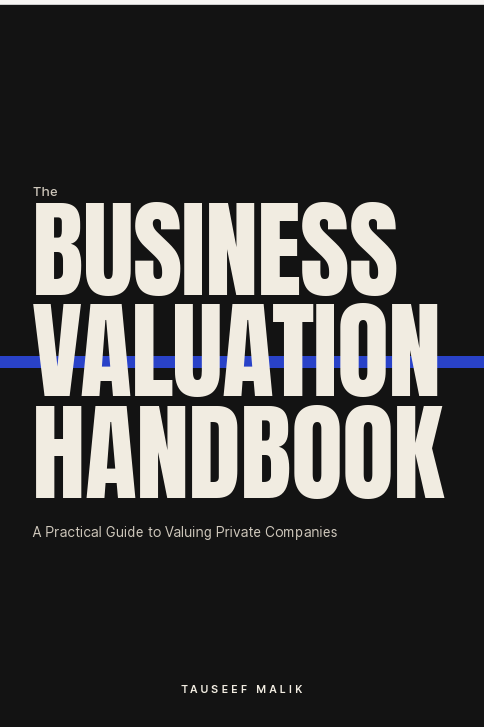
A comprehensive guide helps finance professionals, accountants, advisers and business owners navigate the complexities of valuing privately held businesses.
Tauseef Malik has announced the release of The Business Valuation Handbook, a practical e-book designed to equip accountants, finance managers, valuation analysts, advisers and business owners with the knowledge and tools to navigate the complete business valuation process.
Recognizing that valuing a private business is rarely straightforward, the handbook addresses the challenges professionals face when working with small and privately held companies, where financial records may be limited, unaudited or heavily influenced by owner involvement. It offers a structured approach to transforming imperfect financial information into a credible, well-supported valuation.
The book takes readers through the entire valuation journey, from defining the engagement and establishing the purpose and premise of valuation to gathering financial information, normalizing financial statements, developing forecasts, applying valuation methodologies and preparing a defensible valuation report.
At the heart of the handbook is its distinctive Value Composition Framework, a four-tier analytical model that examines business value through four dimensions: asset-secured value, contract-secured value, owner-dependent value and institutional value. The framework helps readers understand how different components contribute to a company’s overall valuation and, critically, how much of that value is likely to transfer to a potential buyer.
The handbook also explores the three principal approaches to business valuation: the market approach, the asset approach and the income approach. It explains how these methodologies can be applied, evaluated and reconciled to arrive at a reasoned valuation conclusion.
Rather than treating business valuation as a purely mathematical exercise, The Business Valuation Handbook emphasizes the importance of professional judgment, business context, financial analysis and the underlying assumptions that shape a valuation outcome.
The publication is intended not only for professionals responsible for conducting valuations but also for business owners and decision-makers who want to understand, evaluate and critically assess the valuation of a business.
With its practical checklists, working templates and structured methodology, The Business Valuation Handbook aims to make the valuation process more accessible, systematic and defensible for professionals working across the private business landscape.
The second part takes the methods into specialist areas. It moves theory into practice for small businesses, treats early-stage or distressed companies in depth, and takes on intangible assets and holding entities, with professional standards alongside. A dedicated chapter covers building the valuation model so a colleague can check the spreadsheet.
Experience Behind the Book
Malik’s professional focus is corporate finance, financial planning and business valuation. He works across financial reporting, strategic planning, financial modeling and corporate budgeting. The book is written for accountants, advisers and owners who need to prepare a valuation, or to read one critically.
Tauseef Malik Moving from Method to Practice
The final chapters ask how that valuation method translates into a completed assignment. The book follows one running case, STARECO Ltd, a timber warehousing and distribution business, from the engagement letter to the final opinion, showing each judgment and number in context. Two further complete cases follow the running case, while industry notes cover what drives value in ten common types of business. The last chapter explains how owners and advisers commission, read and use a valuation report.
What Readers Get
The book’s ten appendices group working tools for live engagements. Engagement setup tools include a checklist, a sample engagement letter and a work plan. Operational and reporting tools offer a condensed sample report, an information request and a management questionnaire. Practice guidance completes the set with a formula sheet, a glossary, review questions, worked problems and answers to common queries.
About the Author
Tauseef Malik is the author of The Business Valuation Handbook, an e-book focused on providing practical guidance and structured tools for professionals and business owners navigating the complexities of private business valuation.