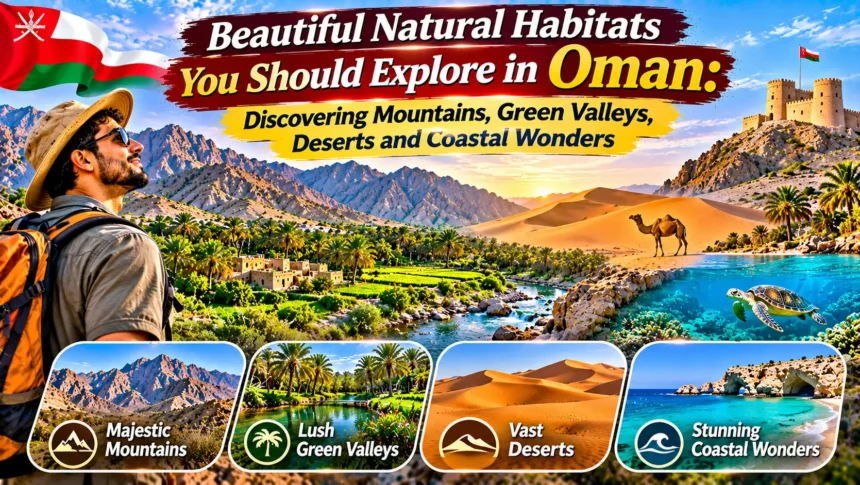
Beautiful Natural Habitats You Should Explore in Oman
Oman is one of the most beautiful countries in the Arabian Peninsula for people who enjoy nature and outdoor travel. While many visitors know the country for its deserts, mountains and historic forts, it also has a surprising variety of natural habitats. From green valleys and rocky mountain ranges to mangrove forests, coastal wetlands and coral reefs, Oman offers many different environments to explore.
- 1. Al Hajar Mountains: A Home for Unique Mountain Plants and Wildlife
- 2. Wadis: Natural Valleys Filled with Water and Greenery
- 3. Dhofar’s Green Mountains: A Tropical-Looking Landscape During Khareef
- 4. Arabian Desert Habitats: Life in the Sand Dunes and Open Plains
- 5. Mangrove Forests: Important Coastal Habitats for Birds and Fish
- 6. Barr Al Hikman: A Major Habitat for Migratory Birds
- 7. Daymaniyat Islands: Coral Reefs and Marine Biodiversity
- 8. Ras Al Jinz and Ras Al Hadd: Important Sea Turtle Nesting Habitats
- 9. Jabal Samhan: A Protected Mountain Habitat for Wildlife
- 10. Coastal Wetlands and Lagoons of Dhofar: A Home for Migratory Birds
- Best Time to Explore Oman’s Natural Habitats
- How to Explore Oman’s Natural Habitats Responsibly
- Why Oman’s Natural Habitats Are Worth Exploring
- Conclusion
- Frequently Asked Questions
The country’s natural beauty is not limited to one region. Northern Oman is known for its impressive Al Hajar Mountains, while the southern Dhofar region becomes green during the seasonal Khareef monsoon. The central parts of the country offer wide desert landscapes, and its long coastline supports marine life, sea turtles and migratory birds.
These different environments provide homes to many plants and animals. According to Oman’s Environment Authority, the country supports a wide range of terrestrial and marine biodiversity, including plant species, birds, mammals, reptiles and marine life. Its location, changing landscape and seasonal weather help create these different habitats.
For nature lovers, photographers, hikers and wildlife enthusiasts, exploring these places offers a chance to experience a different side of Oman. Here are some of the most beautiful natural habitats you should explore in the country.
1. Al Hajar Mountains: A Home for Unique Mountain Plants and Wildlife
The Al Hajar Mountains are among the most impressive natural landscapes in Oman. Stretching across the northern part of the country, this mountain range is known for its rocky peaks, deep valleys, narrow roads and traditional villages.
The Al Hajar Mountains are one of the richest natural areas in eastern Arabia. Jebel Shams, the highest peak, rises to 3,009 metres and the mountains are home to around one-third of Oman’s plant species.
They also support rare plants and animals that survive in the rocky landscape and cooler mountain climate.
The mountains create different environmental conditions compared with the surrounding lowlands. Higher elevations can experience cooler temperatures, while rainfall and seasonal water flow support plants that may not survive in the drier desert areas.
Jebel Akhdar and Jebel Shams are two of the best-known mountain destinations. Jebel Akhdar, meaning Green Mountain, is particularly famous for its terraced farms, fruit trees and traditional villages. Pomegranates, walnuts and roses are among the crops grown in this area. Jebel Shams, the country’s highest mountain area, is known for its dramatic cliffs and deep canyons.
The mountain environment supports different types of vegetation and wildlife.
Depending on the location, visitors may come across:
- Mountain shrubs and small trees.
- Wild plants adapted to rocky conditions.
- Birds of prey and other mountain birds.
- Reptiles adapted to dry and rocky environments.
- Mountain goats and other wildlife in suitable habitats.
These mountains are ideal for hiking, nature photography and exploring traditional agricultural landscapes. Visitors should remain on suitable trails and avoid damaging native plants.
2. Wadis: Natural Valleys Filled with Water and Greenery
Wadis are one of the most attractive natural features of Oman. These valleys and natural channels are formed by water flowing through mountain and rocky landscapes. Some remain dry for long periods, while others contain pools and flowing water during suitable seasons.
After rainfall, wadis can become important areas for plants, birds and other wildlife. Water collects in natural pools, supporting vegetation and creating small freshwater environments in an otherwise dry landscape.
wadis are beautiful green valleys and natural oases found among dry mountains and deserts. They get water from underground springs and seasonal rainfall, creating clear blue pools, green gardens, and homes for different types of wildlife throughout the year.
Wadi Shab is one of the most famous examples. Located in the Al Sharqiyah South region, it is known for its turquoise pools, limestone cliffs and natural walking routes. Visitors can explore the valley, enjoy the scenery and swim in suitable areas.
Another beautiful destination is Wadi Bani Khalid. Located in the Eastern Al Hajar Mountains, it is known for its natural pools, surrounding greenery and flowing water. The valley has also supported local farming through traditional irrigation channels.
Some of the natural features visitors can enjoy in Oman’s wadis include:
- Clear pools surrounded by rocky cliffs.
- Palm trees and other plants growing near water.
- Natural streams and small waterfalls in suitable seasons.
- Rocky walking trails and interesting geological formations.
- Opportunities to observe birds and other wildlife.
Wadis are important natural environments, not simply swimming spots. Visitors should avoid leaving waste behind and should never enter flooded channels during or after heavy rainfall.
3. Dhofar’s Green Mountains: A Tropical-Looking Landscape During Khareef
Dhofar, in southern Oman, has a natural environment that looks very different from many other parts of the Arabian Peninsula. During the Khareef season, which generally runs from June to September, seasonal monsoon winds bring mist, light rain and cooler conditions to the region.
Every summer, from mid-June to mid-September, the Dhofar Mountains in southern Oman turn green and misty.
This happens during the Khareef monsoon season, when cool winds and light rain cover the hills around Salalah with greenery. Dry mountain slopes become green landscapes with flowing waterfalls and lush trees, while temperatures stay around 22°C to 26°C.
The changing weather transforms many hills and valleys into green landscapes. Grassy slopes, flowing water, low clouds and seasonal waterfalls make Dhofar particularly attractive to nature lovers.
The mountains around Salalah support different plant communities, including species that depend on the region’s seasonal moisture. The area also has a long connection with frankincense trees, which have been an important part of Oman’s natural and cultural history.
Some of the most interesting places to explore include:
- Wadi Darbat: Known for its green surroundings, seasonal waterfalls and natural scenery.
- Jabal Samhan: A protected mountain area with dramatic cliffs and important wildlife habitats.
- Ain Razat: A natural spring surrounded by attractive vegetation.
- Al Mughsail: A coastal destination where dramatic cliffs meet the Arabian Sea.
Dhofar is an excellent example of how seasonal weather can change the appearance and biodiversity of a natural habitat. The Khareef season attracts many visitors, so travellers should respect the environment and avoid driving over sensitive grasslands.
4. Arabian Desert Habitats: Life in the Sand Dunes and Open Plains
Oman’s desert landscapes are much more than large areas of empty sand. They include sand dunes, gravel plains, rocky areas and scattered vegetation that support specially adapted plants and animals.
More than 80% of Oman is covered by dry deserts and large gravel plains. Despite the harsh conditions, many plants and animals have found ways to survive. Some collect moisture from coastal fog, while others hide under the sand to escape the heat or travel long distances in search of water after rainfall.
The Sharqiyah Sands, formerly known as the Wahiba Sands, are among the country’s most famous desert destinations. Their large dunes create a beautiful landscape that changes colour throughout the day. The desert is home to different reptiles, insects, birds and mammals that have developed ways to survive with limited water.
Further south, the Empty Quarter extends across parts of Oman and neighbouring countries. Its vast sand dunes and remote surroundings create one of the most challenging natural environments in the region.
Oman’s desert wildlife includes species such as Arabian gazelles, foxes, lizards and other animals adapted to dry conditions. Some species are active during cooler periods or at night to avoid the strongest daytime heat.
Visitors exploring these habitats may enjoy:
- Watching the changing colours of sand dunes.
- Exploring desert landscapes with responsible guides.
- Looking for animal tracks in suitable areas.
- Enjoying sunrise and sunset photography.
- Learning about desert plants and their adaptations.
Al Wusta is another important area for desert wildlife. Its protected landscapes support species such as the Arabian oryx and other animals that depend on open desert habitats.
Desert environments can be easily damaged by uncontrolled driving and littering. Visitors should use approved routes and avoid disturbing animals or removing native plants.
5. Mangrove Forests: Important Coastal Habitats for Birds and Fish
Mangrove forests are among Oman’s most valuable coastal habitats. These salt-tolerant trees grow in shallow coastal waters and sheltered areas where they are regularly affected by tides.
Mangrove forests, locally known as al qurm, provide important places for young fish and other sea animals to find food and grow.
These forests are mainly made up of grey mangrove trees (Avicennia marina), which can survive in salty water. They grow along coastal waterways, known as khawrs, from Musandam to Dhofar.
Their tangled roots provide shelter for small fish, crabs and other marine organisms. Mangroves also offer feeding and resting areas for different bird species, including some migratory birds.
One of the best-known mangrove areas is the Qurum Natural Reserve in Muscat. It contains Avicennia marina, commonly known as grey mangrove, and provides an important habitat for birds and marine life.
Another important mangrove environment is found in the Al Wusta Wetlands Reserve, particularly around the Barr Al Hikman region.
Mangrove forests offer several environmental benefits:
- They provide shelter and nursery areas for young fish.
- Their roots help protect parts of the coastline.
- They support birds and other coastal wildlife.
- They help store carbon in coastal ecosystems.
- They contribute to maintaining the natural balance of coastal environments.
Visitors interested in nature photography and birdwatching can enjoy these environments while learning about the importance of coastal conservation.
However, mangroves are sensitive habitats. Travellers should avoid damaging roots, leaving waste or disturbing birds and other wildlife.
6. Barr Al Hikman: A Major Habitat for Migratory Birds
Barr Al Hikman, located in Oman’s Al Wusta Governorate, is one of the country’s most important natural wetland areas. It is known for its shallow lagoons, mudflats, sandy beaches, seagrass beds and coastal waters.
The region supports a remarkable variety of wildlife. During migration periods, thousands of birds visit its coastal wetlands to feed, rest and find suitable conditions before continuing their journeys.
The area is especially important for shorebirds and waterbirds that travel between different parts of Asia, Africa and other regions.
The wetlands contain several connected habitats, including:
- Intertidal mudflats.
- Shallow lagoons and coastal waters.
- Seagrass beds.
- Mangrove areas.
- Sandy beaches and coastal plains.
- Salt flats, also known as sabkhas.
According to the Ramsar Convention on Wetlands, the Al Wusta Wetlands Reserve supports many threatened species and provides an important habitat for large numbers of waterbirds. Its coastal ecosystems also support fish, sharks, rays and other marine life.
Barr Al Hikman is an excellent destination for understanding how important wetlands are to wildlife. Visitors interested in birdwatching and photography can discover a different side of Oman away from the country’s better-known mountain and desert attractions.
Because this is an ecologically important area, visitors should follow local guidance and avoid disturbing birds, especially during migration and breeding periods.
7. Daymaniyat Islands: Coral Reefs and Marine Biodiversity
The Daymaniyat Islands are a group of nine islands located off Oman’s northern coast, near Muscat and Barka. They are protected as a nature reserve and are known for their clear waters, coral reefs, sandy beaches and marine wildlife.
The underwater environment is one of the main attractions. Coral reefs provide shelter and feeding areas for different marine species, including reef fish and other sea creatures.
The surrounding waters are also important for sea turtles. Some beaches provide nesting habitats, making the islands valuable for marine conservation.
Visitors can explore the area through authorised boat trips, snorkelling and scuba diving activities. These experiences offer an opportunity to observe marine life in its natural surroundings.
Popular experiences include:
- Snorkelling around suitable reef areas.
- Scuba diving with authorised operators.
- Observing colourful marine fish.
- Enjoying boat trips around the islands.
- Learning about coral reefs and sea turtle protection.
The Daymaniyat Islands are a protected reserve, so visitors must follow the Environment Authority’s rules. Entry permits are required, and entering or camping on the islands is prohibited from May to October. Outside this period, camping is restricted to specified islands and approved locations.
Visitors must never touch or remove coral, disturb nesting turtles or collect marine species.
8. Ras Al Jinz and Ras Al Hadd: Important Sea Turtle Nesting Habitats
Oman’s coastline provides important nesting areas for sea turtles. Among the best-known locations are Ras Al Jinz and Ras Al Hadd in the Al Sharqiyah South Governorate.
These beaches are particularly important for green turtles, which return to suitable nesting beaches to lay their eggs. The coastal environment provides the sandy conditions needed for nesting and the surrounding sea offers access to feeding areas.
Ras Al Jinz Turtle Reserve is one of the best-known places in Oman to learn about sea turtle conservation. Visitors may have the opportunity to join guided experiences to understand the nesting process and the importance of protecting these animals.
Sea turtles face several challenges, including plastic pollution, disturbance from visitors, fishing-related threats and damage to nesting areas.
A responsible visit should follow a few important rules:
- Join authorised guided turtle-watching activities.
- Keep a respectful distance from the turtles.
- Avoid using bright lights or camera flashes.
- Never touch turtles or their eggs.
- Keep beaches clean and free from plastic waste.
- Follow all instructions given by reserve staff.
These nesting beaches show how Oman’s natural habitats are connected to the wider marine environment. Protecting them is important for the future of sea turtle populations.
9. Jabal Samhan: A Protected Mountain Habitat for Wildlife
Jabal Samhan in Dhofar is one of Oman’s important protected mountain environments. Its high cliffs, rocky slopes, valleys and seasonal weather create habitats for different types of wildlife and vegetation.
The area is especially important because it provides habitat for rare animals, including the Arabian leopard. This elusive predator lives in remote mountain environments and is difficult to observe in the wild.
The surrounding ecosystem also supports other mammals, birds and plants adapted to the mountain environment.
Jabal Samhan is particularly interesting for people who want to learn about wildlife conservation. Its protected status helps preserve important habitats and supports efforts to protect species that face pressure from habitat loss and human activity.
Visitors can enjoy the dramatic views from suitable viewpoints and learn about the area’s natural importance. However, wildlife watching should always be responsible. Visitors should not attempt to follow animals, approach them closely or enter restricted conservation areas.
The mountain is a reminder that Oman’s natural heritage includes habitats that are important not only for tourism but also for the survival of rare wildlife.
10. Coastal Wetlands and Lagoons of Dhofar: A Home for Migratory Birds
Dhofar’s coastline contains several natural wetlands, lagoons and sheltered water bodies known locally as khawrs. These environments are important because they provide feeding and resting places for waterbirds.
Areas such as Khawr Rori and Khawr Al Baleed are well known for their combination of natural and historical importance. The wetlands support birds, fish and other wildlife while forming part of Dhofar’s wider coastal ecosystem.
During migration periods, different bird species visit these areas. Depending on the season, visitors may see flamingos, herons, waders and other waterbirds.
These wetlands also help maintain the natural balance between land and sea. Their shallow waters, vegetation and muddy shores provide important habitats for small marine organisms and feeding birds.
For visitors interested in birdwatching, these coastal areas provide an opportunity to observe wildlife in a peaceful natural setting.
Photography should be done from suitable locations without disturbing birds or damaging the surrounding vegetation.
Best Time to Explore Oman’s Natural Habitats
Oman has different climate conditions across its regions, so the best time to visit depends on the habitat and activities you want to enjoy.
The period from September to March is generally suitable for exploring many northern and central destinations, especially mountains, wadis and deserts. The weather is usually more comfortable for hiking, sightseeing and outdoor activities.
However, Dhofar has a different seasonal pattern. The Khareef season from June to September transforms its mountains and valleys with mist and seasonal rainfall.
Here is a simple seasonal guide:
- Winter (December to February): Suitable for desert trips, mountain visits, hiking and exploring wetlands.
- Spring (March to May): A good period for many outdoor activities, although temperatures begin to rise.
- Khareef (June to September): The best-known season for enjoying Dhofar’s green landscapes and misty mountains.
- Autumn (October to November): A comfortable period for visiting many parts of the country as the weather begins to cool.
Before visiting protected habitats, check current access conditions, permits and seasonal restrictions.
How to Explore Oman’s Natural Habitats Responsibly
Oman’s natural environments are beautiful but can also be fragile. Tourism can support conservation awareness, but careless behaviour may damage wildlife habitats and natural landscapes.
Visitors can help protect these places by following a few simple practices:
- Avoid leaving plastic, food waste or other rubbish behind.
- Stay on approved trails and designated visitor routes.
- Never feed or disturb wild animals.
- Avoid touching coral reefs or collecting marine life.
- Follow camping and entry rules in protected areas.
- Respect nesting beaches and seasonal wildlife restrictions.
- Carry reusable water bottles and avoid unnecessary waste.
- Choose responsible guides and authorised tour operators.
Responsible travel helps protect biodiversity and ensures that these natural destinations remain valuable for future generations.
Why Oman’s Natural Habitats Are Worth Exploring
Oman’s natural habitats reveal a side of the country that many visitors may not expect. Its landscapes are not limited to rocky mountains and dry deserts. They also include green seasonal valleys, coastal wetlands, mangrove forests, coral reefs and wildlife reserves.
Each habitat has its own character and supports different forms of life. The Al Hajar Mountains are known for their dramatic terrain and mountain vegetation, while Dhofar becomes green during the Khareef season. Barr Al Hikman supports important bird populations, and the Daymaniyat Islands provide valuable marine habitats.
Exploring these places also helps visitors understand why conservation is important. Every environment plays a role in supporting wildlife, maintaining natural systems and protecting the country’s biodiversity.
Conclusion
Oman is a wonderful destination for anyone interested in discovering different natural environments. From the high peaks of the Al Hajar Mountains and the green valleys of Dhofar to the coastal wetlands of Barr Al Hikman and the coral reefs of the Daymaniyat Islands, the country offers a remarkable range of habitats.
These places provide homes for many plants, birds, mammals and marine species. They also offer visitors opportunities to hike, watch wildlife, enjoy nature photography and learn about the importance of environmental protection.
Whether you are exploring a mountain trail, walking beside a wadi or watching birds along the coast, Oman’s natural beauty offers something special in every region. With responsible travel and respect for local conservation rules, visitors can enjoy these habitats while helping protect them for the future.
Frequently Asked Questions
1. What are the most beautiful natural habitats in Oman?
Some of Oman’s most interesting natural habitats include the Al Hajar Mountains, wadis, Dhofar’s green mountains, the Arabian Desert, mangrove forests, Barr Al Hikman wetlands, Daymaniyat Islands and sea turtle nesting beaches.
2. Which part of Oman is best for nature lovers?
Different regions offer different experiences. Dhofar is popular for its green landscapes during Khareef, northern Oman is known for its mountains and wadis, and Al Wusta offers important desert and wetland habitats.
3. What wildlife can be found in Oman?
Oman supports Arabian oryx, Arabian gazelles, Arabian leopards, foxes, sea turtles, birds of prey, migratory waterbirds, reptiles and a wide variety of marine species.
4. When is the best time to explore Oman’s natural habitats?
The cooler months from September to March are suitable for many northern and central destinations. June to September is the main Khareef season in Dhofar, when its mountains and valleys become green.
5. Where can visitors see sea turtles in Oman?
Ras Al Jinz and the wider Ras Al Hadd area are important locations for sea turtle nesting. Visitors can join authorised guided experiences to learn about turtle conservation.
6. Are Oman’s natural habitats protected?
Yes. Oman has established nature reserves and special protection areas covering desert, mountain, marine and wetland environments. Visitors must follow the rules and restrictions of each protected area.
Do follow us on Instagram
Read More – Why Weekend Road Trips Are Becoming Popular Among Gulf Residents