




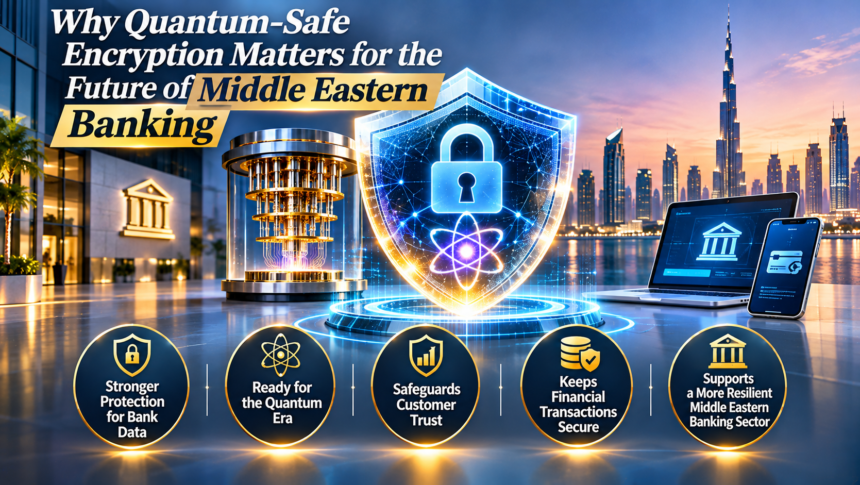
How Post-Quantum Cryptography Could Secure Middle East Banking
Banking systems across the Middle East are becoming increasingly digital as financial institutions expand mobile banking, electronic payments, cloud services, and international financial transactions. Customers can transfer money, access investments, and manage accounts through platforms that depend on complex networks of software, servers, and cybersecurity systems.
- 1. Why Quantum-Safe Encryption in Middle Eastern Banking Is Becoming Essential
- 2. How Quantum Computing Could Threaten Banking Data and Transactions
- 3. What NIST’s Post-Quantum Standards Mean for Banks
- 4. How UAE and Saudi Arabia Are Preparing for Quantum Cybersecurity Risks
- 5. Why Digital Payments and Financial Infrastructure Need Quantum Readiness
- 6. The Challenges of Moving Middle Eastern Banks to Quantum-Safe Encryption
- 7. The Future of Quantum-Safe Banking in the GCC
- Conclusion
Behind these services is an essential technology that most customers rarely notice: cryptography.
Cryptographic systems protect sensitive information, authenticate electronic communications, and help ensure that transactions cannot be modified without detection. They are fundamental to the security of modern financial services.
However, advances in quantum computing are creating questions about whether some widely used cryptographic methods will remain secure in the future.
This is why quantum-safe encryption in Middle Eastern banking is becoming an increasingly important topic for financial institutions, technology companies, and regulators.
Quantum computers use principles of quantum mechanics to perform certain types of computation. Although existing machines have not demonstrated the ability to break the strongest commonly deployed public-key cryptographic systems at the scale required for practical attacks, sufficiently powerful future quantum computers could threaten some methods used to secure banking communications.
The concern is not limited to attacks that might occur decades from now.
Sensitive encrypted information intercepted today could potentially be stored and decrypted later if the cryptographic methods protecting it become vulnerable. This possibility is commonly described as the harvest now, decrypt later threat.
International standards organisations are responding by developing quantum-resistant cryptography.
In August 2024, the US National Institute of Standards and Technology published three major post-quantum cryptography standards. The Bank for International Settlements subsequently published a financial-sector quantum-readiness roadmap in July 2025.
Gulf countries are also addressing these developments. The UAE approved a National Encryption Policy in November 2025, while Saudi Arabia’s central bank has introduced supervisory expectations concerning quantum computing risks.
However, preparing for quantum threats is not as simple as installing new cybersecurity software.
Banks must understand where cryptography is used, coordinate with technology suppliers, evaluate performance, and introduce changes without disrupting essential financial services.
Understanding these challenges reveals why quantum-safe security could become an important part of the region’s future banking infrastructure.
1. Why Quantum-Safe Encryption in Middle Eastern Banking Is Becoming Essential
Modern banking depends on information moving securely between customers, financial institutions, payment processors, and other service providers.
An individual checking an account balance may interact with several systems before the information appears on a mobile screen.
Each connection must be protected against unauthorised access and manipulation.
Understanding Encryption in Banking
Encryption converts readable information into a protected form using cryptographic algorithms and keys.
Authorised parties can recover the information using the relevant keys.
Banks use encryption to protect customer communications, stored information, and many internal processes.
However, cryptography also supports functions beyond confidentiality, including digital signatures and authentication.
These functions help systems verify identities and establish whether information has been altered.
What Quantum-Safe Means
Quantum-safe cryptography refers to cryptographic approaches intended to resist attacks from both conventional and future quantum computers.
Post-quantum cryptography, or PQC, is a major part of this effort.
Unlike quantum communication technologies, most post-quantum algorithms are designed to operate on conventional computing equipment.
This makes them potentially suitable for existing banking networks, although implementation may still require significant changes.
Why Current Cryptography Faces Different Levels of Risk
Some commonly used public-key systems rely on mathematical problems that are difficult for conventional computers to solve.
A sufficiently capable quantum computer could exploit algorithms that undermine certain of these assumptions.
RSA and widely used elliptic-curve public-key techniques are among the important categories affected.
By contrast, well-designed symmetric encryption is generally considered more resistant to known quantum attacks when appropriate key lengths are used.
The distinction matters because banks do not need to replace every cryptographic function in exactly the same way.
Cryptographic Functions Compared
| Function | Common Use | Quantum-Era Consideration |
|---|---|---|
| Public-Key Key Establishment | Establish secure communications | Vulnerable algorithms need replacement |
| Digital Signatures | Authenticate transactions and software | Quantum-resistant alternatives are needed |
| Symmetric Encryption | Protect stored and transmitted data | Appropriate algorithms and key strengths remain important |
| Cryptographic Hashing | Integrity checks and other security functions | Security parameters may require review |
| Certificate Infrastructure | Establish system identities | Dependent signature systems may need migration |
Why Banks Cannot Ignore the Issue
Banking technology often remains in service for many years.
A major cryptographic migration may involve payment networks, cloud platforms, databases, customer applications, and third-party software.
Waiting until a practical quantum attack becomes available could leave insufficient time to update these interconnected systems safely.
2. How Quantum Computing Could Threaten Banking Data and Transactions
Quantum computers are not simply faster versions of conventional computers.
They use a different computational approach that may provide major advantages for particular mathematical problems.
However, not every computing task benefits from quantum processing.
Understanding the Threat to Public-Key Cryptography
Public-key cryptography allows parties to establish secure communications without previously sharing a secret key.
It also supports digital signatures used to verify software and electronic messages.
Certain established public-key algorithms rely on the difficulty of factoring large numbers or solving discrete logarithm problems.
A sufficiently powerful quantum computer running appropriate algorithms could solve these problems much more efficiently than conventional machines.
This creates a potential threat to cryptographic systems that depend on them.
Harvest Now, Decrypt Later
One important concern involves information that must remain confidential for many years.
An attacker could collect encrypted communications today without being able to read them.
If future quantum computing capabilities make the original cryptography vulnerable, the stored information could become accessible.
For financial institutions, this may be relevant to long-lived sensitive records, confidential business communications, or selected customer information.
However, the severity depends on the information’s confidentiality period and the cryptographic protections involved.
Digital Signatures and Transaction Integrity
Digital signatures help authenticate software, communications, and certain financial processes.
Quantum threats to signature algorithms raise concerns extending beyond the secrecy of data.
If an attacker could forge signatures under a compromised cryptographic system, trusted processes might become vulnerable.
This is one reason post-quantum standards address both key establishment and digital signatures.
Banking Functions That Require Review
| Banking Activity | Cryptographic Dependency | Possible Future Concern |
|---|---|---|
| Mobile Banking | Secure connections and authentication | Vulnerable key establishment |
| Interbank Messaging | Secure communications and signatures | Authentication and integrity |
| Digital Certificates | Public-key infrastructure | Trust validation |
| Software Updates | Code signing | Signature authenticity |
| Cloud Banking | Encrypted connections and storage | Complex vendor dependencies |
| Payment Infrastructure | Authentication and transaction security | Interoperability during migration |
Why the Threat Should Not Be Exaggerated
As of November 2026, public evidence does not establish that a cryptographically relevant quantum computer has successfully broken widely deployed high-strength banking public-key cryptography in practical use.
The timetable for such a capability remains uncertain.
The case for preparation comes from the potentially severe consequences of a future breakthrough and the time needed to migrate complex systems.
It does not require claiming that a quantum banking attack is already taking place.
3. What NIST’s Post-Quantum Standards Mean for Banks
International cryptographic standards are an important part of quantum-readiness planning.
Banks need solutions that can be evaluated, tested, and integrated consistently with wider technology systems.
The First Three NIST Standards
In August 2024, NIST finalised three Federal Information Processing Standards for post-quantum cryptography.
These standards establish algorithms intended to support quantum-resistant key establishment and digital signatures.
The initial standards are FIPS 203, FIPS 204, and FIPS 205.
Understanding ML-KEM
FIPS 203 specifies the Module-Lattice-Based Key-Encapsulation Mechanism, or ML-KEM.
A key-encapsulation mechanism supports the establishment of shared secret information used for secure communication.
ML-KEM is therefore relevant to systems that currently rely on quantum-vulnerable public-key methods for establishing encryption keys.
However, ML-KEM is not a complete replacement for every encryption function.
Understanding ML-DSA and SLH-DSA
FIPS 204 specifies ML-DSA, a lattice-based digital signature algorithm.
FIPS 205 specifies SLH-DSA, a stateless hash-based digital signature algorithm.
These standards address authentication and integrity rather than simply encrypting files.
Banks may need to evaluate different signature applications, including certificates, software signing, and financial infrastructure.
NIST Standards Compared
| Standard | Algorithm | Main Purpose |
|---|---|---|
| FIPS 203 | ML-KEM | Key establishment |
| FIPS 204 | ML-DSA | Digital signatures |
| FIPS 205 | SLH-DSA | Digital signatures |
The October 2026 Migration Guidance
On October 27, 2026, NIST announced the finalisation of NIST Internal Report 8547.
The report explains the transition away from quantum-vulnerable cryptographic algorithms.
It identifies relevant standards and discusses how organisations should plan migration.
Its broader US federal transition framework uses 2035 as a key completion target, with earlier deadlines for certain high-priority federal systems.
However, those US federal timelines are not automatically binding on every Middle Eastern bank.
GCC institutions must consider their own applicable regulations and risk profiles.
Why Standards Do Not Eliminate Implementation Risk

Standardised algorithms provide a technical foundation.
However, security also depends on software implementation, key management, configuration, system architecture, and operational procedures.
Banks should avoid assuming that a product is secure merely because its marketing refers to a recognised post-quantum standard.
4. How UAE and Saudi Arabia Are Preparing for Quantum Cybersecurity Risks
The UAE and Saudi Arabia provide particularly relevant regional examples of quantum-readiness activity.
Their approaches demonstrate how a future technological threat can become part of present-day cybersecurity planning.
The UAE’s National Encryption Policy
On November 27, 2025, the UAE announced approval of its National Encryption Policy and issuance of its executive regulation.
The policy calls on government entities to establish clear plans for transitioning from traditional encryption methods to post-quantum cryptography.
The UAE government’s policy description addresses key management, implementation, post-quantum requirements, and ongoing performance monitoring.
This demonstrates that quantum-readiness has become part of the country’s wider national cybersecurity agenda.
However, a policy directed at government entities should not automatically be presented as imposing identical implementation requirements on every commercial bank.
UAE Research and Technology Collaboration
In May 2026, the UAE Cyber Security Council announced cooperation with Abu Dhabi’s Advanced Technology Research Council and related technology entities.
The collaboration focuses on national post-quantum security transition, research, technology development, and readiness.
It includes engagement involving the Technology Innovation Institute, VentureOne, and QuantumGate.
The initiative also identifies workforce training and awareness as areas of activity.
However, an announced collaboration does not demonstrate that all participating systems have completed migration.
Saudi Central Bank’s Quantum Risk Expectations
The Saudi Central Bank, known as SAMA, has published supervisory guidance on enhancing operational resilience to address quantum computing risks.
The guidance requires relevant financial institutions to strengthen their preparation for potential quantum threats.
It includes governance expectations, institutional planning, and ongoing oversight.
Notably, the framework addresses the responsibility of information security and board-level risk governance structures to monitor quantum computing risks.
This shows that quantum-readiness is not solely a technical responsibility of cybersecurity departments.
Saudi Arabia’s Cryptographic Standards
Saudi Arabia’s National Cybersecurity Authority has also developed national cryptographic standards addressing approved cryptographic mechanisms and security practices.
The published standards cover subjects including public-key infrastructure, key lifecycle management, and post-quantum cryptography.
Organisations must verify the applicable version, status, scope, and regulatory obligations when implementing these requirements.
Regional Developments Compared
| Development | Country | Main Significance |
|---|---|---|
| National Encryption Policy | UAE | National post-quantum transition planning |
| Cyber Security Council Research Partnership | UAE | Technology and institutional readiness |
| SAMA Quantum Risk Guidance | Saudi Arabia | Financial-sector operational resilience |
| National Cryptographic Standards | Saudi Arabia | Cryptographic security requirements |
Why GCC-Wide Claims Require Caution
The UAE and Saudi Arabia have identifiable public initiatives.
However, their existence does not prove that Bahrain, Kuwait, Oman, and Qatar have adopted identical post-quantum banking requirements.
Each country’s financial institutions should review current guidance from their own supervisors and cybersecurity authorities.
5. Why Digital Payments and Financial Infrastructure Need Quantum Readiness
Financial institutions depend on shared networks that extend beyond individual banks.
A customer transferring money may interact with payment processors, settlement systems, telecommunications providers, and several security services.
Cryptographic changes must therefore work across organisational boundaries.
The Importance of Interoperability
A bank cannot always replace a cryptographic system independently.
Secure communication requires both communicating parties to support compatible mechanisms.
If one organisation upgrades before its counterpart can process the new protocol, transactions may fail.
This makes industry coordination important.
Lessons From BIS Project Leap
The Bank for International Settlements Innovation Hub has conducted research into post-quantum cryptography for financial systems.
In December 2025, Project Leap Phase 2 reported results from testing post-quantum cryptographic signatures within an operational payment-system environment.
The experiment involved the BIS Innovation Hub Eurosystem Centre and collaborators including central banks, Swift, and technology providers.
It demonstrated that post-quantum changes can be tested in payment infrastructure.
However, the project also identified performance and integration challenges.
It should not be described as evidence that the entire global payment system has completed quantum-safe migration.
Performance Considerations
Post-quantum algorithms can have different key sizes, signature sizes, processing requirements, and communication overheads compared with conventional algorithms.
These differences can affect systems that process large numbers of transactions.
Banks need to evaluate performance under realistic workloads.
A solution performing well in a laboratory may behave differently when integrated into complex production infrastructure.
Protecting Long-Term Financial Records
Some banking information must remain confidential or authentic over extended periods.
Long-term records, legal agreements, and archived communications may require special attention.
However, the relevant protection mechanism depends on whether confidentiality, authenticity, or both must be maintained.
Financial Infrastructure Priorities
| Infrastructure | Migration Consideration |
|---|---|
| Payment Gateways | Transaction performance and compatibility |
| Interbank Networks | Coordinated cryptographic support |
| Digital Certificates | Replacement of vulnerable signature methods |
| ATM Networks | Hardware and software dependencies |
| Mobile Applications | Customer-device compatibility |
| Cloud Platforms | Supplier and service integration |
| Financial Archives | Long-term confidentiality and integrity |
Why Hybrid Cryptography May Be Useful
Hybrid approaches combine conventional cryptographic mechanisms with post-quantum algorithms.
This can provide transitional protection when implemented appropriately.
NIST’s 2026 guidance discusses hybrid approaches as one option during migration.
However, hybrid systems introduce additional processing and complexity.
They must be carefully designed rather than treated as automatically superior.
6. The Challenges of Moving Middle Eastern Banks to Quantum-Safe Encryption
The most difficult part of post-quantum migration may not be choosing an algorithm.
For established financial institutions, the challenge is understanding where cryptography is embedded across thousands of applications, devices, and external services.
The Cryptographic Inventory Problem
Banks may use cryptography in websites, mobile apps, databases, identity systems, payment terminals, software updates, and communications infrastructure.
Some cryptographic functions are managed internally.
Others are supplied by software vendors or infrastructure partners.
An institution cannot plan a reliable transition without knowing which systems depend on vulnerable algorithms.
Understanding Cryptographic Discovery
Cryptographic discovery involves identifying where algorithms, keys, certificates, and related security mechanisms are used.
A cryptographic inventory can record these dependencies.
Some organisations may develop a cryptographic bill of materials to help document relevant components.
However, an inventory should be maintained as systems change.
A one-time spreadsheet may become outdated quickly.
Third-Party Dependencies
A bank may depend on external payment processors, cloud providers, hardware manufacturers, and software developers.
Even if the bank updates its internal systems, a critical external service may continue using vulnerable cryptography.
Supplier readiness should therefore be assessed as part of procurement and operational resilience.
Legacy Technology
Older banking systems may not support newer algorithms without extensive modification.
Replacing them could affect applications developed over many years.
Banks should assess operational risks before implementing changes to critical infrastructure.
Major Challenges and Practical Responses
| Challenge | Potential Consequence | Response |
|---|---|---|
| Unknown Cryptographic Assets | Incomplete migration | System-wide inventory |
| Legacy Software | Compatibility failures | Phased upgrades |
| Vendor Dependence | Delayed implementation | Contractual readiness requirements |
| Performance Overhead | Transaction delays | Realistic testing |
| Staff Skill Gaps | Implementation mistakes | Professional training |
| Weak Key Management | Security vulnerabilities | Strong key lifecycle controls |
| Unclear Ownership | Governance delays | Defined responsibilities |
| Disruption During Migration | Payment or service outages | Controlled rollout and recovery planning |
Why Cryptographic Agility Matters
Cryptographic agility is the ability to update or replace cryptographic methods without rebuilding an entire system.
For example, a banking application designed with flexible cryptographic components may be easier to upgrade than one that depends on a specific algorithm embedded throughout its code.
Agility is important because standards and security knowledge continue evolving.
A successful migration should prepare institutions for future changes rather than create another rigid technical dependency.
7. The Future of Quantum-Safe Banking in the GCC
Quantum-safe banking will require cooperation between regulators, financial institutions, technology companies, and international financial infrastructure providers.
The transition is likely to occur in stages because not every system has the same urgency, technical complexity, or data sensitivity.
The BIS Quantum-Readiness Roadmap
In July 2025, the Bank for International Settlements published Quantum-readiness for the financial system: a roadmap.
The report recommends a structured approach involving awareness, inventory, risk assessment, planning, implementation, and continued monitoring.
It emphasises coordination across the financial sector.
However, the roadmap is guidance rather than a universal legal deadline.
The G7’s 2026 Roadmap
In January 2026, the G7 Cyber Expert Group published a coordinated roadmap for transitioning the financial sector toward post-quantum cryptography.
The statement emphasises planning, leadership accountability, risk prioritisation, and progress measurement.
Although the G7 framework is not GCC legislation, it provides a useful international reference for financial institutions preparing internal plans.
A Practical Quantum-Safe Banking Checklist
- Assign executive and board-level responsibility for quantum risks.
- Identify critical banking systems and sensitive information.
- Create and maintain a cryptographic inventory.
- Determine which algorithms are potentially quantum-vulnerable.
- Prioritise information requiring long-term confidentiality.
- Review cryptographic dependencies involving third parties.
- Evaluate relevant NIST post-quantum standards.
- Test interoperability and transaction performance.
- Assess hybrid cryptography where appropriate.
- Develop phased migration and recovery plans.
- Verify applicable national regulatory requirements.
- Train cybersecurity, architecture, and risk-management teams.
- Monitor emerging standards and vendor capabilities.
- Update cryptographic systems as risks evolve.
Measuring Quantum Readiness
Banks should not evaluate preparedness only by counting how many applications use a post-quantum algorithm.
Readiness depends on whether critical systems have been assessed and whether migration improves security without creating unacceptable operational risks.
Suggested Readiness Indicators
| Indicator | What It Measures |
|---|---|
| Cryptographic Inventory Coverage | Visibility of algorithms and dependencies |
| High-Risk System Assessment | Progress reviewing priority applications |
| Vendor Readiness | External provider preparedness |
| Migration Testing | Compatibility and performance |
| Protected Long-Term Data | Coverage of sensitive information |
| Cryptographic Agility | Ability to update security mechanisms |
| Staff Training | Internal technical preparedness |
| Governance Reporting | Oversight of identified quantum risks |
| Production Migration Progress | Verified deployment in relevant systems |
Opportunities for Middle Eastern Technology Companies
Demand for quantum-readiness services could create opportunities for regional cybersecurity firms, cryptographic specialists, software developers, and technical consultants.
Services may include cryptographic discovery, system testing, software integration, risk assessment, and professional training.
However, providers should avoid promising complete quantum-proof security.
The security of any system depends on implementation quality, evolving standards, and the broader threat environment.
Why Customer Trust Remains Important
Most banking customers will not need to understand the mathematics of post-quantum algorithms.
However, they rely on financial institutions to protect their information and provide dependable services.
Banks should communicate security developments accurately without creating unnecessary fear.
Quantum-safe cryptography should be presented as part of long-term cybersecurity modernisation, not as a solution to phishing, identity theft, or every other banking threat.
Conclusion
Quantum-safe encryption is becoming an important consideration for the future of Middle Eastern banking because financial institutions depend on cryptographic systems that may face new risks as quantum computing develops.
Although a practical quantum computer capable of breaking widely deployed high-strength public-key cryptography has not been publicly demonstrated, the potential consequences justify early preparation.
International standards from NIST provide technical foundations for quantum-resistant key establishment and digital signatures.
The Bank for International Settlements and G7 financial cybersecurity experts have also developed guidance supporting coordinated migration.
In the Gulf, the UAE’s National Encryption Policy and Saudi Arabia’s quantum-risk supervisory guidance demonstrate increasing institutional attention to the issue.
However, transitioning to post-quantum cryptography requires far more than selecting new algorithms.
Banks must identify vulnerable systems, assess suppliers, protect long-lived information, test performance, and coordinate upgrades across financial infrastructure.
For banking executives, quantum readiness should become part of long-term operational resilience planning.
For cybersecurity professionals, the immediate priority is understanding existing cryptographic dependencies and establishing a practical migration strategy.
For regulators and technology providers, collaboration will be important in preventing incompatible or poorly planned transitions.
Ultimately, the future of secure banking in the Middle East will depend not only on defending against today’s cyber threats but also on preparing responsibly for the technologies that could reshape digital security in the years ahead.
Do follow us on Instagram
Read More – How Privacy-Preserving AI Could Change Healthcare Data Sharing in the GCC