




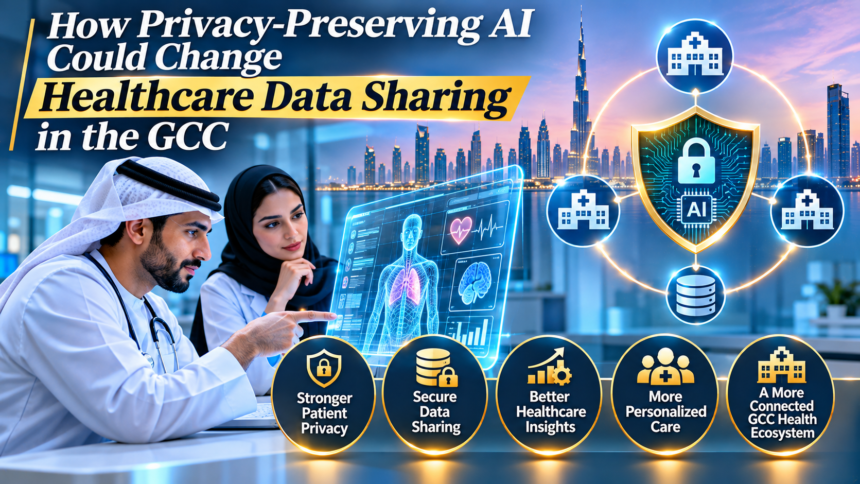
How Federated Learning Could Change Middle East Healthcare
Healthcare systems across the Gulf Cooperation Council are becoming increasingly digital as hospitals, clinics, research institutions, and government health authorities adopt electronic medical records, artificial intelligence, and connected healthcare platforms.
- 1. Why Privacy-Preserving AI in GCC Healthcare Is Becoming More Important
- 2. How Federated Learning Could Transform Hospital Collaboration
- 3. What UAE Health Information Exchanges Reveal About Data Sharing
- 4. How GCC Privacy Laws Could Shape Healthcare AI Development
- 5. How Differential Privacy and Secure Computing Could Protect Medical Information
- 6. The Challenges of Implementing Privacy-Preserving AI in Gulf Hospitals
- 7. The Future of Privacy-Preserving AI and Healthcare Data Collaboration in the GCC
- Conclusion
These developments are creating new opportunities to improve medical research, support earlier diagnosis, and coordinate care between healthcare providers. However, they also raise an important question: how can institutions benefit from large amounts of medical information without unnecessarily exposing patients’ private records?
Medical data is among the most sensitive information an organisation can hold. It may include diagnoses, treatment histories, laboratory results, genetic information, prescriptions, and details about a person’s physical or mental health.
Inappropriate access or disclosure can have serious consequences for patients, healthcare institutions, and public confidence.
This is why privacy-preserving AI in GCC healthcare is emerging as a potentially important area of digital health innovation.
Privacy-preserving artificial intelligence refers to techniques that enable certain forms of analysis or machine learning while reducing the exposure of sensitive underlying information.
These approaches include federated learning, differential privacy, secure multiparty computation, and other protective technologies.
Instead of requiring every participating hospital to transfer its entire patient database into one central system, some methods allow institutions to collaborate through controlled exchanges of model updates or statistical results.
The UAE already has established health information exchange infrastructure, including Malaffi, NABIDH, and Riayati. Saudi Arabia has developed national data protection requirements, and researchers are investigating how privacy-focused AI can support healthcare applications.
Qatar and Oman also operate under personal data protection frameworks relevant to medical information.
However, privacy-preserving AI is not a complete solution to every data protection challenge.
A federated learning system can still expose information through poorly protected model updates. Encryption does not eliminate all risks, and technical safeguards do not automatically satisfy legal requirements.
Understanding these distinctions is essential for evaluating how privacy-focused technology could support healthcare collaboration in the Gulf.
1. Why Privacy-Preserving AI in GCC Healthcare Is Becoming More Important
Healthcare increasingly depends on information gathered from different systems and institutions.
A patient may receive treatment from a primary-care clinic, a specialist hospital, a diagnostic laboratory, and a rehabilitation provider.
Each organisation may hold information relevant to the patient’s medical history.
When appropriate information is available to authorised professionals, it can support continuity of care.
However, sharing medical records requires strict protection of confidentiality and patient rights.
Why Healthcare Data Is Particularly Sensitive
Medical records can reveal deeply personal information about an individual.
Some information may remain relevant for many years, making the consequences of unauthorised disclosure difficult to reverse.
Health information can also involve family members, particularly when genetic or hereditary conditions are documented.
Consequently, healthcare institutions must consider confidentiality, cybersecurity, lawful processing, and appropriate access controls.
The Challenge of Fragmented Data
Hospitals may maintain separate electronic health record systems.
Even when data-sharing arrangements exist, records can differ in terminology, completeness, and technical format.
This fragmentation can complicate research involving patients from multiple institutions.
For example, researchers studying an uncommon medical condition may require information from several hospitals to obtain a sufficiently diverse sample.
Centralising those records may introduce additional privacy, governance, and security requirements.
What Privacy-Preserving AI Changes
Privacy-preserving techniques can sometimes allow institutions to collaborate without transferring all their underlying records to a single research database.
This may reduce some risks associated with unnecessary data duplication.
However, these methods do not mean that no sensitive information can ever be exposed.
Their effectiveness depends on system design, implementation, and governance.
Traditional and Privacy-Focused Data Analysis
| Approach | How Information Is Used | Main Consideration |
|---|---|---|
| Centralised Research Database | Data copied into a common repository | Access and transfer risks |
| Conventional Health Information Exchange | Authorised users access relevant medical records | Strong access controls required |
| Federated Learning | Institutions train models locally and exchange updates | Updates may leak information |
| Differential Privacy | Statistical mechanisms limit individual data influence | Privacy–accuracy trade-off |
| Secure Multiparty Computation | Parties jointly compute protected results | Computational complexity |
| Secure Research Environment | Approved users analyse controlled datasets | Governance and system security |
Why One Method Cannot Solve Every Problem
A hospital supporting direct patient treatment has different information needs from a university training a research model.
The appropriate data-sharing method depends on the purpose, clinical requirements, legal basis, and acceptable risks.
2. How Federated Learning Could Transform Hospital Collaboration
Federated learning is one of the most frequently discussed approaches to privacy-conscious artificial intelligence.
It allows multiple institutions to contribute to the training of a shared model while keeping their underlying training datasets in their respective environments.
Understanding Federated Learning
In a conventional centralised machine learning project, participating hospitals might send selected patient records to a common research environment.
Researchers then train a model using the collected data.
With federated learning, a shared model is distributed to participating institutions.
Each institution trains the model using its locally held data.
It then sends approved model updates to an aggregation process, where information from participating institutions is combined to improve the shared model.
The next version of the model may be redistributed for further training.
A Hypothetical GCC Example
Consider three hospitals in the UAE, Saudi Arabia, and Qatar investigating AI-assisted interpretation of medical images.
Under a proposed federated learning arrangement, each hospital could train an agreed model using locally controlled data.
Instead of routinely sending every patient image abroad, the institutions could exchange protected training updates.
This might support collaboration while reducing the need to centralise raw images.
However, the project would still require legal assessments, institutional agreements, security controls, and clinical validation.
This example is illustrative, not a claim that those hospitals currently operate such a network.
Why Federated Learning Can Be Useful
Different hospitals treat different patient populations.
A model trained using information from several institutions may have access to more varied training conditions than one developed from a single hospital.
This could improve generalisability in some circumstances.
However, federated learning does not guarantee better accuracy or fairness.
Differences in patient populations, equipment, clinical practices, and record quality can complicate training.
Why Federated Learning Alone Is Not Private Enough
The US National Institute of Standards and Technology has explained that information may be reconstructed or inferred from model updates.
Potential threats include gradient inversion and membership inference attacks.
Consequently, additional protection such as secure aggregation and differential privacy may be necessary.
Federated Learning Benefits and Limitations
| Potential Benefit | Important Limitation |
|---|---|
| Less routine transfer of raw records | Model updates can leak information |
| Multi-institution collaboration | Requires technical coordination |
| Local institutional data control | Local systems still need security |
| Broader training diversity | Data differences can reduce performance |
| Reduced central data duplication | Does not eliminate legal obligations |
Why Clinical Oversight Remains Essential
A technically successful AI model is not automatically suitable for clinical deployment.
Healthcare professionals must evaluate its safety, performance, limitations, and relevance to actual patient care.
3. What UAE Health Information Exchanges Reveal About Data Sharing
The UAE provides an important example of how digital healthcare infrastructure can support information exchange between medical providers.
However, conventional health information exchange and privacy-preserving AI should be understood as different technologies.
Abu Dhabi’s Malaffi Platform
Malaffi is Abu Dhabi’s health information exchange platform, developed as an initiative of the Department of Health – Abu Dhabi.
It connects participating healthcare providers and supports access to relevant patient information.
The platform also identifies services involving radiology image exchange, patient-facing records, and predictive risk profiles.
Its main purpose includes supporting care coordination and providing authorised healthcare professionals with relevant medical information.
This is an example of an operational health information exchange, not evidence that the entire platform uses federated learning.
Dubai’s NABIDH

Dubai’s NABIDH system supports health information exchange among connected healthcare providers.
It forms part of Dubai’s wider digital healthcare infrastructure.
The system aims to improve access to relevant clinical records across participating facilities.
However, access remains subject to applicable data-sharing and information-security requirements.
The UAE’s Riayati Platform
Riayati is associated with the UAE’s National Unified Medical Record programme.
The Ministry of Health and Prevention explains that Riayati is connected with Malaffi and NABIDH.
This integration helps authorised healthcare providers access relevant information across participating healthcare systems.
It illustrates the development of national-level connectivity between previously separate healthcare environments.
How Privacy-Preserving AI Could Complement These Systems
Existing health information exchanges focus on making relevant patient records available for authorised healthcare purposes.
Privacy-preserving AI could potentially support a different objective: allowing approved institutions to conduct collaborative analytics or train models with less movement of identifiable source records.
The two approaches could complement each other.
However, integrating them would require additional technical design, governance, and regulatory approval.
UAE Digital Health Systems
| Platform | Main Function | Relationship to Privacy-Preserving AI |
|---|---|---|
| Malaffi | Abu Dhabi health information exchange | Potential source environment for future approved analytics |
| NABIDH | Dubai healthcare information exchange | Existing clinical information infrastructure |
| Riayati | National unified health record connectivity | Cross-system healthcare coordination |
| Federated Research Network | Collaborative local model training | Potential future application, not equivalent to the above platforms |
Why the Difference Matters
A system that securely shares records with authorised clinicians is not necessarily using privacy-preserving machine learning.
Likewise, a research system that exchanges protected model updates may not provide the patient-level information needed for direct clinical treatment.
Both have possible roles within modern healthcare infrastructure.
4. How GCC Privacy Laws Could Shape Healthcare AI Development
Healthcare organisations cannot select data-sharing methods based on technical convenience alone.
They must comply with applicable legal and regulatory requirements.
Privacy-preserving technology may support compliance efforts, but it does not create an automatic exemption from privacy laws.
The UAE’s Health Data Law
Federal Law No. 2 of 2019 regulates the use of information and communication technology in healthcare in the UAE.
It includes requirements concerning health information, confidentiality, security, and the storage and transfer of data.
The law establishes a general restriction on transferring relevant health data outside the UAE.
Ministerial Resolution No. 51 of 2021 provides for specified exemptions, subject to applicable requirements and approvals.
Therefore, a multinational research project should not assume that sending model updates abroad is automatically lawful merely because raw medical records remain in the UAE.
The nature of the transferred information and the relevant legal permissions still need assessment.
Saudi Arabia’s Personal Data Protection Law
Saudi Arabia’s Personal Data Protection Law recognises health information as sensitive personal data.
The framework requires suitable safeguards and establishes obligations for those processing personal data.
Relevant health sector regulations may also apply.
In a federated learning project, hospitals would need to assess processing purposes, lawful grounds, security arrangements, and any applicable cross-border requirements.
Qatar’s Personal Data Privacy Protection Law
Qatar’s Law No. 13 of 2016 provides a legal framework for the protection of personal data.
It recognises health-related information as personal data of a special nature.
Processing this category of information involves additional legal considerations.
Hospitals and research institutions would therefore need to verify the requirements relevant to their intended use of medical information.
Oman’s Data Protection Framework
Oman introduced its Personal Data Protection Law through Royal Decree No. 6 of 2022.
The executive regulations were issued in 2024.
Royal Decree No. 68 of 2026 subsequently amended provisions of the law, including aspects of its definitions and application.
Oman’s Ministry of Transport, Communications and Information Technology identifies health data among categories requiring specific regulatory consideration and permitting under the applicable framework.
Bahrain’s Personal Data Protection Law
Bahrain’s Law No. 30 of 2018 addresses personal data processing and provides additional rules for sensitive information, including health-related data.
Healthcare research involving Bahraini institutions must assess the relevant requirements rather than assume a regional technology standard overrides national law.
Selected GCC Privacy Frameworks
| Country | Relevant Framework | Main Consideration |
|---|---|---|
| UAE | Federal Health Data Law No. 2 of 2019 | Health data use and cross-border restrictions |
| Saudi Arabia | Personal Data Protection Law | Sensitive health information |
| Qatar | Personal Data Privacy Protection Law No. 13 of 2016 | Special-category personal information |
| Oman | Personal Data Protection Law, as amended | Health data processing and regulatory controls |
| Bahrain | Personal Data Protection Law No. 30 of 2018 | Sensitive data protection |
Why a Regional Data Framework Would Be Complex
GCC countries have separate legal systems and healthcare regulators.
A future regional AI research network would need to account for these differences.
Technical data localisation alone would not resolve questions about consent, responsibility, research ethics, patient rights, or cross-border information exchange.
5. How Differential Privacy and Secure Computing Could Protect Medical Information
Federated learning is only one component of privacy-preserving AI.
Other technologies can help reduce the possibility that sensitive information will be exposed through statistical outputs, model updates, or collaborative calculations.
Understanding Differential Privacy
Differential privacy is a mathematical framework for limiting how much the presence or absence of one person’s data can influence a released result.
It commonly involves carefully designed randomness.
The objective is to reduce the ability to infer information about an individual from the output.
However, stronger privacy protection can reduce statistical precision or model performance.
Choosing an appropriate level of protection requires evaluating the intended use and potential risks.
Secure Aggregation
Secure aggregation allows a central system to combine model updates without necessarily accessing every participant’s individual update in readable form.
This can strengthen federated learning arrangements.
However, the security properties depend on the design and assumptions of the protocol.
It does not automatically prevent all forms of malicious participation or data leakage.
Homomorphic Encryption
Homomorphic encryption enables selected computations to be performed on encrypted information.
This can create opportunities for collaborative analysis without exposing all underlying values during processing.
However, it can impose significant computational and operational costs.
Not every healthcare application requires or benefits from this approach.
Secure Multiparty Computation
Secure multiparty computation allows several parties to jointly calculate an agreed result while limiting the information each reveals to others.
Potential healthcare applications include collaborative statistics and selected research analyses.
However, the method must be appropriate for the computational task and threat model.
Privacy Technologies Compared
| Technology | Main Purpose | Important Limitation |
|---|---|---|
| Federated Learning | Train models across separate datasets | Update leakage and coordination |
| Differential Privacy | Limit individual information disclosure | Accuracy trade-offs |
| Secure Aggregation | Protect individual model updates | Protocol limitations |
| Homomorphic Encryption | Compute on encrypted data | Computational overhead |
| Secure Multiparty Computation | Perform protected joint calculations | Complexity and communication costs |
| Trusted Execution Environments | Protect selected computations in isolated hardware | Hardware and implementation vulnerabilities |
Why Layered Protection Is Necessary
A healthcare AI system may combine federated learning, secure aggregation, access controls, and carefully selected privacy safeguards.
Each measure addresses different risks.
No single technology guarantees complete anonymity, security, or legal compliance.
6. The Challenges of Implementing Privacy-Preserving AI in Gulf Hospitals
Although privacy-preserving AI offers promising possibilities, implementing it across hospitals requires significant preparation.
Healthcare data can be technically complex and clinically inconsistent.
Institutions may also differ in infrastructure, cybersecurity maturity, staffing, and governance procedures.
Differences in Medical Data Quality
Hospitals may use different clinical coding systems, laboratory units, imaging protocols, or data formats.
These differences can make collaborative model training difficult.
For example, two hospitals may record the same clinical condition using different classification practices.
Researchers must determine whether the data is sufficiently comparable.
Bias and Unequal Model Performance
A model trained using information from several hospitals may still perform differently across patient groups.
Variations in age, clinical conditions, medical equipment, and care practices can affect performance.
Privacy protection does not automatically eliminate algorithmic bias.
Healthcare institutions should evaluate results across relevant patient populations.
Cybersecurity Risks
Decentralised data arrangements still involve software, networks, credentials, and participating devices.
Attackers may target individual institutions, model updates, or central coordination systems.
Participating organisations must therefore maintain appropriate cybersecurity controls.
The Cost of Technical Infrastructure
Advanced privacy technologies may require specialist computing resources and experienced technical teams.
Hospitals must also allocate resources for monitoring, validation, maintenance, and incident response.
Costs should be compared with the expected clinical and research benefits.
Accountability Between Institutions
A multi-hospital AI project needs clear responsibility for its design and operation.
Participants should determine who approves the research, manages security incidents, validates the model, and decides whether results may be used clinically.
Without these arrangements, technical collaboration can create governance uncertainty.
Challenges and Possible Responses
| Challenge | Potential Consequence | Practical Response |
|---|---|---|
| Inconsistent Data Formats | Poor model performance | Common data standards |
| Privacy Leakage | Exposure of sensitive information | Layered technical safeguards |
| Algorithmic Bias | Unequal clinical performance | Subgroup evaluation |
| Cybersecurity Weaknesses | Data or system compromise | Security assessments |
| High Computing Costs | Limited project feasibility | Controlled pilot programmes |
| Unclear Governance | Accountability gaps | Formal institutional agreements |
| Regulatory Differences | Compliance difficulties | Jurisdiction-specific review |
| Limited Clinical Validation | Unsafe or ineffective use | Independent clinical testing |
Why Research Results Should Not Be Overstated
A published proof-of-concept can demonstrate technical feasibility under particular conditions.
However, it does not establish that a system is ready for routine clinical use.
Research involving simulated, public, or limited datasets may produce results that differ from real hospital deployment.
Clinical implementation requires additional evaluation.
7. The Future of Privacy-Preserving AI and Healthcare Data Collaboration in the GCC
Privacy-preserving AI could become part of the next stage of digital healthcare development across the GCC.
As medical institutions expand their use of artificial intelligence, demand may grow for systems that support research and innovation while maintaining strong data protection.
However, future adoption should be guided by demonstrable clinical value.
Collaborative Medical Research
Privacy-focused approaches may allow hospitals to participate in research without routinely transferring entire patient datasets.
Potential applications include medical imaging analysis, selected chronic disease research, and population-level health analytics.
However, each project must establish a valid research purpose, appropriate permissions, and an acceptable level of risk.
Saudi Research Into Privacy-Focused AI
Researchers affiliated with Saudi institutions have contributed to studies examining federated learning and healthcare data protection.
A 2026 research publication on an OPAL-based healthcare analytics framework discusses privacy-preserving computation, auditability, and governance in a Saudi urgent-care context.
Such studies illustrate the development of regional expertise.
However, research findings should not be described as evidence of nationwide deployment.
The Role of Universities and Technology Companies
Universities can contribute research expertise in cryptography, machine learning, privacy engineering, and clinical validation.
Healthcare technology companies may develop infrastructure supporting authorised data collaboration.
Hospitals and regulators can help ensure that projects address genuine medical needs.
However, commercial incentives should not override patient protection.
A Practical Privacy-Preserving Healthcare AI Checklist
- Define the clinical or research purpose.
- Determine whether identifiable data is genuinely necessary.
- Review applicable healthcare and privacy regulations.
- Obtain required approvals and ethical review.
- Identify the institutions responsible for processing.
- Assess privacy threats and possible information leakage.
- Choose suitable technical safeguards.
- Establish secure access and incident-response procedures.
- Standardise relevant clinical data.
- Evaluate model accuracy across patient groups.
- Document cross-border processing arrangements.
- Maintain audit records and accountability.
- Test the system before clinical deployment.
- Monitor safety, security, and performance over time.
How Hospitals Should Measure Success
The number of participating hospitals does not, by itself, demonstrate that a privacy-preserving project is effective.
Institutions should measure privacy protection, clinical performance, reliability, cost, and compliance.
Suggested Performance Indicators
| Indicator | What It Measures |
|---|---|
| Privacy Risk Assessment | Potential information exposure |
| Security Incidents | System protection performance |
| Model Accuracy | Technical predictive performance |
| Subgroup Performance | Fairness across relevant populations |
| Clinical Validation | Suitability for intended healthcare use |
| Institutional Participation | Collaboration under approved arrangements |
| Data Quality | Reliability of participating datasets |
| Operational Cost | Resource requirements |
| Regulatory Compliance | Adherence to applicable rules |
| Patient and Clinician Trust | Confidence in governance and use |
Why Patient Trust Must Remain Central
Healthcare AI systems depend on the responsible use of information about real people.
Patients should be given understandable information about relevant uses of their data, consistent with applicable laws and clinical circumstances.
Where consent is required, it should be obtained appropriately.
Healthcare organisations must also recognise that patient rights, legal permissions, and professional duties cannot be replaced by technical privacy claims.
The Possibility of Future GCC Collaboration
A regional healthcare AI research network could potentially bring together institutions interested in studying shared medical challenges.
Privacy-preserving computation may reduce some obstacles associated with transferring sensitive data.
However, any future network would require agreements concerning legal compliance, security, accountability, data standards, and research governance.
It should not be assumed that a single technical architecture automatically makes cross-border collaboration permissible.
Conclusion
Privacy-preserving AI could change healthcare data sharing in the GCC by creating new ways for hospitals and research institutions to collaborate while reducing unnecessary exposure of sensitive medical records.
Technologies such as federated learning, differential privacy, secure aggregation, and encrypted computation offer potential alternatives to some conventional data-centralisation practices.
The UAE’s connected health information exchanges demonstrate the importance of digital healthcare infrastructure, while privacy regulations in Saudi Arabia, Qatar, Oman, Bahrain, and the UAE highlight the responsibilities associated with medical information.
However, privacy-preserving AI should not be viewed as a universal solution.
Technical safeguards can reduce selected risks, but they do not eliminate the need for legal compliance, clinical validation, cybersecurity, ethical oversight, and accountable management.
For hospitals, the opportunity lies in carefully evaluating whether collaborative AI can improve research or patient care without creating disproportionate privacy risks.
For technology companies, it involves developing systems that provide meaningful protection rather than relying on broad claims of anonymity or security.
For regulators and research institutions, it means establishing clear requirements for responsible collaboration.
Ultimately, the future of healthcare data sharing in the Gulf will depend on finding an appropriate balance between innovation and patient protection.
Privacy-preserving AI may become a valuable part of that balance, helping medical institutions learn from wider evidence while respecting the sensitive nature of the information entrusted to them.
Do follow us on Instagram
Read More – How Franchise Incubation Could Help Homegrown Gulf Brands Expand Internationally