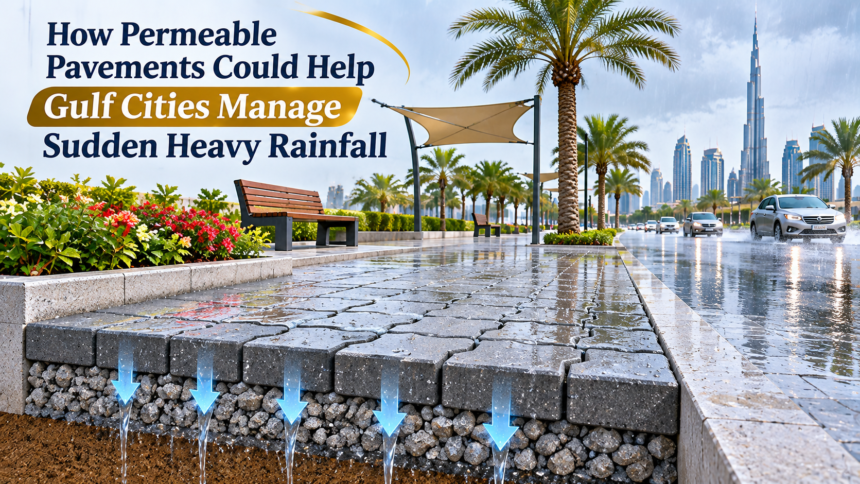
The Opportunities and Challenges of Permeable Pavements in Desert Climates
Heavy rainfall is not usually the first environmental challenge associated with the Gulf region. Cities such as Dubai, Abu Dhabi, Doha, Riyadh and Kuwait City are more commonly recognised for their hot climates, limited freshwater resources and extensive desert landscapes. However, occasional intense storms have demonstrated that even regions with relatively low annual rainfall can experience serious urban flooding.
- 1. Why Sudden Heavy Rainfall Creates Challenges for Gulf Cities
- 2. What Are Permeable Pavements and How Do They Work?
- 3. How Permeable Pavements Could Reduce Urban Flooding
- 4. Where Could Permeable Pavements Be Used Across Gulf Cities?
- 5. The Environmental and Economic Benefits of Permeable Pavements
- 6. What Challenges Could Limit Permeable Pavements in Gulf Climates?
- 7. How Gulf Cities Could Integrate Permeable Pavements With Existing Drainage Systems
- 8. The Future of Permeable Pavements in Sustainable Gulf Urban Planning
- Conclusion: A Practical Opportunity for More Resilient Gulf Cities
As Gulf cities continue expanding their roads, residential communities, commercial districts and transportation networks, managing sudden rainfall is becoming an important part of long-term infrastructure planning. One approach attracting attention is the use of permeable pavements in Gulf cities, which could help reduce surface runoff and improve the management of rainwater.
Unlike conventional asphalt and concrete surfaces, permeable pavements are designed to allow rainwater to pass through openings or pores in the surface. Water can then be temporarily stored in underlying layers, gradually absorbed into suitable soil or directed into controlled drainage systems.
This approach offers an alternative to relying exclusively on conventional stormwater drains, underground pipelines and pumping stations.
The importance of better rainfall management became particularly visible during the exceptional storms that affected the United Arab Emirates in April 2024. The country experienced its heaviest recorded rainfall in 75 years, with extensive flooding disrupting roads, airports and everyday activities. The event demonstrated how unusual but intense rainfall can challenge urban infrastructure in arid environments. Emirates News Agency+1
For Gulf municipalities, permeable pavements could become one component of broader flood-resilience strategies. Their potential benefits include reducing runoff from suitable paved areas, temporarily storing stormwater and supporting more sustainable urban design.
However, their performance depends on rainfall intensity, soil conditions, groundwater levels, maintenance and engineering standards. They cannot independently prevent flooding during every extreme storm.
Understanding where these systems work, how they should be designed and what limitations they face is essential for evaluating their future role in Middle Eastern infrastructure.
1. Why Sudden Heavy Rainfall Creates Challenges for Gulf Cities
Many cities across the Gulf have developed in environments where dry weather dominates much of the year. Consequently, infrastructure planning has historically needed to address heat, water scarcity, dust, urban expansion and transportation demand.
Nevertheless, low annual rainfall does not eliminate the possibility of severe flooding.
In some situations, a large quantity of rain can fall within a relatively short period, overwhelming local drainage systems and accumulating across streets, tunnels and low-lying areas.
The impact of extreme rainfall
The UAE’s April 2024 rainfall event provided an important example of the challenges associated with exceptional storms.
According to the European Centre for Medium-Range Weather Forecasts, the highest reported 24-hour rainfall total during the event reached approximately 259.5 millimetres.
The storms caused significant disruption, particularly in urban locations where accumulated water affected transportation and commercial activity. ECMWF
Although this was an exceptional event, it highlighted the importance of planning infrastructure for rainfall extremes rather than relying only on historical averages.
How urban development contributes to runoff
Natural landscapes can absorb, store or slow portions of rainfall, depending on their soil characteristics and surface conditions.
Urbanisation changes these processes.
When land is covered with roads, buildings, parking areas and conventional pavements, water has fewer opportunities to enter the ground.
Instead, larger quantities may move across hard surfaces toward drainage channels and lower-lying areas.
If rainfall exceeds the drainage system’s capacity, water can begin accumulating.
This problem is not unique to the Middle East, but rapid development and local environmental conditions make it particularly relevant to expanding Gulf cities.
Why drainage networks can become overwhelmed
Conventional stormwater systems typically collect runoff through roadside drains, underground pipes, channels and storage infrastructure.
Their performance depends on design capacity, maintenance and the intensity of rainfall.
During severe storms, the volume of incoming water may exceed what these systems can safely transport.
Blocked drains, sediment accumulation and inadequate outlet capacity can create additional difficulties.
Permeable pavements could help by reducing the amount of runoff entering drainage networks from selected areas.
However, they work best as part of an integrated system rather than as replacements for major flood protection infrastructure.
2. What Are Permeable Pavements and How Do They Work?
Permeable pavements are engineered surfaces designed to allow rainfall to move through the pavement rather than remaining entirely on top.
Traditional asphalt and concrete pavements are generally designed to prevent water from penetrating the surface and underlying structure.
Permeable alternatives follow a different principle.
They use interconnected pores, gaps or joints that allow water to enter specially prepared layers beneath the pavement.
The basic structure of permeable pavement
A typical system contains several components.
- Permeable surface: Allows water to enter through pores or openings.
- Bedding layer: Supports the surface and helps distribute incoming water.
- Aggregate reservoir: Provides temporary underground storage through spaces between stones.
- Optional drainage pipes: Carry stored water to an approved outlet where necessary.
- Underlying soil or lined base: Determines whether water infiltrates into the ground or remains within a controlled drainage system.
The exact design depends on soil permeability, traffic requirements, groundwater conditions and expected rainfall.
The US Federal Highway Administration explains that permeable pavements can provide stormwater storage and reduce peak flows even where full infiltration into native soil is not practical. Federal Highway Administration
Three common types of permeable pavements
Permeable interlocking concrete pavers
These systems use individual concrete blocks separated by specially designed joints.
Rainwater enters through the spaces between the blocks and moves into the underlying aggregate layers.
They may be suitable for pedestrian areas, residential streets and selected parking facilities when appropriately engineered.
Pervious concrete
Pervious concrete contains interconnected voids that allow water to pass through the material.
It is produced using a carefully controlled mixture that differs from conventional dense concrete.
The surface can support suitable traffic loads when designed and constructed for the intended use.
Porous asphalt
Porous asphalt is manufactured with interconnected voids that allow rainwater to move downward through the pavement.
It can be used in selected parking and road applications, subject to structural requirements and maintenance arrangements.
Comparison of pavement types
| Pavement type | Main characteristic | Potential application |
|---|---|---|
| Permeable concrete pavers | Water passes through joints | Walkways, parking areas, residential developments |
| Pervious concrete | Water passes through connected pores | Pedestrian spaces and suitable low-traffic areas |
| Porous asphalt | Permeable asphalt structure | Selected roads and parking areas |
| Conventional asphalt | Water mainly runs across the surface | Major roads and general transportation infrastructure |
| Conventional concrete | Relatively impermeable surface | Roads, industrial areas and structural pavements |
These materials have different strengths, installation requirements and maintenance needs.
Engineers must evaluate them according to the intended location rather than assuming that one pavement type is suitable for every Gulf development.
3. How Permeable Pavements Could Reduce Urban Flooding
The primary advantage of permeable pavement is its ability to manage rainwater close to where it falls.
Instead of allowing all rainfall to become immediate surface runoff, a properly designed pavement system can capture part of the water and temporarily store it beneath the surface.
This can reduce pressure on conventional drainage infrastructure.
Reducing surface runoff
When rain falls on impermeable pavement, much of the water moves across the surface.
In contrast, permeable pavement allows water to enter its subsurface structure.
Depending on the design, some of this water may infiltrate into the soil while the remainder is released through drainage outlets.
By reducing immediate runoff from suitable areas, permeable pavement can help manage stormwater more effectively.
Temporarily storing rainwater
The aggregate reservoir beneath permeable pavement contains void spaces capable of holding water.
During rainfall, these spaces can temporarily store runoff before it infiltrates or is discharged.
This storage function can be particularly useful when rainfall arrives faster than conventional drainage networks can transport it.
However, the reservoir has a finite capacity.
Once it becomes full, additional water requires another drainage route.
Reducing peak stormwater flows
The rate at which stormwater enters drainage infrastructure can be as important as the total volume.
Permeable pavements may slow the release of water, reducing peak flows during certain rainfall events.
This can help reduce the sudden pressure placed on downstream drainage systems.
The US Environmental Protection Agency recognises permeable pavement as a stormwater management practice capable of supporting infiltration, detention and runoff control. US EPA
Supporting groundwater recharge
Where soil conditions are suitable and groundwater protection requirements are satisfied, infiltrating rainwater may contribute to local groundwater recharge.
However, this benefit cannot be assumed across all Gulf locations.
High groundwater levels, saline groundwater, low-permeability soils or contamination risks may make infiltration inappropriate.
In such circumstances, engineers may use lined storage systems and controlled drainage outlets instead.
Understanding the limitations during extreme storms
Permeable pavement cannot absorb unlimited rainfall.
During an exceptional storm, the volume of rain may exceed the combined capacity of its surface, reservoir and drainage system.
This means major flood-control infrastructure remains necessary.
Conventional versus permeable pavement
| Factor | Conventional pavement | Permeable pavement |
|---|---|---|
| Rainwater movement | Mainly surface runoff | Passes into underlying layers |
| Temporary underground storage | Usually not provided by pavement | Can be integrated |
| Peak runoff | Often reaches drains quickly | Can be delayed or reduced |
| Groundwater recharge | Generally limited | Possible where conditions permit |
| Maintenance | Conventional pavement maintenance | Additional permeability and sediment management |
| Heavy rainfall performance | Depends on external drainage | Depends on storage, infiltration and drainage |
| Flood prevention | Cannot prevent all flooding | Cannot prevent all flooding |
The greatest benefit may come from distributing permeable surfaces across appropriate urban locations rather than depending on a single large installation.
4. Where Could Permeable Pavements Be Used Across Gulf Cities?
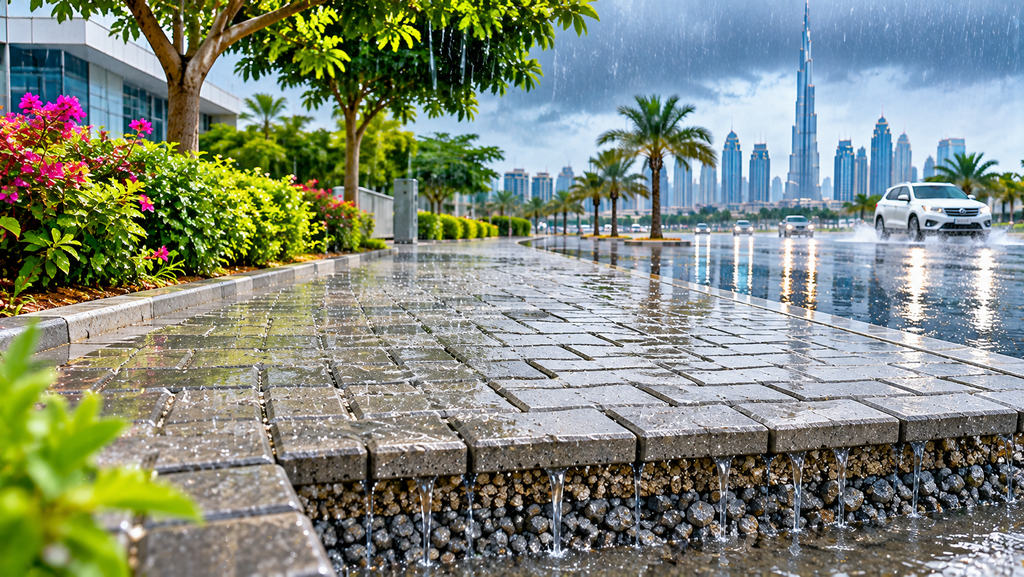
The effectiveness of permeable pavement depends significantly on where it is installed.
Not every urban surface is suitable.
High-speed highways, heavy industrial roads, locations with contaminated runoff and areas with challenging subsurface conditions may require conventional pavement or specialised designs.
Nevertheless, many public and private spaces could provide opportunities for appropriately engineered systems.
Residential communities
Housing developments often contain driveways, pedestrian pathways, parking spaces and internal access roads.
These areas can generate runoff during heavy rainfall.
Permeable pavements may help manage rainwater locally while providing practical walking and parking surfaces.
In newly planned communities, designers can integrate these systems with landscaping and stormwater drainage from the beginning.
Parking facilities
Large parking areas contain extensive paved surfaces.
When suitable, permeable pavement can reduce immediate runoff from these spaces.
Shopping centres, residential developments, office complexes and public facilities may be candidates for installation.
The suitability of each location depends on traffic loads, potential contamination and maintenance arrangements.
Public parks and pedestrian areas
Urban parks, promenades and pedestrian zones provide opportunities to combine permeable surfaces with landscape design.
These installations may contribute to stormwater management without requiring major changes to the visible appearance of public spaces.
They can also be integrated with suitable planting areas and rain gardens.
Commercial developments
Office districts and mixed-use developments frequently contain plazas, courtyards and outdoor pedestrian spaces.
Permeable pavements could help reduce runoff from selected surfaces while supporting attractive urban design.
Developers may also combine them with underground detention systems.
Hotel and tourism developments
Hotels and resorts often include landscaped outdoor areas, pathways and parking facilities.
In suitable locations, permeable pavement could support more responsible stormwater management.
This may be especially relevant to tourism developments seeking to incorporate sustainable infrastructure.
Potential applications by city
| Gulf city | Possible application | Important consideration |
|---|---|---|
| Dubai | Residential parking and pedestrian areas | Storm intensity and drainage integration |
| Abu Dhabi | Parks, plazas and planned communities | Groundwater conditions and salinity |
| Doha | Public walkways and commercial landscapes | Soil conditions and flood-risk planning |
| Riyadh | Residential districts and suitable parking areas | Sediment, dust and runoff management |
| Kuwait City | Community spaces and parking facilities | Groundwater, drainage and maintenance |
| Muscat | Selected urban developments and public spaces | Topography and flash-flood pathways |
These are potential applications, not claims that each city has implemented the systems at these locations.
A 2025 UAE research case study examined geopolymer pervious concrete as a potential tool for more sustainable urban stormwater management, supporting the value of further investigation under regional conditions. ISPRS Archives
For municipalities, identifying appropriate pilot locations could provide practical evidence about performance before larger installations are considered.
5. The Environmental and Economic Benefits of Permeable Pavements
Permeable pavements may provide benefits beyond managing rainfall.
When appropriately designed, they can support more sustainable urban development by reducing runoff, helping manage stormwater pollutants and improving the use of land already dedicated to roads or pedestrian infrastructure.
However, the scale of these benefits depends on local conditions and maintenance.
Supporting sustainable stormwater management
Conventional drainage systems often depend on collecting water and transporting it away from built-up areas.
Permeable pavements introduce a more distributed approach.
Instead of treating every paved surface as a contributor to runoff, suitable surfaces can participate in stormwater storage and management.
This principle is consistent with green infrastructure and low-impact development practices.
Potential improvements in water quality
As stormwater passes through pavement and aggregate layers, some suspended particles and associated pollutants may be retained.
However, the treatment effect varies according to pavement design and pollutant type.
Permeable pavements should not be considered universal water-purification systems.
Runoff from hazardous industrial activities or areas with significant chemical spill risks may be unsuitable for infiltration without appropriate safeguards.
The US Geological Survey has examined the effects of permeable pavement on stormwater quantity and quality, including potential benefits and maintenance-related performance challenges. U.S. Geological Survey
Reducing pressure on drainage infrastructure
When permeable surfaces capture or delay runoff, they may reduce the amount of water entering conventional drains during some storms.
This could potentially reduce the required size of certain downstream drainage components in appropriate new developments.
However, this benefit must be demonstrated through site-specific engineering calculations.
It should not be assumed that installing permeable pavement automatically allows municipalities to reduce existing drainage capacity.
Potential long-term economic benefits
The initial installation cost of permeable pavement may be higher than conventional alternatives.
Additional expenses can include aggregate reservoirs, specialised construction and maintenance equipment.
However, some projects may recover part of these costs through reduced drainage infrastructure requirements or other stormwater-management benefits.
A full economic assessment should consider the entire life cycle of the pavement.
| Potential benefit | Environmental significance | Possible economic relevance |
|---|---|---|
| Reduced runoff | Less immediate stormwater discharge | Potential reduction in downstream drainage demand |
| Temporary storage | Better management of rainfall peaks | Improved infrastructure resilience |
| Pollutant retention | Potential improvements in stormwater quality | Possible reduction in some treatment requirements |
| Groundwater recharge | May support recharge where appropriate | Potential local water-resource benefit |
| Integrated urban design | Combines paving and stormwater functions | More efficient use of suitable public spaces |
| Flood-risk reduction | May reduce localised surface accumulation | Potential reduction in some disruption and damage |
Supporting broader urban resilience
Gulf cities are investing in infrastructure designed to support long-term economic growth.
Stormwater resilience should be considered alongside transportation, housing and public-space development.
Research published in 2026 on stormwater management in Sharjah found that permeable and vegetated land cover can contribute meaningfully to urban runoff regulation, even in environments with low annual rainfall. Springer
This supports the argument for evaluating a combination of engineered drainage infrastructure and nature-based stormwater measures.
6. What Challenges Could Limit Permeable Pavements in Gulf Climates?
Although permeable pavements offer promising advantages, Gulf environmental conditions create specific engineering challenges.
High temperatures, airborne dust, sediment, variable soil conditions and occasional intense rainfall can all influence pavement performance.
Successful installations must address these factors during planning, construction and maintenance.
Dust and sediment accumulation
Dust is a familiar environmental condition across many Gulf cities.
Over time, fine particles can accumulate within pavement pores or joints.
This may reduce the rate at which rainwater enters the surface.
Sediment transported during storms can also contribute to clogging.
Regular cleaning and suitable sediment-control measures are therefore important.
High temperatures and material durability
Pavement materials in the Gulf experience prolonged exposure to high temperatures and strong sunlight.
Engineers must evaluate the ability of selected surfaces to withstand local thermal conditions, traffic loads and repeated use.
The performance of porous asphalt, pervious concrete and concrete pavers may differ under these conditions.
Material selection should therefore reflect local testing and established engineering standards.
Soil permeability
The ability of the underlying soil to absorb water is a major design consideration.
Some soils allow water to infiltrate relatively quickly, while others have low permeability.
Where the underlying soil cannot absorb water at the required rate, a pavement system may need a storage reservoir and controlled outlet.
The Federal Highway Administration identifies subgrade permeability as an important factor in determining whether full infiltration is practical. Federal Highway Administration
High groundwater and salinity
Coastal Gulf locations may have shallow groundwater or saline subsurface conditions.
These factors can restrict infiltration and influence pavement design.
Engineers may need to prevent uncontrolled interaction between stormwater, groundwater and nearby building foundations.
Impermeable liners and underdrains may be appropriate in some circumstances.
Maintenance requirements
Permeable pavement needs planned maintenance to preserve its drainage function.
Depending on the material and conditions, maintenance may involve specialised vacuum cleaning, removal of accumulated sediment and periodic testing.
Poor maintenance can gradually reduce the system’s ability to accept rainwater.
Heavy traffic and structural requirements
Not every permeable pavement design is suitable for heavy vehicles.
Roads carrying frequent trucks or high-speed traffic require detailed structural assessment.
For many Gulf developments, low-speed streets, parking areas and pedestrian environments may offer more practical initial applications.
Major challenges and possible responses
| Challenge | Potential consequence | Possible solution |
|---|---|---|
| Dust accumulation | Reduced permeability | Scheduled surface cleaning |
| Sediment from storms | Clogging of pores and joints | Sediment controls and maintenance |
| High temperatures | Material deterioration | Climate-appropriate material selection |
| Low-permeability soil | Slow drainage | Underdrains and detention design |
| Shallow groundwater | Limited storage and infiltration | Lined systems and controlled discharge |
| Heavy vehicle loads | Structural damage | Appropriate pavement design or alternative surfaces |
| Extreme rainfall | Storage capacity exceeded | Emergency overflow and conventional drainage integration |
Permeable pavement should therefore be treated as engineered infrastructure rather than a simple replacement for ordinary paving materials.
7. How Gulf Cities Could Integrate Permeable Pavements With Existing Drainage Systems
A successful urban flood-management strategy usually requires several types of infrastructure working together.
Permeable pavements can contribute to this approach by managing runoff at the surface level.
However, major drainage networks, detention basins, pumping stations and flood channels remain important, particularly during extreme weather.
Combining permeable paving with conventional drains
One practical approach is to install permeable pavement in suitable areas while retaining conventional stormwater networks.
During smaller rainfall events, the pavement may capture and store a portion of the incoming water.
During larger storms, controlled overflow routes can direct excess water toward drainage infrastructure.
This helps ensure that the system can function even when its underground storage reaches capacity.
Integrating rain gardens and landscaped areas
Rain gardens are landscaped depressions designed to receive and temporarily hold stormwater.
They may be combined with permeable pedestrian areas, parking facilities and other green infrastructure.
This can create a connected system in which different surfaces contribute to runoff management.
However, planted areas in the Gulf require careful consideration of soil, water availability, salinity and vegetation selection.
Using underground stormwater storage
In dense urban areas, available land for surface storage may be limited.
Underground detention tanks or engineered aggregate reservoirs can help manage runoff without occupying large visible spaces.
Permeable pavements may direct water into these systems, depending on the design.
This approach may be relevant to commercial districts and mixed-use developments.
Digital monitoring and smart drainage
Monitoring technology could help municipalities evaluate how permeable pavement systems perform.
Sensors may track water levels, drainage rates and the condition of storage systems.
Collected data can support maintenance planning and engineering decisions.
However, monitoring equipment should be justified by project requirements rather than added solely for technological novelty.
The importance of integrated planning
Flood resilience requires coordination between urban planners, transportation authorities, water utilities, developers and environmental specialists.
If permeable pavement is introduced without considering existing underground infrastructure and drainage capacity, its benefits may be limited.
A coordinated approach allows the pavement system to operate as part of a wider stormwater network.
Example of an integrated stormwater strategy
| Infrastructure component | Main function |
|---|---|
| Permeable pavement | Capture and temporarily store surface rainfall |
| Rain gardens | Manage selected runoff through landscaped systems |
| Drainage pipes | Transport excess stormwater |
| Underground detention | Temporarily hold larger volumes of water |
| Pumping stations | Move water where gravity drainage is insufficient |
| Flood channels | Convey significant stormwater flows |
| Monitoring systems | Support maintenance and operational decisions |
Together, these systems may provide greater resilience than any single measure operating independently.
8. The Future of Permeable Pavements in Sustainable Gulf Urban Planning
As Gulf cities continue investing in new residential districts, transport corridors, public spaces and commercial developments, stormwater management offers an opportunity to improve infrastructure planning.
Permeable pavements could become one part of this process.
However, widespread adoption should depend on evidence from regional pilot projects, long-term maintenance studies and realistic assessments of construction costs.
Prioritising new urban developments
New developments provide opportunities to consider permeable pavement during initial design.
Engineers can coordinate surface materials, underground storage, landscaping and drainage systems before construction begins.
This may be more practical than modifying older urban areas where utilities, road layouts and existing buildings create constraints.
Introducing carefully selected pilot projects
Municipalities could begin with suitable public parking areas, pedestrian zones and residential developments.
Pilot installations would allow engineers to evaluate actual performance under local environmental conditions.
Important measurements could include rainfall infiltration, underground storage, surface clogging, maintenance costs and structural durability.
Developing Gulf-specific engineering guidance
International design standards provide a useful starting point.
However, Gulf conditions may require additional evaluation of heat exposure, dust accumulation, groundwater salinity and intense rainfall.
Local research institutions and engineering organisations could support the development of regionally appropriate guidance.
This would help municipalities avoid applying design assumptions that may not match local conditions.
Training construction and maintenance teams
Proper installation is essential for permeable pavement performance.
Contractors must understand the requirements of aggregate layers, soil preparation, pavement materials and construction practices.
Maintenance teams must also know which cleaning methods are suitable.
For example, applying conventional sealants or placing impermeable resurfacing materials over permeable pavement can compromise its intended drainage function.
Encouraging cooperation between public and private sectors
Municipalities, property developers, universities and construction companies could collaborate on pilot projects.
Such partnerships may support material testing, performance monitoring and cost assessments.
Research findings can then inform future development standards and investment decisions.
A practical implementation roadmap
- Site assessmentIdentify locations with suitable traffic conditions, soil characteristics and stormwater requirements.
- Engineering designSelect appropriate pavement materials, reservoir capacity, drainage outlets and overflow routes.
- Pilot installationConstruct small-scale demonstration projects in carefully selected urban areas.
- Performance monitoringMeasure infiltration, runoff reduction, structural performance and maintenance requirements.
- Economic evaluationCompare construction and long-term operating costs with conventional paving and drainage alternatives.
- Gradual expansionIntroduce successful systems into additional suitable developments using evidence from pilot projects.
Could permeable pavements become standard infrastructure?
Permeable pavements may eventually become more common in suitable Gulf developments, particularly where municipalities integrate sustainable drainage practices into planning requirements.
However, their adoption should remain site-specific.
The objective should not be to replace every conventional road or pedestrian surface with permeable materials.
Instead, planners should identify locations where these systems provide measurable hydraulic, environmental and economic benefits.
As the region strengthens its resilience to extreme weather, permeable pavements could contribute to a more diversified approach to urban flood management.
Conclusion: A Practical Opportunity for More Resilient Gulf Cities
Sudden heavy rainfall presents a significant infrastructure challenge for Gulf cities, despite the region’s predominantly dry climate.
The flooding experienced during exceptional storms demonstrates the importance of preparing urban environments for rainfall events that can exceed familiar weather patterns.
Permeable pavements offer a potentially useful response by allowing rainwater to move through selected paved surfaces, temporarily storing it and reducing immediate runoff.
These systems could help manage stormwater in residential communities, parking facilities, public spaces and certain commercial developments.
Their environmental benefits may also extend to improved runoff management, limited groundwater recharge where appropriate and more efficient integration of urban infrastructure.
Nevertheless, permeable pavements are not a complete solution to extreme flooding.
Dust accumulation, challenging groundwater conditions, high temperatures and maintenance requirements must be addressed through appropriate engineering.
The strongest approach for Gulf cities will likely involve combining permeable pavements with conventional drainage systems, underground storage, flood channels and carefully planned urban landscapes.
Ultimately, permeable pavements could help Gulf cities become more resilient to sudden heavy rainfall, provided they are installed in suitable locations and supported by reliable design, maintenance and wider flood-management infrastructure.
Do follow us on Instagram
Read More – Can Desalination Brine Become a Source of Valuable Minerals in the Middle East?