
How Desalination Brine Could Unlock New Mineral Resources
Water scarcity has long influenced economic development, infrastructure planning and environmental policies across the Middle East. Countries such as Saudi Arabia, the United Arab Emirates, Qatar, Kuwait and Oman rely on desalination technology to help meet the freshwater requirements of growing cities, industrial facilities and communities. While desalination plays an essential role in regional water security, it also produces a concentrated waste stream that is increasingly attracting scientific and commercial attention.
- 1. What Is Desalination Brine and Why Does the Middle East Produce So Much?
- 2. Which Valuable Minerals Can Be Recovered From Desalination Brine?
- 3. How Modern Technology Could Turn Desalination Waste Into Resources
- 4. Why Saudi Arabia and the UAE Could Lead Mineral Recovery Innovation
- 5. Can Desalination Brine Mining Become Economically Profitable?
- 6. How Mineral Recovery Could Support Environmental Sustainability
- 7. What Challenges Must Be Solved Before Large-Scale Brine Mining?
- 8. The Future of Desalination Brine Recovery in the Middle East
- Conclusion: Can Desalination Brine Become a Valuable Resource?
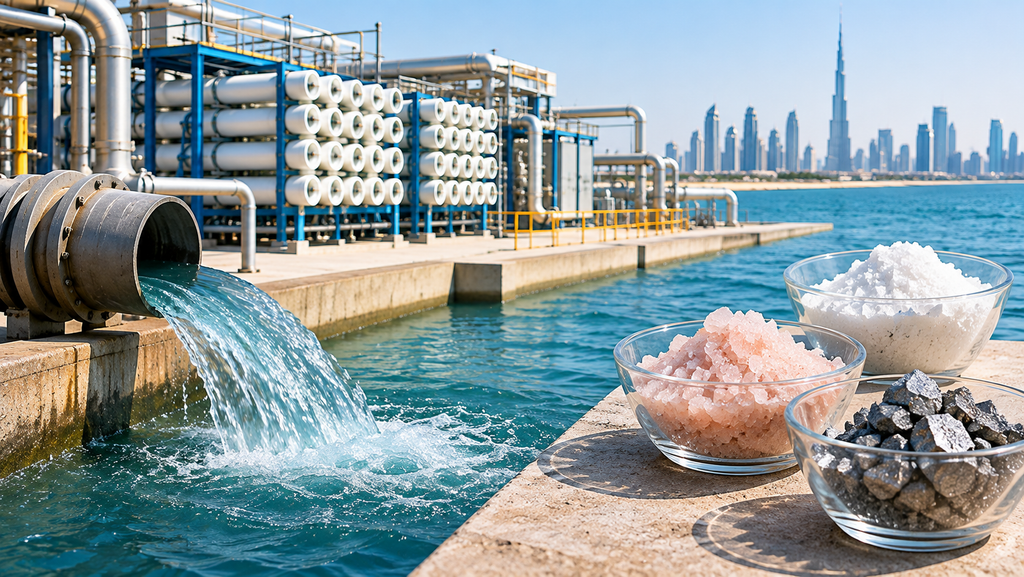
This waste stream, known as desalination brine, contains high concentrations of dissolved salts and various minerals. Traditionally, much of it has been discharged into the sea after treatment or dilution, raising concerns about its potential effects on marine environments. However, researchers and industry specialists are exploring whether these concentrated liquids could become a source of economically valuable materials.
Minerals such as magnesium, lithium, calcium, potassium and bromine can be present in desalination brine. Several of these materials are important for construction, chemical manufacturing, agriculture, advanced technologies and energy storage systems.
The possibility of recovering them introduces an interesting question for Middle Eastern economies: could a by-product of freshwater production become a valuable industrial resource?
The answer depends on several factors, including mineral concentrations, extraction technology, energy requirements, market demand and environmental performance.
Recent research suggests that mineral recovery from desalination brine is technically possible, with some projects progressing beyond laboratory experiments. Nevertheless, recovering every valuable mineral profitably remains difficult, particularly when elements are present in extremely small quantities. U.S. GAO+1
For the Middle East, where freshwater security and economic diversification are major priorities, desalination brine recovery could eventually connect water management with mineral production, industrial innovation and more circular resource use.
1. What Is Desalination Brine and Why Does the Middle East Produce So Much?
Desalination is the process of removing salts and other impurities from seawater or brackish water to produce freshwater suitable for different purposes.
The technology is particularly important in arid regions where natural freshwater resources are limited and demand continues to grow.
Middle Eastern countries operate extensive desalination infrastructure to supply municipal water networks, commercial facilities and industrial operations.
Among the widely used technologies is reverse osmosis, which pushes seawater through specialised membranes that separate much of the dissolved salt from the water.
Thermal desalination methods are also used, particularly in facilities historically integrated with electricity generation.
How desalination brine is produced
During the desalination process, freshwater is separated from seawater. The remaining liquid contains a higher concentration of salts and other dissolved substances.
This concentrated remainder is called brine.
For example, ordinary seawater commonly contains approximately 35 grams of dissolved salts per litre. Depending on the desalination process and operating conditions, the rejected brine can contain much higher concentrations.
Seawater reverse osmosis brine is often reported at approximately 70 grams of dissolved salts per litre, although actual concentrations vary by location and plant design. DOI
Brine is not simply ordinary seawater. It may also contain treatment-related chemicals, depending on the desalination process, which can influence how it must be managed or processed for mineral recovery.
Why production is concentrated in the Gulf
The Middle East faces a combination of limited natural freshwater availability, high temperatures, urban development and substantial industrial demand.
Desalination has therefore become an important component of regional water supply systems.
Saudi Arabia, the UAE, Kuwait and Qatar are particularly significant contributors to global desalination brine generation.
The United Nations World Ocean Assessment reports that these four countries collectively account for approximately 55% of estimated global brine production in the study it references. World Ocean Assessment
This concentration creates both an environmental challenge and a potential industrial opportunity.
When desalination facilities produce large volumes of concentrated brine every day, even minerals present in relatively modest concentrations may represent substantial theoretical resources.
However, the total quantity present does not indicate how much can be recovered economically.
Why traditional brine disposal raises concerns
Many coastal desalination facilities discharge brine into marine environments through specially designed outfalls.
If poorly managed, concentrated discharge can increase local salinity and affect organisms sensitive to changes in water chemistry.
Potential impacts depend on discharge volume, temperature, chemical composition, marine circulation and the sensitivity of local ecosystems.
Carefully designed outfalls, dilution systems and environmental monitoring can reduce certain risks.
Nevertheless, growing desalination capacity has encouraged research into alternatives that recover useful resources instead of treating the entire brine stream as waste.
2. Which Valuable Minerals Can Be Recovered From Desalination Brine?
Desalination brine contains a mixture of dissolved elements and compounds. Some are relatively abundant, while others occur in very low concentrations.
Understanding this distinction is essential when evaluating mineral recovery opportunities.
A mineral does not automatically become commercially attractive simply because it has a high market value.
Its concentration, recovery efficiency, processing requirements and final product quality determine whether extraction is economically reasonable.
Magnesium: An important industrial material
Magnesium is one of the more promising materials for recovery because it is present in seawater at substantially higher concentrations than lithium.
Magnesium compounds are used in water treatment, industrial chemicals, construction products and other manufacturing applications.
Magnesium metal is also valued for its low weight and industrial properties.
Producing magnesium compounds from brine may offer opportunities for regional chemical industries, particularly where suitable processing facilities are available.
Lithium: A valuable but difficult target
Lithium has attracted considerable attention because of its importance in rechargeable batteries and energy storage technologies.
Electric vehicles, electronic devices and stationary battery systems commonly rely on lithium-containing battery chemistries.
However, lithium is present in ordinary seawater at very low concentrations.
Even when desalination increases its concentration in the remaining brine, extracting lithium selectively can still be technically challenging and expensive.
Researchers are therefore investigating specialised membranes and electrochemical processes that could improve recovery efficiency.
Bromine: Opportunities for specialised chemicals
Bromine is used in several chemical and industrial applications, including certain specialty chemicals and pharmaceutical manufacturing processes.
Because bromide is present in seawater, concentrated brine may provide an alternative feedstock for bromine production.
Commercial feasibility depends on concentration, extraction costs, product purity and demand from industrial buyers.
Calcium and potassium
Calcium can be recovered in various chemical forms, including compounds with potential construction and industrial applications.
Potassium is important in agriculture and chemical manufacturing, although separating commercially useful potassium compounds from complex seawater brine can require additional processing.
Sodium chloride and other salts
Sodium chloride is abundant in desalination brine.
Salt recovery may be technically simpler than recovering trace minerals, but commercial success depends heavily on energy costs, purity requirements, logistics and the price of competing salt supplies.
A low-value bulk product can become uneconomic when concentration and drying expenses are too high.
Comparison of recoverable materials
| Mineral or material | Potential applications | Main extraction challenge |
|---|---|---|
| Magnesium | Lightweight metals, industrial chemicals, water treatment | Processing energy and product purity |
| Lithium | Batteries and energy storage | Extremely low concentrations and selective separation |
| Bromine | Specialty chemicals and industrial manufacturing | Recovery costs and market conditions |
| Calcium compounds | Construction materials and chemical processing | Separation, purity and product specification |
| Potassium compounds | Fertilisers and chemical manufacturing | Separation from competing dissolved salts |
| Sodium chloride | Industrial salt and chemical manufacturing | Low market value relative to processing costs |
| Boron compounds | Glass, ceramics and specialised industrial applications | Selective recovery and purification |
Research published in 2026 identifies these materials among the potential products of desalination brine recovery, while emphasising that their economic value depends strongly on local conditions and processing technology. ScienceDirect
The practical opportunity may therefore involve recovering several compatible products from the same brine stream rather than focusing exclusively on one expensive mineral.
3. How Modern Technology Could Turn Desalination Waste Into Resources
Extracting minerals from brine is more complicated than simply allowing salty water to evaporate.
The liquid contains multiple dissolved substances, and separating one material from another can require carefully controlled physical and chemical processes.
Researchers are developing technologies that improve mineral selectivity, reduce energy requirements and support more efficient resource recovery.
Membrane separation technologies
Membranes are already central to many desalination processes.
Advanced membrane technologies can also help separate dissolved ions according to their properties.
Nanofiltration, for instance, may assist in separating certain multivalent ions from other components of a salt solution.
Other specialised membranes are being developed to target specific minerals more selectively.
The effectiveness of these systems depends on the composition of the brine, membrane durability, fouling behaviour and energy consumption.
Electrodialysis and electrochemical extraction
Electrodialysis uses electrical potential and ion-selective membranes to move dissolved ions between different liquid streams.
This approach can help concentrate or separate selected salts.
Related electrochemical technologies are being investigated for recovering lithium and other valuable materials.
In January 2025, researchers at King Abdullah University of Science and Technology (KAUST) described a lithium extraction method using a redox electrode bridge and the concentration difference between saline streams.
The research demonstrated an approach to extracting lithium from brines, including low-concentration sources, but commercial-scale viability remains subject to further development and validation. Saudi Press Agency+1
Chemical precipitation
Chemical precipitation involves introducing controlled chemical conditions that cause selected dissolved materials to form solid compounds.
These solids can then be separated, washed and processed into usable products.
For example, magnesium may be recovered through precipitation as magnesium hydroxide.
This approach is particularly relevant when the target mineral is sufficiently concentrated.
However, chemical consumption, impurity management and the disposal of secondary waste streams must be considered.
Crystallisation and evaporation
Crystallisation can separate dissolved salts by changing concentration, temperature or other operating conditions.
Evaporation increases dissolved salt concentrations by removing water, potentially allowing selected materials to crystallise.
These processes are established in industrial salt production, but their application to desalination brine can require significant energy.
Efficient heat recovery or access to suitable low-cost energy may improve economic performance.
Integrated mineral recovery systems
Instead of using one technology to recover one material, some researchers are exploring integrated systems.
These may combine membrane separation, precipitation, concentration and crystallisation.
An integrated approach could allow facilities to recover several products while reducing the volume of liquid requiring final disposal.
| Technology | Primary purpose | Potential limitation |
|---|---|---|
| Nanofiltration | Separating groups of dissolved ions | Membrane fouling and selectivity |
| Electrodialysis | Concentrating and separating ionic materials | Electricity demand and membrane costs |
| Chemical precipitation | Recovering solid mineral compounds | Chemical use and secondary waste |
| Crystallisation | Producing solid salts | Energy requirements |
| Direct lithium extraction | Targeting lithium selectively | Low concentrations and recovery economics |
| Integrated recovery systems | Producing multiple materials | Greater operational complexity |
A 2025 review of desalination brine mining describes how integrated processes could improve mineral recovery while supporting new approaches to water treatment and environmental management. Springer
The most suitable technology will depend on the individual desalination facility rather than a single universal solution.
4. Why Saudi Arabia and the UAE Could Lead Mineral Recovery Innovation
Middle Eastern countries possess an important advantage in desalination brine recovery: established infrastructure that already processes large volumes of seawater.
Building a completely new mineral extraction industry requires access to raw materials, processing technology, electricity, industrial facilities and customers.
Existing desalination plants provide a starting point because concentrated brine is already generated during freshwater production.
However, converting that advantage into profitable mineral production requires additional equipment, technical expertise and commercial partnerships.
Saudi Arabia’s research and industrial potential
Saudi Arabia has emerged as an important location for research into mineral recovery from saline water.
The Kingdom’s large desalination industry provides opportunities to study resource extraction under real operating conditions.
KAUST has developed research programmes focused on lithium extraction, water treatment and advanced separation technologies.
One significant development is its work on recovering magnesium from desalination brine.
KAUST describes a Green Magnesium pilot designed to process brine into magnesium compounds and ultimately magnesium metal, with a stated capacity of up to 750 tonnes annually. This is a project capacity figure, not proof of sustained commercial production at that level. KAUST
The initiative demonstrates how desalination waste streams could support domestic mineral processing and industrial supply chains.
Another example is the Haql brine mining project in Saudi Arabia.
Research published in 2026 describes a demonstration facility being developed to recover products including sodium chloride, bromine and magnesium through a phased approach.
The study reports design targets of 6–10 tonnes of salt per day in its first phase, followed by bromine and magnesium production in the second phase. These represent project targets rather than confirmed continuous commercial output. ScienceDirect
Such projects are valuable because they test whether laboratory concepts can operate under industrial conditions.
The UAE’s opportunities in water and industrial innovation
The UAE also has strong potential to investigate desalination brine recovery.
Its desalination infrastructure, industrial zones, research institutions and renewable energy investments could support the development of integrated water and mineral processing systems.
Possible opportunities include partnerships between water utilities, chemical manufacturers, technology companies and research organisations.
For example, industrial operators could examine whether magnesium compounds recovered from desalination facilities meet the requirements of nearby manufacturers.
The commercial benefits would depend on production costs, quality requirements and the ability to secure customers.
The UAE’s coastal geography also makes responsible brine management important.
Research published in 2026 highlights the technical challenges associated with recovering lithium and other critical elements from saline resources in Gulf environments, particularly because low lithium concentrations make selective extraction difficult. Springer
Opportunities for other GCC countries
Qatar, Kuwait, Oman and Bahrain may also benefit from mineral recovery research because of their desalination activities and industrial requirements.
However, the opportunity will vary between countries and individual facilities.
Potential factors include plant capacity, local seawater composition, available energy, environmental regulations and access to mineral-processing customers.
Regional cooperation could help reduce research costs and encourage knowledge sharing.
Universities, water authorities and private companies might collaborate on pilot projects before committing to large investments.
5. Can Desalination Brine Mining Become Economically Profitable?
The most important question surrounding mineral recovery is not whether useful elements exist in desalination brine.
Scientific studies have already established that they do.
The more difficult question is whether those elements can be recovered at a cost that allows businesses to operate sustainably.
Economic feasibility is influenced by several interconnected factors.
Mineral concentration determines extraction difficulty
Recovering a relatively abundant substance such as sodium chloride is fundamentally different from extracting lithium, which occurs at much lower concentrations.
Low concentrations mean larger volumes of brine may need to be processed to obtain a commercially useful quantity.
This can increase equipment requirements, energy consumption and operating expenses.
Therefore, a mineral with a high market price may still be less profitable to recover than a lower-value material available in much greater quantities.
Energy requirements affect production costs
Membrane systems, electrochemical processes, evaporation and crystallisation all require energy.
Some recovery methods also require heating, cooling or additional chemical treatment.
Electricity prices and energy efficiency can therefore strongly influence project profitability.
Facilities with access to suitable renewable electricity or recoverable industrial waste heat may have advantages, depending on the technology and operating conditions.
Product purity and market demand
Recovered minerals must meet the specifications required by customers.
For example, industrial-grade magnesium compounds may have different purity requirements from materials intended for specialised chemical applications.
Additional purification can raise production costs.
Businesses must also consider whether enough customers exist to purchase the recovered products.
Producing a mineral does not guarantee commercial success if transport expenses are high or regional demand is limited.
The importance of recovering several products
A mineral recovery facility may become more economically attractive when it can produce multiple useful materials.
Revenue from magnesium compounds, salts or other products could potentially contribute toward the cost of processing the same brine stream.
However, integrated recovery systems can also increase capital requirements and operational complexity.
Each product must have a viable market and meet quality standards.
A 2025 techno-economic study examining metals and salts recovered from seawater reverse osmosis brine identified opportunities for some materials while also highlighting significant cost barriers, particularly for extracting lithium from dilute seawater-derived streams. MDPI
Economic factors affecting mineral recovery
| Economic factor | Why it matters | Possible business response |
|---|---|---|
| Mineral concentration | Influences the amount of processing required | Prioritise suitable feedstocks |
| Energy costs | Affect operating expenses | Improve efficiency and evaluate energy integration |
| Equipment investment | Determines initial capital requirements | Begin with pilot-scale projects |
| Product purity | Influences market acceptance | Establish quality-control systems |
| Chemical consumption | Adds recurring costs | Optimise treatment processes |
| Market demand | Determines potential sales | Secure industrial customers |
| Transport and logistics | Affect delivered product costs | Consider nearby industrial users |
| Environmental compliance | Influences operating requirements | Integrate monitoring and responsible waste handling |
Why pilot projects matter
Pilot facilities allow researchers and businesses to evaluate real production costs before investing in full-scale systems.
They can reveal unexpected challenges involving membrane fouling, mineral scaling, corrosion, equipment reliability and chemical consumption.
These issues may be difficult to identify through laboratory experiments alone.
For the Middle East, a gradual approach involving pilot testing, independent economic assessments and carefully selected commercial projects could reduce investment risks.
6. How Mineral Recovery Could Support Environmental Sustainability
Desalination is essential for water security in many Middle Eastern countries, but its environmental impacts require continued management.
Energy consumption and the discharge of concentrated saline water are among the main concerns associated with the industry.
Mineral recovery could potentially improve the management of desalination waste streams, particularly if it reduces the quantity of concentrated liquid requiring disposal.
However, mineral extraction should not automatically be considered environmentally beneficial.
Its actual performance depends on the entire process, including electricity consumption, chemical use and remaining waste.
Reducing concentrated brine discharge
If useful materials are removed from desalination brine, the remaining stream may contain lower quantities of certain dissolved substances.
Some technologies can also recover additional freshwater.
These improvements could reduce the amount of material requiring final disposal.
Nevertheless, removing one mineral does not necessarily make the remaining liquid safe for direct discharge.
Environmental monitoring and appropriate treatment would still be necessary.
Protecting marine ecosystems
The Arabian Gulf and Red Sea contain marine ecosystems that can be sensitive to changes in water quality.
Poorly managed brine discharge may affect local salinity, temperature and chemical conditions.
Research published in the United Nations World Ocean Assessment identifies these factors among the environmental concerns associated with desalination operations. World Ocean Assessment
Mineral recovery technologies that reduce residual discharge could contribute to environmental protection where they demonstrate measurable improvements.
Connecting mineral recovery with circular economy principles
The circular economy encourages more efficient use of resources by reducing waste and recovering materials that can be reused.
Desalination brine recovery fits this concept because it attempts to transform an existing industrial by-product into useful products.
Instead of producing freshwater and treating the remaining concentrated stream solely as waste, a facility could potentially supply both freshwater and mineral materials.
This approach may create connections between water utilities, chemical industries and manufacturing businesses.
Zero liquid discharge and its limitations
Zero liquid discharge, commonly called ZLD, is an industrial treatment approach designed to eliminate routine liquid waste discharge by recovering water and managing the remaining dissolved solids.
In principle, ZLD systems can recover additional water and produce solid residual materials.
However, these systems may require significant energy and investment.
Not all recovered solids are commercially valuable, and some may require further treatment or disposal.
A 2026 techno-economic study examining advanced brine treatment systems identifies both the environmental potential and the technical challenges associated with near-zero-liquid-discharge approaches. ScienceDirect
Measuring environmental benefits
A responsible assessment should consider:
- Changes in the volume and composition of final brine discharge.
- Electricity and heat consumption.
- Greenhouse gas emissions associated with processing.
- Chemical requirements and secondary waste generation.
- Marine environmental impacts.
- Additional freshwater recovery.
- Transport requirements for recovered minerals.
- Environmental impacts compared with conventional mineral production.
Life-cycle assessments can help determine whether a particular recovery system delivers genuine environmental benefits.
The objective should be to improve overall resource efficiency without transferring pollution or excessive energy demand to another part of the production process.
7. What Challenges Must Be Solved Before Large-Scale Brine Mining?
Although desalination brine recovery has promising applications, widespread commercial development remains challenging.
Research progress does not automatically translate into profitable industrial production.
Moving from laboratory experiments to continuous commercial operations requires overcoming several technical, financial and regulatory obstacles.
Low concentrations of valuable minerals
One of the main challenges is the small quantity of certain valuable elements dissolved in seawater.
Lithium illustrates this problem.
Although lithium is economically important for battery manufacturing, its concentration in seawater is extremely low compared with many conventional lithium-rich mineral brines.
Extracting it requires highly selective technologies capable of separating lithium from much larger quantities of other dissolved ions.
Even when a process demonstrates successful extraction in laboratory conditions, scaling it economically can remain difficult.
Complex chemical composition
Desalination brine contains multiple dissolved substances.
Some minerals can interfere with the recovery of others.
For example, magnesium and calcium may contribute to scaling, where solid deposits accumulate on equipment surfaces.
Scaling can reduce processing efficiency and increase maintenance requirements.
Operators must therefore understand the chemistry of each brine stream before selecting extraction technologies.
Equipment durability
Highly saline water can be corrosive, particularly when combined with certain temperatures and chemical conditions.
Recovery systems may require specialised construction materials, protective coatings and regular maintenance.
These requirements can increase investment costs.
Membrane technologies may also experience fouling or degradation, which affects performance over time.
Commercial uncertainty
Mineral prices can change according to global supply, technological developments and industrial demand.
A project that appears financially attractive under one set of market conditions may become less competitive if product prices fall or operating costs increase.
Developers therefore need realistic financial models rather than relying exclusively on optimistic revenue forecasts.
Regulatory and environmental requirements
Mineral recovery facilities may be subject to requirements governing water treatment, industrial manufacturing, chemical handling and environmental discharge.
Applicable rules differ between countries.
Businesses must understand which permits, environmental assessments and product standards are necessary for their projects.
The need for stronger cooperation
Commercial development may require partnerships between different industries.
Water utilities understand desalination operations, while chemical companies may possess greater experience in mineral processing and product marketing.
Research institutions can contribute advanced technologies and technical evaluation.
Combining these capabilities could improve project planning and reduce operational risks.
| Challenge | Possible solution | Expected benefit |
|---|---|---|
| Low mineral concentrations | Highly selective separation technologies | Better recovery efficiency |
| High energy demand | Energy optimisation and process integration | Lower operating costs |
| Equipment corrosion | Suitable materials and maintenance planning | Improved reliability |
| Complex brine chemistry | Detailed feedwater analysis and pretreatment | More stable operations |
| High capital investment | Demonstration projects and phased development | Reduced financial uncertainty |
| Uncertain product demand | Industrial partnerships and supply agreements | Improved market confidence |
| Environmental risks | Life-cycle assessments and discharge monitoring | Better environmental performance |
| Limited commercial experience | Research-industry collaboration | Faster technology development |
These challenges should not discourage innovation, but they demonstrate why responsible project evaluation is essential.
The most promising recovery projects will likely be those designed around specific mineral concentrations, suitable technologies and clearly identified markets.
8. The Future of Desalination Brine Recovery in the Middle East
The future of desalination brine recovery will depend on whether emerging technologies can deliver reliable performance at a competitive cost.
The Middle East is well positioned to investigate these opportunities because of its desalination infrastructure, industrial development and growing interest in efficient resource management.
However, progress is likely to occur gradually rather than through a sudden transformation of every desalination facility into a mineral production plant.
Integration with existing desalination facilities
One potential development is the introduction of mineral recovery units alongside existing desalination operations.
Instead of transporting large quantities of brine to distant processing facilities, selected minerals could be recovered near their point of production.
This may reduce certain logistics requirements and make it easier to integrate water treatment and mineral processing.
However, integration must not interfere with the reliability of freshwater supply.
For municipal desalination facilities, water production will continue to be the primary responsibility.
Development of specialised industrial clusters
Industrial zones located near desalination facilities could potentially support mineral processing businesses.
For example, a coastal industrial cluster might combine desalination infrastructure, chemical manufacturing, storage facilities and product transportation services.
Such arrangements could create opportunities for local businesses supplying equipment, maintenance, engineering and laboratory testing.
Research into critical minerals
Lithium and other strategically important materials are likely to remain subjects of scientific interest.
KAUST and other research institutions are investigating technologies intended to improve the separation and recovery of valuable minerals from saline water.
Saudi Arabia’s collaboration between Aramco and Lihytech illustrates interest in direct lithium extraction from oilfield brines. Although oilfield brines differ from desalination brine, developments in selective extraction technology may provide useful knowledge for both fields. KAUST
It is important to distinguish these different feedstocks because their mineral concentrations, impurities and operating requirements can vary substantially.
Opportunities for local innovation
The development of mineral recovery systems could encourage new engineering businesses and technology startups.
Potential opportunities include specialised membrane manufacturing, mineral separation equipment, process monitoring systems and industrial consulting.
Universities may also contribute by training engineers and researchers in water chemistry, mineral processing and environmental technology.
These activities could support economic diversification even before mineral recovery reaches widespread commercial deployment.
A practical development roadmap
- Stage 1: Resource assessmentAnalyse the chemical composition of brine from individual desalination plants and identify minerals with realistic recovery potential.
- Stage 2: Technology evaluationCompare extraction methods according to recovery efficiency, energy demand, chemical consumption and product quality.
- Stage 3: Pilot testingOperate small demonstration systems using real brine under realistic plant conditions.
- Stage 4: Commercial assessmentEvaluate capital costs, operating expenses, customer demand, environmental performance and possible revenue.
- Stage 5: Industrial integrationDevelop commercially justified recovery facilities alongside suitable water treatment or industrial operations.
- Stage 6: Continuous improvementMonitor performance, improve resource efficiency and adjust operations according to environmental requirements and market conditions.
This development pathway could help water authorities and private investors distinguish promising technologies from approaches that remain commercially uncertain.
Conclusion: Can Desalination Brine Become a Valuable Resource?
Desalination brine has the potential to become a useful source of minerals in the Middle East, particularly where technological improvements make extraction more efficient and commercially practical.
Materials such as magnesium, sodium chloride, calcium compounds and bromine offer possible industrial opportunities, while lithium recovery remains an important but technically demanding area of research.
Saudi Arabia’s research and demonstration projects show that the concept is progressing beyond theoretical discussions.
For the wider Middle East, mineral recovery could create new connections between water security, industrial production, environmental management and economic diversification.
However, commercial success cannot be assumed simply because concentrated brine contains valuable materials.
Projects must demonstrate reliable recovery, competitive costs, suitable product quality and measurable environmental benefits.
The most realistic future may involve carefully selected facilities recovering specific minerals rather than every desalination plant attempting to extract every possible resource.
Ultimately, desalination brine could become part of a more resource-efficient industrial economy, transforming a difficult waste-management challenge into an opportunity for scientific innovation and valuable material recovery.
Do follow us on Instagram
Read More – Discover how Gulf Wedding Trends Could Transform the Gulf’s Event Industry