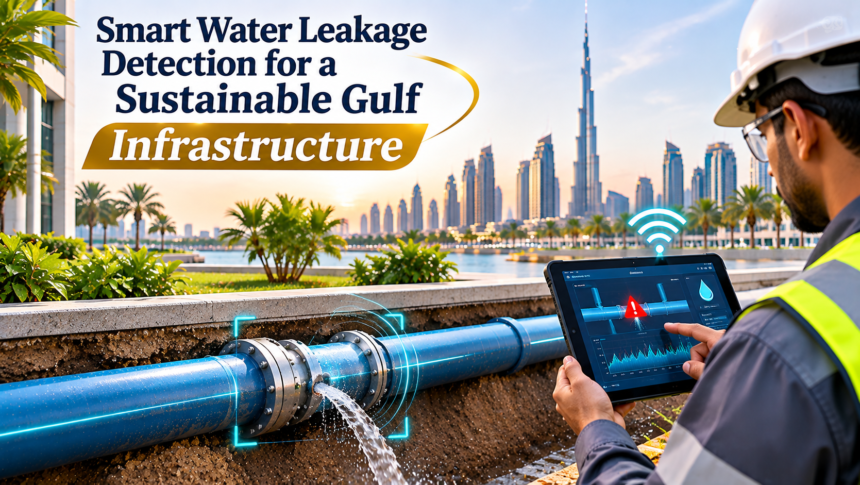
Why Water Leakage Is a Serious Challenge for Gulf Infrastructure
Water is one of the most valuable resources in the Gulf region, where extreme temperatures, limited natural freshwater supplies and rapid urban development place continuous pressure on water infrastructure. Countries such as the United Arab Emirates, Saudi Arabia, Qatar, Kuwait, Bahrain and Oman have invested heavily in desalination plants, reservoirs, pipelines and distribution networks to meet the needs of growing populations and expanding industries.
- 1. Why Water Leakage Is a Serious Challenge for Gulf Infrastructure
- 2. How Modern Water Leakage Detection Technologies Work
- 3. Why Smart Water Networks Are Expanding Across Gulf Cities
- 4. The Environmental Benefits of Detecting and Preventing Water Leaks
- 5. How Early Leakage Detection Can Reduce Infrastructure Costs
- 6. Why Artificial Intelligence Could Transform Water Infrastructure Maintenance
- 7. The Role of Water Leakage Detection in Smart Cities and Sustainable Buildings
- 8. How Gulf Countries Can Build More Resilient Water Networks
- Conclusion: Water Leakage Detection Is Essential for Sustainable Gulf Infrastructure
However, producing enough freshwater is only one part of maintaining reliable water supplies. Ensuring that this water reaches homes, businesses, hospitals and industrial facilities without unnecessary losses is equally important.
This is why water leakage detection in Gulf infrastructure is becoming a major consideration for utilities, urban planners, property developers and sustainability specialists.
Water leaks can occur in underground pipelines, distribution connections, storage facilities and building plumbing systems. Some are immediately visible, while others remain hidden for long periods, gradually wasting treated water and increasing operating expenses.
In regions where freshwater production often depends on energy-intensive desalination, preventable water losses can carry wider economic and environmental consequences. Every significant leak represents not only lost water but also part of the energy, treatment and transportation effort invested in delivering that supply.
Modern technologies are changing how water utilities identify and manage these problems. Smart meters, acoustic sensors, artificial intelligence, pressure monitoring systems and specialised pipeline inspection devices can help operators identify unusual water flows before minor faults develop into more serious failures.
Dubai offers an example of this shift. In August 2026, Dubai Electricity and Water Authority (DEWA) reported that its Hydro Insight system analyses information from more than 1.1 million smart water meters at 15-minute intervals, supporting more proactive network monitoring and operational decisions. dewa.gov.ae
For the wider Gulf, effective water leakage detection is becoming more than a maintenance activity. It is an important part of water security, responsible infrastructure investment and long-term environmental sustainability.
1. Why Water Leakage Is a Serious Challenge for Gulf Infrastructure
The Gulf region faces distinctive water management challenges because of its arid climate and limited renewable freshwater resources.
Rainfall is generally low and irregular across much of the region, while groundwater resources face pressures from historical extraction and growing demand.
Consequently, several Gulf countries depend heavily on desalination and carefully managed distribution systems to maintain reliable water supplies.
Water leakage can weaken the efficiency of these systems, even when sufficient freshwater is produced.
The hidden problem of underground leaks
Water distribution networks often extend across thousands of kilometres of underground pipelines.
These networks connect desalination facilities, pumping stations, storage reservoirs, neighbourhoods and individual properties.
Because most pipelines are buried, leaks are not always immediately visible.
Small cracks, weakened joints, corrosion, ground movement and pressure fluctuations can allow water to escape underground.
In some cases, a leak may continue for an extended period before water appears at the surface or a significant pressure drop becomes noticeable.
The longer a substantial leak remains undetected, the greater the potential volume of wasted water.
Understanding non-revenue water
Water utilities commonly use the term non-revenue water, or NRW, to describe water entering a distribution system that does not generate billed revenue.
However, non-revenue water is not the same as physical leakage.
It includes several categories:
- Real losses: Physical water losses from leaking pipes, service connections and overflowing storage tanks.
- Apparent losses: Losses associated with inaccurate metering, unauthorised consumption and data-handling errors.
- Unbilled authorised consumption: Water legitimately used for purposes that are not billed.
This distinction is important because different problems require different solutions.
For example, repairing pipelines reduces real losses, while improving meter accuracy helps address apparent losses.
The International Water Association’s 2026 Global Trends report emphasises the importance of combining leak detection, pressure management, digital monitoring and reliable institutional practices to improve water distribution efficiency. iwa-website-assets.s3.eu-west-2.amazonaws.com
Why Gulf conditions increase the importance of leakage management
Gulf cities often operate extensive infrastructure in demanding environmental conditions.
High temperatures, soil characteristics, groundwater salinity, construction activity and urban expansion can influence the performance of water networks.
Infrastructure age and operating practices are also important factors.
These conditions do not mean every Gulf network experiences unusually high leakage. In fact, some utilities have achieved comparatively low reported water-loss rates.
Nevertheless, the region’s reliance on carefully managed water resources makes efficient leakage control especially valuable.
2. How Modern Water Leakage Detection Technologies Work
Traditional leak detection frequently relied on visible signs of water loss, customer complaints, routine inspections and manual acoustic surveys.
Although these methods remain useful, technological developments now allow water utilities to monitor larger networks and identify problems more systematically.
Different technologies are suitable for different types of pipelines and operating conditions.
Acoustic leak detection systems
Water escaping from a pressurised pipe can generate vibrations or sound.
Acoustic sensors and specialised microphones can detect these signals and help identify possible leak locations.
Some systems use multiple sensors to compare the timing of detected sounds, allowing technicians to estimate where a leak may have occurred.
These methods can be particularly useful for certain underground distribution networks.
However, their effectiveness depends on pipe materials, background noise, water pressure and surrounding conditions.
Smart water meters
Smart meters measure water consumption and transmit information to utility operators or customer management systems.
By examining usage patterns, software can identify unusual consumption that may indicate a leak.
For example, a property showing continuous water consumption throughout the night may require further investigation.
However, continuous consumption does not automatically prove leakage. Irrigation systems, industrial processes or other legitimate activities can produce similar patterns.
Smart meter alerts should therefore be treated as indicators requiring appropriate verification.
Pressure monitoring sensors
Changes in water pressure can provide information about the condition of a distribution network.
A sudden pressure drop may indicate a pipe burst, equipment malfunction or other operational disturbance.
Pressure sensors can help utilities identify unusual conditions and respond more quickly.
Pressure management can also reduce leakage from some systems by avoiding unnecessarily high operating pressures.
Artificial intelligence and predictive analytics
Artificial intelligence can analyse information collected from flow meters, pressure sensors, maintenance records and other monitoring systems.
Algorithms may identify abnormal patterns that would be difficult to detect through manual analysis alone.
These systems can also help prioritise pipeline inspections based on historical failures, operating conditions and other risk factors.
However, predictive models require reliable data and ongoing evaluation. They cannot guarantee that every future leak will be detected.
Specialised pipeline inspection devices
Some utilities use devices that travel inside pipelines to detect abnormal acoustic signals.
Dubai’s Smart Ball system is one example.
The technology moves through water transmission pipes and identifies sounds associated with leakage, allowing operators to investigate faults that may otherwise remain difficult to locate.
According to DEWA, its Smart Ball technology prevented the loss of approximately 1.34 million cubic metres of water during 2024, generating estimated savings of AED 12 million. dewa.gov.ae
Comparison of water leakage detection technologies
| Technology | Main function | Potential advantage | Main limitation |
|---|---|---|---|
| Acoustic sensors | Detect sounds associated with leaks | Helps locate hidden pipeline faults | Performance depends on pipe and site conditions |
| Smart water meters | Monitor consumption patterns | Identifies unusual customer usage | Cannot always identify exact leak locations |
| Pressure sensors | Monitor changes in network pressure | Supports early fault detection | Pressure changes can have several causes |
| AI analytics | Analyse network data and anomalies | Helps prioritise investigations | Requires accurate, representative data |
| Internal inspection devices | Detect faults from inside pipes | Useful for selected major pipelines | Requires suitable pipeline access |
| District metered areas | Compare water entering and leaving defined zones | Helps localise water losses | Requires reliable metering and network boundaries |
| Ground microphones | Support detailed leak localisation | Useful during field investigations | Often requires trained operators |
The most effective strategies generally combine several technologies rather than depending exclusively on one system.
3. Why Smart Water Networks Are Expanding Across Gulf Cities
Smart water networks connect monitoring equipment, communication systems and operational software to improve the management of water infrastructure.
These networks allow utilities to observe changes in flow, pressure and consumption while coordinating maintenance activities and operational responses.
As Gulf cities continue investing in digital infrastructure, smart water management is becoming an increasingly relevant part of urban sustainability.
Dubai’s approach to digital water management
Dubai has introduced several technologies intended to improve water distribution efficiency.
DEWA uses systems including supervisory control and data acquisition, pressure monitoring, district metering, acoustic leak detection and specialised pipeline inspection equipment.
In January 2026, DEWA reported that water transmission and distribution losses stood at 4.5%, reflecting the results of network monitoring, automation and operational improvements. Emirates News Agency
The authority has also expanded the deployment of monitoring equipment.
During 2025, it added 205 fully monitored flow-measurement devices and the same number of pressure-monitoring units, alongside additional automated remote-control valves. dewa.gov.ae
These developments demonstrate how digital monitoring can support more responsive infrastructure management.
Saudi Arabia’s water efficiency priorities
Saudi Arabia faces substantial water management requirements because of its geography, population distribution and dependence on desalination in many areas.
Its National Water Strategy 2030 identifies reducing water losses as an important component of improving sector performance.
The strategy addresses efficiency challenges in distribution networks and within buildings. MEWA
The Kingdom has also supported research into smart leakage management technologies.
In June 2026, Saudi Arabia’s Ministry of Environment, Water and Agriculture published information concerning smart leakage management innovations intended to support the development of more efficient water infrastructure.
Such initiatives could encourage collaboration between water utilities, engineering businesses and technology providers.
Abu Dhabi’s growing use of intelligent monitoring
Abu Dhabi has also introduced digital monitoring initiatives in water-related infrastructure.
For example, the Department of Energy announced an AI-powered smart meter project for agricultural water management, designed to improve consumption monitoring and provide users with access to real-time information.
While agricultural water monitoring is different from municipal pipeline leak detection, it demonstrates the broader movement toward data-driven water resource management. doe.gov.ae
Opportunities across the wider GCC
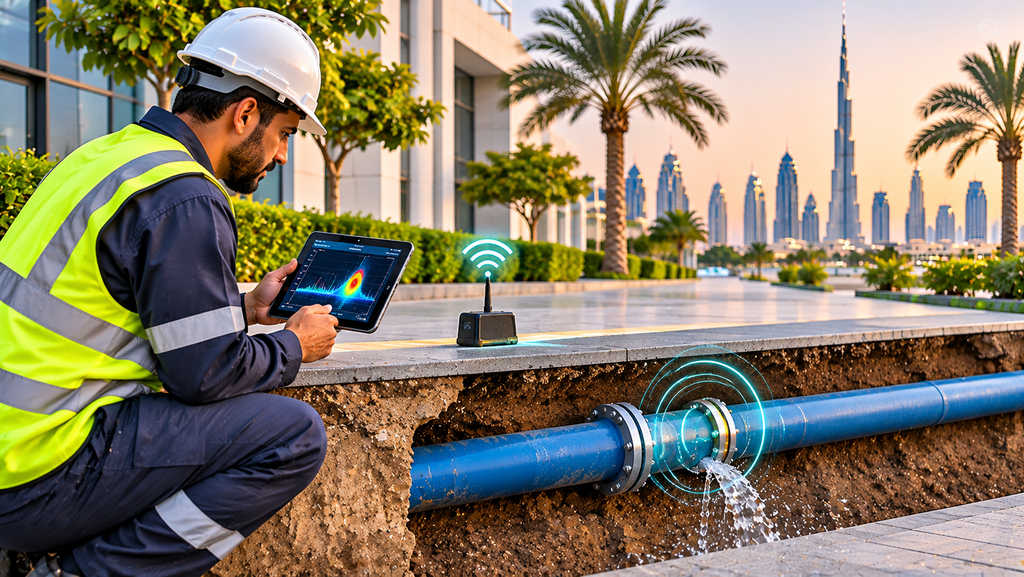
Qatar, Kuwait, Oman and Bahrain could benefit from similar approaches where network conditions and operational requirements justify investment.
Potential applications include district metering, pressure monitoring, customer-side leak alerts and better maintenance planning.
However, technology adoption should reflect the needs of individual utilities.
A city with relatively modern infrastructure may require a different strategy from an area with older pipelines or limited monitoring coverage.
4. The Environmental Benefits of Detecting and Preventing Water Leaks
Water leakage detection contributes to sustainability by helping utilities use existing resources more efficiently.
In the Gulf, this connection is especially important because a substantial share of freshwater supply is produced through desalination.
The environmental benefit of leakage reduction comes not only from conserving water but also from avoiding unnecessary production and distribution activities.
Reducing unnecessary desalination demand
Desalination requires infrastructure, treatment processes and energy.
When treated freshwater escapes from a pipeline before reaching customers, part of the effort invested in producing that water has been wasted.
Reducing physical losses can therefore help utilities supply more usable water from existing production.
Over time, this may reduce the need for additional water production compared with a situation where leakage continues unchecked.
However, the precise energy savings depend on plant operations, system demand and whether reduced losses actually change production requirements.
Supporting lower energy consumption
Water systems consume energy during treatment, pumping, transportation and sometimes storage operations.
Leakage reduction may lower the amount of water that needs to be processed and transported to meet customer demand.
The World Bank identifies non-revenue water reduction as an important opportunity to improve service efficiency, reduce costs and support climate resilience. World Bank Blogs
Energy savings should be calculated using actual operating data rather than assuming every unit of recovered water produces an identical reduction in electricity consumption.
Reducing environmental pressure
Efficient water management can reduce unnecessary demand on water production infrastructure.
In systems relying on desalination, avoiding preventable water losses may also contribute indirectly to more efficient use of treatment chemicals and other operational resources.
However, these benefits vary according to the technologies and operating practices of individual facilities.
Protecting groundwater resources
Some communities and facilities in the wider Gulf region rely partly on groundwater.
Leaks involving groundwater-based supplies can place additional pressure on already limited resources.
Improving distribution efficiency can help ensure that extracted water is used more effectively.
Supporting sustainable development goals
Water leakage management contributes to the wider objectives of efficient water use, reliable infrastructure and responsible resource management.
It is particularly relevant to United Nations Sustainable Development Goal 6, which addresses clean water and sanitation.
Nevertheless, leakage detection is one part of water sustainability rather than a complete solution.
Water conservation, wastewater reuse, efficient desalination and responsible groundwater management must also remain priorities.
Environmental outcomes of effective leakage management
| Sustainability objective | Contribution of leakage detection |
|---|---|
| Water conservation | Reduces avoidable physical losses |
| Energy efficiency | May reduce unnecessary treatment and pumping demand |
| Infrastructure resilience | Helps identify faults before they develop further |
| Resource efficiency | Improves utilisation of existing water supplies |
| Environmental protection | May reduce pressure for additional water production |
| Sustainable urban development | Supports more reliable infrastructure planning |
These potential benefits make leak detection relevant to both environmental strategy and everyday utility operations.
5. How Early Leakage Detection Can Reduce Infrastructure Costs
Water leakage is not only an environmental concern. It can also create financial pressures for water utilities, property owners and infrastructure operators.
The cost of a leak depends on its size, location, duration and the damage it causes.
A small hidden leak may waste water gradually, while a major pipeline failure can interrupt services, damage roads and require emergency repairs.
Detecting problems early can help reduce these risks.
Avoiding unnecessary water production costs
When treated water is lost before reaching customers, utilities absorb the cost of producing and distributing water that delivers no useful service.
These costs can include energy, chemicals, maintenance and operational expenses.
By reducing losses, utilities may improve the financial efficiency of their existing networks.
However, the value of saved water should be based on the actual marginal cost and economic value of supply, not simply the retail price charged to customers.
Preventing expensive pipeline failures
Leaks can sometimes develop into larger failures if underlying deterioration continues.
Early detection allows maintenance teams to investigate problems before they become more severe.
This may reduce emergency excavation, road closures, property damage and service interruptions.
Not every leak will become a major pipe failure, but identifying faults earlier can give operators more options for scheduling repairs.
Improving infrastructure investment decisions
Water utilities often manage extensive networks containing pipes of different ages, materials and conditions.
Replacing every pipeline at once is usually impractical.
Leak detection data can help identify sections experiencing repeated faults or unusual operating conditions.
This information supports more targeted investment decisions.
Instead of replacing infrastructure solely according to age, utilities can consider actual performance and the risk of future failure.
Financial benefits for commercial properties
Water leakage can also affect hotels, shopping centres, hospitals, warehouses and residential buildings.
Undetected leaks may increase utility bills and damage floors, walls, ceilings or equipment.
In commercial buildings, interruptions caused by plumbing failures can affect business operations.
Smart monitoring systems and routine inspections can help property managers identify unusual consumption and respond before damage becomes extensive.
Economic comparison
| Cost factor | Without effective leak detection | With effective leak detection |
|---|---|---|
| Water losses | May continue unnoticed | Can be identified earlier |
| Emergency repairs | Greater risk of reactive maintenance | More opportunity for planned repairs |
| Energy consumption | Avoidable losses may increase production needs | Potential operating efficiency gains |
| Infrastructure damage | Faults may remain undetected | Earlier investigation becomes possible |
| Maintenance planning | Greater reliance on reactive work | More data for prioritisation |
| Customer experience | Possible unexpected interruptions | Potentially faster fault response |
| Capital investment | Decisions may rely on incomplete information | Better asset-condition evidence |
The World Bank’s work on performance-based contracting for non-revenue water reduction identifies proactive leak detection, better repair practices and pressure management as important opportunities for improving utility performance. PPP Resource Center
For Gulf cities investing in long-term infrastructure, the financial benefits of detecting leaks early may become increasingly important.
6. Why Artificial Intelligence Could Transform Water Infrastructure Maintenance
Artificial intelligence is becoming relevant to water infrastructure because utility networks generate increasingly large quantities of operational data.
Sensors, smart meters, pumps and monitoring systems can continuously record information about water distribution.
Analysing this information manually across an extensive network can be difficult.
AI systems can help organise data, identify unusual patterns and support maintenance decisions.
Moving from reactive to predictive maintenance
Traditional infrastructure maintenance often involves responding after a fault becomes visible or causes operational problems.
Predictive maintenance attempts to identify conditions associated with possible failures before they occur.
AI models may examine historical leakage incidents, pressure fluctuations, pipeline age, pipe material and maintenance records.
This information can help utilities prioritise inspections.
However, predictions are not guarantees. A system may incorrectly flag a healthy pipeline or fail to identify an unexpected fault.
Human review and physical inspections remain necessary.
Detecting unusual consumption patterns
Machine learning can identify water consumption patterns that differ from expected behaviour.
For example, a building with consistently high overnight consumption might be selected for investigation.
Similarly, an unexpected change in water flow within a particular distribution zone may indicate a possible network problem.
These alerts can reduce the time required to identify suspicious conditions.
Combining AI with geographic information systems
Geographic information systems, commonly called GIS, allow utilities to map pipelines, valves, meters and other infrastructure assets.
When combined with monitoring data, GIS can help maintenance teams understand where potential faults may be located.
This can improve inspection planning and coordination.
Digital twins and network simulation
A digital twin is a digital representation of a physical system that uses relevant operational data to support monitoring, modelling or analysis.
Water utilities can use hydraulic models and digital twin approaches to study pressure conditions, water flows and possible operational changes.
For example, engineers may simulate how adjusting pressure in one area could affect water delivery elsewhere.
Such systems can support decision-making, but their reliability depends on the accuracy of the model and the information supplied.
Challenges of AI-based systems
Several issues must be addressed before deploying advanced analytics:
- Reliable collection of water flow and pressure data.
- Accurate mapping of the distribution network.
- Integration with existing operational software.
- Protection against cybersecurity risks.
- Appropriate handling of customer consumption information.
- Training for technical and maintenance personnel.
- Regular evaluation of model performance.
- Clear procedures for verifying automated alerts.
AI should therefore be viewed as a decision-support tool rather than a complete substitute for experienced water engineers.
The long-term opportunity lies in combining intelligent monitoring with practical maintenance expertise.
7. The Role of Water Leakage Detection in Smart Cities and Sustainable Buildings
Water infrastructure does not end at municipal distribution pipelines.
Residential buildings, hotels, hospitals, offices and industrial facilities also contain extensive plumbing systems.
These internal networks can experience leaks that increase consumption, damage property and interrupt operations.
As Gulf cities develop more digitally connected buildings, leakage monitoring could become a valuable feature of modern property management.
Smart residential communities
Residential developments often contain shared water infrastructure, underground service connections, irrigation systems and individual household plumbing.
Property managers can use smart meters and monitoring platforms to identify unusual consumption.
For example, a sudden increase in water usage in a vacant apartment may indicate a plumbing fault.
Early alerts can help residents or maintenance teams investigate the problem.
Hotels and hospitality facilities
Hotels use water for guest rooms, restaurants, laundry operations, landscaping, swimming pools and other services.
A hidden leak can increase operational expenses without immediately affecting guest comfort.
Smart water monitoring can help hotel operators understand consumption patterns and identify unusual conditions.
This supports both financial management and sustainability initiatives.
Commercial buildings
Large office buildings and shopping centres may contain complex plumbing networks serving multiple tenants.
Water leakage detection systems can monitor selected supply lines, mechanical facilities and high-risk areas.
Some building systems can also activate automatic shutoff valves when predefined conditions are detected.
However, automatic isolation must be designed carefully to avoid interrupting essential services or creating safety problems.
Healthcare facilities
Hospitals and medical facilities require reliable water services for hygiene, patient care and building operations.
Water leakage detection can help facilities teams identify potential plumbing problems and protect vulnerable building areas.
However, any automated control system must respect critical water supply requirements.
Industrial operations
Manufacturing facilities may use water for processing, cooling, cleaning and other operational requirements.
Unexpected water losses can affect production efficiency and operating costs.
Monitoring systems can support water accounting and help identify opportunities for improved resource management.
Potential applications in smart buildings
| Building type | Possible detection application | Primary benefit |
|---|---|---|
| Residential towers | Smart consumption monitoring | Earlier identification of household leaks |
| Hotels | Monitoring guest and service water systems | Lower avoidable operating costs |
| Shopping centres | Plumbing and utility monitoring | Property protection |
| Hospitals | Monitoring critical water infrastructure | Improved service reliability |
| Office buildings | Digital building management integration | Better maintenance planning |
| Industrial facilities | Flow monitoring and water accounting | Improved resource efficiency |
| Public buildings | Automated alerts and inspections | More responsive facility management |
Water leakage detection could become an increasingly useful part of sustainable building operations, especially when combined with efficient fixtures, responsible landscaping and broader water conservation programmes.
8. How Gulf Countries Can Build More Resilient Water Networks
The future of water infrastructure in the Gulf will depend on more than increasing desalination capacity or expanding distribution networks.
Cities must also improve how efficiently existing infrastructure operates.
Leakage detection can contribute to this objective by helping utilities identify losses, coordinate maintenance and manage networks more effectively.
However, successful implementation requires a clear strategy.
Begin with a comprehensive water audit
Utilities should first understand how much water enters their systems and how it is used.
A standardised water audit can help distinguish physical leakage from apparent losses and legitimate unbilled consumption.
This provides a more reliable foundation for improvement programmes.
The International Water Association’s water balance framework is useful because it separates the different categories of water use and loss.
Identify high-risk areas
Utilities can analyse maintenance history, infrastructure condition, pressure patterns and previous leakage incidents.
This information can help identify locations where additional monitoring may provide value.
High-risk sections can then receive priority during inspection and rehabilitation planning.
Introduce district metered areas
A district metered area, or DMA, is a defined section of a water distribution network where flows can be measured and monitored.
By comparing water entering the area with legitimate consumption, operators can investigate possible losses.
DMAs can make large networks easier to manage, although reliable boundary control and meter accuracy are essential.
Invest in suitable technology
Water utilities should evaluate technologies according to their network conditions and operational objectives.
For example, acoustic monitoring may be useful in certain distribution networks, while internal inspection devices may be appropriate for selected transmission pipelines.
Smart meters and pressure sensors can provide additional information.
The most expensive technology is not automatically the most suitable.
Improve maintenance and repair procedures
Detecting a leak provides limited value if repairs are consistently delayed.
Utilities need trained personnel, suitable equipment, emergency response procedures and clear maintenance priorities.
Repair quality is also important because poorly completed work may lead to repeated failures.
Strengthen cooperation and research
Gulf utilities, universities, technology companies and engineering organisations could benefit from sharing research and operational knowledge.
Regional collaboration may support the development of technologies suitable for local temperatures, soil conditions and distribution systems.
It could also encourage the growth of specialised water technology businesses.
A practical roadmap for leakage management
- Stage 1: Assess water lossesConduct a standardised water audit, review existing measurements and establish an evidence-based performance baseline.
- Stage 2: Map infrastructure risksExamine pipeline condition, historical failures, pressure conditions and areas with unusual consumption.
- Stage 3: Deploy monitoring systemsIntroduce appropriate flow meters, pressure sensors, district metering and leak detection equipment.
- Stage 4: Improve response proceduresEstablish clear processes for confirming leaks, prioritising repairs and documenting completed work.
- Stage 5: Introduce advanced analyticsUse validated digital models and AI tools where they offer demonstrable operational value.
- Stage 6: Measure resultsMonitor physical water losses, repair times, operational costs, energy consumption and service reliability.
- Stage 7: Expand successful practicesApply proven methods to additional areas while updating maintenance plans and infrastructure investment priorities.
Measuring long-term success
Water utilities should not evaluate leakage management solely through the number of sensors installed.
More meaningful indicators include the volume of real water losses, the time required to locate and repair faults, the frequency of pipeline failures and the economic cost of leakage.
Metrics should also account for changes in network length, operating pressure and the number of service connections.
These factors help utilities compare performance more fairly over time.
Conclusion: Water Leakage Detection Is Essential for Sustainable Gulf Infrastructure
Water security remains one of the Gulf region’s most important infrastructure priorities.
Desalination facilities, reservoirs and distribution networks provide the foundations for reliable freshwater supplies, but their effectiveness depends on limiting unnecessary losses.
Water leakage detection offers a practical way to improve the use of existing resources.
By identifying hidden leaks, monitoring consumption patterns and supporting faster maintenance responses, modern technologies can help utilities reduce waste and strengthen infrastructure reliability.
Dubai’s experience demonstrates how smart meters, specialised inspection devices and network monitoring can contribute to measurable improvements in water distribution performance.
Saudi Arabia’s water efficiency initiatives also highlight the importance of combining infrastructure investment with more effective resource management.
For the wider Gulf, the opportunity extends beyond water utilities. Residential communities, hotels, commercial buildings and industrial facilities can all benefit from appropriate leak monitoring.
Nevertheless, technology alone cannot guarantee sustainable outcomes.
Reliable data, trained personnel, effective repairs, suitable infrastructure design and continuous performance evaluation remain essential.
As Gulf cities continue growing, improving existing water networks will be just as important as constructing new facilities.
Ultimately, effective water leakage detection can help Gulf countries protect valuable freshwater supplies, reduce avoidable costs and develop more resilient infrastructure for future generations.
Do follow us on Instagram
Read More – How Permeable Pavements Could Help Gulf Cities Manage Sudden Heavy Rainfall