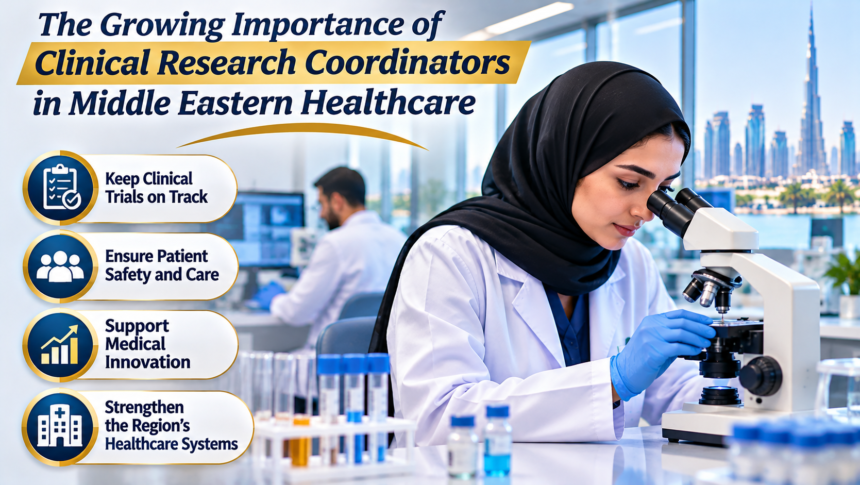
How Research Coordinators Improve Patient Safety and Clinical Trial Quality
Healthcare systems across the Middle East are experiencing significant transformation as countries invest in medical innovation, specialised hospitals, biotechnology and advanced treatment technologies. From major research institutions in Saudi Arabia to expanding clinical trial facilities in the United Arab Emirates and Qatar, the region is developing stronger foundations for scientific research and evidence-based healthcare.
- 1. Understanding the Role of Clinical Research Coordinators in Healthcare
- 2. Why Clinical Research Is Becoming More Important in Middle Eastern Healthcare
- 3. How Clinical Research Coordinators Support Patient Safety and Research Ethics
- 4. The Skills and Qualifications Needed to Become a Clinical Research Coordinator
- 5. Why Research Data Quality Depends on Effective Clinical Trial Coordination
- 6. What Challenges Do Clinical Research Coordinators Face in the Middle East?
- 7. How Digital Technology and AI Could Transform Research Coordination
- 8. The Future of Clinical Research Coordinator Careers in Middle Eastern Healthcare
- Conclusion
However, successful medical research requires more than advanced laboratories, experienced doctors and modern equipment. Every clinical study involves detailed planning, patient communication, regulatory requirements, accurate documentation and careful coordination between multiple healthcare professionals.
This is why clinical research coordinators in the Middle East are becoming increasingly important to the future of healthcare.
Clinical research coordinators, commonly known as CRCs, are professionals who help organise and manage the daily operations of clinical studies. They support research investigators, coordinate participant appointments, maintain study documentation and help ensure that research activities follow approved protocols.
Their work is particularly important in clinical trials, where treatments, medical devices and healthcare interventions are evaluated to understand their safety, effectiveness or other outcomes.
As healthcare organisations expand their research activities, the demand for reliable study coordination may increase. Research projects often involve several institutions, specialised medical professionals, regulatory authorities and participants who require clear information throughout the process.
Saudi Arabia offers an example of the region’s developing research environment. In January 2026, the Saudi Food and Drug Authority reported an 83% increase in applications for clinical trials involving advanced therapies and biotechnology products during 2025 compared with 2024. This growth relates to that specific category of applications, rather than the entire clinical research sector. General Authority for Food and Drug
Meanwhile, healthcare organisations in Abu Dhabi and Qatar are establishing research partnerships and strengthening clinical trial infrastructure.
These developments highlight an opportunity to build a more skilled clinical research workforce.
For Middle Eastern healthcare systems, clinical research coordinators are not simply administrative professionals. They support participant protection, research quality and the organised delivery of studies that can contribute to future medical treatments.
1. Understanding the Role of Clinical Research Coordinators in Healthcare
Clinical research coordinators help manage the operational activities required to conduct medical studies effectively.
Their responsibilities vary depending on the research institution, study protocol and qualifications of the individual professional.
In many clinical trials, coordinators work closely with principal investigators, who remain responsible for the appropriate conduct and oversight of the research.
Coordinators help connect the different people and departments involved in a study.
Supporting clinical trial preparation
Before a clinical trial begins, research teams must complete several preparation activities.
These may include obtaining necessary approvals, reviewing the study protocol, organising documentation and confirming that participating professionals understand their assigned responsibilities.
Coordinators may help investigators prepare research files, schedule training and organise study initiation activities.
They also help maintain communication between hospitals, laboratories and sponsoring organisations.
Managing participant appointments
Clinical studies frequently involve multiple appointments over several weeks, months or years.
Participants may need medical assessments, laboratory tests, questionnaires or follow-up consultations.
Coordinators help arrange these activities according to approved study schedules.
For example, a clinical trial involving a new treatment for diabetes may require participants to attend regular assessments.
The coordinator helps organise visits and ensure that the necessary research information is collected by authorised personnel.
Maintaining research documentation
Accurate documentation is essential for evaluating study findings.
Clinical research coordinators help maintain records involving appointments, consent documentation, study procedures and communications.
They must follow approved procedures for handling confidential information and correcting research records.
Common responsibilities of clinical research coordinators
| Responsibility | Main activity | Importance |
|---|---|---|
| Study preparation | Organising essential documentation | Supports research readiness |
| Participant coordination | Arranging screening and study visits | Improves study organisation |
| Consent support | Coordinating authorised consent procedures | Protects participant rights |
| Data management | Maintaining accurate research information | Supports reliable findings |
| Safety communication | Escalating relevant medical concerns | Supports participant protection |
| Regulatory documentation | Maintaining required records | Supports compliance |
| Team communication | Coordinating investigators and other departments | Reduces operational difficulties |
The ICH E6(R3) Good Clinical Practice guideline emphasises that delegated trial activities should be performed by appropriately qualified individuals under suitable investigator oversight. ICH Database
This makes clear responsibilities and professional training essential for clinical research coordination.
2. Why Clinical Research Is Becoming More Important in Middle Eastern Healthcare
Medical research is an important part of improving healthcare quality and developing new treatment options.
Clinical studies allow researchers to investigate medicines, medical devices, diagnostic methods and healthcare interventions.
Across the Middle East, expanding research infrastructure is creating opportunities for hospitals and academic institutions to participate in international scientific programmes.
Saudi Arabia’s growing research activities
Saudi Arabia has introduced initiatives intended to strengthen clinical research and pharmaceutical innovation.
The Saudi Food and Drug Authority maintains the Saudi Clinical Trials Registry, which supports the registration of clinical studies.
Its published drug clinical trials list includes studies across different therapeutic areas and medical institutions. General Authority for Food and Drug+1
These activities require coordination between researchers, patients, sponsors and regulatory bodies.
As studies become more complex, experienced coordinators can help research institutions manage operational requirements.
The UAE’s expanding research infrastructure
Abu Dhabi has been investing in medical research, biotechnology and international healthcare partnerships.
In October 2026, the Department of Health Abu Dhabi, Cleveland Clinic Abu Dhabi and AstraZeneca announced a collaboration to explore the feasibility of conducting up to 30 clinical trials by 2030.
The planned research focuses particularly on cardiovascular, renal and metabolic diseases. These are prospective opportunities, not a confirmed number of completed trials. Emirates News Agency
Such partnerships could increase the importance of trained research support teams.
Qatar’s clinical research development
Qatar has also expanded its research capabilities through Hamad Medical Corporation.
Its Clinical Trials Unit was established in January 2024 to support the design, management and implementation of clinical research.
The unit provides assistance with clinical trial activities and aims to strengthen research quality and collaboration. hamad.qa
In June 2026, Hamad Medical Corporation announced a partnership with Boehringer Ingelheim intended to strengthen clinical research capabilities and professional development. hamad.qa
Opportunities across other Middle Eastern countries
Oman, Kuwait, Bahrain and other regional healthcare markets may also benefit from stronger research coordination capabilities.
However, clinical research development varies significantly between countries and institutions.
Not every hospital conducts the same volume of clinical trials, and workforce requirements depend on research funding, study complexity and institutional capacity.
The broader opportunity is to establish professional research teams capable of supporting ethically conducted, scientifically reliable studies.
3. How Clinical Research Coordinators Support Patient Safety and Research Ethics
Patient protection is one of the most important responsibilities within clinical research.
Studies involving human participants must follow ethical and regulatory requirements intended to protect individual rights, safety and wellbeing.
Clinical research coordinators contribute by helping investigators maintain appropriate procedures and communication.
Supporting informed consent
Before joining a clinical trial, potential participants must receive relevant information about the research.
This generally includes the study’s purpose, procedures, foreseeable risks, potential benefits and available alternatives.
Participation must be voluntary.
Coordinators may assist with arranging informed consent appointments, preparing approved information materials and supporting communication.
However, consent-related duties must remain within the coordinator’s qualifications and formally delegated responsibilities.
Protecting participant confidentiality
Clinical studies may collect sensitive personal and medical information.
Coordinators must handle this information according to applicable privacy rules, institutional procedures and approved study requirements.
Secure electronic records, access restrictions and appropriate documentation practices are important.
In multinational studies, sharing research information across borders may require additional safeguards.
Communicating medical concerns
Participants may report symptoms or other medical concerns during research appointments.
Coordinators can help document and promptly communicate relevant information to qualified medical professionals.
Medical assessment and treatment decisions remain the responsibility of appropriately authorised clinicians.
Following Good Clinical Practice
Good Clinical Practice, commonly called GCP, provides internationally recognised principles for conducting ethical and scientifically reliable clinical trials.
The updated ICH E6(R3) guideline became effective in the European Union in July 2025.
It emphasises participant protection, risk-based quality management, reliable data and appropriate oversight. European Medicines Agency (EMA)
Middle Eastern research organisations conducting international studies may need to align their procedures with relevant GCP expectations alongside applicable local requirements.
Ethical research priorities
| Ethical requirement | Coordinator’s supporting role |
|---|---|
| Voluntary participation | Support approved consent processes |
| Confidentiality | Protect research records |
| Participant safety | Escalate reported concerns promptly |
| Protocol compliance | Coordinate approved activities |
| Accurate reporting | Maintain reliable documentation |
| Participant communication | Provide appropriate study information |
| Professional accountability | Work within delegated responsibilities |
A well-organised clinical study must protect participants while generating reliable scientific information.
Clinical research coordinators contribute to both objectives through consistent communication and careful administration.
4. The Skills and Qualifications Needed to Become a Clinical Research Coordinator
Clinical research coordination requires scientific understanding, organisational ability and strong communication skills.
Professionals may enter this field through different educational and professional backgrounds.
Common qualifications include nursing, pharmacy, biomedical science, biotechnology, public health and other healthcare-related disciplines.
However, employment requirements differ according to the institution, research specialty and responsibilities of the position.
Understanding clinical research protocols
A research protocol explains how a study should be conducted.
It includes objectives, participant eligibility, procedures, safety requirements and methods of collecting research data.
Coordinators must understand the parts of the protocol relevant to their assigned activities.
This helps them organise appointments, identify scheduling requirements and communicate operational questions.
Knowledge of research regulations
Research coordinators should understand Good Clinical Practice, participant confidentiality and applicable regulatory requirements.
For example, clinical trials in Saudi Arabia must satisfy relevant SFDA requirements.
The SFDA’s June 2026 regulations make clear that registering a trial in the Saudi Clinical Trials Registry does not itself constitute regulatory approval. الهيئة العامة للغذاء والدواء
Coordinators need to understand these distinctions to avoid confusing administrative processes with official authorisation.
Communication and organisational skills
Clinical trials frequently involve multiple appointments, departments and documentation deadlines.
Coordinators must manage these activities while maintaining professional communication.
Their work may involve answering logistical questions from participants, coordinating with laboratories and arranging meetings with research teams.
Digital skills
Modern clinical studies increasingly use electronic databases and digital research management systems.
Coordinators should understand approved data entry procedures, electronic documentation and information security.
They must also know how to identify missing records and communicate data queries.
Professional qualifications and certifications
Some professionals pursue training or certification through organisations such as the Association of Clinical Research Professionals or the Society of Clinical Research Associates.
These qualifications may support professional development, but they do not replace employer requirements, clinical licences or study-specific training.
| Essential skill | Practical application |
|---|---|
| Scientific knowledge | Understanding research terminology |
| Good Clinical Practice | Supporting ethical study conduct |
| Communication | Coordinating patients and research professionals |
| Organisation | Managing schedules and documentation |
| Data management | Maintaining accurate research records |
| Digital literacy | Using electronic research systems |
| Problem-solving | Addressing operational difficulties |
| Cultural awareness | Communicating with diverse participants |
As clinical research expands, specialised training could help Middle Eastern institutions develop a stronger professional workforce.
5. Why Research Data Quality Depends on Effective Clinical Trial Coordination
Reliable data are essential for determining whether medical interventions are safe and effective.
Clinical studies depend on information collected through approved procedures, documented accurately and reviewed appropriately.
Errors in documentation can reduce the reliability of research findings.
Clinical research coordinators help maintain the consistency of everyday study activities.
Preventing missing information
Research protocols specify the information that must be collected during different visits.
Coordinators help organise these activities and check whether required documentation has been completed.
For example, a study may require a laboratory assessment within a defined appointment window.
Missing that assessment could affect the completeness of the study data.
Supporting accurate records

Research documentation should reflect what actually happened during the study.
Corrections must follow approved procedures and preserve appropriate records of changes.
Coordinators should never alter information simply to make results appear more favourable.
Managing protocol deviations
A protocol deviation occurs when a research activity differs from the approved study plan.
Some deviations have limited operational consequences, while others may affect participant safety or data reliability.
Coordinators can help identify and document deviations and notify appropriate research personnel.
Investigators and relevant oversight bodies determine the necessary response.
Supporting sponsor communication
Clinical trials may involve pharmaceutical companies, universities, hospitals and contract research organisations.
Coordinators often help maintain communication among these groups.
They may assist with monitoring visits, documentation requests and resolving study-related queries.
Hamad Medical Corporation’s Clinical Trials Unit describes support for administrative and non-clinical research activities, illustrating the value of dedicated coordination services. hamad.qa
Measuring coordination performance
| Indicator | What it measures |
|---|---|
| Completed study visits | Adherence to visit schedules |
| Missing data queries | Completeness of study information |
| Protocol deviations | Consistency with approved procedures |
| Documentation timeliness | Availability of required records |
| Safety communication | Prompt escalation of relevant concerns |
| Participant retention | Continuity of participation |
| Monitoring findings | Areas needing improvement |
These indicators require careful interpretation.
For example, participant retention should never be improved through pressure or inappropriate incentives.
Scientific integrity and voluntary participation must remain more important than meeting numerical targets.
6. What Challenges Do Clinical Research Coordinators Face in the Middle East?
Although clinical research coordination offers professional opportunities, the work can involve considerable complexity.
Research institutions must address staffing, training, regulatory and communication challenges to establish sustainable research programmes.
Limited specialised research capacity
Some healthcare organisations may have experienced doctors and researchers but relatively few dedicated research coordinators.
As a result, investigators may spend significant time managing administrative work.
Dedicated coordination teams could help distribute these responsibilities more effectively.
However, staffing decisions should reflect actual study requirements rather than assuming every research project needs the same number of coordinators.
Complex approval processes
Clinical research may require approvals from ethics committees, healthcare authorities and other relevant bodies.
Requirements vary according to study type and country.
For instance, Abu Dhabi’s Department of Health provides specific approval pathways for research involving investigational products. Ministry of Health and Prevention
Coordinators must therefore understand the procedures relevant to their institution.
Participant recruitment
Finding eligible volunteers can be challenging.
Research teams must identify individuals who meet the study criteria without compromising ethical recruitment standards.
Coordinators may help organise screening and explain approved study logistics.
Participation must remain voluntary.
Language and cultural differences
Middle Eastern hospitals serve patients from diverse backgrounds.
Potential participants may need research information in different languages.
Appropriate translation, interpretation and culturally respectful communication can support understanding.
Workload management
Coordinators may work on several studies simultaneously, each with different procedures and deadlines.
Poor workload planning can increase the risk of documentation problems and missed activities.
Institutions should provide adequate staffing, supervision and professional support.
| Common challenge | Possible improvement |
|---|---|
| Limited trained workforce | Supervised training and career development |
| Complex regulation | Country-specific regulatory education |
| Participant recruitment | Ethical and realistic recruitment planning |
| Language differences | Approved translations and interpreters |
| High administrative workload | Better staffing and workflow systems |
| Data management difficulties | Digital training and quality controls |
| Limited career progression | Structured professional development |
Investing in research coordinators can help healthcare organisations improve operational capacity while maintaining appropriate study standards.
7. How Digital Technology and AI Could Transform Research Coordination
Digital transformation is influencing how clinical studies are organised and monitored.
Electronic data capture, remote communication and digital research records can help research teams manage increasingly complex information.
Clinical research coordinators may benefit from these tools, particularly when they reduce repetitive administrative tasks.
Electronic data capture systems
Electronic data capture systems allow authorised professionals to enter and manage study information digitally.
They can support data validation, record changes and identify incomplete fields.
However, staff must continue verifying information against appropriate source records.
Decentralised clinical trials
Some studies allow certain research activities to take place outside traditional hospital research sites.
Participants may complete approved assessments remotely or communicate with researchers through digital platforms.
Coordinators may help organise these arrangements.
However, decentralised research requires appropriate safeguards for participant safety, identity verification, data quality and privacy.
Artificial intelligence in clinical research
AI may support scheduling, data review and preliminary analysis of operational patterns.
For example, a system could help identify incomplete documentation or highlight appointments requiring follow-up.
AI-assisted recruitment tools may also help researchers identify potentially eligible participant groups.
However, AI cannot replace valid informed consent, investigator oversight or qualified medical judgement.
Research organisations must evaluate accuracy, bias, privacy and regulatory compliance before deploying these systems.
The importance of human communication
Clinical trials involve individuals making decisions about participation in medical research.
Participants may need reassurance, explanations or opportunities to raise concerns.
Digital systems cannot replace the value of clear, respectful communication with trained research professionals.
The ICH E6(R3) guideline acknowledges the use of modern technologies in clinical research while maintaining a strong emphasis on participant rights and reliable data. FDA
Technology comparison
| Technology | Research application | Important safeguard |
|---|---|---|
| Electronic data capture | Recording study information | Audit trails and verification |
| Digital scheduling | Managing participant visits | Protocol compliance |
| Remote monitoring | Collecting approved measurements | Reliable clinical oversight |
| Electronic consent | Supporting consent procedures | Participant understanding |
| AI-supported analysis | Identifying operational patterns | Human verification |
| Digital document systems | Managing essential records | Access controls and confidentiality |
Technology could improve coordination efficiency, but trained research professionals will remain essential for ethical study delivery.
8. The Future of Clinical Research Coordinator Careers in Middle Eastern Healthcare
The development of clinical research infrastructure could create further professional opportunities across Middle Eastern healthcare systems.
As hospitals, universities and research organisations participate in more complex studies, experienced coordinators may become increasingly valuable.
However, employment growth will depend on research investment, study volume and institutional requirements.
Developing specialised research departments
Hospitals conducting several clinical trials may benefit from dedicated research coordination departments.
These teams can support investigators through shared administrative expertise and standardised documentation practices.
Creating clearer career pathways
Clinical research coordination can offer professional development opportunities for graduates and healthcare workers interested in medical research.
With appropriate experience and training, potential career directions include senior clinical research coordinator, clinical trial manager, research operations manager and research quality specialist.
Some professionals may move into clinical research associate positions or other industry roles, subject to employer requirements.
Supporting university partnerships
Universities can contribute by providing clinical research education and opportunities for supervised practical experience.
Partnerships with hospitals may help students understand research ethics, study documentation and clinical trial operations.
Encouraging international collaboration
The Middle East’s developing research infrastructure creates opportunities to participate in multinational clinical studies.
Abu Dhabi’s October 2026 clinical research partnerships and Qatar’s expanding trial infrastructure demonstrate how regional institutions are developing international connections.
Qualified coordinators can help these institutions meet operational requirements while supporting locally relevant research.
A practical workforce development roadmap
- Assess the number and complexity of studies requiring coordination support.
- Establish training in research ethics, Good Clinical Practice and data quality.
- Define professional responsibilities and investigator oversight.
- Provide supervised practical experience for new coordinators.
- Develop skills in electronic research systems and digital documentation.
- Introduce structured career progression for experienced professionals.
- Monitor research quality and workload to improve staffing arrangements.
- Strengthen cooperation between hospitals, universities and research organisations.
Why long-term investment matters
Experienced coordinators can contribute valuable institutional knowledge.
They understand research procedures, communication requirements and recurring operational challenges.
Retaining skilled professionals can improve continuity between studies and support the development of more capable research organisations.
Conclusion
Clinical research coordinators play an important role in supporting the safe, organised and scientifically reliable conduct of medical studies.
Their responsibilities connect investigators, participants, healthcare departments and research sponsors.
As the Middle East strengthens its medical research capabilities, effective coordination will become increasingly relevant to clinical trial quality.
Saudi Arabia’s developing research sector, the UAE’s international clinical research partnerships and Qatar’s dedicated clinical trial facilities demonstrate the region’s growing research ambitions.
However, successful research requires more than advanced technology and financial investment.
Healthcare organisations need trained professionals, clear responsibilities, reliable documentation and ethical study practices.
Clinical research coordinators contribute to these requirements by helping research teams operate consistently while protecting participants and maintaining scientific standards.
Ultimately, the growing importance of clinical research coordinators in Middle Eastern healthcare reflects a wider opportunity to strengthen medical research, develop specialised healthcare careers and support better evidence for future patient care.
Do follow us on Instagram
Read More – How Hospital-at-Home Services Could Change Patient Recovery in GCC Countries