How Heat-Tolerant Algae Help Coral Reefs Adapt to Extreme Ocean Conditions
The Arabian Gulf is known for its hot summers, highly saline waters and rapidly developing coastal cities. From Abu Dhabi and Dubai to Qatar, Bahrain and Saudi Arabia’s Eastern Province, the region experiences environmental conditions that can be extremely challenging for marine life.
- 1. Why the Arabian Gulf Is One of the World’s Harshest Coral Reef Environments
- 2. How Gulf Corals Have Adapted to Extreme Ocean Heat
- 3. Heat-Tolerant Algae Help Arabian Gulf Corals Survive
- 4. Why Even Heat-Resistant Arabian Gulf Corals Can Experience Bleaching
- 5. The Importance of Coral Reefs for Arabian Gulf Marine Biodiversity
- 6. How Marine Heatwaves and Coastal Development Threaten Gulf Reefs
- 7. How the UAE, Qatar and Other Gulf Countries Are Protecting Coral Reefs
- 8. What Arabian Gulf Corals Can Teach Scientists About Climate Change
Yet beneath the surface of these warm waters lies one of the region’s most fascinating natural ecosystems: coral reefs.
Coral reefs are usually associated with tropical oceans, where relatively stable water temperatures support colourful marine habitats. However, the Arabian Gulf is different. Its shallow waters can experience extraordinary seasonal temperature changes, with summer temperatures in some reef environments approaching or exceeding 35°C.
For many reef-building corals elsewhere in the world, such conditions can cause severe stress and bleaching.
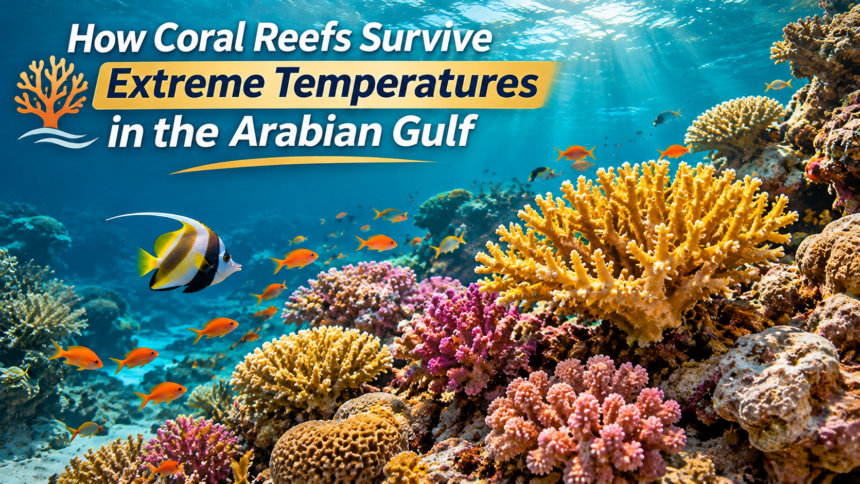
Surprisingly, coral reefs in the Arabian Gulf have developed ways to survive temperatures that would seriously damage many other coral populations.
Their remarkable resilience has attracted international scientific attention. Researchers are studying how these corals tolerate extreme heat, interact with specialised microscopic algae and respond to environmental conditions that resemble some of the warming challenges expected in other tropical oceans.
Scientific studies have documented Arabian Gulf corals surviving summer seawater temperatures of approximately 36°C, making them important models for understanding coral thermal tolerance. PubMed+1
However, surviving extreme temperatures does not mean these reefs are immune to climate change.
Repeated marine heatwaves, coastal development, pollution and bleaching events continue to threaten coral communities across the region.
Studies from Abu Dhabi, Bahrain and Qatar demonstrate that even unusually heat-tolerant coral populations can suffer significant losses when environmental conditions exceed their limits.
Understanding these ecosystems is therefore important for marine conservation, climate research and the future of coastal biodiversity in the Middle East.
1. Why the Arabian Gulf Is One of the World’s Harshest Coral Reef Environments
The Arabian Gulf is a shallow, semi-enclosed sea connected to the Gulf of Oman through the Strait of Hormuz.
Its geography creates environmental conditions that differ significantly from those of many tropical coral reef regions.
The Gulf experiences intense summer heating, substantial evaporation and high salinity.
These factors combine to create a demanding environment for marine organisms.
Extreme summer water temperatures
During summer, seawater temperatures in parts of the southern Arabian Gulf can reach approximately 35–36°C.
Such temperatures can exceed the thermal conditions normally experienced by coral reefs in many other regions.
However, temperatures are not identical across the Gulf.
Depth, location, currents and seasonal conditions influence how much heat individual reefs experience.
A study of coral reefs around Qatar found that summer seawater temperatures can exceed 36°C in some shallow environments, while deeper offshore waters may remain several degrees cooler. Frontiers
Large seasonal temperature differences
The Gulf also experiences considerable seasonal variation.
In some coastal areas, winter temperatures can fall to approximately 16°C, while summer temperatures can approach 36°C.
This means corals may experience annual temperature differences of around 20°C.
For organisms adapted to relatively stable tropical conditions, such variation would present a major challenge.
Gulf corals must tolerate both hot summers and cooler winter periods.
High salinity
Intense evaporation and limited freshwater input contribute to elevated salinity across much of the Arabian Gulf.
Salt concentrations can be higher than those in many open-ocean coral reef environments.
This creates additional physiological challenges because corals must maintain suitable internal chemical conditions while living in salty seawater.
Coastal development pressures
Environmental stress is not limited to temperature and salinity.
Land reclamation, dredging, industrial facilities, shipping and other coastal activities can influence water quality and marine habitats.
These human pressures may reduce coral resilience when combined with extreme heat.
Arabian Gulf versus typical tropical coral environments
| Environmental factor | Arabian Gulf reefs | Many tropical reef environments |
|---|---|---|
| Summer temperatures | Can approach or exceed 35–36°C | Generally lower, depending on region |
| Seasonal variation | Often substantial | Frequently more moderate |
| Salinity | High in many locations | Often closer to open-ocean conditions |
| Water depth | Extensive shallow coastal areas | Highly variable |
| Heat stress | Extreme seasonal exposure | Increasing exposure from marine heatwaves |
| Human pressures | Coastal development, pollution and shipping | Varies by location |
The Arabian Gulf’s unusual conditions make its coral reefs valuable for understanding the limits of marine life in a warming world.
2. How Gulf Corals Have Adapted to Extreme Ocean Heat
Corals are living animals related to sea anemones and jellyfish.
Many reef-building corals live in colonies made up of small individual animals called polyps.
These polyps produce calcium carbonate skeletons that gradually contribute to reef structures.
To survive in extreme environments, corals rely on physiological processes that help maintain their essential functions.
Understanding heat tolerance
Heat tolerance is the ability of an organism to withstand elevated temperatures without experiencing unacceptable damage.
For corals, heat stress can interfere with cellular processes, energy production and the relationship between coral animals and their microscopic algal partners.
Gulf corals have developed unusually high temperature tolerance compared with some populations of the same or related species living in cooler environments.
Local adaptation over generations
Adaptation occurs when inherited traits that improve survival or reproduction become more common over generations.
The Arabian Gulf’s environmental history has exposed coral populations to demanding conditions over thousands of years.
Natural selection may therefore have favoured coral genotypes better suited to the region’s extreme temperatures and salinity.
Research comparing Arabian Gulf corals with populations from the neighbouring Gulf of Oman has identified genetic signals associated with local thermal adaptation. PubMed Central (PMC)
Physiological responses to heat
Corals may respond to elevated temperatures through changes in their metabolism, cellular protection mechanisms and interactions with symbiotic microorganisms.
Some responses can occur within an individual coral’s lifetime.
Others reflect genetic differences that have developed across generations.
Scientists distinguish between acclimatisation, which involves adjustments during an organism’s life, and evolutionary adaptation, which involves inherited changes within populations.
Both may contribute to thermal tolerance.
Why species differences matter
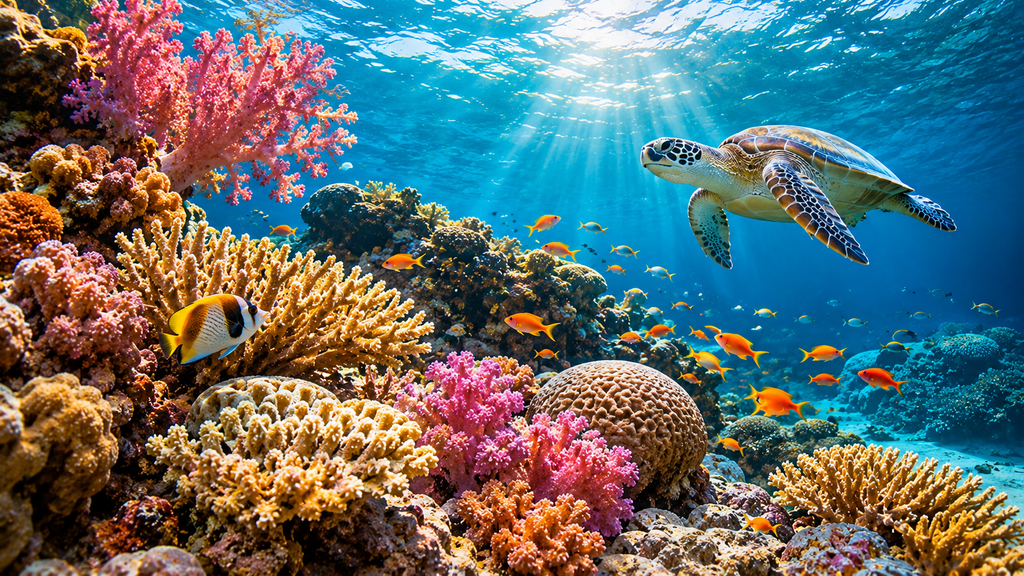
Not every coral species responds to extreme heat in the same way.
Some species or colonies tolerate particular conditions better than others.
Their responses can also depend on previous environmental exposure.
This means researchers cannot assume that all Arabian Gulf corals possess identical levels of heat resistance.
Adaptation mechanisms
| Mechanism | Potential contribution |
|---|---|
| Genetic adaptation | Favouring inherited traits suited to high temperatures |
| Physiological acclimatisation | Adjusting to environmental conditions |
| Cellular stress responses | Helping protect important biological processes |
| Symbiotic partnerships | Supporting energy production under suitable conditions |
| Local environmental history | Influencing how populations respond to heat |
| Species-specific traits | Creating differences in stress tolerance |
These processes help explain why some Gulf coral populations can survive temperatures that would be highly stressful for corals elsewhere.
3. Heat-Tolerant Algae Help Arabian Gulf Corals Survive
One of the most important explanations for coral heat tolerance involves a partnership between coral animals and microscopic algae.
Many reef-building corals contain photosynthetic microorganisms belonging to the family Symbiodiniaceae.
These organisms live within coral tissues and contribute energy through photosynthesis.
The coral provides the algae with a protected environment and access to resources.
Why this relationship matters
Photosynthesis allows symbiotic algae to produce energy-rich compounds that can support coral growth and metabolism.
This partnership is especially important in tropical and subtropical environments where sunlight is available.
However, high temperatures can disrupt the relationship.
When the partnership becomes severely stressed, corals may lose symbiotic algae or their photosynthetic pigments.
This process is known as coral bleaching.
The discovery of heat-tolerant symbionts
Research in the Arabian Gulf identified unusually heat-tolerant algal partners associated with local coral populations.
One important group is now commonly referred to as Cladocopium thermophilum.
Earlier scientific literature frequently used the name Symbiodinium thermophilum, reflecting changes in the classification of these microorganisms.
Studies suggest that this symbiont group contributes to the remarkable temperature tolerance observed in some Arabian Gulf coral species.
Research published in The ISME Journal found that locally adapted coral–algal partnerships were capable of tolerating particularly high temperatures in the Gulf’s saline environment. PubMed Central (PMC)
A stable partnership rather than constant switching
Scientists once considered whether extreme Gulf heat tolerance depended mainly on corals frequently changing their algal partners.
However, research published in 2020 found that several Gulf coral species maintained relatively stable associations with particular symbionts despite substantial seasonal warming.
The findings suggested that persistent relationships with heat-tolerant algae were important. PubMed
Can these algae help corals elsewhere?
The discovery has attracted interest because heat-tolerant symbionts might contribute to research on coral resilience in other regions.
However, the situation is complicated.
Organisms adapted to high temperature and salinity in the Arabian Gulf may not perform equally well in environments with different conditions.
Experiments have shown that local adaptation to Gulf salinity can limit the suitability of some symbionts in other reef environments.
Researchers must therefore investigate ecological compatibility before considering any deliberate movement of microorganisms between ecosystems.
The coral–algae partnership
| Component | Main function |
|---|---|
| Coral animal | Provides habitat and resources for symbiotic algae |
| Symbiotic algae | Produces photosynthetic energy |
| Heat-tolerant symbionts | May help maintain function under elevated temperatures |
| Environmental conditions | Influence the partnership’s performance |
| Thermal stress | Can disrupt symbiosis and cause bleaching |
The survival of Arabian Gulf corals is therefore not simply the result of unusually strong coral animals.
It also depends on complex biological relationships developed within their local environment.
4. Why Even Heat-Resistant Arabian Gulf Corals Can Experience Bleaching
One of the most important facts about Arabian Gulf coral reefs is that heat tolerance has limits.
Although Gulf corals regularly survive temperatures that would severely stress many tropical reef species, they can still experience bleaching and mortality.
This distinction is essential for understanding the region’s environmental challenges.
What causes coral bleaching?
Bleaching occurs when corals lose substantial amounts of their symbiotic algae or the pigments associated with them.
Without these pigments, the underlying white skeleton can become visible through the coral’s tissues.
Bleached corals are not necessarily dead.
However, bleaching can reduce the energy available to the animal and increase its vulnerability to further stress.
If environmental conditions improve, some corals may recover.
Prolonged or severe stress can lead to disease, reduced growth or death.
Heat stress depends on local conditions
A temperature that is extremely stressful for one coral population may be within the normal seasonal range of another.
Researchers therefore evaluate heat stress relative to the conditions corals ordinarily experience.
For Gulf corals, temperatures above their already high seasonal norms can still cause serious problems.
The duration of exposure is also important.
A short period of unusually warm water may have different consequences from several weeks of elevated temperatures.
Repeated bleaching in the UAE
Coral reefs along the UAE’s Arabian Gulf coast have experienced several documented bleaching events.
A 2025 study examining remaining Acropora-dominated reefs reported the effects of recurring heat stress and previous bleaching episodes in 2010, 2011, 2012, 2017 and 2021. MDPI
Repeated events may leave insufficient time for sensitive coral communities to recover fully.
Evidence from Bahrain
Research published in 2024 examined how bleaching affected reef-building processes in Bahrain.
At the shallow Fasht Al Adhm reef, researchers reported a reduction in average hard coral cover from approximately 14.2% to 8.5% across the study comparison.
The study also found a decline in the reef’s net carbonate production, which is important for maintaining reef structure. Springer
This demonstrates that thermal stress can affect not only living corals but also the long-term capacity of reefs to build and maintain their physical structures.
Bleaching and coral mortality are not the same
| Condition | What happens | Possible outcome |
|---|---|---|
| Healthy coral | Coral and symbiotic algae function together | Normal growth and reproduction |
| Heat-stressed coral | Elevated temperatures disrupt biological functions | Reduced performance |
| Bleached coral | Loss of algae or pigments | Possible recovery or further decline |
| Recovering coral | Symbiosis and function begin to return | Recovery depends on conditions |
| Coral mortality | Living tissue dies | Loss of the affected colony or tissue |
Heat resistance is therefore a valuable biological characteristic, but it cannot guarantee survival under unlimited warming.
5. The Importance of Coral Reefs for Arabian Gulf Marine Biodiversity
Coral reefs are not only scientifically remarkable because of their ability to tolerate heat.
They also provide important habitats for marine organisms.
Reef structures create spaces where fish, crustaceans, molluscs and other animals can feed, shelter and reproduce.
In parts of the Arabian Gulf, coral habitats support marine biodiversity despite challenging water conditions.
Providing shelter for marine life
Living corals and their calcium carbonate skeletons create complex underwater structures.
Small fish and invertebrates can use spaces within these structures to avoid predators.
Larger fish may also depend on reef areas for feeding and other activities.
When coral colonies die and reef structures gradually deteriorate, some of these habitats may disappear.
Connections with neighbouring ecosystems
Coral reefs are connected to other marine environments, including seagrass meadows, sandy seabeds and coastal tidal habitats.
Some fish species use different habitats during different life stages.
Protecting reef biodiversity therefore requires attention to the wider marine environment.
What research in Qatar reveals
A 2022 study examined fish and coral communities across different reef environments in Qatar.
Researchers found important differences between shallow coastal reefs and deeper offshore habitats.
Some deeper reefs supported richer coral and fish communities, suggesting that local depth and environmental conditions can influence biodiversity. Frontiers
However, deeper water does not guarantee protection against future warming.
Why reef structure matters
Coral reefs build three-dimensional habitats over many years.
When repeated bleaching and mortality reduce coral growth, reef structures may gradually become less complex.
This can affect the organisms that depend on them.
Protecting living coral cover and the physical reef framework are therefore related but distinct conservation objectives.
Ecological functions of Arabian Gulf coral reefs
| Ecological function | Importance |
|---|---|
| Marine habitat | Provides shelter and living space |
| Food webs | Supports relationships between marine organisms |
| Fish communities | Offers feeding and refuge areas |
| Reef building | Creates calcium carbonate structures |
| Coastal ecology | Contributes to wider marine habitat networks |
| Scientific research | Helps researchers understand environmental tolerance |
The ecological value of Arabian Gulf coral reefs extends far beyond their remarkable ability to survive heat.
6. How Marine Heatwaves and Coastal Development Threaten Gulf Reefs
Coral reefs across the Arabian Gulf face several environmental pressures.
Extreme temperatures are among the most widely studied, but other disturbances can make conditions more difficult.
Increasing marine heat stress
A marine heatwave occurs when ocean temperatures remain unusually high relative to the local seasonal conditions.
Such events may expose corals to additional stress beyond the temperatures they regularly tolerate.
Research on Arabian Gulf reefs has documented repeated bleaching and other biological impacts associated with severe heat stress.
A 2026 study of reefs around Abu Dhabi found increased coral disease prevalence in years following substantial summer heat stress and bleaching. Springer
This shows why scientists investigate both immediate bleaching and longer-term reef health.
Land reclamation and dredging
Coastal construction can change water movement and increase suspended sediments.
Excessive sedimentation may cover coral surfaces or reduce the sunlight available to their symbiotic algae.
The severity of these impacts depends on sediment concentration, exposure duration, water circulation and local habitat characteristics.
Pollution and declining water quality
Coral reefs can be affected by certain pollutants, including untreated wastewater and harmful industrial discharges.
Nutrient enrichment may also change relationships between corals, algae and other marine organisms.
Good water-quality management is therefore important for coastal conservation.
Fishing and physical damage
Fishing gear, anchors and other activities may physically damage coral colonies.
Some forms of fishing can also influence reef food webs.
Marine management should consider both direct damage and wider ecological effects.
Combined environmental pressures
| Pressure | Potential impact | Management consideration |
|---|---|---|
| Marine heatwaves | Bleaching and mortality | Heat monitoring and broader climate action |
| Sedimentation | Reduced light and physical stress | Appropriate coastal construction controls |
| Pollution | Water-quality deterioration | Source reduction and monitoring |
| Physical disturbance | Broken coral structures | Habitat protection |
| Disease | Damage to living coral tissues | Ecological surveillance |
| Repeated bleaching | Reduced recovery opportunities | Long-term reef management |
Protecting Arabian Gulf coral reefs requires reducing manageable local pressures while addressing the broader challenge of ocean warming.
7. How the UAE, Qatar and Other Gulf Countries Are Protecting Coral Reefs
Coral conservation is becoming an important part of marine environmental management across the region.
Different countries are investigating restoration, protected habitats, scientific monitoring and improved coastal planning.
Abu Dhabi’s coral rehabilitation programme
The Environment Agency – Abu Dhabi has established a large-scale coral reef rehabilitation programme.
In 2025, Abu Dhabi’s Government Media Office reported that the agency had restored one million coral colonies since 2021 and announced an expanded objective of outplanting more than four million coral colonies by 2030. mediaoffice.abudhabi
These figures describe restoration activity and a future target, not proof that all transplanted corals have survived permanently.
Long-term monitoring remains necessary to evaluate ecological outcomes.
Protecting coral genetic diversity
The Environment Agency – Abu Dhabi launched a Coral Gene Bank Initiative in 2024.
Its 2025 annual report describes the initiative as a response to major bleaching events affecting reefs in the emirate.
Preserving genetic resources may help support research and future restoration planning. ead.gov.ae
However, maintaining coral material in specialised facilities does not replace the need to protect healthy natural reefs.
Qatar’s reef research
Scientists studying Qatar’s coral habitats have identified important differences in coral communities across locations and depths.
These findings can help environmental authorities understand which habitats require attention and how reef conditions vary.
Research-informed management is particularly useful because interventions suitable for one reef may be inappropriate for another.
Bahrain’s reef protection needs
Studies of Bahrain’s coral reefs have documented the effects of bleaching on living coral cover and reef carbonate production.
These findings provide evidence for considering reef health in coastal management and restoration planning.
Saudi Arabia’s Gulf coastline
Saudi Arabia has coral habitats along its Arabian Gulf coast as well as extensive reef systems in the Red Sea.
These are geographically distinct environments.
Research findings and restoration methods from the Red Sea should not automatically be assumed to apply to the Arabian Gulf.
Important conservation activities
| Conservation approach | Main objective |
|---|---|
| Reef monitoring | Identify changes in coral health |
| Coral propagation | Produce material for suitable restoration projects |
| Genetic conservation | Preserve important biological diversity |
| Marine habitat protection | Reduce damaging activities |
| Water-quality management | Limit pollution and sediment stress |
| Coastal planning | Avoid unnecessary damage to sensitive reefs |
| Research partnerships | Improve scientific understanding |
Effective conservation requires combining restoration with protection of surviving reef habitats.
8. What Arabian Gulf Corals Can Teach Scientists About Climate Change
The extraordinary heat tolerance of Arabian Gulf corals makes them valuable to international marine science.
Their unusual environmental history provides an opportunity to investigate how coral populations respond to extreme conditions.
However, researchers must avoid assuming that Gulf corals provide a simple solution to coral reef decline elsewhere.
A natural laboratory for ocean warming
Many tropical coral reefs face increasing heat stress as global temperatures rise.
Arabian Gulf reefs already experience temperatures that are unusually high by global standards.
Studying these corals can help researchers identify traits associated with tolerance to extreme heat.
These may include genetic characteristics, physiological responses and relationships with symbiotic algae.
Understanding evolutionary adaptation
Genetic research has identified differences between Gulf coral populations and related populations in cooler waters.
These differences can provide information about how selection has shaped heat tolerance.
However, natural adaptation takes place within ecological and evolutionary constraints.
The ability to survive historical conditions does not guarantee that corals can adapt quickly enough to future warming.
Can heat-resistant corals be moved elsewhere?
Researchers have considered whether heat-tolerant corals or their symbiotic microorganisms could help reef restoration in other regions.
This idea is scientifically interesting but presents important challenges.
Corals adapted to extreme Gulf salinity may not thrive in less saline environments.
Moving organisms could also introduce ecological or genetic risks.
Any experimental transplantation would therefore require careful evaluation and appropriate regulatory oversight.
The importance of local conservation
The most practical immediate priority is protecting existing reefs.
Reducing pollution, limiting damaging coastal activities and monitoring reef health can help address pressures that are manageable at the local level.
These measures cannot stop global warming by themselves, but they may help preserve conditions suitable for coral survival.
A practical coral conservation roadmap
- Monitor reef temperatures: Identify seasonal patterns and extreme events.
- Map coral habitats: Document reef distribution, depth and condition.
- Protect healthy colonies: Prioritise the conservation of surviving ecosystems.
- Control pollution: Reduce avoidable chemical and sediment exposure.
- Assess development impacts: Consider reef habitats before coastal construction.
- Support scientific research: Investigate genetics, physiology and symbiotic algae.
- Evaluate restoration carefully: Measure survival, growth and ecological recovery.
- Strengthen regional cooperation: Share evidence between Gulf research institutions.
Conclusion: Extraordinary Heat Tolerance Does Not Mean Unlimited Resilience
Coral reefs in the Arabian Gulf are among the world’s most extraordinary examples of marine adaptation.
Their ability to survive summer water temperatures approaching 36°C demonstrates how coral animals and their microscopic partners can develop remarkable tolerance to environmental stress.
Local genetic adaptation, physiological responses and relationships with heat-tolerant symbiotic algae all contribute to their survival.
However, these reefs remain vulnerable.
Repeated marine heatwaves, bleaching, disease, coastal development and pollution continue to threaten coral communities across the region.
Scientific evidence from Abu Dhabi, Qatar and Bahrain demonstrates that even heat-adapted reefs can experience serious ecological damage.
For the Gulf, protecting these habitats means preserving both marine biodiversity and an important source of scientific knowledge.
For the wider world, the research offers valuable insights into the possibilities and limitations of coral adaptation.
Ultimately, Arabian Gulf coral reefs show how life can survive extraordinary environmental conditions, but their long-term future depends on conservation, scientific research and efforts to reduce the pressures threatening marine ecosystems.
Do follow us on Instagram
Read More – Why the Arabian Desert Is Home to Some of the World’s Most Unique Plants